
Well Testing Module 5 Hydraulically Fractured Well Shahab
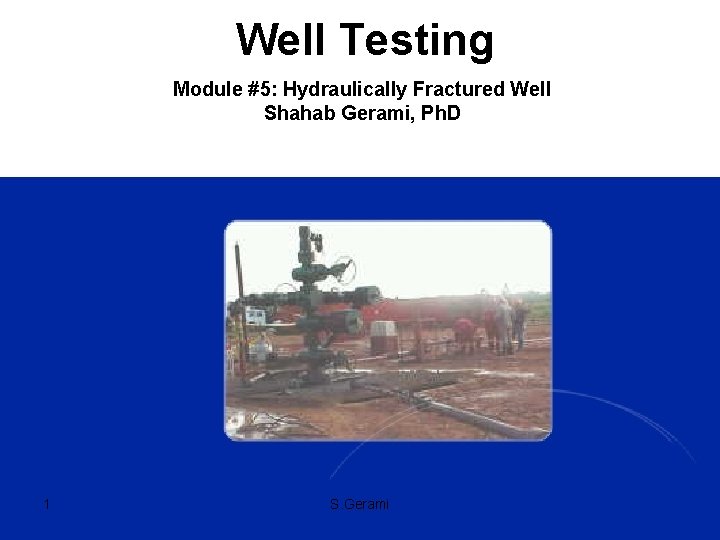
Well Testing Module #5: Hydraulically Fractured Well Shahab Gerami, Ph. D 1 1 S. Gerami
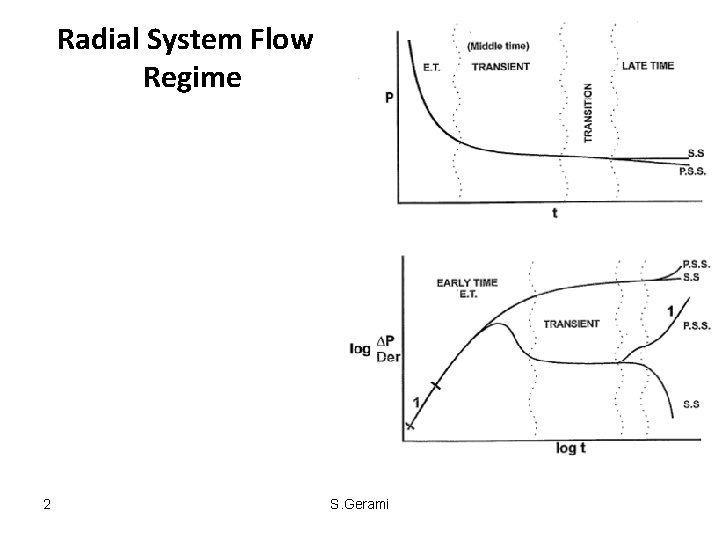
Radial System Flow Regime 2 S. Gerami
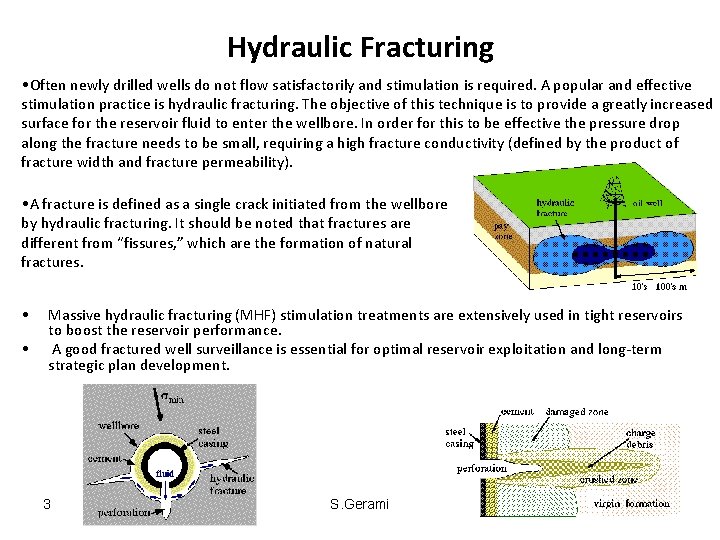
Hydraulic Fracturing • Often newly drilled wells do not flow satisfactorily and stimulation is required. A popular and effective stimulation practice is hydraulic fracturing. The objective of this technique is to provide a greatly increased surface for the reservoir fluid to enter the wellbore. In order for this to be effective the pressure drop along the fracture needs to be small, requiring a high fracture conductivity (defined by the product of fracture width and fracture permeability). • A fracture is defined as a single crack initiated from the wellbore by hydraulic fracturing. It should be noted that fractures are different from “fissures, ” which are the formation of natural fractures. • • Massive hydraulic fracturing (MHF) stimulation treatments are extensively used in tight reservoirs to boost the reservoir performance. A good fractured well surveillance is essential for optimal reservoir exploitation and long-term strategic plan development. 3 S. Gerami
Hydraulically Fractured Well Depth >3000 ft: It is believed that the hydraulic fracturing results in the formation of vertical fractures. Depth< 3000 ft: The likelihood is that horizontal fractures will be induced. 4 S. Gerami
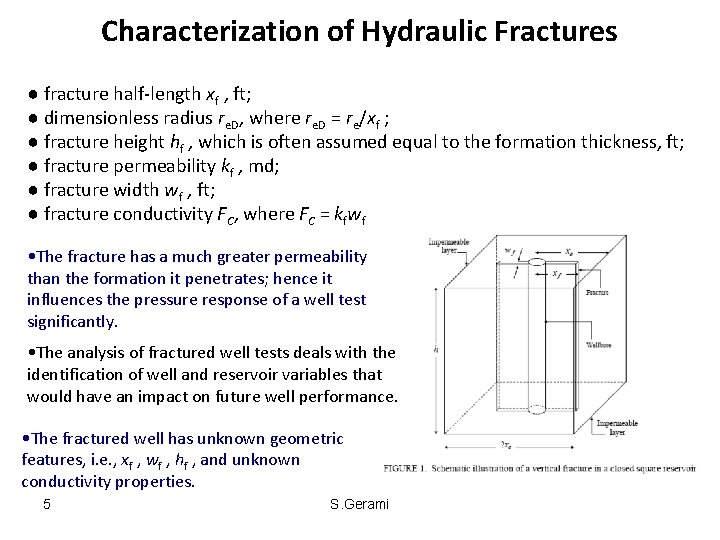
Characterization of Hydraulic Fractures ● fracture half-length xf , ft; ● dimensionless radius re. D, where re. D = re/xf ; ● fracture height hf , which is often assumed equal to the formation thickness, ft; ● fracture permeability kf , md; ● fracture width wf , ft; ● fracture conductivity FC, where FC = kfwf • The fracture has a much greater permeability than the formation it penetrates; hence it influences the pressure response of a well test significantly. • The analysis of fractured well tests deals with the identification of well and reservoir variables that would have an impact on future well performance. • The fractured well has unknown geometric features, i. e. , xf , wf , hf , and unknown conductivity properties. 5 S. Gerami
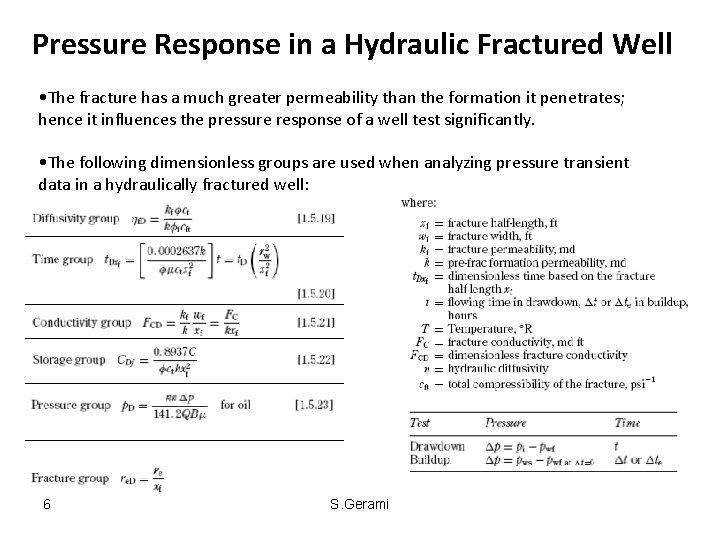
Pressure Response in a Hydraulic Fractured Well • The fracture has a much greater permeability than the formation it penetrates; hence it influences the pressure response of a well test significantly. • The following dimensionless groups are used when analyzing pressure transient data in a hydraulically fractured well: 6 S. Gerami
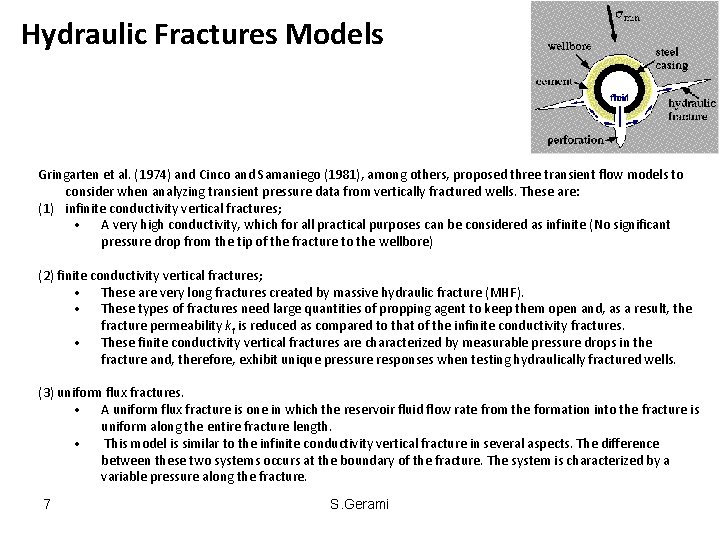
Hydraulic Fractures Models Gringarten et al. (1974) and Cinco and Samaniego (1981), among others, proposed three transient flow models to consider when analyzing transient pressure data from vertically fractured wells. These are: (1) infinite conductivity vertical fractures; • A very high conductivity, which for all practical purposes can be considered as infinite (No significant pressure drop from the tip of the fracture to the wellbore) (2) finite conductivity vertical fractures; • These are very long fractures created by massive hydraulic fracture (MHF). • These types of fractures need large quantities of propping agent to keep them open and, as a result, the fracture permeability kf is reduced as compared to that of the infinite conductivity fractures. • These finite conductivity vertical fractures are characterized by measurable pressure drops in the fracture and, therefore, exhibit unique pressure responses when testing hydraulically fractured wells. (3) uniform flux fractures. • A uniform flux fracture is one in which the reservoir fluid flow rate from the formation into the fracture is uniform along the entire fracture length. • This model is similar to the infinite conductivity vertical fracture in several aspects. The difference between these two systems occurs at the boundary of the fracture. The system is characterized by a variable pressure along the fracture. 7 S. Gerami
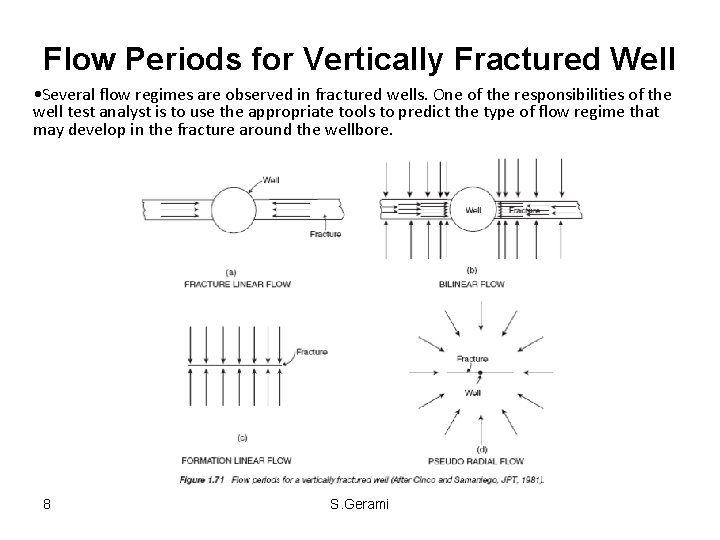
Flow Periods for Vertically Fractured Well • Several flow regimes are observed in fractured wells. One of the responsibilities of the well test analyst is to use the appropriate tools to predict the type of flow regime that may develop in the fracture around the wellbore. 8 S. Gerami
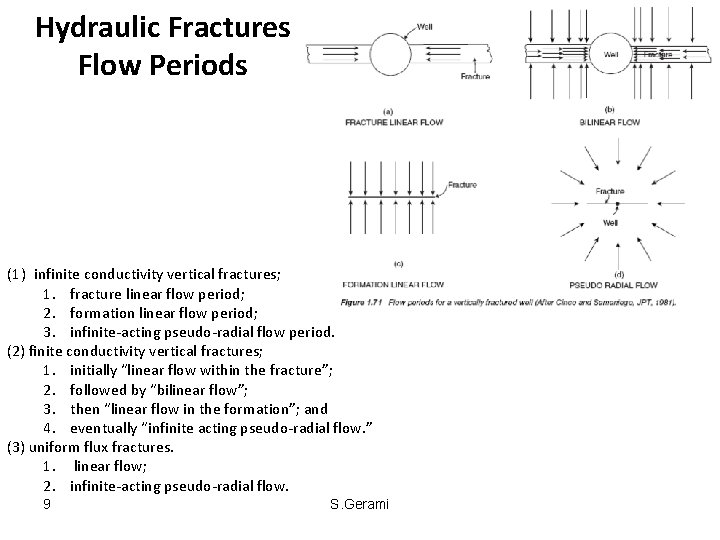
Hydraulic Fractures Flow Periods (1) infinite conductivity vertical fractures; 1. fracture linear flow period; 2. formation linear flow period; 3. infinite-acting pseudo-radial flow period. (2) finite conductivity vertical fractures; 1. initially “linear flow within the fracture”; 2. followed by “bilinear flow”; 3. then “linear flow in the formation”; and 4. eventually “infinite acting pseudo-radial flow. ” (3) uniform flux fractures. 1. linear flow; 2. infinite-acting pseudo-radial flow. 9 S. Gerami
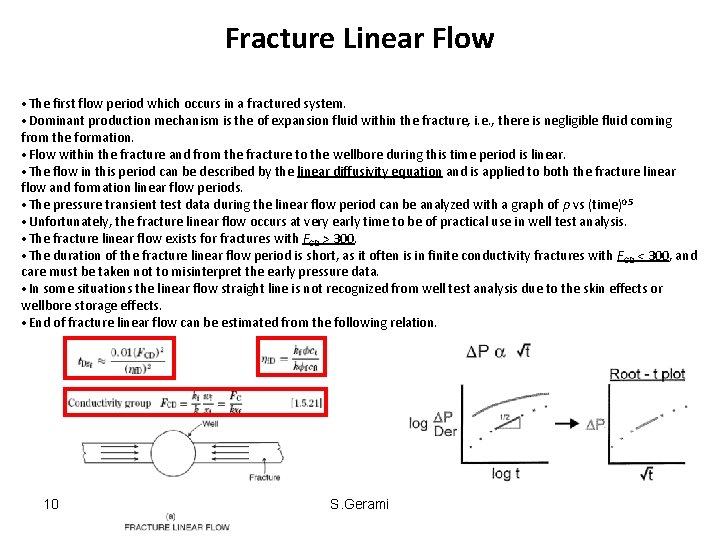
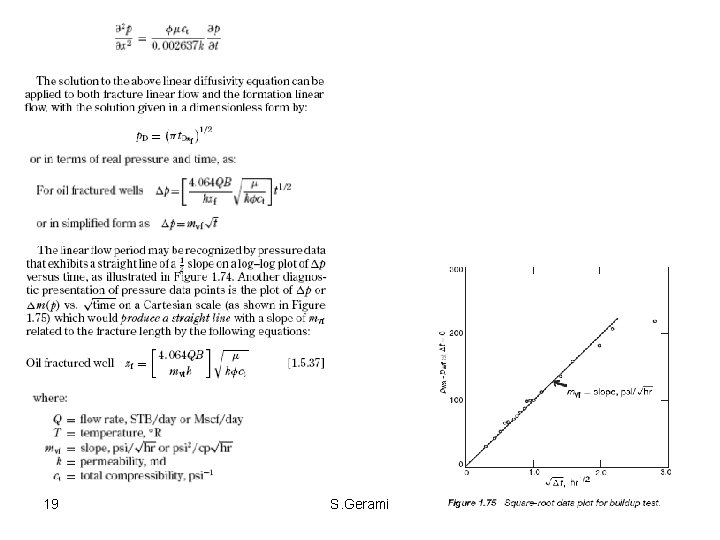
Fracture Linear Flow • The first flow period which occurs in a fractured system. • Dominant production mechanism is the of expansion fluid within the fracture, i. e. , there is negligible fluid coming from the formation. • Flow within the fracture and from the fracture to the wellbore during this time period is linear. • The flow in this period can be described by the linear diffusivity equation and is applied to both the fracture linear flow and formation linear flow periods. • The pressure transient test data during the linear flow period can be analyzed with a graph of p vs (time)0. 5 • Unfortunately, the fracture linear flow occurs at very early time to be of practical use in well test analysis. • The fracture linear flow exists for fractures with FCD > 300. • The duration of the fracture linear flow period is short, as it often is in finite conductivity fractures with FCD < 300, and care must be taken not to misinterpret the early pressure data. • In some situations the linear flow straight line is not recognized from well test analysis due to the skin effects or wellbore storage effects. • End of fracture linear flow can be estimated from the following relation. 10 S. Gerami
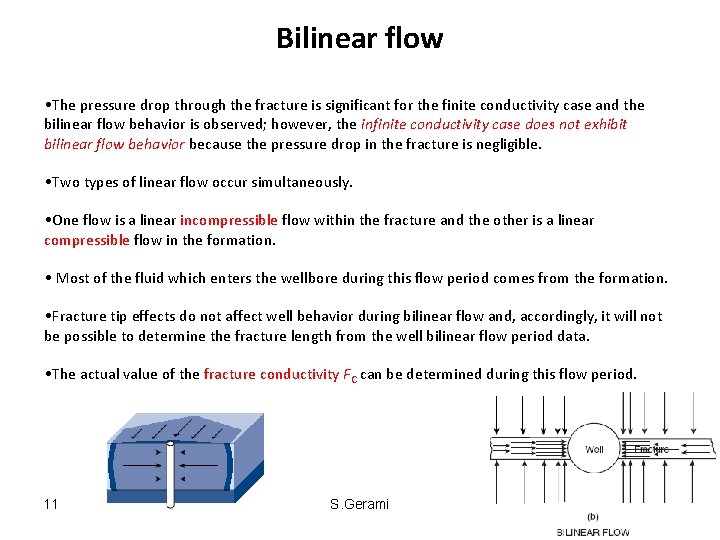
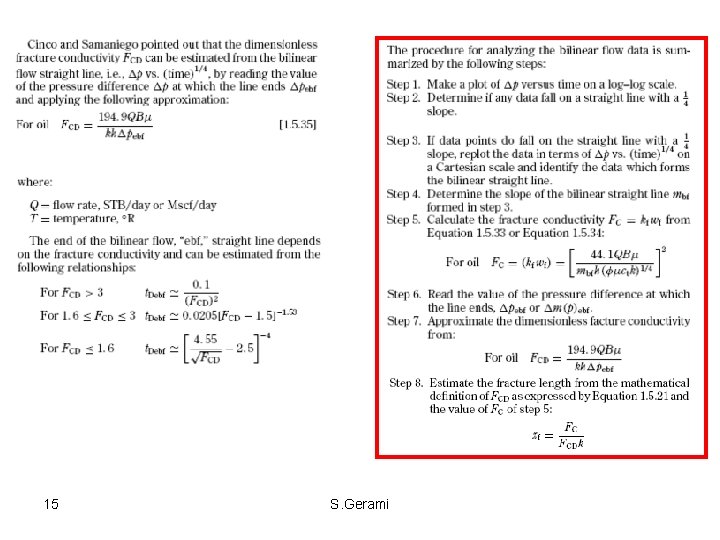
Bilinear flow • The pressure drop through the fracture is significant for the finite conductivity case and the bilinear flow behavior is observed; however, the infinite conductivity case does not exhibit bilinear flow behavior because the pressure drop in the fracture is negligible. • Two types of linear flow occur simultaneously. • One flow is a linear incompressible flow within the fracture and the other is a linear compressible flow in the formation. • Most of the fluid which enters the wellbore during this flow period comes from the formation. • Fracture tip effects do not affect well behavior during bilinear flow and, accordingly, it will not be possible to determine the fracture length from the well bilinear flow period data. • The actual value of the fracture conductivity FC can be determined during this flow period. 11 S. Gerami
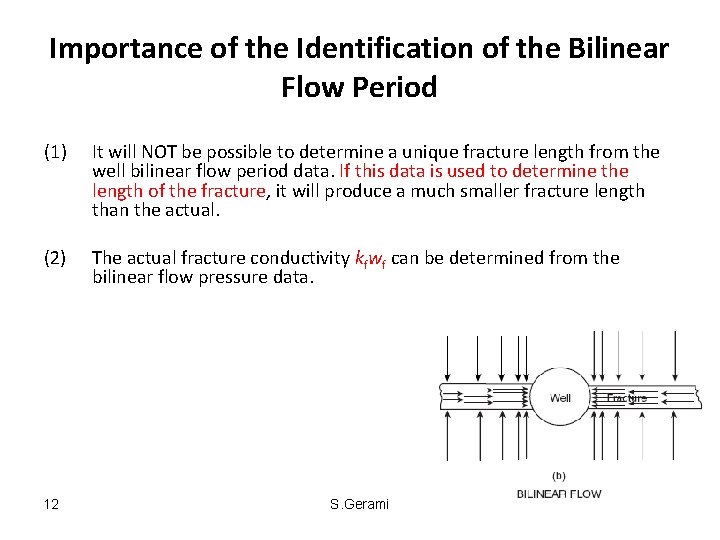
Importance of the Identification of the Bilinear Flow Period (1) It will NOT be possible to determine a unique fracture length from the well bilinear flow period data. If this data is used to determine the length of the fracture, it will produce a much smaller fracture length than the actual. (2) The actual fracture conductivity kfwf can be determined from the bilinear flow pressure data. 12 S. Gerami
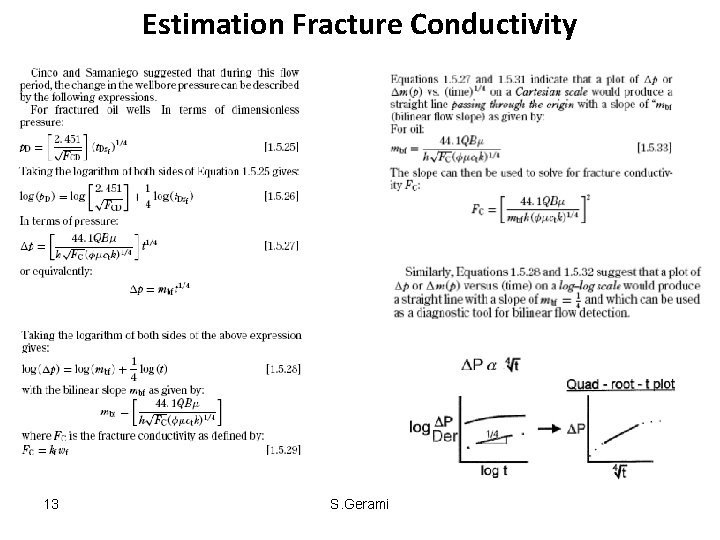
Estimation Fracture Conductivity 13 S. Gerami
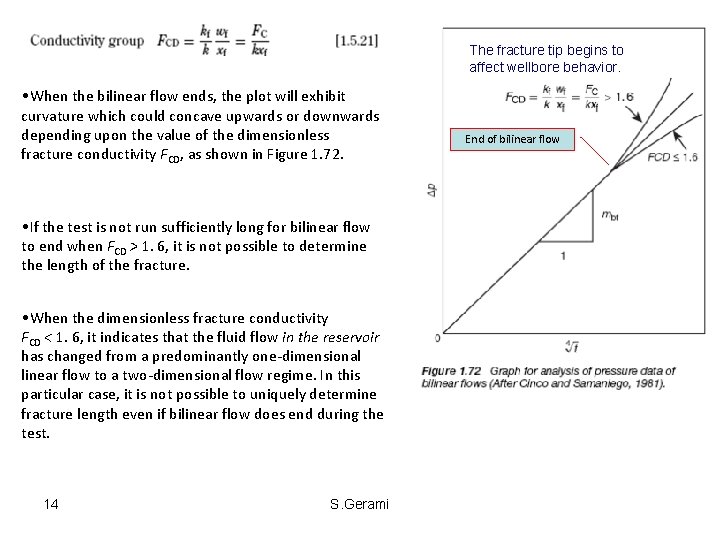
The fracture tip begins to affect wellbore behavior. • When the bilinear flow ends, the plot will exhibit curvature which could concave upwards or downwards depending upon the value of the dimensionless fracture conductivity FCD, as shown in Figure 1. 72. • If the test is not run sufficiently long for bilinear flow to end when FCD > 1. 6, it is not possible to determine the length of the fracture. • When the dimensionless fracture conductivity FCD < 1. 6, it indicates that the fluid flow in the reservoir has changed from a predominantly one-dimensional linear flow to a two-dimensional flow regime. In this particular case, it is not possible to uniquely determine fracture length even if bilinear flow does end during the test. 14 S. Gerami End of bilinear flow
15 S. Gerami
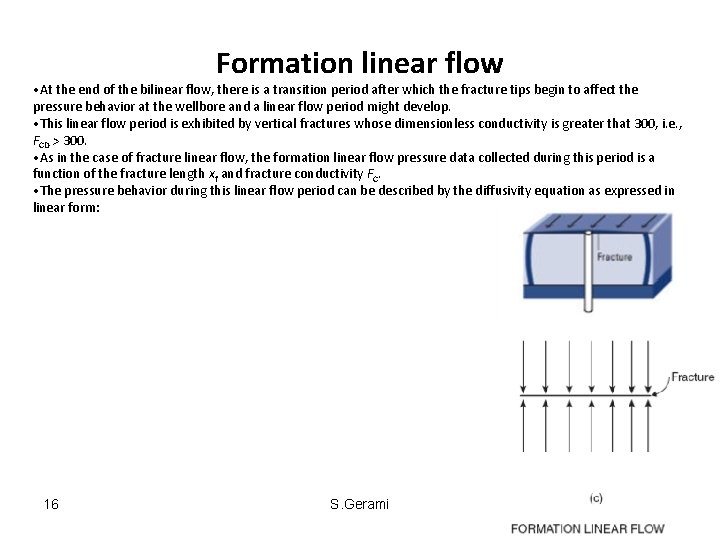
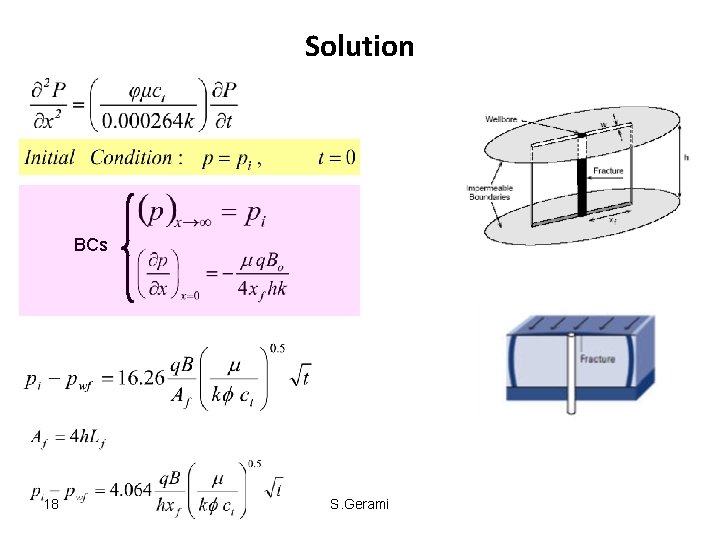
Formation linear flow • At the end of the bilinear flow, there is a transition period after which the fracture tips begin to affect the pressure behavior at the wellbore and a linear flow period might develop. • This linear flow period is exhibited by vertical fractures whose dimensionless conductivity is greater that 300, i. e. , FCD > 300. • As in the case of fracture linear flow, the formation linear flow pressure data collected during this period is a function of the fracture length xf and fracture conductivity FC. • The pressure behavior during this linear flow period can be described by the diffusivity equation as expressed in linear form: 16 S. Gerami
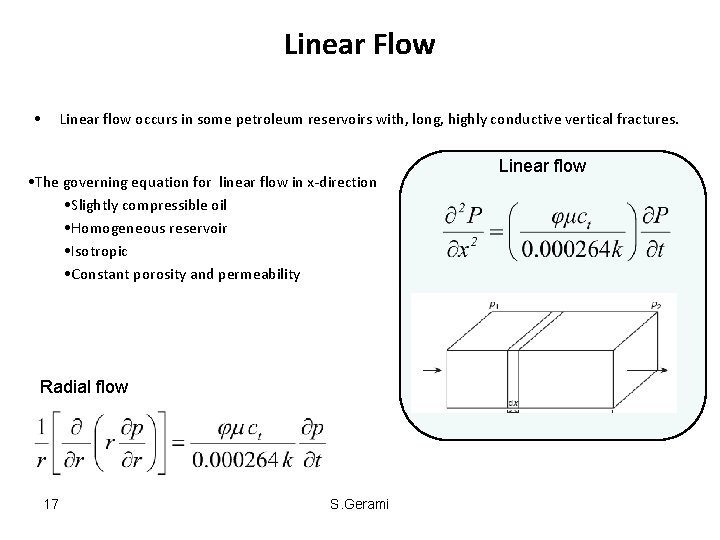
Linear Flow • Linear flow occurs in some petroleum reservoirs with, long, highly conductive vertical fractures. • The governing equation for linear flow in x-direction • Slightly compressible oil • Homogeneous reservoir • Isotropic • Constant porosity and permeability Radial flow 17 S. Gerami Linear flow
Solution BCs 18 S. Gerami
19 S. Gerami
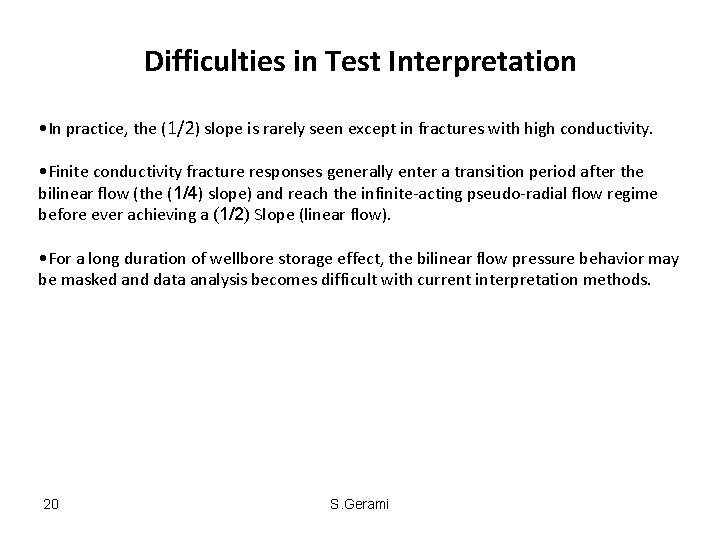
Difficulties in Test Interpretation • In practice, the (1/2) slope is rarely seen except in fractures with high conductivity. • Finite conductivity fracture responses generally enter a transition period after the bilinear flow (the (1/4) slope) and reach the infinite-acting pseudo-radial flow regime before ever achieving a (1/2) Slope (linear flow). • For a long duration of wellbore storage effect, the bilinear flow pressure behavior may be masked and data analysis becomes difficult with current interpretation methods. 20 S. Gerami
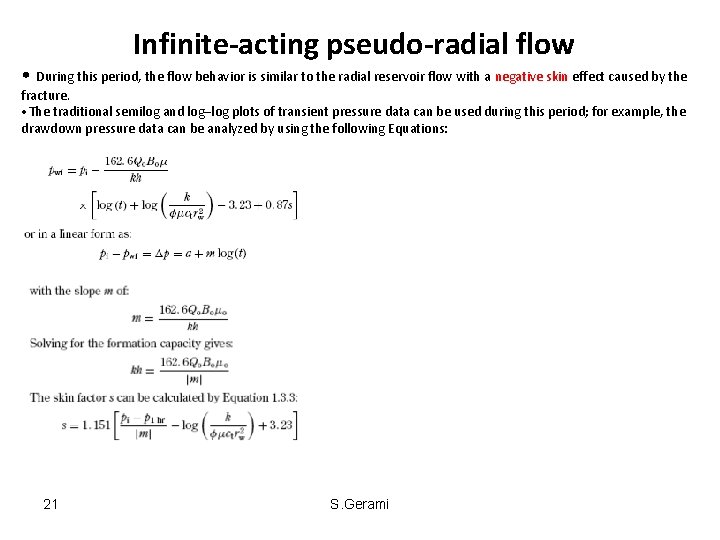
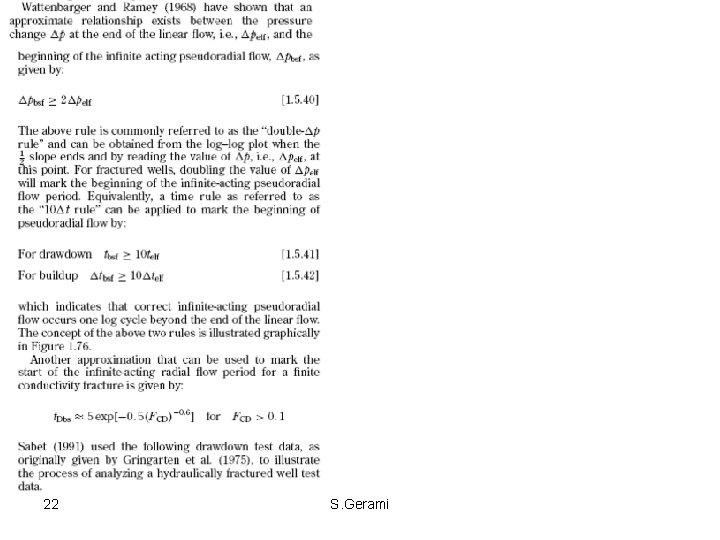
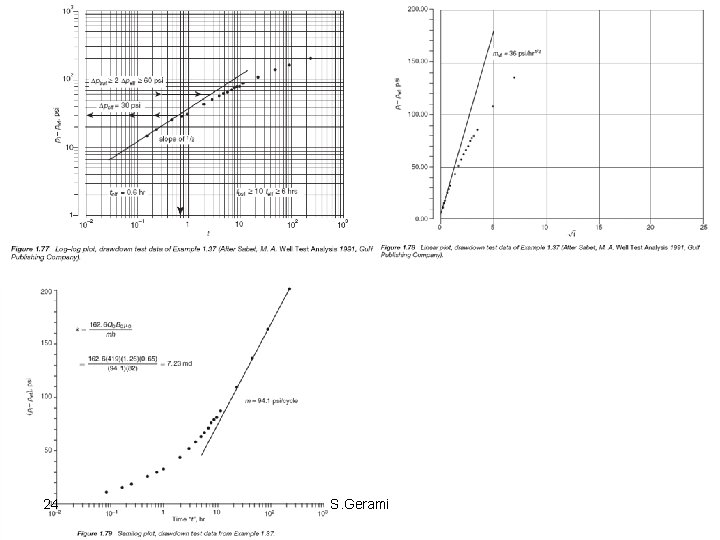
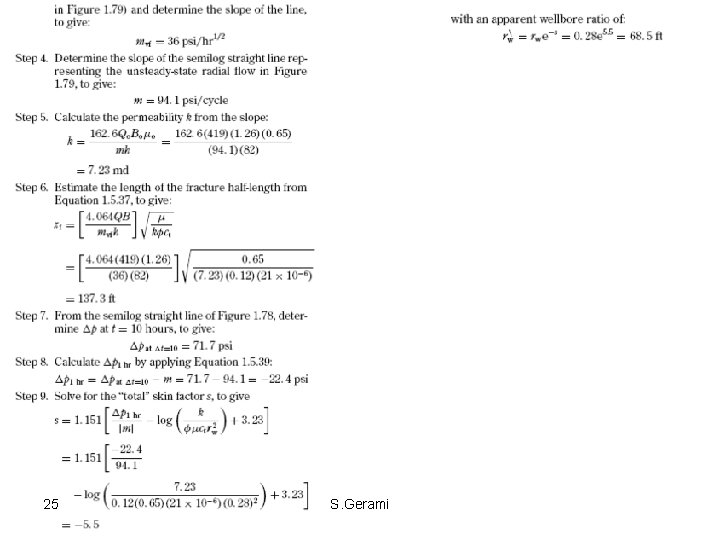
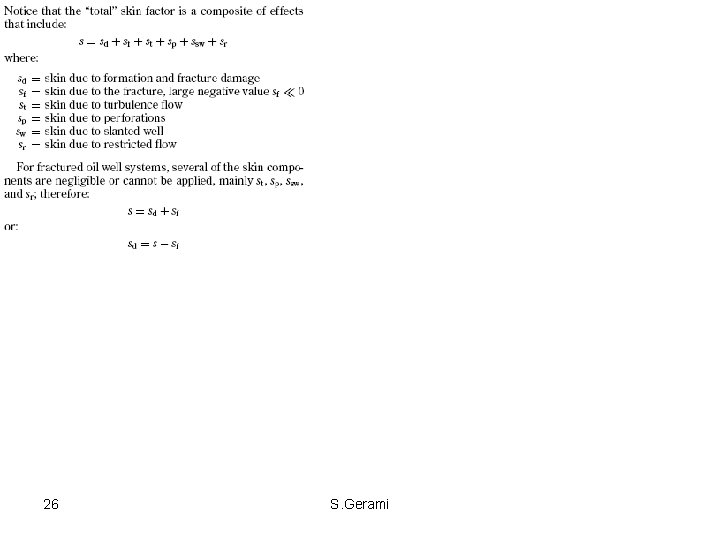
Infinite-acting pseudo-radial flow • During this period, the flow behavior is similar to the radial reservoir flow with a negative skin effect caused by the fracture. • The traditional semilog and log–log plots of transient pressure data can be used during this period; for example, the drawdown pressure data can be analyzed by using the following Equations: 21 S. Gerami
22 S. Gerami

23 S. Gerami
24 S. Gerami
25 S. Gerami
26 S. Gerami
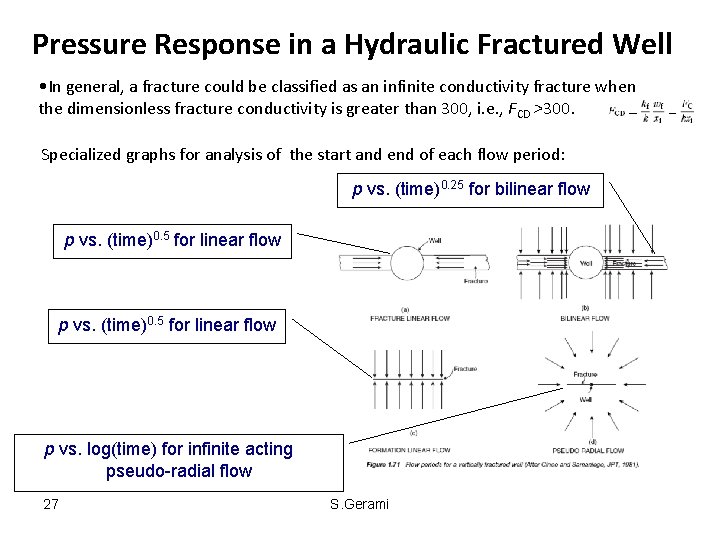
Pressure Response in a Hydraulic Fractured Well • In general, a fracture could be classified as an infinite conductivity fracture when the dimensionless fracture conductivity is greater than 300, i. e. , FCD >300. Specialized graphs for analysis of the start and end of each flow period: p vs. (time)0. 25 for bilinear flow p vs. (time)0. 5 for linear flow p vs. log(time) for infinite acting pseudo-radial flow 27 S. Gerami
- Slides: 27