
Welfare Economics Chapter 7 Consumer Producer Surplus CONSUMER
- Slides: 8
Welfare Economics Chapter 7: Consumer & Producer Surplus
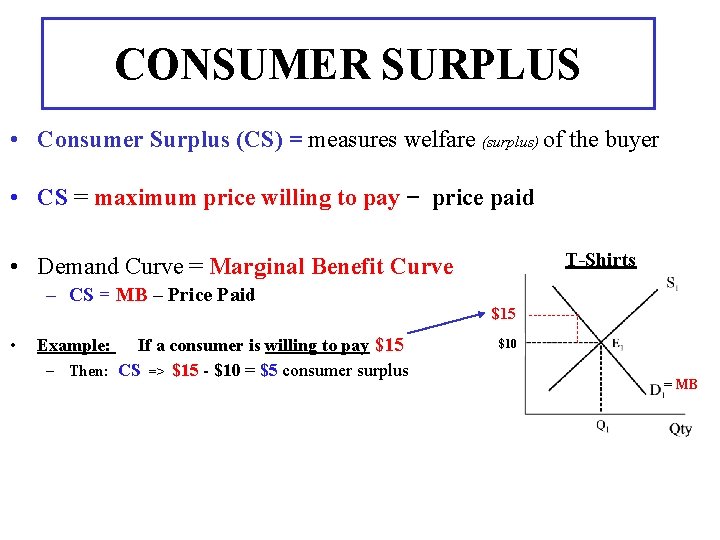
CONSUMER SURPLUS • Consumer Surplus (CS) = measures welfare (surplus) of the buyer • CS = maximum price willing to pay − price paid T-Shirts • Demand Curve = Marginal Benefit Curve – CS = MB – Price Paid If a consumer is willing to pay $15 – Then: CS => $15 - $10 = $5 consumer surplus Example: $10 ------ • $15 ------ = MB
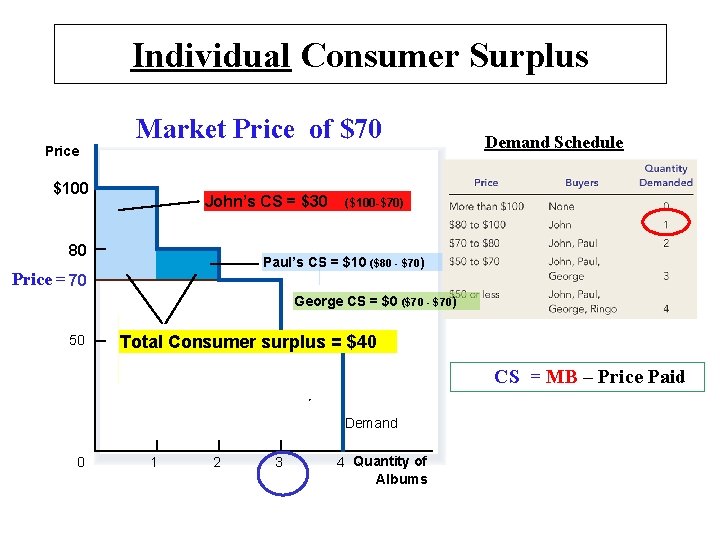
Individual Consumer Surplus Market Price of $70 Price $100 John’s CS = $30 80 Demand Schedule ($100 -$70) Paul’s CS = $10 ($80 - $70) Price = 70 George CS = $0 ($70 - $70) 50 Total Consumer surplus = $40 CS = MB – Price Paid Demand 0 1 2 3 4 Quantity of Albums
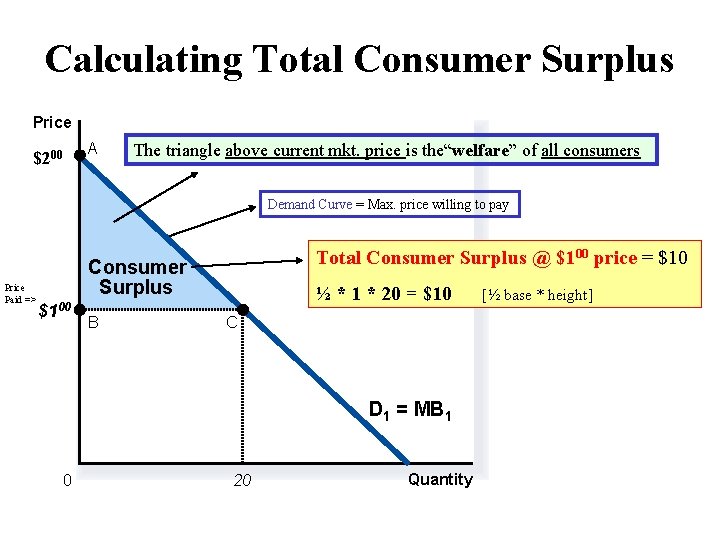
Calculating Total Consumer Surplus Price $200 A The triangle above current mkt. price is the“welfare” of all consumers Demand Curve = Max. price willing to pay Price Paid => Total Consumer Surplus @ $100 price = $10 Consumer Surplus $100 B ½ * 1 * 20 = $10 C D 1 = MB 1 0 20 Quantity [½ base * height]
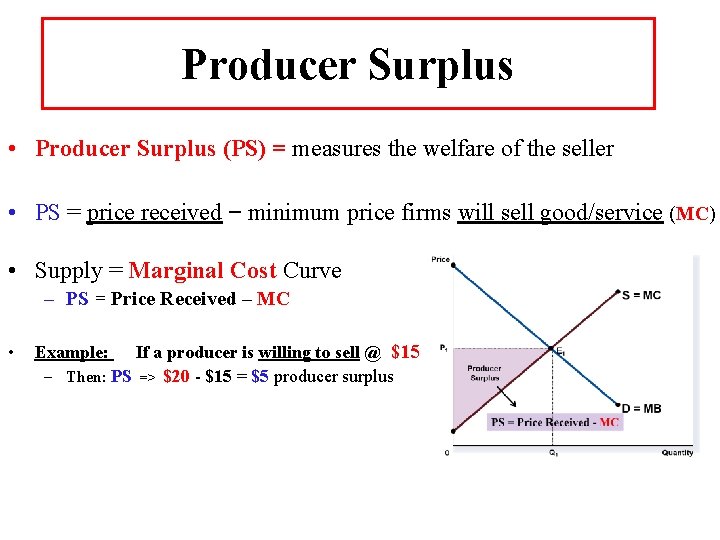
Producer Surplus • Producer Surplus (PS) = measures the welfare of the seller • PS = price received − minimum price firms will sell good/service (MC) • Supply = Marginal Cost Curve – PS = Price Received – MC • If a producer is willing to sell @ $15 – Then: PS => $20 - $15 = $5 producer surplus Example:
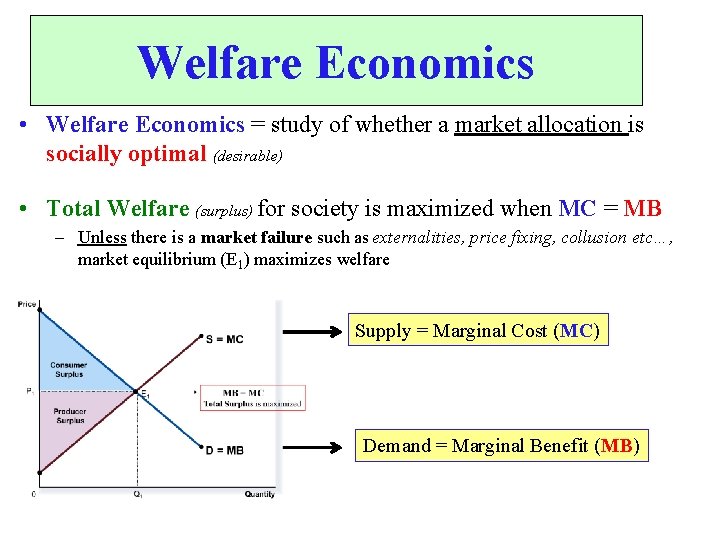
Welfare Economics • Welfare Economics = study of whether a market allocation is socially optimal (desirable) • Total Welfare (surplus) for society is maximized when MC = MB – Unless there is a market failure such as externalities, price fixing, collusion etc…, market equilibrium (E 1) maximizes welfare Supply = Marginal Cost (MC) Demand = Marginal Benefit (MB)
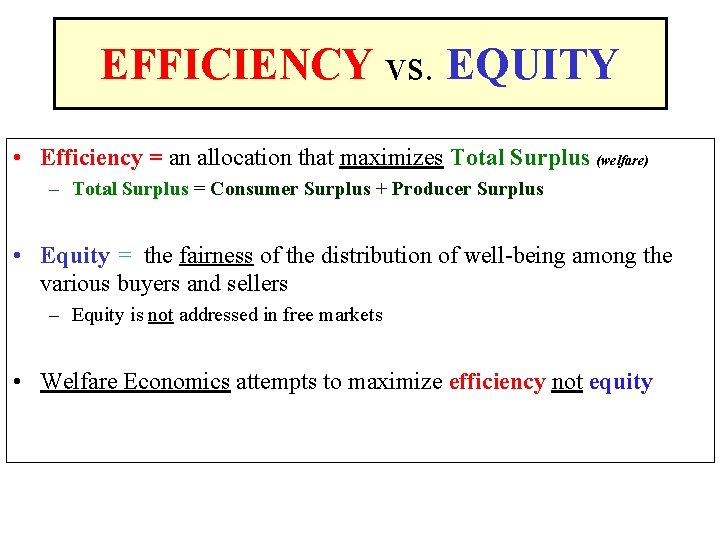
EFFICIENCY vs. EQUITY • Efficiency = an allocation that maximizes Total Surplus (welfare) – Total Surplus = Consumer Surplus + Producer Surplus • Equity = the fairness of the distribution of well-being among the various buyers and sellers – Equity is not addressed in free markets • Welfare Economics attempts to maximize efficiency not equity
Consumer & Producer Surplus Handout