
Welding Brazing Cutting Hot Work OSHA 29 CFR
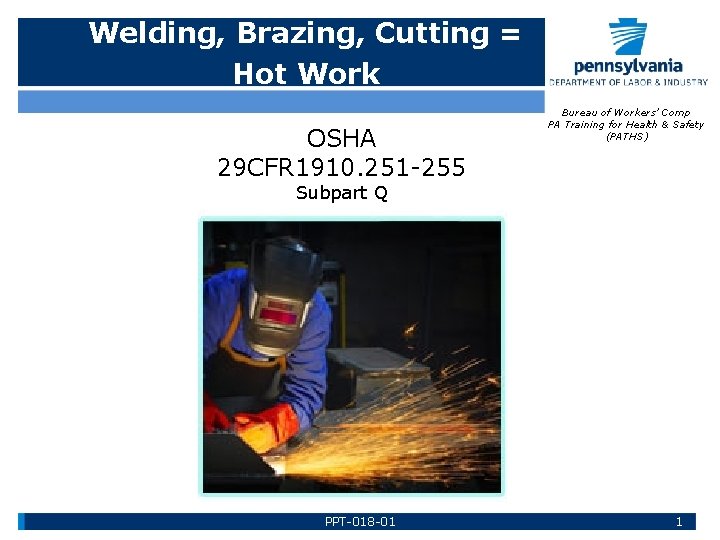
Welding, Brazing, Cutting = Hot Work OSHA 29 CFR 1910. 251 -255 Bureau of Workers’ Comp PA Training for Health & Safety (PATHS) Subpart Q PPT-018 -01 1
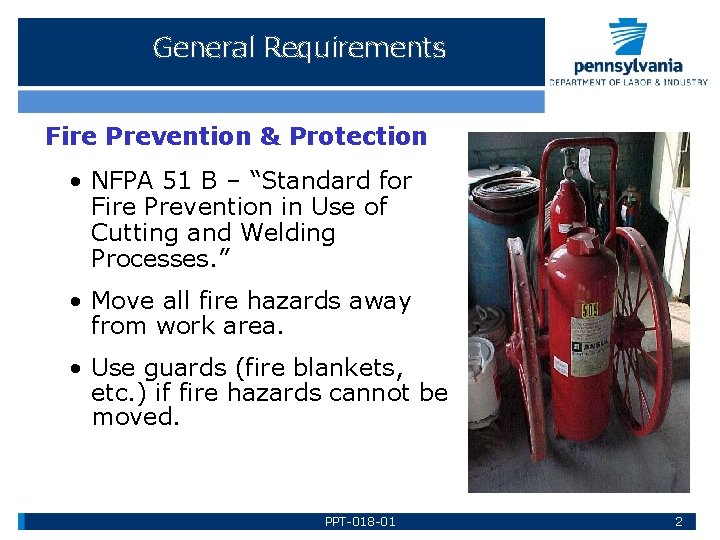
General Requirements Fire Prevention & Protection • NFPA 51 B – “Standard for Fire Prevention in Use of Cutting and Welding Processes. ” • Move all fire hazards away from work area. • Use guards (fire blankets, etc. ) if fire hazards cannot be moved. PPT-018 -01 2
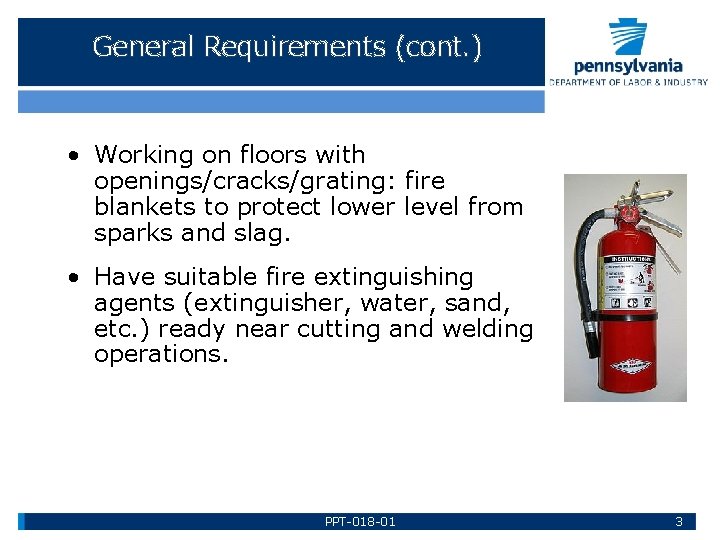
General Requirements (cont. ) • Working on floors with openings/cracks/grating: fire blankets to protect lower level from sparks and slag. • Have suitable fire extinguishing agents (extinguisher, water, sand, etc. ) ready near cutting and welding operations. PPT-018 -01 3
Fire Watch Requirements A “fire watch” must be available where there is a fire potential or where; • Combustible materials are closer than 35 feet to the point of operation. • Walls opening within the 35 foot radius, exposing combustible material. • Material opposite metal walls and roofs could catch fire from conduction or radiation. PPT-018 -01 4
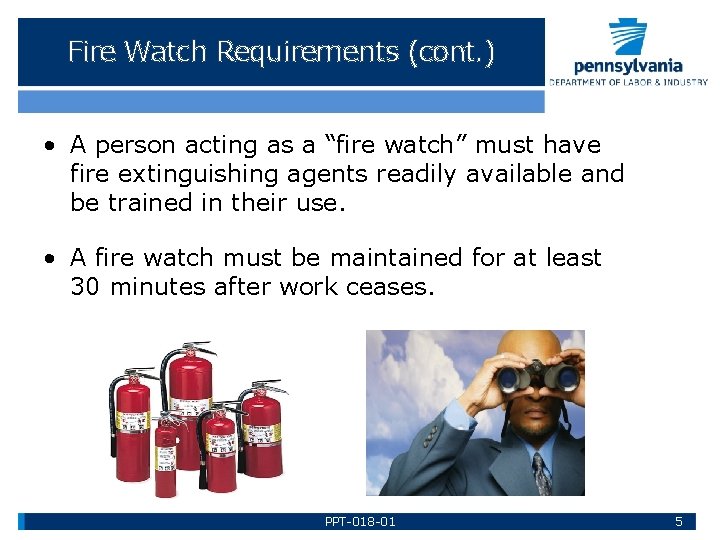
Fire Watch Requirements (cont. ) • A person acting as a “fire watch” must have fire extinguishing agents readily available and be trained in their use. • A fire watch must be maintained for at least 30 minutes after work ceases. PPT-018 -01 5
Before Welding • Obtain a “burn permit” (hot work permit) authorized by the designated responsible person. • Sweep away all paper clippings, wood shavings or textile fibers within a radius of 35 feet of cutting/welding operations. PPT-018 -01 6
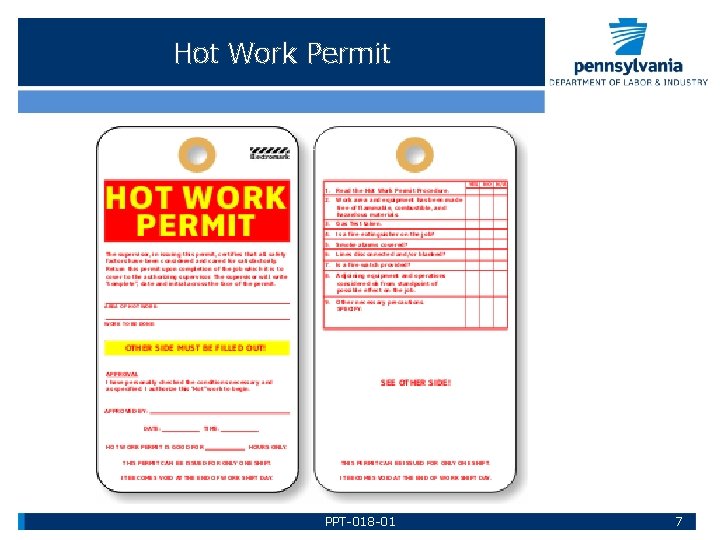
Hot Work Permit PPT-018 -01 7
Hot Work Permit (cont. ) Is a hot work permit required under related OSHA standards? NO! Is a hot work permit a “best practice? ” YES! PPT-018 -01 8
Welding/cutting is prohibited in • Areas not authorized by company management. • Areas near large quantities of readily-ignitable materials, such as baled paper or cotton. • Sprinkler-equipped buildings while sprinklers are impaired or out of order. • The presence of explosive atmospheres such as unclean or improperly-prepared tanks. PPT-018 -01 9
Management Responsibilities • Recognize safe usage of welding/cutting/burning equipment on its property. • Establish areas for cutting and welding operations. • Protect welding leads from damage by vehicles, slag, etc. PPT-018 -01 10
Management Responsibilities (cont. ) • Designate a responsible individual to authorize hot work permits. • Insist that cutters/welders are trained in safe work habits for their specific tasks. • Advise all contractors about flammable or hazardous materials. PPT-018 -01 11
Welding or Cutting Containers • Ensure that used containers (drums, barrels, tanks) have been thoroughly cleaned of flammable materials including grease, tars and acids. • All spaces must be vented and purged before welding. • Purging with inert gas is recommended. PPT-018 -01 12
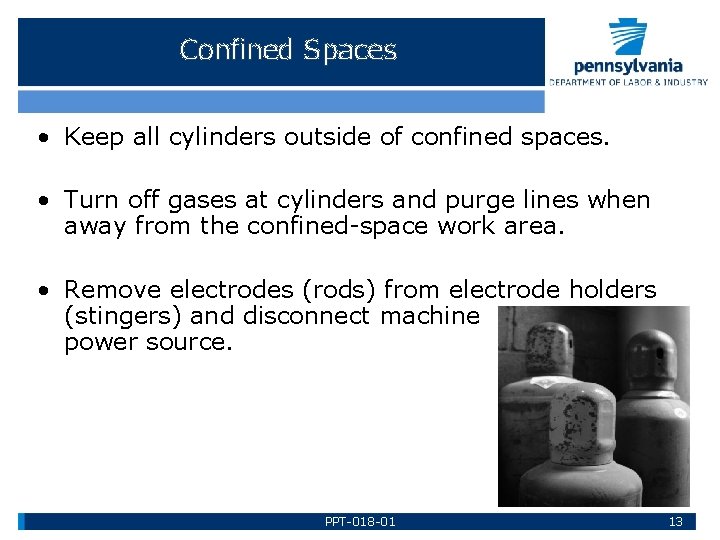
Confined Spaces • Keep all cylinders outside of confined spaces. • Turn off gases at cylinders and purge lines when away from the confined-space work area. • Remove electrodes (rods) from electrode holders (stingers) and disconnect machine power source. PPT-018 -01 13
Working at Heights • Workers on platforms, scaffolds or open sided floors must be protected from falls with: • A guardrail system or lifeline. • Safety harnesses with lanyards. • Welding cable and hoses must be kept clear of passageways, ladders and stairways. PPT-018 -01 14
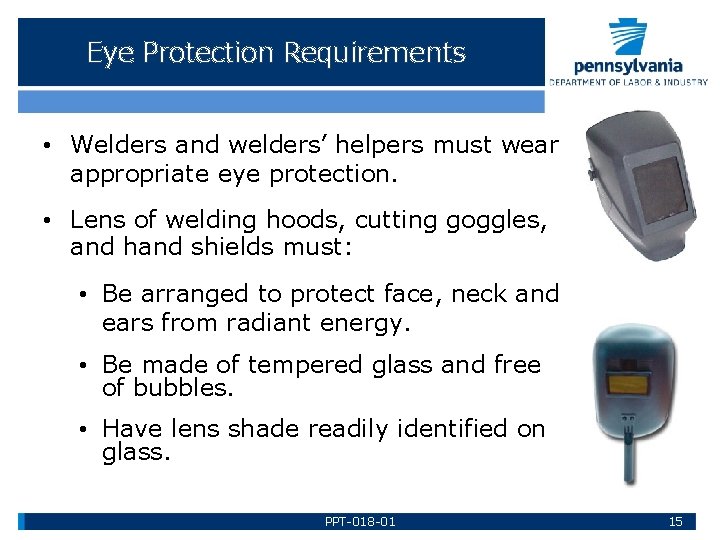
Eye Protection Requirements • Welders and welders’ helpers must wear appropriate eye protection. • Lens of welding hoods, cutting goggles, and hand shields must: • Be arranged to protect face, neck and ears from radiant energy. • Be made of tempered glass and free of bubbles. • Have lens shade readily identified on glass. PPT-018 -01 15
Radiation Hazards Results of excessive exposure to ultraviolet radiation: • Causes eyes to feel like they are full of sand. • Can lead to premature cataracts of the eyes. Protect against ultraviolet radiation, sparks, fumes and slag. • Wear protective clothing and respirators. • Provide warning signs to warn of hot metal. • Use ventilation or suitable respiratory protection. PPT-018 -01 16
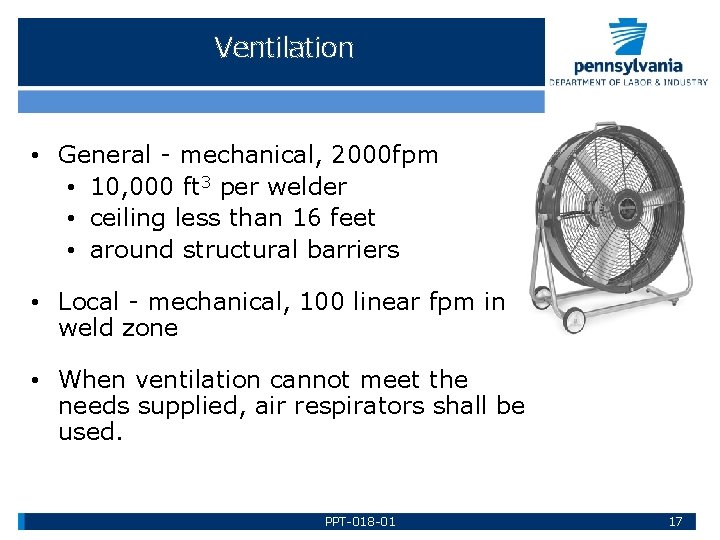
Ventilation • General - mechanical, 2000 fpm • 10, 000 ft 3 per welder • ceiling less than 16 feet • around structural barriers • Local - mechanical, 100 linear fpm in weld zone • When ventilation cannot meet the needs supplied, air respirators shall be used. PPT-018 -01 17
Ventilation (cont. ) Mostly require local exhaust ventilation or airline respirators (reference OSHA standard): • Fluorine compounds • Zinc • Lead • Beryllium • Cadmium • Mercury • Stainless steel • Chlorinated hydrocarbons PPT-018 -01 18
Acetylene • Liquefied petroleum gas • Formed when calcium carbide is submerged in water or in petrochemical processes. • Very unstable at pressures over 15 psi. • Never operate above 15 psi. • LEL = 2%, UEL=100% PPT-018 -01 19
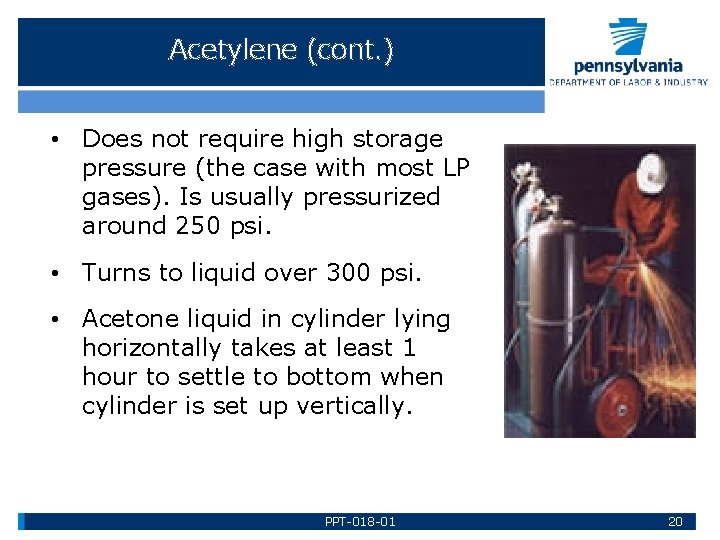
Acetylene (cont. ) • Does not require high storage pressure (the case with most LP gases). Is usually pressurized around 250 psi. • Turns to liquid over 300 psi. • Acetone liquid in cylinder lying horizontally takes at least 1 hour to settle to bottom when cylinder is set up vertically. PPT-018 -01 20
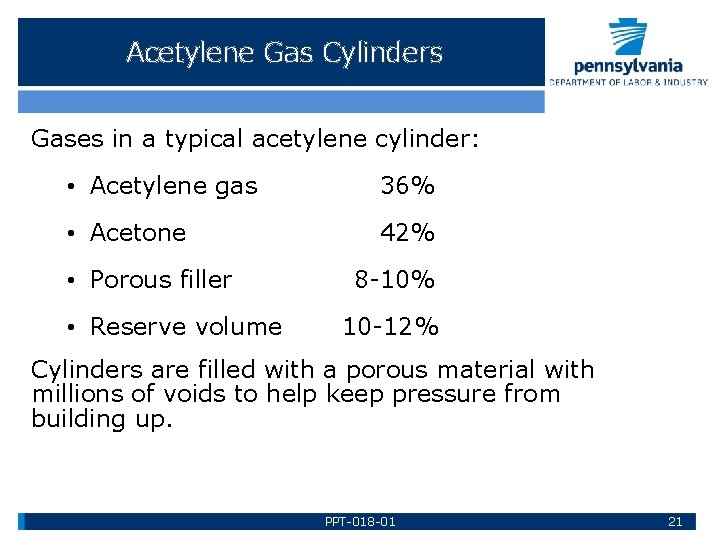
Acetylene Gas Cylinders Gases in a typical acetylene cylinder: • Acetylene gas 36% • Acetone 42% • Porous filler • Reserve volume 8 -10% 10 -12% Cylinders are filled with a porous material with millions of voids to help keep pressure from building up. PPT-018 -01 21
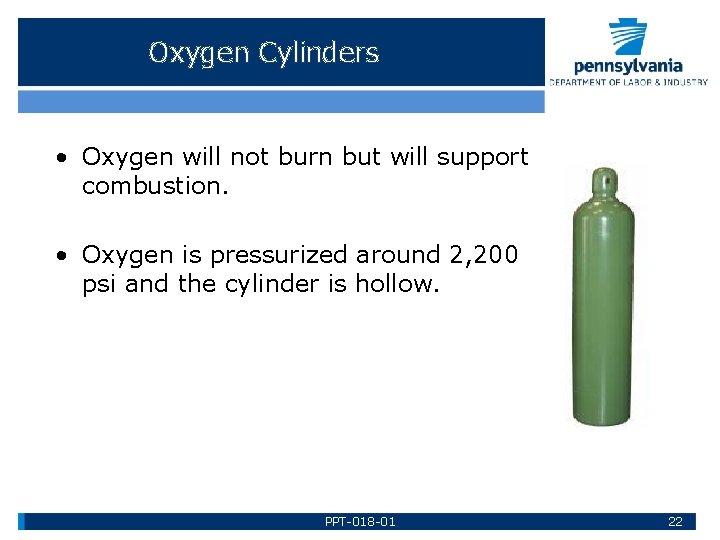
Oxygen Cylinders • Oxygen will not burn but will support combustion. • Oxygen is pressurized around 2, 200 psi and the cylinder is hollow. PPT-018 -01 22
Oxygen Cylinders (cont. ) • Keep oil and grease off oxygen cylinder valves and fittings (oil and grease will burn violently). • Protect valves of oxygen cylinders (if valves are knocked off, the cylinder becomes a “bomb”). • Separate oxygen cylinders from fuel gas cylinders or combustible materials by a distance of at least 20 feet. PPT-018 -01 23
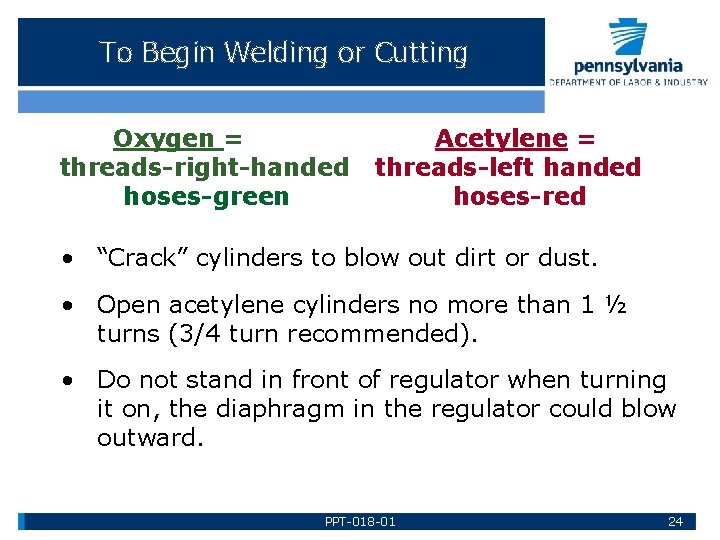
To Begin Welding or Cutting Oxygen = threads-right-handed hoses-green Acetylene = threads-left handed hoses-red • “Crack” cylinders to blow out dirt or dust. • Open acetylene cylinders no more than 1 ½ turns (3/4 turn recommended). • Do not stand in front of regulator when turning it on, the diaphragm in the regulator could blow outward. PPT-018 -01 24
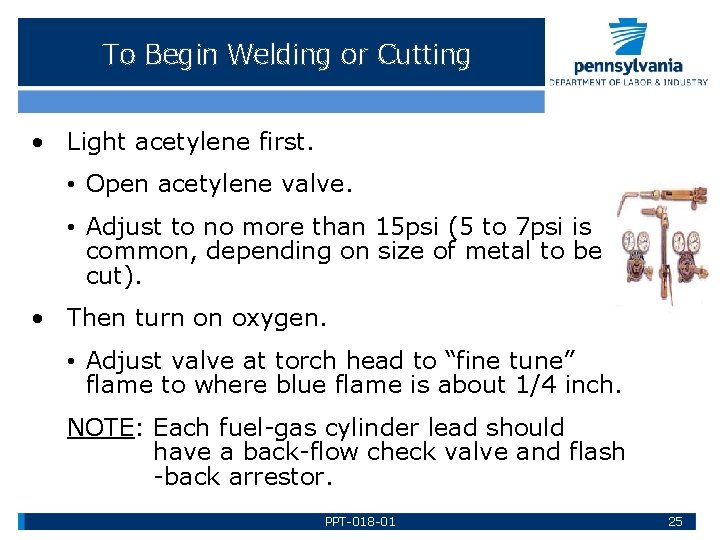
To Begin Welding or Cutting • Light acetylene first. • Open acetylene valve. • Adjust to no more than 15 psi (5 to 7 psi is common, depending on size of metal to be cut). • Then turn on oxygen. • Adjust valve at torch head to “fine tune” flame to where blue flame is about 1/4 inch. NOTE: Each fuel-gas cylinder lead should have a back-flow check valve and flash -back arrestor. PPT-018 -01 25
To Stop Welding or Cutting • Shut oxygen valve off first, then acetylene. • Oxygen cylinder valves should be opened entirely. • Turn main valve off and bleed lines. • Mark empty cylinders “MT” or “Empty” with railroad chalk. • When moving cylinders, roll them on their bottom edges. PPT-018 -01 26
Special Precautions • Welding fumes from zinc, cadmium, beryllium, lead, mercury and stainless steel are addressed in OSHA standards. • Argon gas used in MIG welding operations must be handled as an inert gas and stored accordingly. PPT-018 -01 27
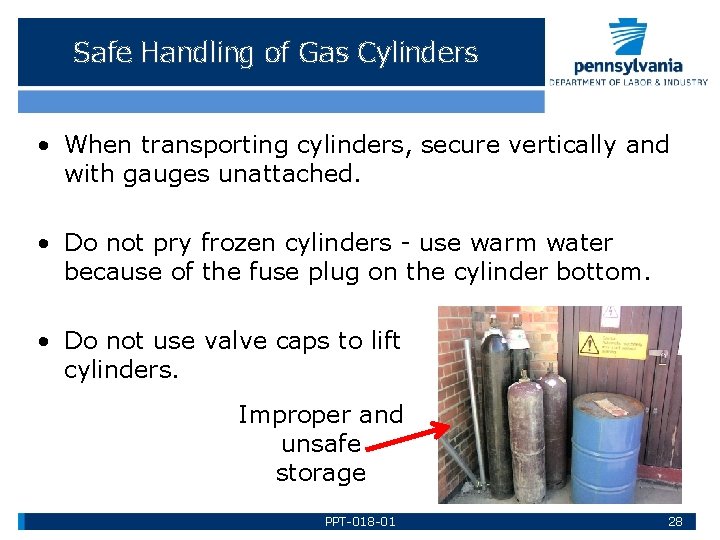
Safe Handling of Gas Cylinders • When transporting cylinders, secure vertically and with gauges unattached. • Do not pry frozen cylinders - use warm water because of the fuse plug on the cylinder bottom. • Do not use valve caps to lift cylinders. Improper and unsafe storage PPT-018 -01 28
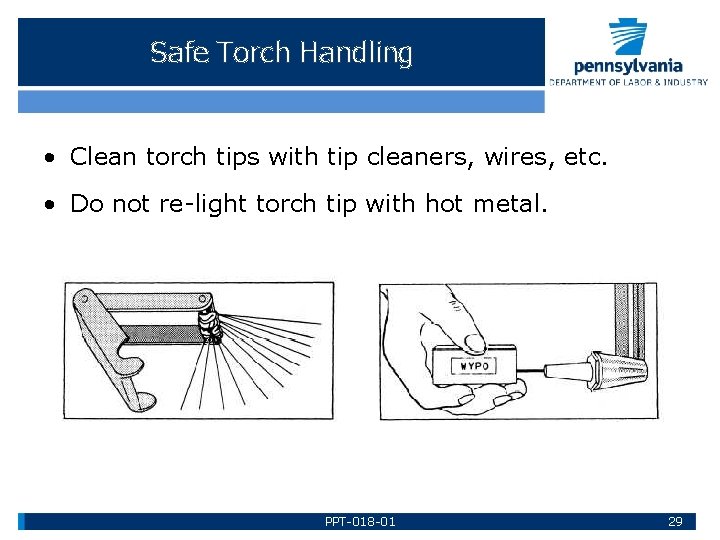
Safe Torch Handling • Clean torch tips with tip cleaners, wires, etc. • Do not re-light torch tip with hot metal. Welding Tip Orifice Cleaner Tip Cleaner in Use PPT-018 -01 29
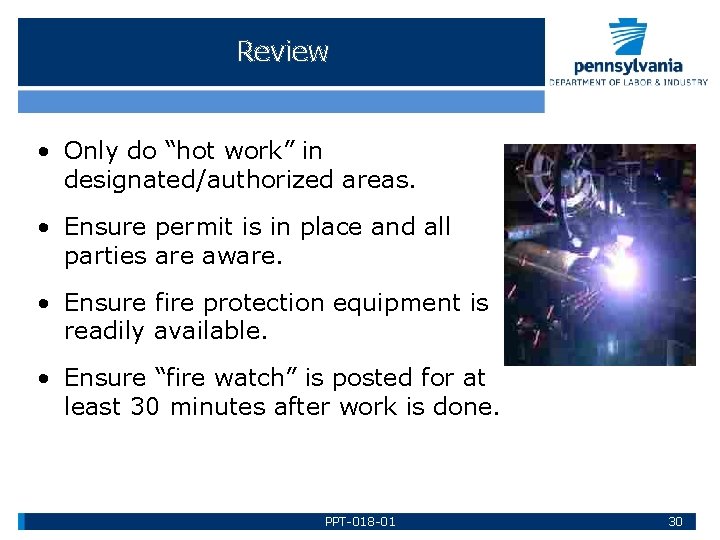
Review • Only do “hot work” in designated/authorized areas. • Ensure permit is in place and all parties are aware. • Ensure fire protection equipment is readily available. • Ensure “fire watch” is posted for at least 30 minutes after work is done. PPT-018 -01 30
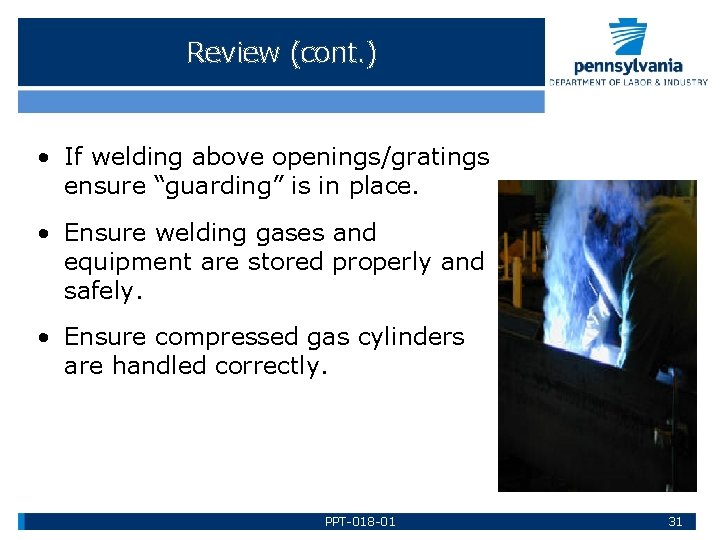
Review (cont. ) • If welding above openings/gratings ensure “guarding” is in place. • Ensure welding gases and equipment are stored properly and safely. • Ensure compressed gas cylinders are handled correctly. PPT-018 -01 31

Any Questions? PPT-018 -01 32
- Slides: 32