
Welding and Hot Work Introduction How to Use

- Slides: 41
Welding and Hot Work
Introduction How to Use this Presentation This presentation contains base material for use in an instructor-led training setting. You may modify this presentation to satisfy the specific training needs of your organization. On some slides, the display text is supplemented with additional material in the slide notes. This content is licensed for modification and use in a classroom setting. You may not redistribute this material in any form. DISCLAIMER This training material presents very important, pertinent information. It should not be assumed, however, that this program satisfies every legal requirement of every state. Some states require the training be developed and delivered by an individual with specific training and experience. This training is AWARENESS LEVEL and does not authorize any person to perform work or validate their level of competency; it must be supplemented with operation and processspecific assessments and training, as well as management oversight, to assure that all training is understood and followed. Your organization must do an evaluation of all exposures and applicable codes and regulations. In addition, establish proper controls, training, and protective measures to effectively control exposures and assure compliance. This program is neither a determination that the conditions and practices of your organization are safe, nor a warranty that reliance upon this program will prevent accidents and losses or satisfy local, state, or federal regulations.
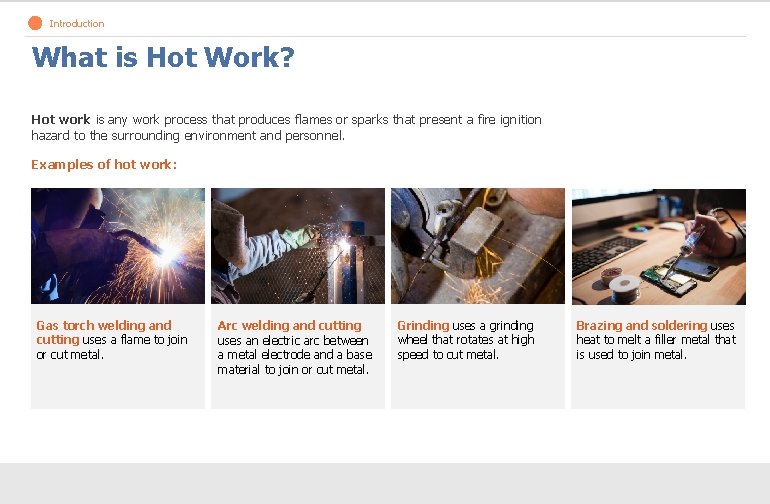
Introduction What is Hot Work? Hot work is any work process that produces flames or sparks that present a fire ignition hazard to the surrounding environment and personnel. Examples of hot work: Gas torch welding and cutting uses a flame to join or cut metal. Arc welding and cutting uses an electric arc between a metal electrode and a base material to join or cut metal. Grinding uses a grinding wheel that rotates at high speed to cut metal. Brazing and soldering uses heat to melt a filler metal that is used to join metal.
Introduction Course Overview 1. Hazards of Hot Work 2. Hazard Prevention Safeguards 3. Personal Protective Equipment (PPE) 4. Arc Welding 5. Torch Welding, Cutting, and Brazing 6. Cylinder Handling and Storage
1 Hazards of Hot Work What you need to know: 1. The hazards associated with hot work 2. Which environments require unique hazard prevention training and precautions
1 Hazards of Hot Work Hazards Associated with Hot Work Hot work presents a variety of hazards. Before hot work can begin, your supervisor will identify the hazards in your workplace. Fire Burns Intense heat, sparks, or metal splatter produced during hot work can create fire hazards. Radiant energy, sparks, or metal splatter can cause serious burns. Electric shock Flammable gases If you touch two metal objects containing voltage, you will become a part of the electrical circuit. Higher voltages increase the risk of injury or death. If allowed to accumulate, flammable gases can flash or explode with catastrophic results. Arc flash occurs when an electric current leaves its intended path and travels through the air from one conductor to another or to the ground. Intense light The incredibly bright light of arc welding can cause serious eye damage.
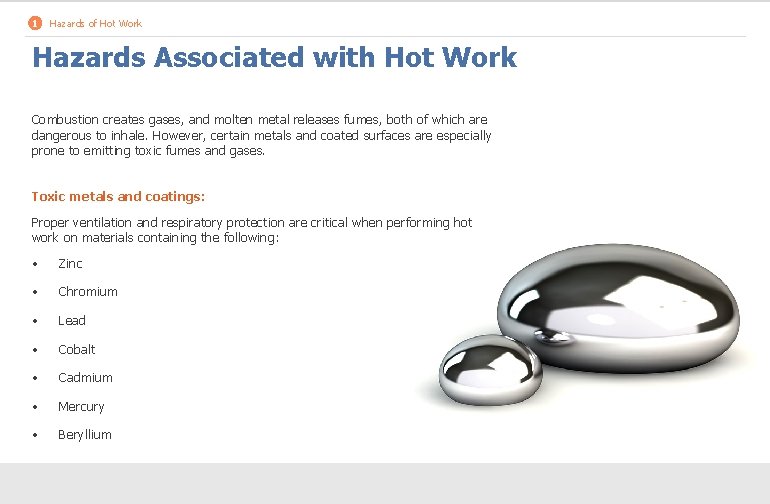
1 Hazards of Hot Work Hazards Associated with Hot Work Combustion creates gases, and molten metal releases fumes, both of which are dangerous to inhale. However, certain metals and coated surfaces are especially prone to emitting toxic fumes and gases. Toxic metals and coatings: Proper ventilation and respiratory protection are critical when performing hot work on materials containing the following: • Zinc • Chromium • Lead • Cobalt • Cadmium • Mercury • Beryllium
1 Hazards of Hot Work Environments with Special Hazard Considerations The hazards of hot work intensify in certain environments, such as wells or other confined spaces. Potential hazards in oil or gas wells: Hazards in confined spaces: • Flammable or combustible gases, vapors, and liquids • Limited escape routes • Toxic gases in deadly amounts • Limited visibility, which impedes awareness of injuries and delays emergency response • Limited ventilation, presenting a greater risk of exposure to harmful fumes • Displaced oxygen caused by welding flames in a confined space, which can be fatal
2 Hazard Prevention Safeguards What you need to know: 1. Roles and responsibilities 2. Administrative procedures 3. General hazard controls 4. Additional controls 5. Safety restrictions
2 Hazard Prevention Safeguards Roles and Responsibilities You, supervisors, and management all have the responsibility to assure a safe environment for hot work. The employee: The supervisor: Management: • Lays out the work area • • Appoints a qualified supervisor • Keeps the work area clean • • Follows fire prevention and other safety controls • Communicates and enforces safety procedures Establishes the proper locations, policies, and procedures • Follows related procedures, such as lockout/tagout • Assigns fire watches, if required Assures that employees have the training they need to work safely • Advises contractors of hazards • Uses all personal protective equipment (PPE) properly • Secures authorizations • Uses all equipment properly • Assures that equipment is safe to use • Reports any safety issues • Tells the employee when to proceed • Conducts hazard assessments and identifies safety precautions
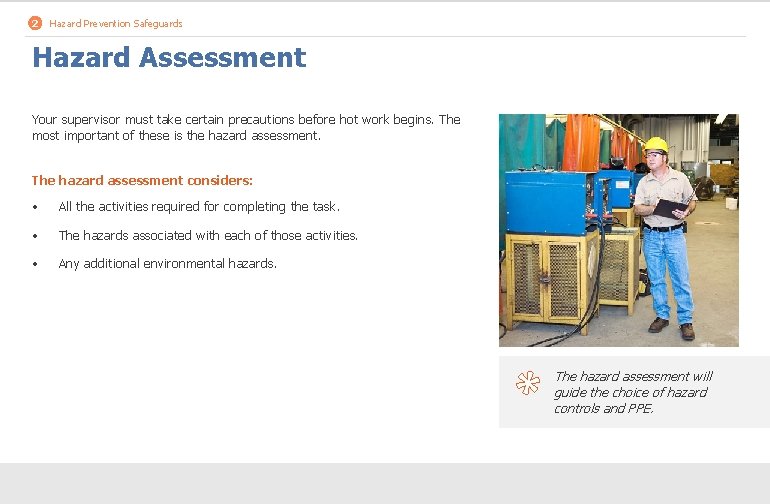
2 Hazard Prevention Safeguards Hazard Assessment Your supervisor must take certain precautions before hot work begins. The most important of these is the hazard assessment. The hazard assessment considers: • All the activities required for completing the task. • The hazards associated with each of those activities. • Any additional environmental hazards. * The hazard assessment will guide the choice of hazard controls and PPE.
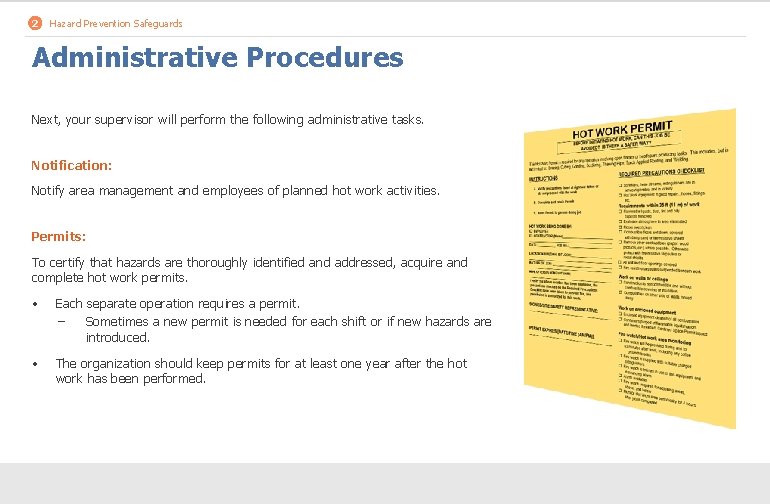
2 Hazard Prevention Safeguards Administrative Procedures Next, your supervisor will perform the following administrative tasks. Notification: Notify area management and employees of planned hot work activities. Permits: To certify that hazards are thoroughly identified and addressed, acquire and complete hot work permits. • Each separate operation requires a permit. ‒ Sometimes a new permit is needed for each shift or if new hazards are introduced. • The organization should keep permits for at least one year after the hot work has been performed.
2 Hazard Prevention Safeguards Hazard Controls Based on the hazard assessment, your supervisor will establish hazard controls for each risk. Controlling combustible materials: • Remove all combustible materials 35 feet from the work area. • Move combustibles located on the opposite side of partitions and ceilings that will be subject to welding or cutting. • Avoid unmovable combustible materials, such as wooden floors. If unable to remove or avoid fire hazards: • Cover combustible floors or materials with fire blankets or other suitable non-combustible material to contain slag and sparks. • Use guards. • Establish restrictions. • In some cases, hot work may be prohibited entirely.
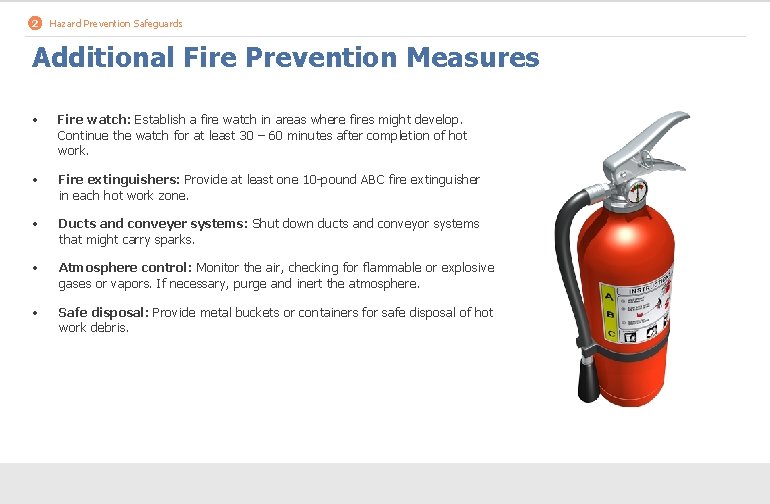
2 Hazard Prevention Safeguards Additional Fire Prevention Measures • Fire watch: Establish a fire watch in areas where fires might develop. Continue the watch for at least 30 – 60 minutes after completion of hot work. • Fire extinguishers: Provide at least one 10 -pound ABC fire extinguisher in each hot work zone. • Ducts and conveyer systems: Shut down ducts and conveyor systems that might carry sparks. • Atmosphere control: Monitor the air, checking for flammable or explosive gases or vapors. If necessary, purge and inert the atmosphere. • Safe disposal: Provide metal buckets or containers for safe disposal of hot work debris.
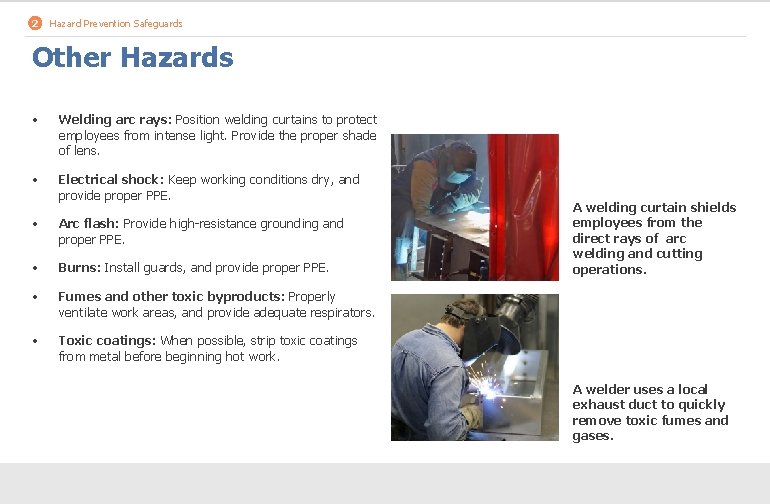
2 Hazard Prevention Safeguards Other Hazards • Welding arc rays: Position welding curtains to protect employees from intense light. Provide the proper shade of lens. • Electrical shock: Keep working conditions dry, and provide proper PPE. • Arc flash: Provide high-resistance grounding and proper PPE. • Burns: Install guards, and provide proper PPE. • Fumes and other toxic byproducts: Properly ventilate work areas, and provide adequate respirators. • Toxic coatings: When possible, strip toxic coatings from metal before beginning hot work. A welding curtain shields employees from the direct rays of arc welding and cutting operations. A welder uses a local exhaust duct to quickly remove toxic fumes and gases.
2 Hazard Prevention Safeguards Controlling Hazards Around Confined Spaces Certain environments, such as well sites, vessels, and other confined spaces, require additional precautions. • Move all ignition sources outside the hot work area. • Use local exhaust ventilation to keep exposures within acceptable limits. • Follow your organization’s respiratory protection program. • Your supervisor will arrange for monitoring to evaluate air quality, potential contaminants, and ignition sources. • Before beginning hot work on vessels that formerly contained flammable or toxic materials, thoroughly clean them. • Always vent and purge hollow spaces. • Assure that oxygen is not displaced, or use a supplied air respirator. • Do not bring cylinders or welding machines inside of confined spaces. • Follow your organization’s policies for working in confined spaces.
2 Hazard Prevention Safeguards Safety Restrictions In some conditions, you should never perform hot work. Never weld in the following locations: Never weld on the following materials: • Rooms where fire sprinklers are impaired • Metal that has combustible covers or layers • Spaces with potentially explosive atmospheres • Metal in close proximity to combustibles • Areas near the storage of large quantities of readily ignitable materials
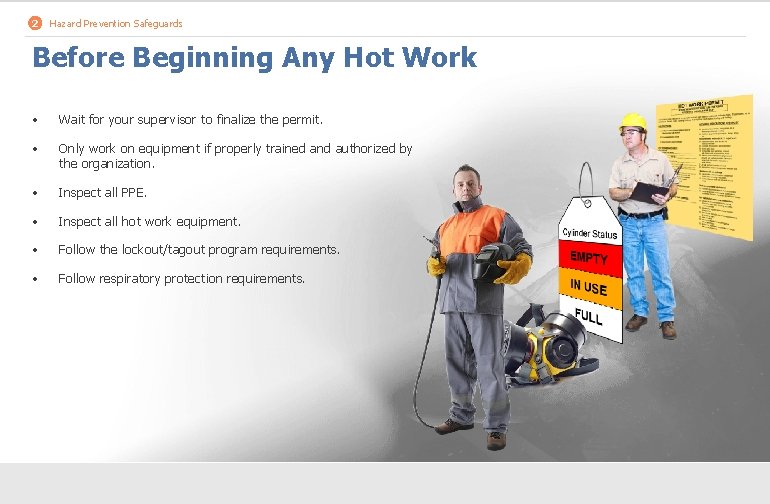
2 Hazard Prevention Safeguards Before Beginning Any Hot Work • Wait for your supervisor to finalize the permit. • Only work on equipment if properly trained and authorized by the organization. • Inspect all PPE. • Inspect all hot work equipment. • Follow the lockout/tagout program requirements. • Follow respiratory protection requirements.
3 Personal Protective Equipment (PPE) What you need to know: 1. Common PPE designed for hot work 2. How to select eye protection 3. The proper use of respirators
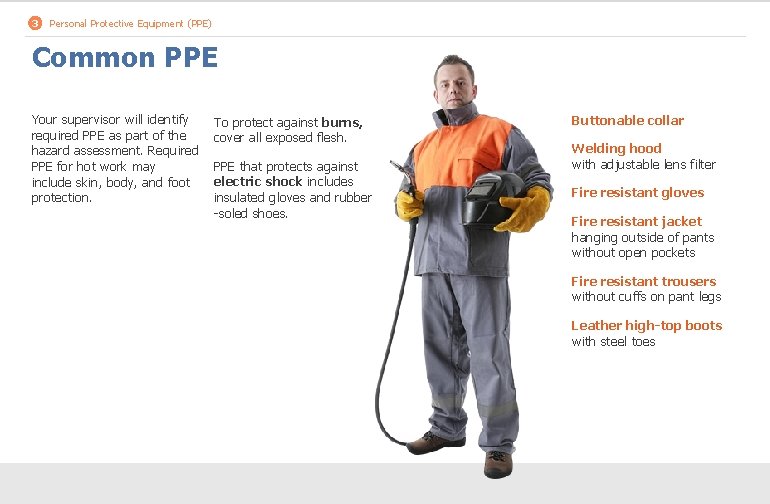
3 Personal Protective Equipment (PPE) Common PPE Your supervisor will identify required PPE as part of the hazard assessment. Required PPE for hot work may include skin, body, and foot protection. To protect against burns, cover all exposed flesh. PPE that protects against electric shock includes insulated gloves and rubber -soled shoes. Buttonable collar Welding hood with adjustable lens filter Fire resistant gloves Fire resistant jacket hanging outside of pants without open pockets Fire resistant trousers without cuffs on pant legs Leather high-top boots with steel toes
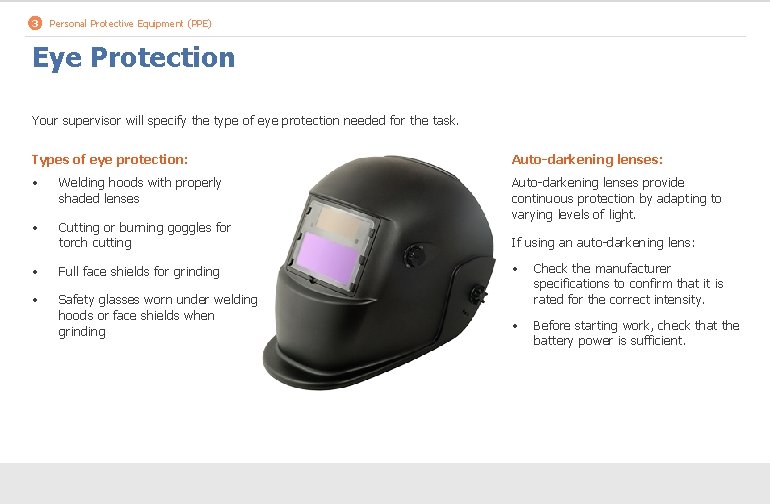
3 Personal Protective Equipment (PPE) Eye Protection Your supervisor will specify the type of eye protection needed for the task. Types of eye protection: Auto-darkening lenses: • Welding hoods with properly shaded lenses • Cutting or burning goggles for torch cutting Auto-darkening lenses provide continuous protection by adapting to varying levels of light. • Full face shields for grinding • • Safety glasses worn under welding hoods or face shields when grinding Check the manufacturer specifications to confirm that it is rated for the correct intensity. • Before starting work, check that the battery power is sufficient. If using an auto-darkening lens:
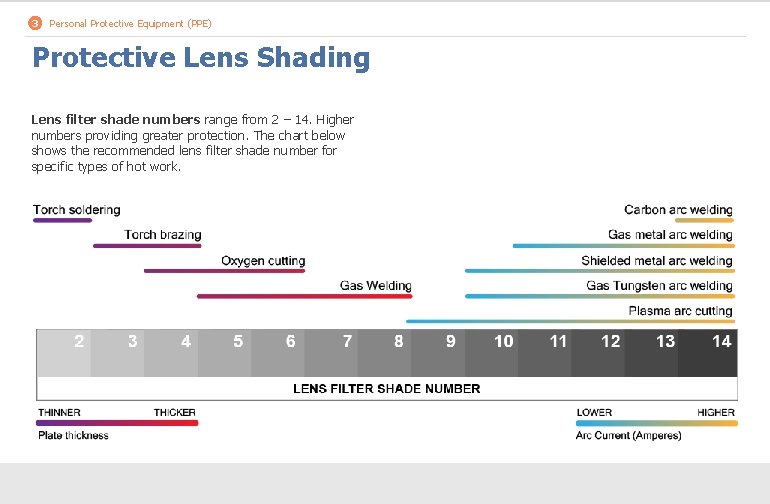
3 Personal Protective Equipment (PPE) Protective Lens Shading Lens filter shade numbers range from 2 – 14. Higher numbers providing greater protection. The chart below shows the recommended lens filter shade number for specific types of hot work.
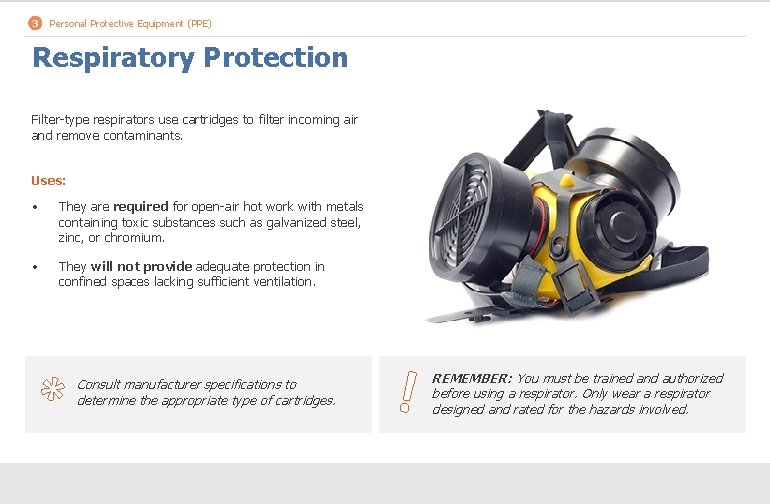
3 Personal Protective Equipment (PPE) Respiratory Protection Filter-type respirators use cartridges to filter incoming air and remove contaminants. Uses: • They are required for open-air hot work with metals containing toxic substances such as galvanized steel, zinc, or chromium. • They will not provide adequate protection in confined spaces lacking sufficient ventilation. * Consult manufacturer specifications to determine the appropriate type of cartridges. ! REMEMBER: You must be trained and authorized before using a respirator. Only wear a respirator designed and rated for the hazards involved.
3 Personal Protective Equipment (PPE) Respiratory Protection Supplied air respirators (SARs) supply the face mask with clean air from outside the work area. Uses: • They provide critical life support when working in spaces where flames may consume available oxygen. • They are always required for hot work with beryllium materials. • They may be required when working with materials containing cadmium, lead, and mercury. • They are always required in a confined space with inadequate ventilation. ! REMEMBER: Follow your organization’s respiratory protection policy.
4 Arc Welding What you need to know: 1. How to safely handle arc welding tools 2. Safety procedures
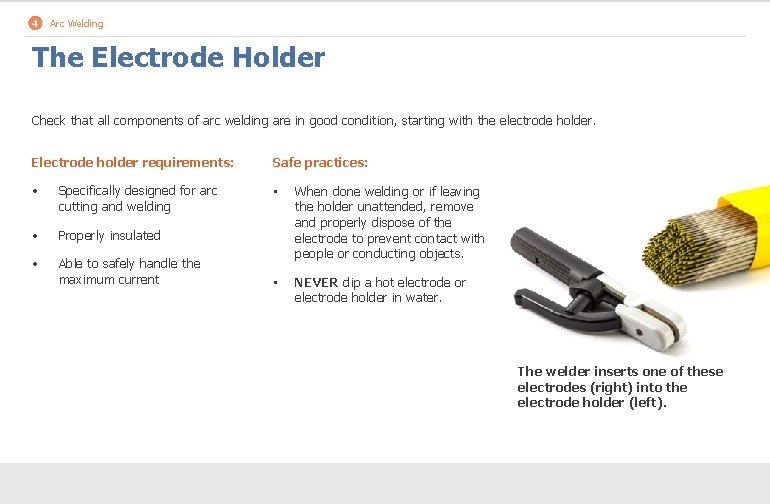
4 Arc Welding The Electrode Holder Check that all components of arc welding are in good condition, starting with the electrode holder. Electrode holder requirements: Safe practices: • Specifically designed for arc cutting and welding • • Properly insulated • Able to safely handle the maximum current When done welding or if leaving the holder unattended, remove and properly dispose of the electrode to prevent contact with people or conducting objects. • NEVER dip a hot electrode or electrode holder in water. The welder inserts one of these electrodes (right) into the electrode holder (left).
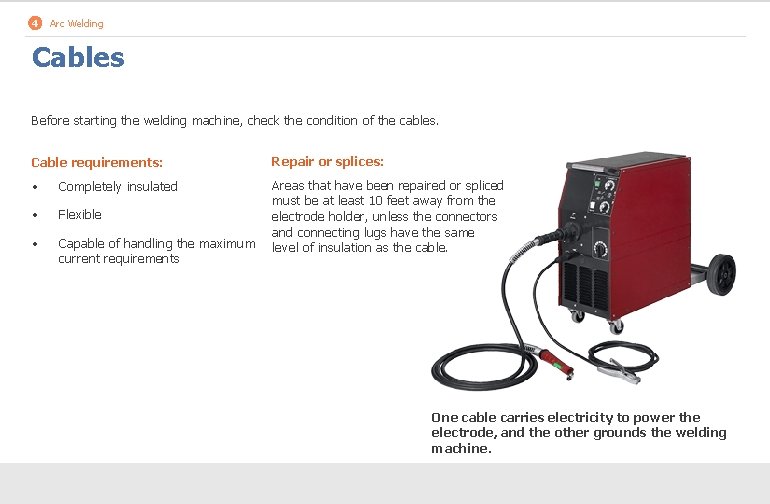
4 Arc Welding Cables Before starting the welding machine, check the condition of the cables. Cable requirements: Repair or splices: • Completely insulated • Flexible • Capable of handling the maximum current requirements Areas that have been repaired or spliced must be at least 10 feet away from the electrode holder, unless the connectors and connecting lugs have the same level of insulation as the cable. One cable carries electricity to power the electrode, and the other grounds the welding machine.
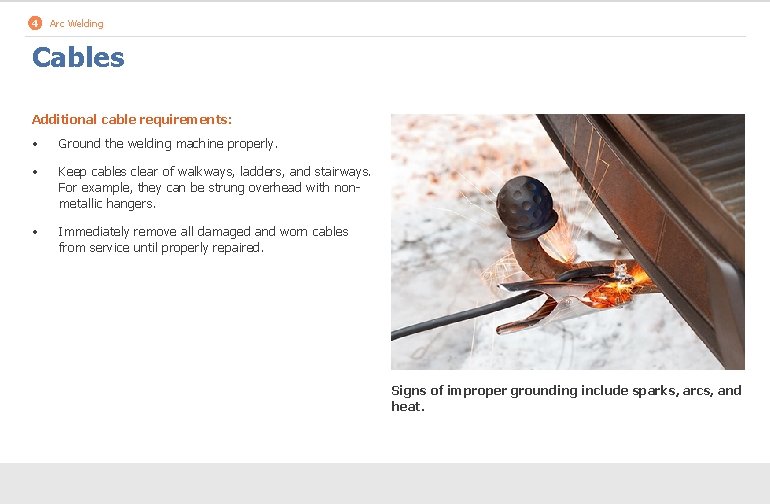
4 Arc Welding Cables Additional cable requirements: • Ground the welding machine properly. • Keep cables clear of walkways, ladders, and stairways. For example, they can be strung overhead with nonmetallic hangers. • Immediately remove all damaged and worn cables from service until properly repaired. Signs of improper grounding include sparks, arcs, and heat.
4 Arc Welding Additional Procedures Follow your organization’s lockout/tagout program and any PPE requirements. Before you begin: When you are finished: • Inspect your PPE. • • Inspect all equipment to assure that it meets the manufacturer’s specifications. Shut off the welding machine at the end of each shift and whenever the machine is moved. • • Make sure that the welding machine’s power supply has a circuit breaker or can be easily disconnected. Assure that stored energy is released in accordance with the manufacturer’s specifications.
5 Torch Welding, Cutting, and Brazing What you need to know: 1. Equipment inspection procedures 2. Safe use of torch cutting equipment 3. Safety guidelines for supply hoses 4. Safe use of cylinder valves
5 Torch Welding, Cutting, and Brazing Inspection and General Torch Use Before torch welding, cutting, or brazing, inspect all equipment. Regularly follow preventive maintenance procedures, and consult the manufacturer’s specifications. Pre-shift inspection: Maintenance: • Torches and hoses: Check for leaks, damage, and loose connections. • Tag and remove defective, damaged, or worn equipment from service. Either repair or discard it. • Oxygen cylinders and fittings: They must be properly labeled, distinguishable, and free of oil and grease. • Properly clean clogged torch tips. • Welding apparatus: Make sure all components are clean and free of oil and grease. Safe torch use: • Use flashback arrestors. • Valves • Light torches only with approved tools. • Regulators • When finished working, shut off valves and relieve hose pressure.
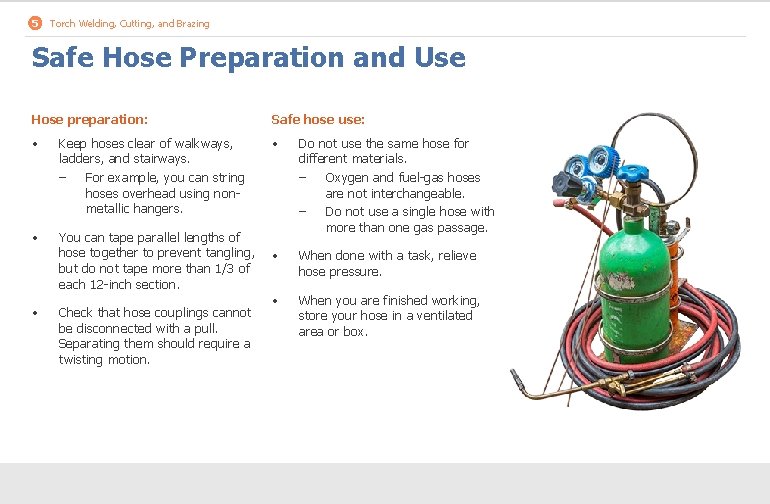
5 Torch Welding, Cutting, and Brazing Safe Hose Preparation and Use Hose preparation: Safe hose use: • Keep hoses clear of walkways, ladders, and stairways. ‒ For example, you can string hoses overhead using nonmetallic hangers. • • You can tape parallel lengths of hose together to prevent tangling, but do not tape more than 1/3 of each 12 -inch section. Do not use the same hose for different materials. ‒ Oxygen and fuel-gas hoses are not interchangeable. ‒ Do not use a single hose with more than one gas passage. • When done with a task, relieve hose pressure. • When you are finished working, store your hose in a ventilated area or box. • Check that hose couplings cannot be disconnected with a pull. Separating them should require a twisting motion.
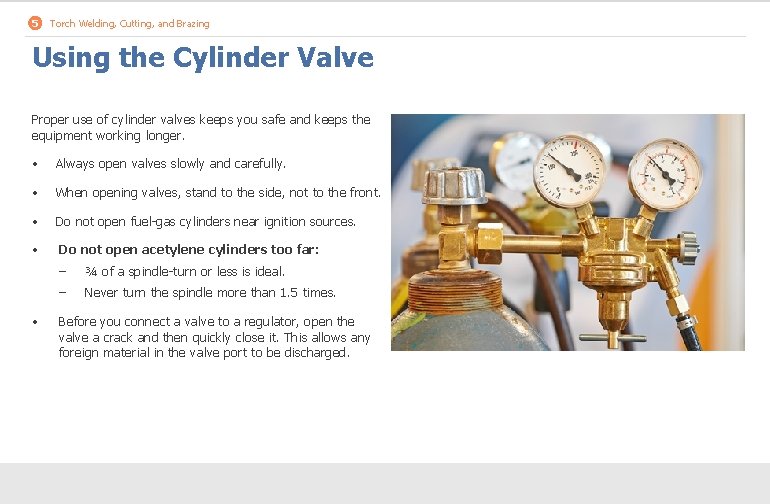
5 Torch Welding, Cutting, and Brazing Using the Cylinder Valve Proper use of cylinder valves keeps you safe and keeps the equipment working longer. • Always open valves slowly and carefully. • When opening valves, stand to the side, not to the front. • Do not open fuel-gas cylinders near ignition sources. • Do not open acetylene cylinders too far: • ‒ ¾ of a spindle-turn or less is ideal. ‒ Never turn the spindle more than 1. 5 times. Before you connect a valve to a regulator, open the valve a crack and then quickly close it. This allows any foreign material in the valve port to be discharged.
6 Cylinder Handling and Storage What you need to know: 1. Hazard communication resources 2. Identification requirements 3. Safe handling practices 4. Guidelines for moving and storage 5. Environments and practices to avoid
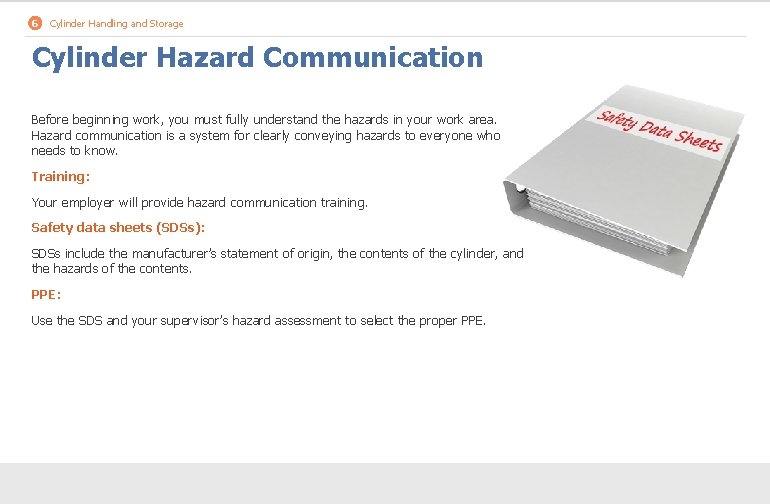
6 Cylinder Handling and Storage Cylinder Hazard Communication Before beginning work, you must fully understand the hazards in your work area. Hazard communication is a system for clearly conveying hazards to everyone who needs to know. Training: Your employer will provide hazard communication training. Safety data sheets (SDSs): SDSs include the manufacturer’s statement of origin, the contents of the cylinder, and the hazards of the contents. PPE: Use the SDS and your supervisor’s hazard assessment to select the proper PPE.
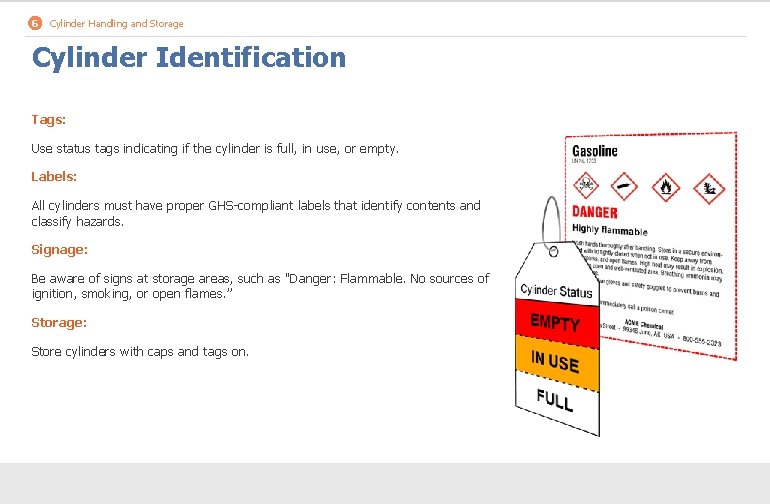
6 Cylinder Handling and Storage Cylinder Identification Tags: Use status tags indicating if the cylinder is full, in use, or empty. Labels: All cylinders must have proper GHS-compliant labels that identify contents and classify hazards. Signage: Be aware of signs at storage areas, such as "Danger: Flammable. No sources of ignition, smoking, or open flames. ” Storage: Store cylinders with caps and tags on.
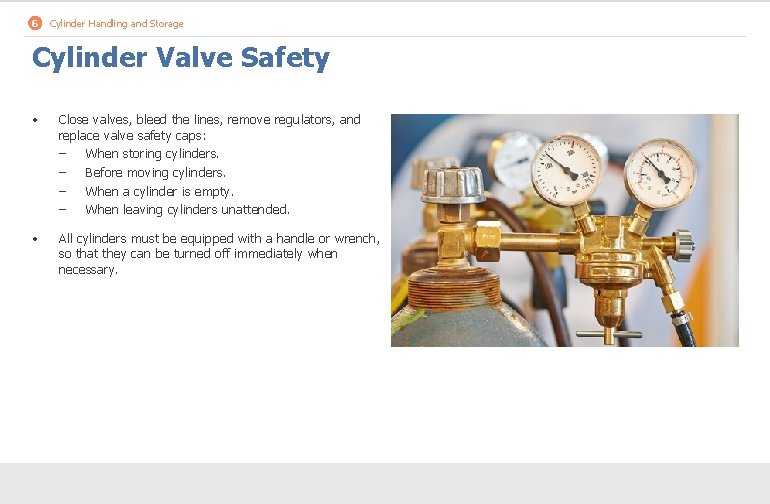
6 Cylinder Handling and Storage Cylinder Valve Safety • Close valves, bleed the lines, remove regulators, and replace valve safety caps: ‒ When storing cylinders. ‒ Before moving cylinders. ‒ When a cylinder is empty. ‒ When leaving cylinders unattended. • All cylinders must be equipped with a handle or wrench, so that they can be turned off immediately when necessary.
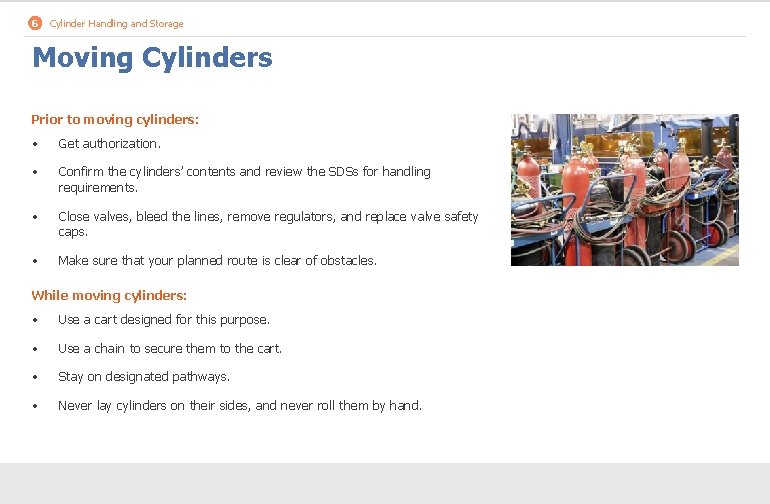
6 Cylinder Handling and Storage Moving Cylinders Prior to moving cylinders: • Get authorization. • Confirm the cylinders’ contents and review the SDSs for handling requirements. • Close valves, bleed the lines, remove regulators, and replace valve safety caps. • Make sure that your planned route is clear of obstacles. While moving cylinders: • Use a cart designed for this purpose. • Use a chain to secure them to the cart. • Stay on designated pathways. • Never lay cylinders on their sides, and never roll them by hand.
6 Cylinder Handling and Storage Cylinder Storage Guidelines Store cylinders according to SDSs and local, state, and federal requirements. Storage area requirements: Segregation: • Cool and dry • • Well-ventilated Keep all cylinders and combustible materials 20 feet away from stairs, aisles, and elevators. • Clean and free from combustible materials • Keep combustible and flammable materials 20 feet away from all cylinders. • Protected from recognizable hazards • Keep oxygen cylinders separate from fuel-gas cylinders and combustible materials with one of the following: Storage practices: • Limit access to authorized and trained persons. • Always keep cylinders upright. • Bleed the lines, remove regulators, and replace valve safety caps. • Follow safe practices for additional cylinders, whether full or empty. • ‒ A 5 -foot, noncombustible barrier with a ½ hour fire-resistance rating ‒ A 20 -foot distance Some gases have additional storage requirements.
6 Cylinder Handling and Storage Cylinder Storage and Handling Practices to Avoid Never: • Use cylinders for anything other than the intended use. • Move or store gas cylinders in confined spaces. • Position cylinders near ignition sources. • Position cylinders between electrical sources. • Hoist cylinders improperly, such as with magnets. • Use acetylene with a pressure greater than 15 psi gauge or 30 psi absolute. • Use hammers or wrenches to open cylinders that have fixed handwheels. • Strike an electrode against a cylinder when striking an arc. • Refill cylinders. • Mix gases in a cylinder.
Summary Hot work can be dangerous: Your active participation in workplace safety is essential. Be able to recognize hazards: Be aware of the hazards in your workplace, and know what factors increase the danger. Know when it is too dangerous to perform hot work. Be prepared: Be sure that you understand safety requirements and work practices before starting work. Conduct inspections: Be confident that all parts of your equipment and PPE are undamaged and working properly. Communicate: Communicate any hazards you discover to your supervisor and coworkers.