
WELDED CONNECTIONS I 1 INTRODUCTION Efficient and direct

- Slides: 28
WELDED CONNECTIONS I 1
INTRODUCTION Efficient and direct way of connecting is by welding Metallurgical bond by heat or pressure or both Advantages of welding • Direct transfer of stress - minimum weight , efficiency • Less fabrication • Economy - 15% saving in weight in bridges, less labor • Neat appearance • More rigid 2
BASIC WELDING PROCESSES Gas welding - Oxyacetelene welding , simple , slow, repair and maintenance work Arc welding - All structural welding Electric arc by use of electric energy 3
WELDING PROCEDURE • • • Environment Welding position Current : controls heat input Shrinkage Preheating Weldability of steels Economic welds, good , crack free 4
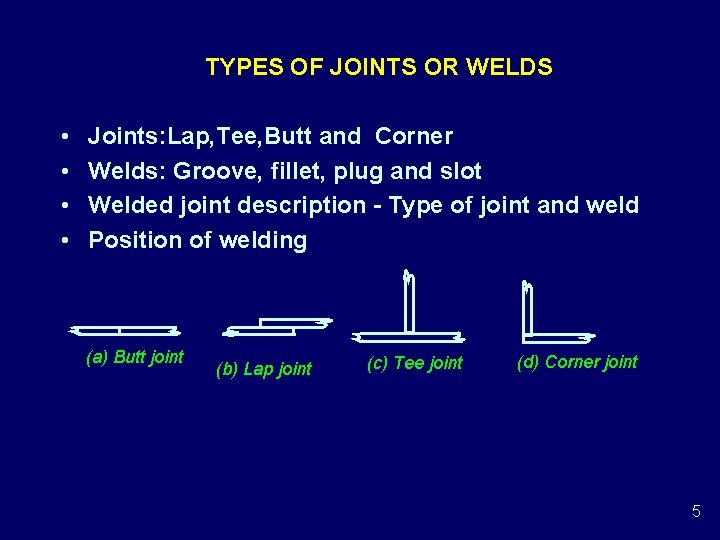
TYPES OF JOINTS OR WELDS • • Joints: Lap, Tee, Butt and Corner Welds: Groove, fillet, plug and slot Welded joint description - Type of joint and weld Position of welding (a) Butt joint (b) Lap joint (c) Tee joint (d) Corner joint 5
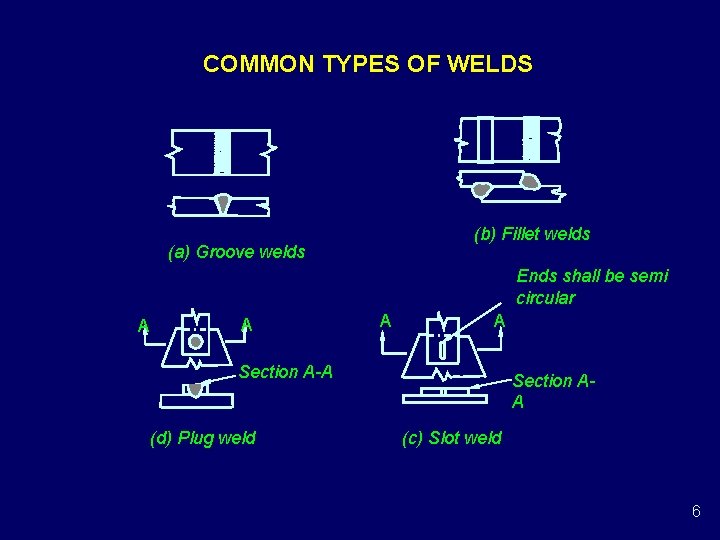
COMMON TYPES OF WELDS (b) Fillet welds (a) Groove welds Ends shall be semi circular A A Section A-A (d) Plug weld Section AA (c) Slot weld 6
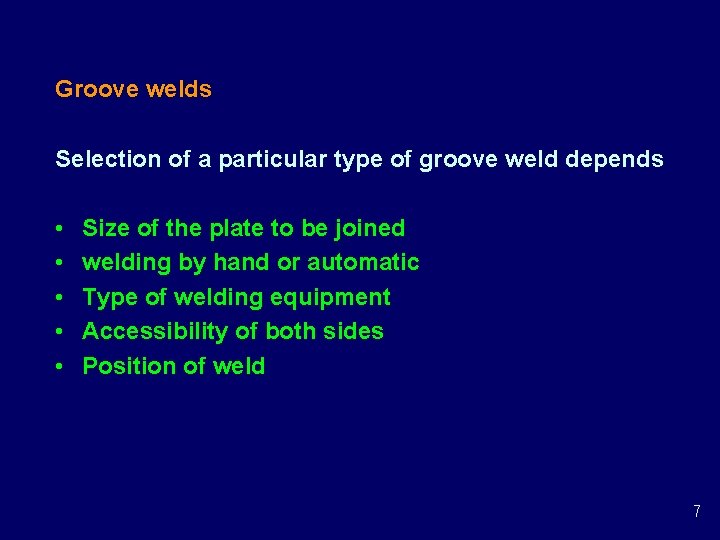
Groove welds Selection of a particular type of groove weld depends • • • Size of the plate to be joined welding by hand or automatic Type of welding equipment Accessibility of both sides Position of weld 7
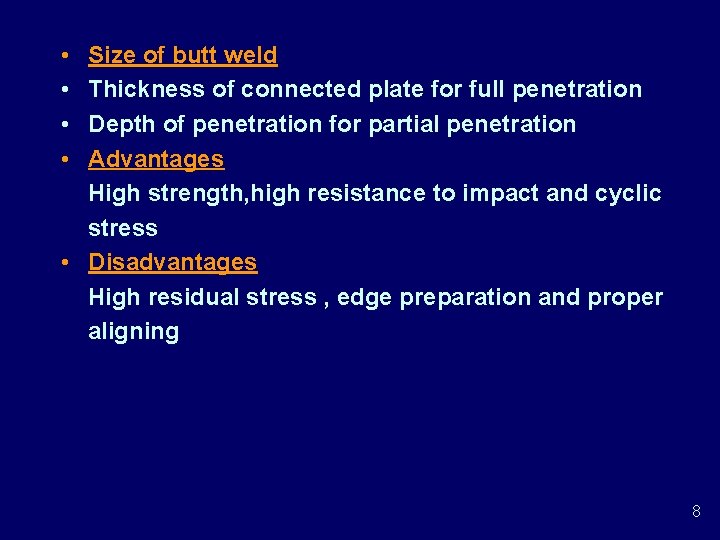
• • Size of butt weld Thickness of connected plate for full penetration Depth of penetration for partial penetration Advantages High strength, high resistance to impact and cyclic stress • Disadvantages High residual stress , edge preparation and proper aligning 8
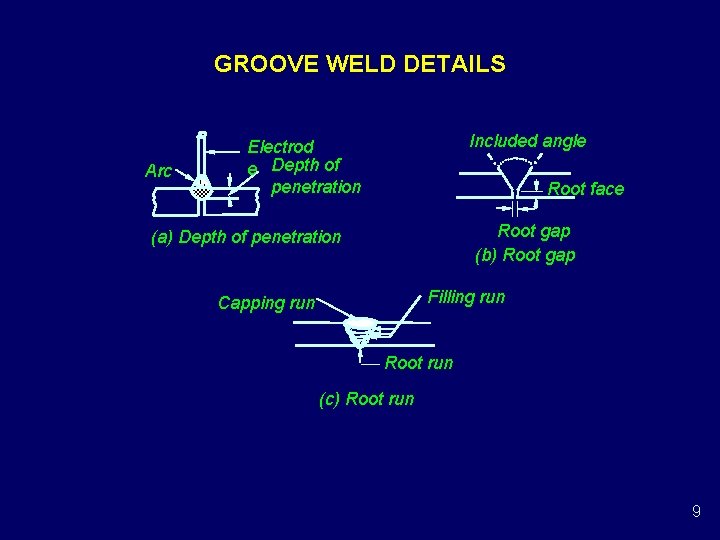
GROOVE WELD DETAILS Arc Included angle Electrod e Depth of penetration Root face Root gap (b) Root gap (a) Depth of penetration Filling run Capping run Root run (c) Root run 9
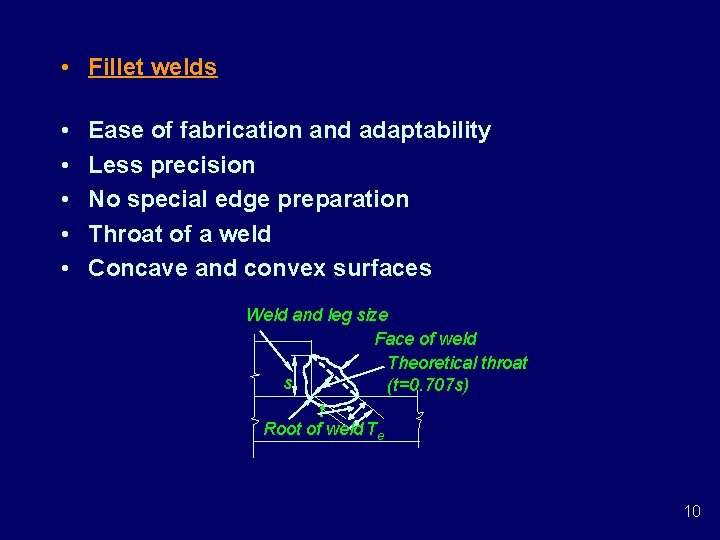
• Fillet welds • • • Ease of fabrication and adaptability Less precision No special edge preparation Throat of a weld Concave and convex surfaces Weld and leg size Face of weld Theoretical throat s (t=0. 707 s) t Root of weld Te 10
QUALITY OF WELDED CONNECTIONS • Proper electrodes , welding apparatus and procedures • Welding sequence Doubling up method Planned wandering method Step back method 11
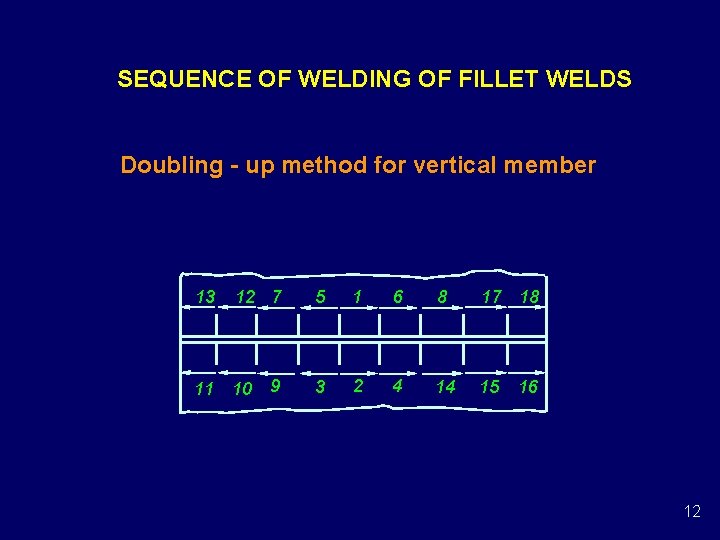
SEQUENCE OF WELDING OF FILLET WELDS Doubling - up method for vertical member 13 12 7 5 1 6 8 17 18 11 10 9 3 2 4 14 15 16 12
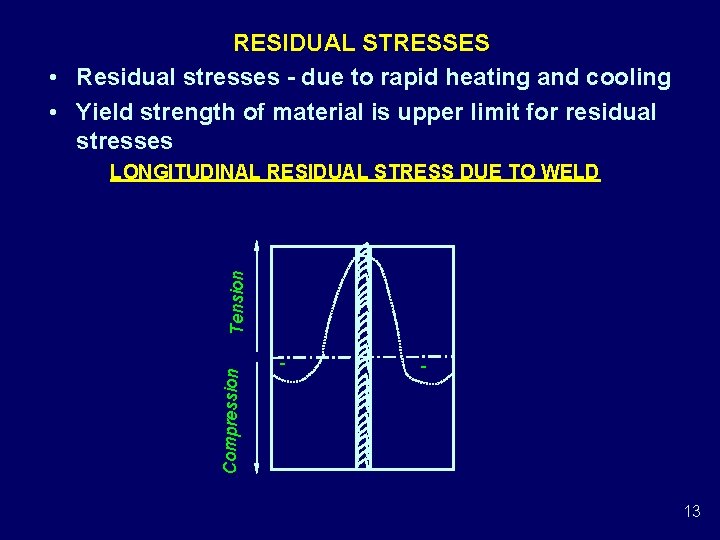
RESIDUAL STRESSES • Residual stresses - due to rapid heating and cooling • Yield strength of material is upper limit for residual stresses Compression Tension LONGITUDINAL RESIDUAL STRESS DUE TO WELD - - 13
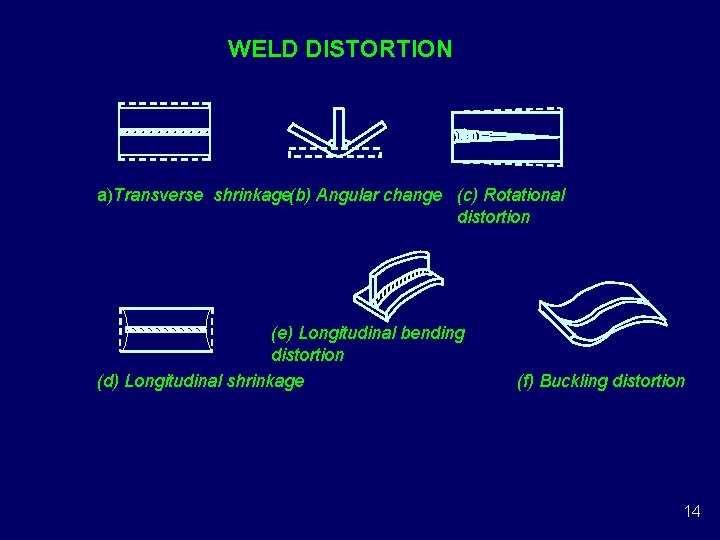
WELD DISTORTION a)Transverse shrinkage(b) Angular change (c) Rotational distortion (e) Longitudinal bending distortion (d) Longitudinal shrinkage (f) Buckling distortion 14
WELD SYMBOLS Symbolic representation of welds (Ref. IS: 813 - 1986 ‘ Scheme of symbols for welding’ ) 15
DEFECTS IN WELDS • • • Incomplete fusion Porosity Inadequate preparation Undercutting - Excessive current or long arc Slag inclusion - Failure to remove slag between runs • Cracks - Breaks in the weld metal • Lamellar tearing - Occurs in the base metal beneath the weld 16
WELD DEFECT TOLERANCE For joints welded from both sides • Incomplete penetration - 5% of parent metal thickness < 2 mm • Length of flaw < 200 mm / meter length Welded on one side • Incomplete penetration - 15% of thickness < 3 mm • Slag inclusion < 200 mm / meter weld length • Total gas pores < 5 per square centimeter of weld • Thickness upto 10 mm , undercut < 0. 5 mm • For thickness > 10 mm undercut < 1 mm • 17
WELD INSPECTION Visual inspection Liquid penetrants Magnetic particles Ultrasonic testing Radiography CONNECTION DESIGN Static strength of welded joint • Type and size of the weld • Manner of welding • Type of electrode used 18
BUTT WELDS • Critical form of loading - Tension in transverse direction • Yield stress of weld metal and parent metal in HAZ (Heat affected Zone) is much higher • Failure always occurs away from the weld • Toughness and ductility properties are affected 19
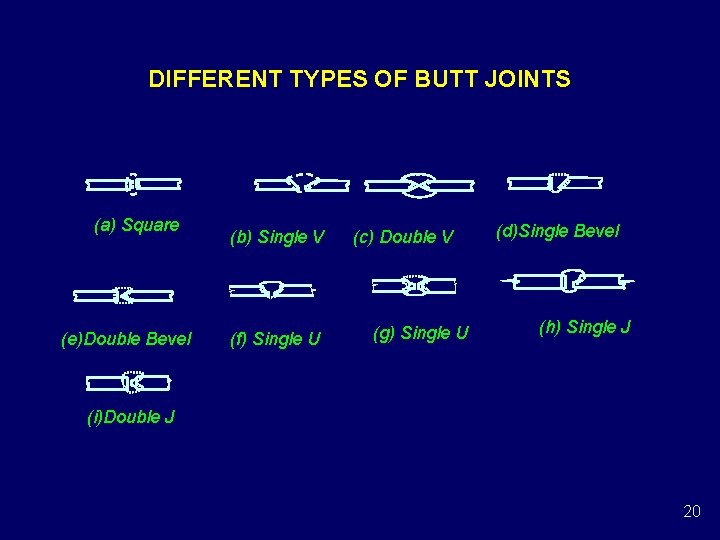
DIFFERENT TYPES OF BUTT JOINTS (a) Square (e)Double Bevel (b) Single V (f) Single U (c) Double V (g) Single U (d)Single Bevel (h) Single J (i)Double J 20
• • • DESIGN Direct tension or compression Design strength same as parent metal strength Effective area equals effective length times throat size For full penetration, thickness of weld , equals thickness of thinner part of connection Partial penetration welds are avoided Throat thickness - 5/8 thickness of thinner part Average stress concept Permissible stresses - Parent metal values Site welds – lower design strengths 21
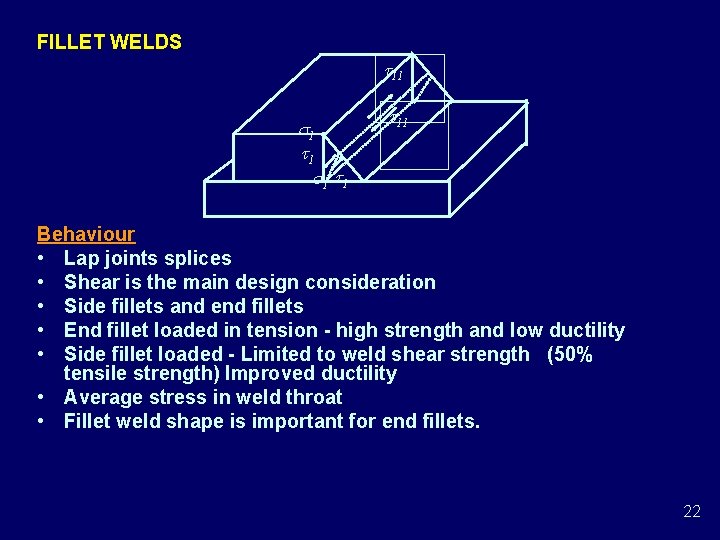
FILLET WELDS 11 1 1 11 Behaviour • Lap joints splices • Shear is the main design consideration • Side fillets and end fillets • End fillet loaded in tension - high strength and low ductility • Side fillet loaded - Limited to weld shear strength (50% tensile strength) Improved ductility • Average stress in weld throat • Fillet weld shape is important for end fillets. 22
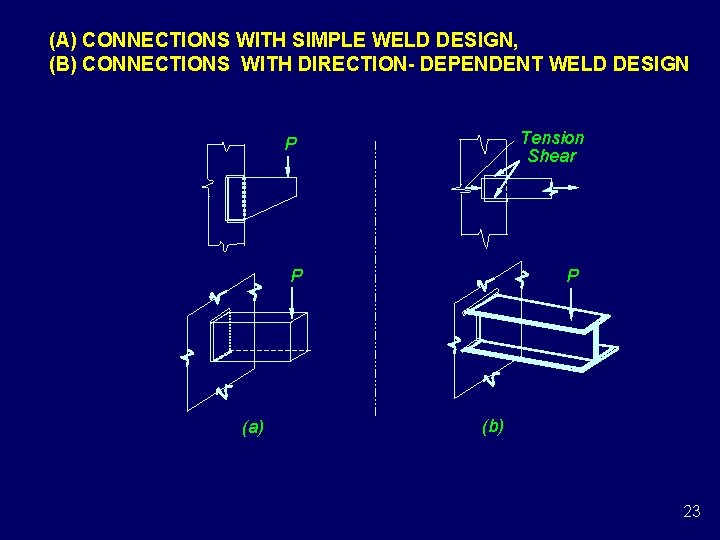
(A) CONNECTIONS WITH SIMPLE WELD DESIGN, (B) CONNECTIONS WITH DIRECTION- DEPENDENT WELD DESIGN Tension Shear P P (a) P (b) 23
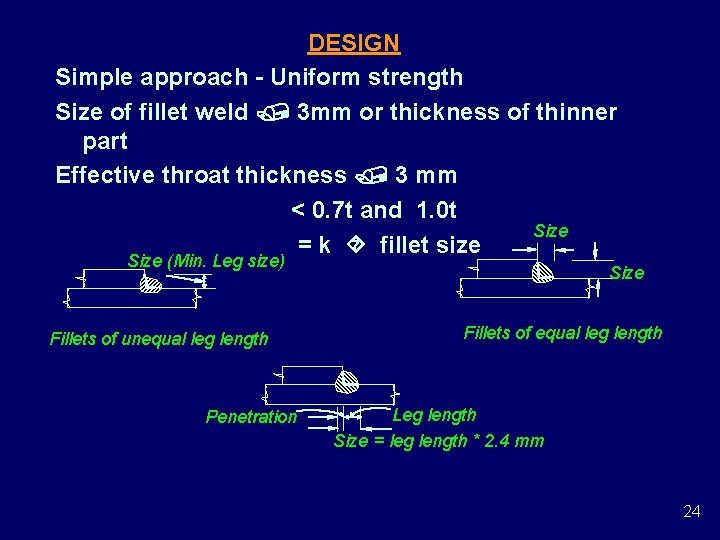
DESIGN Simple approach - Uniform strength Size of fillet weld 3 mm or thickness of thinner part Effective throat thickness 3 mm < 0. 7 t and 1. 0 t Size = k fillet size Size (Min. Leg size) Fillets of unequal leg length Penetration Size Fillets of equal leg length Leg length Size = leg length * 2. 4 mm 24
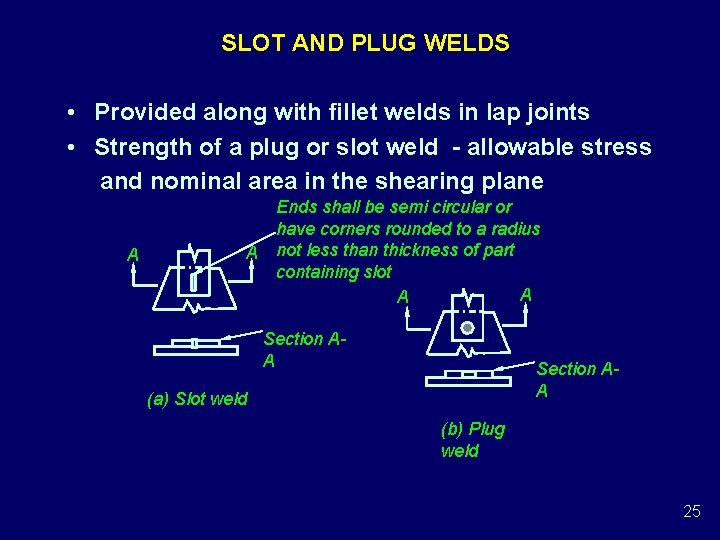
SLOT AND PLUG WELDS • Provided along with fillet welds in lap joints • Strength of a plug or slot weld - allowable stress and nominal area in the shearing plane A A Ends shall be semi circular or have corners rounded to a radius not less than thickness of part containing slot A A Section AA (a) Slot weld (b) Plug weld 25
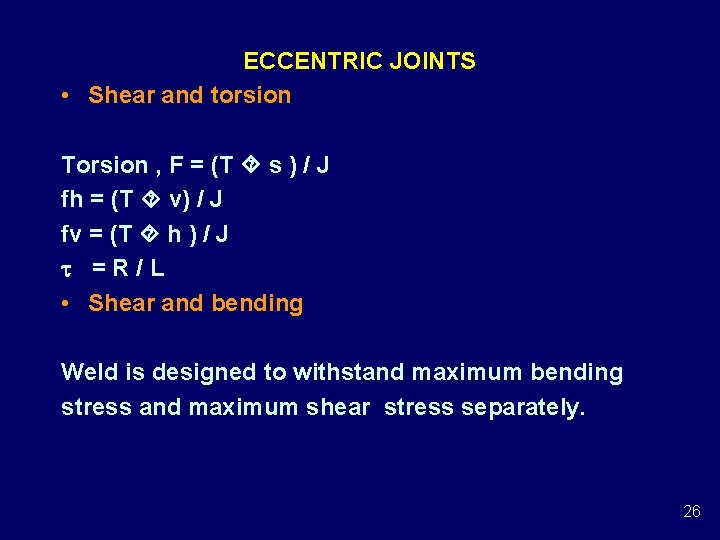
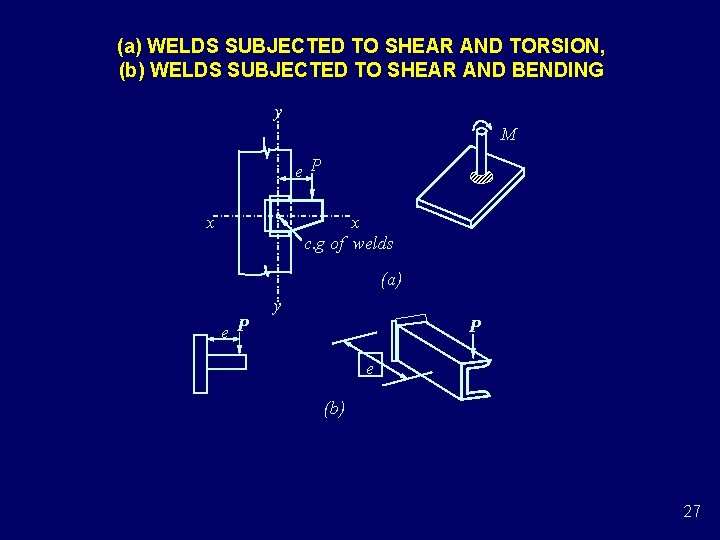
ECCENTRIC JOINTS • Shear and torsion Torsion , F = (T s ) / J fh = (T v) / J fv = (T h ) / J =R/L • Shear and bending Weld is designed to withstand maximum bending stress and maximum shear stress separately. 26
(a) WELDS SUBJECTED TO SHEAR AND TORSION, (b) WELDS SUBJECTED TO SHEAR AND BENDING y M e P x x c. g of welds (a) e P y P e (b) 27
SUMMARY • Fundamentals of welding , details of various welding processes, types of welds, common weld defects and weld inspection have been presented. • Advantages of welding are mentioned. • Behaviour and design of butt - and fillet - welded connections in steel structures are explained. • Truss connections and beam connections are discussed. 28