
Welcome Your course syllabus o The general principles

Welcome. . Your course syllabus: o The general principles of microbiology (Interaction with human and ecosystem). o History and development of microbiology. o Microscopes (seeing the very small). o Cell structure and functions. o Microbial Diversity (Eukaryotic and prokaryotic). o. Chemistry of cellular components o Nutrition of microorganisms o Microbial growth o Microbial classification o Microbial diversity and groups (Archaebacteria, fungi, Algae, Lichens, viruses) o. Immunology o. Antimicrobial agents
140 MIC: Microbiology . . ﺍﻟﺸﻌﺒﺔ Principles of Microbiology Content 1. 1 Microbiology and Microorganisms ◦ The importance of microorganisms 1. 2 Microbial Cells ◦ Cell chemistry and key structure ◦ Characteristics of living systems ◦ Cell functions: coding and metabolism. 1. 3 Microorganisms and Their Environments ◦ Microbial interaction 1. 4 The Impact of Microorganisms on Humans ◦ ◦ ◦ Microorganisms as disease agents Microorganisms and agriculture Microorganisms and food Microorganisms, energy and there environment Microorganisms and their genetic resources Microbiology as a career
140 MIC: Microbiology . . ﺍﻟﺸﻌﺒﺔ Microbiology and Microorganisms The science of microbiology revolves around two themes: 1. Understanding basic life processes (basic biological science). ◦ Microbes are excellent models for understanding cellular processes in unicellular and multicellular organisms 2. Applying that knowledge to the benefit of humans (applied biological science) ◦ Microbes play important roles in medicine, agriculture, and industry
140 MIC: Microbiology and Microorganisms The importance of microorganisms ◦ Oldest and smallest form of life ◦ Largest mass of living material on Earth ◦ Carry out major processes for biogeochemical cycles ◦ Can live in places unsuitable for other organisms ◦ Other life forms require microbes to survive . . ﺍﻟﺸﻌﺒﺔ
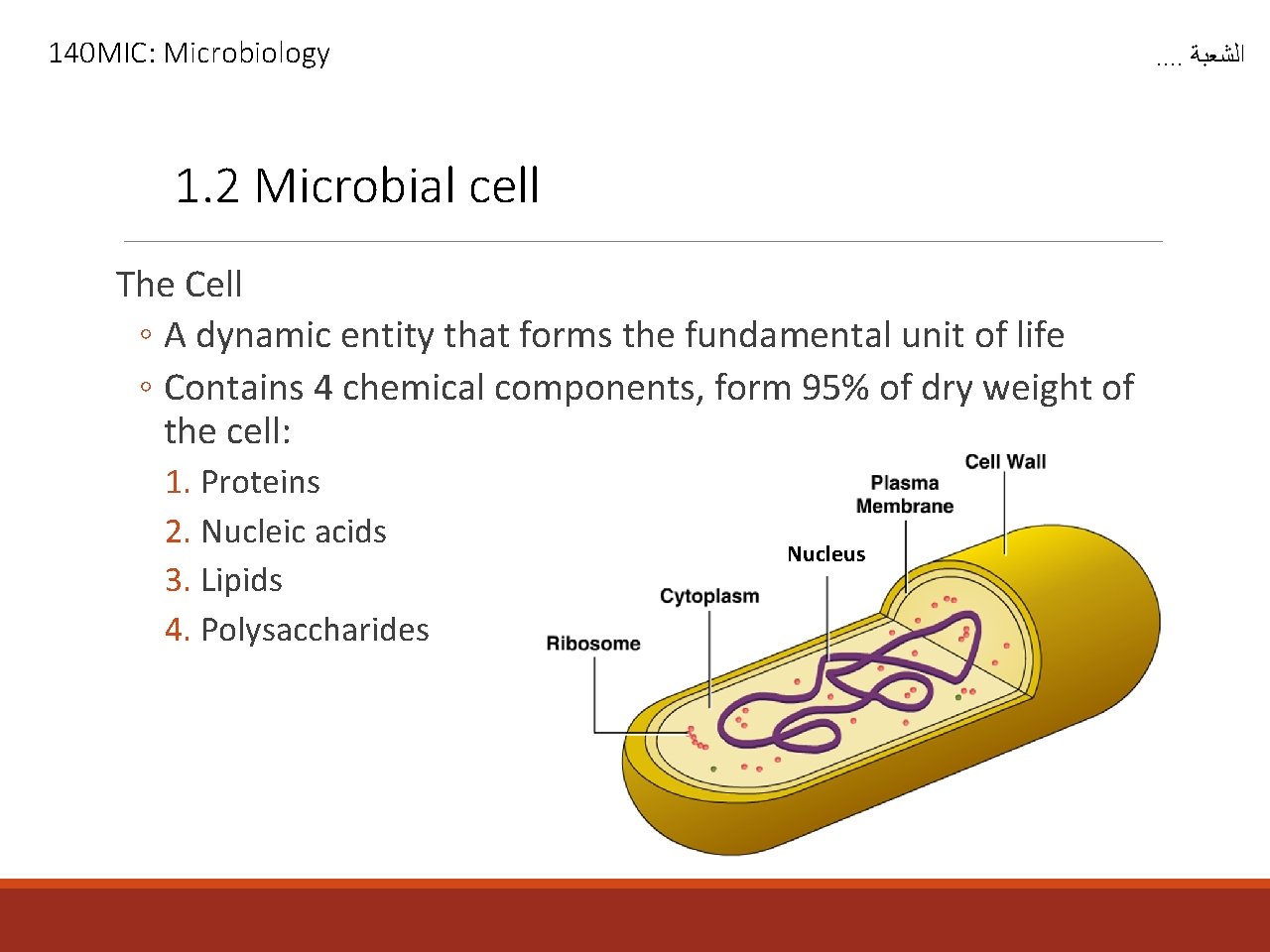
140 MIC: Microbiology . . ﺍﻟﺸﻌﺒﺔ 1. 2 Microbial cell The Cell ◦ A dynamic entity that forms the fundamental unit of life ◦ Contains 4 chemical components, form 95% of dry weight of the cell: 1. Proteins 2. Nucleic acids 3. Lipids 4. Polysaccharides Nucleus
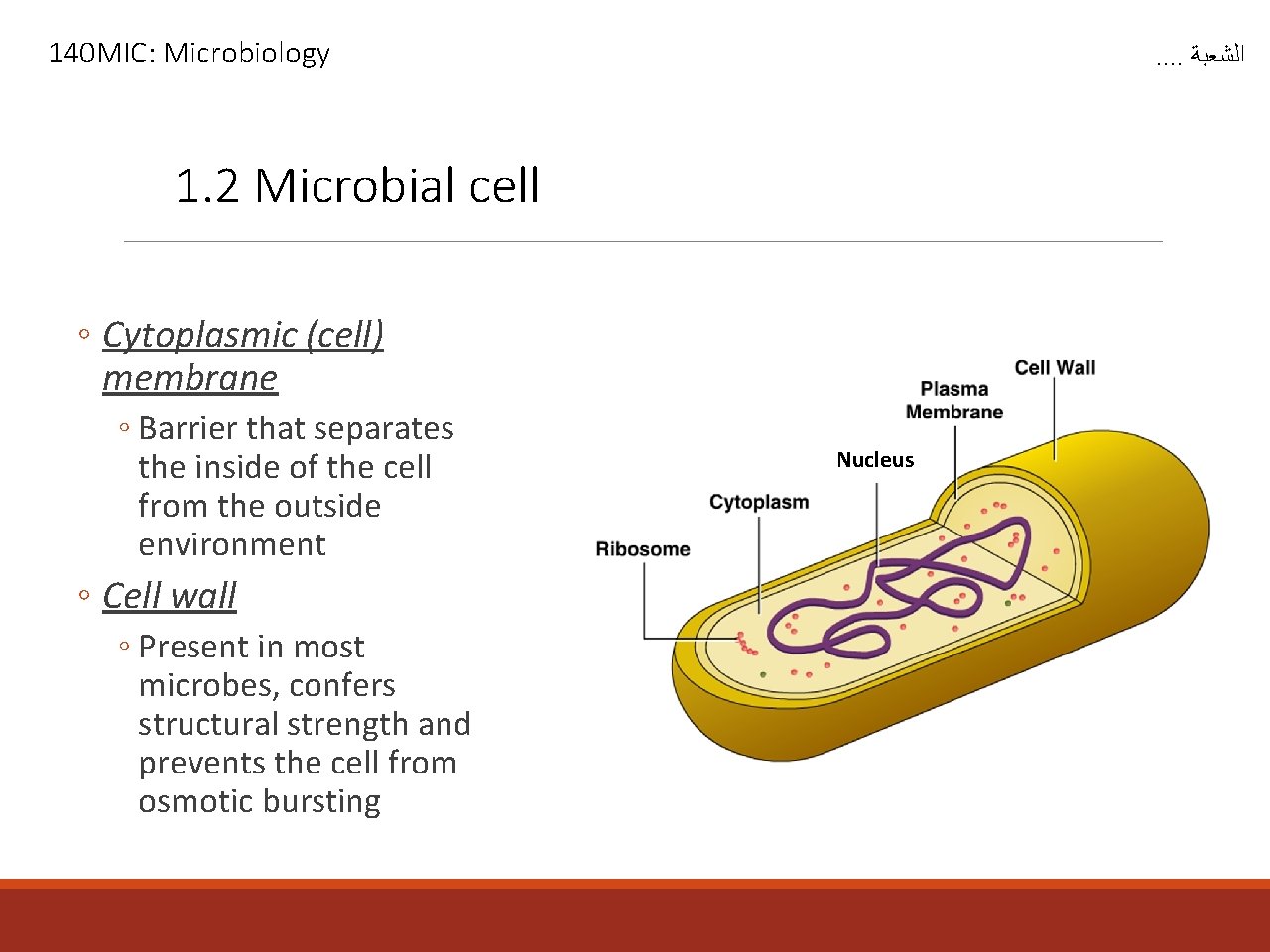
140 MIC: Microbiology . . ﺍﻟﺸﻌﺒﺔ 1. 2 Microbial cell ◦ Cytoplasmic (cell) membrane ◦ Barrier that separates the inside of the cell from the outside environment ◦ Cell wall ◦ Present in most microbes, confers structural strength and prevents the cell from osmotic bursting Nucleus
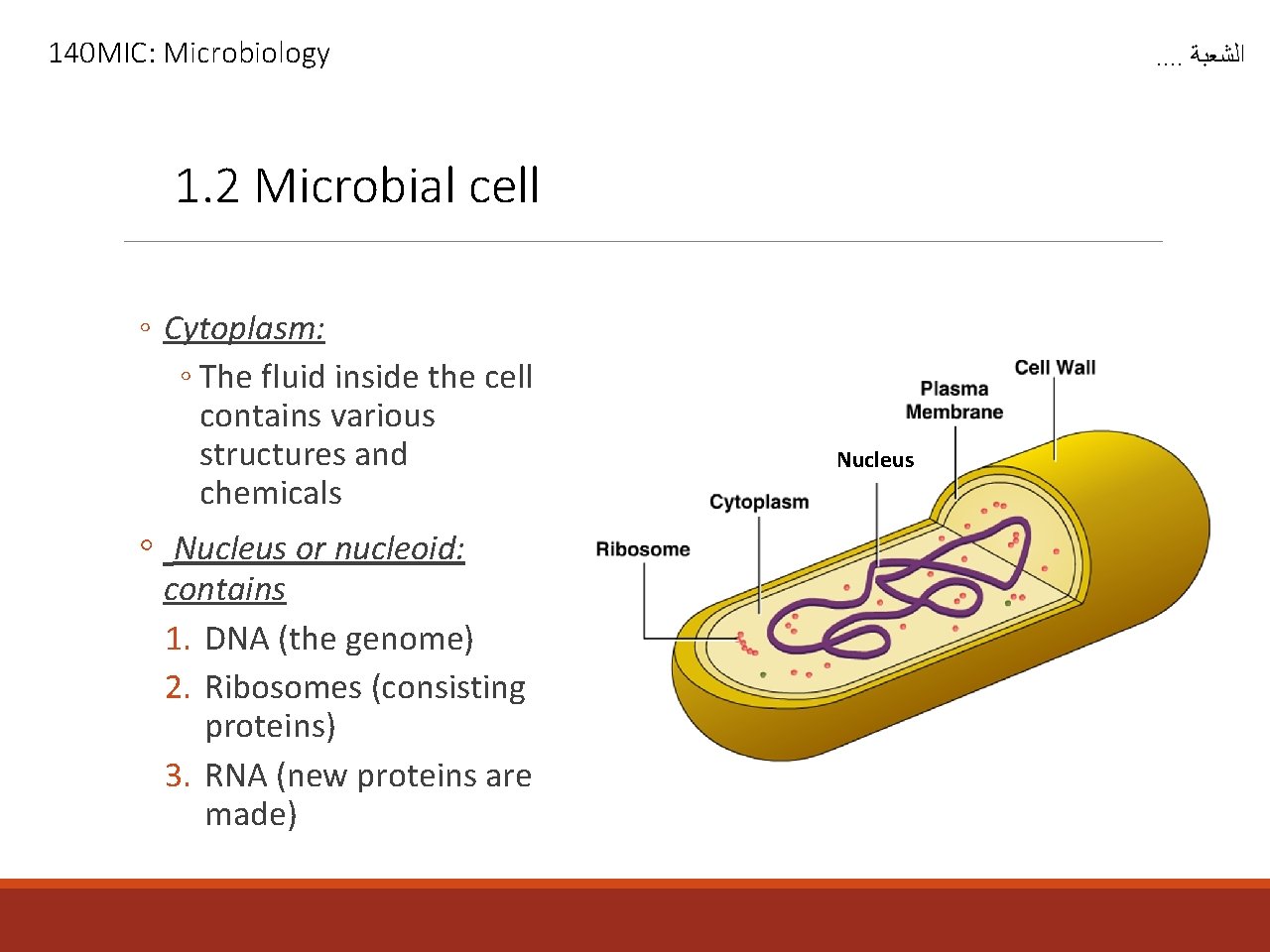
140 MIC: Microbiology . . ﺍﻟﺸﻌﺒﺔ 1. 2 Microbial cell ◦ Cytoplasm: ◦ The fluid inside the cell contains various structures and chemicals ◦ Nucleus or nucleoid: contains 1. DNA (the genome) 2. Ribosomes (consisting proteins) 3. RNA (new proteins are made) Nucleus
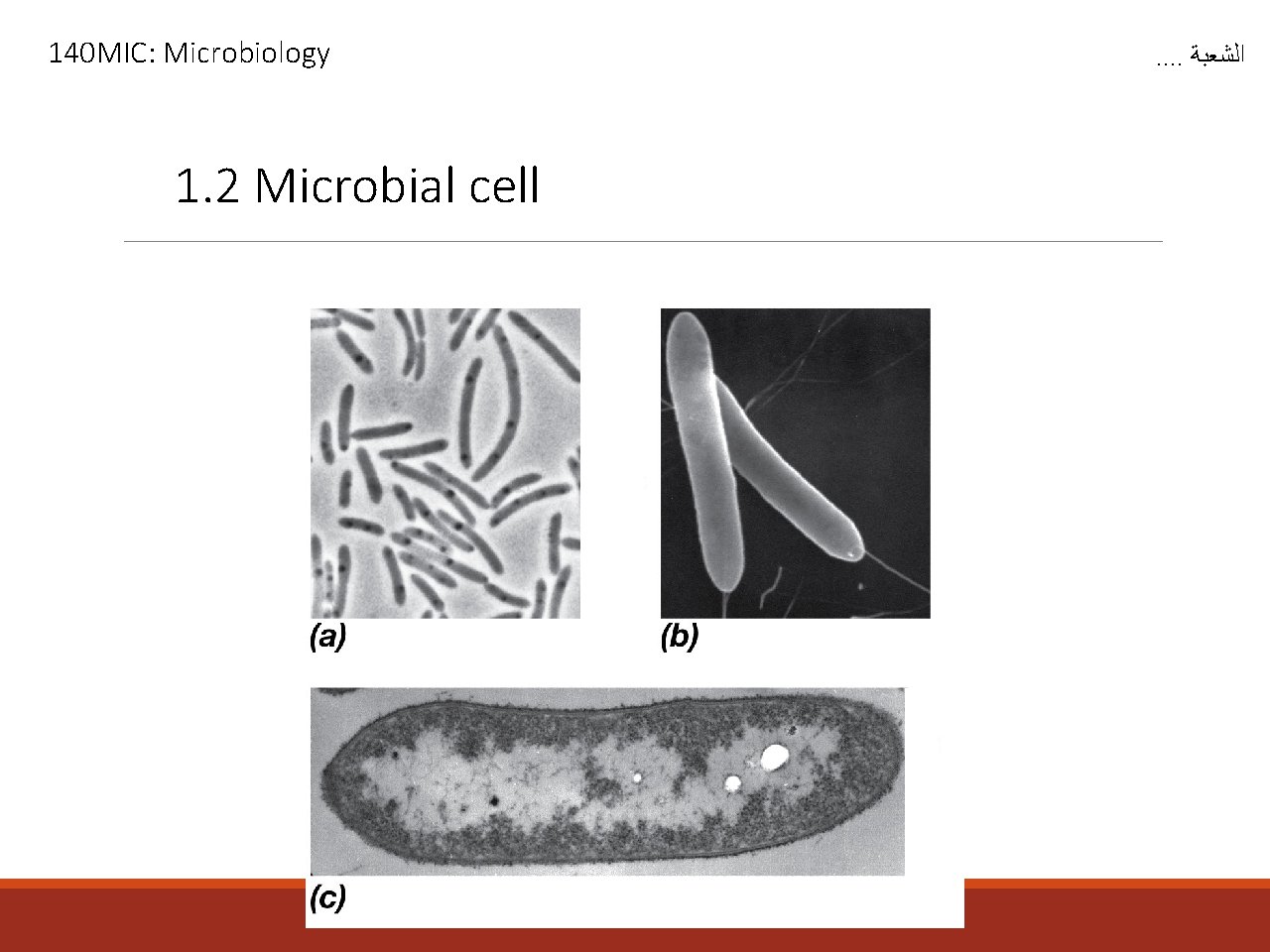
140 MIC: Microbiology 1. 2 Microbial cell . . ﺍﻟﺸﻌﺒﺔ
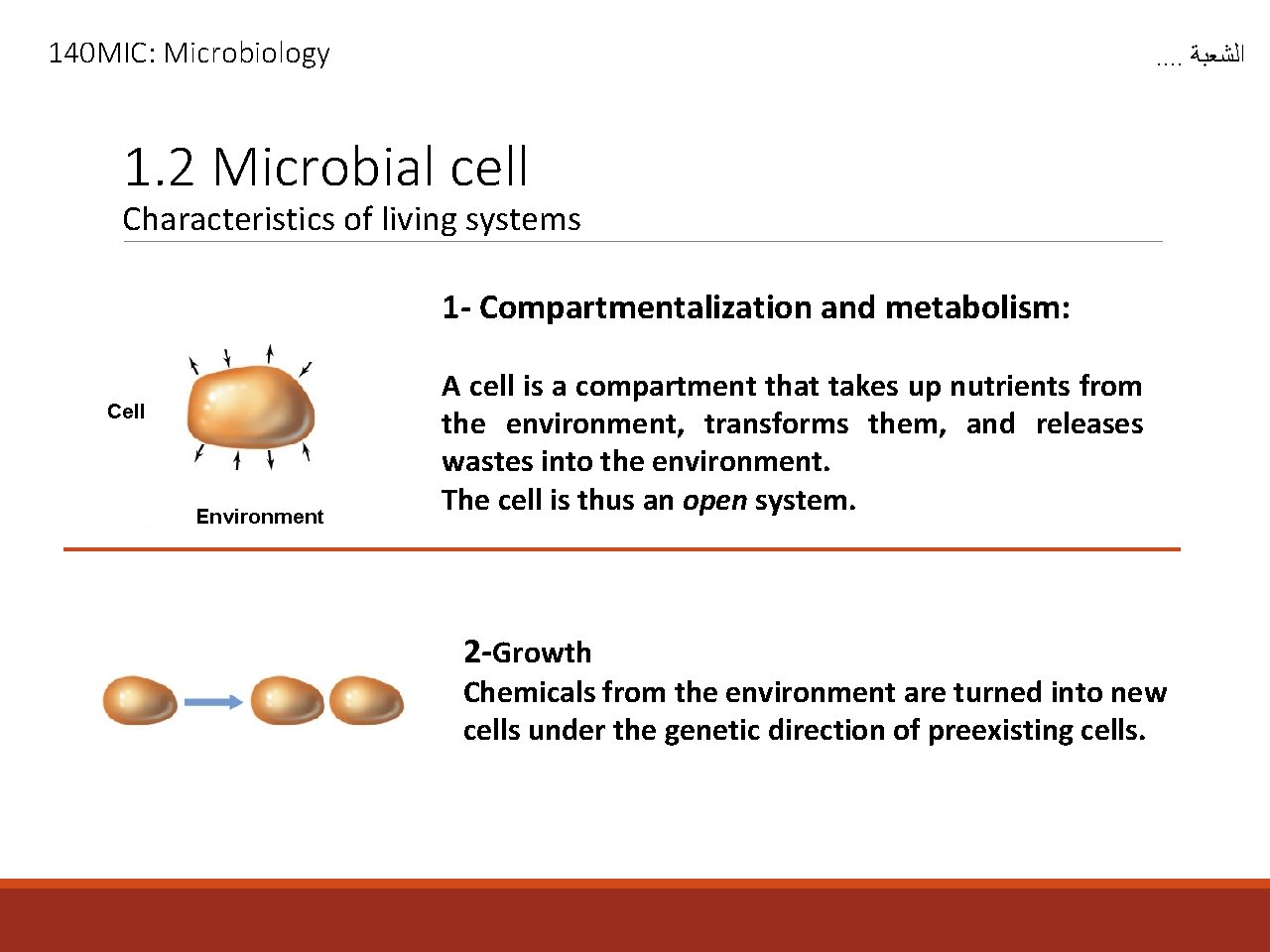
140 MIC: Microbiology . . ﺍﻟﺸﻌﺒﺔ 1. 2 Microbial cell Characteristics of living systems 1 - Compartmentalization and metabolism: Cell Environment A cell is a compartment that takes up nutrients from the environment, transforms them, and releases wastes into the environment. The cell is thus an open system. 2 -Growth Chemicals from the environment are turned into new cells under the genetic direction of preexisting cells.
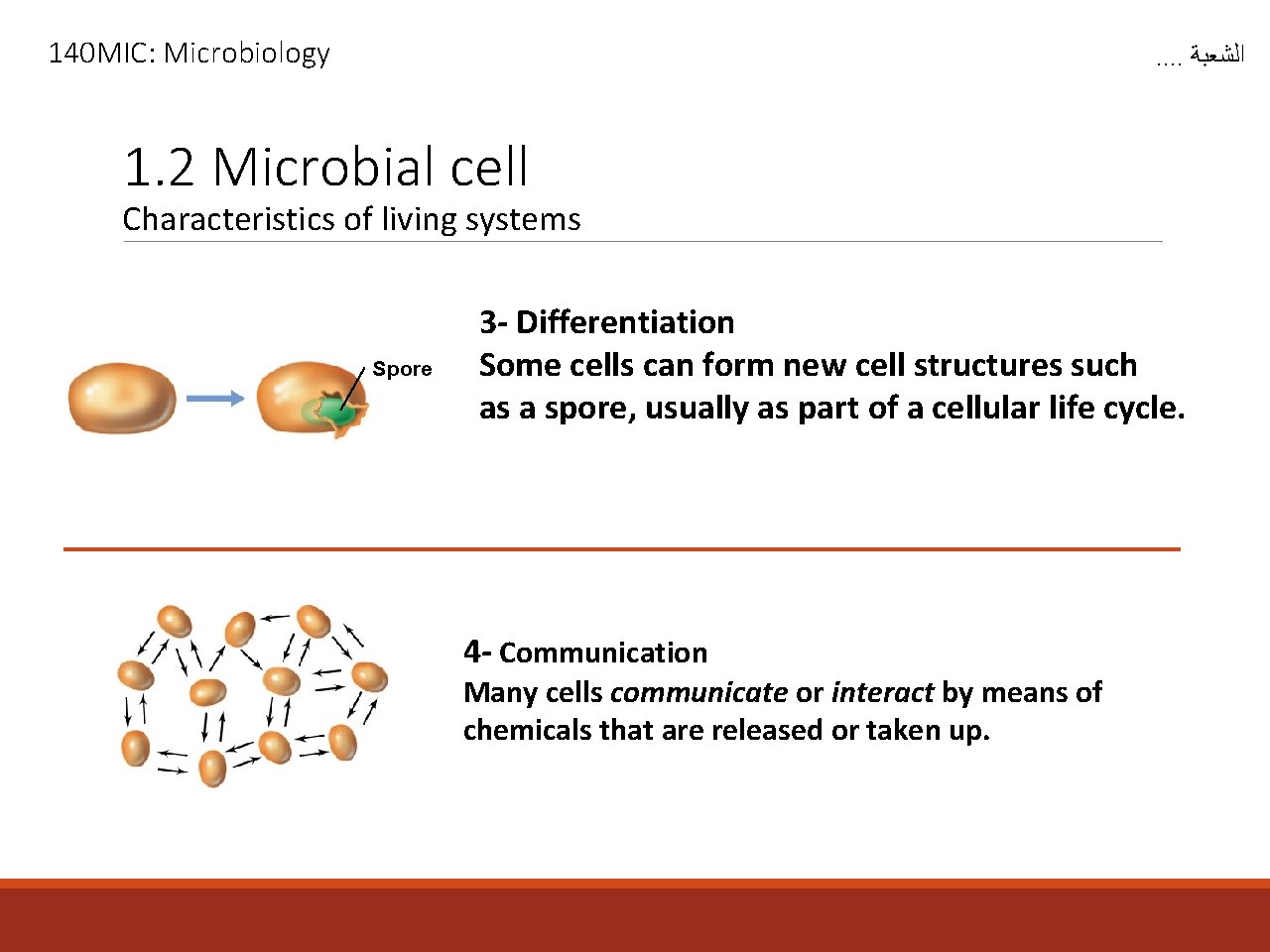
140 MIC: Microbiology . . ﺍﻟﺸﻌﺒﺔ 1. 2 Microbial cell Characteristics of living systems Spore 3 - Differentiation Some cells can form new cell structures such as a spore, usually as part of a cellular life cycle. 4 - Communication Many cells communicate or interact by means of chemicals that are released or taken up.
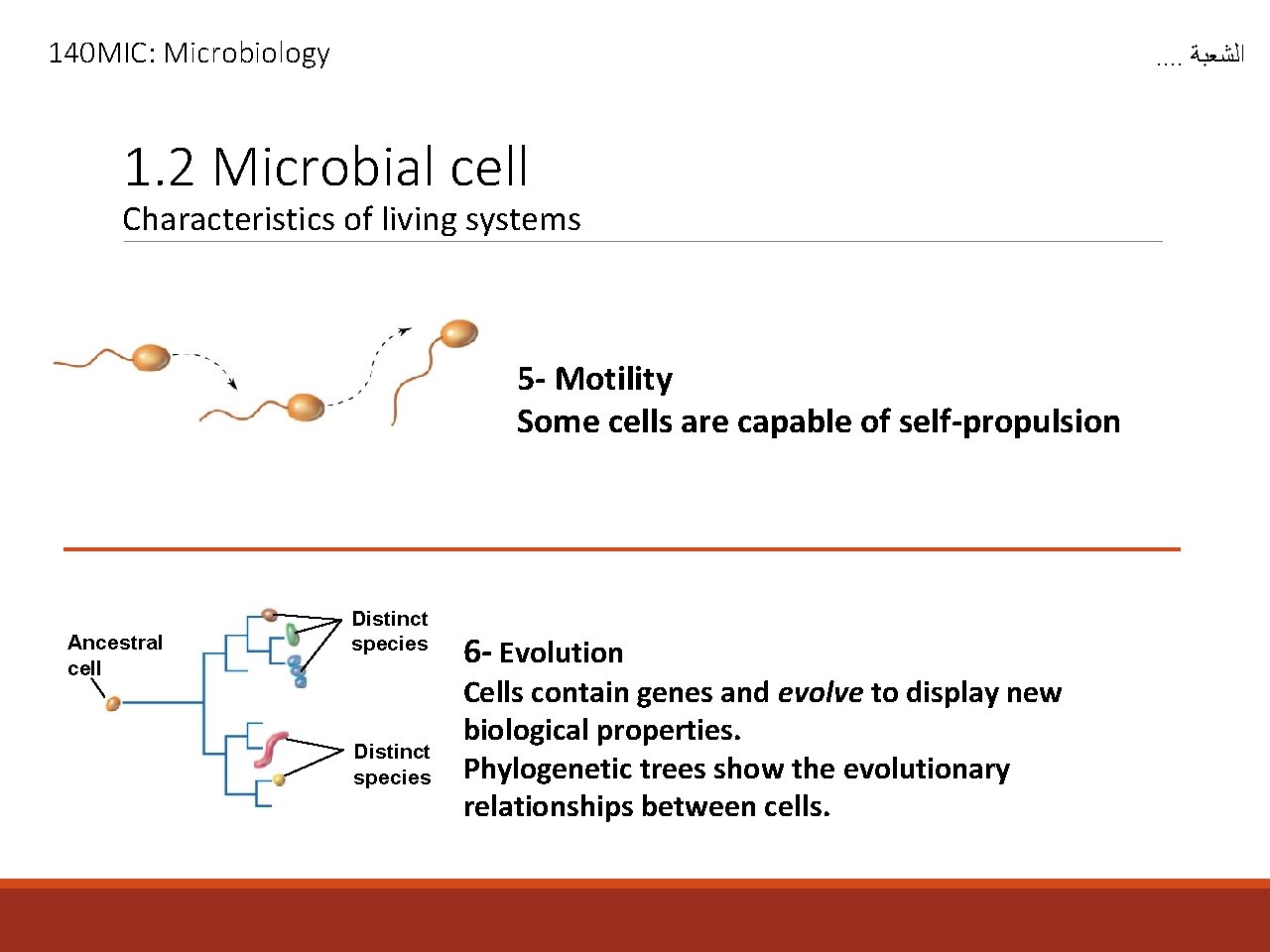
140 MIC: Microbiology . . ﺍﻟﺸﻌﺒﺔ 1. 2 Microbial cell Characteristics of living systems 5 - Motility Some cells are capable of self-propulsion Ancestral cell Distinct species 6 - Evolution Cells contain genes and evolve to display new biological properties. Phylogenetic trees show the evolutionary relationships between cells.
140 MIC: Microbiology 1. 2 Microbial cell Cells as Catalysts and as Coding Devices 1. Cells carry out chemical reactions ◦ Enzymes: protein catalysts of the cell that accelerate chemical reactions 2. Cells store and process information that is eventually passed on to offspring during reproduction through DNA (deoxyribonucleic acid) and evolution. ◦ Transcription: DNA produces RNA ◦ Translation: RNA makes protein . . ﺍﻟﺸﻌﺒﺔ
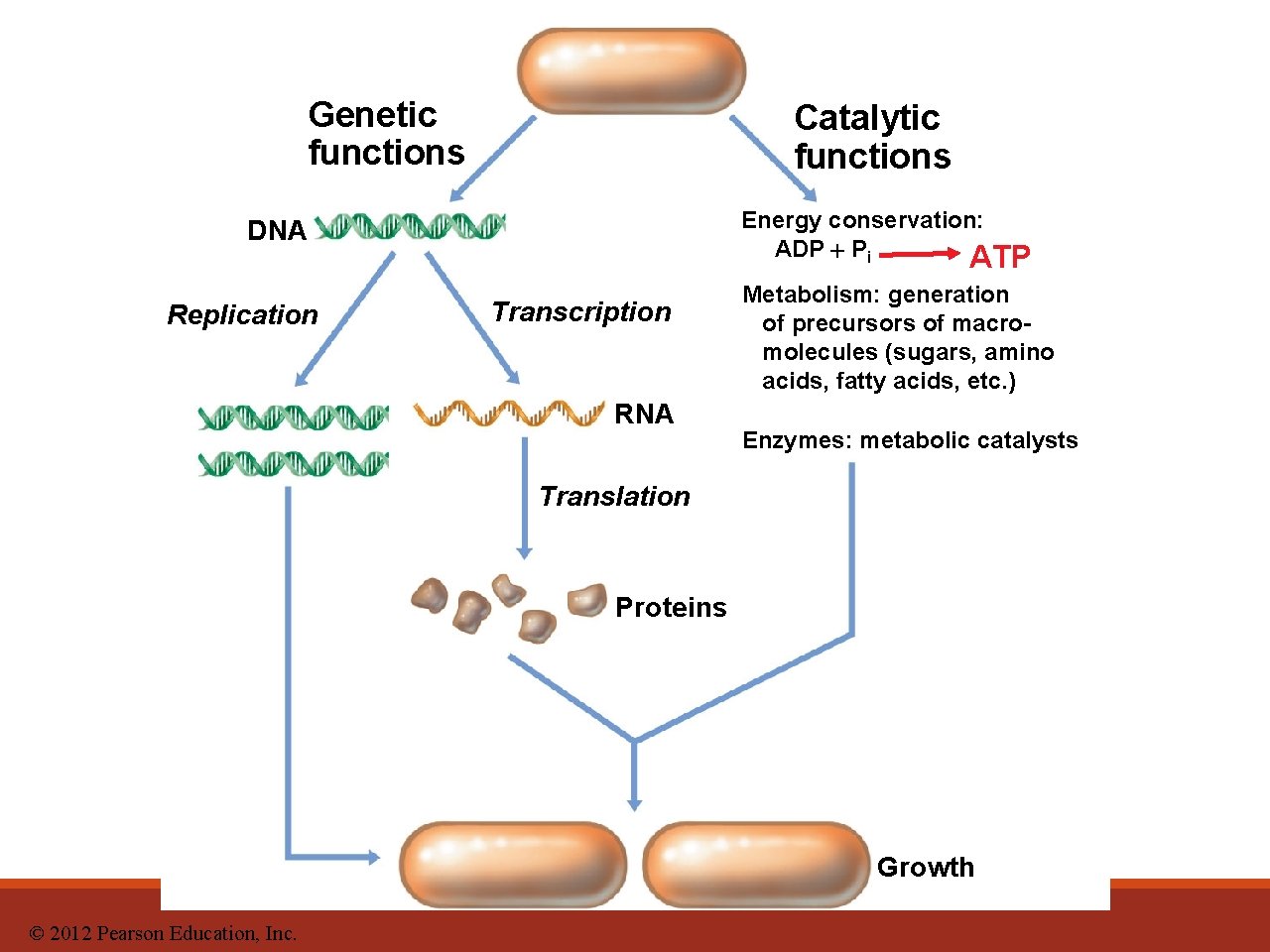
Genetic functions Catalytic functions Energy conservation: ADP Pi ATP DNA Replication Transcription RNA Metabolism: generation of precursors of macromolecules (sugars, amino acids, fatty acids, etc. ) Enzymes: metabolic catalysts Translation Proteins Growth © 2012 Pearson Education, Inc.

REMEMBER You can always ask questions through our discussion board on www. lms. ksu. edu. sa
140 MIC: Microbiology . . ﺍﻟﺸﻌﺒﺔ Principles of Microbiology Content 1. 1 Microbiology and Microorganisms ◦ The importance of microorganisms 1. 2 Microbial Cells ◦ Cell chemistry and key structure ◦ Characteristics of living systems ◦ Cell functions: coding and metabolism. 1. 3 Microorganisms and Their Environments ◦ Microbial interaction 1. 4 The Impact of Microorganisms on Humans ◦ ◦ ◦ Microorganisms as disease agents Microorganisms and agriculture Microorganisms and food Microorganisms, energy and there environment Microorganisms and their genetic resources Microbiology as a career
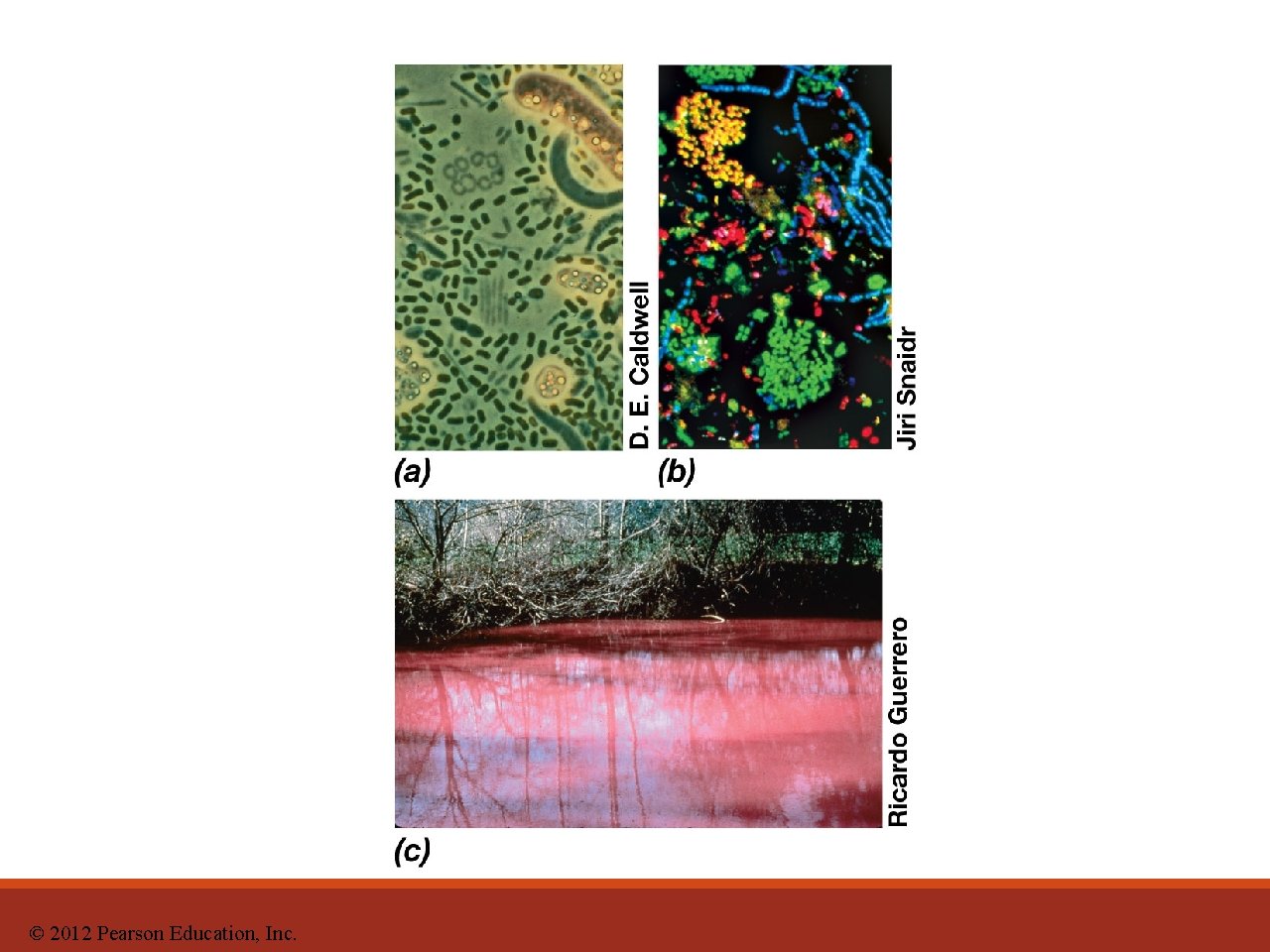
140 MIC: Microbiology 1. 3 Microorganisms and Their Environments 1. Microorganisms exist in nature in populations of interacting assemblages called microbial communities. 2. The environment in which a microbial population lives is its habitat 3. Ecosystem refers to all living organisms plus physical and chemical constituents of their environment 4. Microbial ecology is the study of microbes in their natural environment . . ﺍﻟﺸﻌﺒﺔ
© 2012 Pearson Education, Inc.
© 2012 Pearson Education, Inc.
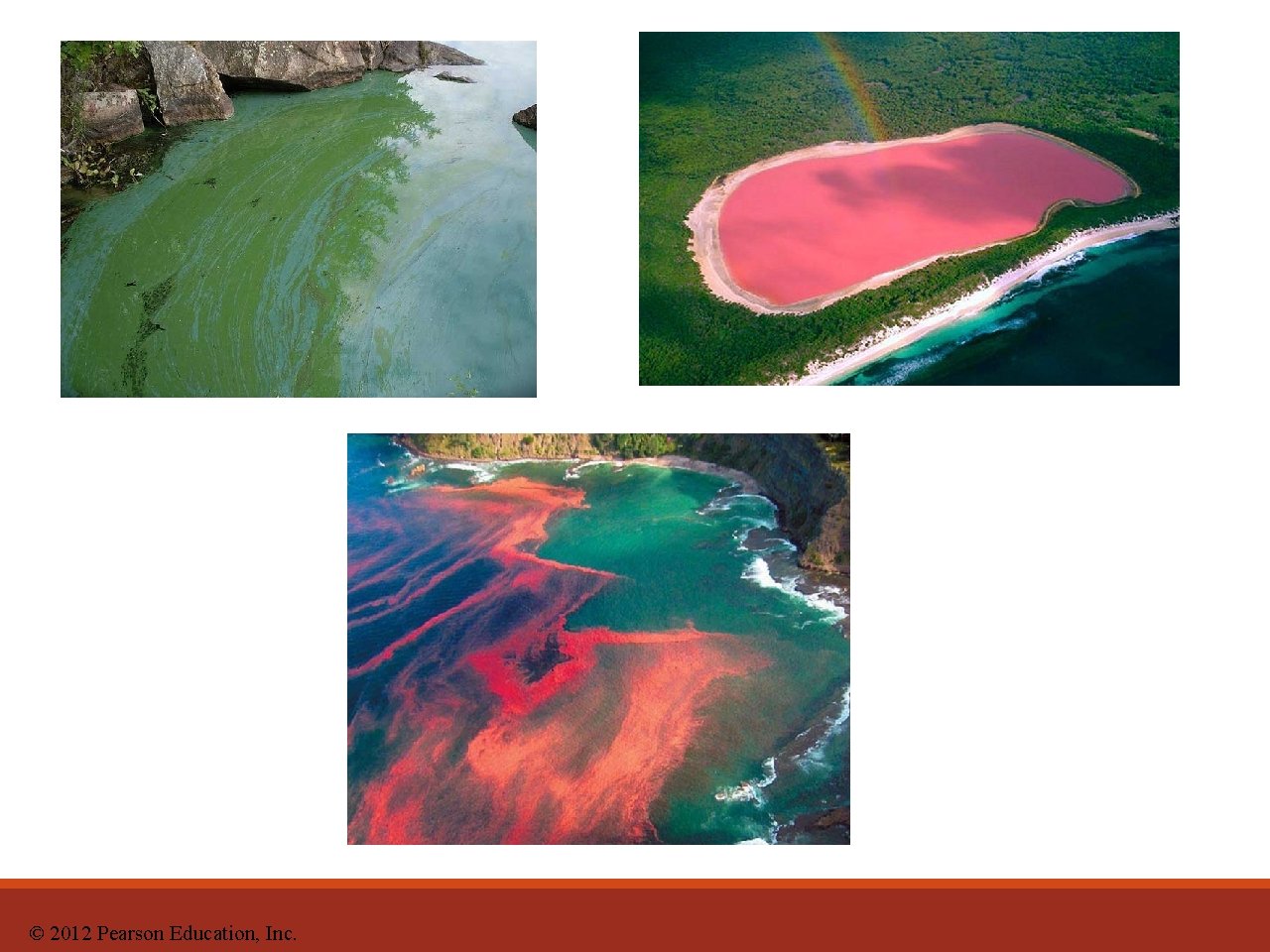
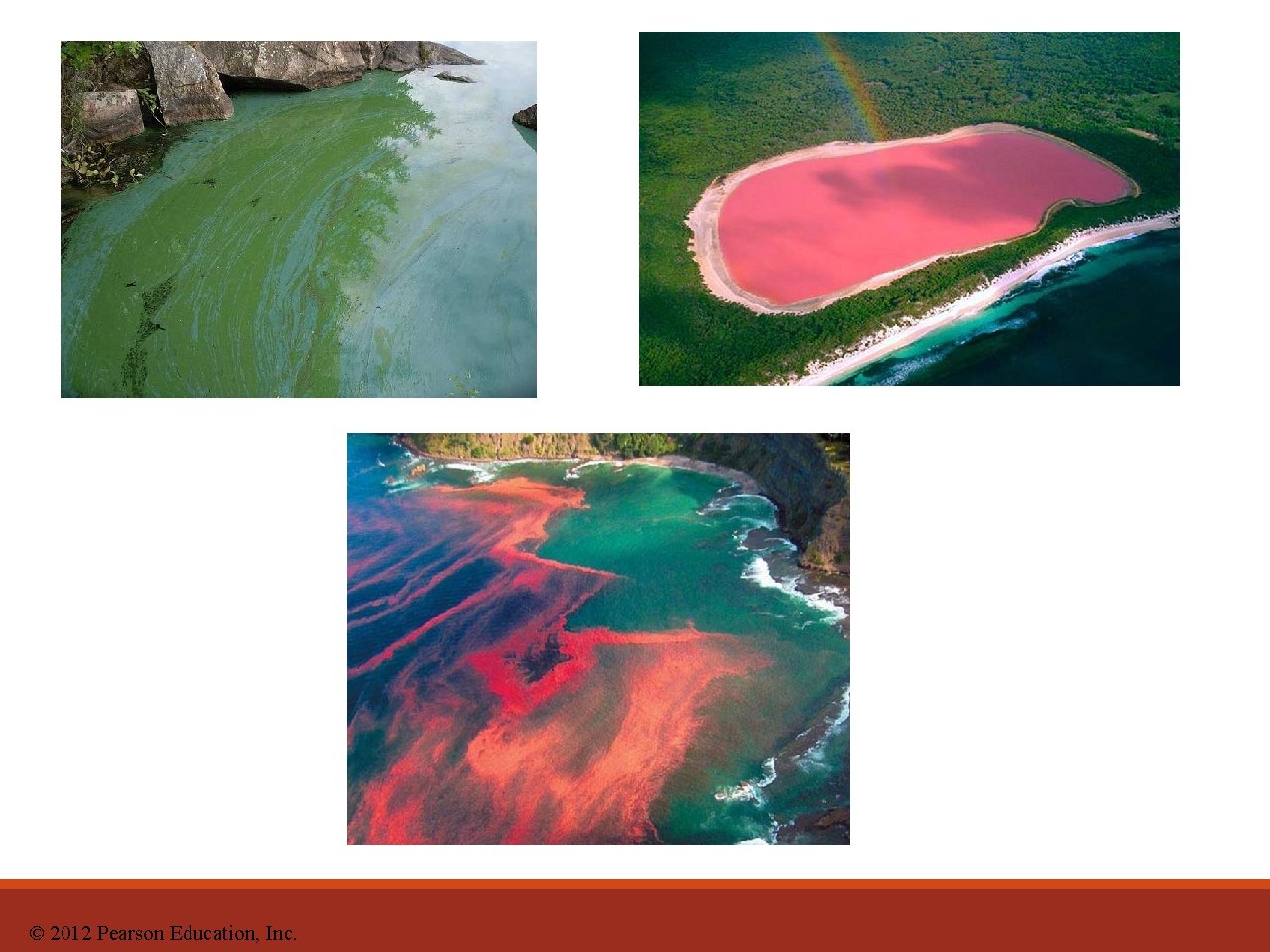
140 MIC: Microbiology 1. 3 Microorganisms and Their Environments 1. Diversity and abundances of microbes are controlled by resources (nutrients) and environmental conditions (e. g. , temp, p. H, O 2) 2. The activities of microbial communities can affect the chemical and physical properties of their habitats . . ﺍﻟﺸﻌﺒﺔ
140 MIC: Microbiology 1. 3 Microorganisms and Their Environments Microbes also interact with their physical and chemical environment ◦ Ecosystems greatly influenced (if not controlled) by microbial activities ◦ Microorganisms change the chemical and physical properties of their habitats through their activities ◦ For example, removal of nutrients from the environment and the excretion of waste products . . ﺍﻟﺸﻌﺒﺔ
© 2012 Pearson Education, Inc.
140 MIC: Microbiology . . . ﺍﻟﺸﻌﺒﺔ The Impact of Microorganisms on Humans Microorganisms as disease agents • Microorganisms can be both beneficial and harmful to humans • Emphasis typically on harmful microorganisms (infectious disease agents, or pathogens). • Pathogens pose a major threat to human’s life in developing countries • Some disease caused by microorganisms include: • Malaria, tuberculosis, cholera, African sleeping sickness, measles, pneumonia and other respiratory diseases and diarrheal syndromes. • Emerging infectious diseases are of particular importance because they spread quickly • Such as Ebola, bird flu and MERS-Co. V • Many more microorganisms are beneficial than are harmful • Microbial flora
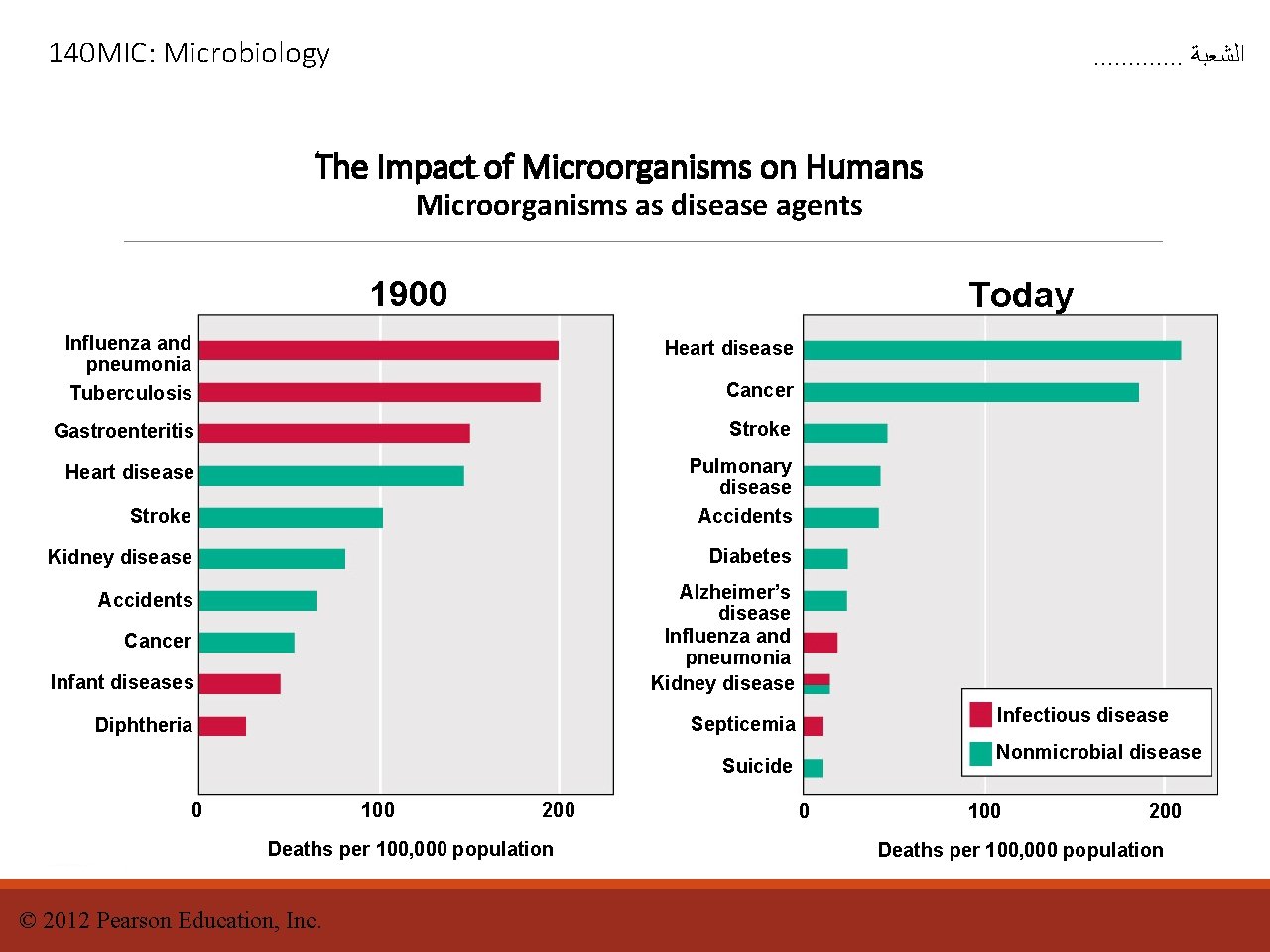
140 MIC: Microbiology . . . ﺍﻟﺸﻌﺒﺔ The Impact of Microorganisms on Humans Microorganisms as disease agents 1900 Today Influenza and pneumonia Tuberculosis Heart disease Gastroenteritis Stroke Heart disease Stroke Pulmonary disease Accidents Kidney disease Diabetes Accidents Infant diseases Alzheimer’s disease Influenza and pneumonia Kidney disease Diphtheria Septicemia Cancer Infectious disease Nonmicrobial disease Suicide 0 100 200 Deaths per 100, 000 population © 2012 Pearson Education, Inc. 0 100 200 Deaths per 100, 000 population
140 MIC: Microbiology . . . ﺍﻟﺸﻌﺒﺔ The Impact of Microorganisms on Humans Microorganisms and agriculture • Microorganisms and Agriculture – Many aspects of agriculture depend on microbial activities. • Positive impacts – Microbes to fix chemical components in the soil (Nitrogen, Sulfate) – cellulose-degrading microbes in the rumen – regeneration of nutrients in soil and water • Negative impacts – diseases in plants and animals
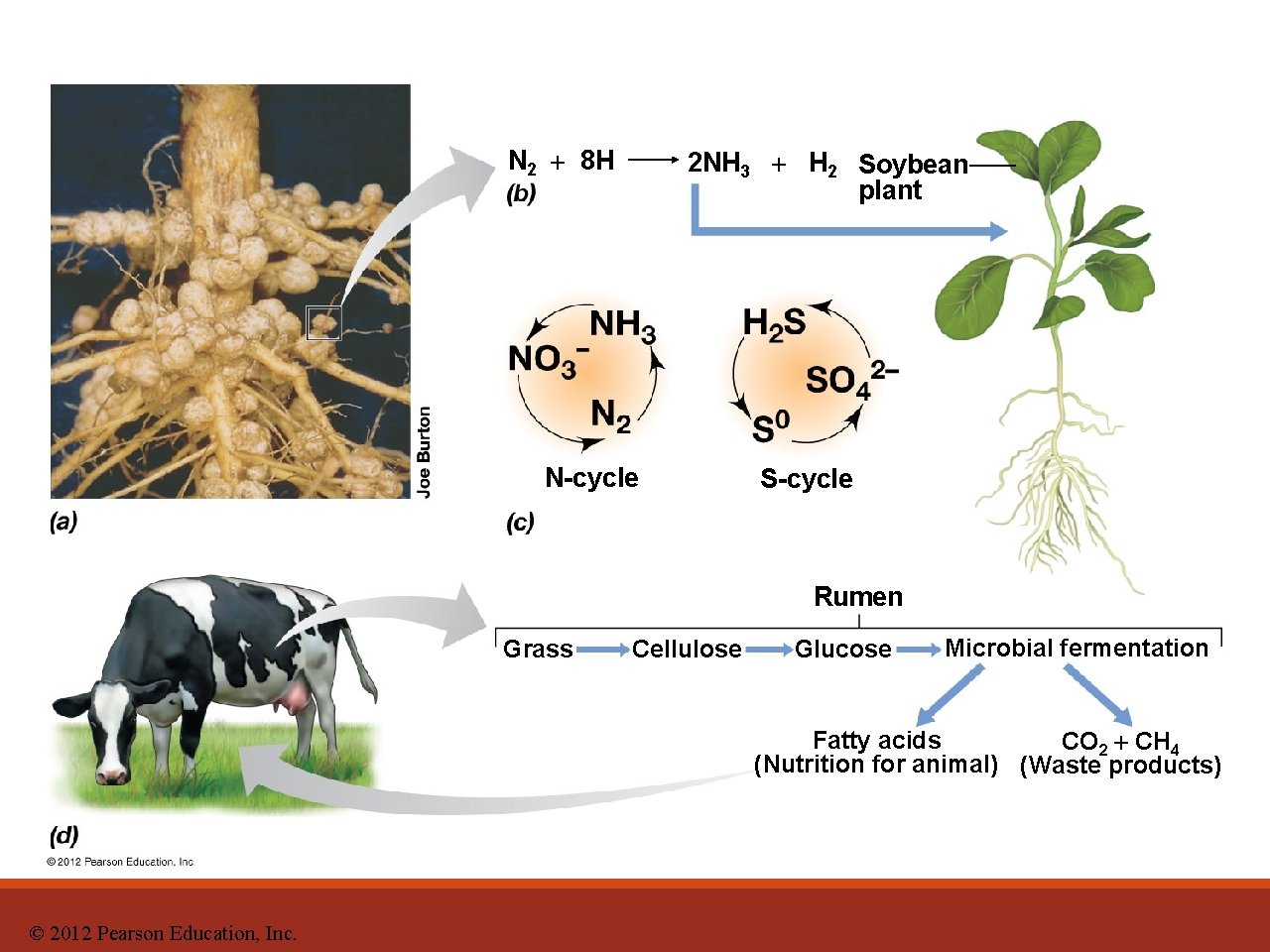
N 2 8 H 2 NH 3 H 2 Soybean plant N-cycle S-cycle Rumen Grass Cellulose Glucose Microbial fermentation Fatty acids CO 2 CH 4 (Nutrition for animal) (Waste products) © 2012 Pearson Education, Inc.
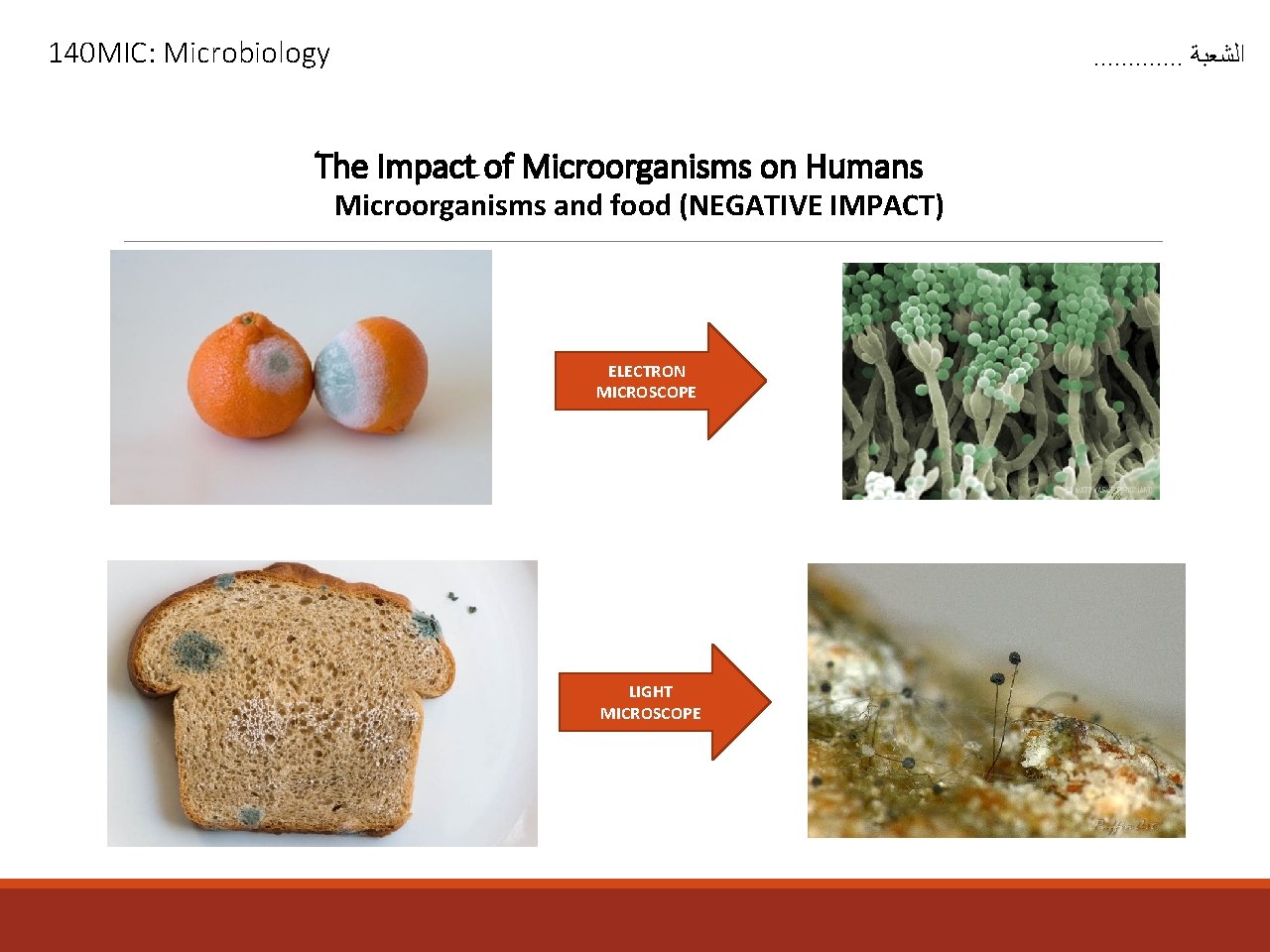
140 MIC: Microbiology . . . ﺍﻟﺸﻌﺒﺔ The Impact of Microorganisms on Humans Microorganisms and food • Microorganisms and Food – Negative impacts • Food spoilage by microorganisms cause economical loss requires specialized preservation of many foods • Food poisoning due to microbial contamination (Salmonella / Escherichia coli (E. coli) Requires constant monitoring to ensure food safety. – Positive impacts • Microbial transformations (typically fermentations) yield – dairy products (e. g. , cheeses, yogurt) – other food products (e. g. , sauerkraut, pickles, leavened breads, vinegar)
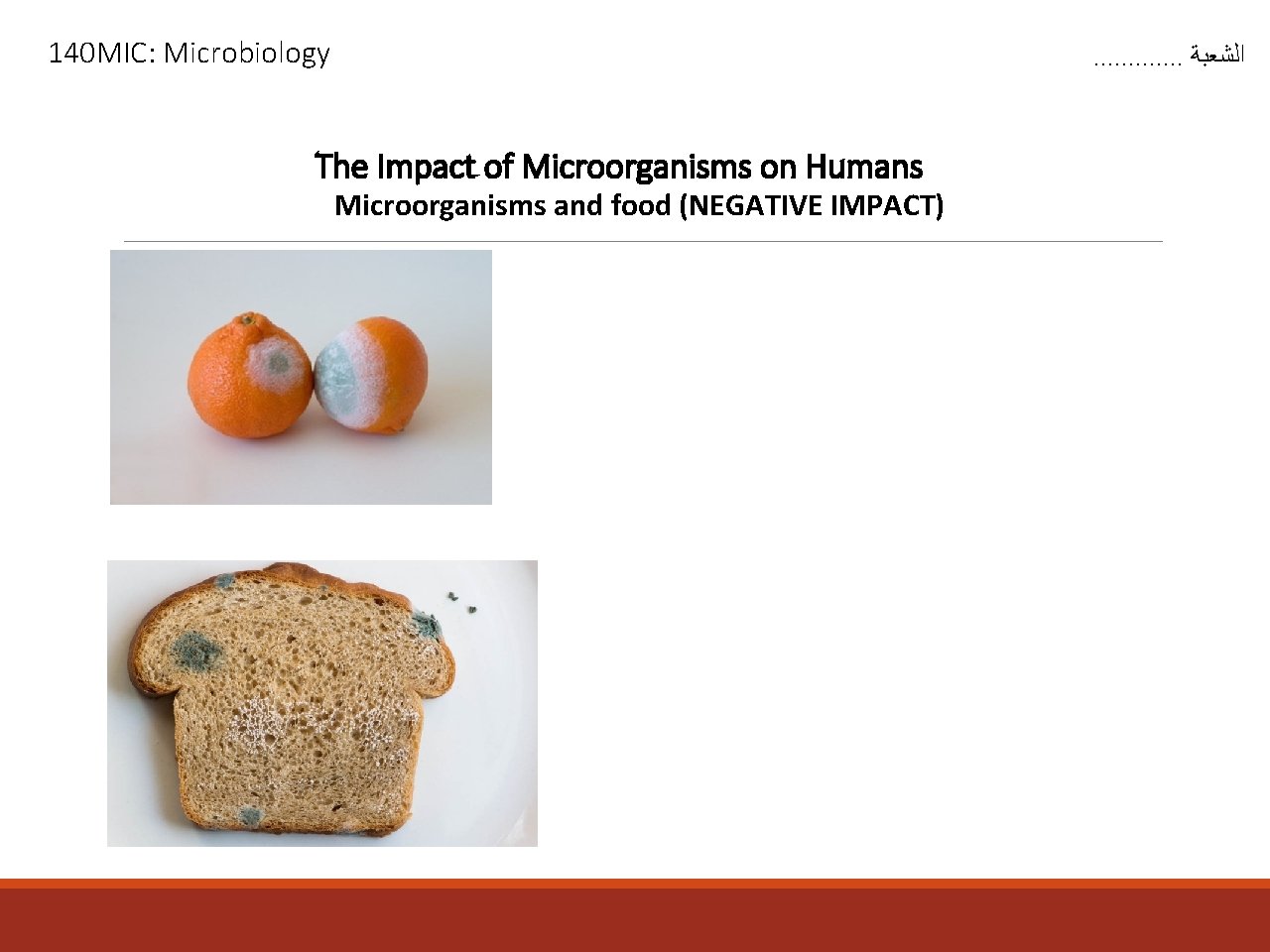
140 MIC: Microbiology . . . ﺍﻟﺸﻌﺒﺔ The Impact of Microorganisms on Humans Microorganisms and food (NEGATIVE IMPACT)
140 MIC: Microbiology . . . ﺍﻟﺸﻌﺒﺔ The Impact of Microorganisms on Humans Microorganisms and food (NEGATIVE IMPACT) ELECTRON MICROSCOPE LIGHT MICROSCOPE
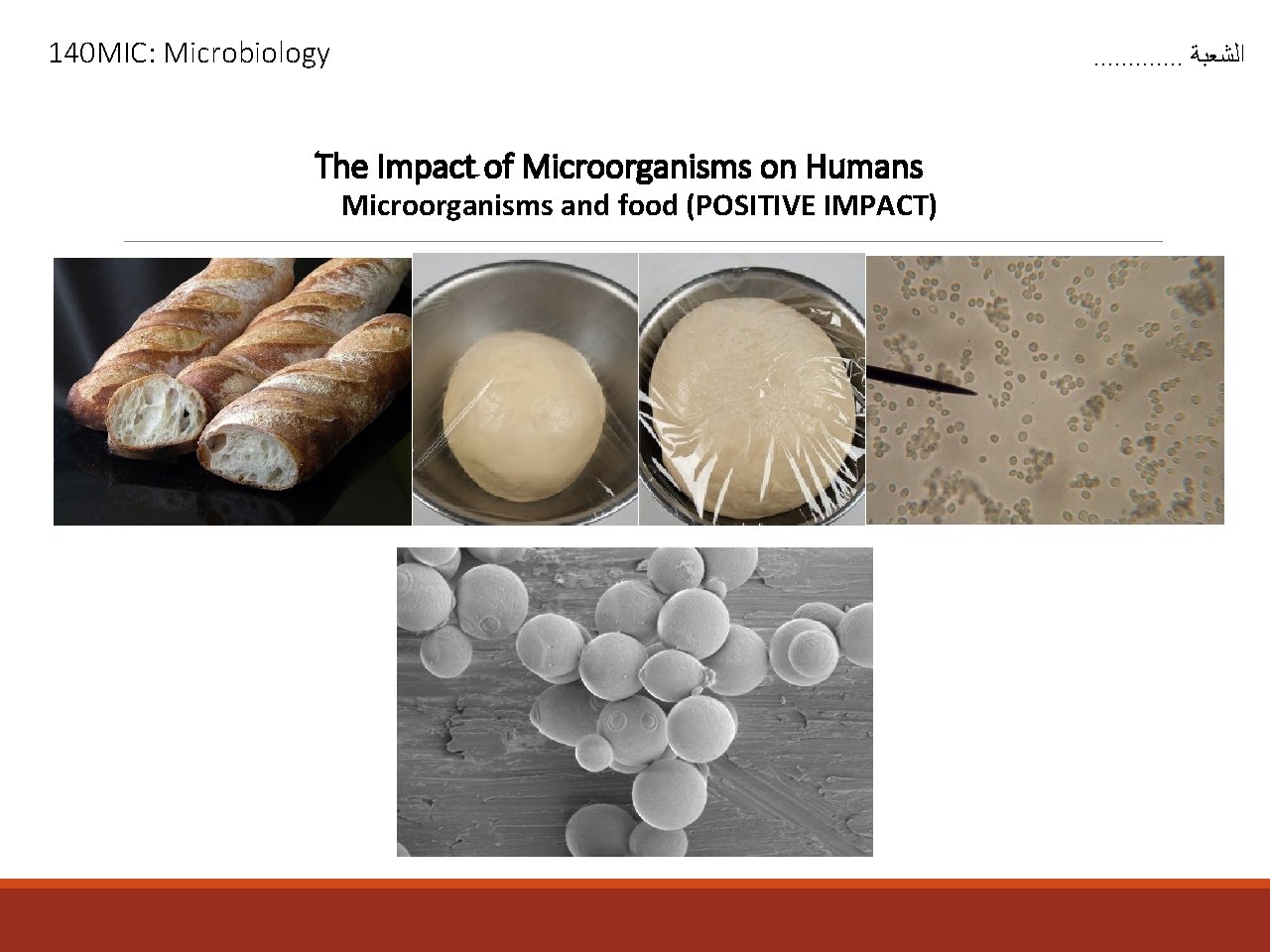
140 MIC: Microbiology . . . ﺍﻟﺸﻌﺒﺔ The Impact of Microorganisms on Humans Microorganisms and food (POSITIVE IMPACT)
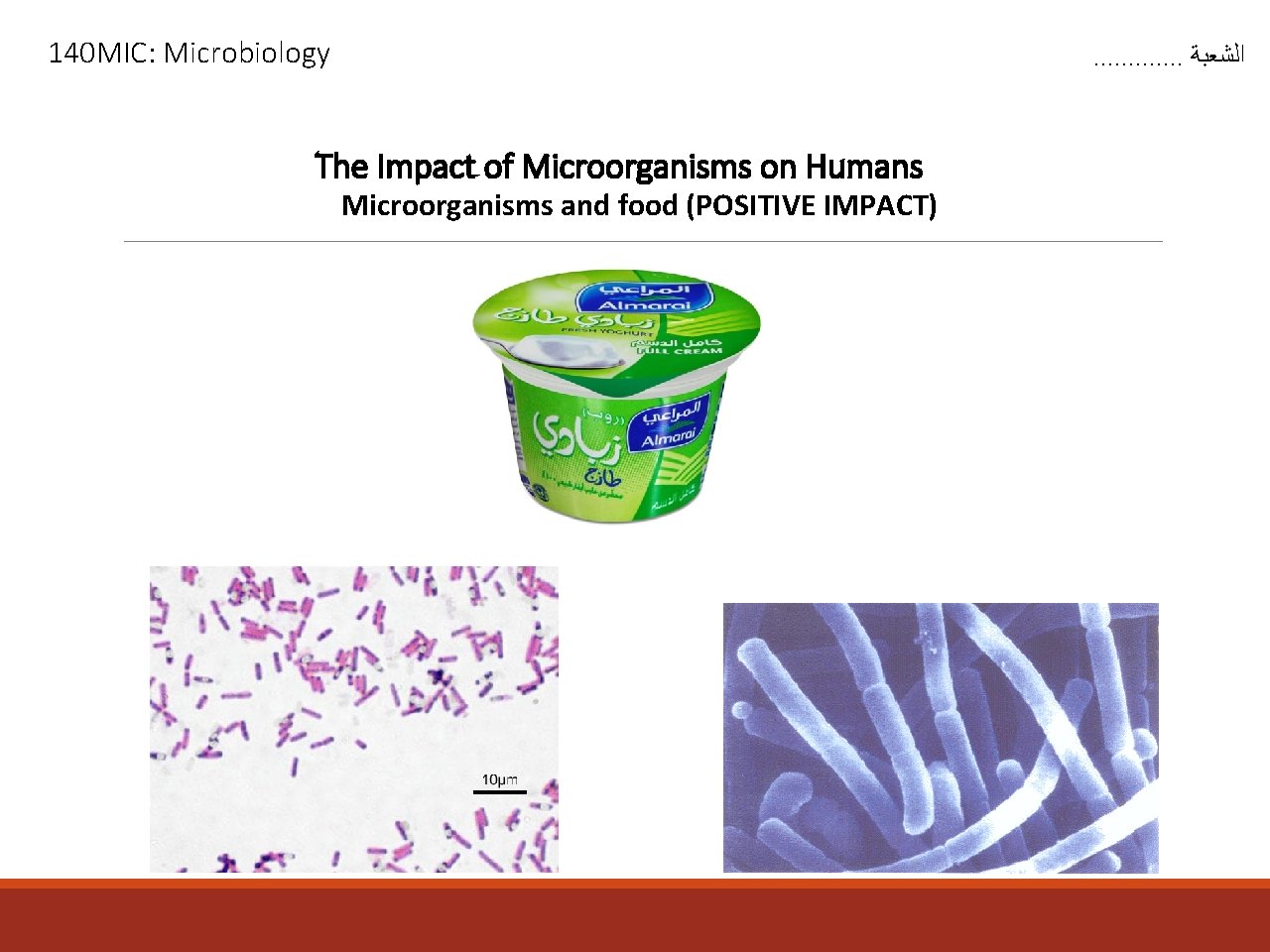
140 MIC: Microbiology . . . ﺍﻟﺸﻌﺒﺔ The Impact of Microorganisms on Humans Microorganisms and food (POSITIVE IMPACT)
140 MIC: Microbiology . . . ﺍﻟﺸﻌﺒﺔ The Impact of Microorganisms on Humans Microorganisms, Energy, and the Environment – The role of microbes in biofuels production • For example, methane, ethanol, hydrogen – Industrial microbiology: Growing microorganisms in large scales to make products of low commercial value. e. g. antibiotics and various chemicals (such as citric acid). – The role of microbes in cleaning up pollutants (bioremediation). There are 2 ways: • By introducing specific microorganisms to a polluted environment • By adding nutrients that stimulate preexisting microorganisms to degrade the pollutants.
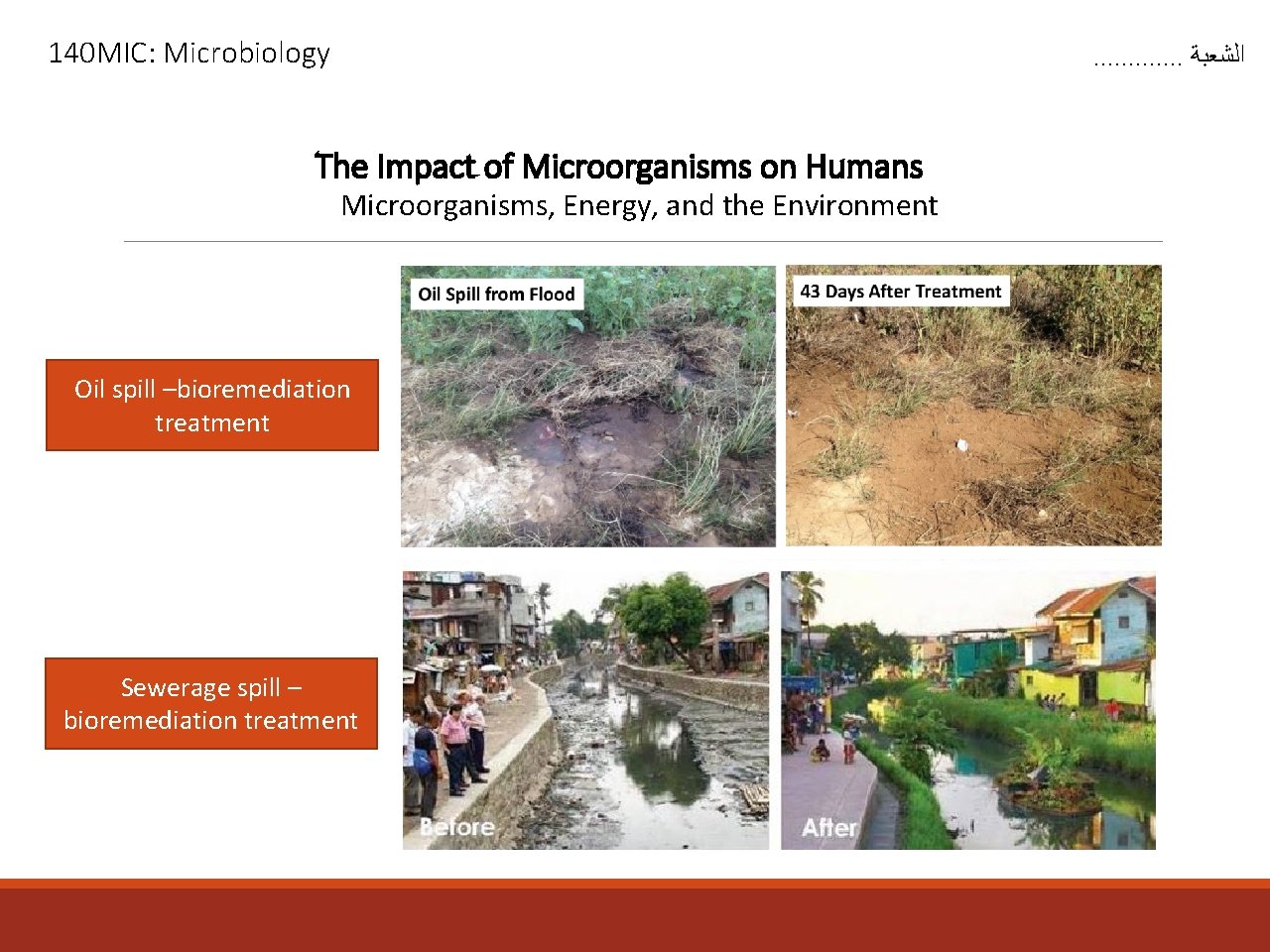
140 MIC: Microbiology . . . ﺍﻟﺸﻌﺒﺔ The Impact of Microorganisms on Humans Microorganisms, Energy, and the Environment Oil spill –bioremediation treatment Sewerage spill – bioremediation treatment
140 MIC: Microbiology . . . ﺍﻟﺸﻌﺒﺔ The Impact of Microorganisms on Humans Microorganisms and Their Genetic Resources Biotechnology employs genetically engineered microorganisms to generate products of high value to humans, such as insulin and human proteins. Microbiology as a Career: • Clinical medicine • Research and development – pharmaceutical, chemical/biochemical, biotechnology • Microbial monitoring in food and beverage industries, public health, government.

REMEMBER You can always ask questions through our discussion board on www. lms. ksu. edu. sa

140 MIC: Microbiology . . . ﺍﻟﺸﻌﺒﺔ History of microbiology Content • History of microbiology (part-1) • Microbiology in the Islamic era (Arabic content). • Pathways of discovery in microbiology o The historical roots of microbiology o Pasteur and the defeat of spontaneous generation o Koch, infectious disease, and pure culture microbiology. • History of microbiology (part-2) o The rise of microbial diversity o The modern era of microbiology
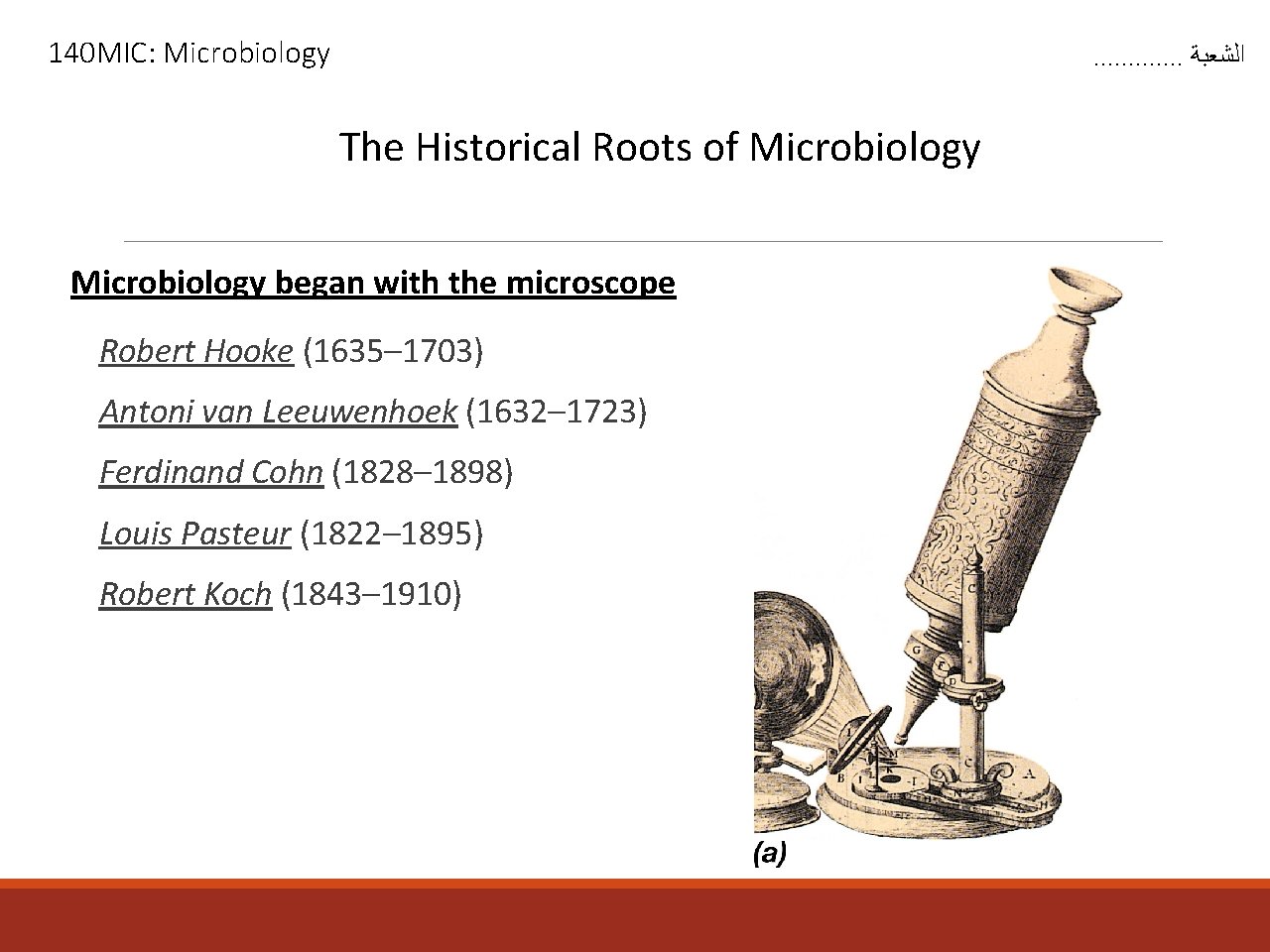
140 MIC: Microbiology . . . ﺍﻟﺸﻌﺒﺔ The Historical Roots of Microbiology began with the microscope Robert Hooke (1635– 1703) Antoni van Leeuwenhoek (1632– 1723) Ferdinand Cohn (1828– 1898) Louis Pasteur (1822– 1895) Robert Koch (1843– 1910)
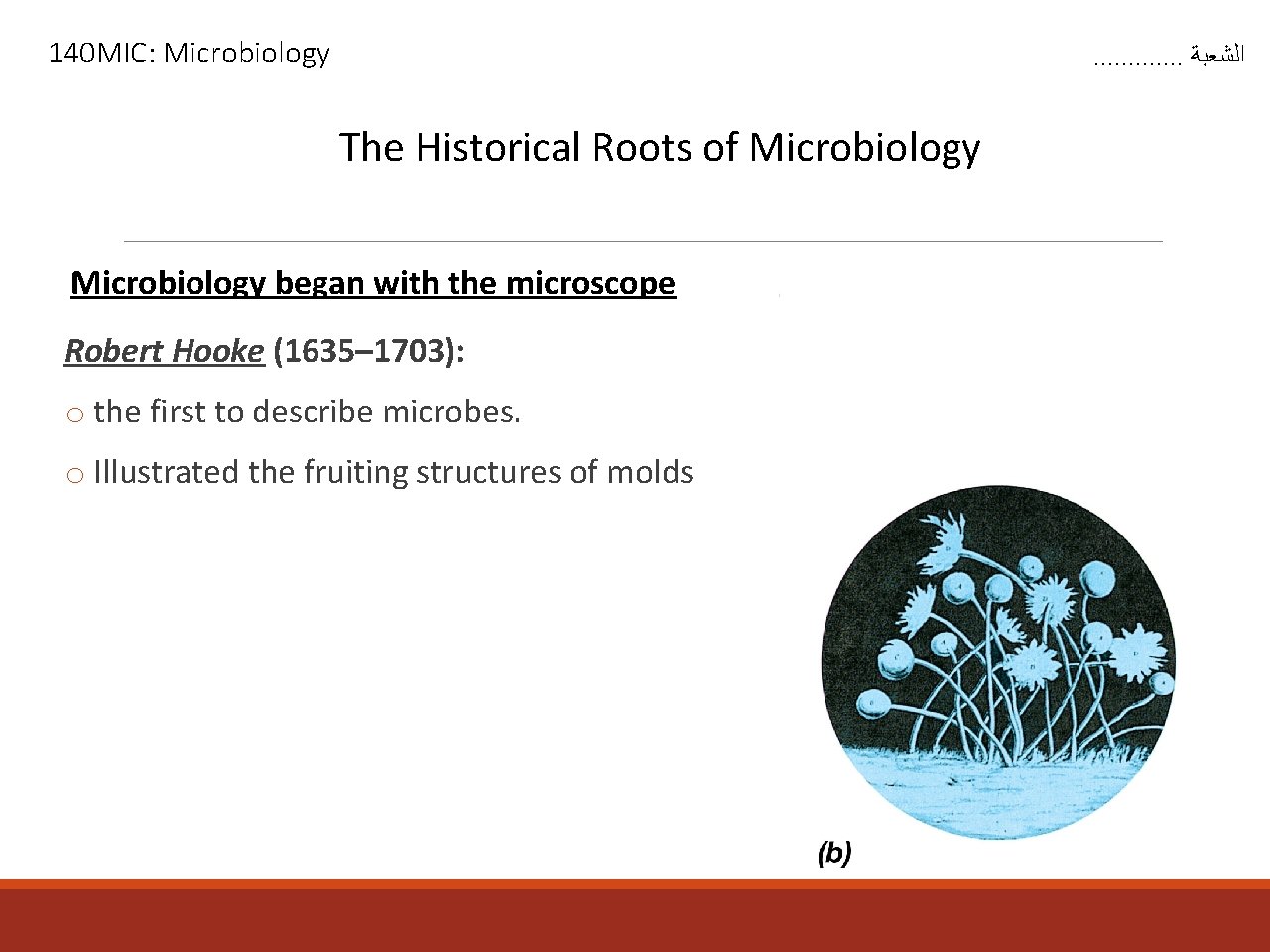
140 MIC: Microbiology . . . ﺍﻟﺸﻌﺒﺔ The Historical Roots of Microbiology began with the microscope Robert Hooke (1635– 1703): o the first to describe microbes. o Illustrated the fruiting structures of molds
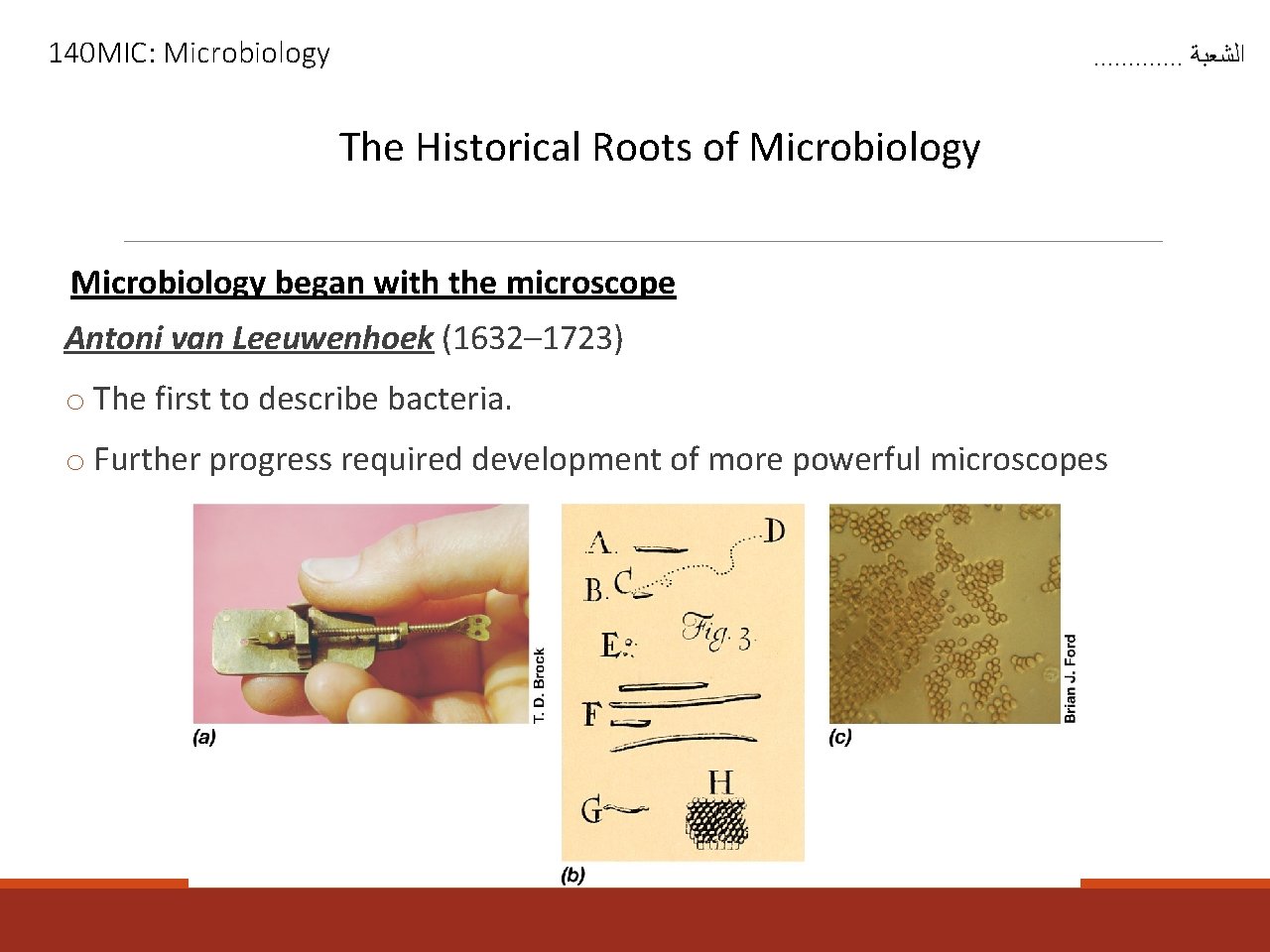
140 MIC: Microbiology . . . ﺍﻟﺸﻌﺒﺔ The Historical Roots of Microbiology began with the microscope Antoni van Leeuwenhoek (1632– 1723) o The first to describe bacteria. o Further progress required development of more powerful microscopes
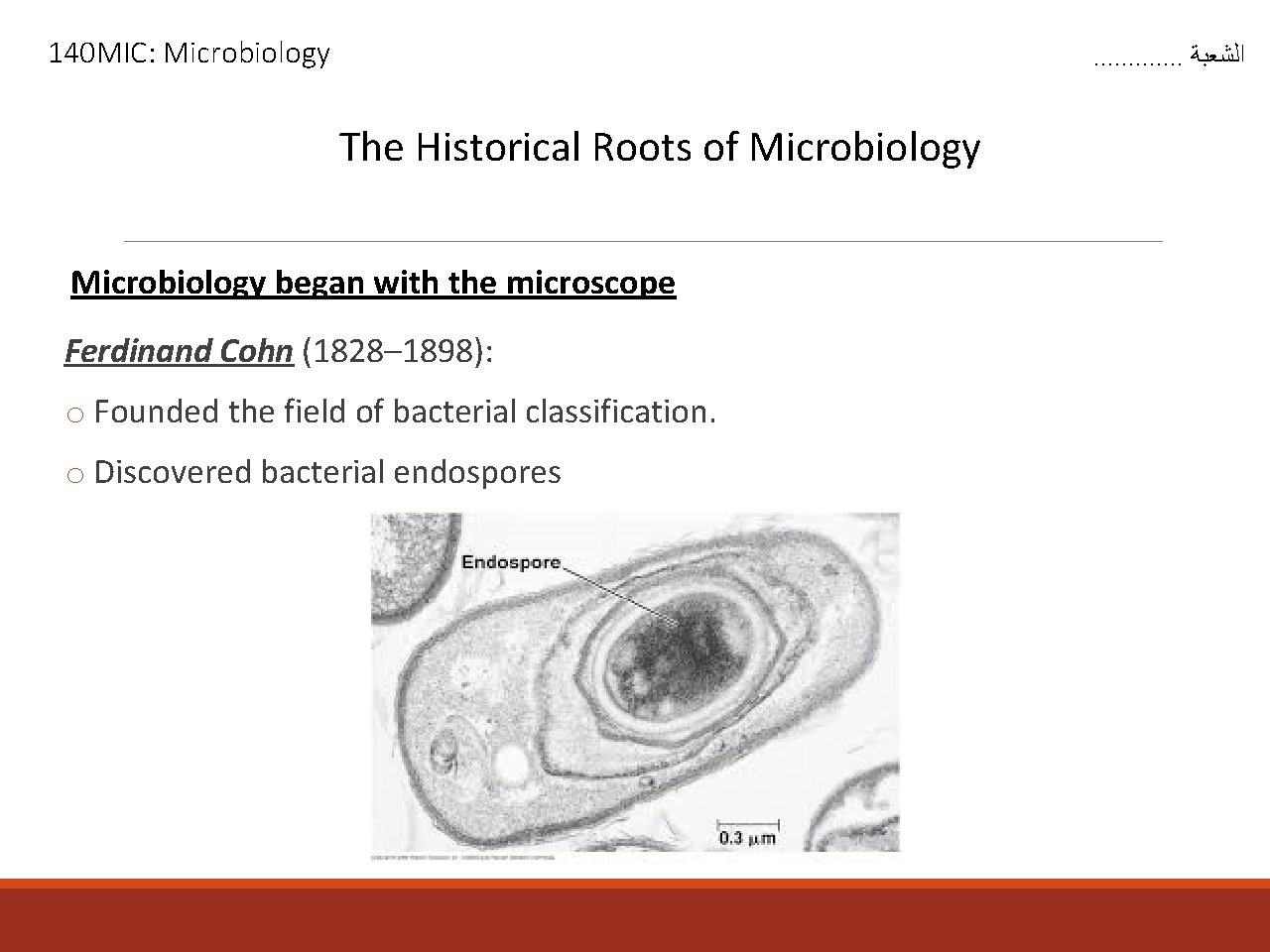
140 MIC: Microbiology . . . ﺍﻟﺸﻌﺒﺔ The Historical Roots of Microbiology began with the microscope Ferdinand Cohn (1828– 1898): o Founded the field of bacterial classification. o Discovered bacterial endospores
140 MIC: Microbiology . . . ﺍﻟﺸﻌﺒﺔ Pasteur and the Defeat of Spontaneous Generation Louis Pasteur (1822– 1895). ◦ Discovered that living organisms discriminate between optical isomers ◦ Discovered that alcoholic fermentation was a biologically mediated process (originally thought to be purely chemical) ◦ Disproved theory of spontaneous generation. ◦ Led to the development of methods for controlling the growth of microorganisms (aseptic technique) ◦ Developed vaccines for anthrax, fowl cholera, and rabies
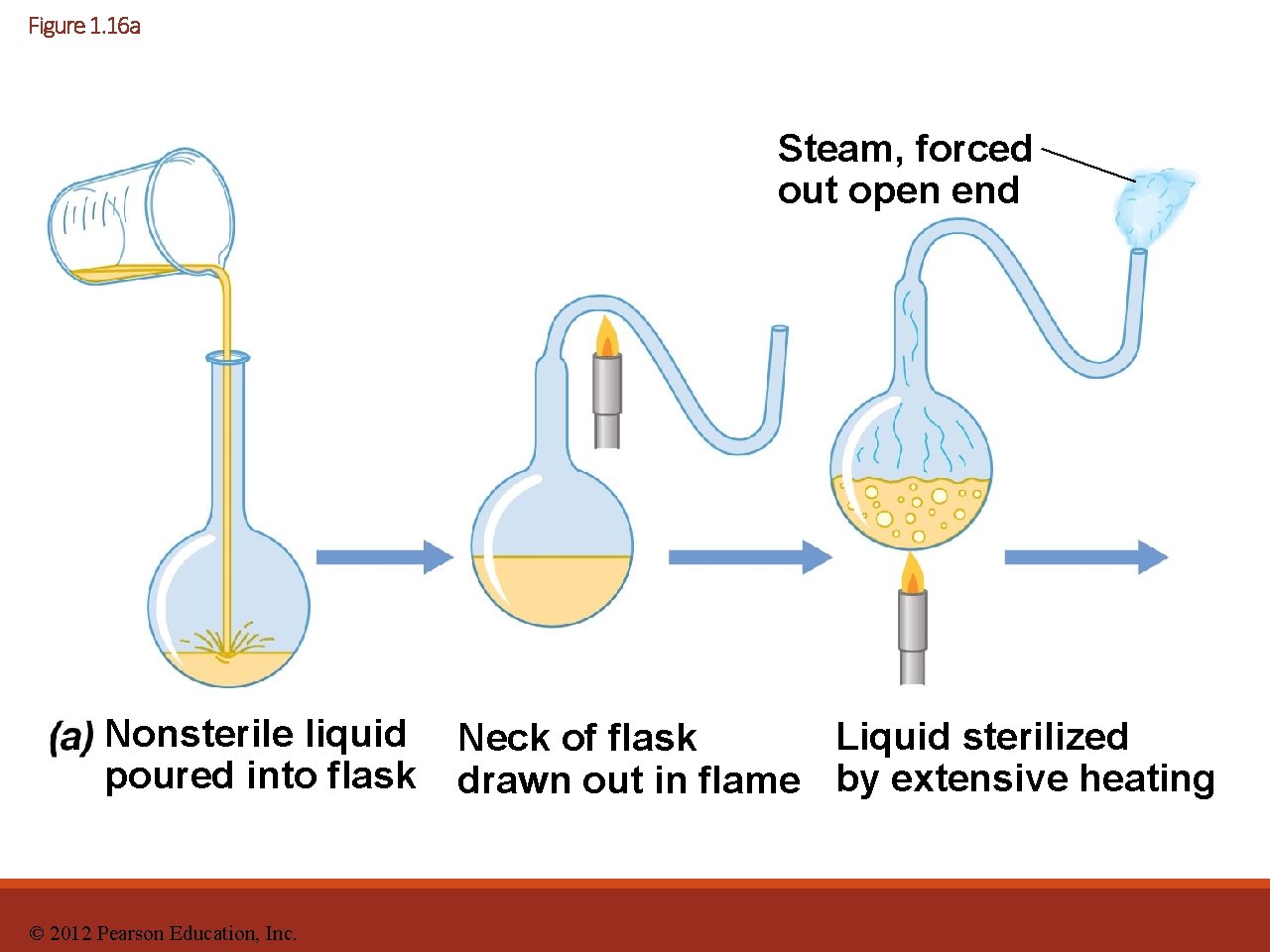
Figure 1. 16 a Steam, forced out open end Nonsterile liquid poured into flask © 2012 Pearson Education, Inc. Liquid sterilized Neck of flask drawn out in flame by extensive heating

Figure 1. 16 b Dust and microorganisms trapped in bend Open end Long time Liquid cooled slowly © 2012 Pearson Education, Inc. Liquid remains sterile indefinitely
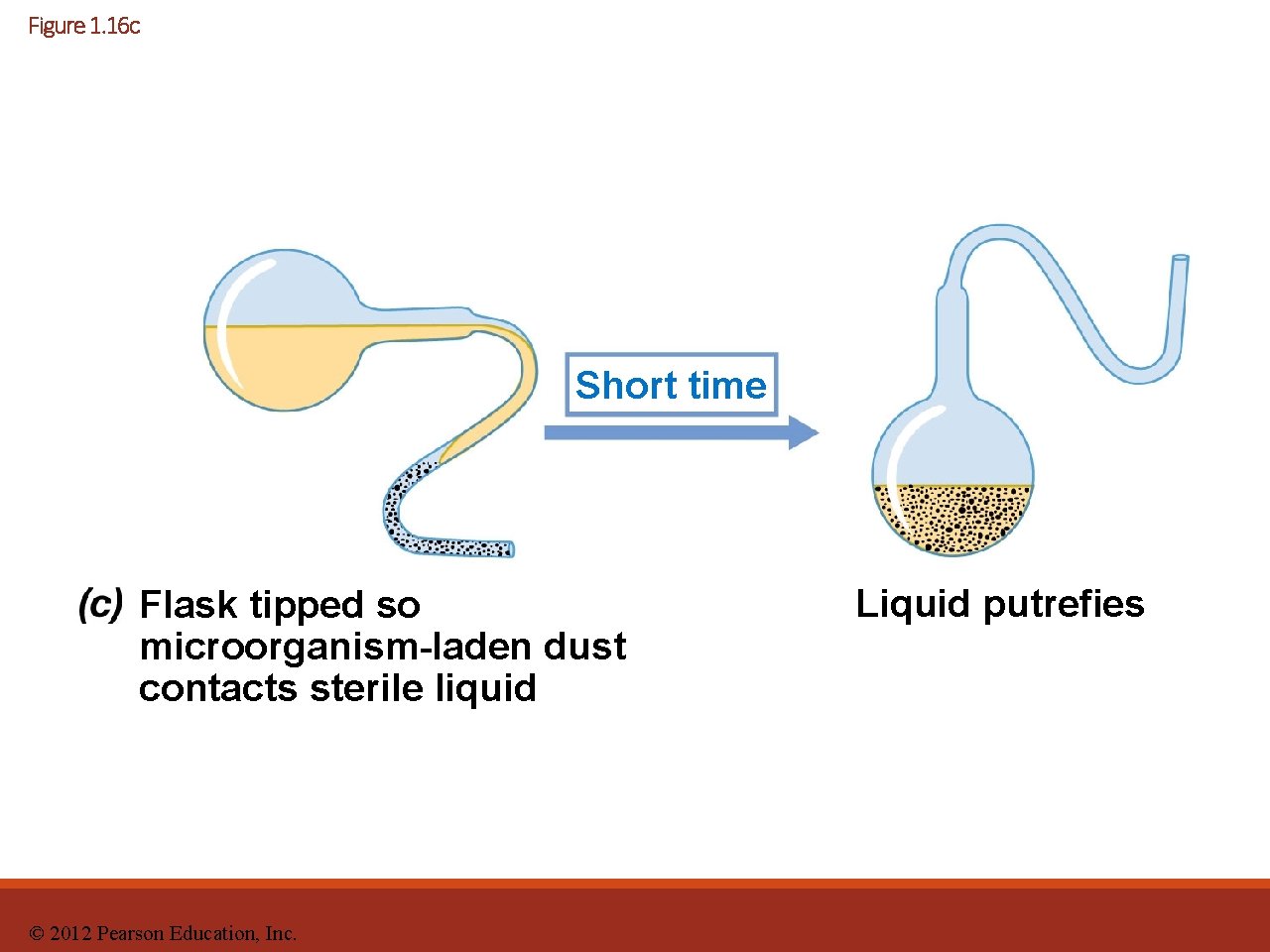
Figure 1. 16 c Short time Flask tipped so microorganism-laden dust contacts sterile liquid © 2012 Pearson Education, Inc. Liquid putrefies
140 MIC: Microbiology . . . ﺍﻟﺸﻌﺒﺔ Koch, Infectious Disease, and the Rise of Pure Cultures Robert Koch (1843– 1910) ◦ Demonstrated the link between microbes and infectious diseases ◦ Identified causative agents of anthrax and tuberculosis ◦ Koch’s postulates ◦ Developed techniques (solid media) for obtaining pure cultures of microbes, some still in existence today ◦ Awarded Nobel Prize for Physiology and Medicine in 1905
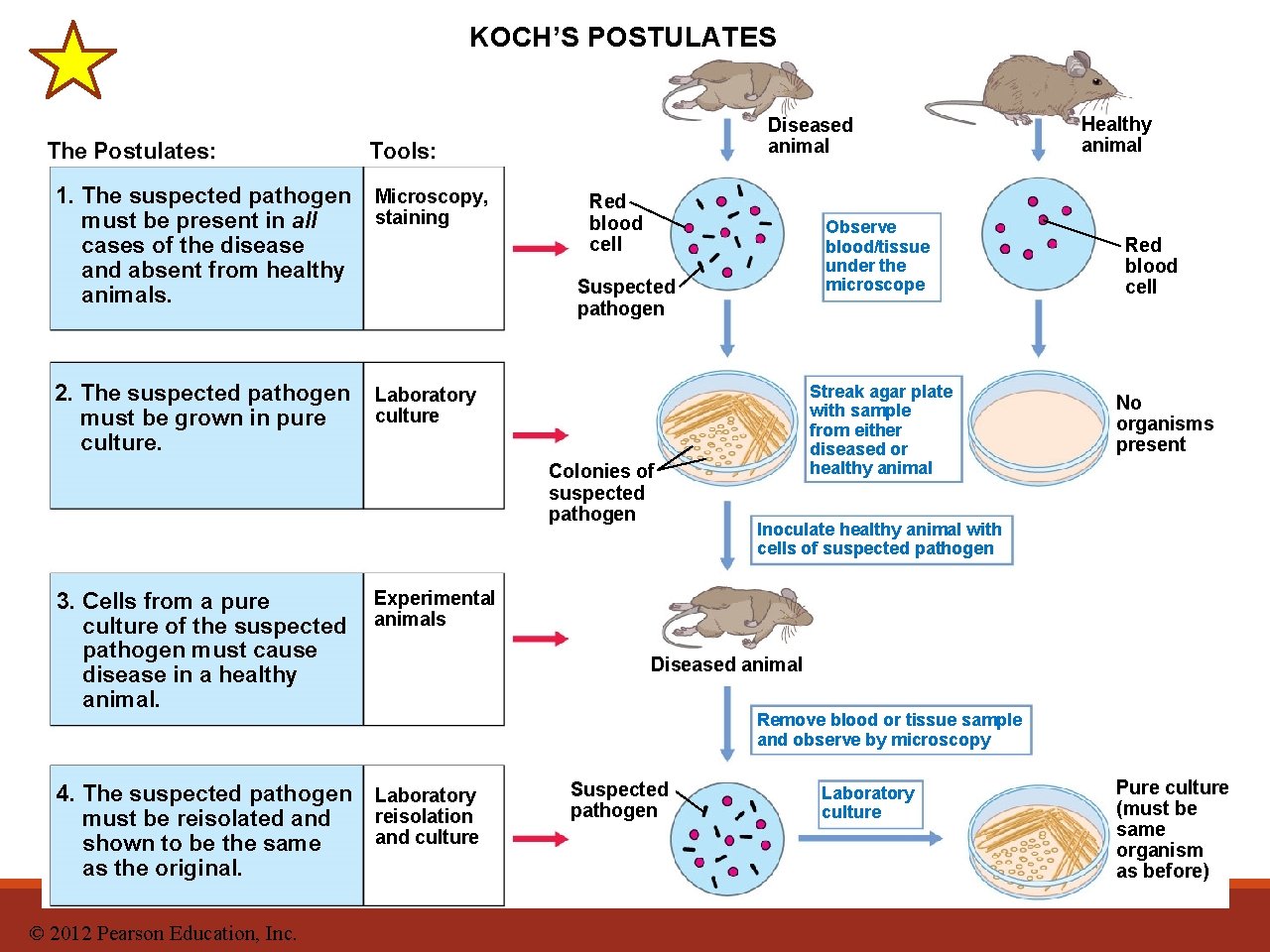
KOCH’S POSTULATES The Postulates: Diseased animal Tools: 1. The suspected pathogen must be present in all cases of the disease and absent from healthy animals. Microscopy, staining 2. The suspected pathogen must be grown in pure culture. Laboratory culture Red blood cell Suspected pathogen Colonies of suspected pathogen 3. Cells from a pure culture of the suspected pathogen must cause disease in a healthy animal. Experimental animals 4. The suspected pathogen must be reisolated and shown to be the same as the original. Laboratory reisolation and culture © 2012 Pearson Education, Inc. Observe blood/tissue under the microscope Streak agar plate with sample from either diseased or healthy animal Healthy animal Red blood cell No organisms present Inoculate healthy animal with cells of suspected pathogen Diseased animal Remove blood or tissue sample and observe by microscopy Suspected pathogen Laboratory culture Pure culture (must be same organism as before)

REMEMBER You can always ask questions through our discussion board on www. lms. ksu. edu. sa
140 MIC: Microbiology . . . ﺍﻟﺸﻌﺒﺔ Koch, Infectious Disease, and the Rise of Pure Cultures Koch’s Postulates Today ◦ Koch’s postulates apply for diseases that have an appropriate animal model ◦ Remain “gold standard” in medical microbiology, but not always possible to satisfy all postulates for every infectious disease ◦ Animal models not always available ◦ For example, cholera, rickettsias, chlamydias Koch and the Rise of Pure Cultures ◦ ◦ Discovered that using solid media provided a simple way of obtaining pure cultures Began with potato slices, but eventually devised uniform and reproducible nutrient solutions solidified with gelatin and agar
140 MIC: Microbiology . . . ﺍﻟﺸﻌﺒﺔ History of microbiology Content • History of microbiology (part-1) • Microbiology in the Islamic era (Arabic content). • Pathways of discovery in microbiology o The historical roots of microbiology o Pasteur and the defeat of spontaneous generation o Koch, infectious disease, and pure culture microbiology. • History of microbiology (part-2) o The rise of microbial diversity o The modern era of microbiology
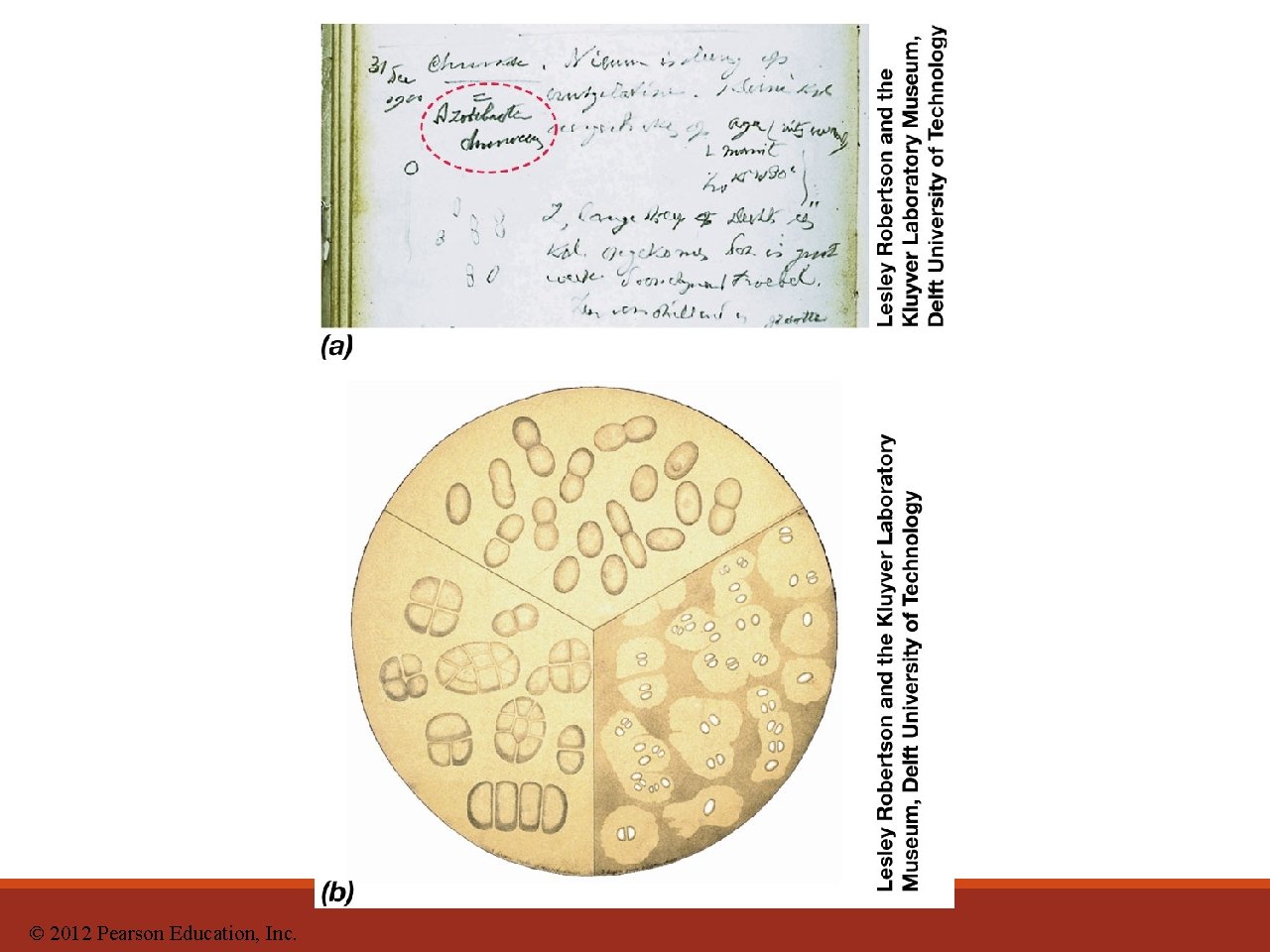
The rise of microbial diversity Microbial Diversity ◦ ◦ Field that focuses on nonmedical aspects of microbiology Roots in 20 th century Martinus Beijerinck (1851– 1931) ◦ Developed enrichment culture technique ◦ Microbes isolated from natural samples in a highly selective fashion by manipulating nutrient and incubation conditions ◦ Example: nitrogen-fixing bacteria (Figure 1. 21)
© 2012 Pearson Education, Inc.
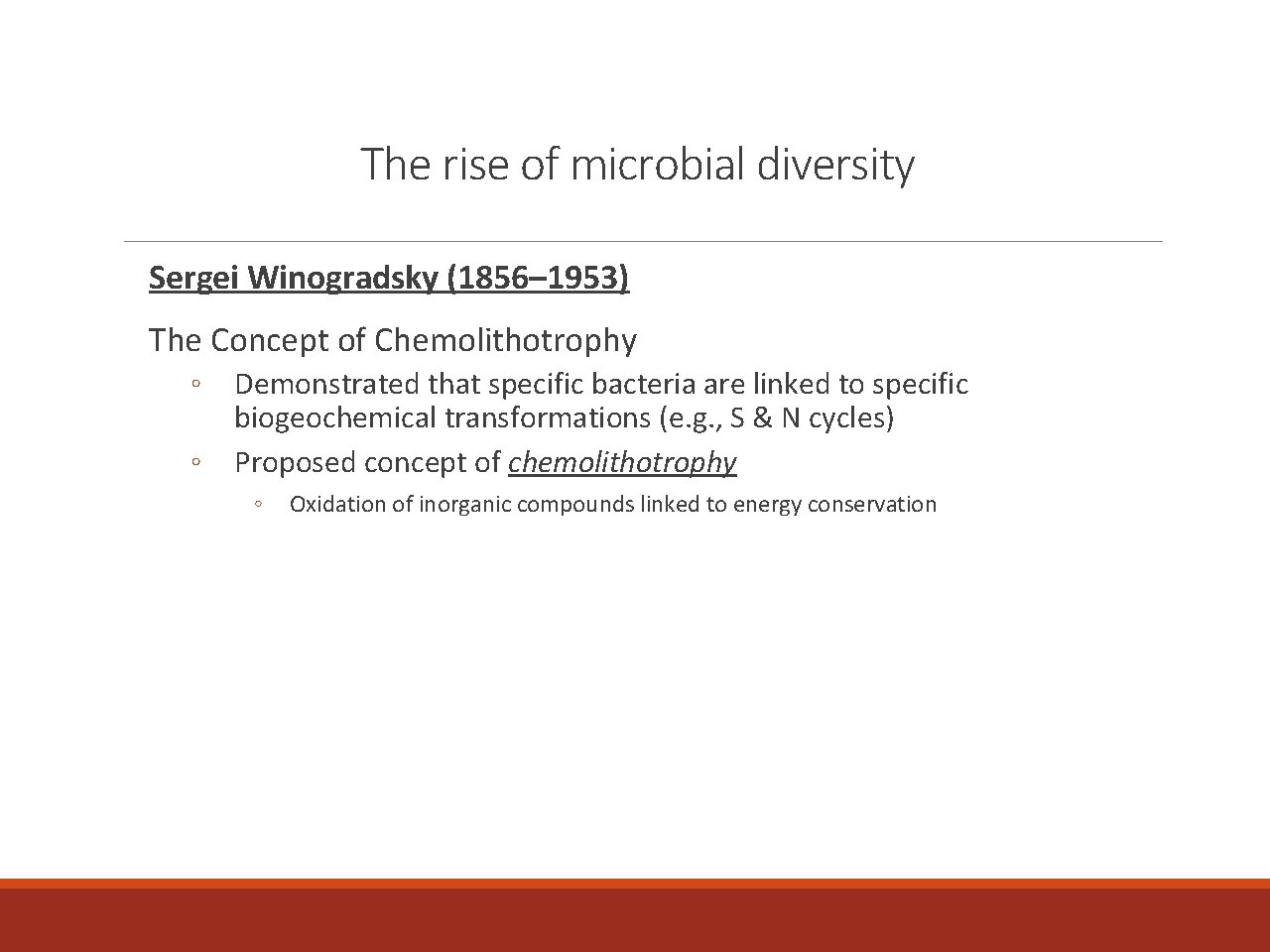
The rise of microbial diversity Sergei Winogradsky (1856– 1953) The Concept of Chemolithotrophy ◦ ◦ Demonstrated that specific bacteria are linked to specific biogeochemical transformations (e. g. , S & N cycles) Proposed concept of chemolithotrophy ◦ Oxidation of inorganic compounds linked to energy conservation

The Modern Era of Microbiology Major Subdisciplines of Applied Microbiology ◦ Medical microbiology and immunology ◦ ◦ Agricultural microbiology and industrial microbiology ◦ ◦ Developed from concepts developed by Beijerinck and Winogradsky Aquatic microbiology and marine microbiology ◦ ◦ Have roots in Koch’s work Developed from advances in soil microbiology Microbial ecology ◦ Emerged in 1960 s– 70 s
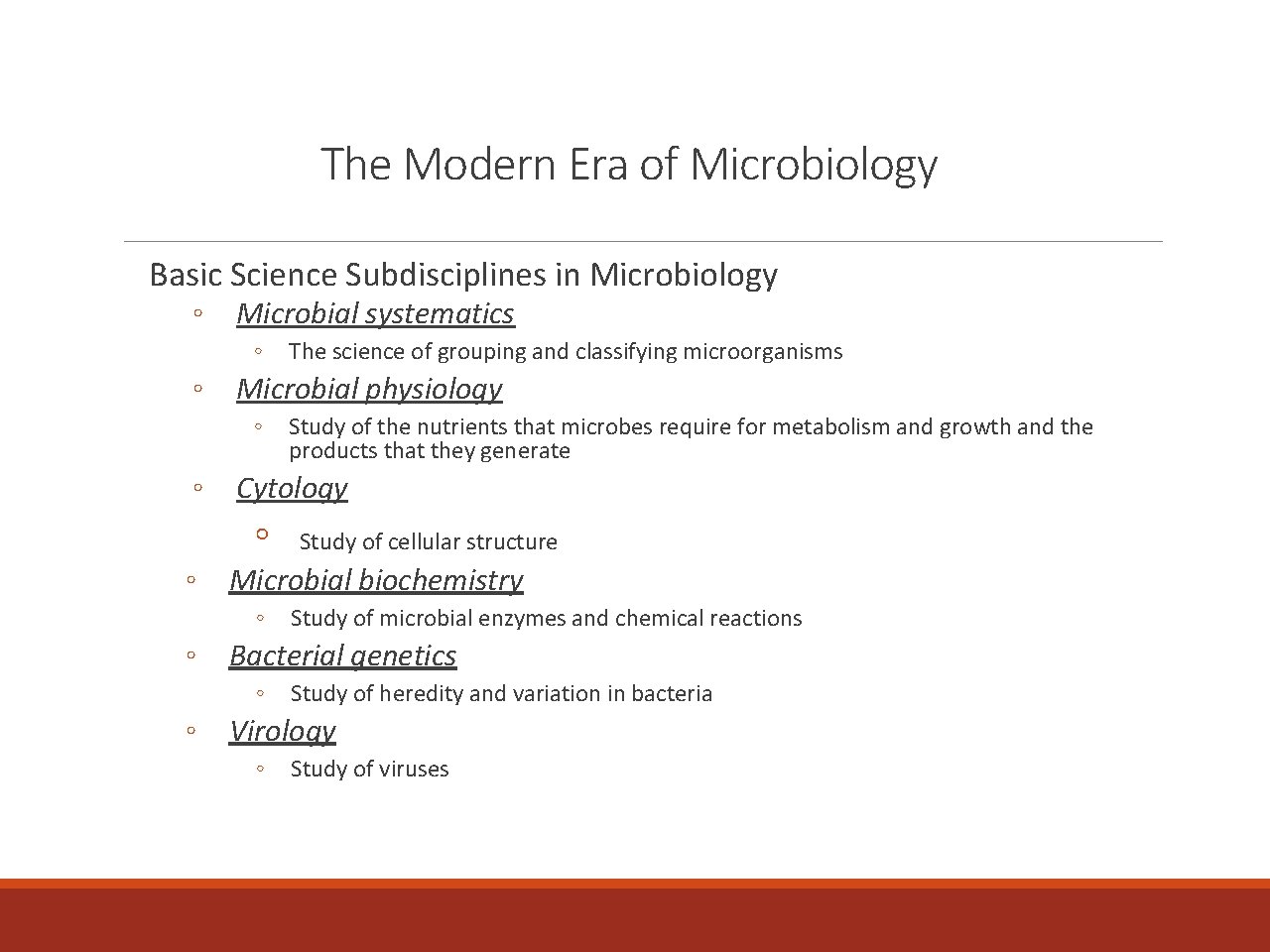
The Modern Era of Microbiology Basic Science Subdisciplines in Microbiology ◦ Microbial systematics ◦ ◦ Microbial physiology ◦ ◦ Study of cellular structure Microbial biochemistry Study of microbial enzymes and chemical reactions Bacterial genetics ◦ ◦ Study of the nutrients that microbes require for metabolism and growth and the products that they generate Cytology ◦ ◦ The science of grouping and classifying microorganisms Study of heredity and variation in bacteria Virology ◦ Study of viruses
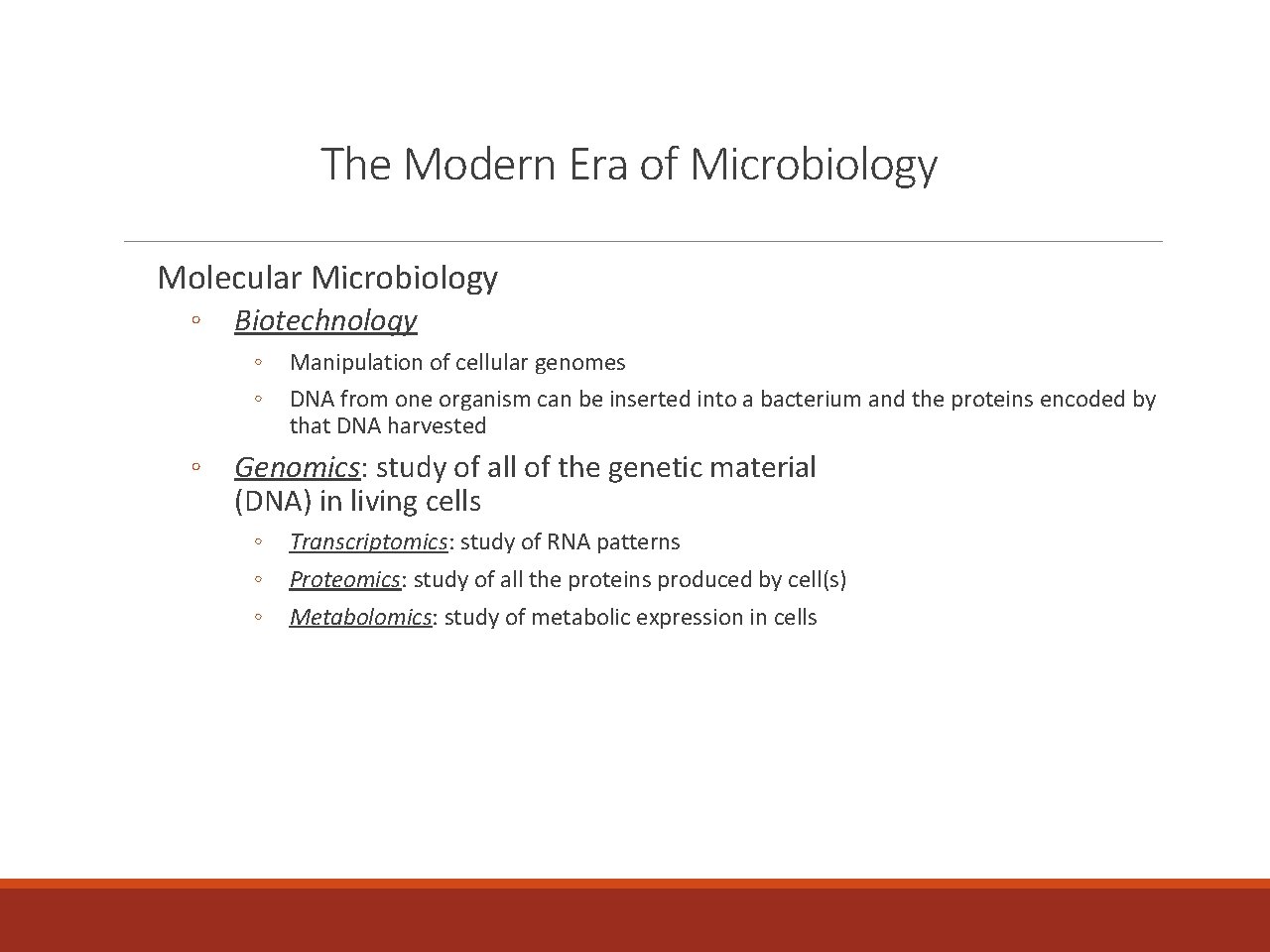
The Modern Era of Microbiology Molecular Microbiology ◦ Biotechnology ◦ ◦ ◦ Manipulation of cellular genomes DNA from one organism can be inserted into a bacterium and the proteins encoded by that DNA harvested Genomics: study of all of the genetic material (DNA) in living cells ◦ ◦ ◦ Transcriptomics: study of RNA patterns Proteomics: study of all the proteins produced by cell(s) Metabolomics: study of metabolic expression in cells

REMEMBER You can always ask questions through our discussion board on www. lms. ksu. edu. sa
140 MIC: Microbiology . . . ﺍﻟﺸﻌﺒﺔ Microscopes • Seeing the very small • Light microscope; principles • Electron microscope.

Microscopes SEEING THE VERY SMALL
Microscopes • Microscopes and microbiology linking advance • Microscopes use lenses to magnify object’s images. • There are two types of microscopes: ◦ Light microscopes (4 types) ◦ Electron microscope (2 types)
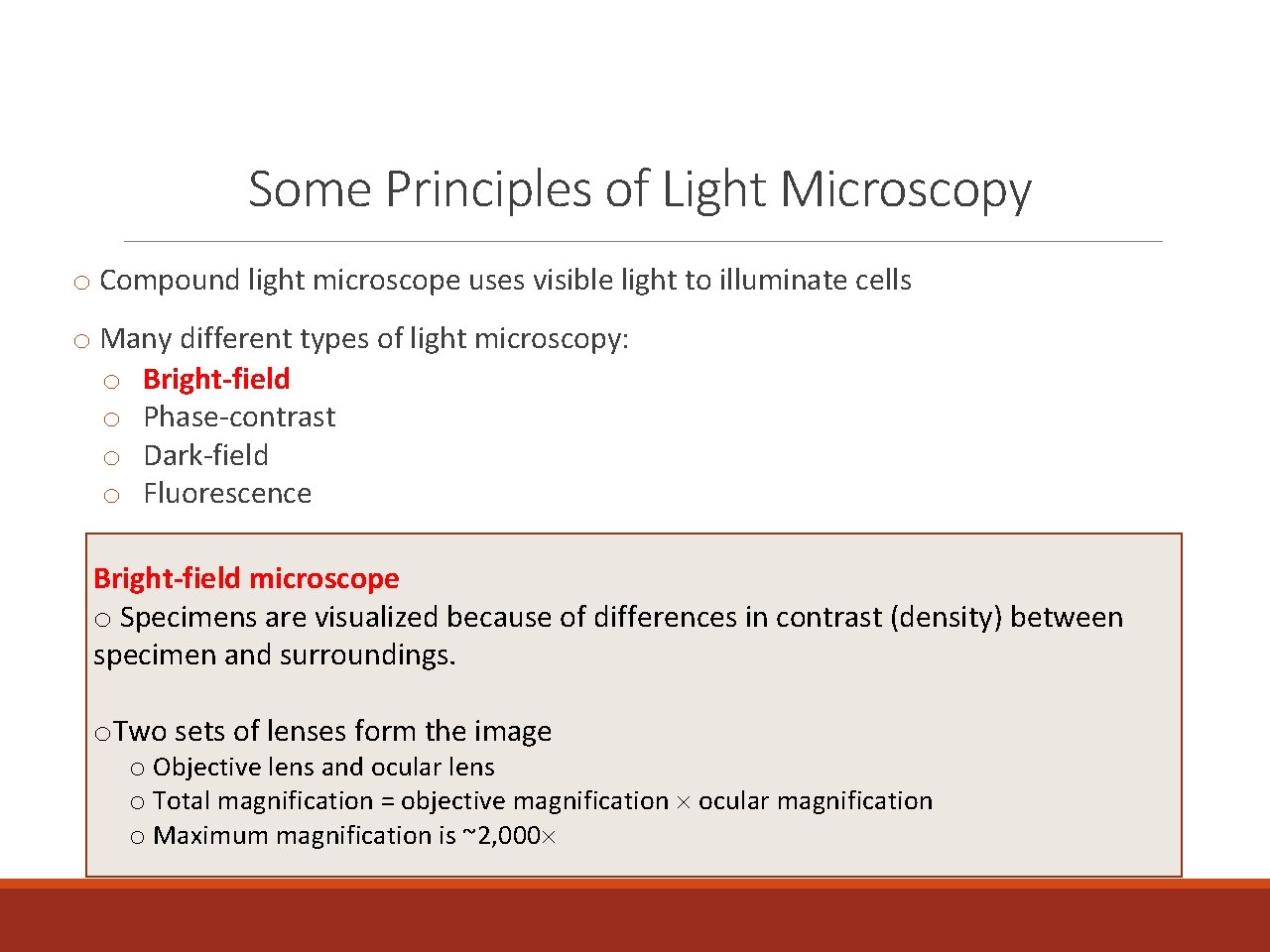
Some Principles of Light Microscopy o Compound light microscope uses visible light to illuminate cells o Many different types of light microscopy: o Bright-field o Phase-contrast o Dark-field o Fluorescence Bright-field microscope o Specimens are visualized because of differences in contrast (density) between specimen and surroundings. o. Two sets of lenses form the image o Objective lens and ocular lens o Total magnification = objective magnification ocular magnification o Maximum magnification is ~2, 000
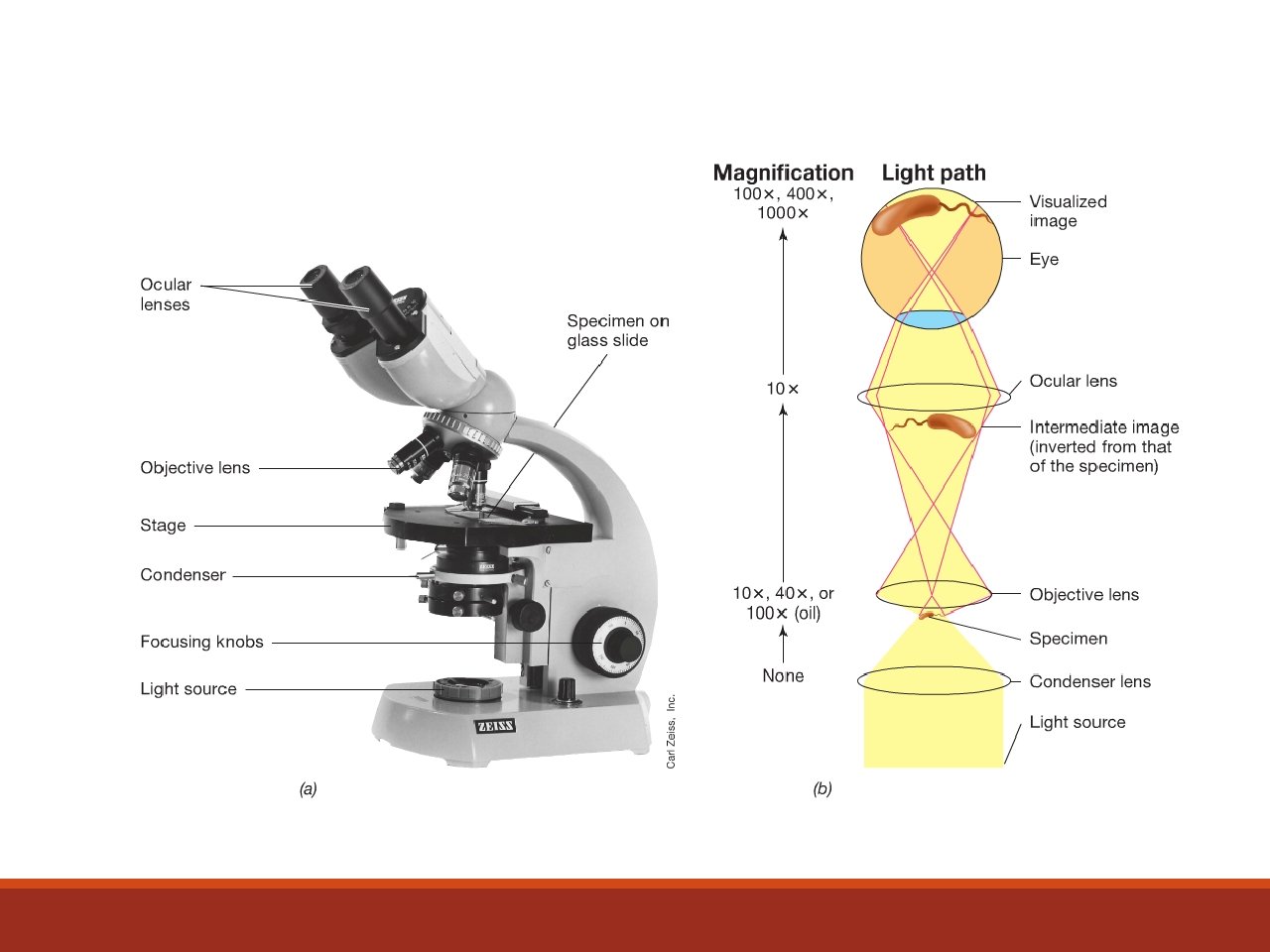
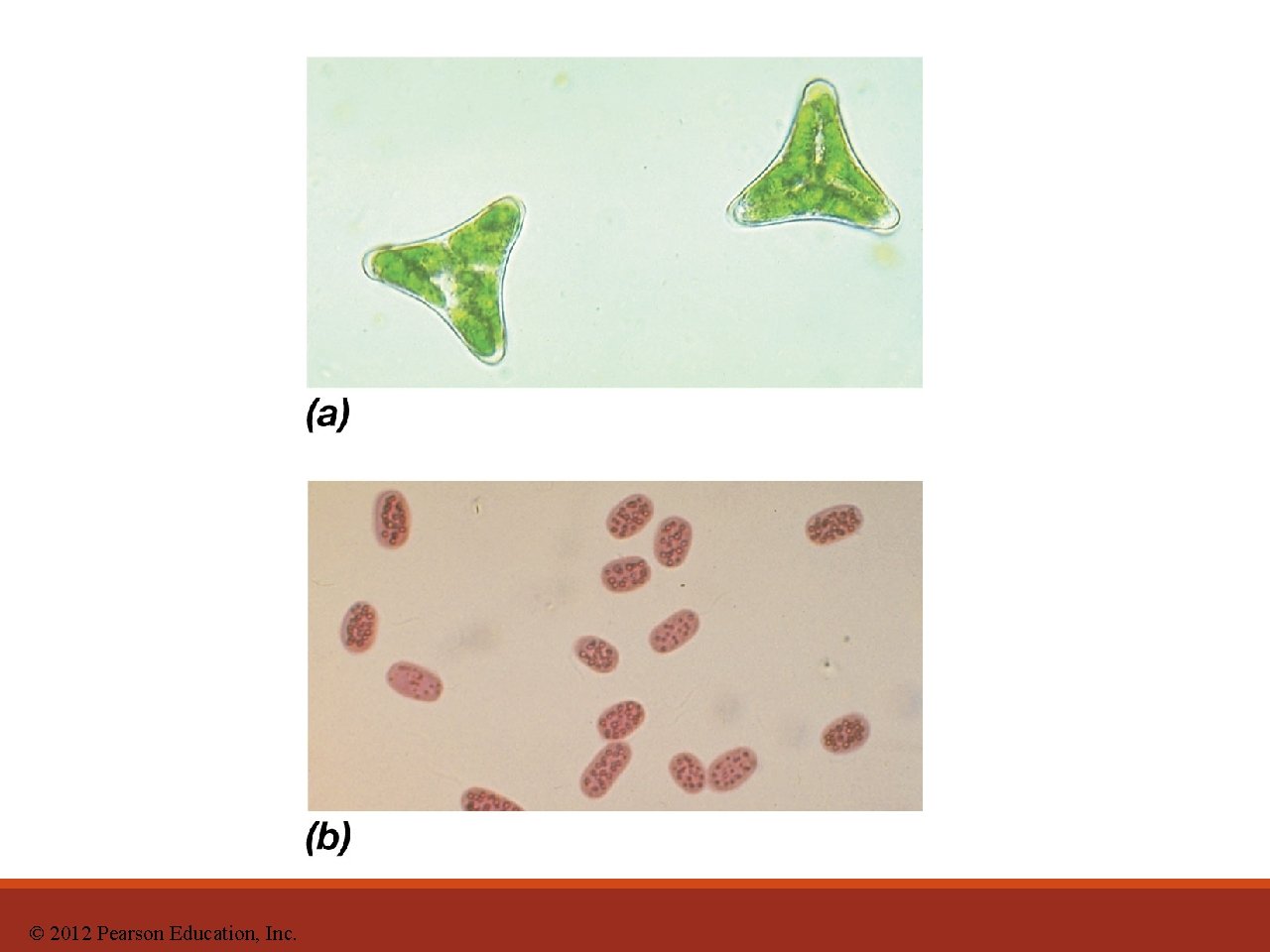
© 2012 Pearson Education, Inc.
Some Principles of Light Microscopy o Resolution: the ability to distinguish two adjacent objects as separate and distinct ◦ Resolution is determined by the wavelength of light used and numerical aperture of lens ◦ Limit of resolution for light microscope is about 0. 2 m Methods to Improve contrast to generate a better final image? Staining o Dyes are organic compounds that bind to specific cellular materials o Examples of common stains are methylene blue, safranin, and crystal violet Differential stains: the Gram stain o Differential stains separate bacteria into groups Bacteria can be divided into two major groups: gram-positive and gram-negative o Gram-positive bacteria appear purple and gram-negative bacteria appear red after staining
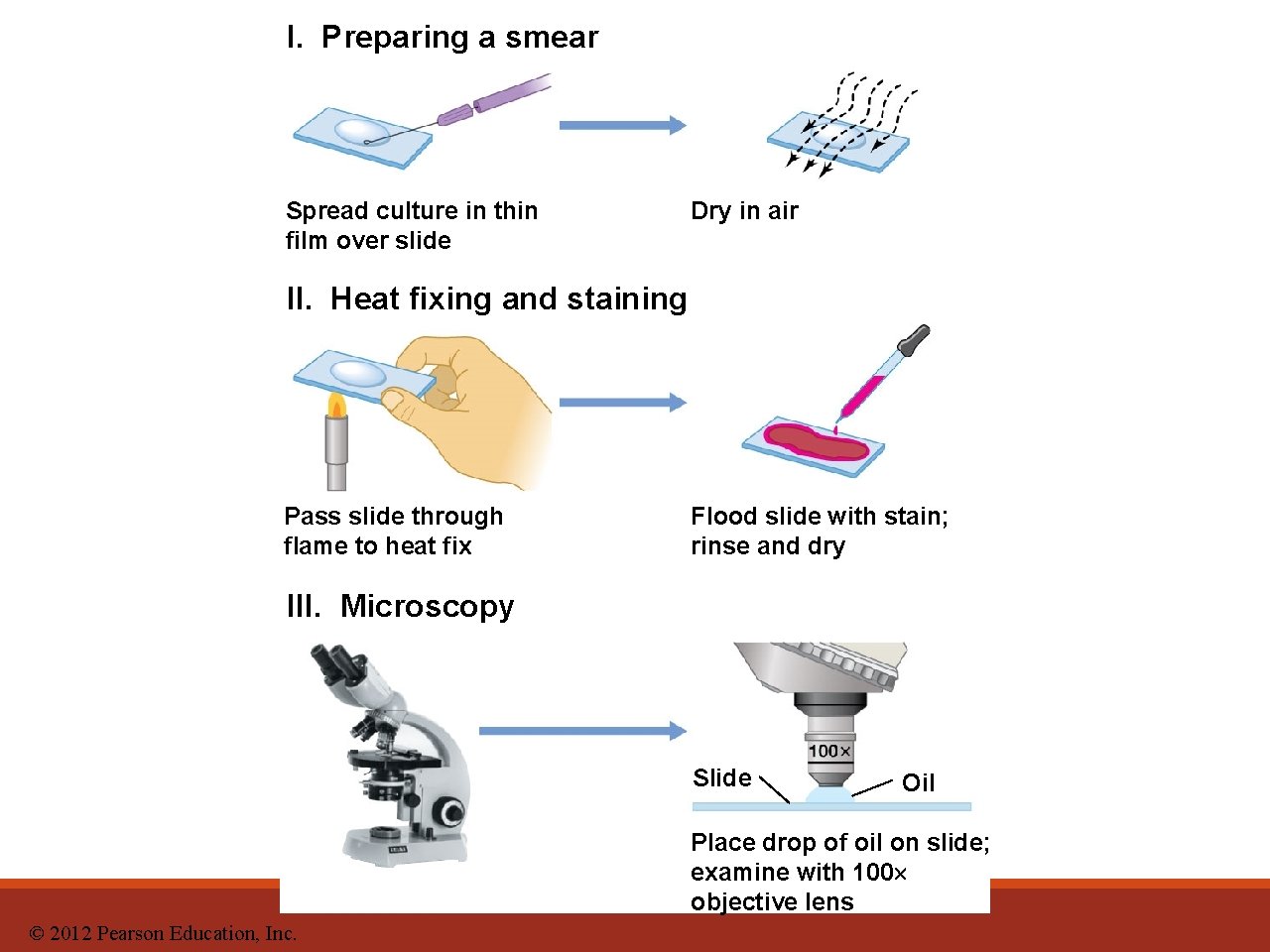
I. Preparing a smear Spread culture in thin film over slide Dry in air II. Heat fixing and staining Pass slide through flame to heat fix Flood slide with stain; rinse and dry III. Microscopy Slide Oil Place drop of oil on slide; examine with 100 objective lens © 2012 Pearson Education, Inc.
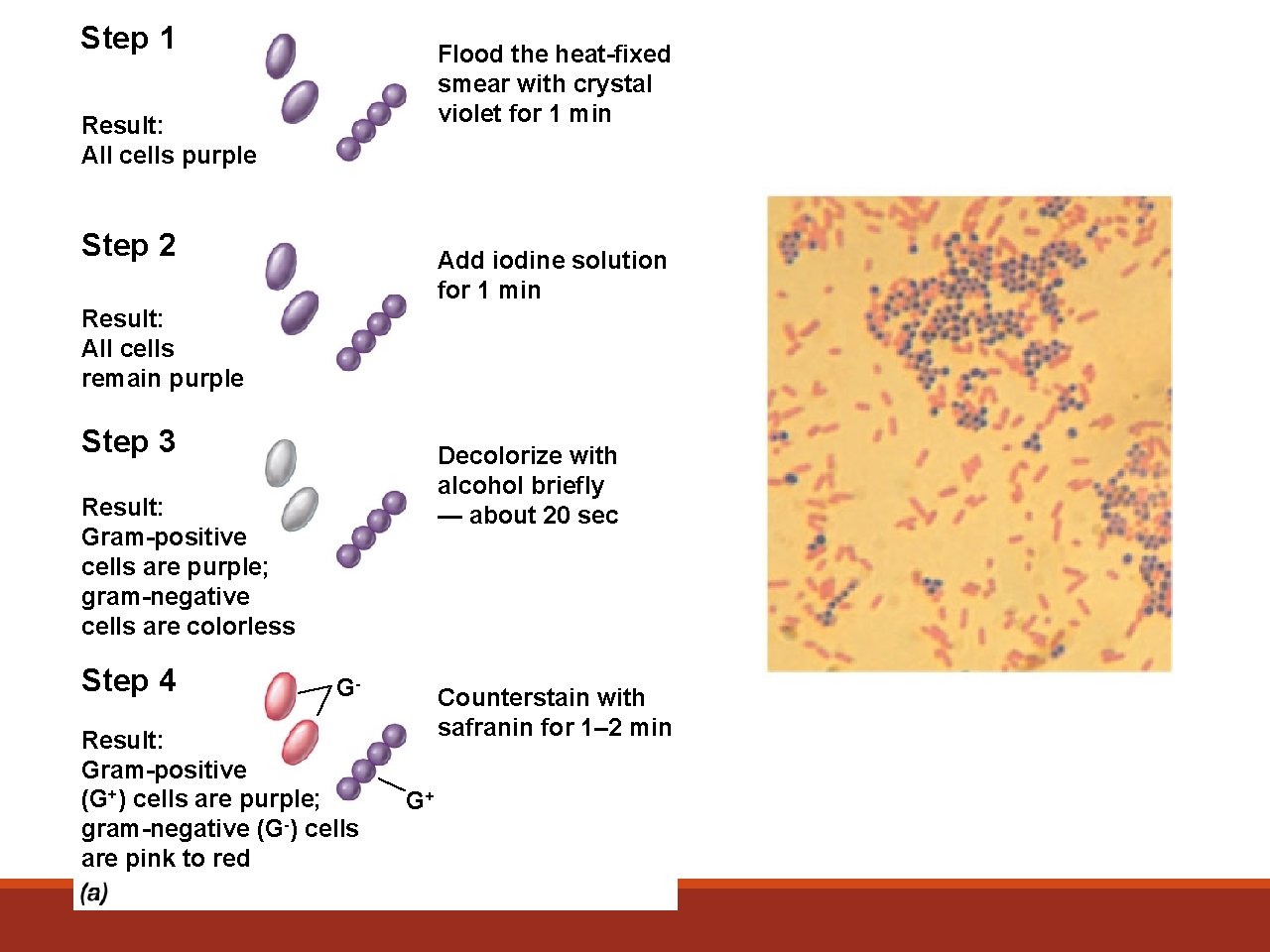
Step 1 Flood the heat-fixed smear with crystal violet for 1 min Result: All cells purple Step 2 Add iodine solution for 1 min Result: All cells remain purple Step 3 Decolorize with alcohol briefly — about 20 sec Result: Gram-positive cells are purple; gram-negative cells are colorless Step 4 G- Result: Gram-positive (G+) cells are purple; gram-negative (G-) cells are pink to red Counterstain with safranin for 1– 2 min G+
Electron Microscopy Electron microscopes use electrons instead of photons to image cells and structures. Two types of electron microscopes: ◦ Transmission electron microscopes (TEM) ◦ Scanning electron microscopes (SEM) Home work 1 - Differentiate between the 4 types of light microscopy. Provide examples of images produced by each type. 2 - Explain the difference between the 2 types of electron microscope. Provide examples of images produced by each types 3 - Is there any other types of microscopies?
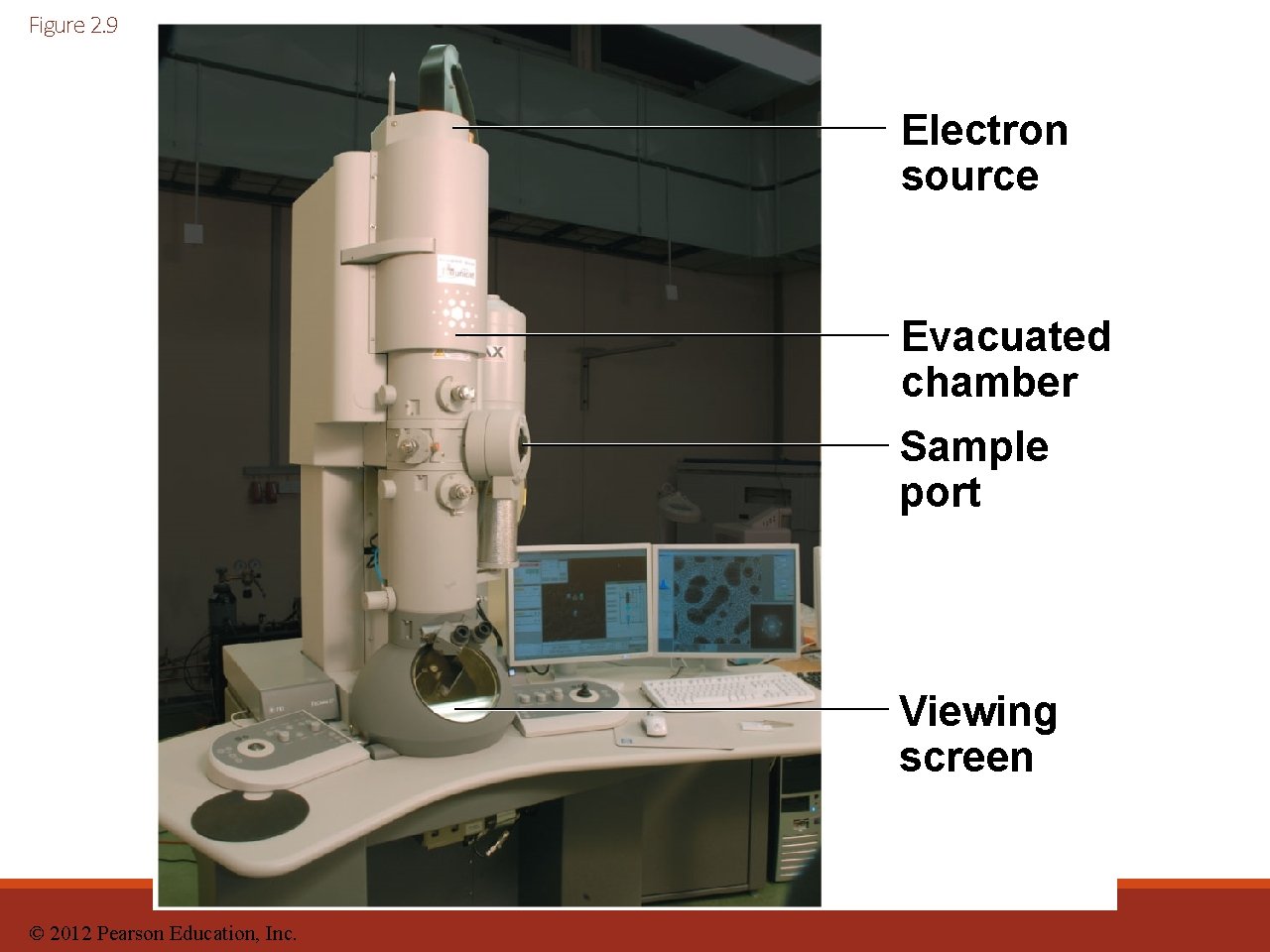
Figure 2. 9 Electron source Evacuated chamber Sample port Viewing screen © 2012 Pearson Education, Inc.
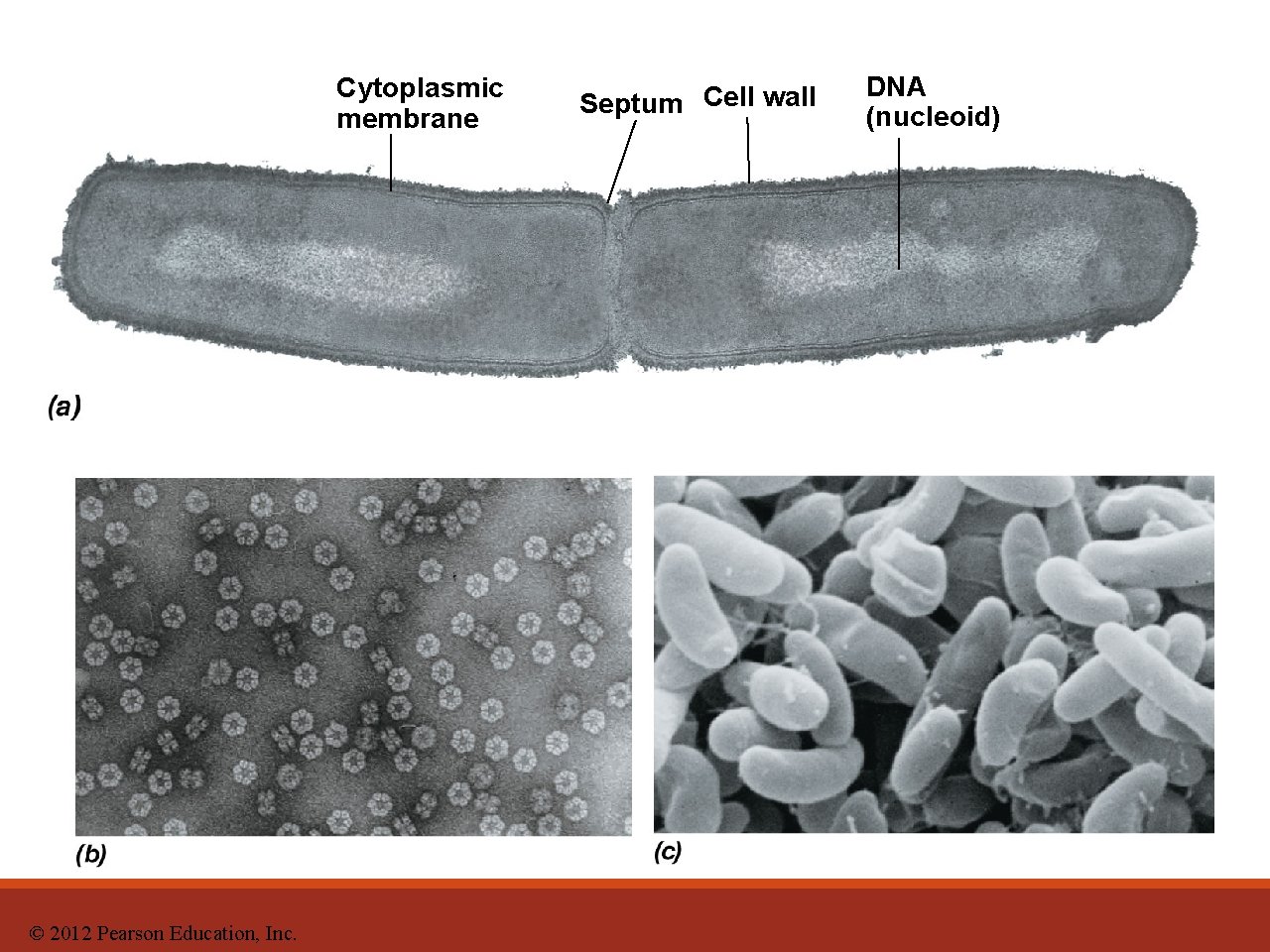
Cytoplasmic membrane © 2012 Pearson Education, Inc. Septum Cell wall DNA (nucleoid)

REMEMBER You can always ask questions through our discussion board on www. lms. ksu. edu. sa
- Slides: 77