
Welcome Worldviews Ellen Waddell Instructor AGENDA Worldviews The

- Slides: 51
Welcome! Worldviews Ellen Waddell Instructor
AGENDA • Worldviews • The deep structure of culture vs. religion – The deep structure of culture deals with issues that matter most to people • Personal Communication Worldview Survey
• “I never talk about politics or religion” – Why do we use this philosophy? – ”For some unexplainable reason, the responsibility of generating and preserving the elements of world view has rested with either religious institutions (for example, the Catholic church) or spiritual leaders (for example, Buddha). ” (Samovar and Porter)
Epistemology, Ontology & Semantics Epistemology: The academic field that studies how you know what you know n Ontology: The academic field that studies what you do with what you know n Semantics- The academic field that studies the meanings attributed to verbal and nonverbal communication. n n All academic research is dependent upon the worldview of the researcher and of the field of study
Worldviews & Academia – “academic research is also cultural behavior, because research traditions require particular worldviews about the nature of reality and knowledge and particular beliefs about how research should be conducted. ” (Martin and Nakayama) • How are the power bases reflected in the worldview issue?
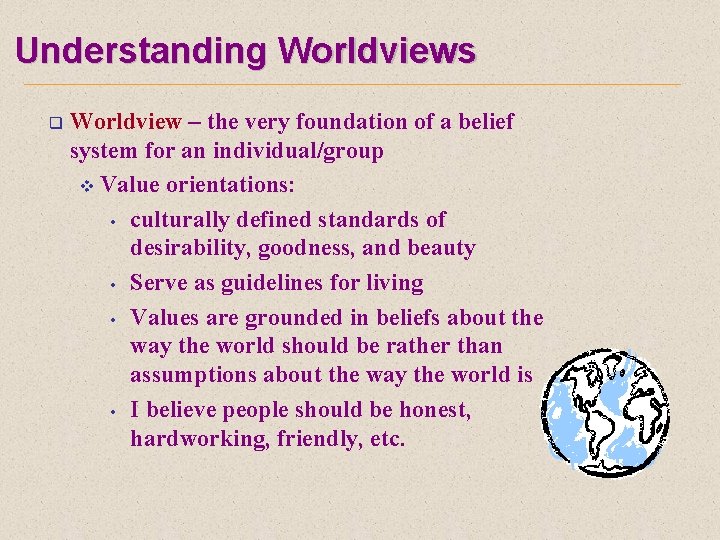
Understanding Worldviews q Worldview – the very foundation of a belief system for an individual/group v Value orientations: • culturally defined standards of desirability, goodness, and beauty • Serve as guidelines for living • Values are grounded in beliefs about the way the world should be rather than assumptions about the way the world is • I believe people should be honest, hardworking, friendly, etc.
Understand Beliefs n Beliefs – confidence in the truth of something l l l Measured on a probable – improbable scale Belief system – everything you agree is true Disbelief system – all things you think are not true Understand not only cultural attitudes, but also beliefs n The more central a belief, the harder members will work to defend it, and less willing they will be to change it n
Understanding Worldviews n What is the foundation, or the “platform” for the: Ø Republican Party Ø Democratic Party
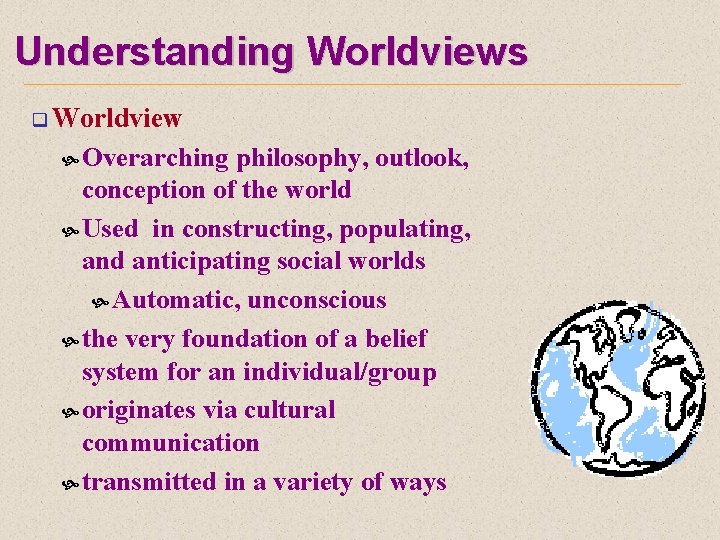
Understanding Worldviews q Worldview Overarching philosophy, outlook, conception of the world Used in constructing, populating, and anticipating social worlds Automatic, unconscious the very foundation of a belief system for an individual/group originates via cultural communication transmitted in a variety of ways
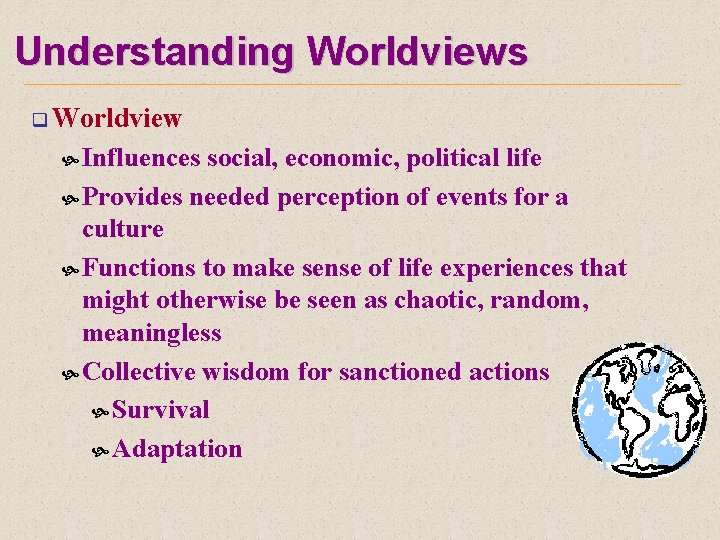
Understanding Worldviews q Worldview Influences social, economic, political life Provides needed perception of events for a culture Functions to make sense of life experiences that might otherwise be seen as chaotic, random, meaningless Collective wisdom for sanctioned actions Survival Adaptation
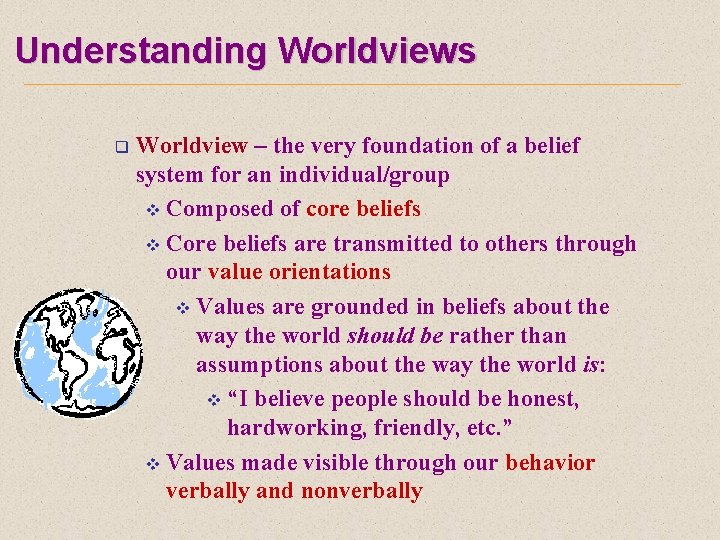
Understanding Worldviews q Worldview – the very foundation of a belief system for an individual/group v Composed of core beliefs v Core beliefs are transmitted to others through our value orientations v Values are grounded in beliefs about the way the world should be rather than assumptions about the way the world is: v “I believe people should be honest, hardworking, friendly, etc. ” v Values made visible through our behavior verbally and nonverbally
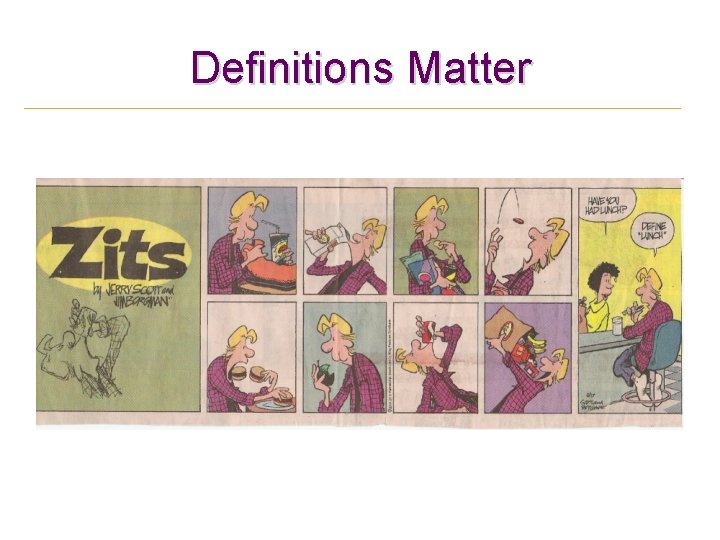
Definitions Matter
Understand Your Listeners’ Worldview • Defining values=priorities and importance – Generation interviews • • • Faith & Religious Beliefs Family Social status Career success Wealth/Financial independence
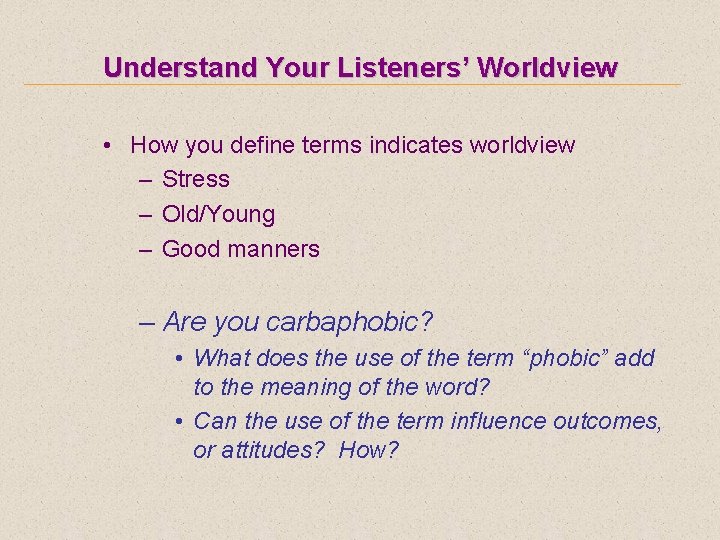
Understand Your Listeners’ Worldview • How you define terms indicates worldview – Stress – Old/Young – Good manners – Are you carbaphobic? • What does the use of the term “phobic” add to the meaning of the word? • Can the use of the term influence outcomes, or attitudes? How?
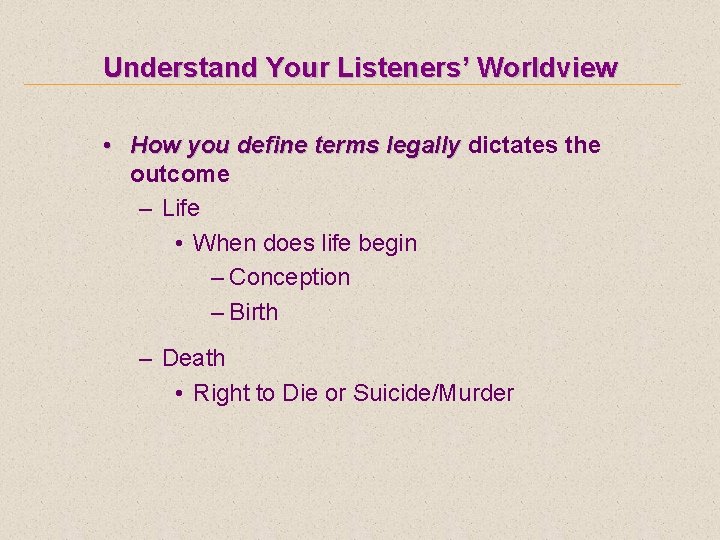
Understand Your Listeners’ Worldview • How you define terms legally dictates the outcome – Life • When does life begin – Conception – Birth – Death • Right to Die or Suicide/Murder
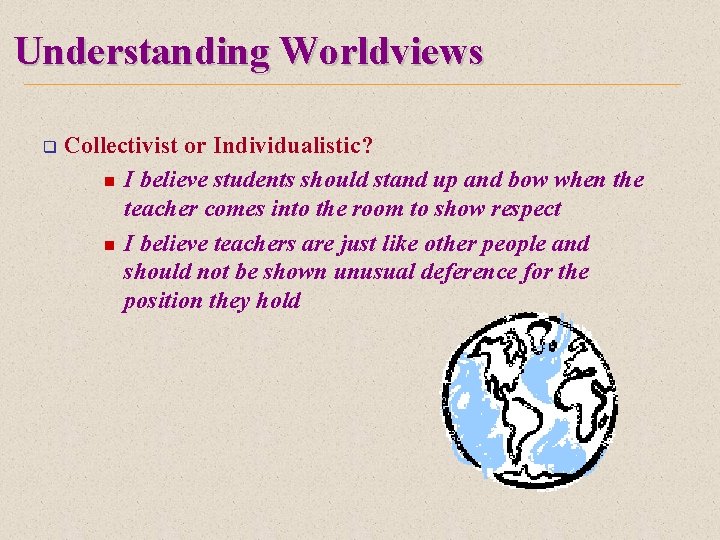
Understanding Worldviews q Collectivist or Individualistic? n I believe students should stand up and bow when the teacher comes into the room to show respect n I believe teachers are just like other people and should not be shown unusual deference for the position they hold
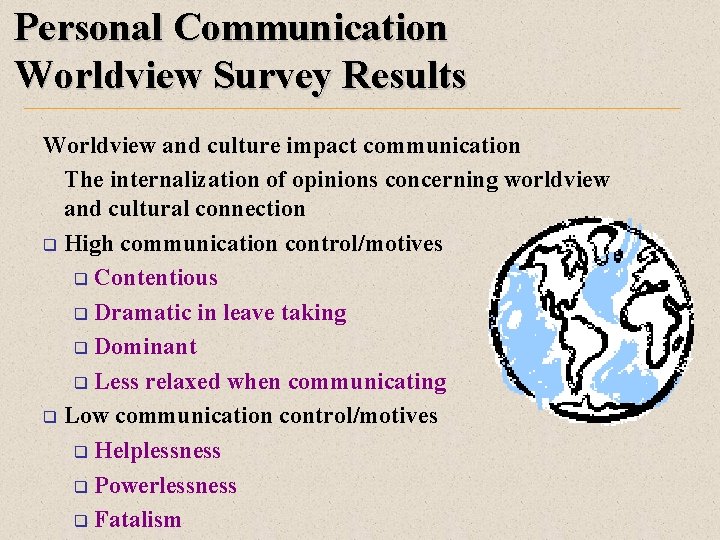
Personal Communication Worldview Survey Results Worldview and culture impact communication The internalization of opinions concerning worldview and cultural connection q High communication control/motives q Contentious q Dramatic in leave taking q Dominant q Less relaxed when communicating q Low communication control/motives q Helplessness q Powerlessness q Fatalism
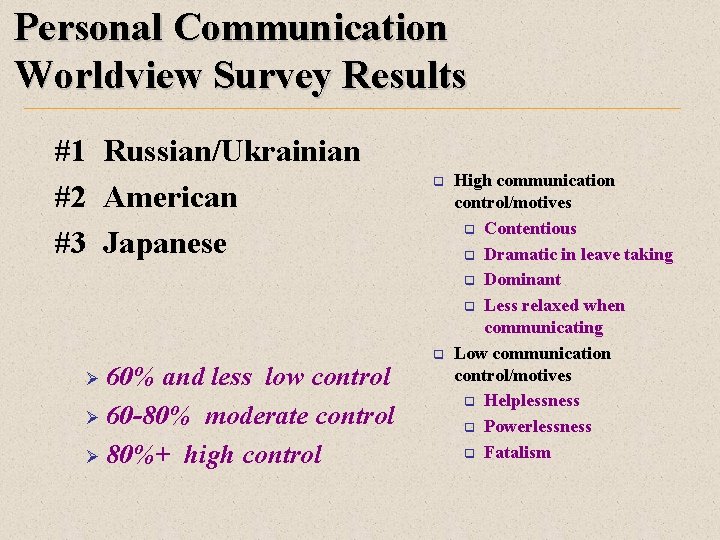
Personal Communication Worldview Survey Results #1 Russian/Ukrainian #2 American #3 Japanese 60% and less low control Ø 60 -80% moderate control Ø 80%+ high control Ø q q High communication control/motives q Contentious q Dramatic in leave taking q Dominant q Less relaxed when communicating Low communication control/motives q Helplessness q Powerlessness q Fatalism
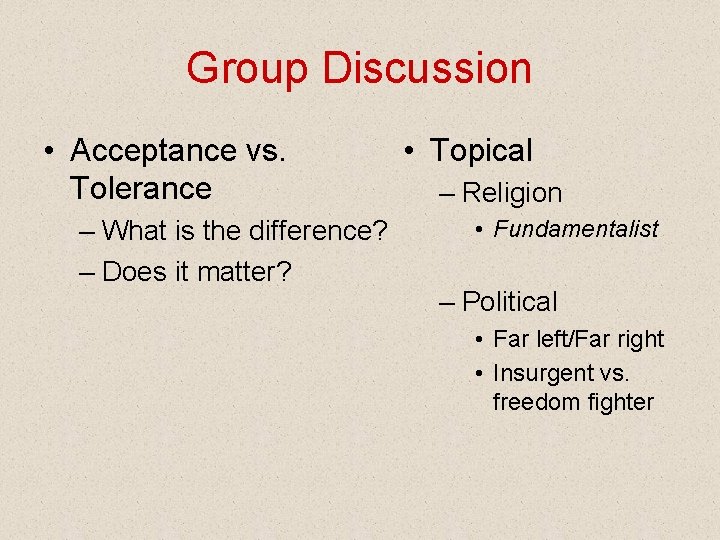
Group Discussion • Acceptance vs. Tolerance – What is the difference? – Does it matter? • Topical – Religion • Fundamentalist – Political • Far left/Far right • Insurgent vs. freedom fighter
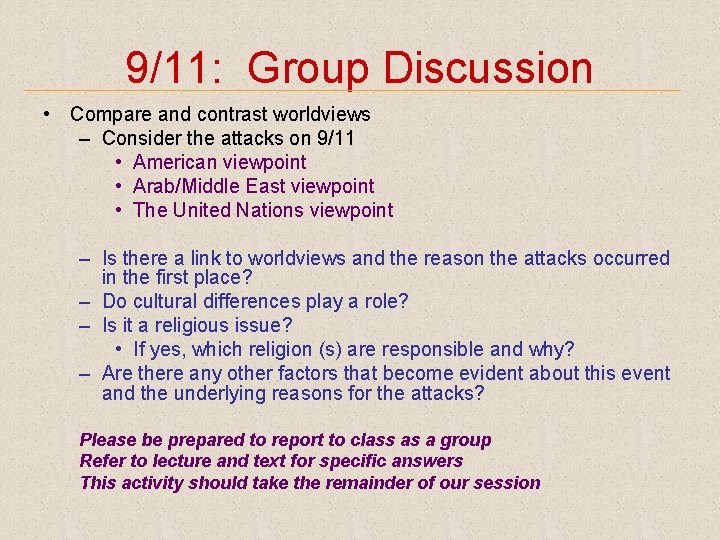
9/11: Group Discussion • Compare and contrast worldviews – Consider the attacks on 9/11 • American viewpoint • Arab/Middle East viewpoint • The United Nations viewpoint – Is there a link to worldviews and the reason the attacks occurred in the first place? – Do cultural differences play a role? – Is it a religious issue? • If yes, which religion (s) are responsible and why? – Are there any other factors that become evident about this event and the underlying reasons for the attacks? Please be prepared to report to class as a group Refer to lecture and text for specific answers This activity should take the remainder of our session
• End of presentation
Welcome! The Deep Structure of Religion Ellen Waddell Instructor
AGENDA • Review Worldviews • The deep structure of culture vs. religion – The deep structure of culture deals with issues that matter most to people
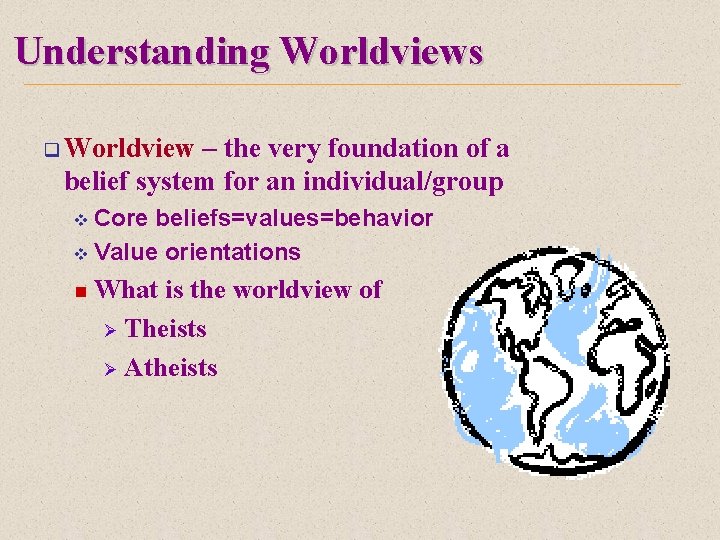
Understanding Worldviews q Worldview – the very foundation of a belief system for an individual/group Core beliefs=values=behavior v Value orientations v n What is the worldview of Ø Theists Ø Atheists
Understand Beliefs n Beliefs – confidence in the truth of something l l l Measured on a probable – improbable scale Belief system – everything you agree is true Disbelief system – all things you think are not true Understand not only cultural attitudes, but also beliefs n The more central a belief, the harder members will work to defend it, and less willing they will be to change it n
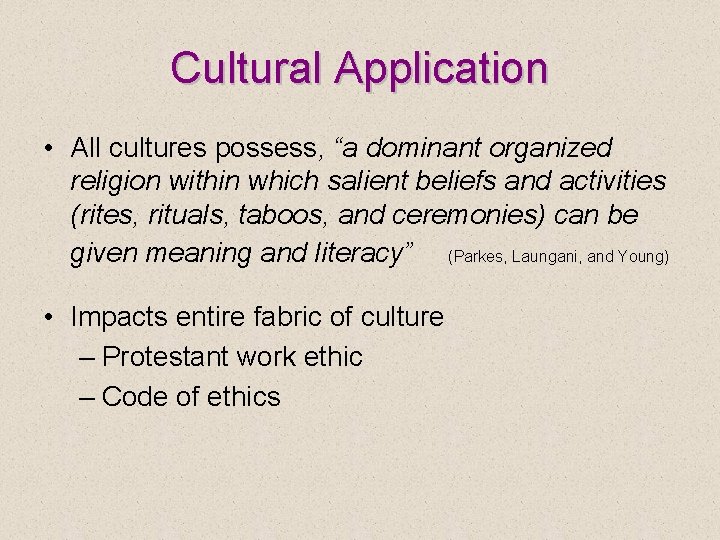
Cultural Application • All cultures possess, “a dominant organized religion within which salient beliefs and activities (rites, rituals, taboos, and ceremonies) can be given meaning and literacy” (Parkes, Laungani, and Young) • Impacts entire fabric of culture – Protestant work ethic – Code of ethics
The Good/Evil Continuum What did you learn about yourself concerning good and evil? What did you learn about religious beliefs and the inclusion of good and evil?
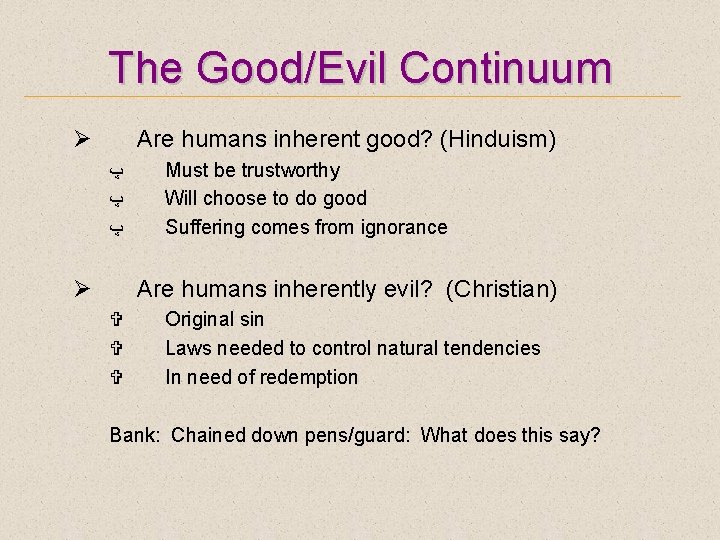
The Good/Evil Continuum Ø Are humans inherent good? (Hinduism) ﭖ ﭖ ﭖ Ø Must be trustworthy Will choose to do good Suffering comes from ignorance Are humans inherently evil? (Christian) V V V Original sin Laws needed to control natural tendencies In need of redemption Bank: Chained down pens/guard: What does this say?
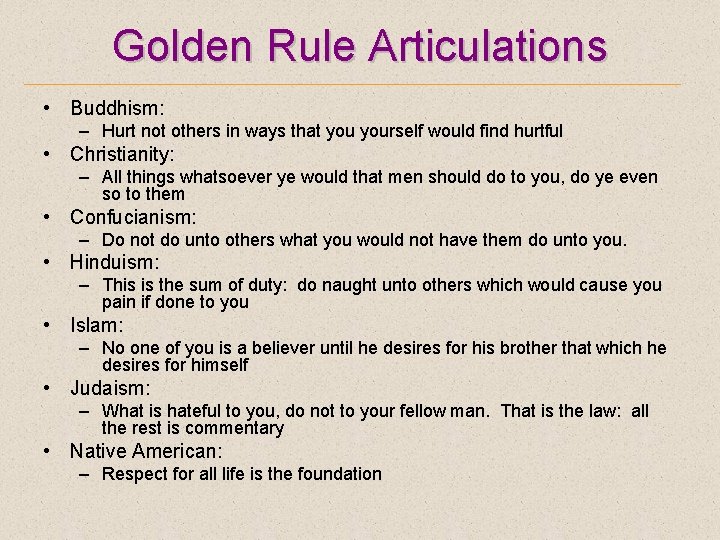
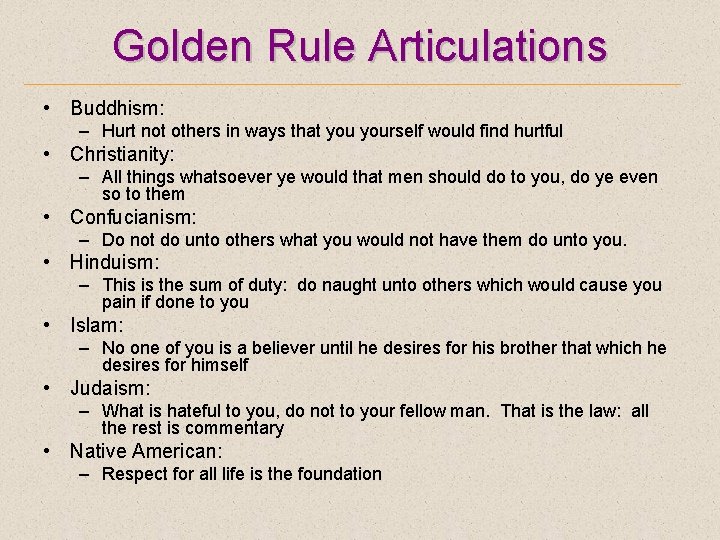
Golden Rule Articulations • Buddhism: – Hurt not others in ways that yourself would find hurtful • Christianity: – All things whatsoever ye would that men should do to you, do ye even so to them • Confucianism: – Do not do unto others what you would not have them do unto you. • Hinduism: – This is the sum of duty: do naught unto others which would cause you pain if done to you • Islam: – No one of you is a believer until he desires for his brother that which he desires for himself • Judaism: – What is hateful to you, do not to your fellow man. That is the law: all the rest is commentary • Native American: – Respect for all life is the foundation
Religion • Is religion myth based? fact based? • Review: – Epistemology/Ontology/Semantics – All academic research is dependent upon the worldview of the researcher and of the field of study
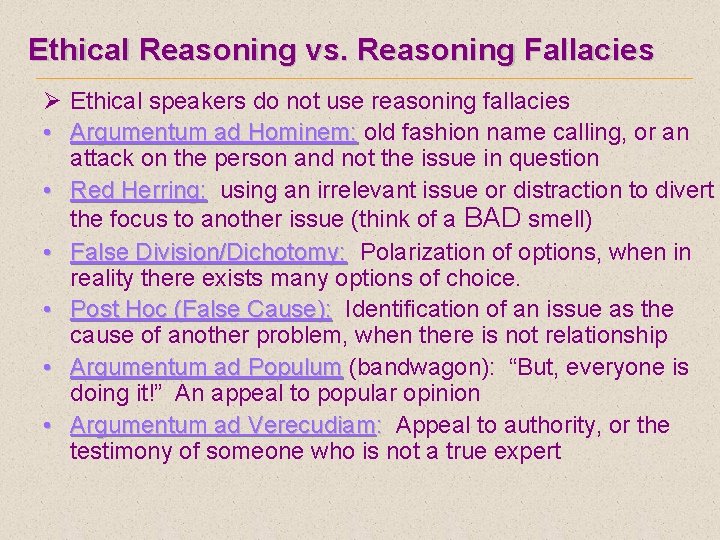
Ethical Reasoning vs. Reasoning Fallacies Ø Ethical speakers do not use reasoning fallacies • Argumentum ad Hominem: old fashion name calling, or an attack on the person and not the issue in question • Red Herring: using an irrelevant issue or distraction to divert the focus to another issue (think of a BAD smell) • False Division/Dichotomy: Polarization of options, when in reality there exists many options of choice. • Post Hoc (False Cause): Identification of an issue as the cause of another problem, when there is not relationship • Argumentum ad Populum (bandwagon): “But, everyone is doing it!” An appeal to popular opinion • Argumentum ad Verecudiam: Appeal to authority, or the testimony of someone who is not a true expert
Religion • Myth? Fact? – Jewish history – WWII
Understand Beliefs “It is clear that religion and culture are inextricably intertwined” (Lamb) n “Religion and civilization seem to have gone hand in the evolution of human society to the extent that one could conclude that they are coequal and co-terminus” (Guruge) n
The Importance of Religion works to generate and preserve elements of world views “A man devoid of religion is like a horse without a bridle” Latin proverb
The Importance of Religion • Psychological • Social • Reduce anxiety of the unknown – Make it more understandable – Comfort in time of crises – Right/wrong clear – Rituals
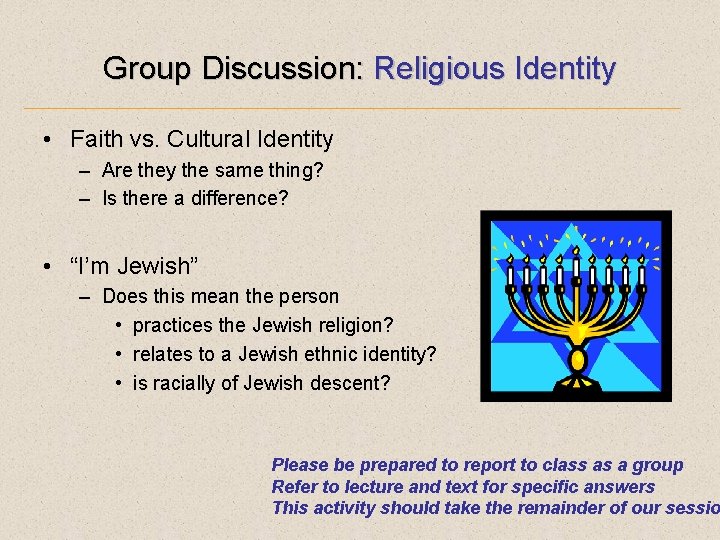
Group Discussion: Religious Identity • Faith vs. Cultural Identity – Are they the same thing? – Is there a difference? • “I’m Jewish” – Does this mean the person • practices the Jewish religion? • relates to a Jewish ethnic identity? • is racially of Jewish descent? Please be prepared to report to class as a group Refer to lecture and text for specific answers This activity should take the remainder of our sessio
• End of presentation
Welcome! The Deep Structure of Religion Ellen Waddell Instructor
AGENDA • Review – Worldviews – The deep structure of culture vs. religion • Religion and culture in action – Video examples • And a little fun…
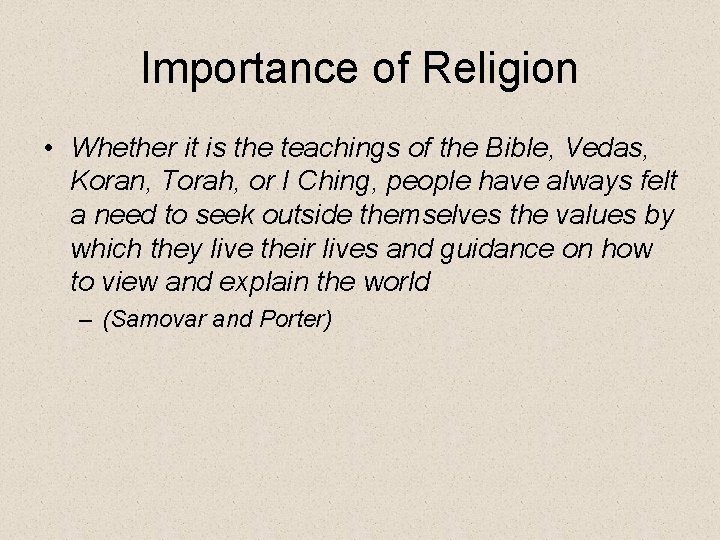
Importance of Religion • Whether it is the teachings of the Bible, Vedas, Koran, Torah, or I Ching, people have always felt a need to seek outside themselves the values by which they live their lives and guidance on how to view and explain the world – (Samovar and Porter)
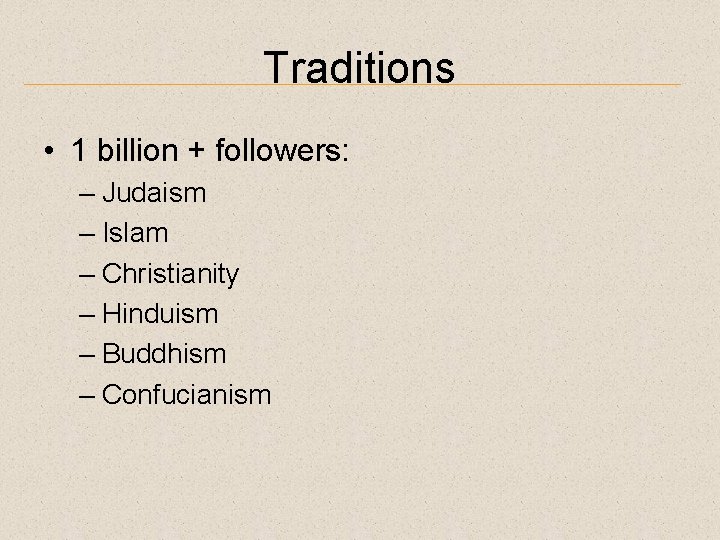
Traditions • 1 billion + followers: – Judaism – Islam – Christianity – Hinduism – Buddhism – Confucianism
Golden Rule Articulations • Buddhism: – Hurt not others in ways that yourself would find hurtful • Christianity: – All things whatsoever ye would that men should do to you, do ye even so to them • Confucianism: – Do not do unto others what you would not have them do unto you. • Hinduism: – This is the sum of duty: do naught unto others which would cause you pain if done to you • Islam: – No one of you is a believer until he desires for his brother that which he desires for himself • Judaism: – What is hateful to you, do not to your fellow man. That is the law: all the rest is commentary • Native American: – Respect for all life is the foundation
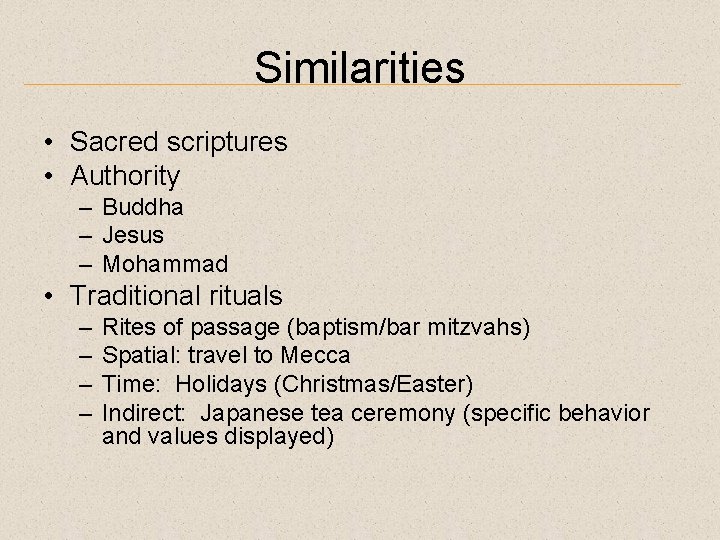
Similarities • Sacred scriptures • Authority – Buddha – Jesus – Mohammad • Traditional rituals – – Rites of passage (baptism/bar mitzvahs) Spatial: travel to Mecca Time: Holidays (Christmas/Easter) Indirect: Japanese tea ceremony (specific behavior and values displayed)
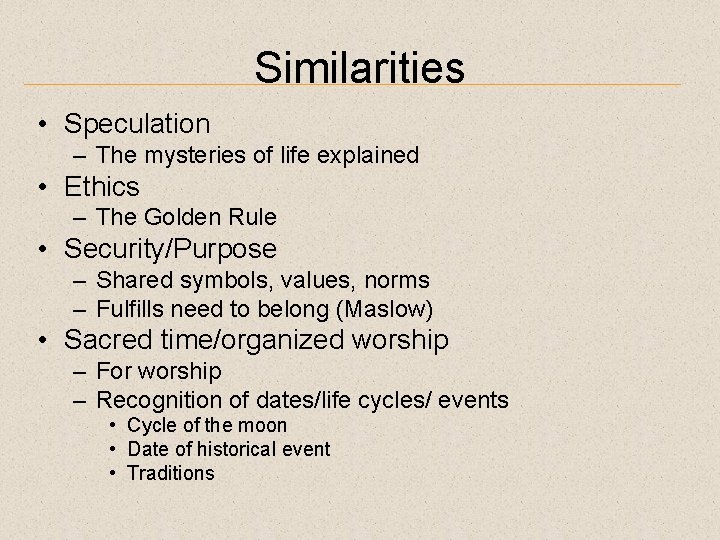
Similarities • Speculation – The mysteries of life explained • Ethics – The Golden Rule • Security/Purpose – Shared symbols, values, norms – Fulfills need to belong (Maslow) • Sacred time/organized worship – For worship – Recognition of dates/life cycles/ events • Cycle of the moon • Date of historical event • Traditions
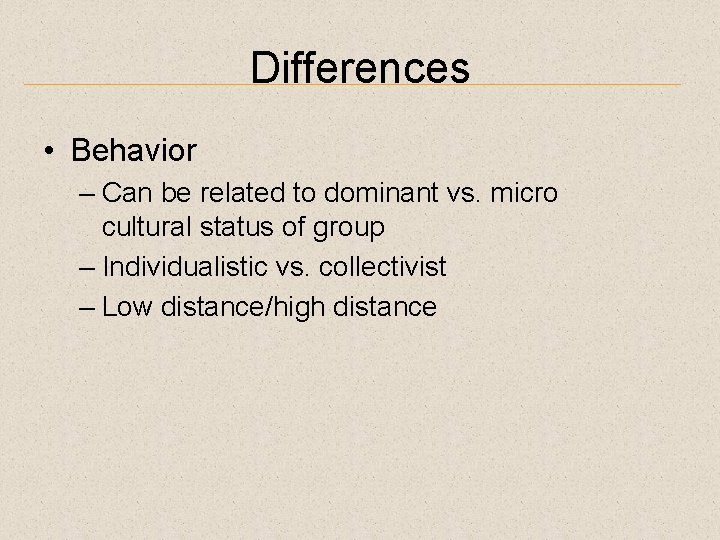
Differences • Behavior – Can be related to dominant vs. micro cultural status of group – Individualistic vs. collectivist – Low distance/high distance
African American Culture • Importance of the church to culture – Historical meaning – Religious identity – Political • Dr. Martin Luther King Jr. • Church burnings • Cross on lawns/KKK
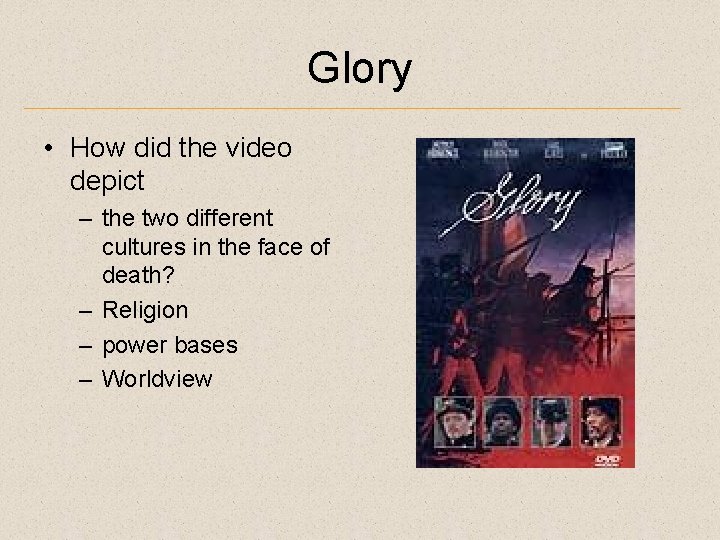
Glory • How did the video depict – the two different cultures in the face of death? – Religion – power bases – Worldview
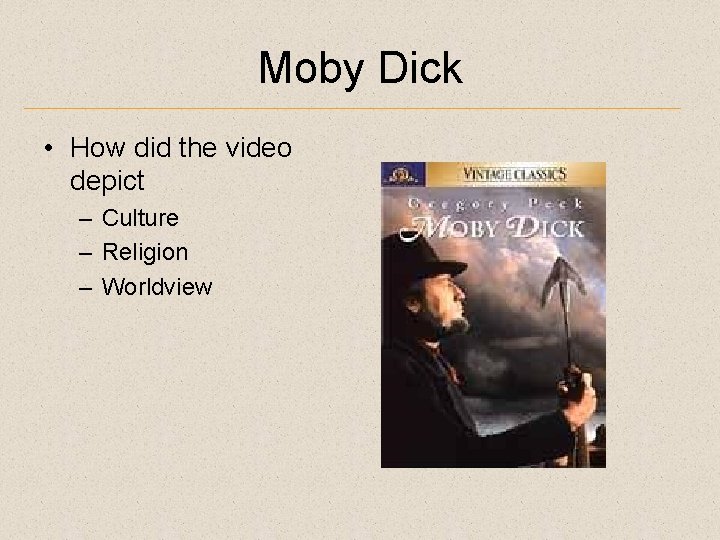
Moby Dick • How did the video depict – Culture – Religion – Worldview
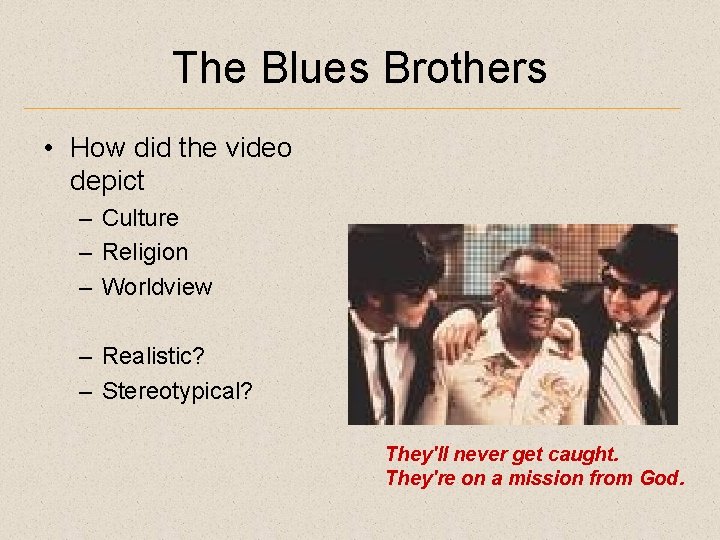
The Blues Brothers • How did the video depict – Culture – Religion – Worldview – Realistic? – Stereotypical? They'll never get caught. They're on a mission from God.
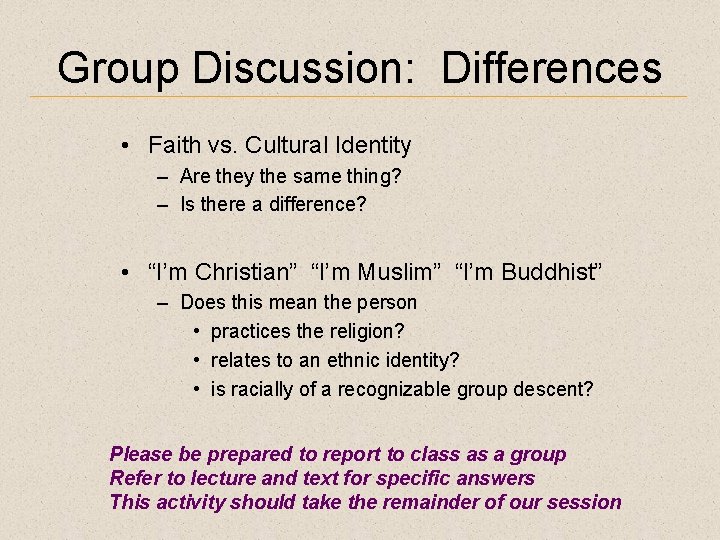
Group Discussion: Differences • Faith vs. Cultural Identity – Are they the same thing? – Is there a difference? • “I’m Christian” “I’m Muslim” “I’m Buddhist” – Does this mean the person • practices the religion? • relates to an ethnic identity? • is racially of a recognizable group descent? Please be prepared to report to class as a group Refer to lecture and text for specific answers This activity should take the remainder of our session
• End of presentation