
Welcome to ZTE University 2004 10 3 Class

- Slides: 23
Welcome to ZTE University! 2004. 10. 3
Class Rules Class Hours: 8: 40 AM - 11: 50 AM 14: 10 PM-17: 20 PM Little Breaks: Several short breaks throughout class Turn down ringers on mobile phones. No smoking in classroom
BSS Course Agenda Course 1: CDMA Foundation Theory Course 2: BSS Hardware Intruduction and Operation Course 3: Practice in Lab
Course 1 CDMA Foundation Theory • CDMA Overview • CDMA Basic Principle • CDMA Channel Structure and Modulation • CDMA Key Technology
CDMA Overview 2004. 10. 3
Objectives Upon completion of this lesson, the student will be able to master: -- the history of mobile communication -- the advantage of CDMA -- CDMA migration from 2 G to 3 G -- CDMA spectrum usage -- the role of ZTE in CDMA
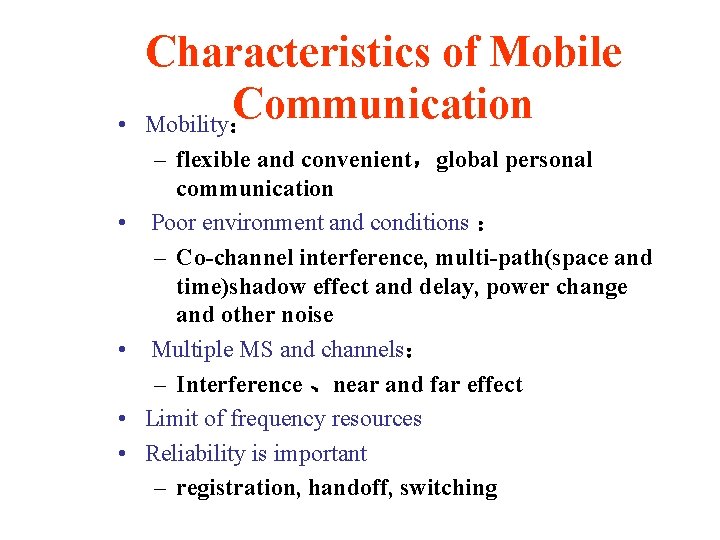
• • • Characteristics of Mobile Communication Mobility: – flexible and convenient,global personal communication Poor environment and conditions : – Co-channel interference, multi-path(space and time)shadow effect and delay, power change and other noise Multiple MS and channels: – Interference 、near and far effect Limit of frequency resources Reliability is important – registration, handoff, switching
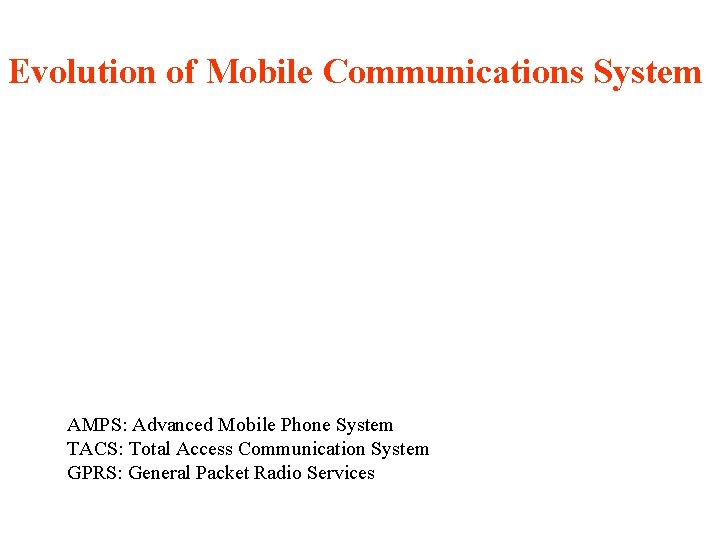
Evolution of Mobile Communications System AMPS: Advanced Mobile Phone System TACS: Total Access Communication System GPRS: General Packet Radio Services
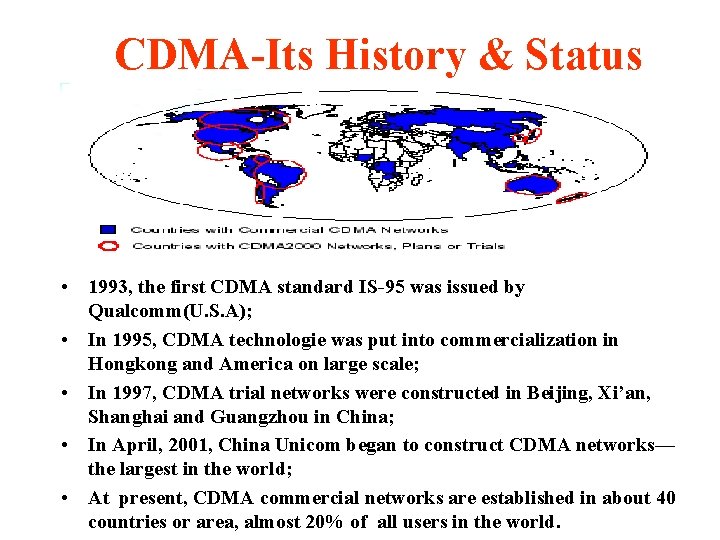
CDMA-Its History & Status • 1993, the first CDMA standard IS-95 was issued by Qualcomm(U. S. A); • In 1995, CDMA technologie was put into commercialization in Hongkong and America on large scale; • In 1997, CDMA trial networks were constructed in Beijing, Xi’an, Shanghai and Guangzhou in China; • In April, 2001, China Unicom began to construct CDMA networks— the largest in the world; • At present, CDMA commercial networks are established in about 40 countries or area, almost 20% of all users in the world.
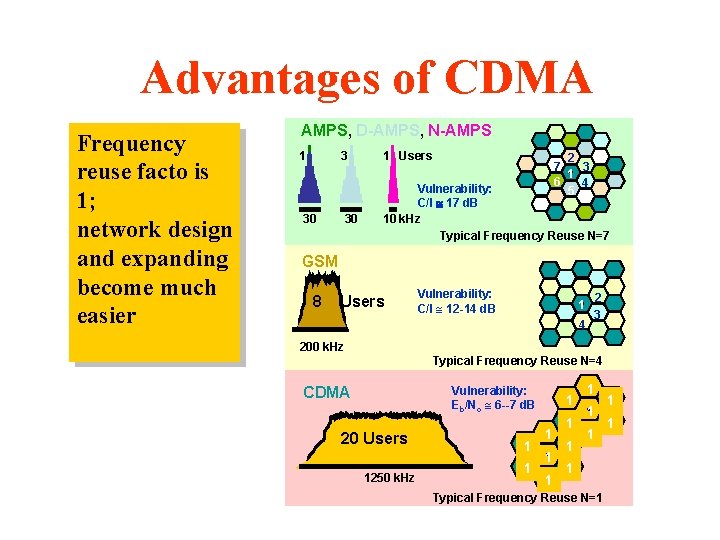
Advantages of CDMA Frequency reuse facto is 1; network design and expanding become much easier AMPS, D-AMPS, N-AMPS 1 3 30 30 1 Users 2 3 7 1 6 4 5 Vulnerability: C/I @ 17 d. B 10 k. Hz Typical Frequency Reuse N=7 GSM 8 Users Vulnerability: C/I @ 12 -14 d. B 2 3 1 4 200 k. Hz Typical Frequency Reuse N=4 CDMA Vulnerability: Eb/No @ 6 --7 d. B 20 Users 1250 k. Hz 1 1 1 Typical Frequency Reuse N=1 1 1
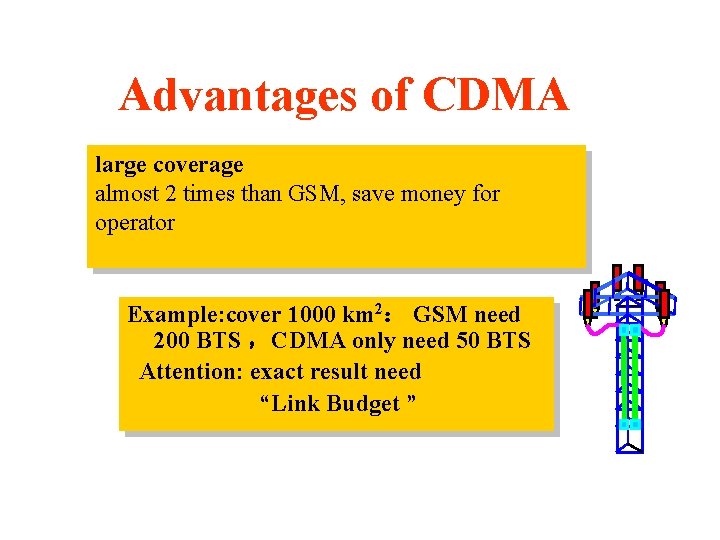
Advantages of CDMA large coverage almost 2 times than GSM, save money for operator Example: cover 1000 km 2: GSM need 200 BTS ,CDMA only need 50 BTS Attention: exact result need “Link Budget ”
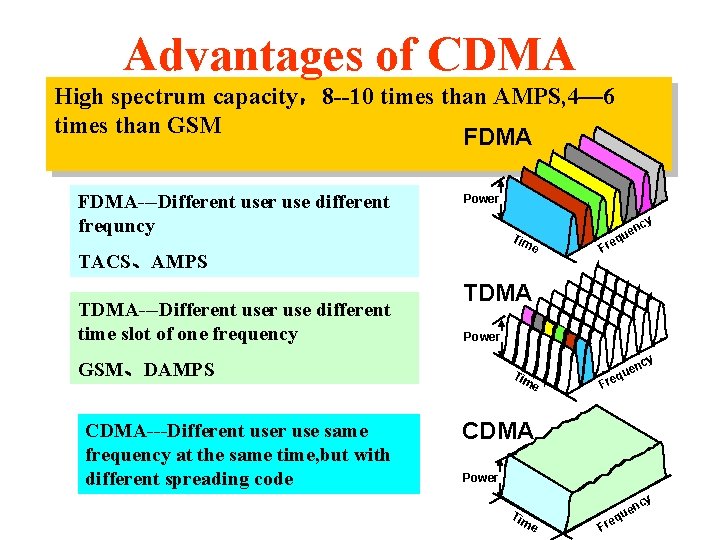
Advantages of CDMA High spectrum capacity,8 --10 times than AMPS, 4— 6 times than GSM FDMA---Different user use different frequncy Power Tim TACS、AMPS TDMA---Different user use different time slot of one frequency e e Fr TDMA Power GSM、DAMPS CDMA---Different user use same frequency at the same time, but with different spreading code y nc e qu Tim e y nc e qu Fre CDMA Power y Tim e Fr eq nc ue
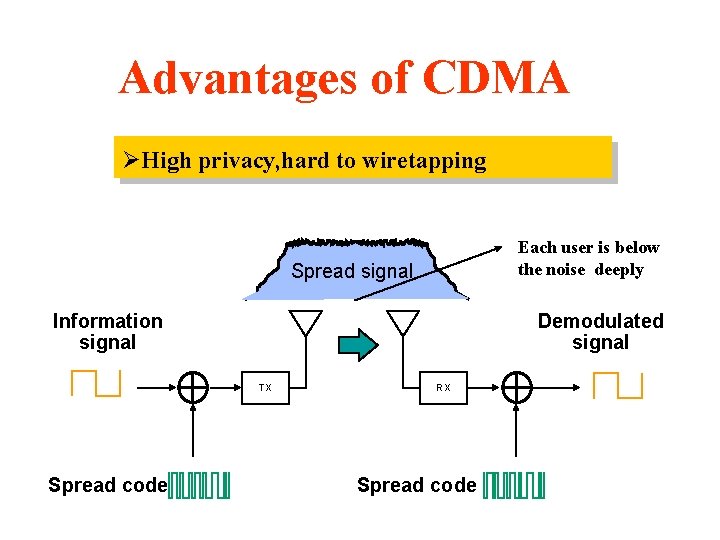
Advantages of CDMA ØHigh privacy, hard to wiretapping Each user is below the noise deeply Spread signal Information signal Demodulated signal TX Spread code RX Spread code
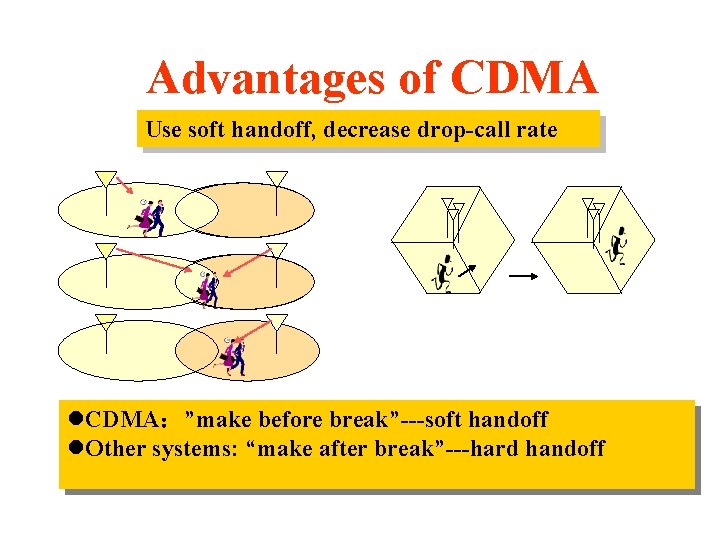
Advantages of CDMA Use soft handoff, decrease drop-call rate l. CDMA:”make before break”---soft handoff l. Other systems: “make after break”---hard handoff
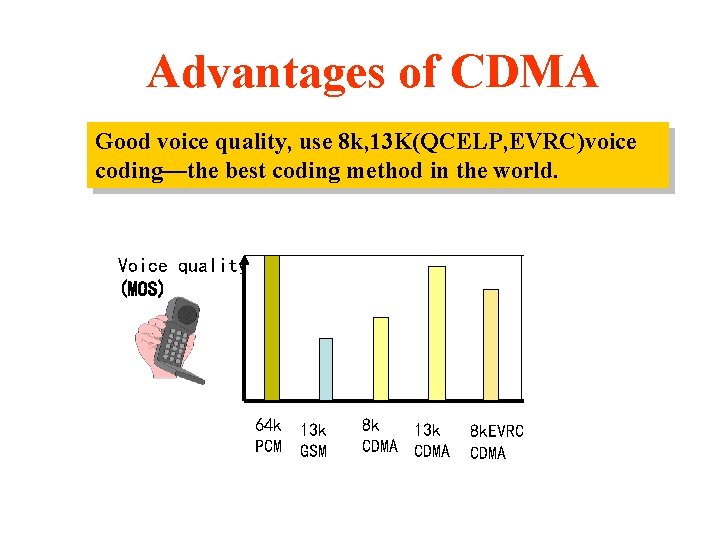
Advantages of CDMA Good voice quality, use 8 k, 13 K(QCELP, EVRC)voice coding—the best coding method in the world. Voice quality (MOS) 64 k PCM 13 k GSM 8 k 13 k CDMA 8 k. EVRC CDMA
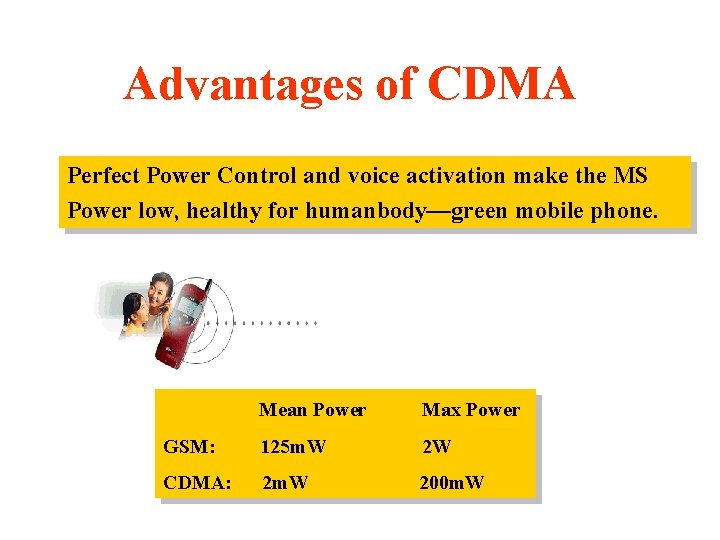
Advantages of CDMA Perfect Power Control and voice activation make the MS Power low, healthy for humanbody—green mobile phone. Mean Power Max Power GSM: 125 m. W 2 W CDMA: 2 m. W 200 m. W
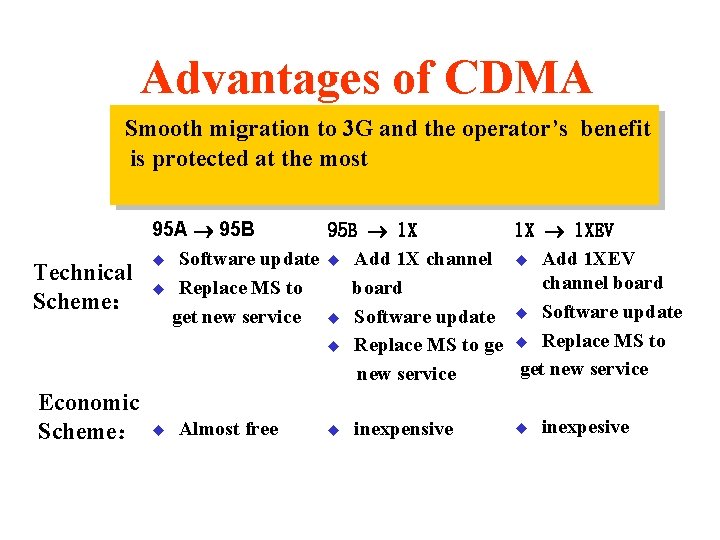
Advantages of CDMA Smooth migration to 3 G and the operator’s benefit is protected at the most Technical Scheme: Economic Scheme: 95 A 95 B 1 X 1 X 1 XEV u Software update u Add 1 X channel u Add 1 XEV channel board u Replace MS to board get new service u Software update u Replace MS to get new service u Almost free u inexpensive u inexpesive
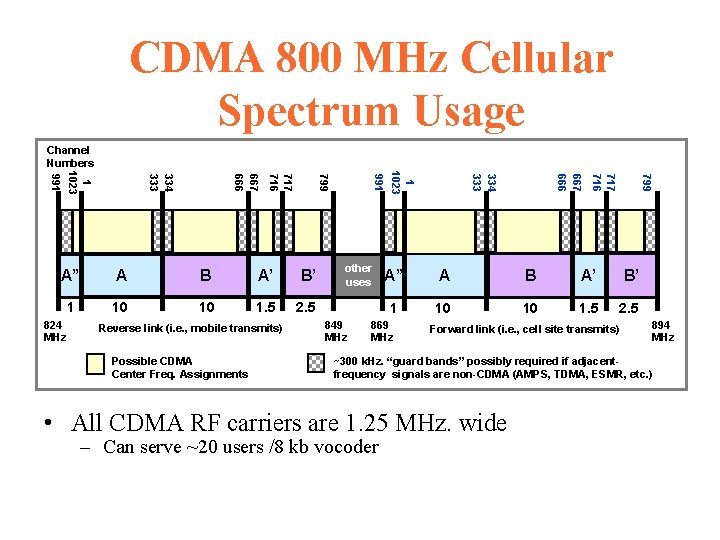
CDMA 800 MHz Cellular Spectrum Usage Channel Numbers 10 10 1. 5 2. 5 824 MHz Reverse link (i. e. , mobile transmits) Possible CDMA Center Freq. Assignments 849 MHz 799 1 other uses 717 716 B’ 667 666 A’ 334 333 B 1 1023 A 991 799 717 716 667 666 334 333 1 1023 991 A” A” A B A’ B’ 1 10 10 1. 5 2. 5 869 MHz Forward link (i. e. , cell site transmits) 894 MHz ~300 k. Hz. “guard bands” possibly required if adjacentfrequency signals are non-CDMA (AMPS, TDMA, ESMR, etc. ) • All CDMA RF carriers are 1. 25 MHz. wide – Can serve ~20 users /8 kb vocoder
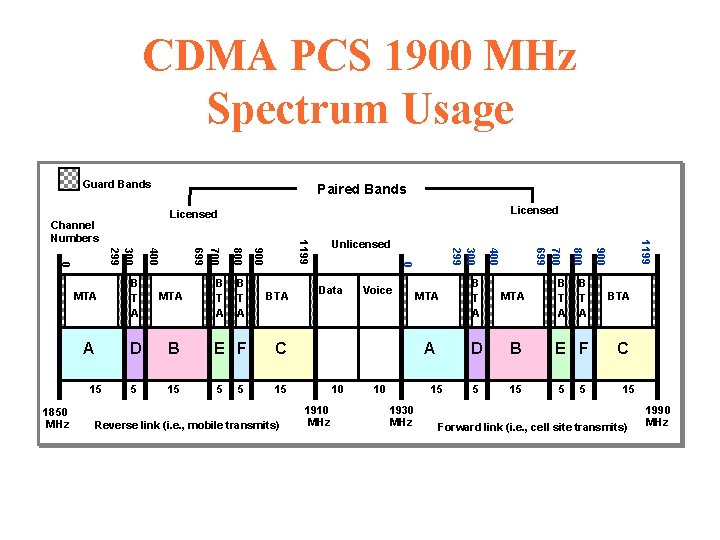
CDMA PCS 1900 MHz Spectrum Usage Guard Bands Paired Bands 15 5 Reverse link (i. e. , mobile transmits) 10 1910 MHz 10 MTA A D B 5 15 15 1930 MHz B T A 1199 5 B T A 900 15 5 MTA 800 C Voice 700 699 E F D Data 400 B A 300 299 BTA MTA 0 800 B T A 900 700 699 400 300 299 0 1850 MHz B T A MTA Unlicensed 1199 Channel Numbers 15 Licensed B T A BTA E F C 5 5 15 Forward link (i. e. , cell site transmits) 1990 MHz
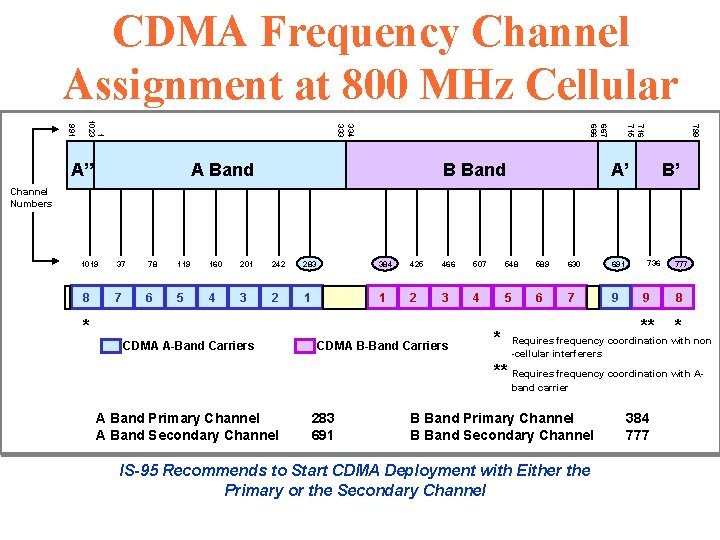
CDMA Frequency Channel Assignment at 800 MHz Cellular B Band 799 A Band 716 715 667 666 334 333 1 1023 991 A” A’ B’ Channel Numbers 1019 8 37 78 119 160 201 242 283 384 425 466 507 548 589 630 691 7 6 5 4 3 2 1 1 2 3 4 5 6 7 9 * CDMA A-Band Carriers CDMA B-Band Carriers * 736 777 9 8 ** * Requires frequency coordination with non -cellular interferers ** Requires frequency coordination with Aband carrier A Band Primary Channel A Band Secondary Channel 283 691 B Band Primary Channel B Band Secondary Channel IS-95 Recommends to Start CDMA Deployment with Either the Primary or the Secondary Channel 384 777
ZTE’s Activities in CDMA ( ( ( ( In 1995, CDMA mobile telecommunication project was started In November, 1999, ZTE signed the “Agreement on CDMA R&D” with Qualcomm In August, 2000, the first field trial was set up. In September, 2000, ZTE presented the first CDMA handset with UIM in th world. In January, 2001, the first cdma 2000 -1 x call was passed through in lab In March, 2001, ZTE cdma 2000 -1 x realized the integrated transmission of voice, data & image. The data rate reach up to 153. 6 Kbps. The certificates acquired: –CDMA 800 M ZXC 10 -MSC/VLR, HLR/AUC, BSC, BTS network access licenses –CDMA 800 M/1. 9 G ZXC 10 -BTS type approval certificates
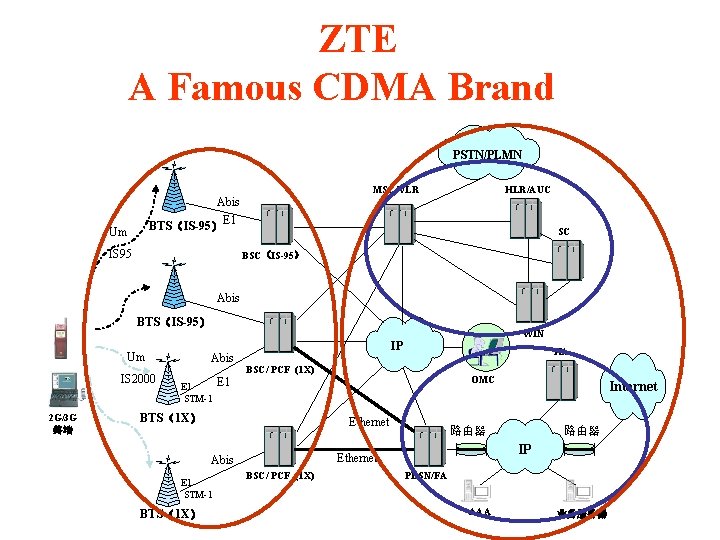
ZTE A Famous CDMA Brand PSTN/PLMN MSC/VLR HLR/AUC Abis BTS(IS-95)E 1 Um IS 95 SC BSC(IS-95) Abis BTS(IS-95) 2 G/3 G 终端 WIN Um Abis IS 2000 E 1 STM-1 IP BSC/ PCF (1 X) BTS(1 X) OMC Ethernet E 1 STM-1 BSC/ PCF (1 X) Internet 路由器 IP Ethernet Abis BTS(1 X) HA PDSN/FA AAA 业务服务器
The End!