
Welcome to your Registered Managers Network Focus of






- Slides: 69
Welcome to your Registered Manager’s Network
Focus of the session What are CQC really looking for in relation to ‘safe’ and ‘responsive’ services?
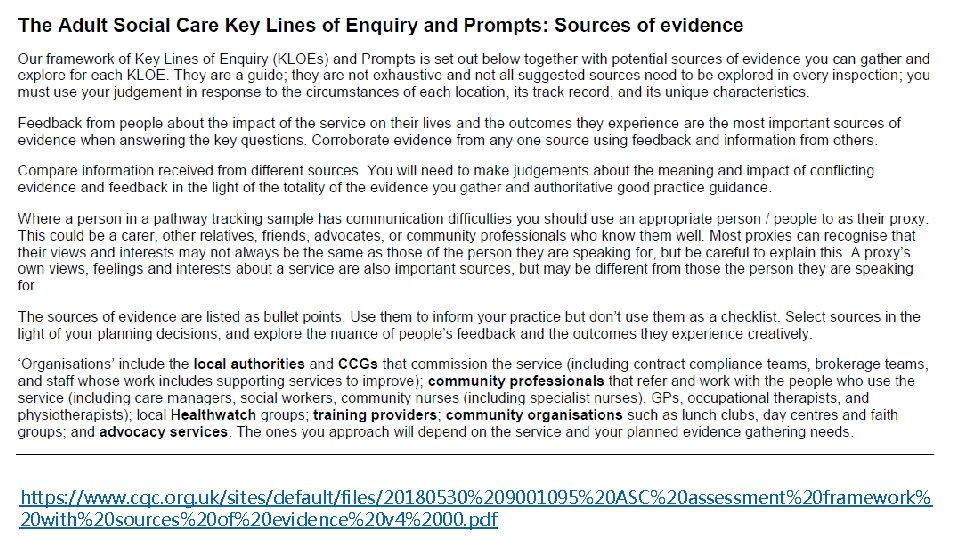
https: //www. cqc. org. uk/sites/default/files/20180530%209001095%20 ASC%20 assessment%20 framework% 20 with%20 sources%20 of%20 evidence%20 v 4%2000. pdf
https: //www. cqc. org. uk/sites/default/files/20180530%209001095%20 ASC%20 assessment%20 framework% 20 with%20 sources%20 of%20 evidence%20 v 4%2000. pdf
When it comes to inspections, it is not what you think that matters …. It is what CQC think The better you understand implement their expectations, the better you are likely to do
Keep things simple and then do those simple things well
The more aligned your approach is with CQC’s requirements …. the clearer and less ambiguous it will be
Registered Manager’s Network resources page https: //www. careandsupportwest. com/registered-managers-networkresources
S 1 – How do systems processes and practices safeguard people from abuse?
Systems, processes and practices that protect people from: Abuse and neglect Harassment and discrimination Breaches of dignity and respect Whatcha got?
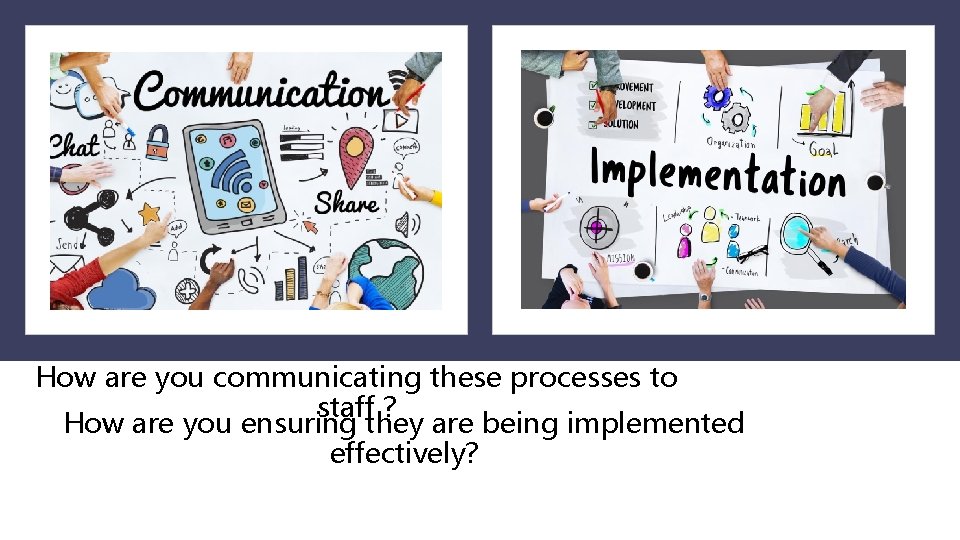
How are you communicating these processes to staff ? How are you ensuring they are being implemented effectively?
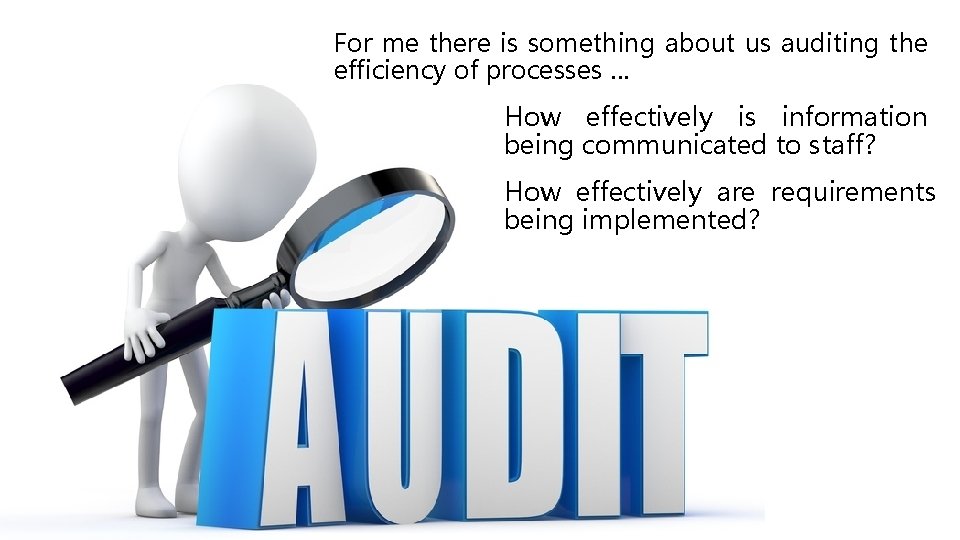
For me there is something about us auditing the efficiency of processes … How effectively is information being communicated to staff? How effectively are requirements being implemented?
Policy of the month … I like this idea
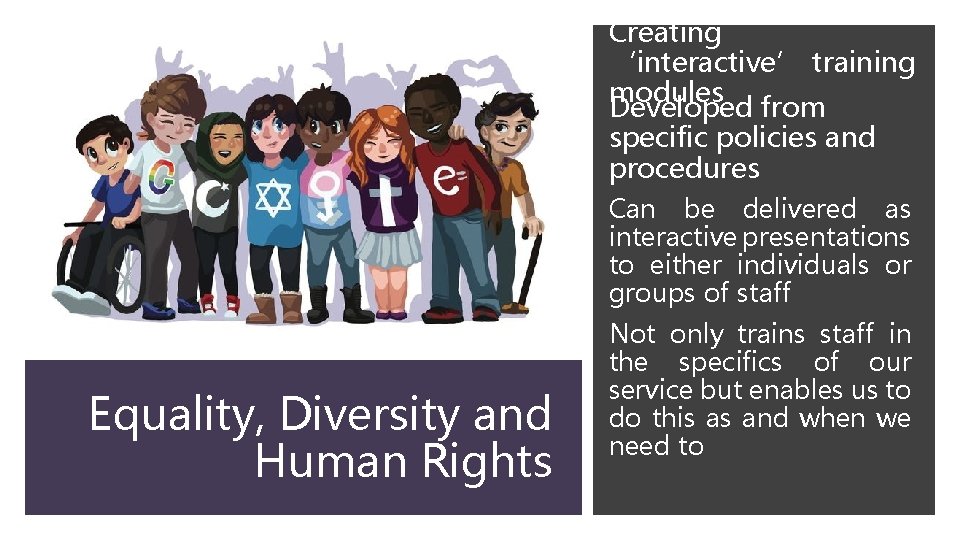
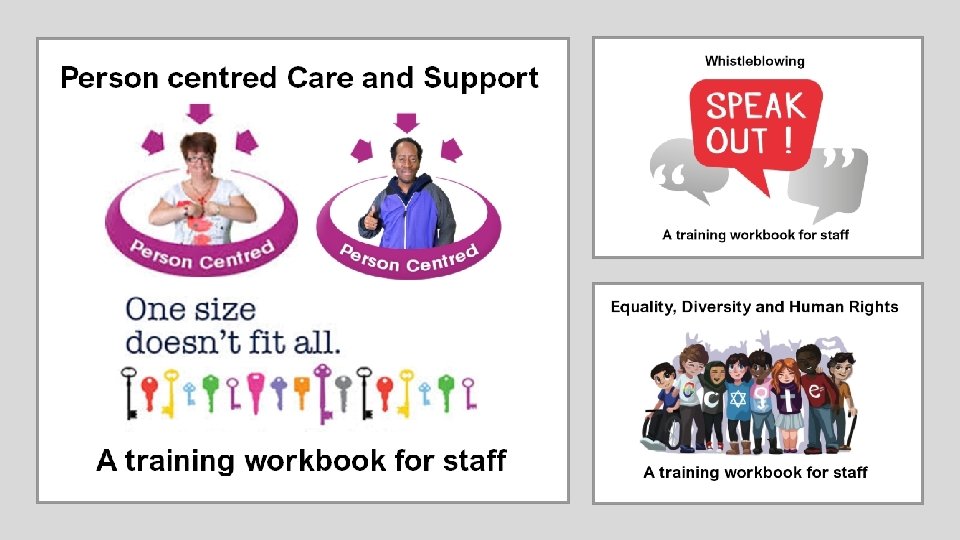
Creating ‘interactive’ training modules Developed from specific policies and procedures Can be delivered as interactive presentations to either individuals or groups of staff Equality, Diversity and Human Rights Not only trains staff in the specifics of our service but enables us to do this as and when we need to
Key aspects of practice … what staff ‘need to know’
Covers: Our vision and values Your duty of care Delivering a person centred service The Mental Capacity Act 2005 Consent to care, treatment and support Record keeping Confidentiality and sharing information Safeguarding Whistleblowing Responding to people’s concerns and complaints Duty of Candour
Covers: The Deprivation of Liberty Safeguards Ensuring equality, respecting diversity and preventing discrimination The Human Rights principles CQC – who they are and what to do if they turn up
How are you supporting people to stay safe and raise concerns if they have any?
S 1 - Safeguarding Make sure you: Keep your staff training up to date Safeguarding Check staff knowledge in relation to Safeguarding and satisfy yourself in relation to this Report all incidents that could be considered Safeguarding Complete Statutory Notification and submit to CQC for safeguarding incidents
S 1 - Safeguarding Make sure you: Provide information to people about Safeguarding and how to raise concerns Anything else …
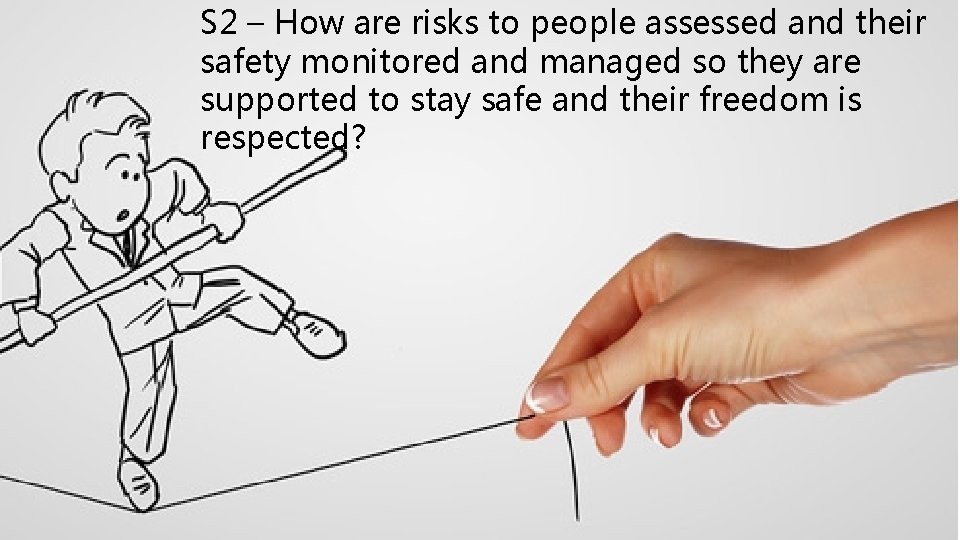
S 2 – How are risks to people assessed and their safety monitored and managed so they are supported to stay safe and their freedom is respected?
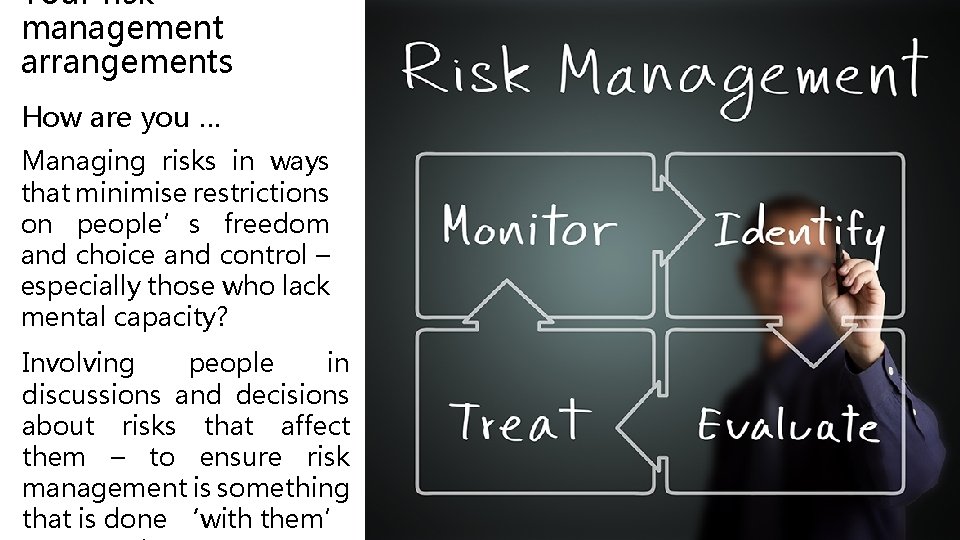
Your risk management arrangements How are you … Managing risks in ways that minimise restrictions on people’s freedom and choice and control – especially those who lack mental capacity? Involving people in discussions and decisions about risks that affect them – to ensure risk management is something that is done ‘with them’
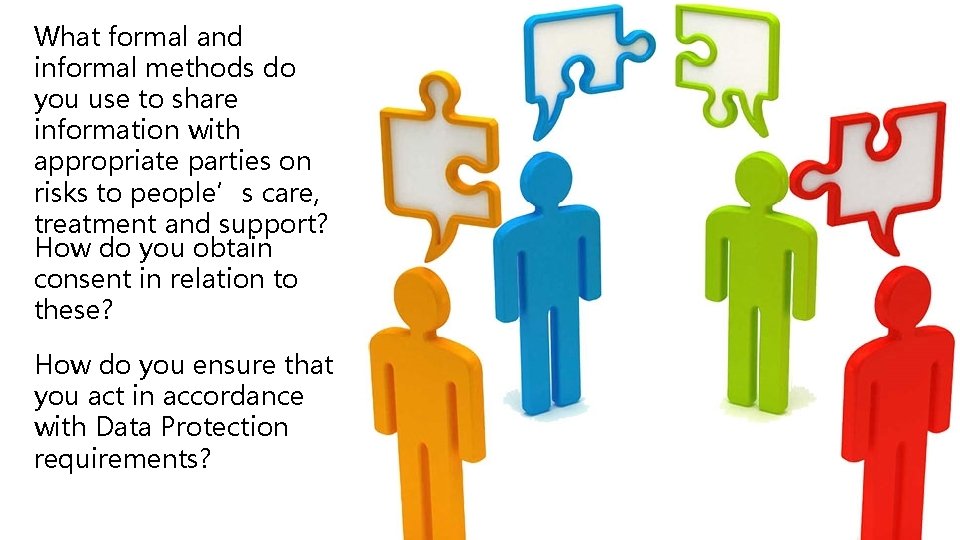
What formal and informal methods do you use to share information with appropriate parties on risks to people’s care, treatment and support? How do you obtain consent in relation to these? How do you ensure that you act in accordance with Data Protection requirements?
Record keeping How do you ensure that the service keeps records that are: accurate complete legible up-to-date securely stored available to relevant staff so that they support people to stay safe What records are you auditing and how frequently do you do this?
Spot check auditing v ongoing auditing There are records that you (and other staff) are looking at as part of your daily work. Whilst we are completing paperwork, we should also be checking it. We want to be identifying mistakes or inadequate or incomplete record keeping as soon after the event as we can. If whilst completing or looking at paperwork staff notice any of the above then they should be flagging it up.
Carrying out investigations Are there thorough, questioning and objective investigations into whistleblowing or staff concerns, safeguarding, and accidents or incidents? Are action plans developed, and are they monitored to make sure they are delivered?
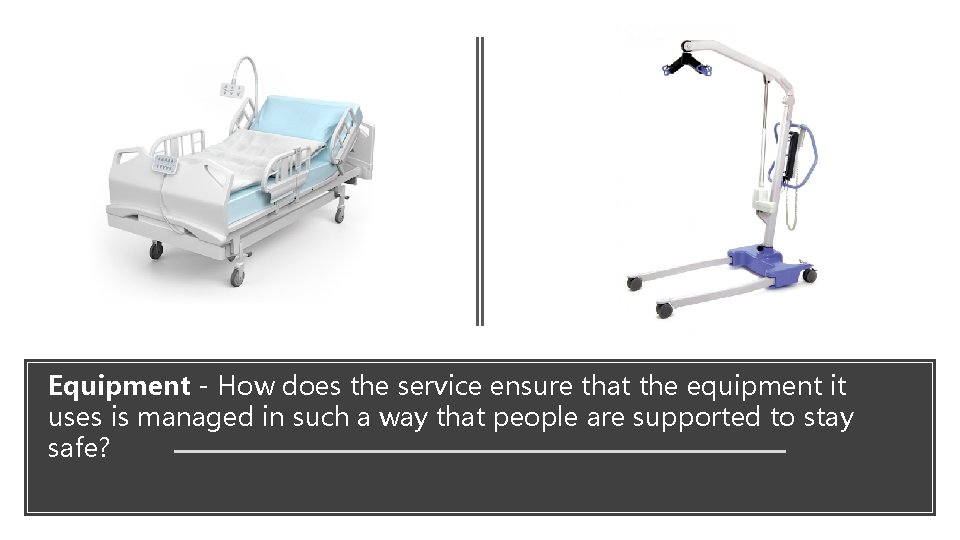
Equipment - How does the service ensure that the equipment it uses is managed in such a way that people are supported to stay safe?
Looking to be able to provide evidence of: v Ongoing checking and monitoring v Regular maintenance and servicing v Removal from operation if faulty v Staff being trained to use the equipment v Anything else?
Looking to be able to provide evidence of: v Environmental risk assessments v Regular checks and audits v Maintenance carried out in a timely manner v Dom Care … strategies to manage risks to the client and staff even when you are not responsible for the property v Anything else?
Challenging behaviour How are staff taught to understand, prevent and manage behaviour that the service finds challenging? How are individuals supported when their behaviour challenges? How well does this align with best practice?
S 2 – Risk management Make sure you: Identify and assess risks in a timely manner Ensure that Care Plans contain up to date information about risks and their management Ensure that information about risks and their management is effectively communicated to staff Involve people where possible in discussions about the opportunities that they want to pursue and the management of risks that affect them
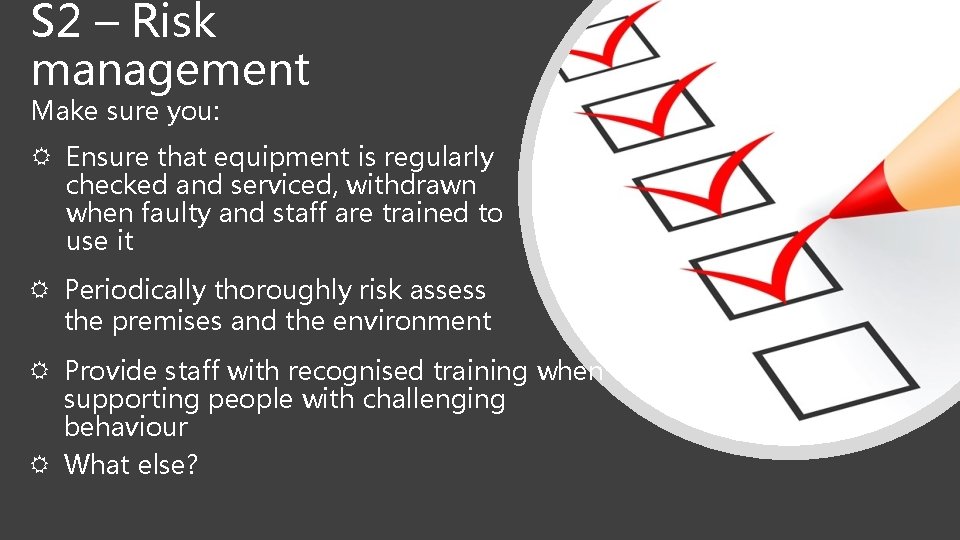
S 2 – Risk management Make sure you: Ensure that equipment is regularly checked and serviced, withdrawn when faulty and staff are trained to use it Periodically thoroughly risk assess the premises and the environment Provide staff with recognised training when supporting people with challenging behaviour What else?
S 3 – How does the service make sure that there are sufficient numbers of suitable staff to support people to stay safe and meet their needs?
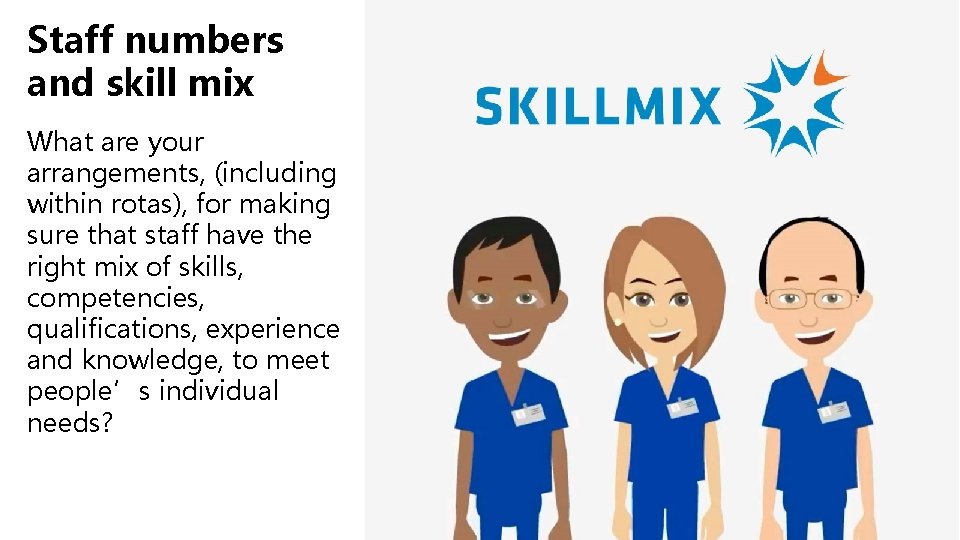
Staff numbers and skill mix What are your arrangements, (including within rotas), for making sure that staff have the right mix of skills, competencies, qualifications, experience and knowledge, to meet people’s individual needs?
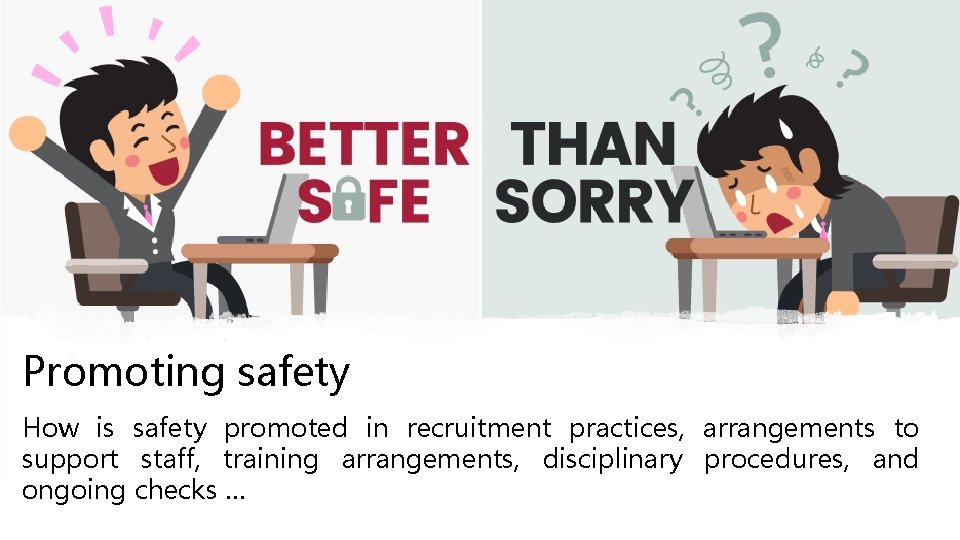
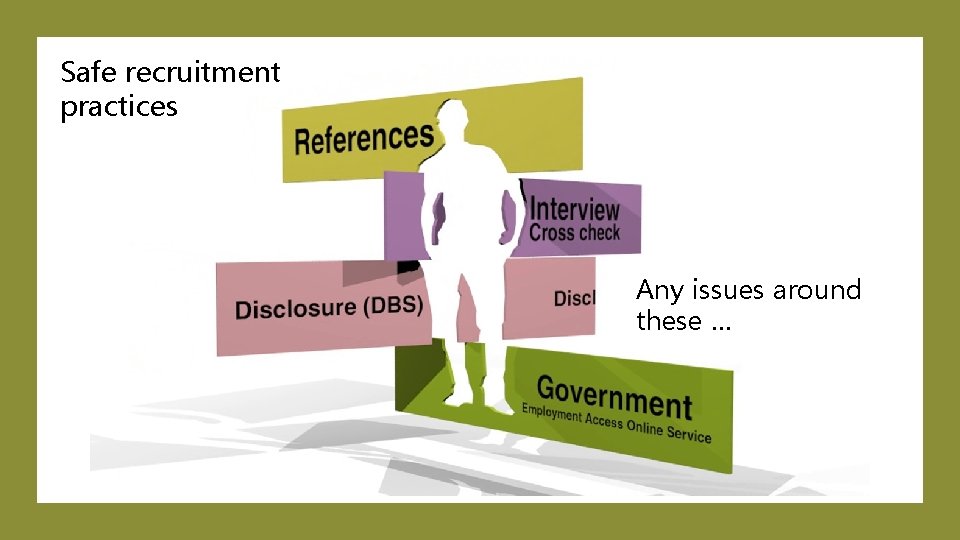
Promoting safety How is safety promoted in recruitment practices, arrangements to support staff, training arrangements, disciplinary procedures, and ongoing checks …
Safe recruitment practices Any issues around these …
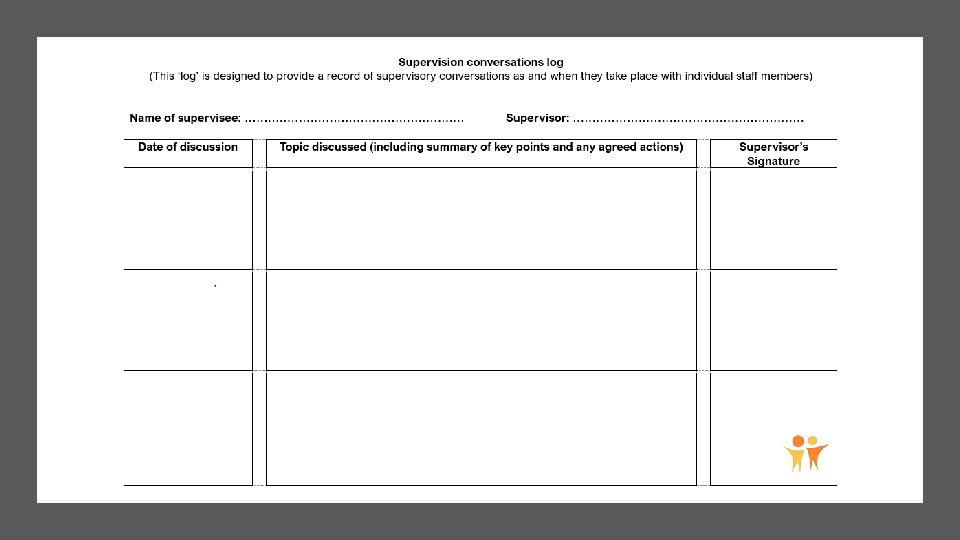
Staff supervision and support Any issues around this …
Staff training How do staff receive effective training in safety systems, processes and practices?
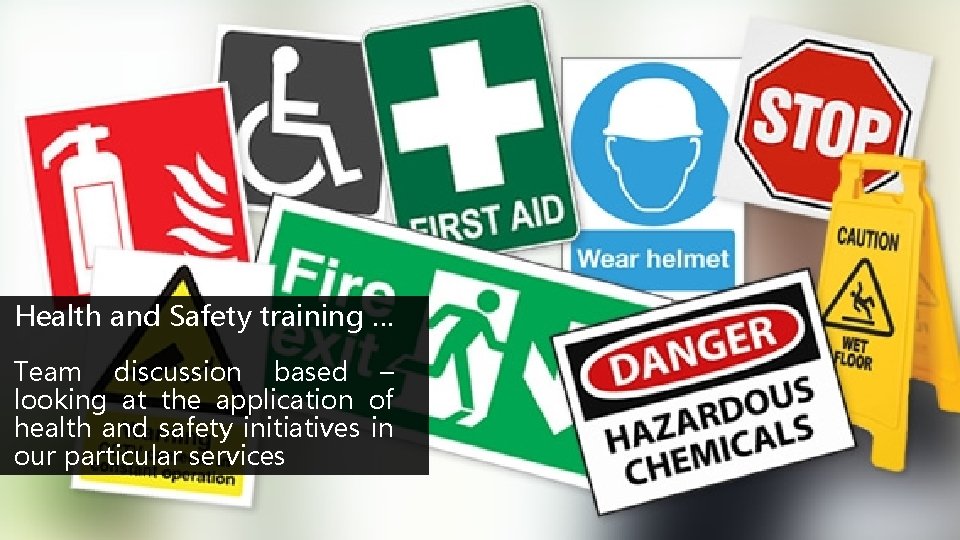
Health and Safety training … Team discussion based – looking at the application of health and safety initiatives in our particular services
S 3 – Sufficient numbers of suitable staff Make sure you: Have a staffing profile for your service that is based on people’s assessed needs Have a recruitment process that includes: § Interview of staff … (ideally informal pre interview visit and potentially value based recruitmenttwo questions) § obtaining satisfactory references or (if you are unable to) use a process to justify your decision making and closely monitor workplace performance satisfactory
S 3 – Sufficient numbers of suitable staff Make sure your recruitment process includes: § a satisfactory DBS check § evidence that the person is eligible to work in this country Keep your staff’s Health & Safety training up to date What else?
S 4 – How does the provider ensure the proper and safe use of medicines?
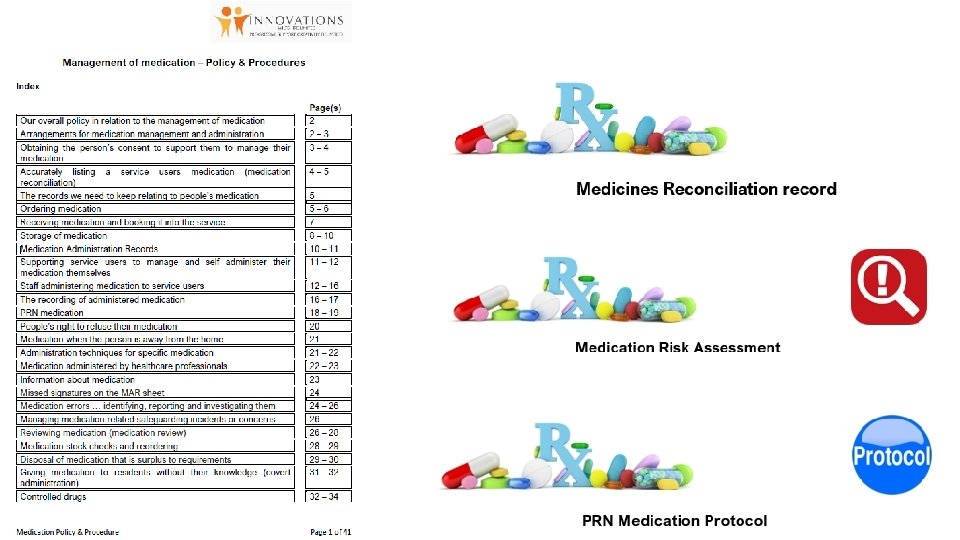
Is the service’s role in relation to medicines clearly defined and described in relevant policies, procedures and training? Is current and relevant professional guidance about the management of medicines followed? Managing medicines in Care Homes guidance (SC 1) https: //www. nice. org. uk/guidance/s c 1 Managing medicines for adults receiving social care in the community (NG 67) https: //www. nice. org. uk/guidance/ng 67
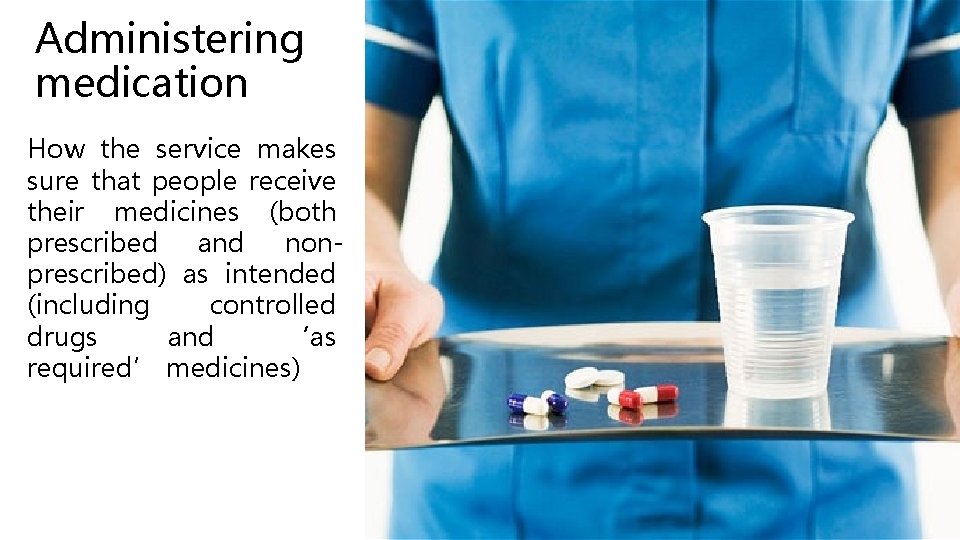
Administering medication How the service makes sure that people receive their medicines (both prescribed and nonprescribed) as intended (including controlled drugs and ‘as required’ medicines)
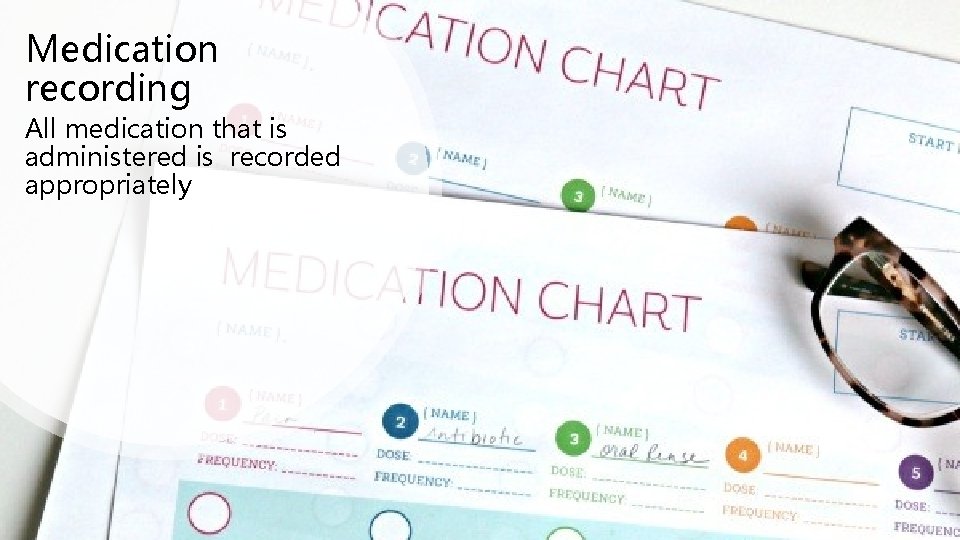
Medication recording All medication that is administered is recorded appropriately
Medicines management How are medicines ordered, transported, stored, and disposed of safely and securely in ways that meet current and relevant legislation and guidance?
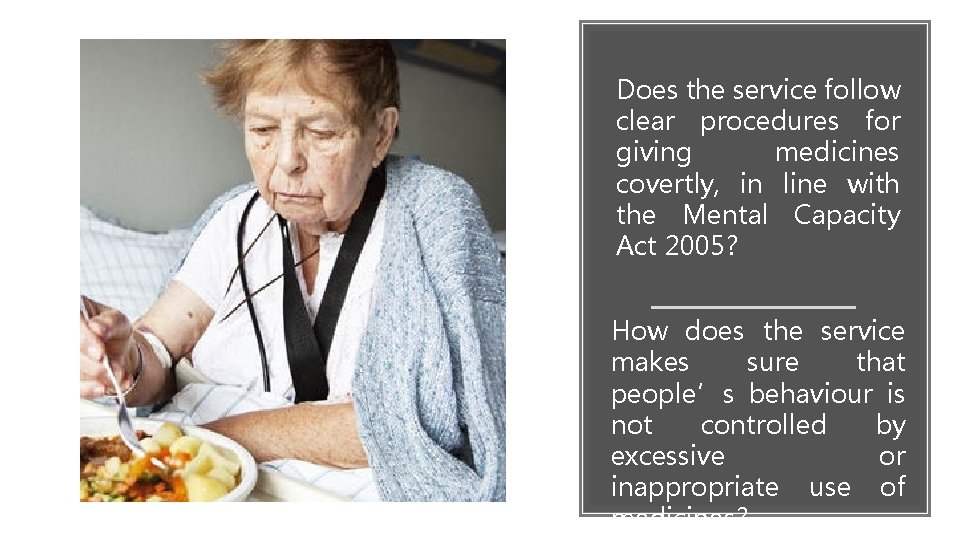
Does the service follow clear procedures for giving medicines covertly, in line with the Mental Capacity Act 2005? How does the service makes sure that people’s behaviour is not controlled by excessive or inappropriate use of medicines?
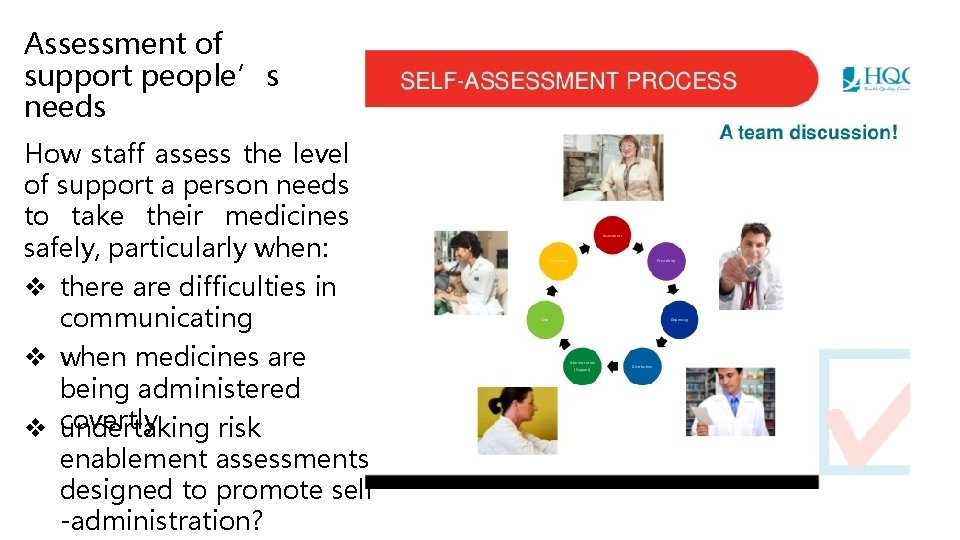
Assessment of support people’s needs How staff assess the level of support a person needs to take their medicines safely, particularly when: v there are difficulties in communicating v when medicines are being administered v covertly undertaking risk enablement assessments designed to promote self -administration?
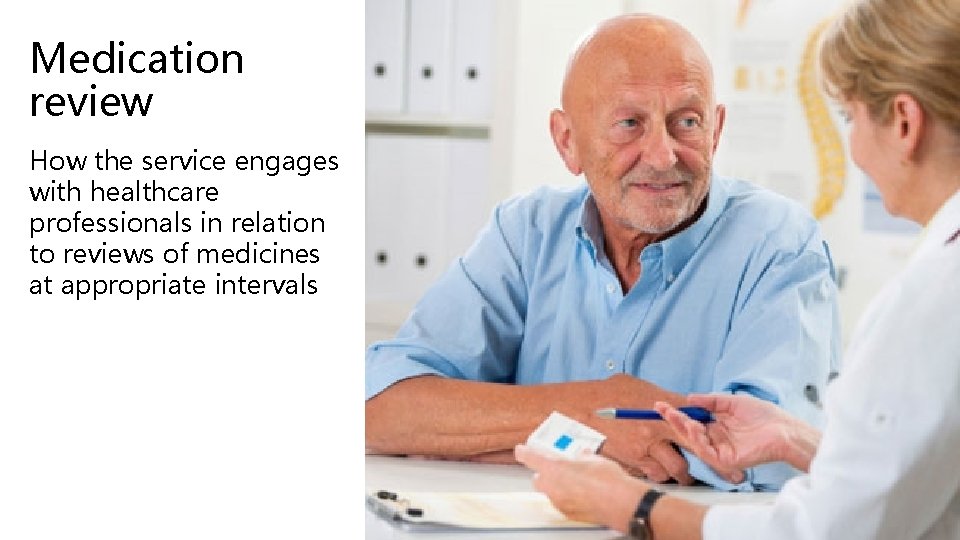
Medication review How the service engages with healthcare professionals in relation to reviews of medicines at appropriate intervals
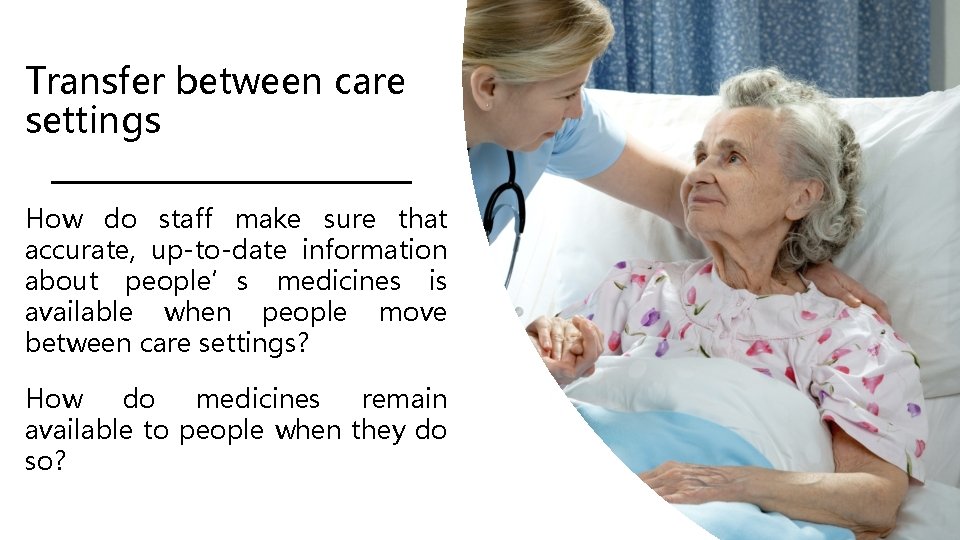
Transfer between care settings How do staff make sure that accurate, up-to-date information about people’s medicines is available when people move between care settings? How do medicines remain available to people when they do so?
S 4 – Management of medicines Make sure you: Have clear medication policies and procedures that are aligned with the NICE guidelines Train your staff in these policies and procedures Audit your medication practices to ensure they are in line with the NICE guidelines What else?
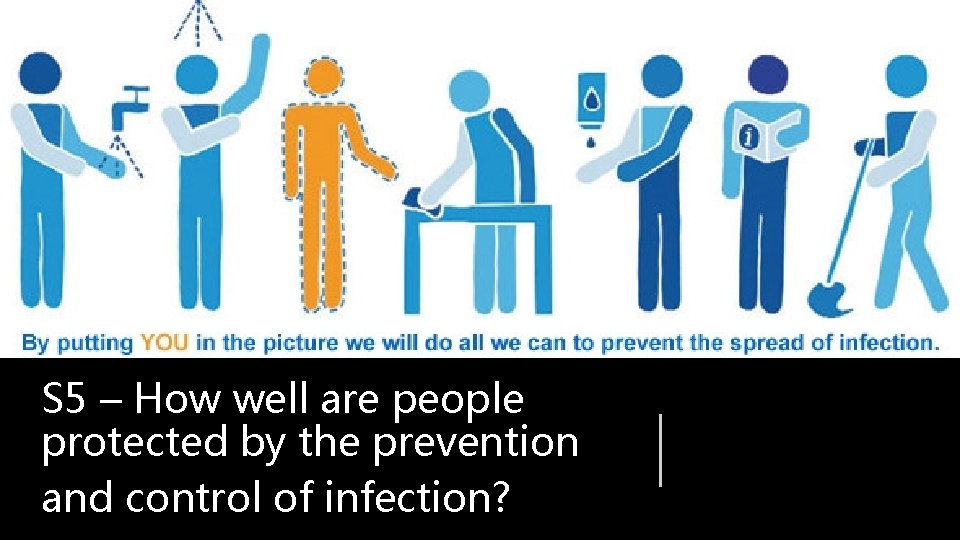
S 5 – How well are people protected by the prevention and control of infection?
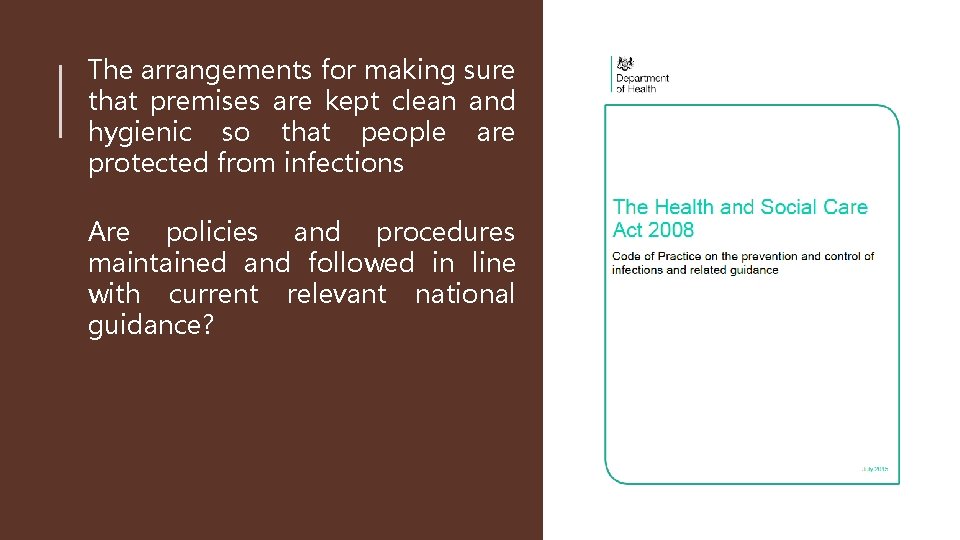
The arrangements for making sure that premises are kept clean and hygienic so that people are protected from infections Are policies and procedures maintained and followed in line with current relevant national guidance?
Do staff understand their roles and responsibilities in relation to infection control and hygiene? Have all relevant staff completed food hygiene training?
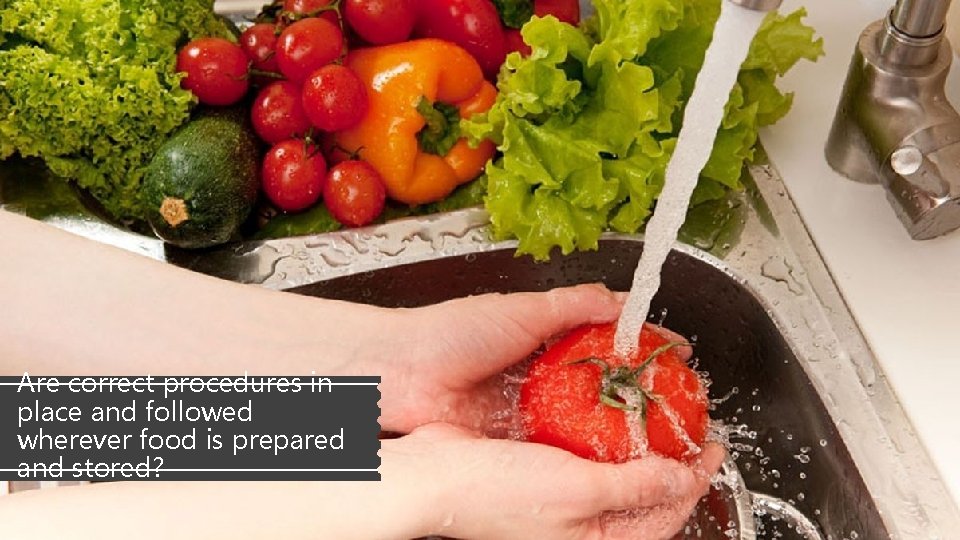
Are correct procedures in place and followed wherever food is prepared and stored?
Communicable diseases That the service alerts the right external agencies to concerns that affect people’s health and wellbeing … where it has the responsibility to do so
S 5 – Infection Control Make sure you: Have clear infection control policies and procedures that are aligned with the Health & Social Care Act Code of Practice on the prevention and control of infections Train your staff in these policies and procedures Audit your infection control practices to ensure they are in line with the Code of Practice What else?
S 6 – Are lessons learned and improvements made when things go wrong?
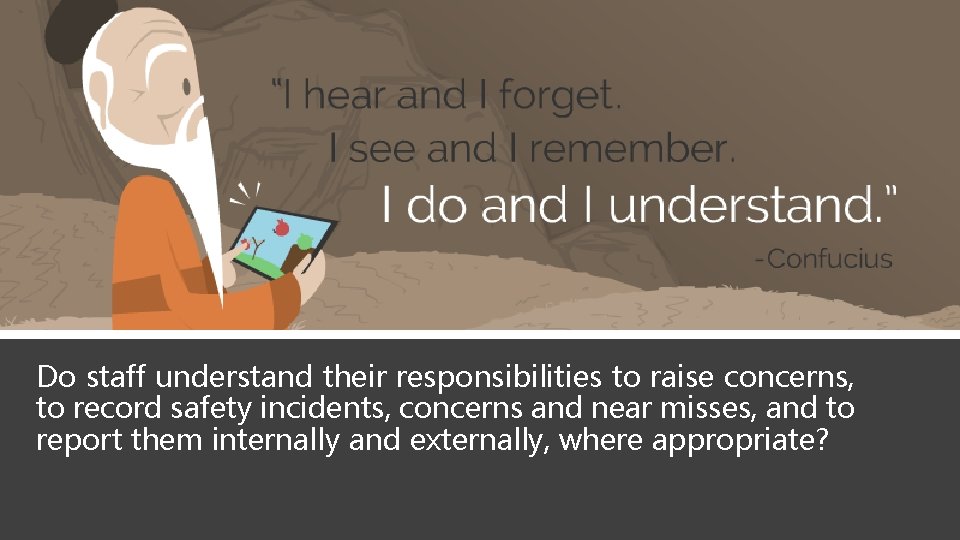
Do staff understand their responsibilities to raise concerns, to record safety incidents, concerns and near misses, and to report them internally and externally, where appropriate?
What are your arrangements for reviewing and investigating safety and safeguarding incidents and events when things go wrong? Are all relevant staff, services, partner organisations and people who use services involved in reviews and investigations?
Doing the learning How are lessons learned and themes identified? Is action taken as a result of reviews and investigations when things go wrong?
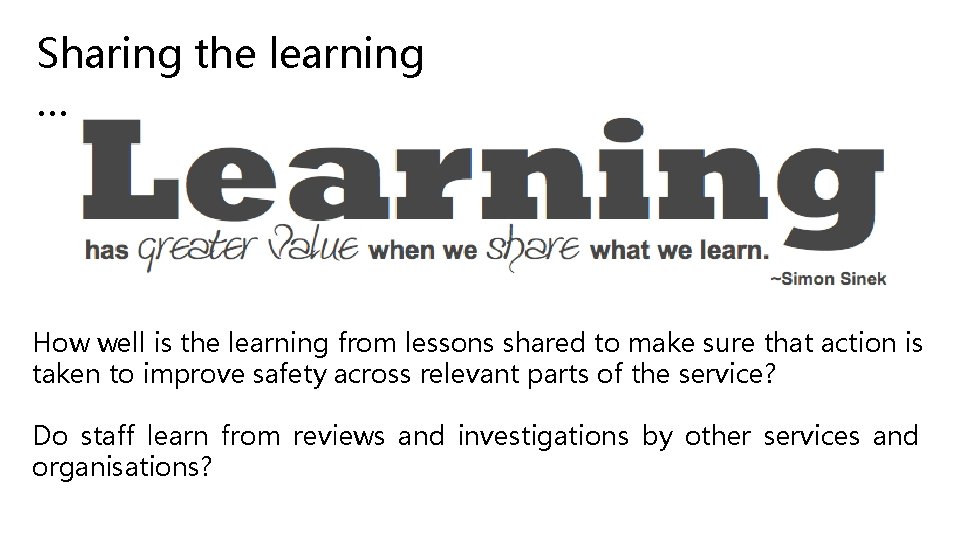
Sharing the learning … How well is the learning from lessons shared to make sure that action is taken to improve safety across relevant parts of the service? Do staff learn from reviews and investigations by other services and organisations?
External notifications and alerts How effective are the arrangements to respond to relevant external safety alerts, recalls, inquiries, investigations or reviews?
S 6 – Lessons learnt Make sure you: Ensure staff know how to report concerns Ensure staff know how to report accidents, incidents and near misses Carry out proper investigations of complaints, concerns and / or incidents when things go wrong Have processes in place for reviewing relevant information and identifying patterns and themes
S 6 – Lessons learnt Make sure you: Have processes in place for disseminating lessons learnt and confirming that those who need to know have received and understood the information Have arrangements in place to respond to safety alerts or product recalls (and to keep you up to date with relevant developments in the sector) What else?