
WELCOME TO YEAR 2 OF PBIS COACHES TRAINING
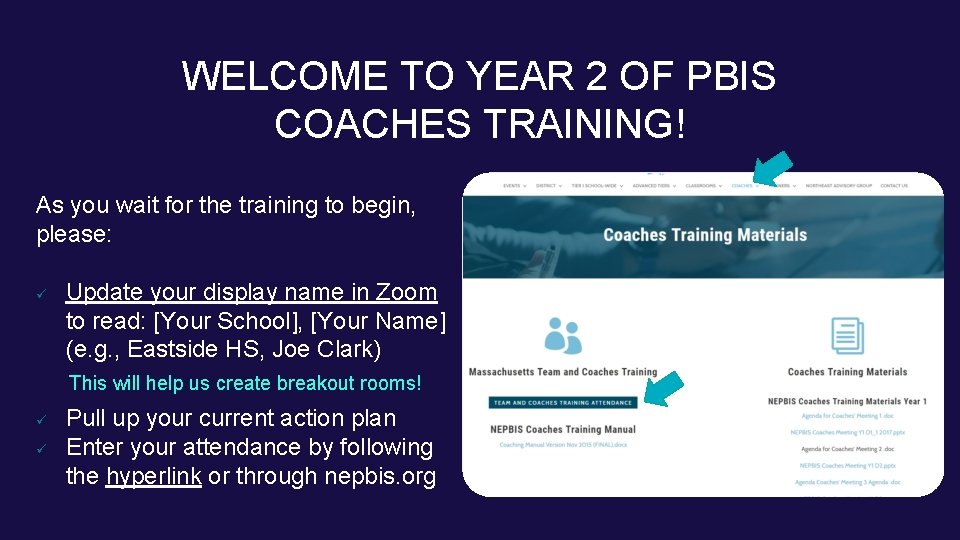
WELCOME TO YEAR 2 OF PBIS COACHES TRAINING! As you wait for the training to begin, please: ü Update your display name in Zoom to read: [Your School], [Your Name] (e. g. , Eastside HS, Joe Clark) This will help us create breakout rooms! ü ü Pull up your current action plan Enter your attendance by following the hyperlink or through nepbis. org
![NEPBIS School-Wide Coaches Training Year 2: January [Insert Trainer Names] with support from Brandi](http://slidetodoc.com/presentation_image_h2/56d0afe169c54dff59964ed2b74717b3/image-2.jpg "NEPBIS School-Wide Coaches Training Year 2: January [Insert Trainer Names] with support from Brandi")
NEPBIS School-Wide Coaches Training Year 2: January [Insert Trainer Names] with support from Brandi Simonsen, Jen Freeman, Susannah Everett, Adam Feinberg & Katie Meyer
TODAY’S AGENDA & TASKS Presentation Content: • Using Data to Promote Equity • Review TFI & Cultural Responsiveness Tool Coaches’ Tasks: • Identify Data Sources & Routines for Assessing Disproportionality • Review TFI • Review Cultural Responsiveness Tool
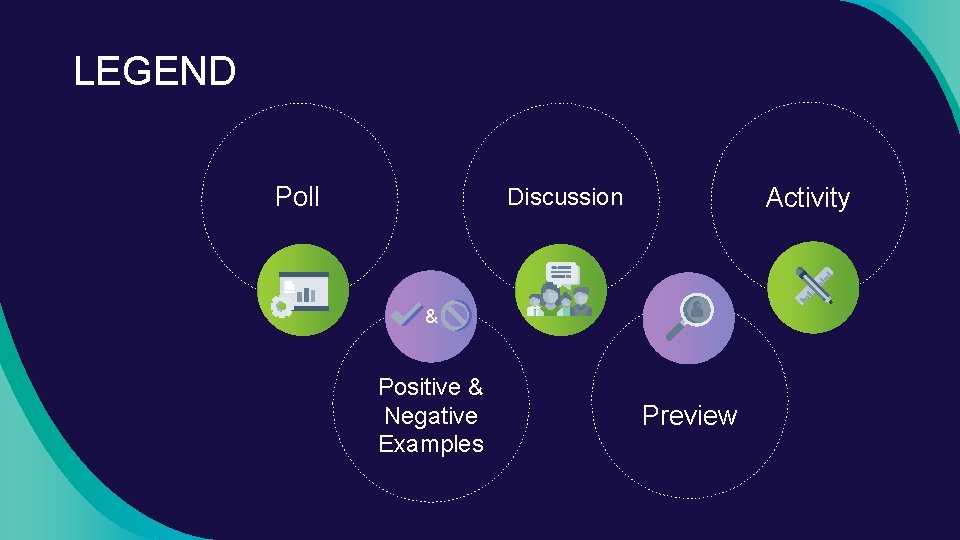
LEGEND Poll Activity Discussion & Positive & Negative Examples Preview
• Self-monitor (Are you participating? Engaged as a learner? ) • Stretch, break, stand as needed • If you have questions or comments, unmute, use the chat box, or click the "raise hand" icon Self • Mute when listening; unmute to talk • Work as a team (room for every voice, reinforce participation) • Have your computer charged and ready to go • Keep necessary materials at hand (e. g. , action plan & other docs, water, snacks, etc. ) Others Environment EXPECTATIONS
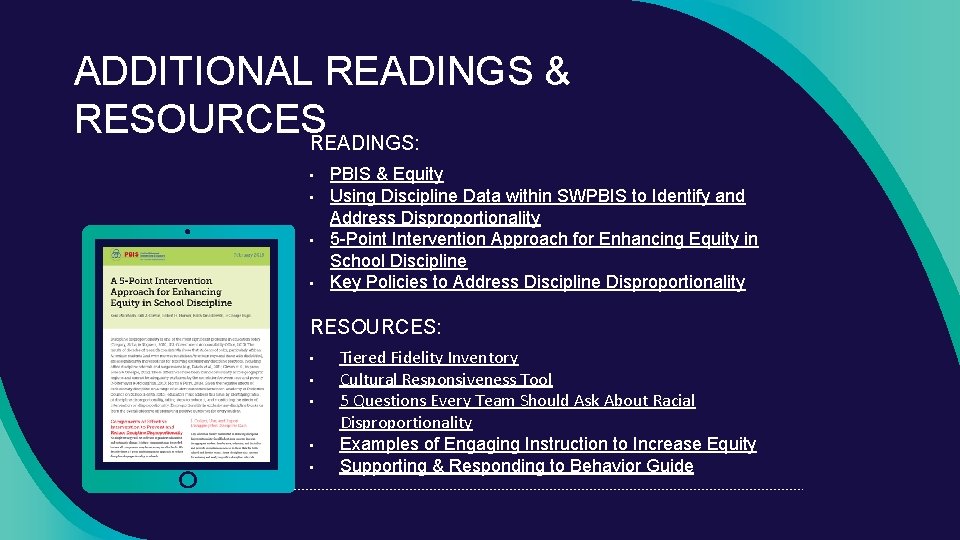
ADDITIONAL READINGS & RESOURCESREADINGS: • • PBIS & Equity Using Discipline Data within SWPBIS to Identify and Address Disproportionality 5 -Point Intervention Approach for Enhancing Equity in School Discipline Key Policies to Address Discipline Disproportionality RESOURCES: • • • Tiered Fidelity Inventory Cultural Responsiveness Tool 5 Questions Every Team Should Ask About Racial Disproportionality Examples of Engaging Instruction to Increase Equity Supporting & Responding to Behavior Guide
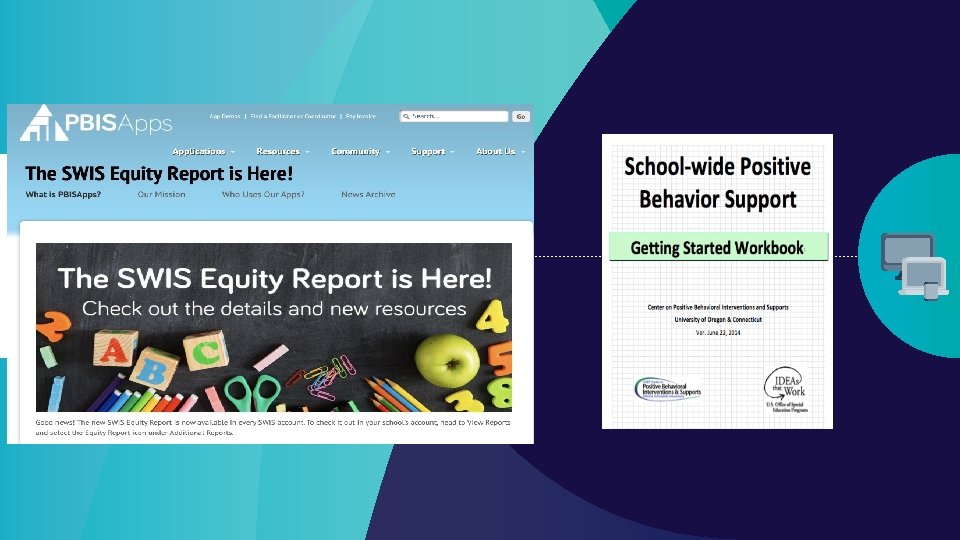
TOOLS ü ü School-Wide PBIS Workbook & Appendices Action Plan WEBSITES nepbis. org ü pbis. org pbisapps. org ü ü
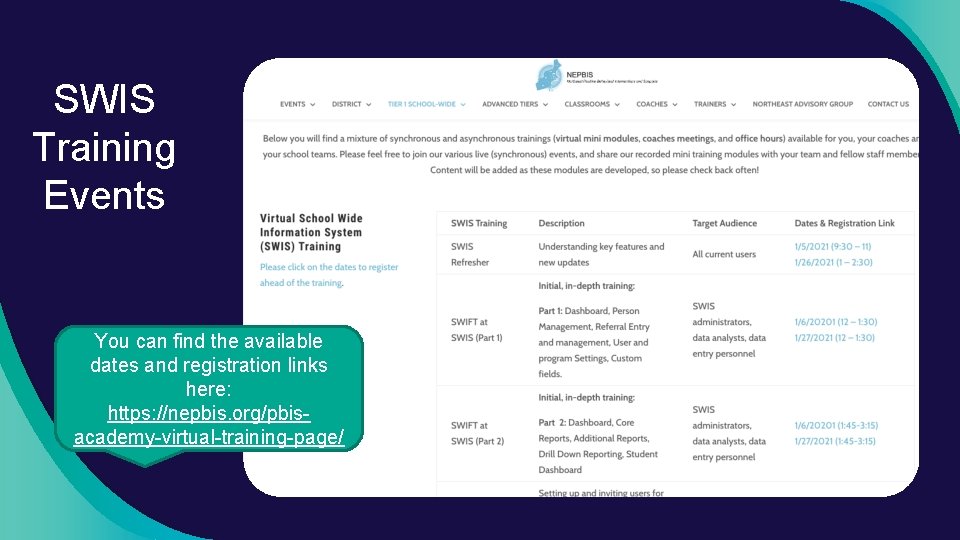
SWIS Training Events You can find the available dates and registration links here: https: //nepbis. org/pbisacademy-virtual-training-page/
ACTIVITY: ATTENDANCE 1. Scan QR code on the left or follow the URL posted in the chat to access the online attendance survey 2. Follow prompts to enter attendance information 3. Notify trainers if you require assistance (e. g. , identifying your cohort or cohort group) 1 minute
PREVIEW: FAMILY-SCHOOL PRACTICES Brief Check-in at Team Training
UNDERSTANDING EQUITY & DISPROPORTIONALITY Content will be revisited in team training
GROUND RULES Ask questions throughout Speak your truth Make no assumptions but good intentions Get comfortable with discomfort Adapted from Singleton, 2015
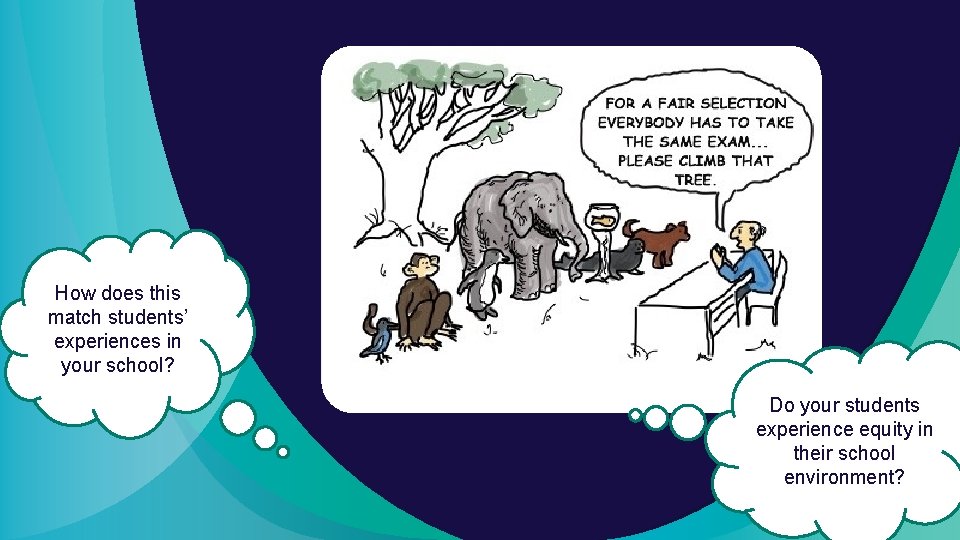
How does this match students’ experiences in your school? Do your students experience equity in their school environment?
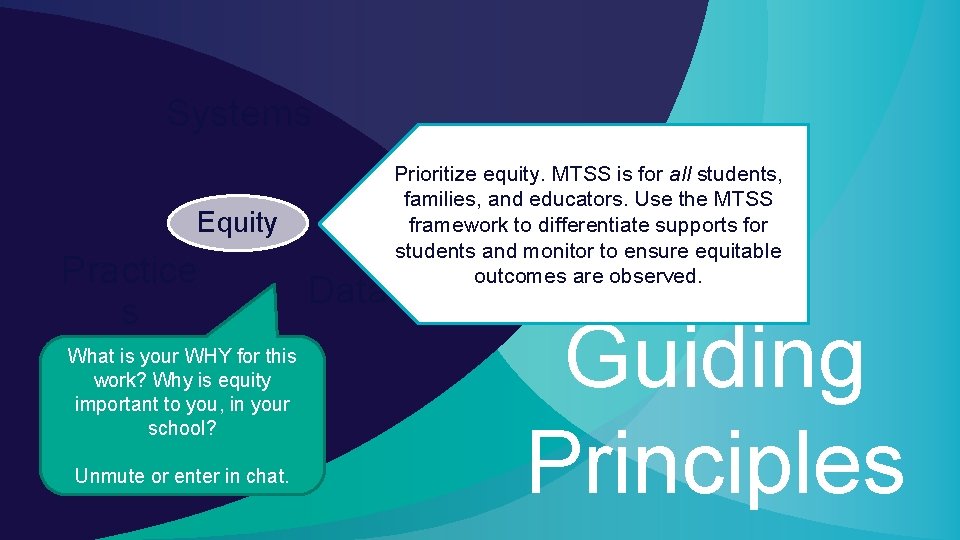
Systems Equity Practice s What is your WHY for this work? Why is equity important to you, in your school? Outcomes Unmute or enter in chat. Data Prioritize equity. MTSS is for all students, families, and educators. Use the MTSS framework to differentiate supports for students and monitor to ensure equitable outcomes are observed. Guiding Principles
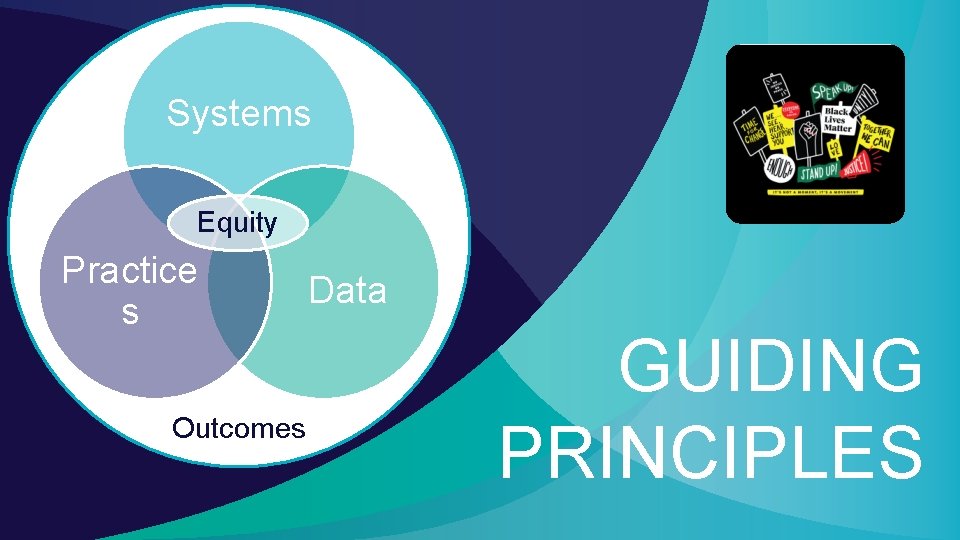
Systems Equity Practice s Outcomes Data GUIDING PRINCIPLES
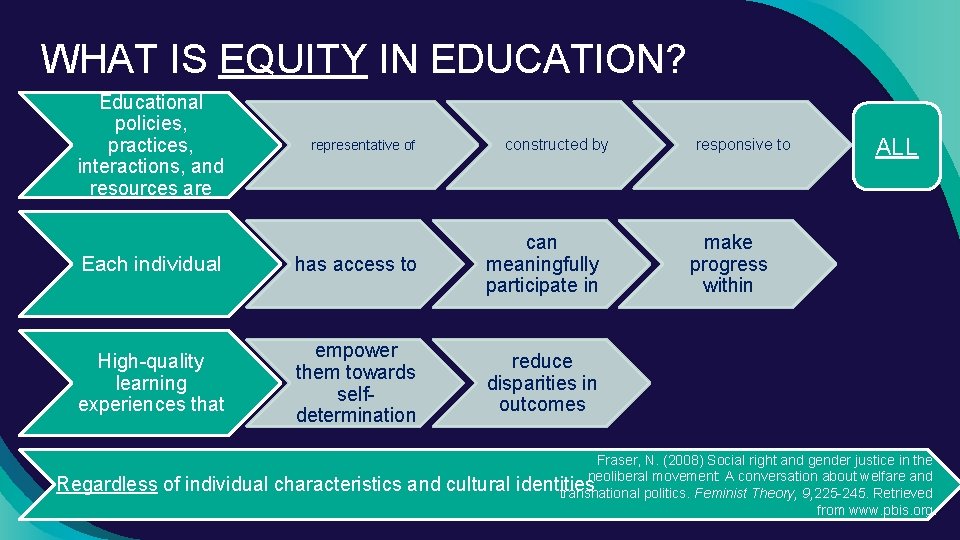
WHAT IS EQUITY IN EDUCATION? Educational policies, practices, interactions, and resources are representative of constructed by Each individual has access to can meaningfully participate in High-quality learning experiences that empower them towards selfdetermination reduce disparities in outcomes Regardless of individual characteristics and cultural responsive to ALL make progress within Fraser, N. (2008) Social right and gender justice in the neoliberal movement: A conversation about welfare and identities transnational politics. Feminist Theory, 9, 225 -245. Retrieved from www. pbis. org.
DISCUSSION: USING STUDENT OUTCOME DATA TO EXAMINE EQUITY o o o What other data are collected to represent students’ socialemotional and behavioral outcomes? Who reviews/has access to these data? Can these data be disaggregated? Whole Group 5 minutes
PROBLEM IDENTIFICATION FOR DISPROPORTIONALITY ● Problem identification involving disproportionality requires comparing rates of discipline across racial/ethnic subgroups. ● It is important to use multiple metrics when viewing disproportionality. (IDEA Data Center, 2014) ○ Disproportionality may be hidden if only one metric or way of measuring data is used.
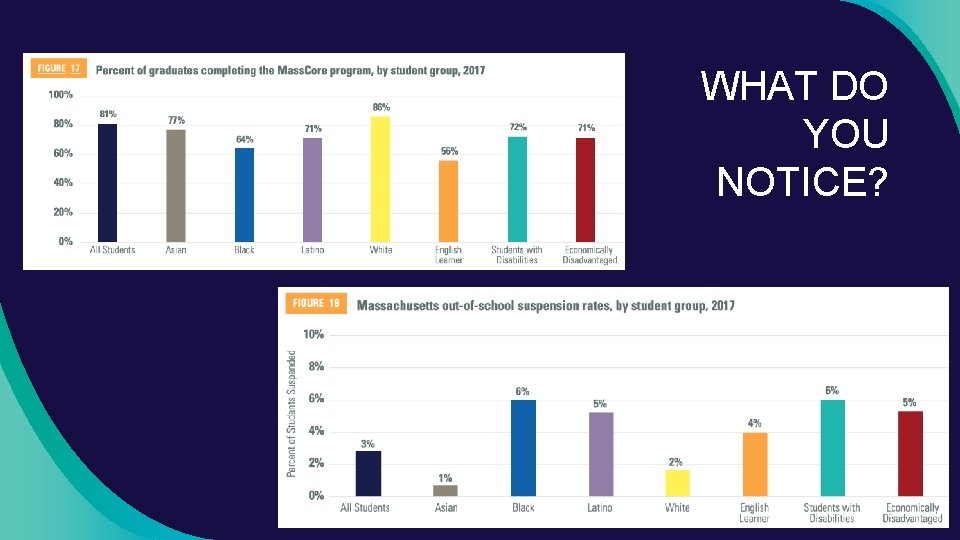
WHAT DO YOU NOTICE?
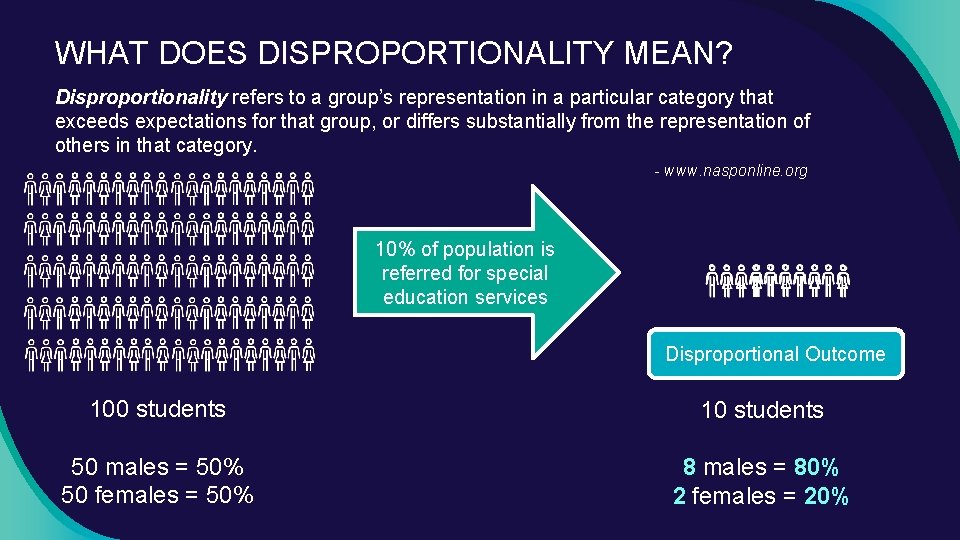
WHAT DOES DISPROPORTIONALITY MEAN? Disproportionality refers to a group’s representation in a particular category that exceeds expectations for that group, or differs substantially from the representation of others in that category. - www. nasponline. org 10% of population is referred for special education services Proportional Outcome Disproportional Outcome 100 students 10 students 50 males = 50% 50 females = 50% 85 males = 80% 50% 25 females = 20%
DISCUSSION: EQUITY & DISPROPORTIONALITY o How would you explain equity in educational environments to non-school related people? o Why is examining disproportionality important? o How will you bring this content back to your staff? Randomized Breakouts & Whole Group 10 minutes
USING DATA TO IDENTIFY & ADDRESS EQUITY CONCERNS
Besides race/ethnicity, what subgroups exist in your school community? (Put in chat)
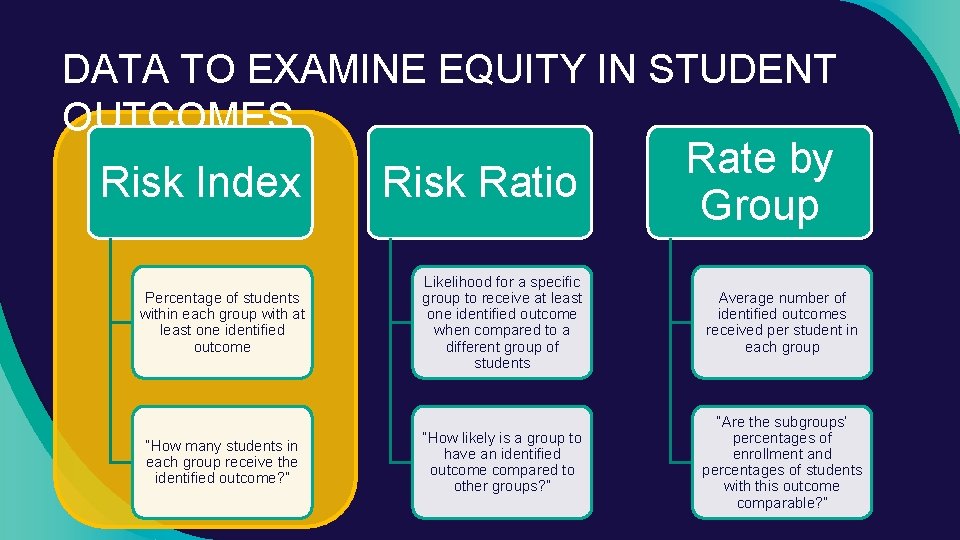
DATA TO EXAMINE EQUITY IN STUDENT OUTCOMES Risk Index Percentage of students within each group with at least one identified outcome “How many students in each group receive the identified outcome? ” Risk Ratio Rate by Group Likelihood for a specific group to receive at least one identified outcome when compared to a different group of students Average number of identified outcomes received per student in each group “How likely is a group to have an identified outcome compared to other groups? ” “Are the subgroups’ percentages of enrollment and percentages of students with this outcome comparable? ”
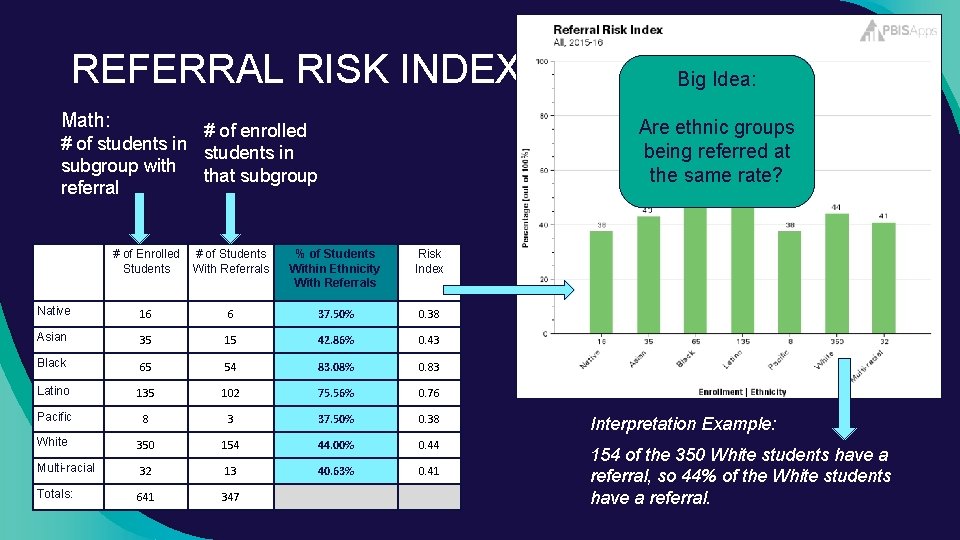
REFERRAL RISK INDEX Math: Big Idea: Are ethnic groups being referred at the same rate? # of enrolled # of students in subgroup with that subgroup referral # of Enrolled Students # of Students With Referrals % of Students Within Ethnicity With Referrals Risk Index Native 16 6 37. 50% 0. 38 Asian 35 15 42. 86% 0. 43 Black 65 54 83. 08% 0. 83 Latino 135 102 75. 56% 0. 76 Pacific 8 3 37. 50% 0. 38 White 350 154 44. 00% 0. 44 Multi-racial 32 13 40. 63% 0. 41 Totals: 641 347 Interpretation Example: 154 of the 350 White students have a referral, so 44% of the White students have a referral.
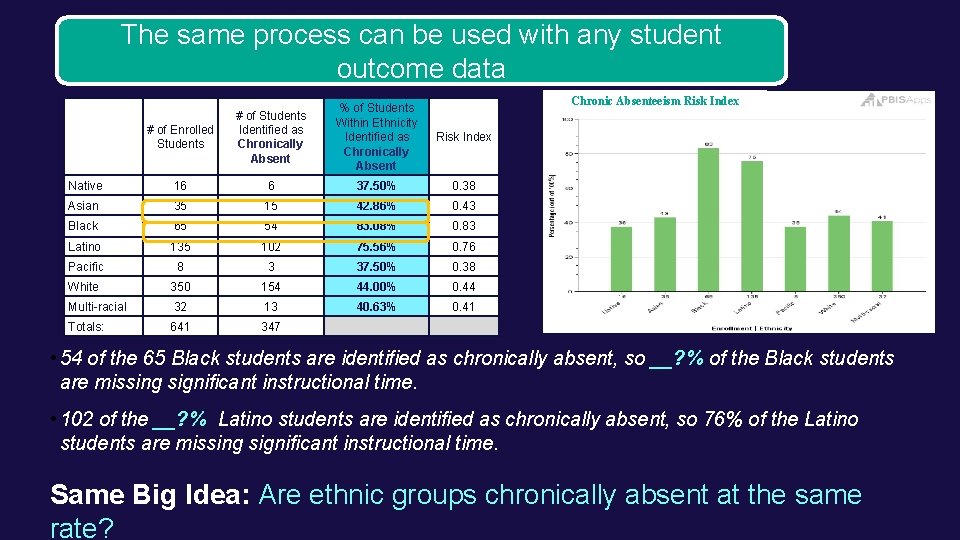
The same process can be used with any student outcome data RISK INDEX CHRONIC ABSENTEEISM Chronic Absenteeism Risk Index # of Enrolled Students # of Students Identified as Chronically Absent % of Students Within Ethnicity Identified as Chronically Absent Risk Index Native 16 6 37. 50% 0. 38 Asian 35 15 42. 86% 0. 43 Black 65 54 83. 08% 0. 83 Latino 135 102 75. 56% 0. 76 Pacific 8 3 37. 50% 0. 38 White 350 154 44. 00% 0. 44 Multi-racial 32 13 40. 63% 0. 41 Totals: 641 347 • 54 of the 65 Black students are identified as chronically absent, so __? % of the Black students are missing significant instructional time. • 102 of the __? % Latino students are identified as chronically absent, so 76% of the Latino students are missing significant instructional time. Same Big Idea: Are ethnic groups chronically absent at the same rate?
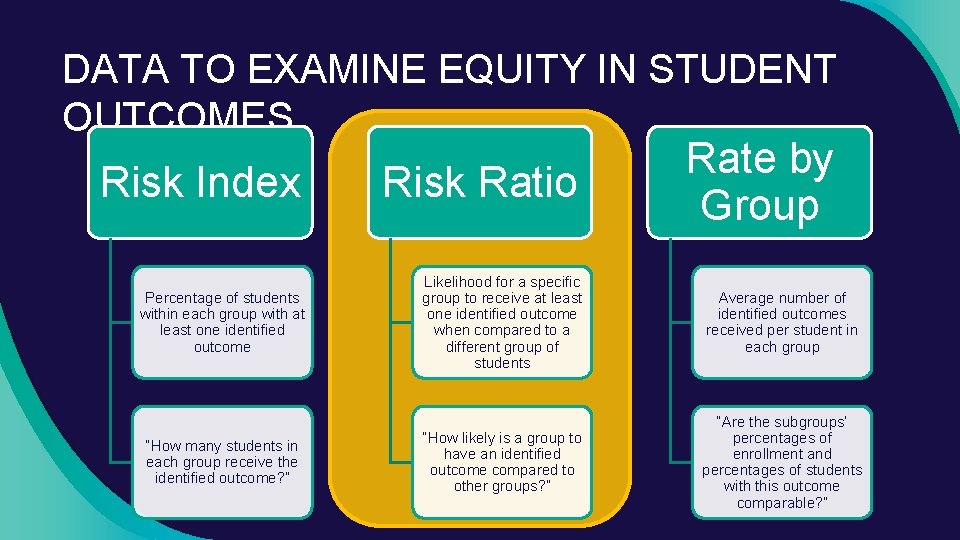
DATA TO EXAMINE EQUITY IN STUDENT OUTCOMES Risk Index Percentage of students within each group with at least one identified outcome “How many students in each group receive the identified outcome? ” Risk Ratio Rate by Group Likelihood for a specific group to receive at least one identified outcome when compared to a different group of students Average number of identified outcomes received per student in each group “How likely is a group to have an identified outcome compared to other groups? ” “Are the subgroups’ percentages of enrollment and percentages of students with this outcome comparable? ”
RISK RATIO Short videos on www. pbisapps. org walk through each graph and how to use it to answer specific questions.
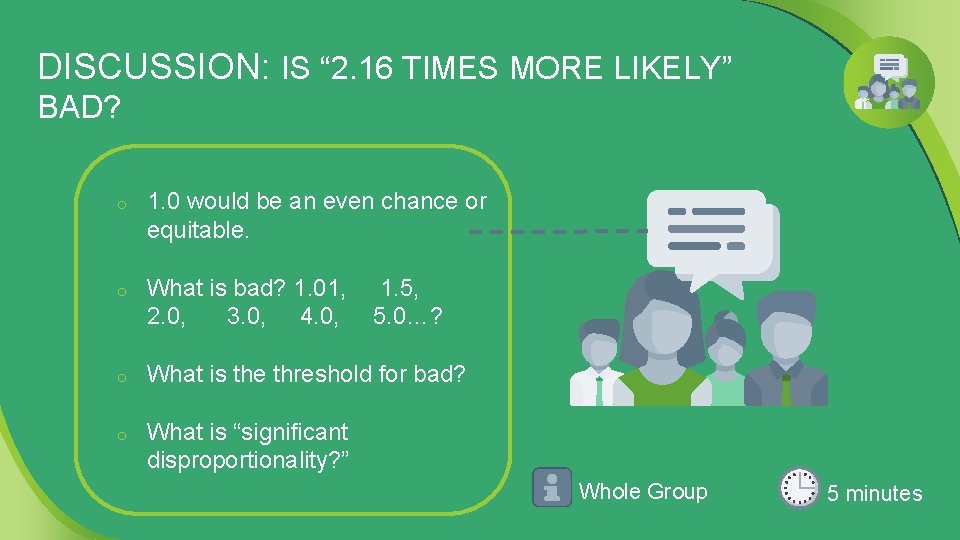
DISCUSSION: IS “ 2. 16 TIMES MORE LIKELY” BAD? o 1. 0 would be an even chance or equitable. o What is bad? 1. 01, 2. 0, 3. 0, 4. 0, o What is the threshold for bad? o What is “significant disproportionality? ” 1. 5, 5. 0…? Whole Group 5 minutes
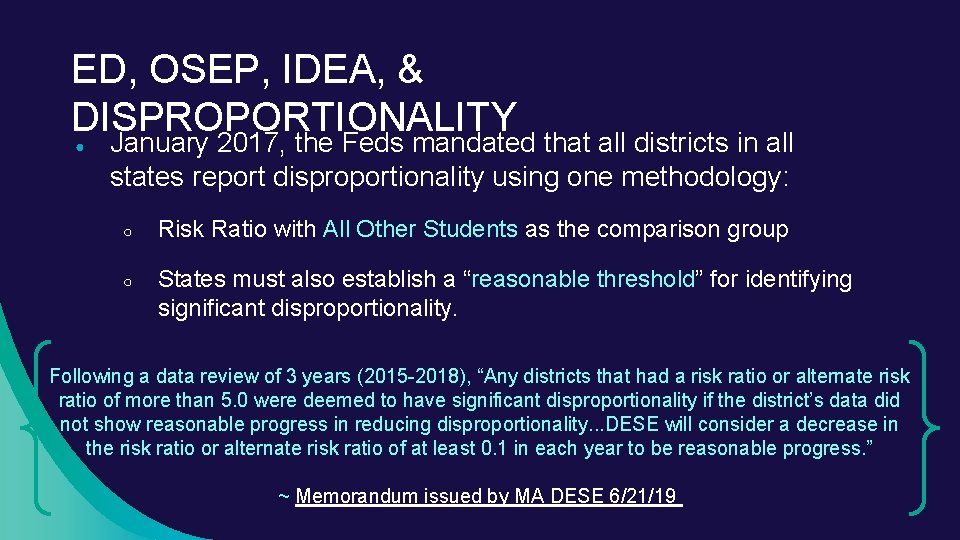
ED, OSEP, IDEA, & DISPROPORTIONALITY ● January 2017, the Feds mandated that all districts in all states report disproportionality using one methodology: ○ Risk Ratio with All Other Students as the comparison group ○ States must also establish a “reasonable threshold” for identifying significant disproportionality. Following a data review of 3 years (2015 -2018), “Any districts that had a risk ratio or alternate risk ratio of more than 5. 0 were deemed to have significant disproportionality if the district’s data did not show reasonable progress in reducing disproportionality. . . DESE will consider a decrease in the risk ratio or alternate risk ratio of at least 0. 1 in each year to be reasonable progress. ” ~ Memorandum issued by MA DESE 6/21/19
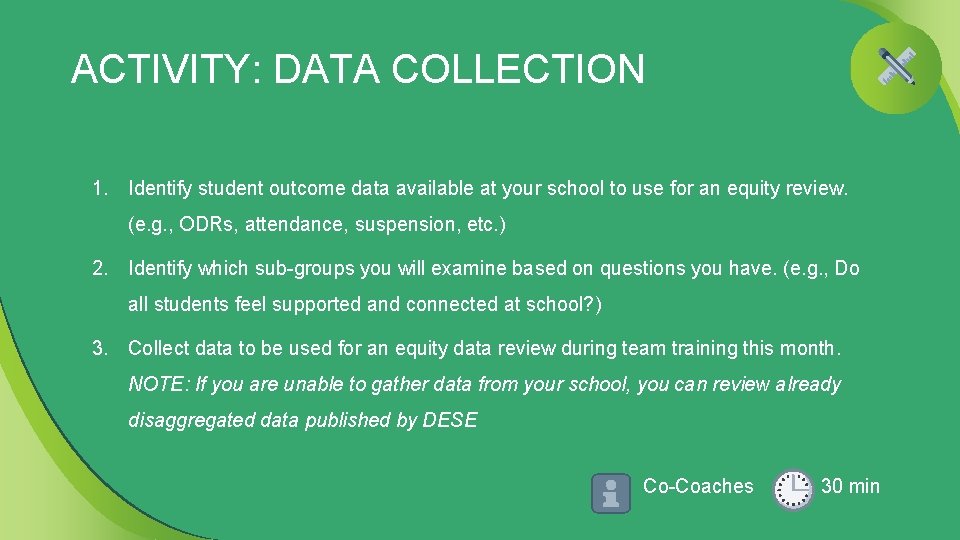
ACTIVITY: DATA COLLECTION 1. Identify student outcome data available at your school to use for an equity review. (e. g. , ODRs, attendance, suspension, etc. ) 2. Identify which sub-groups you will examine based on questions you have. (e. g. , Do all students feel supported and connected at school? ) 3. Collect data to be used for an equity data review during team training this month. NOTE: If you are unable to gather data from your school, you can review already disaggregated data published by DESE Co-Coaches 30 min
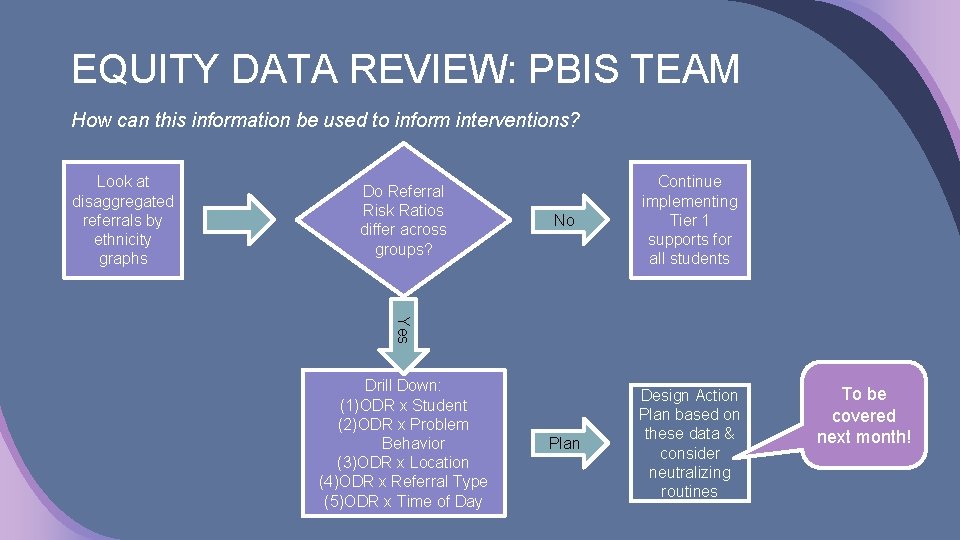
EQUITY DATA REVIEW: PBIS TEAM How can this information be used to inform interventions? Look at disaggregated referrals by ethnicity graphs Do Referral Risk Ratios differ across groups? Plan Design Action Plan based on these data & consider neutralizing routines Yes No Continue implementing Tier 1 supports for all students Drill Down: (1)ODR x Student (2)ODR x Problem Behavior (3)ODR x Location (4)ODR x Referral Type (5)ODR x Time of Day To be covered next month!
ADDRESSING RACIAL DISPROPORTIONALITY WITH SWIS
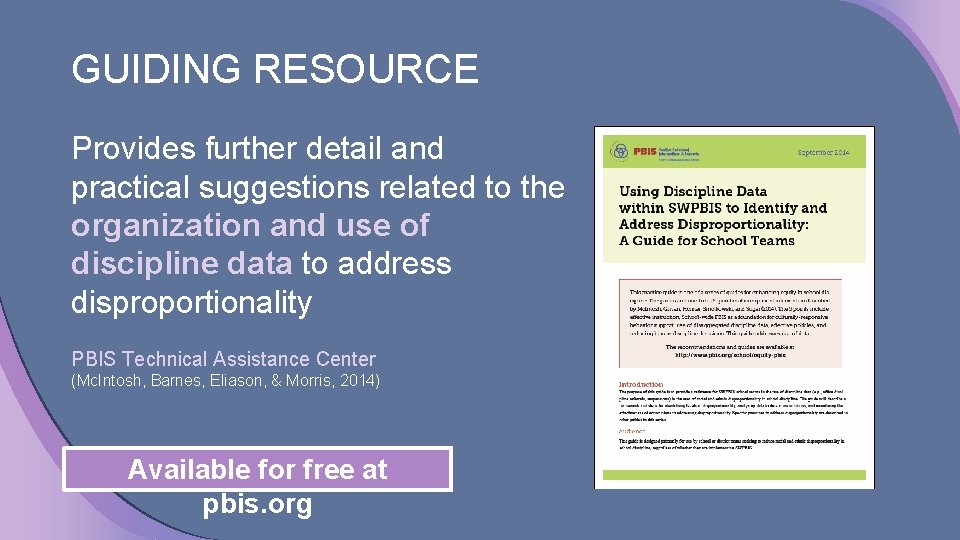
GUIDING RESOURCE Provides further detail and practical suggestions related to the organization and use of discipline data to address disproportionality PBIS Technical Assistance Center (Mc. Intosh, Barnes, Eliason, & Morris, 2014) Available for free at pbis. org
ACTIVITY: DATA COLLECTION 1. Review your school’s chosen student outcome data disaggregated by subgroup 1. Identify questions you want to answer with the data 2. Discuss integrating disaggregated student outcome data into your PBIS practices 1. Who would prepare and summarize for the team? How often? 2. How would you summarize and share with staff? 3. Share 1 min reports (strengths, need areas, and questions). Co-Coaches & 5 min Whole Group 5 min
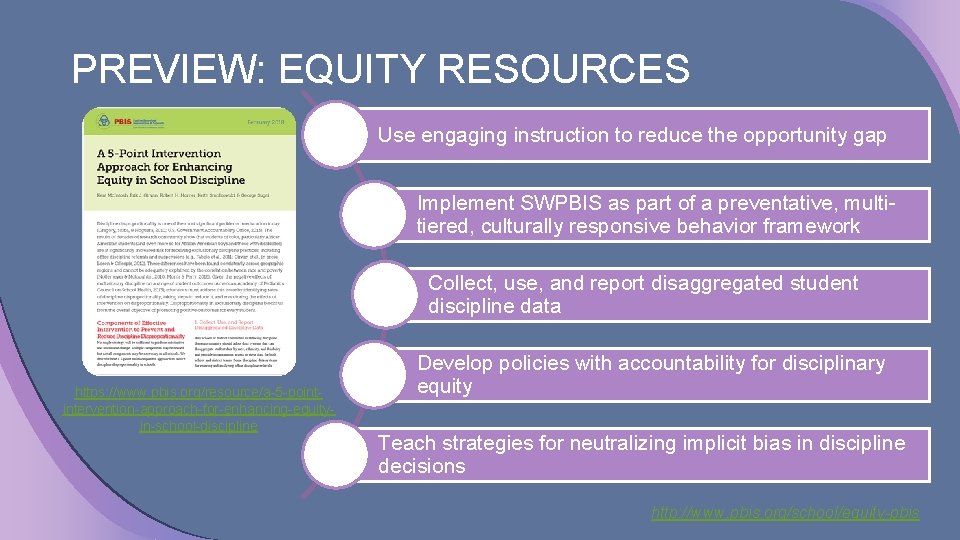
PREVIEW: EQUITY RESOURCES Use engaging instruction to reduce the opportunity gap Implement SWPBIS as part of a preventative, multitiered, culturally responsive behavior framework Collect, use, and report disaggregated student discipline data https: //www. pbis. org/resource/a-5 -pointintervention-approach-for-enhancing-equityin-school-discipline Develop policies with accountability for disciplinary equity Teach strategies for neutralizing implicit bias in discipline decisions http: //www. pbis. org/school/equity-pbis
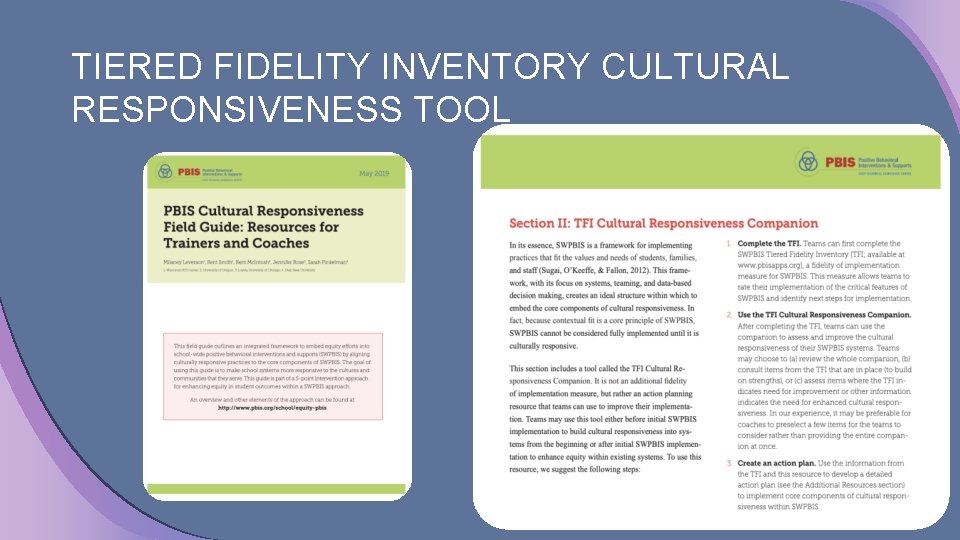
TIERED FIDELITY INVENTORY CULTURAL RESPONSIVENESS TOOL
ACTIVITY: DATA COLLECTION Review independently (5 minutes): 1. 5 Point Intervention Approach for Enhancing Equity in School Discipline 2. Cultural Responsiveness Tool Discuss in breakouts (10 minutes): 1. What are 3 -5 ideas/action items to bring back to your team during training? 2. Be prepared to report back to the whole group Randomized Breakouts & Whole Group 15 min
ADDITIONAL READINGS & RESOURCESREADINGS: • • PBIS & Equity Using Discipline Data within SWPBIS to Identify and Address Disproportionality 5 -Point Intervention Approach for Enhancing Equity in School Discipline Key Policies to Address Discipline Disproportionality RESOURCES: • • • Tiered Fidelity Inventory Cultural Responsiveness Tool 5 Questions Every Team Should Ask About Racial Disproportionality Examples of Engaging Instruction to Increase Equity Supporting & Responding to Behavior Guide
TODAY’S AGENDA & TASKS Presentation Content: • Using Data to Promote Equity • Review TFI & Cultural Responsiveness Tool What questions do you have on today’s content? Coaches’ Tasks: • Identify Data Sources & Routines for Assessing Disproportionality • Review TFI • Review Cultural Responsiveness Tool What questions do you have on today’s follow-up tasks?
PREVIEW: FEBRUARY AGENDA & TASKS Presentation Content: • Review Using Data to Promote Equity • Implicit Bias & Neutralizing Routines • Function of Behavior Coaches’ Tasks: • Review Disproportionality Data • Review Function of Behavior Content
EVALUATION Please remember to complete the evaluation to receive your PDPs! Scan the QR code to access.
- Slides: 42