
Welcome to Workforce 3 One The Workforce Development

- Slides: 41
Welcome to Workforce 3 One The Workforce Development System Part 3: Customer Flow, WIA Access, and the DEI U. S. Department of Labor Employment and Training Administration Webinar Date: 3/06/14 Presented by: DJ Ralston and Brian Ingram with NDI Technical Assistance Team U. S. Department of Labor Employment and Training Administration
Where are you? Enter your location in the Chat window – lower left of screen # 2
Moderators Moderator: Randee Chafkin Title: Workforce Development Specialist Organization: Employment and Training Administration Presenter: Miranda Kennedy Title: Director of Training for DEI, NDI Technical Assistance Team Organization: National Disability Institute # 3
Disability Employment Initiative • The DEI is focused on improving the accessibility, capacity, and accountability of America’s Job Centers to serve customers with disabilities resulting in education and career pathways that lead to unsubsidized employment and economic self-sufficiency. • Training and Technical Assistance to DEI Projects is provided under U. S. DOLETA contract with NDI Consulting, Inc. and the National Disability Institute (NDI). • Evaluation of the impact of the DEI Projects implementation and outcomes will be provided under U. S. DOL ODEP contract with Social Dynamics and its partners. # 4
Learning Objectives Upon completion of this training webinar, DEI grantees and participants from the public workforce system will know: • The differences between the DPN initiative and the DEI • How DEI activities are related to, and should impact, WIA Customer Flow • How the DEI service delivery components are related to WIA customer flow and DEI outcomes # 5
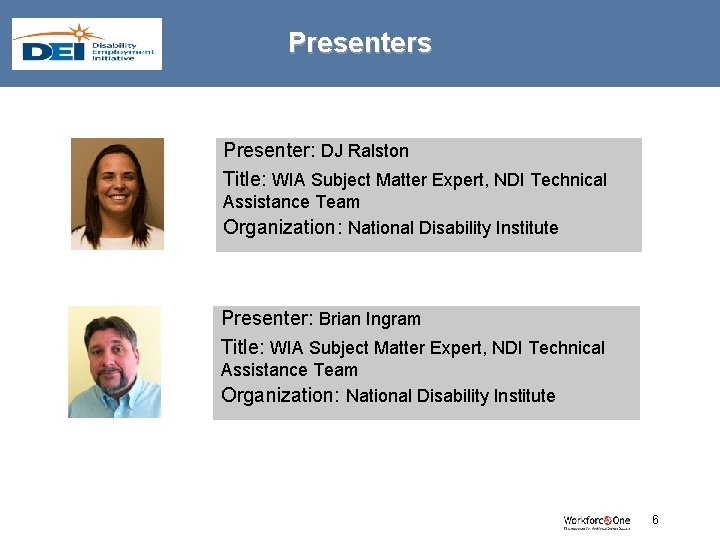
Presenters Presenter: DJ Ralston Title: WIA Subject Matter Expert, NDI Technical Assistance Team Organization: National Disability Institute Presenter: Brian Ingram Title: WIA Subject Matter Expert, NDI Technical Assistance Team Organization: National Disability Institute # 6
Agenda • Review of the Workforce Development System & Access Parts 1 and 2 • DEI vs. DPN: Related but Distinct • DEI and WIA Customer Flow • Service Delivery Components and DEI Outcomes • Focusing on DEI Outcomes • Summary and next steps # 7
Review • Wagner Peyser Services versus WIA Adult/Dislocated Worker Services – Core Services (Wagner-Peyser) – Intensive and Training Services (WIA Adult/Dislocated Worker) • Differences in Funding Streams – Consistent Block Funding – Performance Based Funding • Enrollment = Access 8
Review (cont. ) • Access Challenges o Programmatic Access o Myths and Misperceptions o Lack of Knowledge, Flexibility, and Inclusiveness • Access Solutions o Investigating and identifying access barriers in your own system o Framing accommodation as Customer Service 9
DEI versus DPN Related but Distinct 10
Disability Program Navigator (DPN) Initiative Lessons learned The DPN was successful by many measures, perhaps the most successful project of its kind so far. Many customers with disability and/or multiple challenges were served and many best practices and strategies to serve them were developed and demonstrated. However, in hindsight the DPN initiative was flawed in a few significant ways: • There was no standardization of models or outcomes making documentation of project outcomes very challenging. • There was a lack of focus on impacting the WIA system itself with much of the efforts of Navigators focused on customers with no or minimal (core) attachment to WIA therefore their efforts were not reflected in WIA performance (WIASARD) data. This lack of demonstrated impact constrained any efforts to portray the initiative as successful to it’s funders. • There were very few DPN states who were able to generate ticket revenue and even fewer that managed to generate enough income to contribute to the projects sustainability post-funding. 11
The DEI The Disability Employment Initiative (DEI) has been specifically designed to address the issues from the DPN in a number of concrete ways: • Service delivery elements were standardized and each project in Round 1 and 2 was asked to commit to providing at least two. Round 3 Projects were asked to pick 2 and were required to implement the “Partnership and Collaboration” component. • A sizable evaluation component was implemented with an ODEPContracted provider (Social Dynamics) to provide the development of statistically relevant performance data for the project. • A clear message from DOL/national DEI Program Office to all DEI Projects has been to focus on increasing enrollments in WIA Intensive and Training Services. • Another clear message from DOL/national DEI Program Office to all DEI Projects has been to focus on increasing Ticket Revenue. 12
DEI vs. DPN Side by Side Comparison DPN DEI • No standardization across • models, practices and outcomes. Standardization of service delivery Components • Access to WIA Intensive and • Training Services wasn’t emphasized and was far from a central focus of the project Increased Access to WIA Intensive and Training Services is emphasized as an important component to project success. • The Ticket to Work/Employment • Network program was recommended Standardization of practices – Service Delivery The Ticket to Work/Employment Network program is mandatory and its success is important to supporting sustainability of the projects. 13
DEI and Customer Flow 14
DEI and WIA Customer Flow Perhaps the most distinctive feature of the DEI is its focus on increased access to the WIA Service Delivery System (which includes WIA Intensive and Training Services) and access to the outcomes associated with those services for customers with disability and/or multiple challenges to employment. What are the outcomes that we’re talking about? – Those performance outcomes that are directly associated with enrollment in WIA Intensive and Training Services – Jobs that Include: • A Living Wage • Attachment to a Career Path (one that includes potential opportunities for advancement) • Connection to Targeted Industries • A High Level of Retention 15
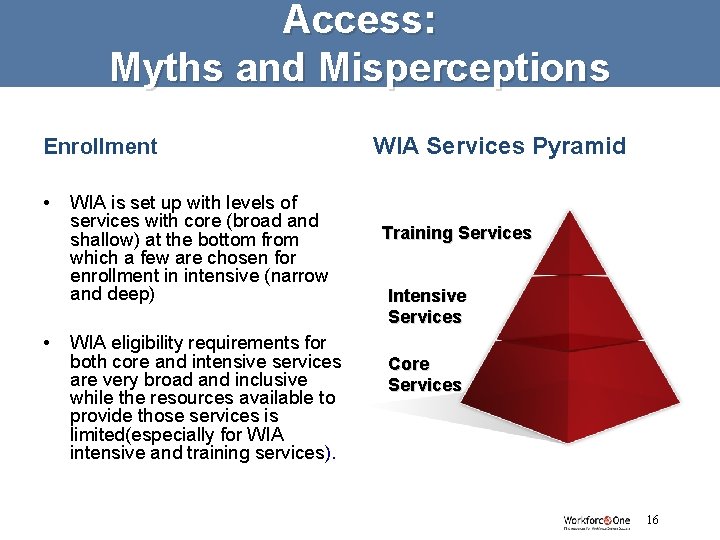
Access: Myths and Misperceptions Enrollment • • WIA is set up with levels of services with core (broad and shallow) at the bottom from which a few are chosen for enrollment in intensive (narrow and deep) WIA eligibility requirements for both core and intensive services are very broad and inclusive while the resources available to provide those services is limited(especially for WIA intensive and training services). WIA Services Pyramid Training Services Intensive Services Core Services 16
DEI and WIA Customer Flow • As a result of this resource scarcity in most WIA service delivery models participation in core services or a specific menu of core services is required prior for consideration for intensive services. • That is why customer flow through all levels of services (core, intensive and training) provided by the center is critical to the success of the DEI. 17
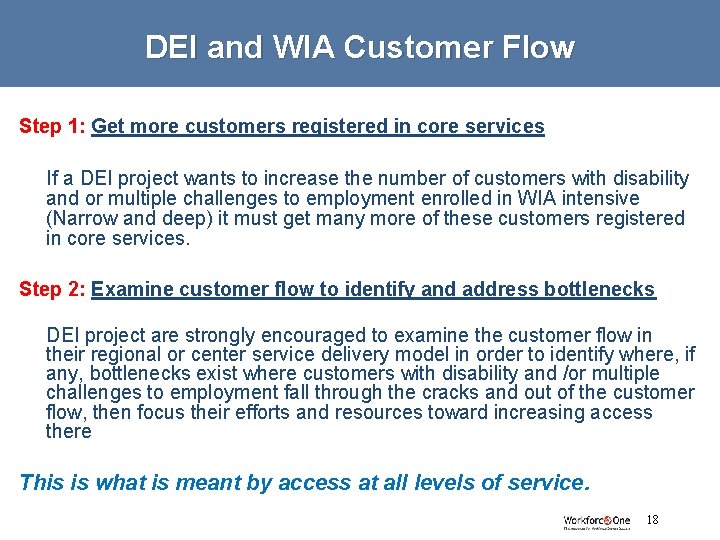
DEI and WIA Customer Flow Step 1: Get more customers registered in core services If a DEI project wants to increase the number of customers with disability and or multiple challenges to employment enrolled in WIA intensive (Narrow and deep) it must get many more of these customers registered in core services. Step 2: Examine customer flow to identify and address bottlenecks DEI project are strongly encouraged to examine the customer flow in their regional or center service delivery model in order to identify where, if any, bottlenecks exist where customers with disability and /or multiple challenges to employment fall through the cracks and out of the customer flow, then focus their efforts and resources toward increasing access there This is what is meant by access at all levels of service. 18
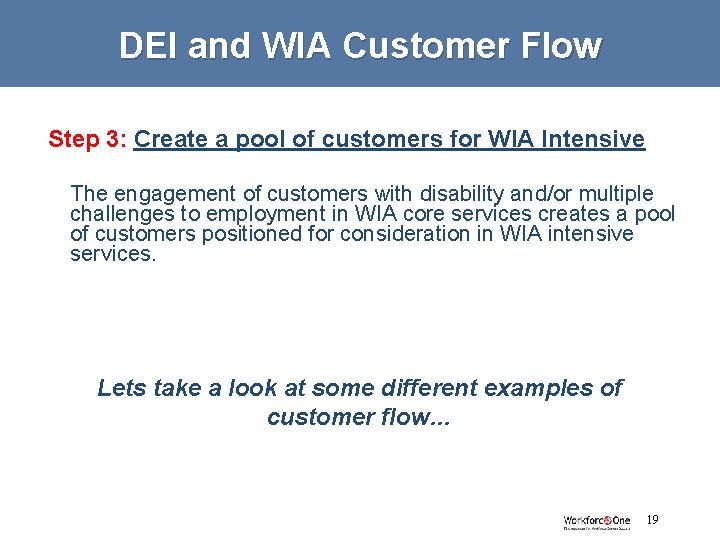
DEI and WIA Customer Flow Step 3: Create a pool of customers for WIA Intensive The engagement of customers with disability and/or multiple challenges to employment in WIA core services creates a pool of customers positioned for consideration in WIA intensive services. Lets take a look at some different examples of customer flow… 19
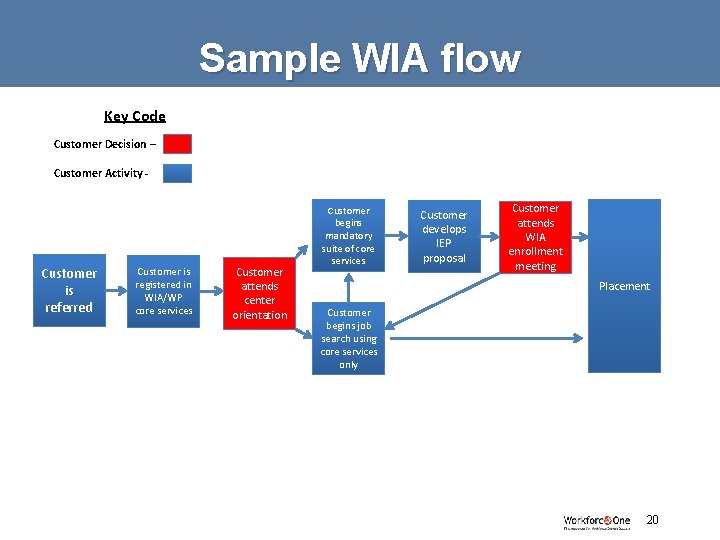
Sample WIA flow Key Code Customer Decision – Customer Activity - Customer is referred Customer is registered in WIA/WP core services Customer attends center orientation Customer begins mandatory suite of core services Customer develops IEP proposal Customer attends WIA enrollment meeting Placement Customer begins job search using core services only 20
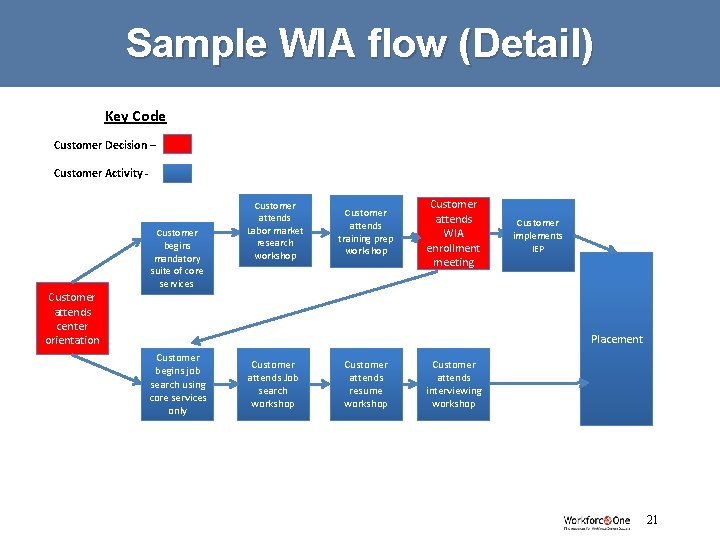
Sample WIA flow (Detail) Key Code Customer Decision – Customer Activity - Customer begins mandatory suite of core services Customer attends Labor market research workshop Customer attends training prep workshop Customer attends WIA enrollment meeting Customer attends center orientation Customer implements IEP Placement Customer begins job search using core services only Customer attends Job search workshop Customer attends resume workshop Customer attends interviewing workshop 21
DEI and WIA Customer Flow • The Job of the DRC is not to develop a new service delivery system for customers with disability and or multiple challenges to employment within WIA, but instead is to make the one that currently exists accessible to them. • This is why access is the focus of this project and why each of the service delivery components were identified, because they had helped the systems that developed them increase access to the WIA service flow. 22
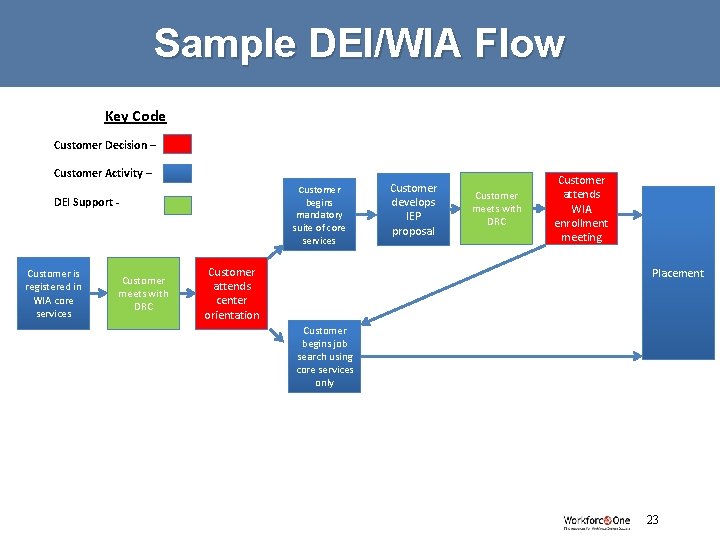
Sample DEI/WIA Flow Key Code Customer Decision – Customer Activity – Customer begins mandatory suite of core services DEI Support - Customer is registered in WIA core services Customer meets with DRC Customer attends center orientation Customer develops IEP proposal Customer meets with DRC Customer attends WIA enrollment meeting Placement Customer begins job search using core services only 23
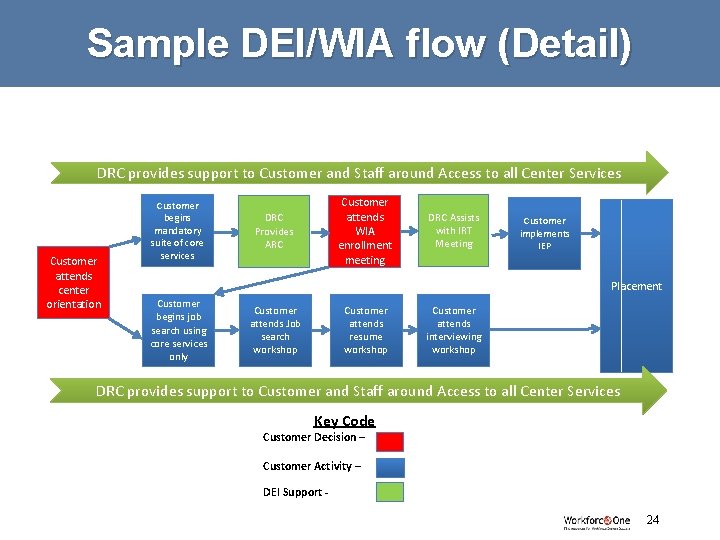
Sample DEI/WIA flow (Detail) DRC provides support to Customer and Staff around Access to all Center Services Customer attends center orientation Customer begins mandatory suite of core services Customer attends WIA enrollment meeting DRC Provides ARC DRC Assists with IRT Meeting Customer implements IEP Placement Customer begins job search using core services only Customer attends Job search workshop Customer attends resume workshop Customer attends interviewing workshop DRC provides support to Customer and Staff around Access to all Center Services Key Code Customer Decision – Customer Activity – DEI Support - 24
Service Delivery Components and DEI Outcomes 25
Service Delivery Components and DEI Outcomes • What do we notice that differentiates the DEI/WIA Service flow from the traditional WIA service flow that we first examined? • How can DEI service delivery components be used to increase access to The WIA customer flow? • These intervention strategies are used to provide support to customers as they engage in the WIA Service customer flow. – IRT – Ticket to Work – Partnership and Collaboration • These strategies are meant to increase a customer with disabilities chances of being enrolled WIA Intensive services by putting supports in place that position them to meet WIA outcomes.
Service Delivery Components and DEI Outcomes • The service delivery elements are not mutually exclusive and all of the DEI strategies can be applied simultaneously to adress multiple challenges to employment and help a particular customer comply with the WIA service delivery model • This allows for the development of a richly resourced plan that can lead a customer all the way from where they are when they begin to receive services to that desired WIA Intensive outcome when they are exited.
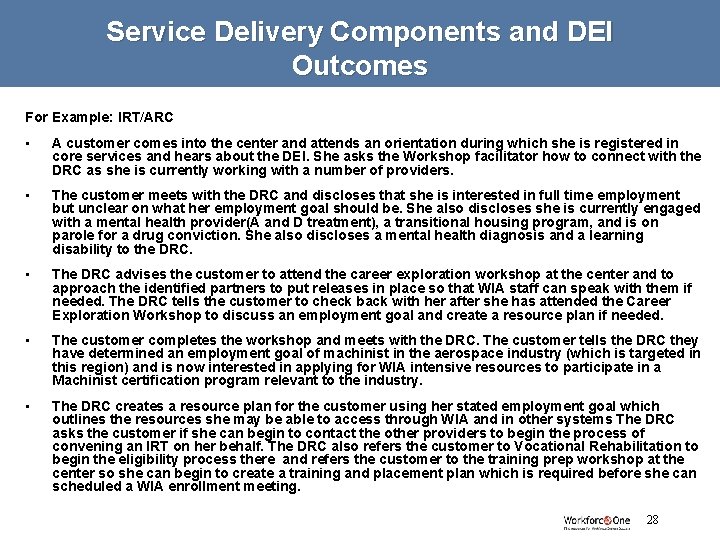
Service Delivery Components and DEI Outcomes For Example: IRT/ARC • A customer comes into the center and attends an orientation during which she is registered in core services and hears about the DEI. She asks the Workshop facilitator how to connect with the DRC as she is currently working with a number of providers. • The customer meets with the DRC and discloses that she is interested in full time employment but unclear on what her employment goal should be. She also discloses she is currently engaged with a mental health provider(A and D treatment), a transitional housing program, and is on parole for a drug conviction. She also discloses a mental health diagnosis and a learning disability to the DRC. • The DRC advises the customer to attend the career exploration workshop at the center and to approach the identified partners to put releases in place so that WIA staff can speak with them if needed. The DRC tells the customer to check back with her after she has attended the Career Exploration Workshop to discuss an employment goal and create a resource plan if needed. • The customer completes the workshop and meets with the DRC. The customer tells the DRC they have determined an employment goal of machinist in the aerospace industry (which is targeted in this region) and is now interested in applying for WIA intensive resources to participate in a Machinist certification program relevant to the industry. • The DRC creates a resource plan for the customer using her stated employment goal which outlines the resources she may be able to access through WIA and in other systems The DRC asks the customer if she can begin to contact the other providers to begin the process of convening an IRT on her behalf. The DRC also refers the customer to Vocational Rehabilitation to begin the eligibility process there and refers the customer to the training prep workshop at the center so she can begin to create a training and placement plan which is required before she can scheduled a WIA enrollment meeting. 28
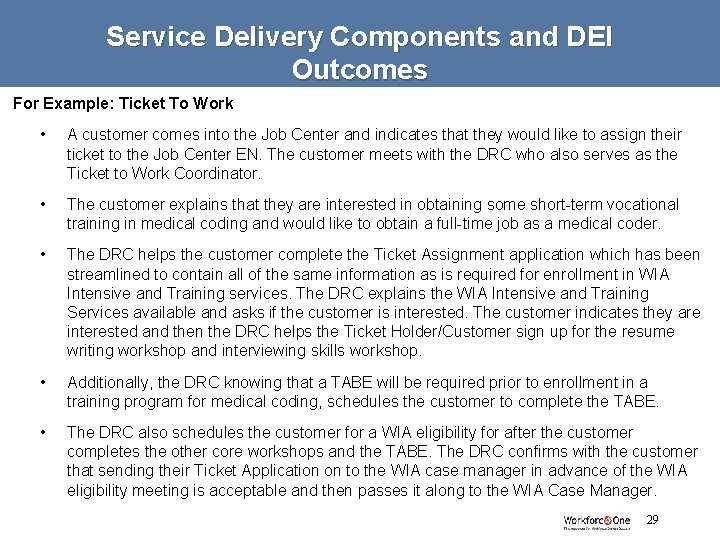
Service Delivery Components and DEI Outcomes For Example: Ticket To Work • A customer comes into the Job Center and indicates that they would like to assign their ticket to the Job Center EN. The customer meets with the DRC who also serves as the Ticket to Work Coordinator. • The customer explains that they are interested in obtaining some short-term vocational training in medical coding and would like to obtain a full-time job as a medical coder. • The DRC helps the customer complete the Ticket Assignment application which has been streamlined to contain all of the same information as is required for enrollment in WIA Intensive and Training services. The DRC explains the WIA Intensive and Training Services available and asks if the customer is interested. The customer indicates they are interested and then the DRC helps the Ticket Holder/Customer sign up for the resume writing workshop and interviewing skills workshop. • Additionally, the DRC knowing that a TABE will be required prior to enrollment in a training program for medical coding, schedules the customer to complete the TABE. • The DRC also schedules the customer for a WIA eligibility for after the customer completes the other core workshops and the TABE. The DRC confirms with the customer that sending their Ticket Application on to the WIA case manager in advance of the WIA eligibility meeting is acceptable and then passes it along to the WIA Case Manager. 29
Service Delivery Components and DEI Outcomes For Example: Partnership and Collaboration In Working closely with WIA youth staff a DRC discovers that the program is engaged in a partnership with the local community college that involves assisting out of school youth attain their GED’s with the WIA program providing case management and career exploration activities while the college provides GED classes and tutoring at the WIA youth programs offices The WIA youth program has discovered that many of the disconnected youth experience disability and are frustrated because they have had to exit many of them because of performance issues they feel are related to these disabilities The DRC proposes assisting the WIA youth staff to • Coordinate their GED attainment activities with the community colleges office of disabilities • Design career exploration activities that are customized to meet the youth’s needs and arrive at an employment goal for each youth. • To develop resource plans convene IRT’s for the youth participating in the pilot 30
Focusing on DEI Outcomes 31
DEI Outcomes Leveraging Multiple Programs If you are working more intensively with a smaller amount of customers it makes sense to get multiple outcomes on each one. Recommended steps include – For every ticket you assign also consider WIA Intensive and/or Training enrollment – For every customer you are attempting to enroll that is a SSA Beneficiary consider taking the ticket. – Consider using the resources made available through a systems level partnership or a customer level IRT to leverage WIA intensive services for a ticketholder. 32
DEI Outcomes The Numbers Game Remember in order to demonstrate increased access at all levels of WIA services you only need to increase the percentage of enrolled customers with disability. This means that if the total enrollees in a system are 100 and 7 percent currently have a disclosed disability an increase of 5 customers with disability will raise that percentage by 5 points or from 7 percent to 12 percent in this case. 33
Summary Today we covered the following: • Reviewed “why” Access issues exist for people with multiple challenges to employment • Discussed the similarities and distinctions between WIA customer flow and how DEI/WIA customer flow seeks to work within the WIA customer flow. • Discussed how to be solution-oriented through examining the customer flow and how providing supports through the process by utilizing DEI intervention strategies can help all customers achieve the end goal of meeting WIA outcomes which includes: – living wage employment, – a viable career path with opportunities for advancement and – is retained for a long period of time. 34
Open Chat What are your thoughts/questions about The Workforce Development System Part 3 ? # 35
Reminder… • Download materials from today’s event. Checkout the Access Resource Guide and 30 Second Training Series. • Join us on March 18 th for TA Office Hours where you can ask more questions, present scenarios specific to your center and learn more about the Access Maturity Model • If you have not already, attend a WIA Adult and Dislocated Worker Orientation in your Job Center or schedule an appointment to talk with the WIA Counselor(s) in your Center(s) • Share Trainings 2 & 3 of this series with your Center staff as a spring board for discussion. # 36
Resources • The Access Maturity Model – Contact Your TA Liaison to learn more and join us on March 18 for TA Office Hours. • The American Job Center Access 30 Second Training Series – http: //www. dei-ideas. org/chapter 1 -28/page 01 a_Access 30 sec_private. cfm • The American Job Center Access Resource Guide – http: //www. dei-ideas. org/chapter 1 -28/page 01 a_Access 30 sec_private. cfm # 37
Resources Workforce System 101 Training Modules U. S. Department of Labor Employment and Training Administration https: //www. workforce 3 one. org/view/1001324149819286670/info An introduction to the workforce system in eight parts, with each module offering the choice to learn from one of three perspectives: as a new workforce system employee, a new Workforce Investment Board (WIB) member, or a more experienced workforce system employee. Modules include: • Module 1: Introduction to State and Local Workforce System Governance • Module 2: The Mechanics of Workforce Funding • Module 3: Workforce System Accountability • Module 4: Wagner-Peyser Act and Reemployment Services • Module 5: Workforce Investment Act Overview • Module 6: Workforce System Services for Employers • Module 7: Workforce System Scenario: Job Seeker • Module 8: Workforce System Scenario: Employer Services # 38
Please enter your questions in the Chat Room! # 39
Speakers’ Contact Information Speaker: DJ Ralston Title: WIA Subject Matter Expert Organization: National Disability Institute Email: dralston@ndi-inc. org Telephone: 740 -398 -5247 Speaker: Brian Ingram Title: WIA Subject Matter Expert Organization: National Disability Institute Email: bingram@ndi-inc. org Telephone: 503 -913 -3169 # 40
Thank You! Find resources for workforce system success at: www. workforce 3 one. org # 41