
Welcome to UWB Biology Chris Shaeffer Kristen Attebery
Welcome to UWB Biology! Chris Shaeffer & Kristen Attebery | sciadv@uw. edu December 2019
Today we will talk about… 1) 2) 3) 4) 5) 6) 7) 8) 9) What academic advising can do for you! What is the Biology major, anyway? Getting involved on campus Related Minors Degree Requirements Planning out your coursework How biology electives work Planning for your “Investigative Biology” requirement Petitioning Requirements Chris Shaeffer & Kristen Attebery | sciadv@uw. edu
Academic Advising • We’re here to help YOU! Set up an appointment online at: www. uwb. edu/biology (click the scheduling button on the right side) • Navigating policies and procedures Try to visit once per quarter! • Finding campus resources and information • Course planning and registration assistance • Exploring careers and graduate school possibilities • Moral and administrative support in the face of difficulties Chris Shaeffer & Kristen Attebery | sciadv@uw. edu
Biology? • Science Systematically building and organizing knowledge by way of testable explanations and predictions. • Natural Sciences The sciences of natural phenomena, as opposed to abstract logic (formal sciences) or human society (social sciences). • Life Sciences The study of living natural phenomena, as opposed to nonliving natural phenomenon (physical sciences – physics, chemistry, etc. ): • • • Biochemistry Molecular Biology Genetics Evolution Cell Biology Microbiology • • • Anatomy Physiology Ecology Botany Zoology Neurobiology Chris Shaeffer & Kristen Attebery | sciadv@uw. edu • Marine Biology • Computational Biology • Theoretical Biology • Systems Biology • Biotechnology
Jobs? • Health-related jobs • Environmental science and conservation biology • Teaching and research in biological science • Government, law, and business • Biotechnology development • Agriculture • Also, anything! Your major is not your career. Visit www. uwb. edu/careers for resources on how to build your professional network and develop a job search strategy. Chris Shaeffer & Kristen Attebery— sciadv@uw. edu
University of Washington Bothell Biology Club Connect: Provide opportunities for students from all majors to get to know fellow students, faculty, & staff who have an interest in the biological sciences. Grow: Promote awareness of career and research opportunities in Biology. Give Back: Make a difference in the local community through volunteering and community service. Visit: www. uwb. edu/biological-sciences/bioclub Chris Shaeffer & Kristen Attebery | sciadv@uw. edu
Other Clubs & Student Groups • Browse our clubs at www. uwb. edu/sea/clubs • Biology-related clubs • • • BWi. SE (Bothell Women in Science and Engineering) Outdoor Wellness Club Pre-Health Society Pre-Medical Club Sustainability Organization at UWB & Cascadia CC • Don’t see a group you want to join? — Make one! Chris Shaeffer & Kristen Attebery | sciadv@uw. edu
Minors • You can take any minor at any campus! • www. uw. edu/uaa/advising → Academic Planning → Majors & Minors → Undergraduate Minors • Some common choices for UWB Biology Majors • • Business Chemistry Mathematics Neuroscience Global Health Studies Computing & Software Systems Chris Shaeffer & Kristen Attebery | sciadv@uw. edu
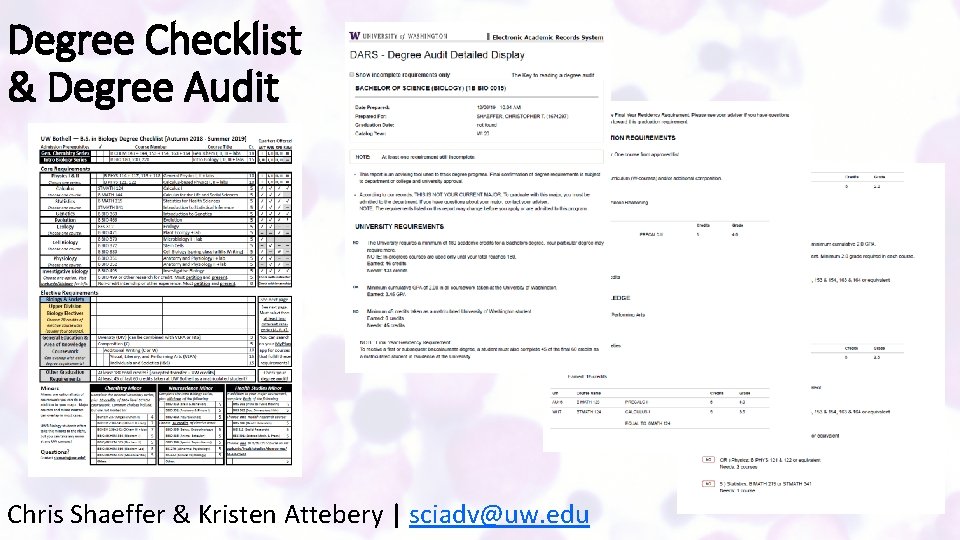
Degree Checklist & Degree Audit Chris Shaeffer & Kristen Attebery | sciadv@uw. edu
Degree Requirements You are responsible for ensuring the completion of all degree requirements. • Visit www. uwb. edu/biology → “Program Structure” tab • Print out the Biology Degree Checklist • Check your Degree Audit once per quarter on My. UW or My. Plan! • This decides whether or not you can graduate. Make sure it is correct. • If you think a requirement should be marked as complete, but it is not: 1) Reload your audit. 2) Send your advisor an email (include your full name and student ID number) Chris Shaeffer & Kristen Attebery | sciadv@uw. edu
Planning Your Coursework • Get familiar with the Time Schedule. • Visit www. uwb. edu Current Students Resources Time Schedule (Or just go to www. uwb. edu/registration/time. ) • Plan out a tentative schedule on your My. Plan App. • • Visit www. myplan. uw. edu Run your degree audit! Search for courses! Make a plan! Note: Planning coursework does not register you! You must click the “Registration” button in the upper right Chris Shaeffer & Kristen Attebery | sciadv@uw. edu
How Biology Electives Work • There are three categories of electives. A) Ecology / Evolution / Biological Diversity-related B) Cell / Molecular Biology-related C) Physiology / Neurobiology-related Note: General Education requirements such as “Writing” (W) and “Individuals & Society” (I&S) can overlap with Major requirements. . • You need 20 credits (usually four classes) from at least two of the categories. • You cannot take all of your electives in the same category (for example, all four elective classes in just the ‘B’ category). • You do not need to take electives from all three categories, but you can if desired. • Biology Major requirements cannot overlap with each other. • Electives are in addition to core requirements like Ecology, Cell Biology, Physiology. • One class cannot fulfill both a core requirement and an elective requirement, etc. • When in doubt – ask your advisor! Chris Shaeffer & Kristen Attebery | sciadv@uw. edu
Investigative Biology & Other Research • All Biology students must complete a research experience. • Visit www. uwb. edu/biology “Investigative Biology” tab for more info • Become very familiar with the contents of this webpage. • Three main options: 1. BBIO 495 (Investigative Biology) Automatically fulfills requirement! 2. 5 credits of BBIO 499 (Biology Research) or similar Must petition and present! 3. 150 hours of non-credit research experience (internships, jobs, volunteering, etc. ) Must petition and present! • Plan for your research early! • At least six months in advance — space fills up! • Not just for seniors — motivates and sets tone for entire undergrad career! Chris Shaeffer & Kristen Attebery | sciadv@uw. edu
Petitioning Requirements • You might have transfer courses that are not yet counting. • You might want to take a course that is not on the standard list of options. (Example: “Biology & Society” requirement is very flexible. ) • Run your degree audit and compare your transcript: • 1) What requirements might not be fulfilled that should be? • 2) Are there any courses at the bottom of the audit (“Other Courses”) that are not counting towards anything that might? • Petitions: Visit www. uwb/biology and click the “Student Forms & Resources” tab if you think a course should count! Chris Shaeffer & Kristen Attebery | sciadv@uw. edu
Summary 1) 2) 3) 4) Communicate with and visit your advisor often. We are here to help! Get involved on campus. It will help you succeed and have more fun. Consider a minor. It is a good way of diversifying your skills. Make sure you understand your degree requirements. You are responsible for ensuring their completion. Check your audit often! 5) Plan for Investigative Biology early. Research and other “experiential learning” like internships, volunteering, and studying abroad are valuable experiences. Planning early ensures you get experiences that are relevant to you. Chris Shaeffer & Kristen Attebery | sciadv@uw. edu
Orientation Complete! Next Steps: 1) Walk to STEM office for 10 -minute registrations. 2) Set up one-on-one advising appointment in winter 2020 quarter for long-term planning. Chris Shaeffer & Kristen Attebery | sciadv@uw. edu
- Slides: 16