
Welcome to Trustee Financial Management Training Sunday April


- Slides: 49
Welcome to Trustee Financial Management Training Sunday, April 7, 2019 Trustee Student Organization Financial Programs, Services and Initiatives
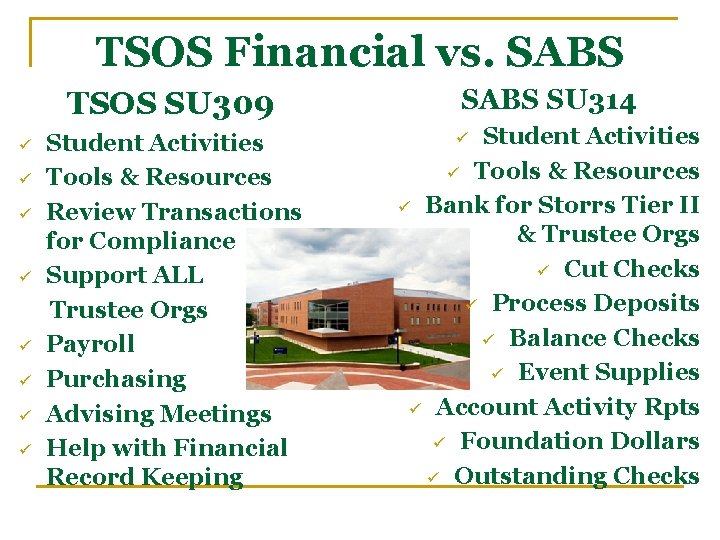
TSOS Financial vs. SABS ü ü ü ü TSOS SU 309 SABS SU 314 Student Activities Tools & Resources Review Transactions for Compliance Support ALL Trustee Orgs Payroll Purchasing Advising Meetings Help with Financial Record Keeping Student Activities ü Tools & Resources ü Bank for Storrs Tier II & Trustee Orgs ü Cut Checks ü Process Deposits ü Balance Checks ü Event Supplies ü Account Activity Rpts ü Foundation Dollars ü Outstanding Checks ü
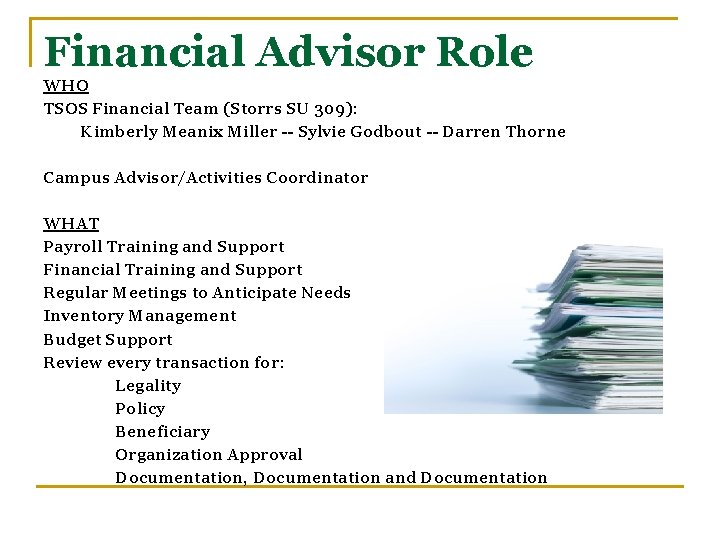
Financial Advisor Role WHO TSOS Financial Team (Storrs SU 309): Kimberly Meanix Miller -- Sylvie Godbout -- Darren Thorne Campus Advisor/Activities Coordinator WHAT Payroll Training and Support Financial Training and Support Regular Meetings to Anticipate Needs Inventory Management Budget Support Review every transaction for: Legality Policy Beneficiary Organization Approval Documentation, Documentation and Documentation
Part I Foundation
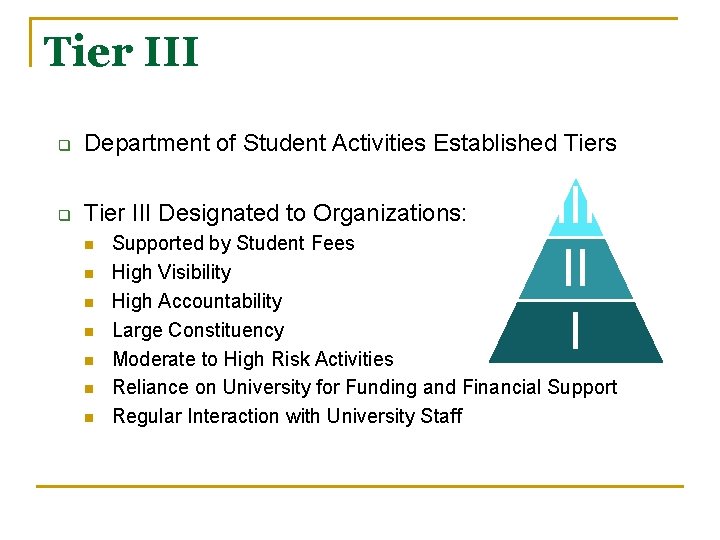
Tier III q Department of Student Activities Established Tiers q Tier III Designated to Organizations: n n n n III II I Supported by Student Fees High Visibility High Accountability Large Constituency Moderate to High Risk Activities Reliance on University for Funding and Financial Support Regular Interaction with University Staff
Trustee q q q Established by the University Approved by the State of Connecticut Account established for the “Welfare” of Others n q In your case, the fee paying student body, Constituents In Compliance with: n n n CGS Sections 4 -52 through 4 -57 a State Comptroller’s Manual for Activity/Welfare Funds State and Federal Law Relevant University Policies including Blueprints Accounting, Financial and Business Best Practices
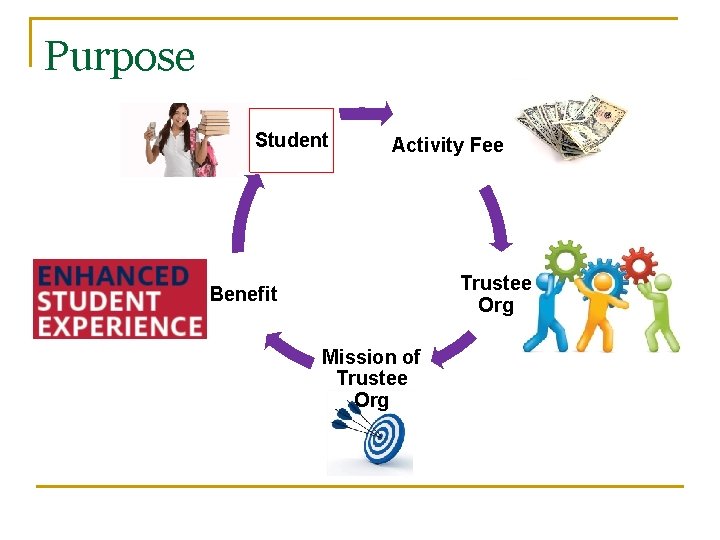
Purpose Student Activity Fee Trustee Org Benefit Mission of Trustee Org
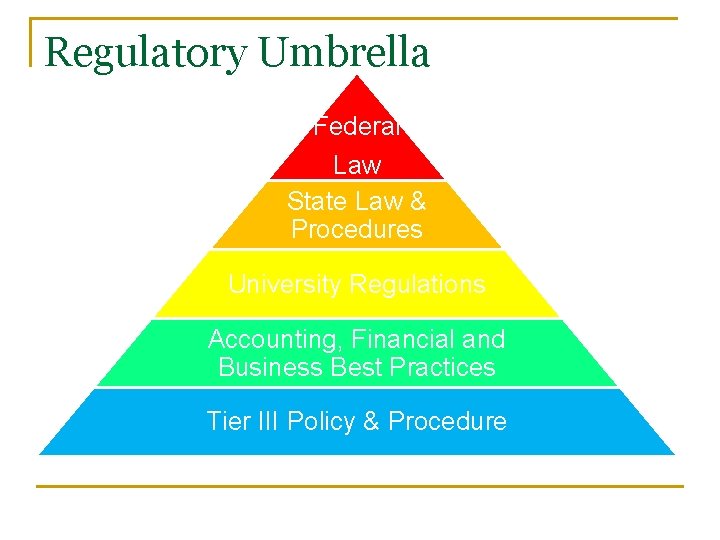
Regulatory Umbrella Federal Law State Law & Procedures University Regulations Accounting, Financial and Business Best Practices Tier III Policy & Procedure
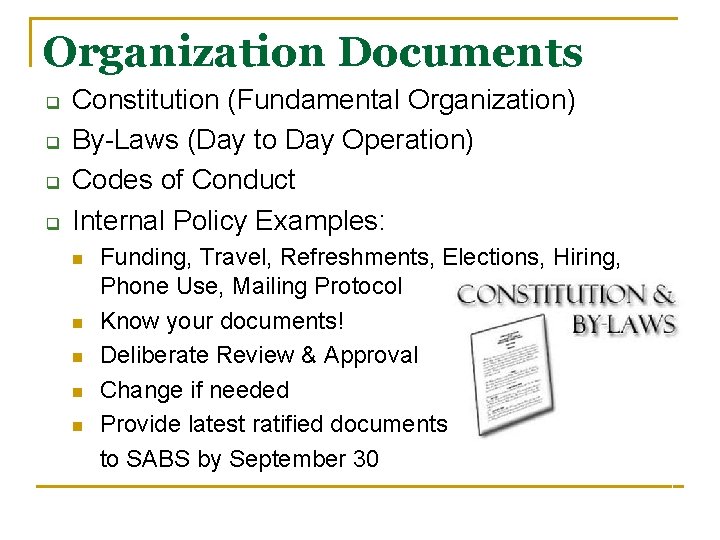
Organization Documents q q Constitution (Fundamental Organization) By-Laws (Day to Day Operation) Codes of Conduct Internal Policy Examples: n n n Funding, Travel, Refreshments, Elections, Hiring, Phone Use, Mailing Protocol Know your documents! Deliberate Review & Approval Change if needed Provide latest ratified documents to SABS by September 30
Part II Transparency
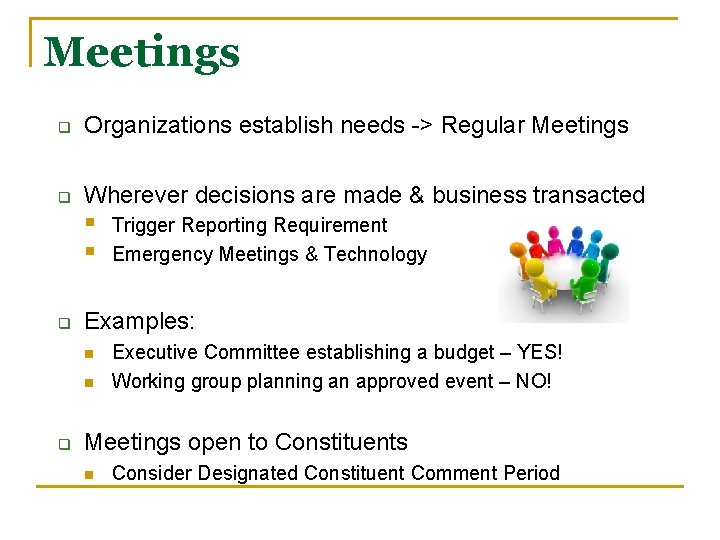
Meetings q Organizations establish needs -> Regular Meetings q Wherever decisions are made & business transacted § § q Examples: n n q Trigger Reporting Requirement Emergency Meetings & Technology Executive Committee establishing a budget – YES! Working group planning an approved event – NO! Meetings open to Constituents n Consider Designated Constituent Comment Period
Agendas q q q Published in advance to best reach your Constituents 7 days in advance of the Meeting * Suggest publishing with the following: q q q Minutes of the previous meeting Regular Reports (President, Treasurer, Committee Chairs, etc) Background Information for Discussion Items Background Information and proposed motions for Action Items Maintained in Organization Files Include: n Include Org, Subcommittee, if applicable, Meeting Date, Time, Location, Type (Regular, Special, Monthly, etc), Matters for Discussion and Matters for Action
Minutes q q q Benefit for all Meetings but a requirement for your decision-making groups Must be published within 7 days of meeting Must be provided to TSOS Must be retained by the Organization Must be approved at subsequent meeting Include all information from Agenda plus: q q q Voting Members, number representing a quorum and notation of present, absent, late arrival and early departure Non-Voting Members and notation of present or absent Guests present during any portion of the meeting Matters discussed, Action Taken and Regular Reports Include legislative intent, dissent, conflict of interest, vote outcome Foot the minutes and title document
Document Title for Minutes q q q Include Organization Include Subcommittee, if applicable Include Meeting Type, if applicable Include Date of Meeting YYYYDDMM Include Fiscal Year Notation and Nmbr Include the number of the meeting n n This is so it is clear if we are missing a set of minutes, 01, 03 Example: USG Exec Monthly 20181122 Meeting Minutes #19 -06
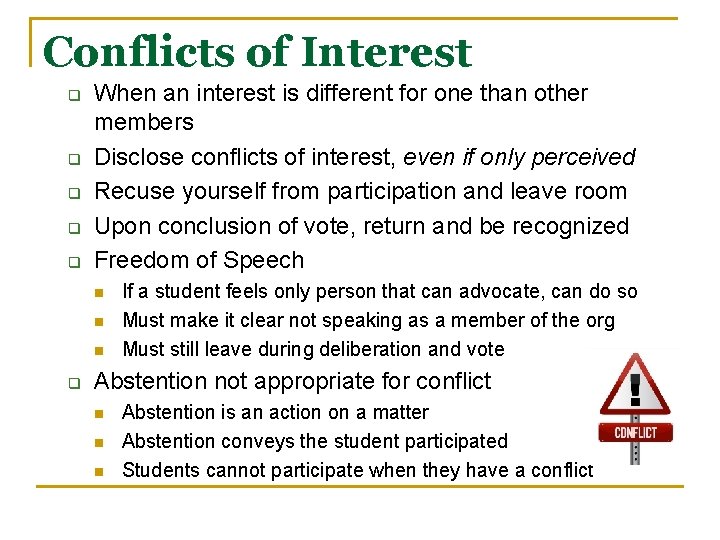
Conflicts of Interest q q q When an interest is different for one than other members Disclose conflicts of interest, even if only perceived Recuse yourself from participation and leave room Upon conclusion of vote, return and be recognized Freedom of Speech n n n q If a student feels only person that can advocate, can do so Must make it clear not speaking as a member of the org Must still leave during deliberation and vote Abstention not appropriate for conflict n n n Abstention is an action on a matter Abstention conveys the student participated Students cannot participate when they have a conflict
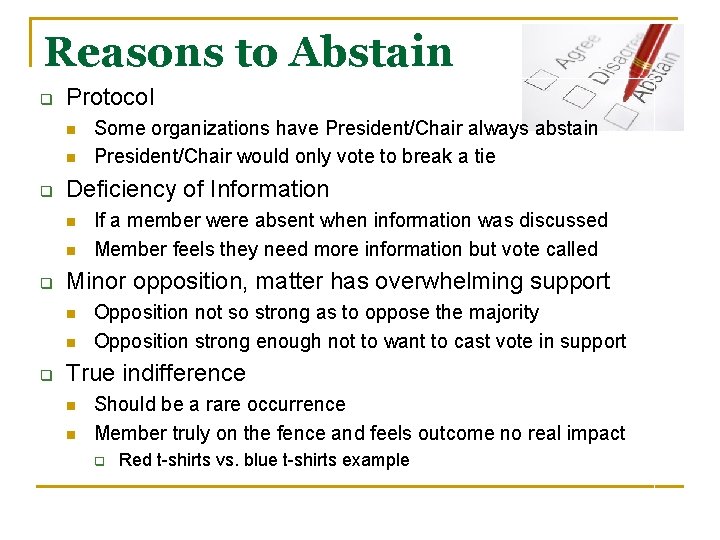
Reasons to Abstain q Protocol n n q Deficiency of Information n n q If a member were absent when information was discussed Member feels they need more information but vote called Minor opposition, matter has overwhelming support n n q Some organizations have President/Chair always abstain President/Chair would only vote to break a tie Opposition not so strong as to oppose the majority Opposition strong enough not to want to cast vote in support True indifference n n Should be a rare occurrence Member truly on the fence and feels outcome no real impact q Red t-shirts vs. blue t-shirts example
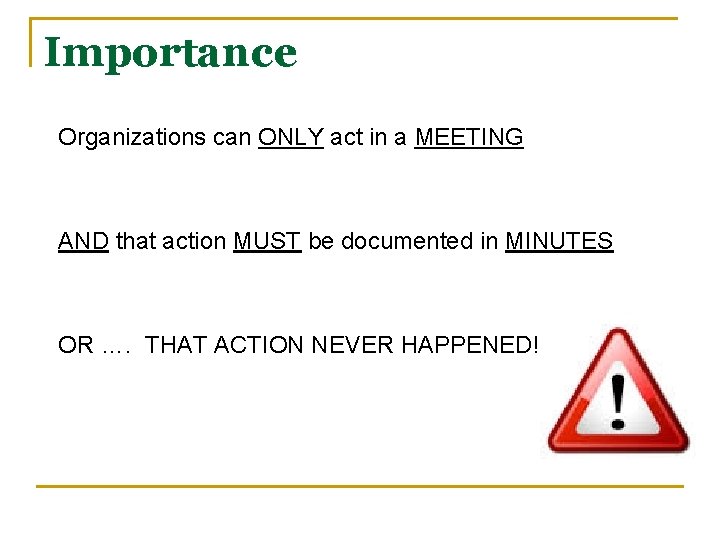
Importance Organizations can ONLY act in a MEETING AND that action MUST be documented in MINUTES OR …. THAT ACTION NEVER HAPPENED!
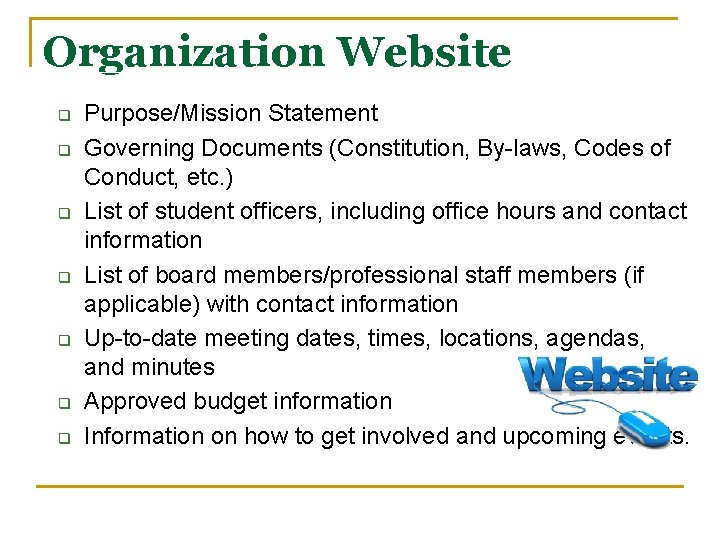
Organization Website q q q q Purpose/Mission Statement Governing Documents (Constitution, By-laws, Codes of Conduct, etc. ) List of student officers, including office hours and contact information List of board members/professional staff members (if applicable) with contact information Up-to-date meeting dates, times, locations, agendas, and minutes Approved budget information Information on how to get involved and upcoming events.
Part III Financial Policies
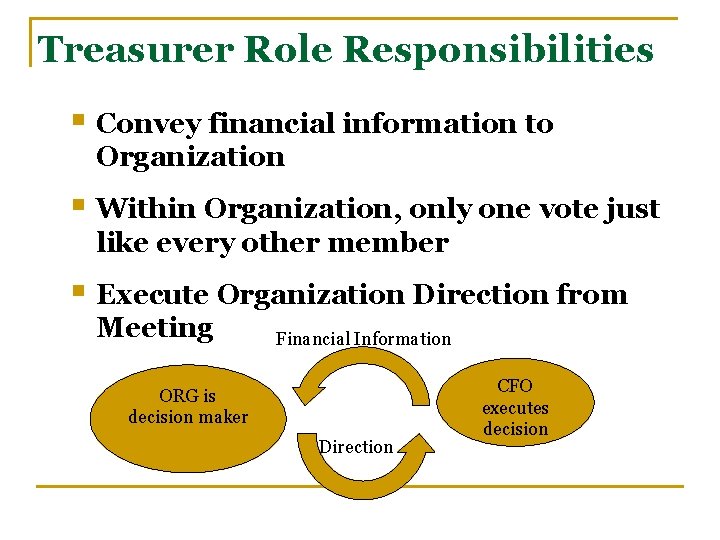
Treasurer Role Responsibilities § Convey financial information to Organization § Within Organization, only one vote just like every other member § Execute Organization Direction from Meeting Financial Information ORG is decision maker Direction CFO executes decision
Account Signers n n Each Trustee account must have four signers Must be an authorized signer to transact business Organization must ensure that signature cards are accurate and changes addressed in a timely manner Account signers execute decisions made by organizations and documented in minutes
Revenue n n n Student Fees Deposits Contributions Organization paid for services rendered Co-sponsorships Tier II Organization paying their portion n For funding organizations only Charging a portion for an activity q Market. Place q One Card q Cash at the door -> best avoided, if possible
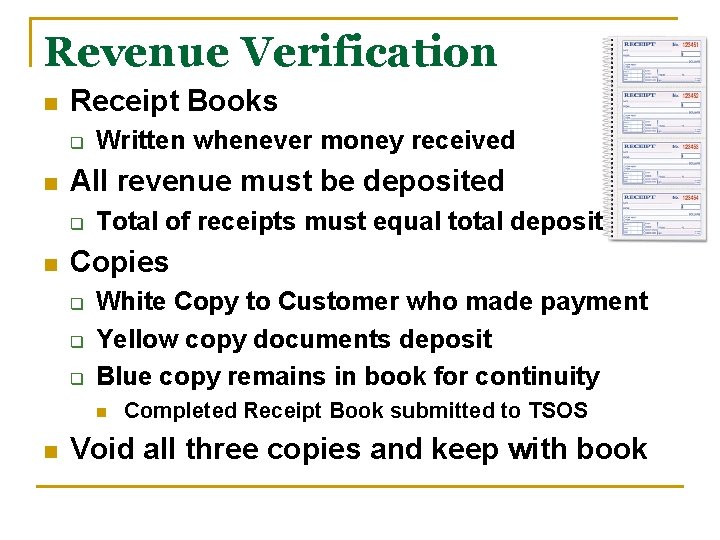
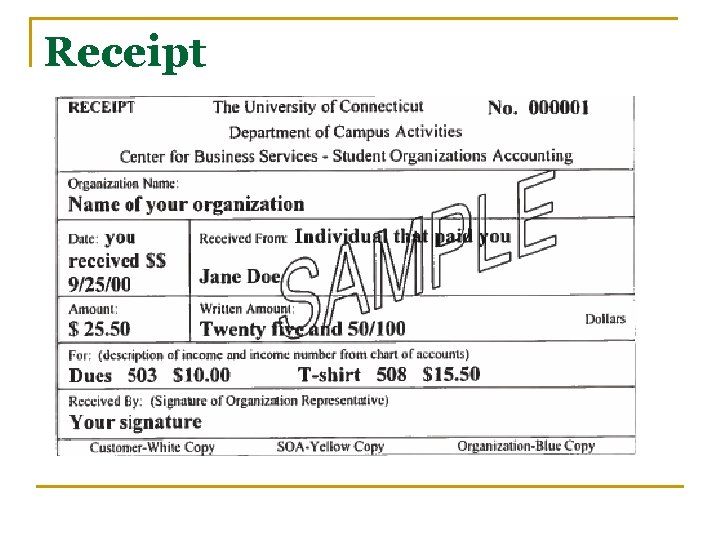
Revenue Verification n Receipt Books q n All revenue must be deposited q n Written whenever money received Total of receipts must equal total deposit Copies q q q White Copy to Customer who made payment Yellow copy documents deposit Blue copy remains in book for continuity n n Completed Receipt Book submitted to TSOS Void all three copies and keep with book
Receipt
Deposits Complete receipts for your Revenue Make timely deposits of all revenue q Establish regular banking visits n n n q If anticipate substantial deposit n n q q Minimum weekly Have one or two back-up people if you can’t make it Don’t put off because of amount Plan special trip for someone to go to the bank/SABS If $500, must deposit within 24 hours Scan/Copy checks deposited Separate deposits, if needed DO NOT pay any event expenses from revenues
Contributions n n If value under $25, may be accepted without DSA approval If value over $25, considered gifts and must be reviewed and approved by TSOS All donors wishes a donation to be tax deductible, they must go through Foundation Tier III Organizations cannot donate any revenue received from Student Fees
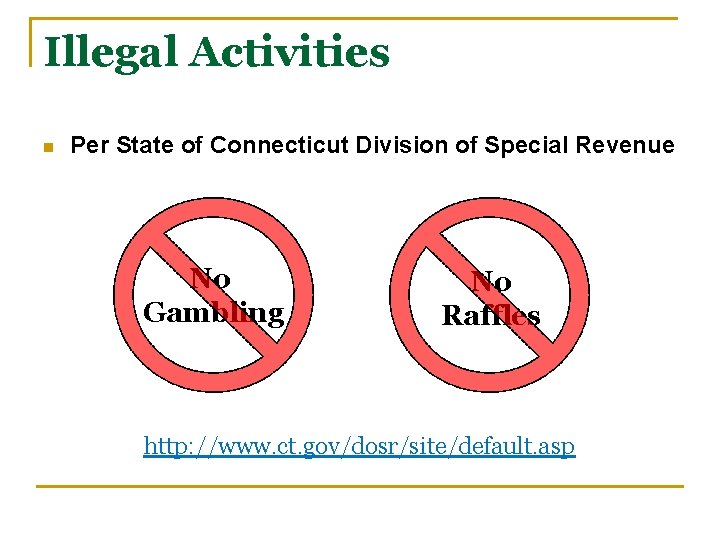
Illegal Activities n Per State of Connecticut Division of Special Revenue No Gambling No Raffles http: //www. ct. gov/dosr/site/default. asp
Events p Plan a minimum 2 months in advance p Organization Approval p Audience (fee paying students) p Advertise p Budget p Purchases what , how & from whom p p p Get advice to maximize success Assess right after event! Track attendance All fund-raising must be submitted to TSOS for review and approval prior to planning
Expenditure Decisions n Approved in Minutes before money spent or committed (up to $ language) n Organization Consider: q q q n Legality and adherence to policies Cost/Benefit to constituents/student body Budget Need and all alternatives to meet the need Reasonableness Cost Benefit to Organization Travel must be approved in advance even if no cost is associated
Documentation n AUTHORITY q q n TIER II GROUP FUNDED(if applicable) q q n n UCONNTACT name/mission for the Group UCONNTACT Roster for the Group BUSINESS JUSTIFICATION EVENT RELATED INFORMATION (if applicable) q q n Minutes with specific motion Paperwork signed by 2 authorized signers Flyer or if meeting related, agenda or minutes Beneficiaries/Attendance & Prize Form (if applicable) PAYMENT INFORMATION q q If vendor payment, invoice If reimbursement: n Original Itemized Receipts and Proof of Payment
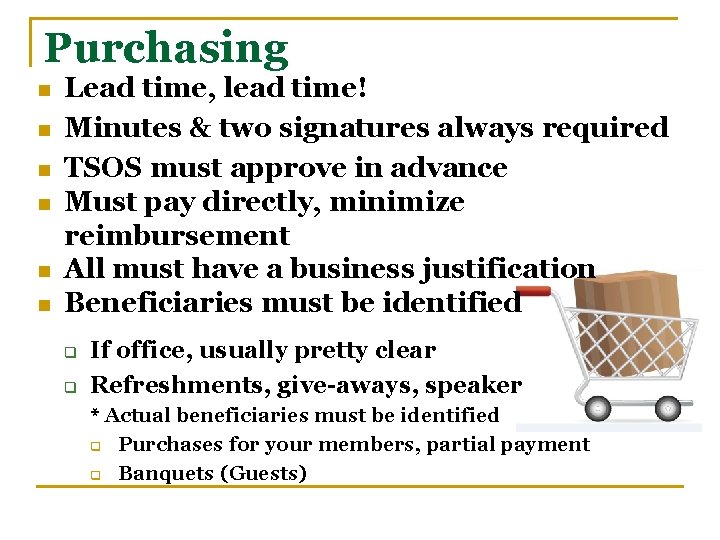
Purchasing n n n Lead time, lead time! Minutes & two signatures always required TSOS must approve in advance Must pay directly, minimize reimbursement All must have a business justification Beneficiaries must be identified q q If office, usually pretty clear Refreshments, give-aways, speaker * Actual beneficiaries must be identified q Purchases for your members, partial payment q Banquets (Guests)
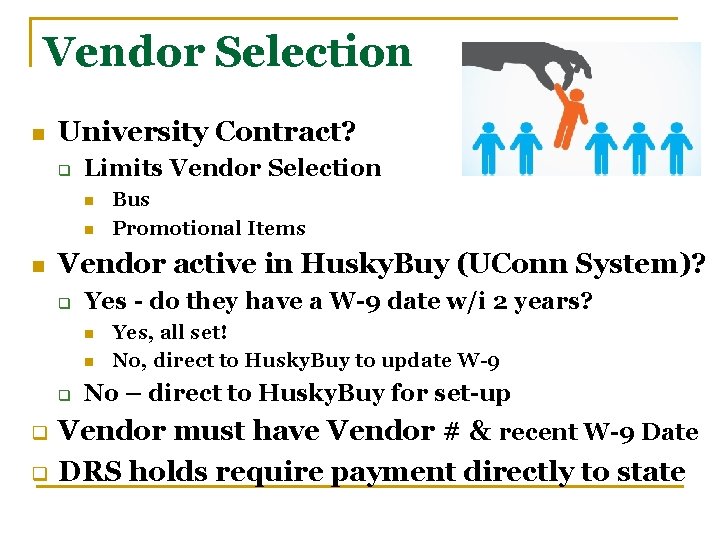
Vendor Selection n University Contract? q Limits Vendor Selection n Vendor active in Husky. Buy (UConn System)? q Yes - do they have a W-9 date w/i 2 years? n n q q q Bus Promotional Items Yes, all set! No, direct to Husky. Buy to update W-9 No – direct to Husky. Buy for set-up Vendor must have Vendor # & recent W-9 Date DRS holds require payment directly to state
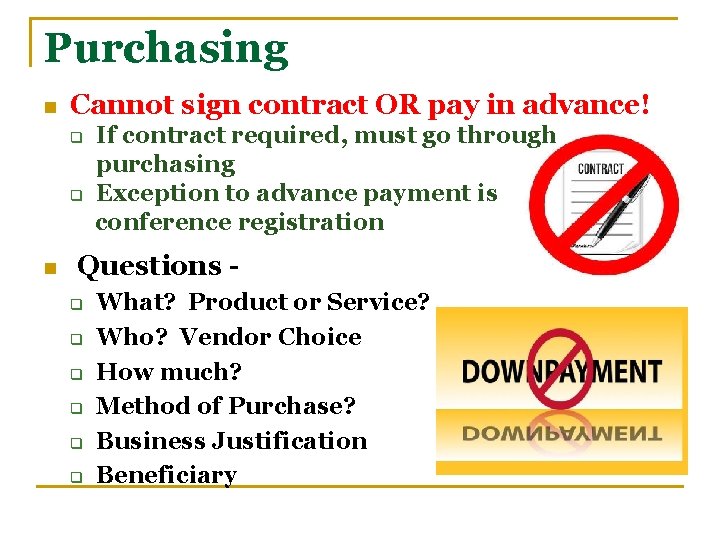
Purchasing n Cannot sign contract OR pay in advance! q q n If contract required, must go through purchasing Exception to advance payment is conference registration Questions q q q What? Product or Service? Who? Vendor Choice How much? Method of Purchase? Business Justification Beneficiary
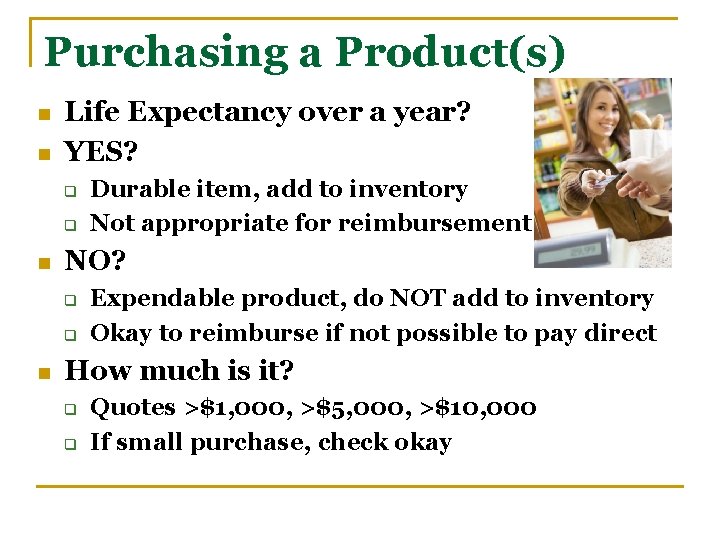
Purchasing a Product(s) n n Life Expectancy over a year? YES? q q n NO? q q n Durable item, add to inventory Not appropriate for reimbursement Expendable product, do NOT add to inventory Okay to reimburse if not possible to pay direct How much is it? q q Quotes >$1, 000, >$5, 000, >$10, 000 If small purchase, check okay
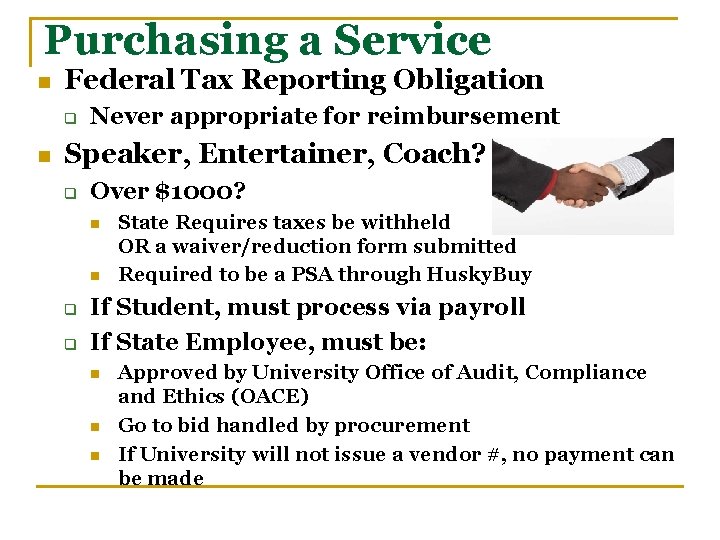
Purchasing a Service n Federal Tax Reporting Obligation q n Never appropriate for reimbursement Speaker, Entertainer, Coach? q Over $1000? n n q q State Requires taxes be withheld OR a waiver/reduction form submitted Required to be a PSA through Husky. Buy OR If Student, must process via payroll If State Employee, must be: n n n Approved by University Office of Audit, Compliance and Ethics (OACE) Go to bid handled by procurement If University will not issue a vendor #, no payment can be made
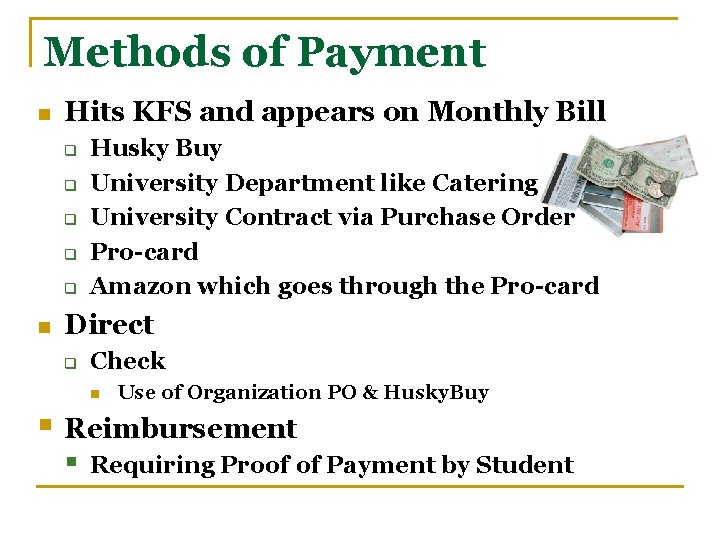
Methods of Payment n Hits KFS and appears on Monthly Bill q q q n Husky Buy University Department like Catering University Contract via Purchase Order Pro-card Amazon which goes through the Pro-card Direct q Check n Use of Organization PO & Husky. Buy § Reimbursement § Requiring Proof of Payment by Student
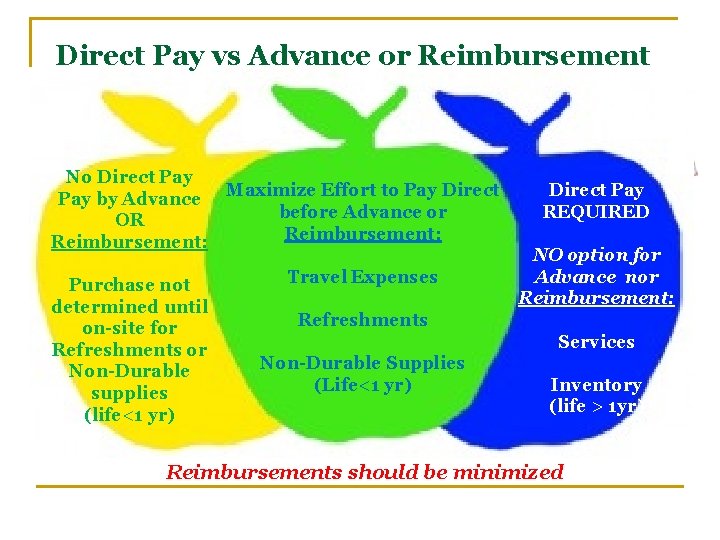
Direct Pay vs Advance or Reimbursement No Direct Pay by Advance OR Reimbursement: Purchase not determined until on-site for Refreshments or Non-Durable supplies (life<1 yr) Maximize Effort to Pay Direct before Advance or Reimbursement: Travel Expenses Direct Pay REQUIRED NO option for Advance nor Reimbursement: Refreshments Services Non-Durable Supplies (Life<1 yr) Inventory (life > 1 yr) Reimbursements should be minimized
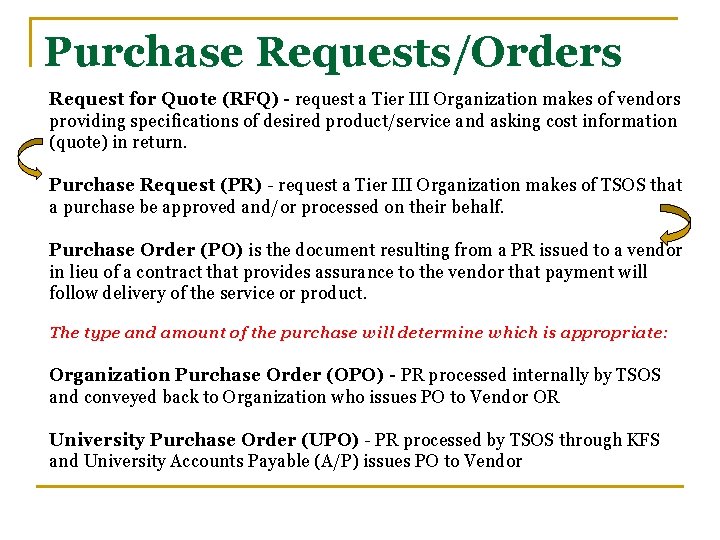
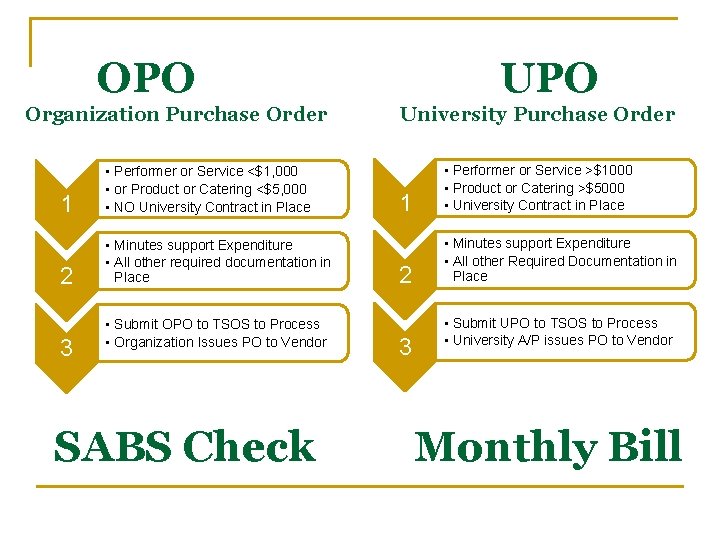
Purchase Requests/Orders Request for Quote (RFQ) - request a Tier III Organization makes of vendors providing specifications of desired product/service and asking cost information (quote) in return. Purchase Request (PR) - request a Tier III Organization makes of TSOS that a purchase be approved and/or processed on their behalf. Purchase Order (PO) is the document resulting from a PR issued to a vendor in lieu of a contract that provides assurance to the vendor that payment will follow delivery of the service or product. The type and amount of the purchase will determine which is appropriate: Organization Purchase Order (OPO) - PR processed internally by TSOS and conveyed back to Organization who issues PO to Vendor OR University Purchase Order (UPO) - PR processed by TSOS through KFS and University Accounts Payable (A/P) issues PO to Vendor
OPO Organization Purchase Order 1 • Performer or Service <$1, 000 • or Product or Catering <$5, 000 • NO University Contract in Place 2 • Minutes support Expenditure • All other required documentation in Place 3 • Submit OPO to TSOS to Process • Organization Issues PO to Vendor SABS Check UPO University Purchase Order 1 • Performer or Service >$1000 • Product or Catering >$5000 • University Contract in Place 2 • Minutes support Expenditure • All other Required Documentation in Place 3 • Submit UPO to TSOS to Process • University A/P issues PO to Vendor Monthly Bill
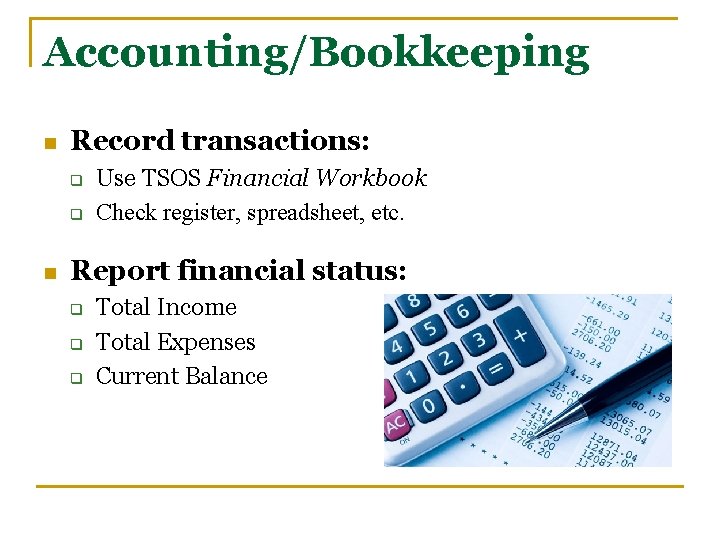
Accounting/Bookkeeping n Record transactions: q q n Use TSOS Financial Workbook Check register, spreadsheet, etc. Report financial status: q q q Total Income Total Expenses Current Balance
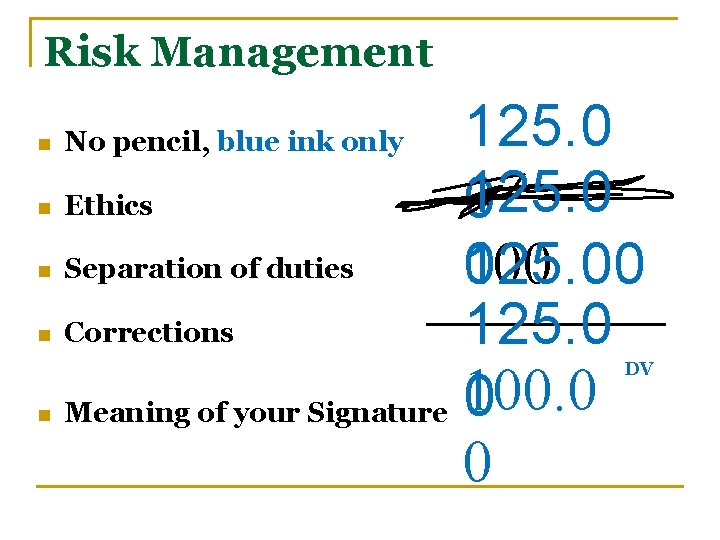
Risk Management n n 125. 0 Ethics 0 Separation of duties 0 100 25. 00 Corrections 125. 0 0 Meaning of your Signature 100. 0 0 No pencil, blue ink only DV n
Outstanding Checks n Outstanding Checks q Collect contact information from payees before payment n q Deliver payment quickly q Follow up if notified of an outstanding check q If subsequent notification, escalate contact! This is the organization’s responsibility!
Travel n Must be approved in advance with up to $ n Pay directly whenever you can n Reimbursement okay for travel n Save all receipts n Mileage rate, insurance levels n Tips up to 20% (if handwritten, need statement) n ITEMIZED ORIGINAL receipts are required! n Off Campus Event Process Required q Submit Final Email
University (KFS) Bill n n n n Quarterly Pay timely Gather documentation throughout quarter Payment processed through SABS Account Check hand delivered by students – Wilbur Cross Ideal Organization review budget vs actual and vote authorizing payment Organization responsible for all documentation n n Payroll All University Purchasing including Procard Internal Billing Credits Phone Bill q q Top signed & returned declaring business justification Bottom submitted with Quarterly Bill
Other… n Tax Exempt q q q n Advances q n Prevent lost student opportunity Gifts and Gift Cards q q q n Advantage of Paying Direct Take time to set it up with vendor in advance Student reimbursements may not always include tax Nominal gifts if at all (none to paid students or staff) No generic gift cards (no MC, Visa, Amex, Amazon) Never gift instead of compensate Prize Forms!!
Other… n “Scan Ready” and “File Friendly” q q n Tape Small Receipts to full sheet, all four sides on edges NO staples or clips within the request packet Do not use highlighter, can obscure Use blue pen marked in margins if needed Exclusively use Shared/Generic Mailboxes q q FOI Transition Ease n n q q Access to History Contacts seamless given same email address Allows to step back for health or academic reasons Allows you to better separate personal/volunteer roles
Other Reporting Requirements q Inventory n q Budget Adoption n q No later than September 30, for current year Student Fee Advisory Committee (SFAC) Budget Projection (training provided in August) n q Minimally at Officer Transition Deadline determined by SFAC near end of Fall Monthly Financial Statements n 5 th of every month
Inventory q q q Sufficient Controls President & Treasurer Responsible for Inventory Control Inventory are items with a lifespan > 1 Year n n q q q Capital Inventory > or = $1, 000 Controllable Inventory < $1, 000 Physical Inventory required minimally 1 X/Year Newly purchased items must be added accordingly Broken/antiquated items must be disposed of following a specific process Items with no further use to the Organization but with remaining useful life – contact SABS for disposition Trustee Organizations are prohibited from making donations
Questions n Policies are references not to be memorized n Website q n SABO. UCONN. EDU/Tier-III-accounts/ Kimberly Meanix Miller, Financial Manager (SABO) q Kimberly. Miller@UConn. edu q Office 860 -486 -4260 q Cell 860 -833 -9000 Thank you!