
Welcome to Third Grade Mrs Lisa Brubaker Ms
Welcome to Third Grade Mrs. Lisa Brubaker Ms. Virginia Davis Mrs. Connie Ngo Mr. Ken Caudle Mrs. Jessica Wham
Responsibilities • • • Follow school, classroom, and bus rules! Have supplies ready each morning. Independence is recommended. Start Morning Work quickly. Homework completed Monday-Thursday and is returned the next day. Long range projects & studying for tests require planning. Take Home Tuesday folder – send back signed on Wed. Calling home for left items is not encouraged. Bring Library books back in a timely manner. Wear sneakers on PE day. Working cooperatively with classmates promotes learning.
Math • Common Core Essential Standards provide the foundation for our instruction. • System-wide Pacing Guide used to plan what is taught each Quarter. • Students will be asked to explain their math thinking often! • 8 Standards for Mathematical Practice will be used to facilitate students’ mathematical thinking as they problem solve in math.
Math Units • • 1 st Quarter Unit 1 - Applying Place Value to Addition and Rounding Unit 2 - Exploring Perimeter Unit 3 - Developing an Understanding of Fractions Unit 4 - Exploring Multiplication 2 nd Quarter Unit 5 - Using Addition and Subtraction Unit 6 - Telling Time and Problem Solving Unit 7 - Reason with Shapes Unit 8 - Develop Multiplication Strategies
Math Topics • • 3 rd Quarter Unit 9 - Solve Problems with Mass and Volume Unit 10 - Measure Perimeter and Area Unit 11 - Explore Division & Relate to Multiplication Unit 12 - Compare Fractions/Models 4 th Quarter Unit 13 - Multiply and Divide and Problem Solve Unit 14 - Data with Fractional Amounts Unit 15 - Investigate Linear and Area Measurement Unit 16 - Fluency in Problem Solving
Parent Support With Math § Have your child explain his/her math thinking. § Review homework. § Use flashcard drill to become fluent with facts. § Encourage double-checking of all math work. § Use math vocabulary. § Use the calculator. § Use problem-solving strategies. § Use on-line math games for practice in all math topics.
Common Core ELA Standards Ø Focus on both reading of literature and informational reading. Ø Expectations are for students to dig deep into what they read – comprehension and vocabulary work will have more rigor.
Reading Pacing Guide • Unit 1 – Main Idea and Supporting Details/Context Clues • Unit 2 – Sequence, Cause & Effect, Compare and Contrast • Unit 3 - Character Analysis and Research • Unit 4 – Central Message and Point of View • Unit 5 – Character Comparison/Cause & Effect • Unit 6 – Point of View
Reading – Comprehension Skills – – – Sequence Author’s Purpose Character Setting Plot Fact and Opinion Main idea/supporting details Summarizing Compare and Contrast Predicting Graphic Sources Text Structure -Drawing Conclusions -Cause and Effect -Context Clues -Visualizing -Generalizing -Steps in a process
3 rd Grade Readers Ø Move from picture to chapter books. Ø Read fiction, nonfiction, informational materials, all genres. Ø Comprehend analyze what is read. Ø Read for longer periods of time.
DIBELS - Dynamic Indicators of Basic Early Literacy Skills TRC – Text Reading and Comprehension Dibels assessments provide insight into your child’s reading fluency levels and comprehension levels. Look for a Home Connect Letter once we have completed the Beginning of Year assessments for information for you to support your child’s reading progress. Third graders will be assessed with the Beginning of Year Dibels assessments starting in September.
Third Grade Writing Skills – Create written texts using correct capitalization, punctuation, sentence structure, and organization. – Create a good paragraph with a topic and closing sentence, as well as lots of elaboration and detail. – Correct use of grammar and its elements – Use strategies for spelling. – Learn to edit and revise Quarter 1 – Narrative Story Quarter 2 – Argument/Opinion Quarter 3 – Information/Explanatory Quarter 4 – Year End Review Ongoing focus on written responses to reading using details from the text to support the response. This will be done across the content areas.
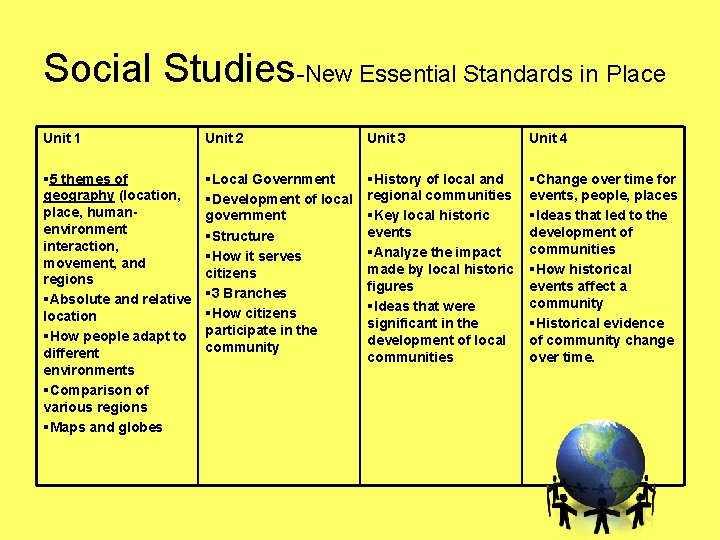
Social Studies-New Essential Standards in Place Unit 1 Unit 2 Unit 3 Unit 4 § 5 themes of geography (location, place, humanenvironment interaction, movement, and regions §Absolute and relative location §How people adapt to different environments §Comparison of various regions §Maps and globes §Local Government §Development of local government §Structure §How it serves citizens § 3 Branches §How citizens participate in the community §History of local and regional communities §Key local historic events §Analyze the impact made by local historic figures §Ideas that were significant in the development of local communities §Change over time for events, people, places §Ideas that led to the development of communities §How historical events affect a community §Historical evidence of community change over time.
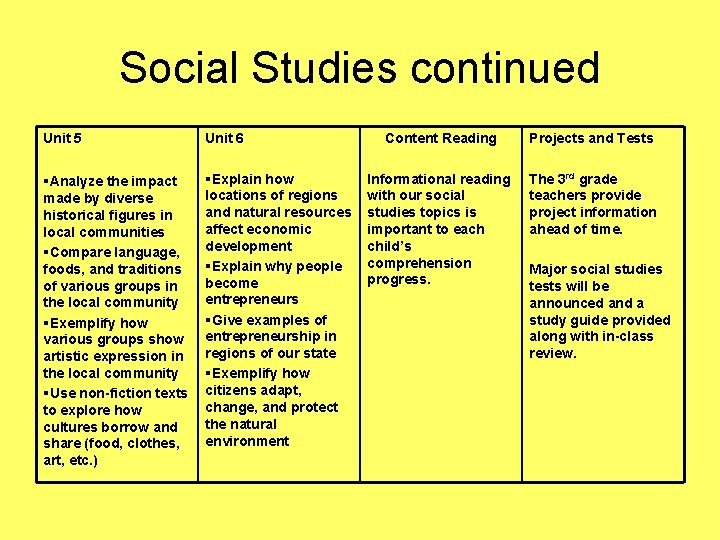
Social Studies continued Unit 5 Unit 6 §Analyze the impact made by diverse historical figures in local communities §Compare language, foods, and traditions of various groups in the local community §Exemplify how various groups show artistic expression in the local community §Use non-fiction texts to explore how cultures borrow and share (food, clothes, art, etc. ) §Explain how locations of regions and natural resources affect economic development §Explain why people become entrepreneurs §Give examples of entrepreneurship in regions of our state §Exemplify how citizens adapt, change, and protect the natural environment Content Reading Projects and Tests Informational reading with our social studies topics is important to each child’s comprehension progress. The 3 rd grade teachers provide project information ahead of time. Major social studies tests will be announced and a study guide provided along with in-class review.
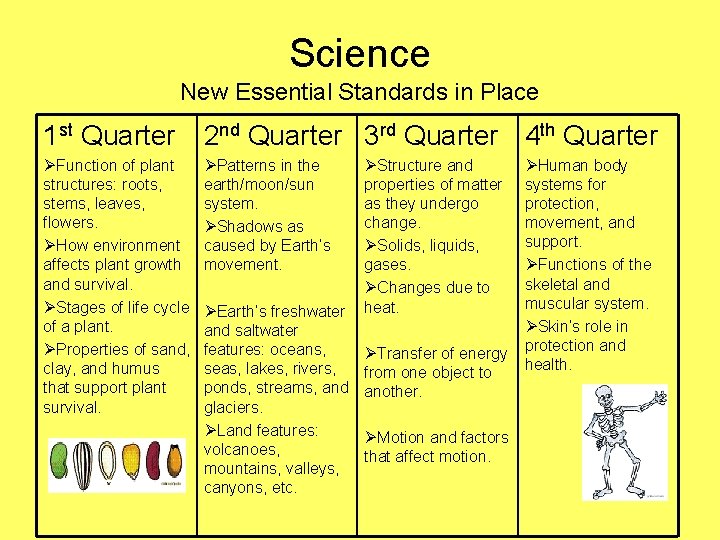
Science New Essential Standards in Place 1 st Quarter 2 nd Quarter 3 rd Quarter 4 th Quarter ØFunction of plant structures: roots, stems, leaves, flowers. ØHow environment affects plant growth and survival. ØStages of life cycle of a plant. ØProperties of sand, clay, and humus that support plant survival. ØPatterns in the earth/moon/sun system. ØShadows as caused by Earth’s movement. ØStructure and properties of matter as they undergo change. ØSolids, liquids, gases. ØChanges due to ØEarth’s freshwater heat. and saltwater features: oceans, ØTransfer of energy seas, lakes, rivers, from one object to ponds, streams, and another. glaciers. ØLand features: ØMotion and factors volcanoes, that affect motion. mountains, valleys, canyons, etc. ØHuman body systems for protection, movement, and support. ØFunctions of the skeletal and muscular system. ØSkin’s role in protection and health.
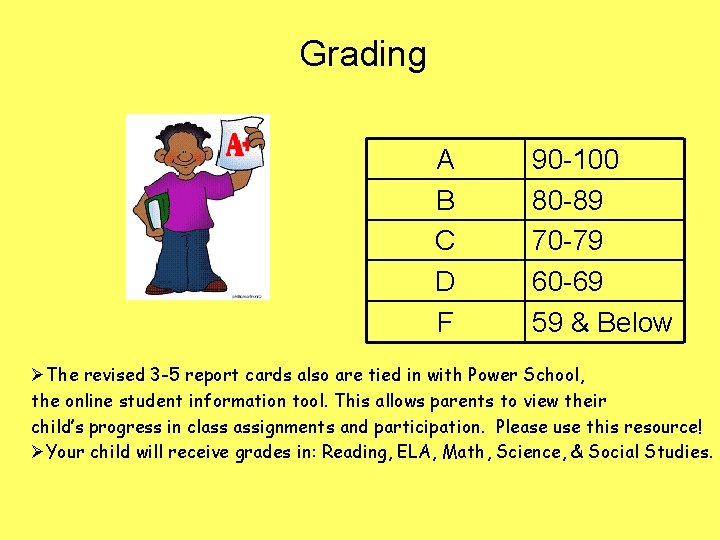
Grading A B C D F 90 -100 80 -89 70 -79 60 -69 59 & Below ØThe revised 3 -5 report cards also are tied in with Power School, the online student information tool. This allows parents to view their child’s progress in class assignments and participation. Please use this resource! ØYour child will receive grades in: Reading, ELA, Math, Science, & Social Studies.
Quarter Tests and End of Grade Ø Quarter Tests - a reading and math quarter test will be given to all 3 rd graders to determine if the standards for the quarter were mastered. These tests are created by our Central Office Assessment teams. Ø 1 st Quarter Testing Dates: Ø Reading – Mon/Tues, Oct. 19 th & 20 th TBD ØMath – Wednesday, Oct. 21 st End of Grade testing dates will occur in the last 10 days of school. End of Grade tests are developed by DPI.
If your child is a 3 rd Grader: Your child will be assessed in reading at the beginning, middle and end of the year. Those assessments will give information to the teacher about the instructional needs of your child. Your child will take the North Carolina End of Grade Test at the end of third grade.
Additional Info v Field Trips and Programs have been scheduled. Notice went home to parents in THT today. v We encourage use of the Online Pay System. Trips will be listed under Third Grade. v On out of county field trips we strongly recommend a Notarized Parent Permission form completed with medical emergency info and contacts. v Getting Field Trip Permission Forms and Fees back quickly is a great help! v Parent ROADMAP for ELA and MATH went home in THT today! v Grade Parents have signed up and will contact you concerning volunteer opportunities for your child’s class. Questions? Please send an email to your child’s specific teacher.
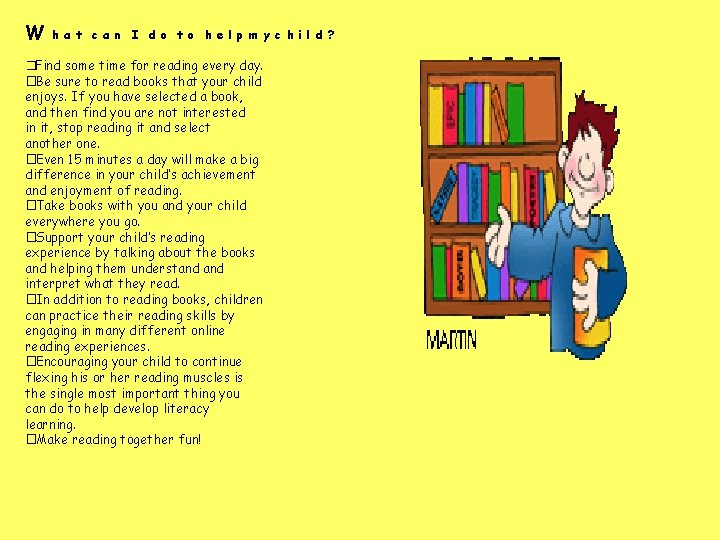
W h a t c a n I d o t o h e l p m y c h i l d ? �Find some time for reading every day. �Be sure to read books that your child enjoys. If you have selected a book, and then find you are not interested in it, stop reading it and select another one. �Even 15 minutes a day will make a big difference in your child’s achievement and enjoyment of reading. �Take books with you and your child everywhere you go. �Support your child’s reading experience by talking about the books and helping them understand interpret what they read. �In addition to reading books, children can practice their reading skills by engaging in many different online reading experiences. �Encouraging your child to continue flexing his or her reading muscles is the single most important thing you can do to help develop literacy learning. �Make reading together fun!
- Slides: 20