
Welcome to the Year 9 Pathways presentation The
- Slides: 18
Welcome to the Year 9 Pathways presentation The next phase of your daughter’s educational journey at Bellerive
Our aims this evening • To provide you with a comprehensive overview of the pathways process • To explain the specifics of the science offer and how it relates to the pathways process • To answer any immediate questions you or your daughter might have • To outline the next steps in the pathways process
What will Y 10 and Y 11 look like for your daughter? • All students study: – English GCSE – English Literature GCSE – Maths GCSE – Science: Combined Science worth 2 GCSEs or Separate Sciences worth 3 GCSEs – RE (GCSE) – PE and PHSE (non-exam subjects)
The core curriculum • These compulsory subjects take up about 75% of the timetable • We believe students should study these subjects because they provide vital skills to help them access the sixth form, employment, training and the most competitive universities • It is also the case that some of them are statutory
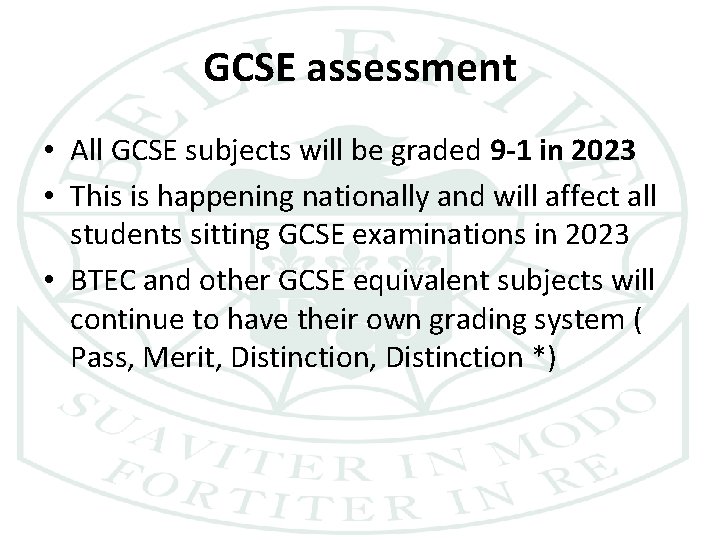
GCSE assessment • All GCSE subjects will be graded 9 -1 in 2023 • This is happening nationally and will affect all students sitting GCSE examinations in 2023 • BTEC and other GCSE equivalent subjects will continue to have their own grading system ( Pass, Merit, Distinction *)
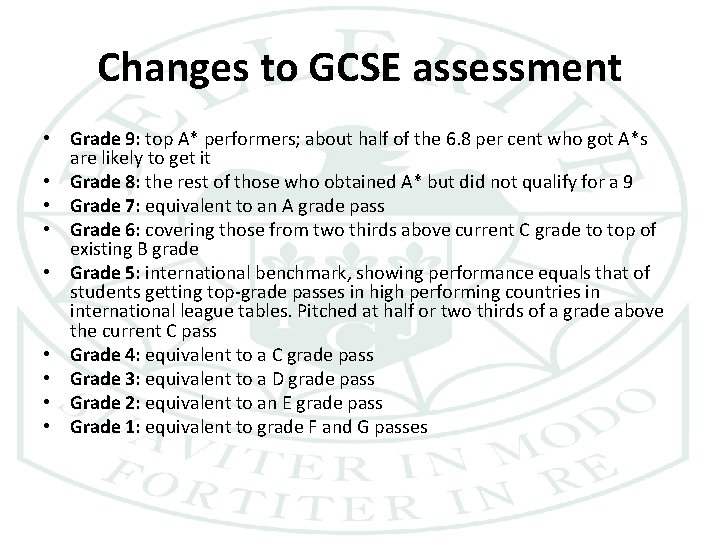
Changes to GCSE assessment • Grade 9: top A* performers; about half of the 6. 8 per cent who got A*s are likely to get it • Grade 8: the rest of those who obtained A* but did not qualify for a 9 • Grade 7: equivalent to an A grade pass • Grade 6: covering those from two thirds above current C grade to top of existing B grade • Grade 5: international benchmark, showing performance equals that of students getting top-grade passes in high performing countries in international league tables. Pitched at half or two thirds of a grade above the current C pass • Grade 4: equivalent to a C grade pass • Grade 3: equivalent to a D grade pass • Grade 2: equivalent to an E grade pass • Grade 1: equivalent to grade F and G passes
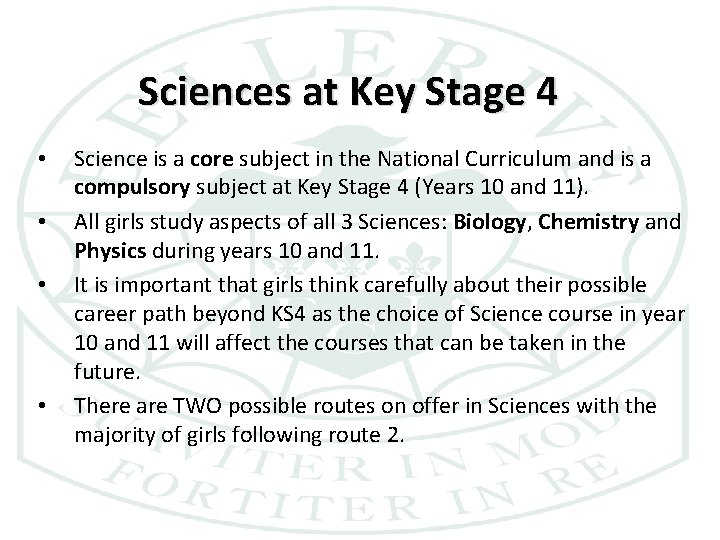
Sciences at Key Stage 4 • • Science is a core subject in the National Curriculum and is a compulsory subject at Key Stage 4 (Years 10 and 11). All girls study aspects of all 3 Sciences: Biology, Chemistry and Physics during years 10 and 11. It is important that girls think carefully about their possible career path beyond KS 4 as the choice of Science course in year 10 and 11 will affect the courses that can be taken in the future. There are TWO possible routes on offer in Sciences with the majority of girls following route 2.
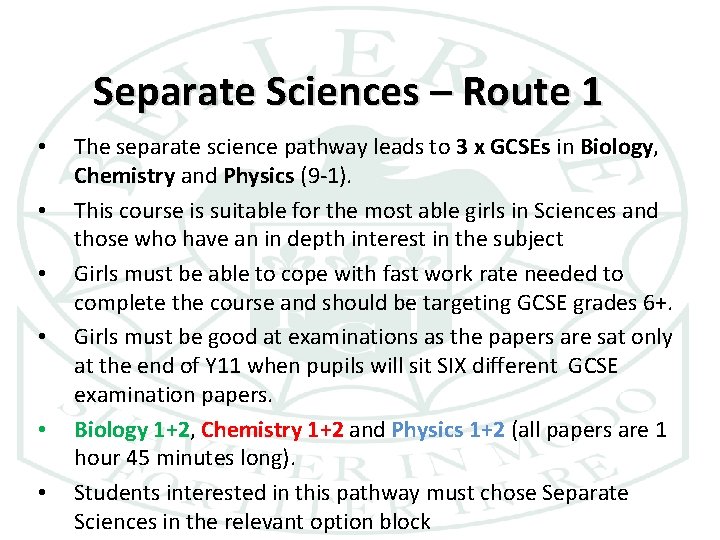
Separate Sciences – Route 1 • • • The separate science pathway leads to 3 x GCSEs in Biology, Chemistry and Physics (9 -1). This course is suitable for the most able girls in Sciences and those who have an in depth interest in the subject Girls must be able to cope with fast work rate needed to complete the course and should be targeting GCSE grades 6+. Girls must be good at examinations as the papers are sat only at the end of Y 11 when pupils will sit SIX different GCSE examination papers. Biology 1+2, Chemistry 1+2 and Physics 1+2 (all papers are 1 hour 45 minutes long). Students interested in this pathway must chose Separate Sciences in the relevant option block
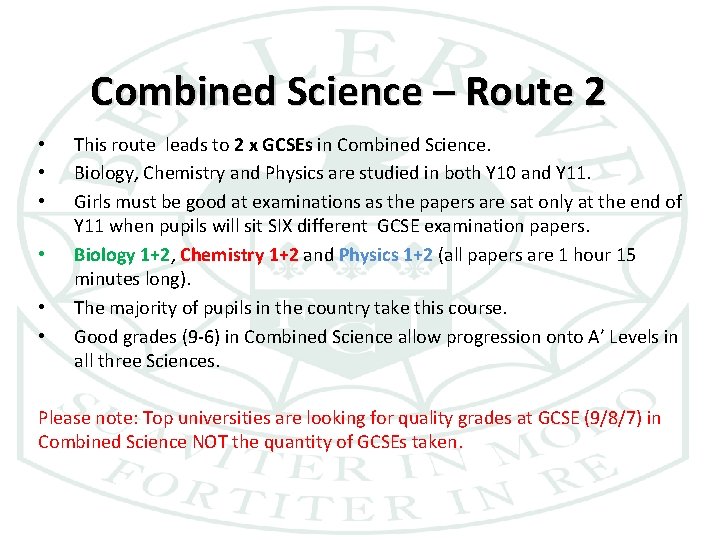
Combined Science – Route 2 • • • This route leads to 2 x GCSEs in Combined Science. Biology, Chemistry and Physics are studied in both Y 10 and Y 11. Girls must be good at examinations as the papers are sat only at the end of Y 11 when pupils will sit SIX different GCSE examination papers. Biology 1+2, Chemistry 1+2 and Physics 1+2 (all papers are 1 hour 15 minutes long). The majority of pupils in the country take this course. Good grades (9 -6) in Combined Science allow progression onto A’ Levels in all three Sciences. Please note: Top universities are looking for quality grades at GCSE (9/8/7) in Combined Science NOT the quantity of GCSEs taken.
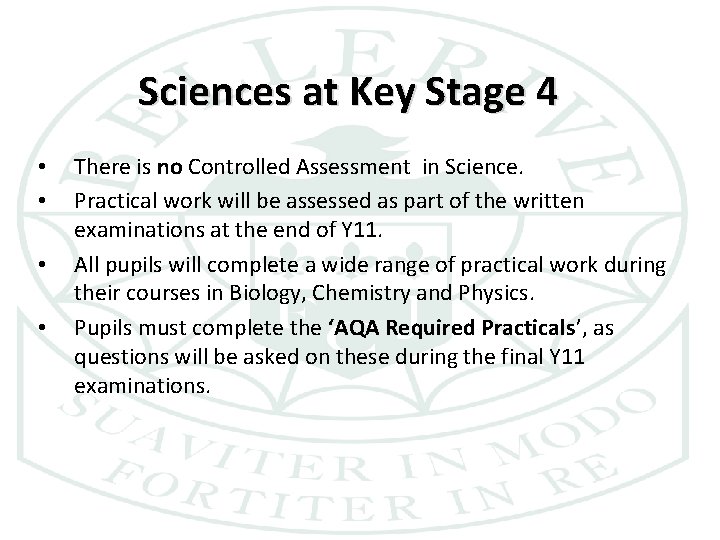
Sciences at Key Stage 4 • • There is no Controlled Assessment in Science. Practical work will be assessed as part of the written examinations at the end of Y 11. All pupils will complete a wide range of practical work during their courses in Biology, Chemistry and Physics. Pupils must complete the ‘AQA Required Practicals’, as questions will be asked on these during the final Y 11 examinations.
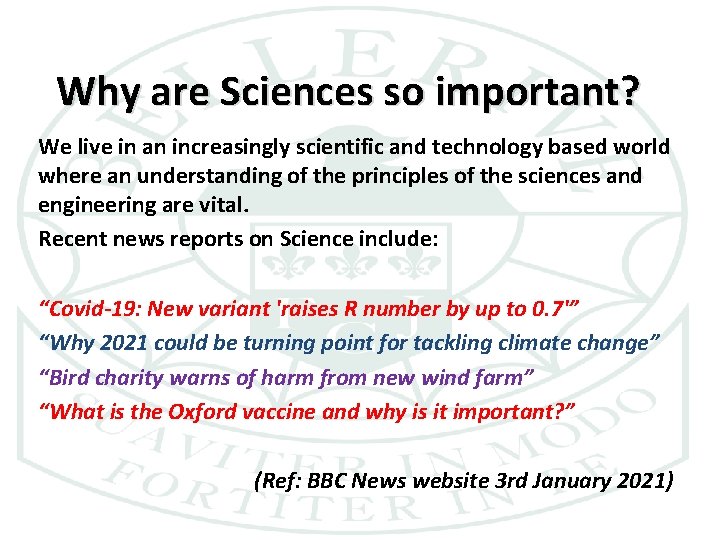
Why are Sciences so important? We live in an increasingly scientific and technology based world where an understanding of the principles of the sciences and engineering are vital. Recent news reports on Science include: “Covid-19: New variant 'raises R number by up to 0. 7'” “Why 2021 could be turning point for tackling climate change” “Bird charity warns of harm from new wind farm” “What is the Oxford vaccine and why is it important? ” (Ref: BBC News website 3 rd January 2021)
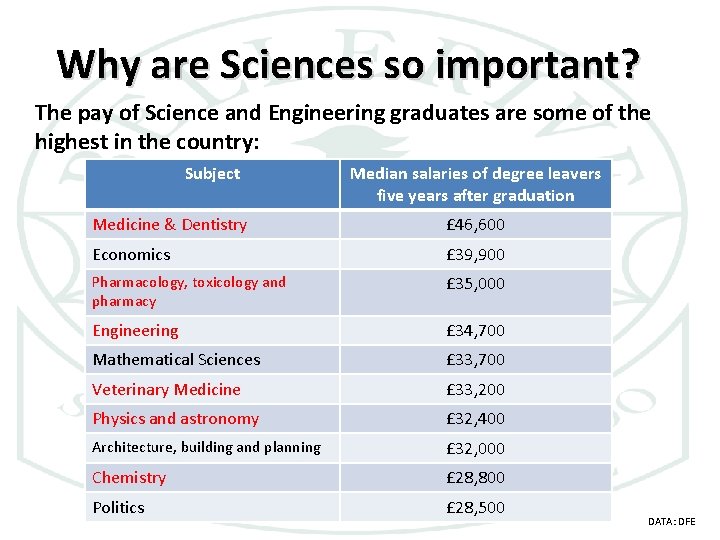
Why are Sciences so important? The pay of Science and Engineering graduates are some of the highest in the country: Subject Median salaries of degree leavers five years after graduation Medicine & Dentistry £ 46, 600 Economics £ 39, 900 Pharmacology, toxicology and pharmacy £ 35, 000 Engineering £ 34, 700 Mathematical Sciences £ 33, 700 Veterinary Medicine £ 33, 200 Physics and astronomy £ 32, 400 Architecture, building and planning £ 32, 000 Chemistry £ 28, 800 Politics £ 28, 500 DATA: DFE
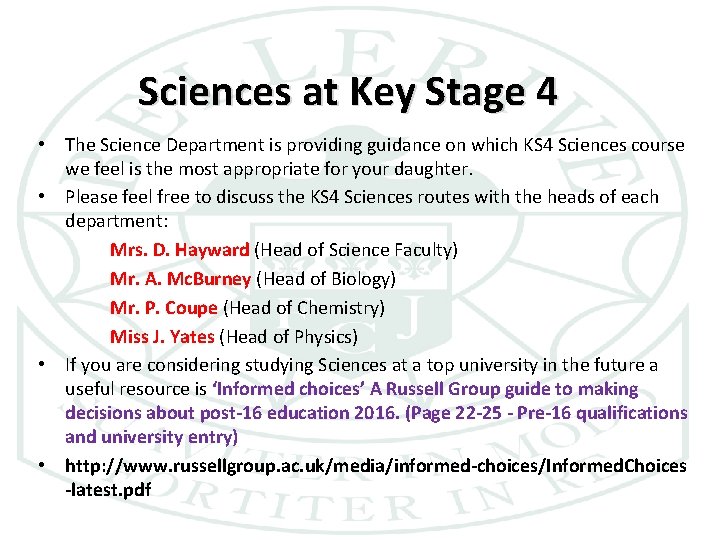
Sciences at Key Stage 4 • The Science Department is providing guidance on which KS 4 Sciences course we feel is the most appropriate for your daughter. • Please feel free to discuss the KS 4 Sciences routes with the heads of each department: Mrs. D. Hayward (Head of Science Faculty) Mr. A. Mc. Burney (Head of Biology) Mr. P. Coupe (Head of Chemistry) Miss J. Yates (Head of Physics) • If you are considering studying Sciences at a top university in the future a useful resource is ‘Informed choices’ A Russell Group guide to making decisions about post-16 education 2016. (Page 22 -25 - Pre-16 qualifications and university entry) • http: //www. russellgroup. ac. uk/media/informed-choices/Informed. Choices -latest. pdf
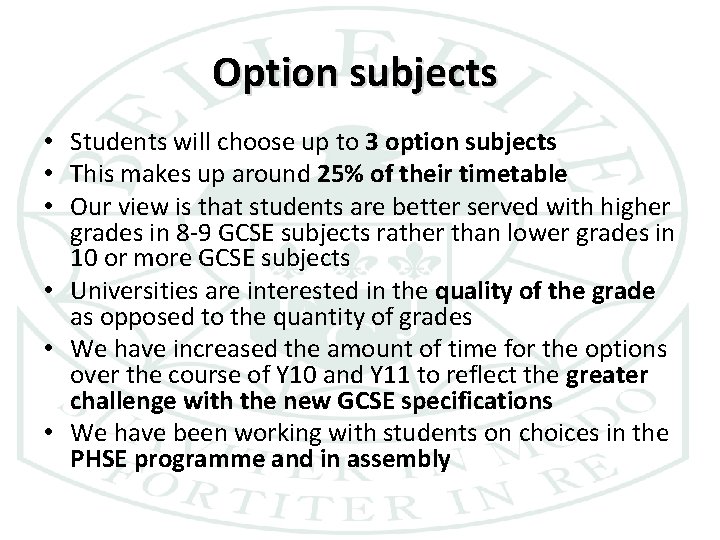
Option subjects • Students will choose up to 3 option subjects • This makes up around 25% of their timetable • Our view is that students are better served with higher grades in 8 -9 GCSE subjects rather than lower grades in 10 or more GCSE subjects • Universities are interested in the quality of the grade as opposed to the quantity of grades • We have increased the amount of time for the options over the course of Y 10 and Y 11 to reflect the greater challenge with the new GCSE specifications • We have been working with students on choices in the PHSE programme and in assembly
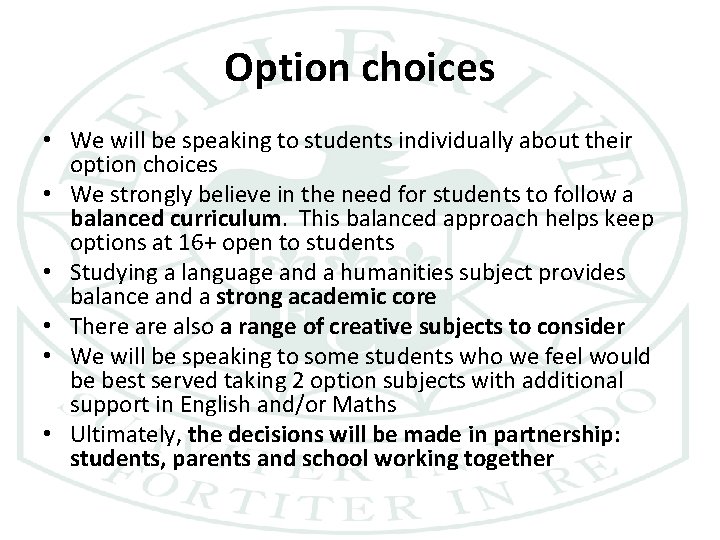
Option choices • We will be speaking to students individually about their option choices • We strongly believe in the need for students to follow a balanced curriculum. This balanced approach helps keep options at 16+ open to students • Studying a language and a humanities subject provides balance and a strong academic core • There also a range of creative subjects to consider • We will be speaking to some students who we feel would be best served taking 2 option subjects with additional support in English and/or Maths • Ultimately, the decisions will be made in partnership: students, parents and school working together
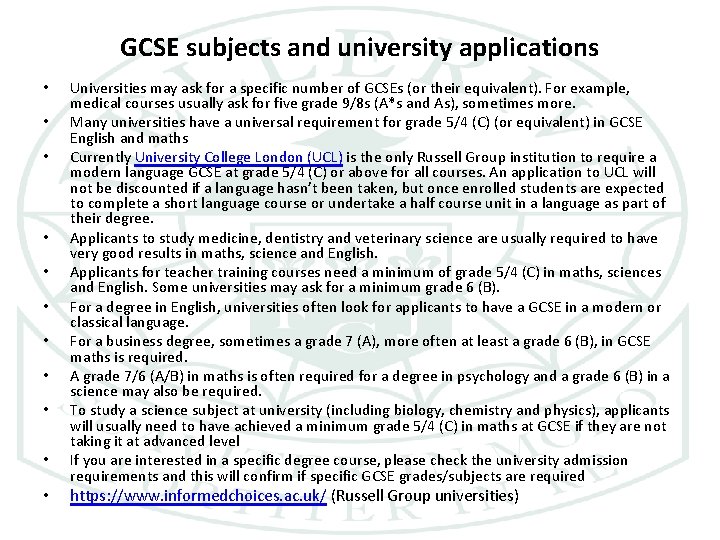
GCSE subjects and university applications • • • Universities may ask for a specific number of GCSEs (or their equivalent). For example, medical courses usually ask for five grade 9/8 s (A*s and As), sometimes more. Many universities have a universal requirement for grade 5/4 (C) (or equivalent) in GCSE English and maths Currently University College London (UCL) is the only Russell Group institution to require a modern language GCSE at grade 5/4 (C) or above for all courses. An application to UCL will not be discounted if a language hasn’t been taken, but once enrolled students are expected to complete a short language course or undertake a half course unit in a language as part of their degree. Applicants to study medicine, dentistry and veterinary science are usually required to have very good results in maths, science and English. Applicants for teacher training courses need a minimum of grade 5/4 (C) in maths, sciences and English. Some universities may ask for a minimum grade 6 (B). For a degree in English, universities often look for applicants to have a GCSE in a modern or classical language. For a business degree, sometimes a grade 7 (A), more often at least a grade 6 (B), in GCSE maths is required. A grade 7/6 (A/B) in maths is often required for a degree in psychology and a grade 6 (B) in a science may also be required. To study a science subject at university (including biology, chemistry and physics), applicants will usually need to have achieved a minimum grade 5/4 (C) in maths at GCSE if they are not taking it at advanced level If you are interested in a specific degree course, please check the university admission requirements and this will confirm if specific GCSE grades/subjects are required https: //www. informedchoices. ac. uk/ (Russell Group universities)
What happens next? • We would like students to complete the option form by Monday 15 th March. This form will be completed online and a link will be emailed to students by Friday 12 th February • Write 1 for the first choice and 2 for the second choice in each column • When deciding if an option subject will run , we will factor in the number of students opting for the subject • Where more students opt for a subject than we can accommodate, we will take factors such as behaviour, attendance and progress in the subject into account • There may be some ‘clashes’: subjects which you want to study that appear in the same option block. This does not happen all that often and we will try our best to resolve the issue • Please make sure you are comfortable with both subjects in both option columns • Students will be informed of their final option choices in the summer term
What happens next? • Subject staff from all option subjects are available via School. Cloud on Tuesday 9 th February between 5 -6. 30 pm • Miss Power is also available to advise on careers • Mrs Walker ( head of sixth form ) will also be available as will Mrs Howlett and myself • options@bellerivefcj. org