
Welcome to the Year 10 Introduction to GCSE
- Slides: 29
Welcome to the Year 10 Introduction to GCSE Evening
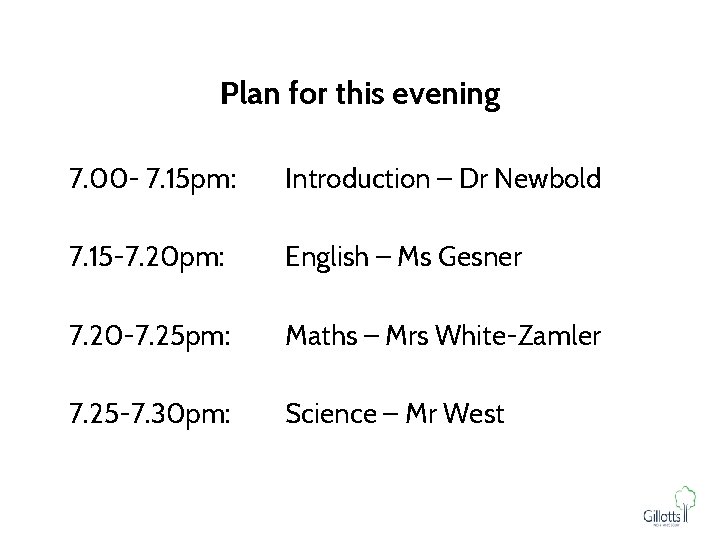
Plan for this evening 7. 00 - 7. 15 pm: Introduction – Dr Newbold 7. 15 -7. 20 pm: English – Ms Gesner 7. 20 -7. 25 pm: Maths – Mrs White-Zamler 7. 25 -7. 30 pm: Science – Mr West
Changes to the GCSEs • New GCSE qualifications have been introduced in all subjects over the past 2 years. • These are based on the new 9 -1 Grade Scale.
What are the key changes? • These new specifications: - contain new, more challenging content - are assessed differently - are graded differently
What are the main changes in assessment? • In most subjects, all assessment (counting towards the final grade) will be based on final examinations. • These examinations will take place at the end of Year 11. • There will not be any controlled assessment/ coursework.
A few exceptions • In some subjects there will still be some ‘non-examined assessment’: • Art & Design, Dance, Drama, Food • BTEC Children’s Play, Learning & Development
What are the other main changes in assessment? • In most subjects (apart from Languages, maths and science), all students will sit the same exam papers. • There will be more challenging command words (e. g. discuss, evaluate). • There will be more unstructured (longer) responses. • There will be a greater mathematical element (e. g. business, geography, science)
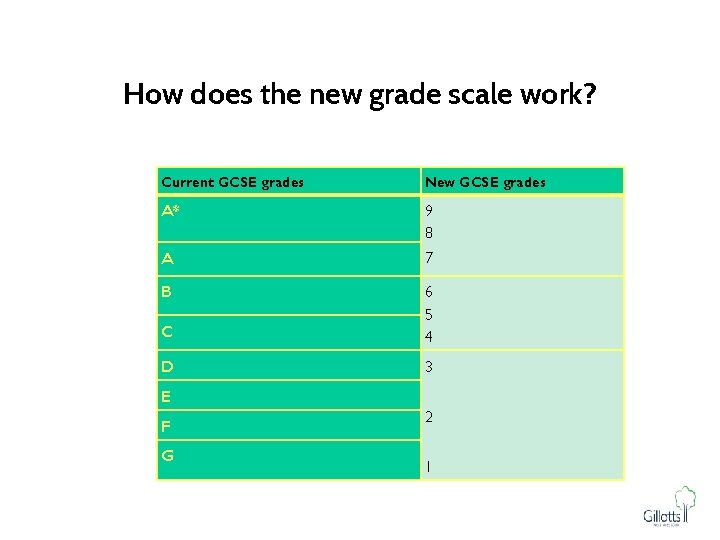
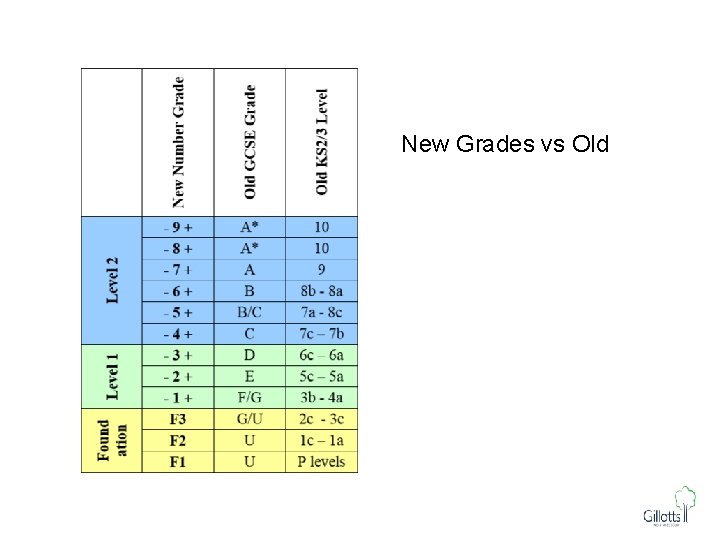
Grading - the new 9 -1 Scale • The grading scale has changed from A*-G to 9 -1 (9 is the highest grade) – and U. • The new benchmark for a ‘standard pass’ grade will be a ‘ 4’ (equivalent to a low C). • The new benchmark for a ‘strong pass’ will be a ‘ 5’ (equivalent to a high C/ low B). • The old A* grade has been divided into two new grades a Grade 8 or 9.
How does the new grade scale work? Current GCSE grades New GCSE grades A* 9 8 A 7 B C 6 5 4 D 3 E 2 F G 1
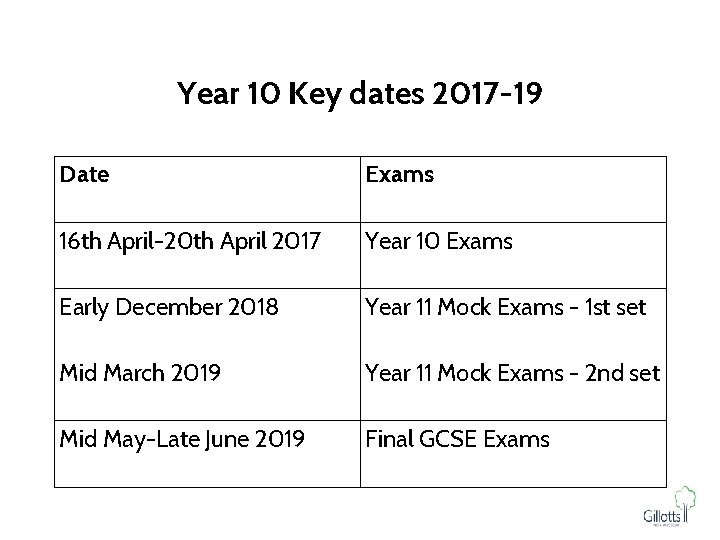
Year 10 Key dates 2017 -19 Date Exams 16 th April-20 th April 2017 Year 10 Exams Early December 2018 Year 11 Mock Exams - 1 st set Mid March 2019 Year 11 Mock Exams - 2 nd set Mid May-Late June 2019 Final GCSE Exams
Introduction to GCSE English Language and GCSE English Literature Subject Leader: Hazel Waelend hwaeland@gillotts. org. uk
GCSE English Language
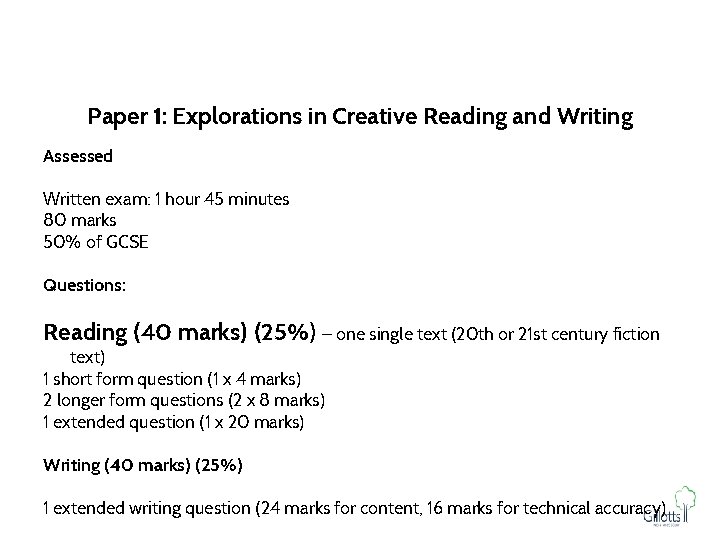
Paper 1: Explorations in Creative Reading and Writing Assessed Written exam: 1 hour 45 minutes 80 marks 50% of GCSE Questions: Reading (40 marks) (25%) – one single text (20 th or 21 st century fiction text) 1 short form question (1 x 4 marks) 2 longer form questions (2 x 8 marks) 1 extended question (1 x 20 marks) Writing (40 marks) (25%) 1 extended writing question (24 marks for content, 16 marks for technical accuracy)
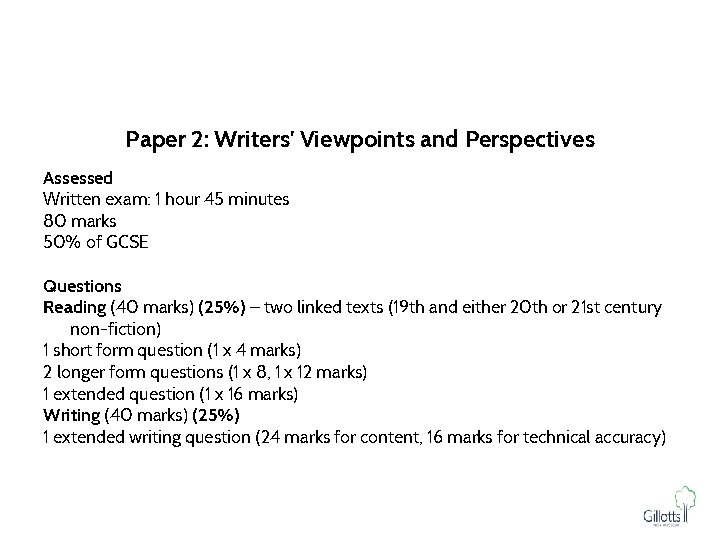
Paper 2: Writers' Viewpoints and Perspectives Assessed Written exam: 1 hour 45 minutes 80 marks 50% of GCSE Questions Reading (40 marks) (25%) – two linked texts (19 th and either 20 th or 21 st century non-fiction) 1 short form question (1 x 4 marks) 2 longer form questions (1 x 8, 1 x 12 marks) 1 extended question (1 x 16 marks) Writing (40 marks) (25%) 1 extended writing question (24 marks for content, 16 marks for technical accuracy)
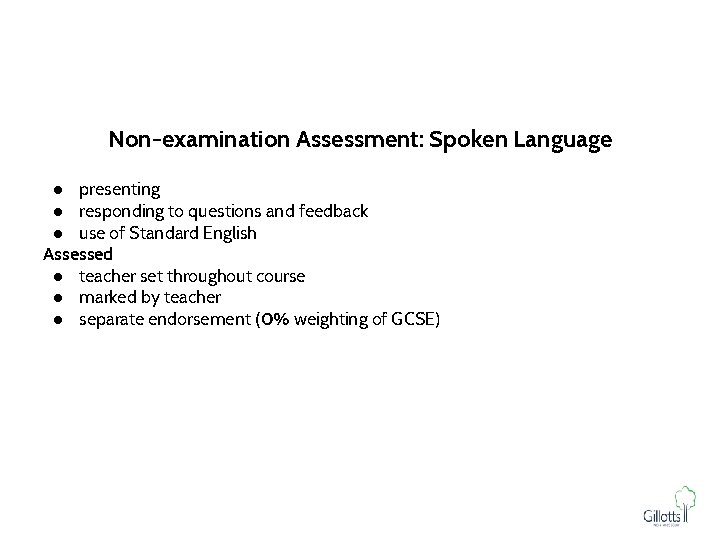
Non-examination Assessment: Spoken Language ● presenting ● responding to questions and feedback ● use of Standard English Assessed ● teacher set throughout course ● marked by teacher ● separate endorsement (0% weighting of GCSE)
GCSE English Literature
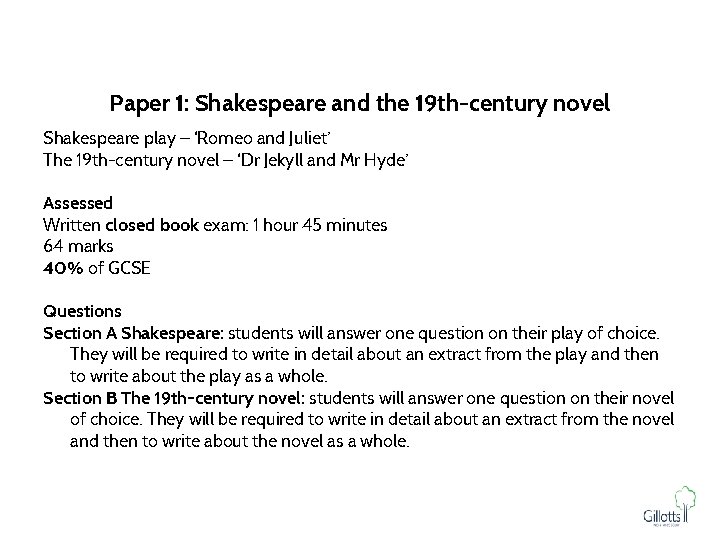
Paper 1: Shakespeare and the 19 th-century novel Shakespeare play – ‘Romeo and Juliet’ The 19 th-century novel – ‘Dr Jekyll and Mr Hyde’ Assessed Written closed book exam: 1 hour 45 minutes 64 marks 40% of GCSE Questions Section A Shakespeare: students will answer one question on their play of choice. They will be required to write in detail about an extract from the play and then to write about the play as a whole. Section B The 19 th-century novel: students will answer one question on their novel of choice. They will be required to write in detail about an extract from the novel and then to write about the novel as a whole.
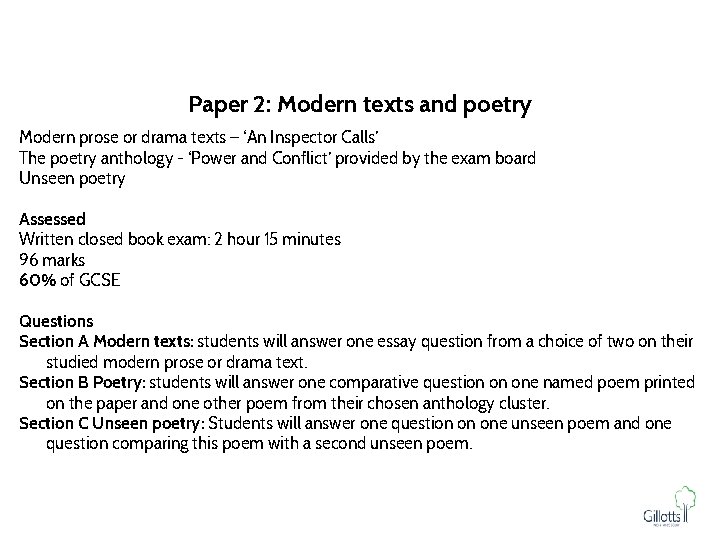
Paper 2: Modern texts and poetry Modern prose or drama texts – ‘An Inspector Calls’ The poetry anthology - ‘Power and Conflict’ provided by the exam board Unseen poetry Assessed Written closed book exam: 2 hour 15 minutes 96 marks 60% of GCSE Questions Section A Modern texts: students will answer one essay question from a choice of two on their studied modern prose or drama text. Section B Poetry: students will answer one comparative question on one named poem printed on the paper and one other poem from their chosen anthology cluster. Section C Unseen poetry: Students will answer one question on one unseen poem and one question comparing this poem with a second unseen poem.
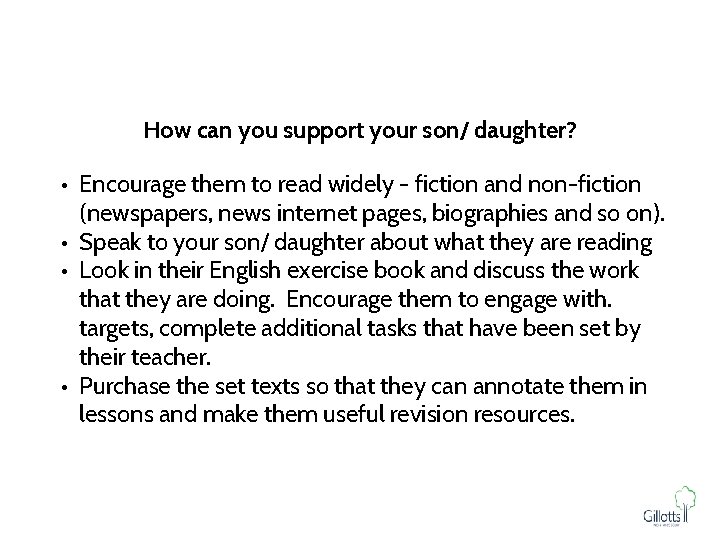
How can you support your son/ daughter? • Encourage them to read widely - fiction and non-fiction (newspapers, news internet pages, biographies and so on). • Speak to your son/ daughter about what they are reading • Look in their English exercise book and discuss the work that they are doing. Encourage them to engage with. targets, complete additional tasks that have been set by their teacher. • Purchase the set texts so that they can annotate them in lessons and make them useful revision resources.
GCSE Maths Subject Leader: Mrs White-Zamler jwhitezamler@gillotts. org. uk
Expectations • • Bringing correct equipment ‘Ready to Learn’ – attitude for learning Resilience Homework 2 x 45 minutes a week completed to a high standard • Asking for help • Deliberate Practice
OCR st 21 Century Science B (9 -1) Simon West Head of Science swest@gillotts. org. uk @gillotts_sci
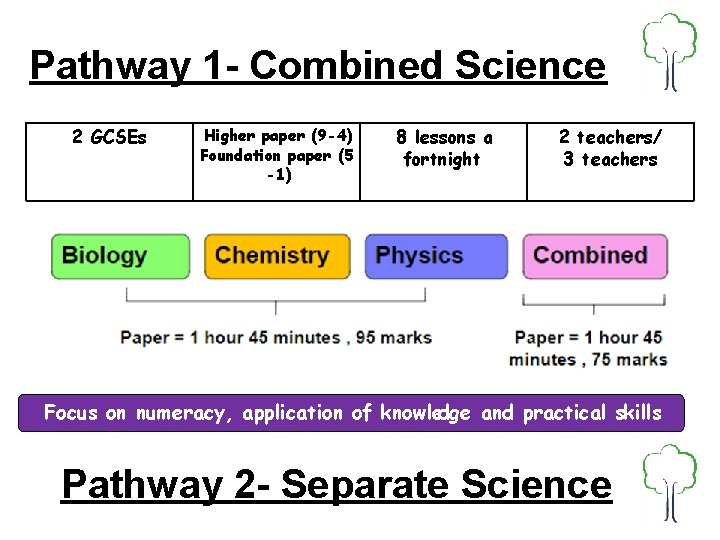
Pathway 1 - Combined Science 2 GCSEs Higher paper (9 -4) Foundation paper (5 -1) 8 lessons a fortnight 2 teachers/ 3 teachers Focus on numeracy, application of knowledge and practical skills Pathway 2 - Separate Science
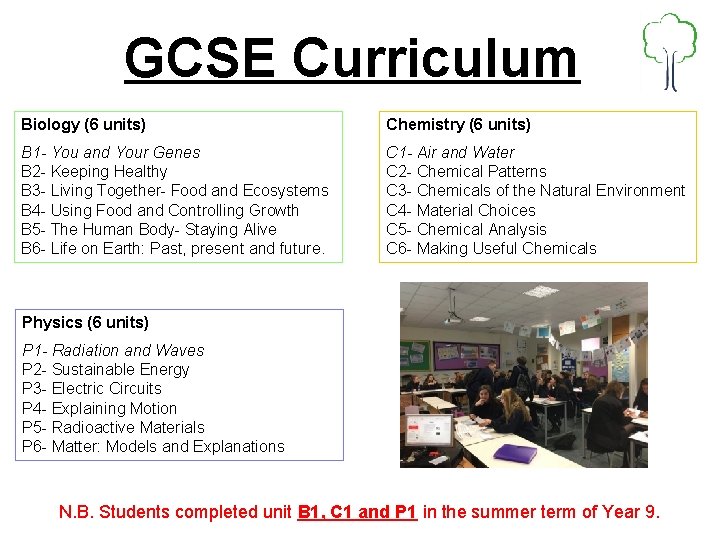
GCSE Curriculum Biology (6 units) Chemistry (6 units) B 1 - You and Your Genes B 2 - Keeping Healthy B 3 - Living Together- Food and Ecosystems B 4 - Using Food and Controlling Growth B 5 - The Human Body- Staying Alive B 6 - Life on Earth: Past, present and future. C 1 - Air and Water C 2 - Chemical Patterns C 3 - Chemicals of the Natural Environment C 4 - Material Choices C 5 - Chemical Analysis C 6 - Making Useful Chemicals Physics (6 units) P 1 - Radiation and Waves P 2 - Sustainable Energy P 3 - Electric Circuits P 4 - Explaining Motion P 5 - Radioactive Materials P 6 - Matter: Models and Explanations N. B. Students completed unit B 1, C 1 and P 1 in the summer term of Year 9.
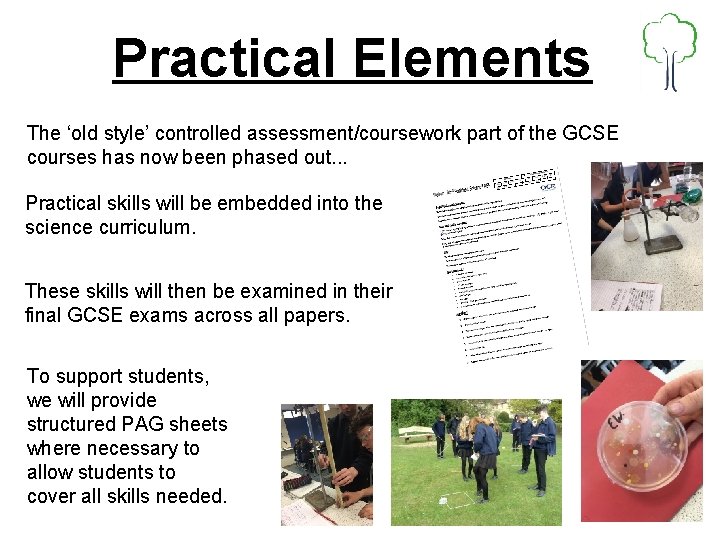
Practical Elements The ‘old style’ controlled assessment/coursework part of the GCSE courses has now been phased out. . . Practical skills will be embedded into the science curriculum. These skills will then be examined in their final GCSE exams across all papers. To support students, we will provide structured PAG sheets where necessary to allow students to cover all skills needed.
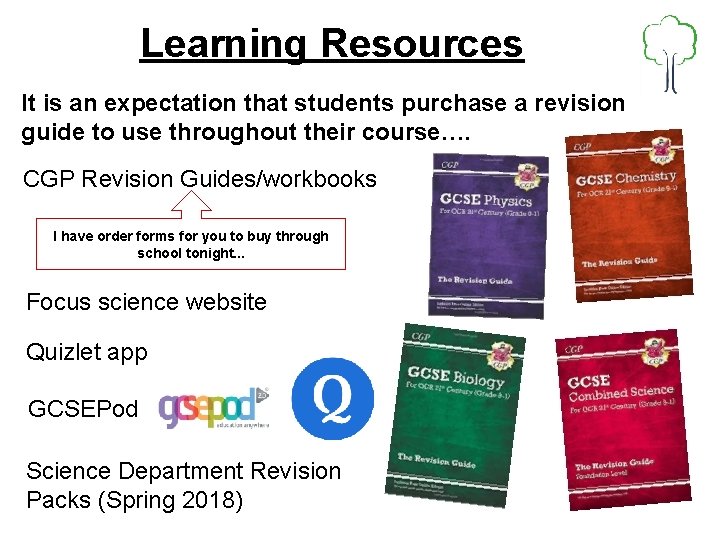
Learning Resources It is an expectation that students purchase a revision guide to use throughout their course…. CGP Revision Guides/workbooks I have order forms for you to buy through school tonight. . . Focus science website Quizlet app GCSEPod Science Department Revision Packs (Spring 2018)
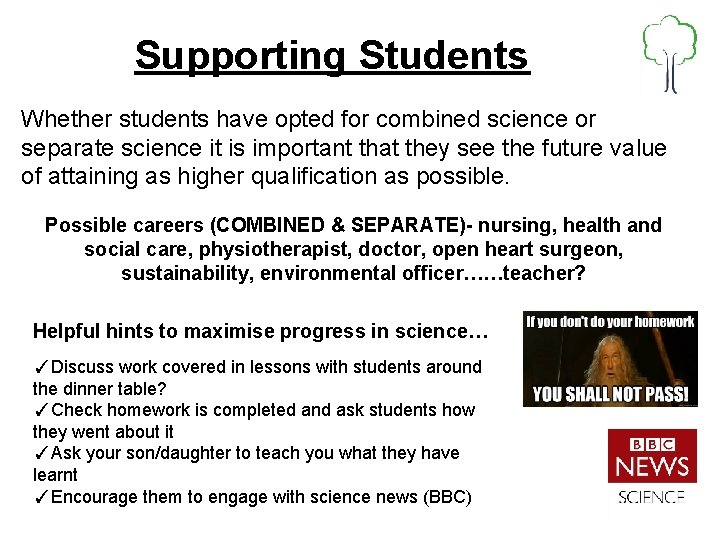
Supporting Students Whether students have opted for combined science or separate science it is important that they see the future value of attaining as higher qualification as possible. Possible careers (COMBINED & SEPARATE)- nursing, health and social care, physiotherapist, doctor, open heart surgeon, sustainability, environmental officer……teacher? Helpful hints to maximise progress in science… ✓Discuss work covered in lessons with students around the dinner table? ✓Check homework is completed and ask students how they went about it ✓Ask your son/daughter to teach you what they have learnt ✓Encourage them to engage with science news (BBC)
New Grades vs Old
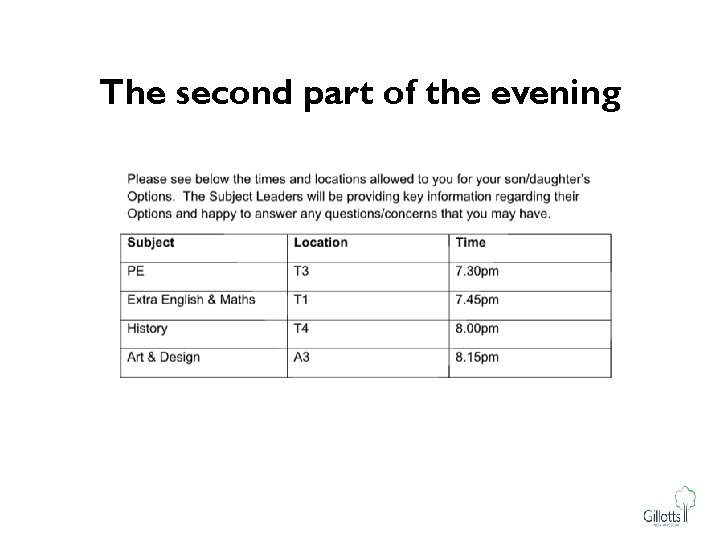
The second part of the evening