
Welcome to the Wonderful World of Senior Project


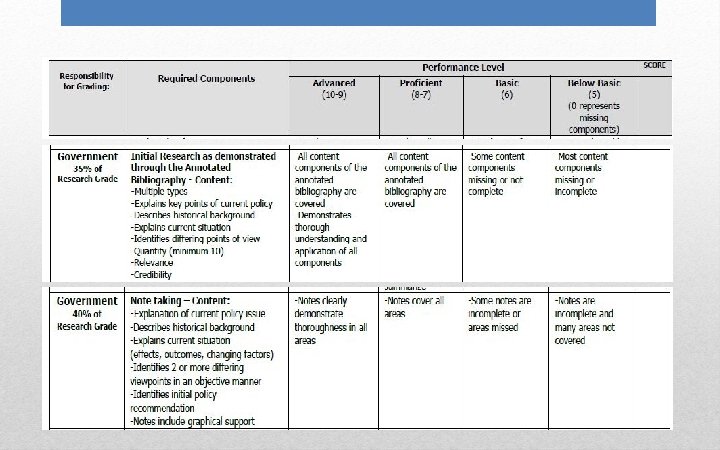


- Slides: 71
Welcome to the Wonderful World of Senior Project The Guide to Research
Idaho Legislative Expedition Step One – How to Find Idaho Bills and Laws
Purpose • Tracking how bills becomes laws within the Idaho legislature • Find specific information about selected law • Practice going through same steps with your selected SP topic in coming weeks Idaho Legislative Expedition
Directions • With a partner you will follow all of the steps and directions on the worksheet • You will then answer each question in the designated area • As this is practice for SP, this is self-guided so I will be of little (to no) help! Idaho Legislative Expedition
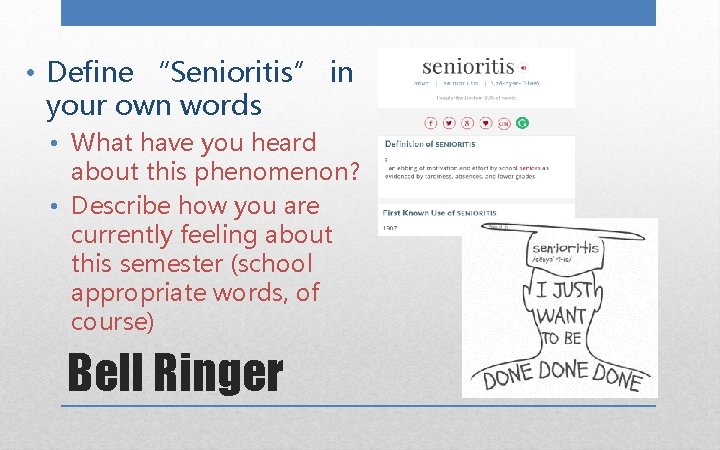
• Define “Senioritis” in your own words • What have you heard about this phenomenon? • Describe how you are currently feeling about this semester (school appropriate words, of course) Bell Ringer
Topic Selection Step Two– How to Pick Your SP Topic Due: 1/23 (A) & 1/24 (B)
Purpose • Consider possible SP topics • Become familiar with databases that will be used for SP research Topic Selection
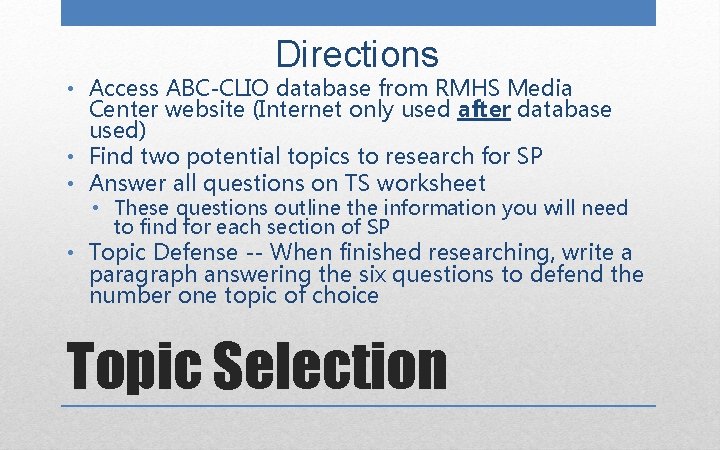
Directions • Access ABC-CLIO database from RMHS Media Center website (Internet only used after database used) • Find two potential topics to research for SP • Answer all questions on TS worksheet • These questions outline the information you will need to find for each section of SP • Topic Defense -- When finished researching, write a paragraph answering the six questions to defend the number one topic of choice Topic Selection
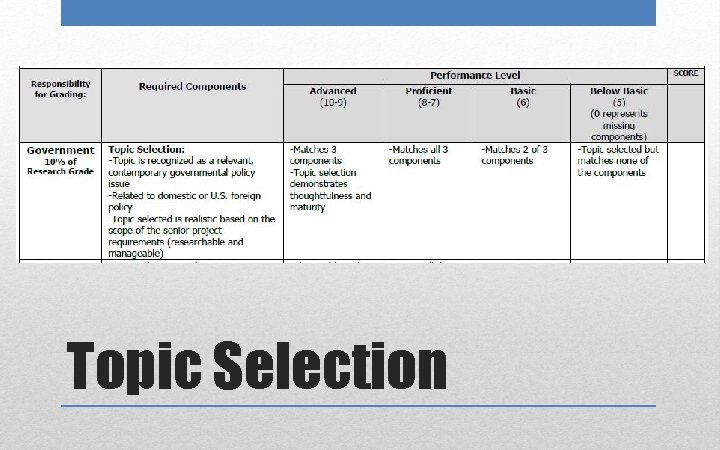
Topic Selection
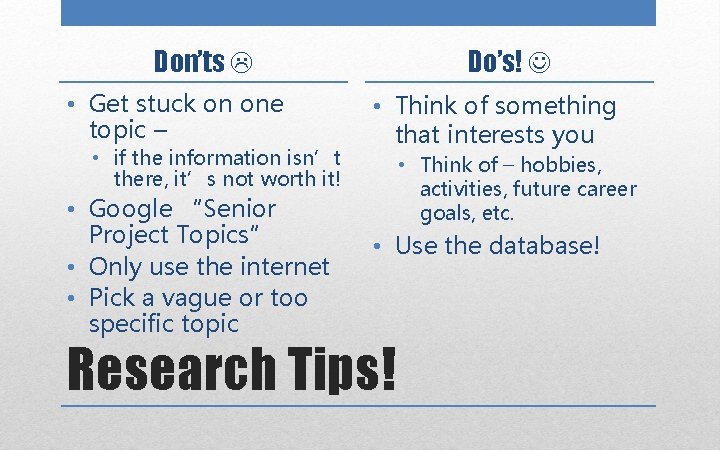
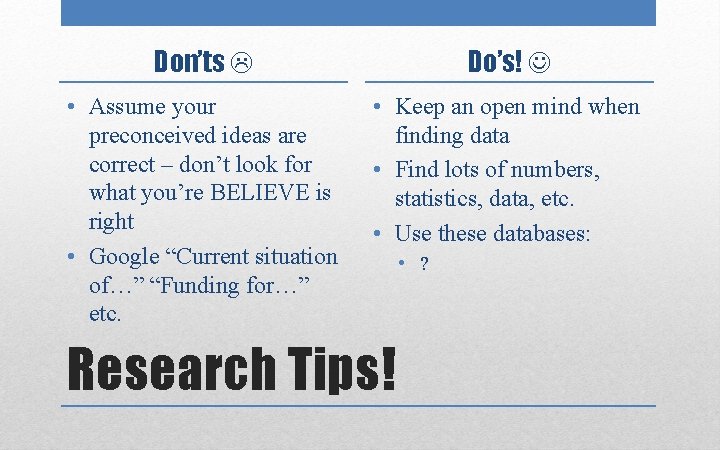
Don’ts • Get stuck on one topic – • if the information isn’t there, it’s not worth it! • Google “Senior Project Topics” • Only use the internet • Pick a vague or too specific topic Do’s! • Think of something that interests you • Think of – hobbies, activities, future career goals, etc. • Use the database! Research Tips!
Syllabus Fun! Reviewing Those Rules
Welcome BACK to the Wonderful World of Senior Project Due TODAY! – Topic Selection The Guide to Research
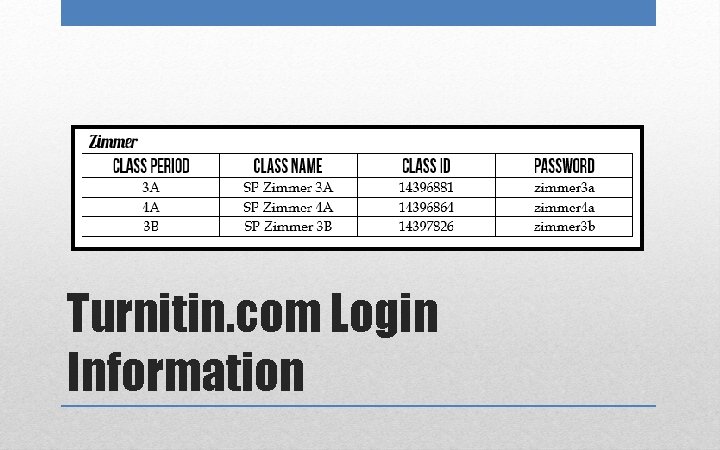
Turnitin. com Login Information
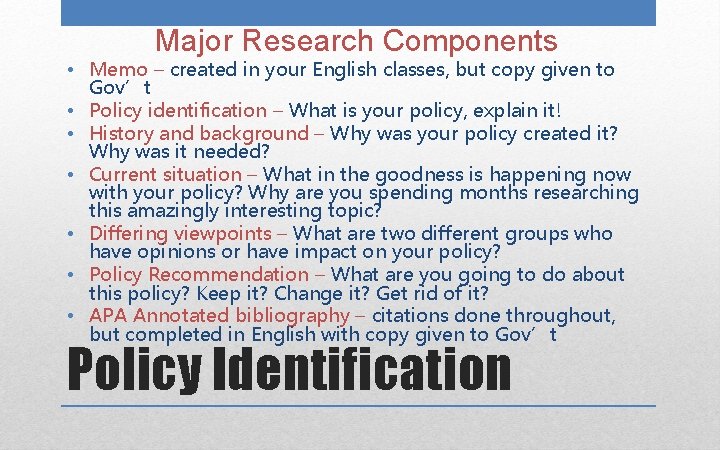
Major Research Components • Memo – created in your English classes, but copy given to Gov’t • Policy identification – What is your policy, explain it! • History and background – Why was your policy created it? Why was it needed? • Current situation – What in the goodness is happening now with your policy? Why are you spending months researching this amazingly interesting topic? • Differing viewpoints – What are two different groups who have opinions or have impact on your policy? • Policy Recommendation – What are you going to do about this policy? Keep it? Change it? Get rid of it? • APA Annotated bibliography – citations done throughout, but completed in English with copy given to Gov’t Policy Identification
Policy Identification Step Three– Researching your Law Due: 1/25 (A) & 1/26 (B)
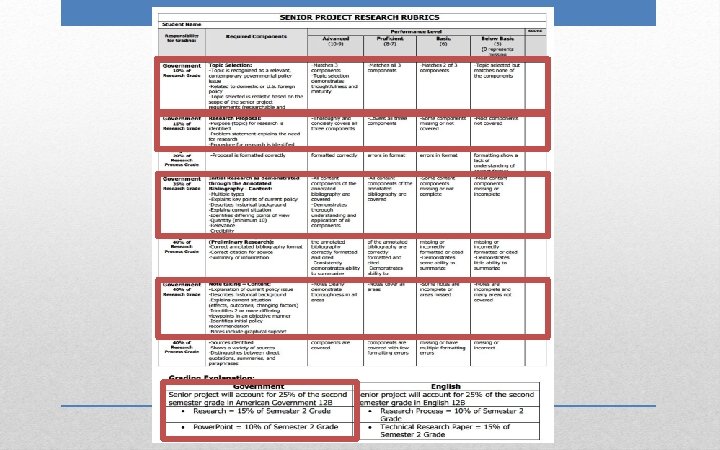
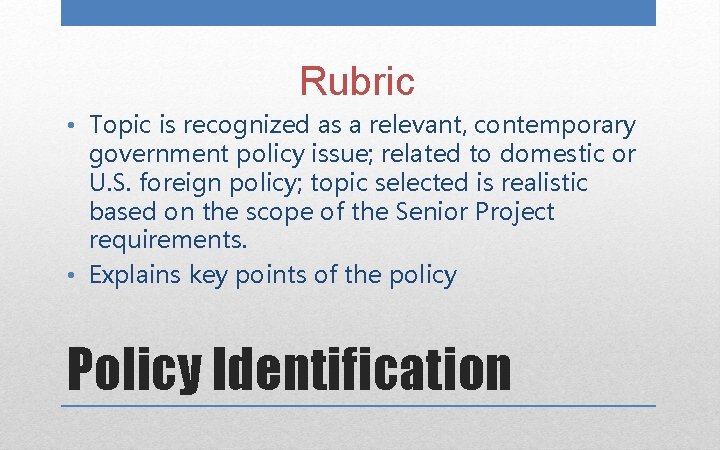
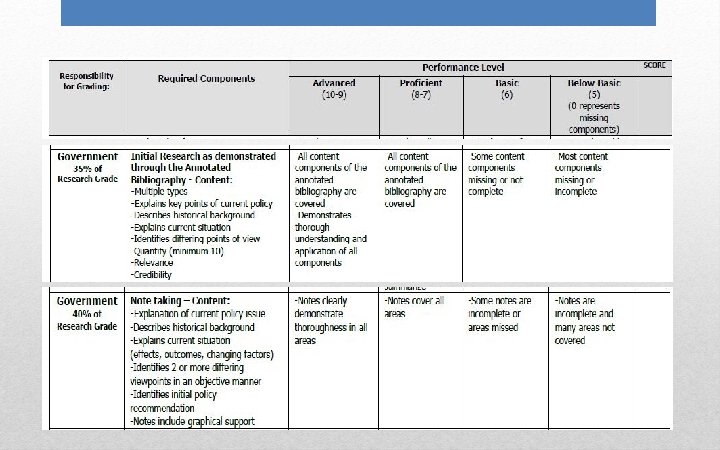
Rubric • Topic is recognized as a relevant, contemporary government policy issue; related to domestic or U. S. foreign policy; topic selected is realistic based on the scope of the Senior Project requirements. • Explains key points of the policy Policy Identification
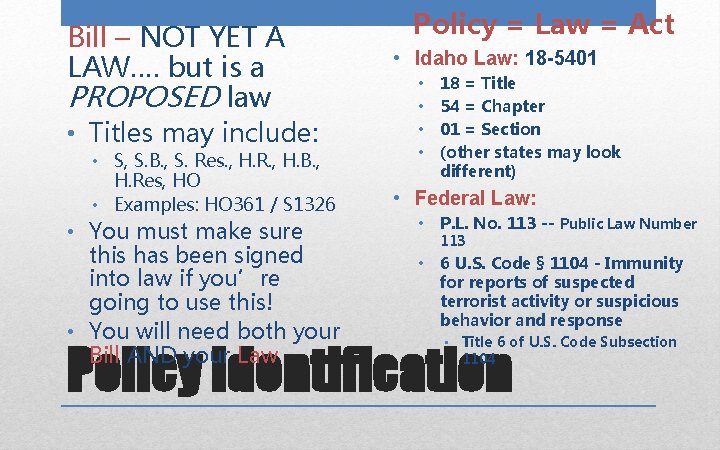
Bill – NOT YET A LAW…. but is a PROPOSED law • Titles may include: • S, S. B. , S. Res. , H. R. , H. B. , H. Res, HO • Examples: HO 361 / S 1326 • You must make sure this has been signed into law if you’re going to use this! • You will need both your Bill AND your Law Policy = Law = Act • Idaho Law: 18 -5401 • • 18 = Title 54 = Chapter 01 = Section (other states may look different) • Federal Law: • P. L. No. 113 -- Public Law Number 113 • 6 U. S. Code § 1104 - Immunity for reports of suspected terrorist activity or suspicious behavior and response • Title 6 of U. S. Code Subsection 1104 Policy Identification
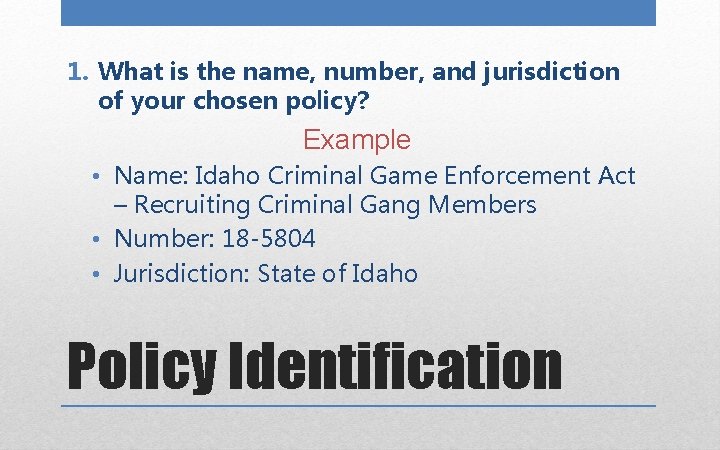
1. What is the name, number, and jurisdiction of your chosen policy? Example • Name: Idaho Criminal Game Enforcement Act – Recruiting Criminal Gang Members • Number: 18 -5804 • Jurisdiction: State of Idaho Policy Identification
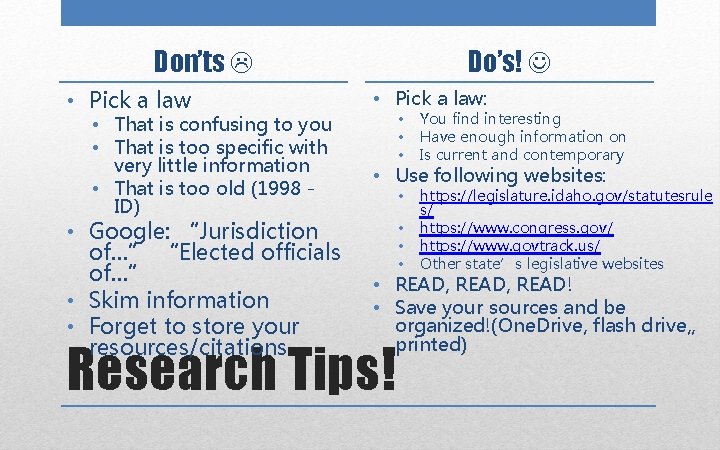
Don’ts • Pick a law • That is confusing to you • That is too specific with very little information • That is too old (1998 ID) • Google: “Jurisdiction of…” “Elected officials of…” • Skim information • Forget to store your resources/citations Do’s! • Pick a law: • • • You find interesting Have enough information on Is current and contemporary • https: //legislature. idaho. gov/statutesrule s/ https: //www. congress. gov/ https: //www. govtrack. us/ Other state’s legislative websites • Use following websites: • • READ, READ! • Save your sources and be organized!(One. Drive, flash drive, , printed) Research Tips!
2. What does this policy make illegal or propose to do? 3. What are the penalties for not following this policy? 4. Who enforces this policy? 5. Does this policy provide funding for different organizations (who)? 6. Is there funding required for this policy? Where will that funding come from? Policy Identification
Citations: 1. Does each section contain a citation? • Can use same reference more than once 2. Do all sources appear credible? 3. Are citations listed in back of packet? Policy Identification
History & Background Step Four- Why was your law needed? Due: 1/31(A) 2/1 (B)
Rubric • Traces the history of the policy issue • Explains what was happening that made it so policy exists today • Includes influence of major political parties, elected officials, interest groups, and/or specific individuals had on policy issue History and Background
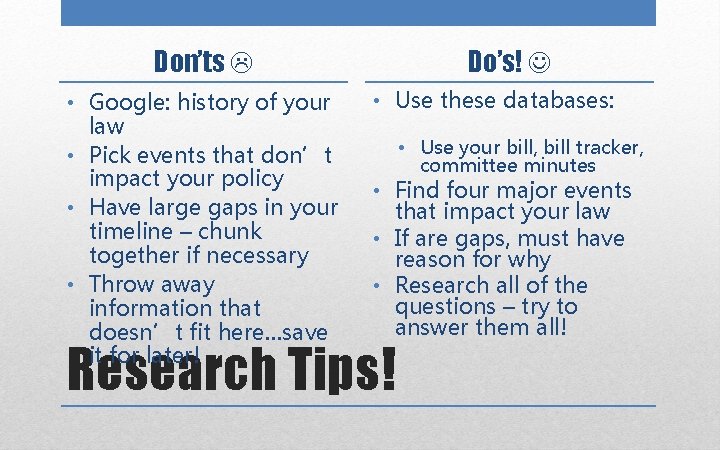
Don’ts • Google: history of your law • Pick events that don’t impact your policy • Have large gaps in your timeline – chunk together if necessary • Throw away information that doesn’t fit here…save it for later! Do’s! • Use these databases: • Use your bill, bill tracker, committee minutes • Find four major events that impact your law • If are gaps, must have reason for why • Research all of the questions – try to answer them all! Research Tips!
1. What is the name of your policy, when was it passed, and where was it passed? • Restate the name/number • Date signed into law • Where it was signed (jurisdiction all over again) History and Background
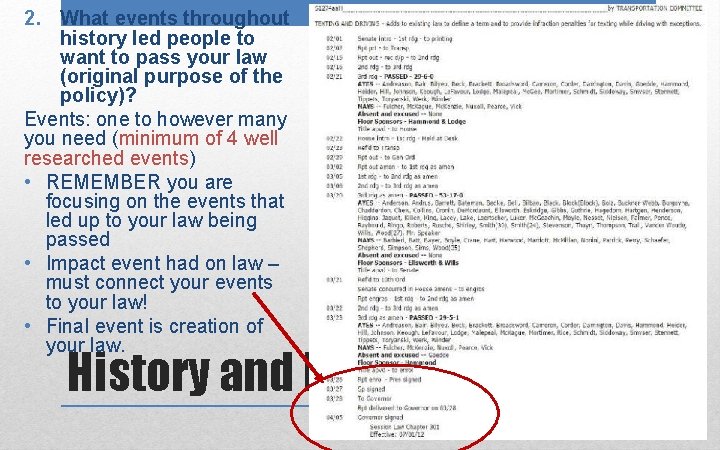
2. What events throughout history led people to want to pass your law (original purpose of the policy)? Events: one to however many you need (minimum of 4 well researched events) • REMEMBER you are focusing on the events that led up to your law being passed • Impact event had on law – must connect your events to your law! • Final event is creation of your law. History and Background -
3. What changes or amendments have been made to your law since it was first passed? Where to find: Bill, Bill Status and Committee Minutes • Amendments – (can write dates) by reading through committee minutes you will find what was discussed for each time the law has been changed History and Background
4. What political parties, agencies, interest groups, elected officials, AND/OR other individuals were involved in CREATING your law? Where to Find: Bill, Bill Status and Committee Minutes • Elected Officials (Governor/Floor Sponsors) • Political Parties (Elected Officials or differences of votes) • Government agencies & Interest Groups (EPA, Health and Welfare, NRA, AARP, etc. ) • Anything else? (any other individual that doesn’t fit within these categories) History and Background
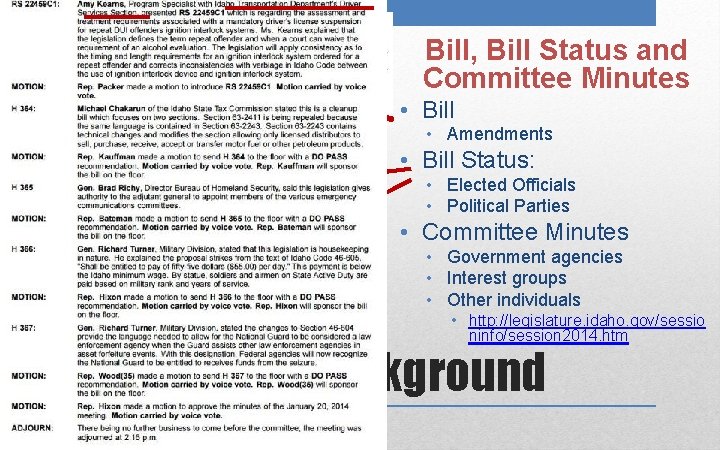
Bill, Bill Status and Committee Minutes • Bill • Amendments • Bill Status: • Elected Officials • Political Parties • Committee Minutes • Government agencies • Interest groups • Other individuals • http: //legislature. idaho. gov/sessio ninfo/session 2014. htm History and Background
Citations: 1. Does each section contain a citation? • Can use same reference more than once 2. Do all sources appear credible? 3. Are citations listed in back of packet? History and Background
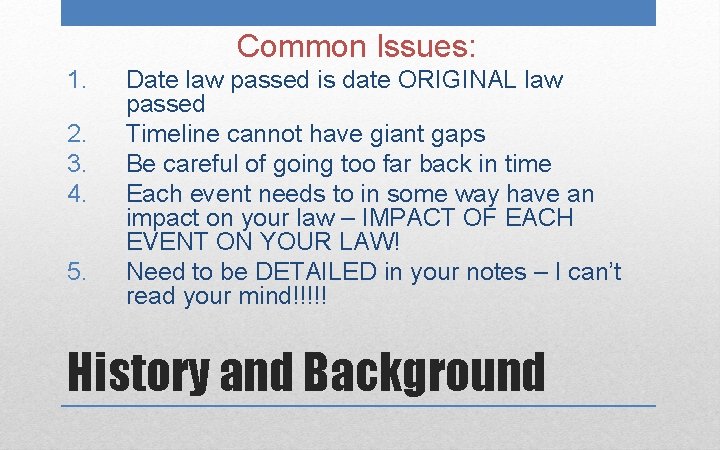
Common Issues: 1. 2. 3. 4. 5. Date law passed is date ORIGINAL law passed Timeline cannot have giant gaps Be careful of going too far back in time Each event needs to in some way have an impact on your law – IMPACT OF EACH EVENT ON YOUR LAW! Need to be DETAILED in your notes – I can’t read your mind!!!!! History and Background
Current Situation Step Five- Is your law working? Due: 2/2(A) 2/3 (B)
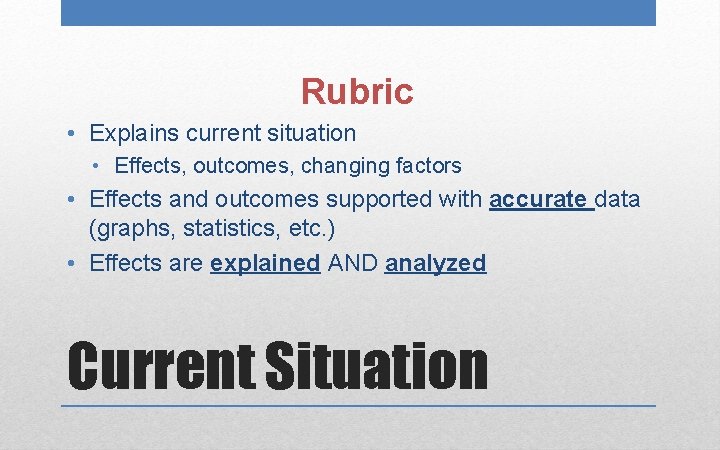
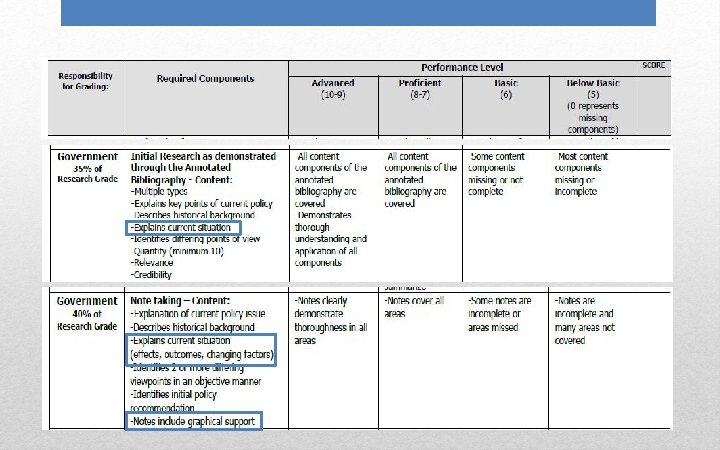
Rubric • Explains current situation • Effects, outcomes, changing factors • Effects and outcomes supported with accurate data (graphs, statistics, etc. ) • Effects are explained AND analyzed Current Situation
Current Situation
Don’ts Do’s! • Assume your preconceived ideas are correct – don’t look for what you’re BELIEVE is right • Google “Current situation of…” “Funding for…” etc. • Keep an open mind when finding data • Find lots of numbers, statistics, data, etc. • Use these databases: Research Tips! • ?
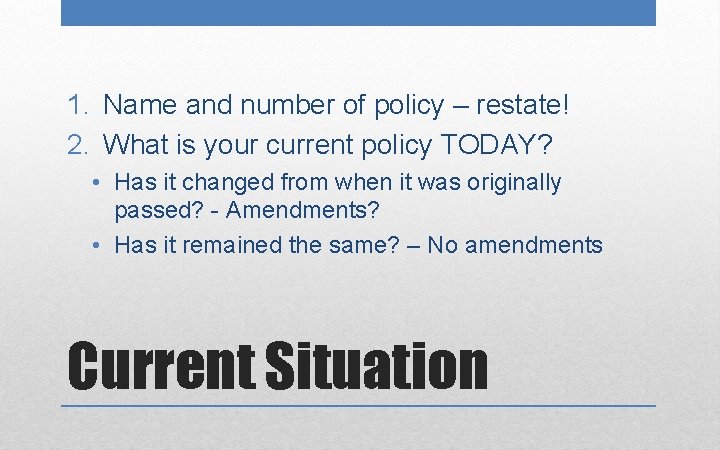
1. Name and number of policy – restate! 2. What is your current policy TODAY? • Has it changed from when it was originally passed? - Amendments? • Has it remained the same? – No amendments Current Situation
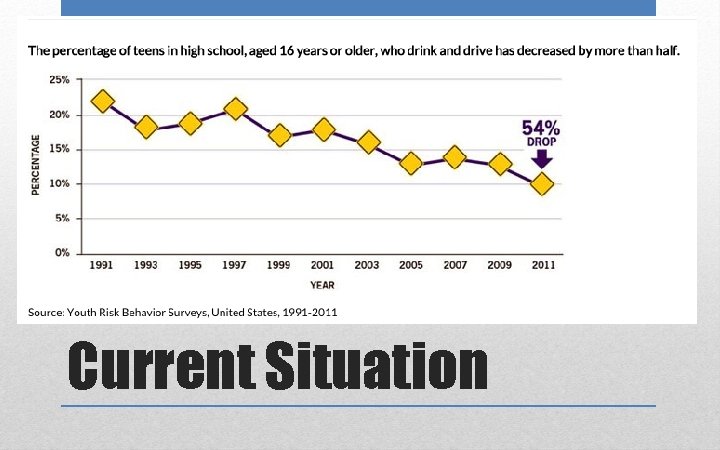
3. In what ways has your policy impacted the lives of the people/animals/things it was intended to? Questions to Consider: • Are more/less people in jail? • Have rates of your topic increased/decreased? • Has it provided funds for things and where did the funds come from? “The percentage of teens in high school who drink and drive has decreased by more than half (54%) since 1991 (CDC, 2015). Current Situation
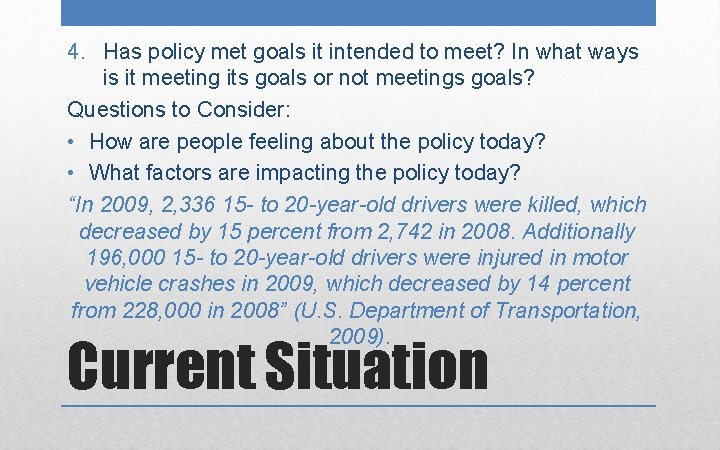
4. Has policy met goals it intended to meet? In what ways is it meeting its goals or not meetings goals? Questions to Consider: • How are people feeling about the policy today? • What factors are impacting the policy today? “In 2009, 2, 336 15 - to 20 -year-old drivers were killed, which decreased by 15 percent from 2, 742 in 2008. Additionally 196, 000 15 - to 20 -year-old drivers were injured in motor vehicle crashes in 2009, which decreased by 14 percent from 228, 000 in 2008” (U. S. Department of Transportation, 2009). Current Situation
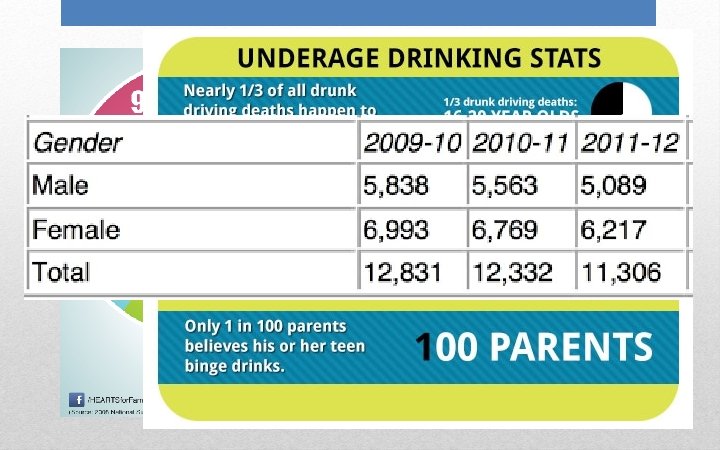
Data, data, data!!
Citations: 1. Does each section contain a citation? • Can use same reference more than once 2. Do all sources appear credible? 3. Are citations listed in back of packet? Current Situation
Common Mistakes 1. 2. 3. 4. No reliable sources – so much bias! No data/statistics No overall explanation/analysis Nothing written… Current Situation
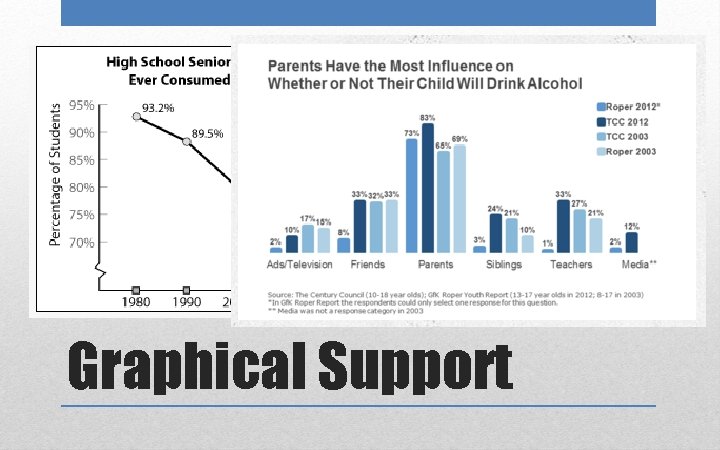
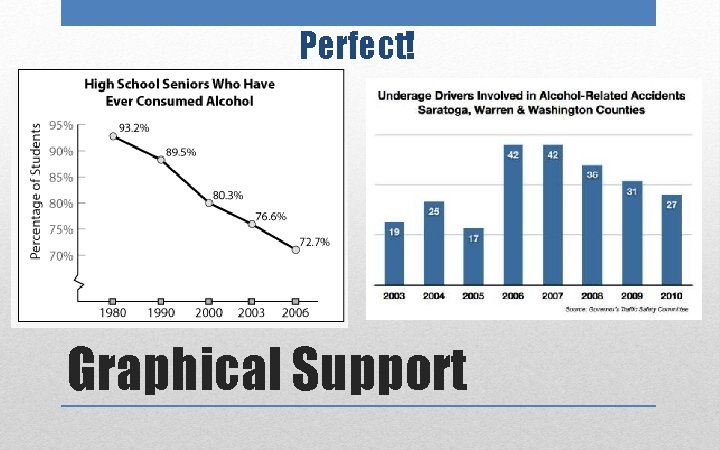
Graphical Support
Not So Good Current Situation – Graphs!
Perfect! Graphical Support
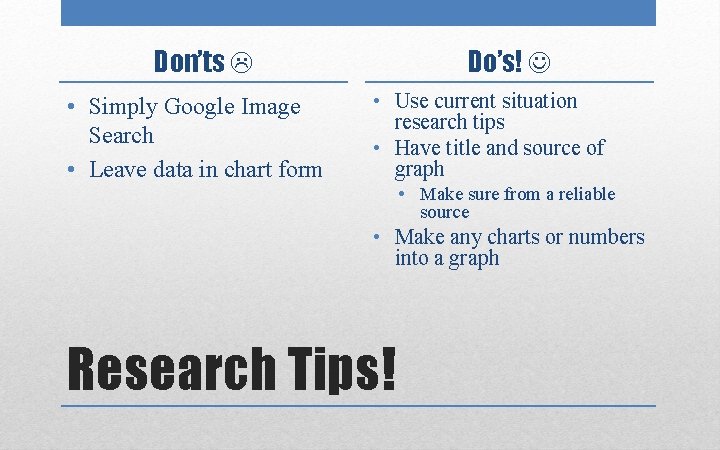
Don’ts • Simply Google Image Search • Leave data in chart form Do’s! • Use current situation research tips • Have title and source of graph • Make sure from a reliable source • Make any charts or numbers into a graph Research Tips!
Citations: 1. Does each section contain a citation? • Can use same reference more than once 2. Do all sources appear credible? 3. Are citations listed in back of packet? Graphical Support
Common Mistakes 1. No reliable sources – so much bias! 2. Not a GRAPH, but instead a chart • You can easily make a graph 3. No explanation of graph 4. No source for graph Current Situation
Differing Viewpoints Step Six- What are people thinking about your law? Due: 2/6(A) 2/7 (B)
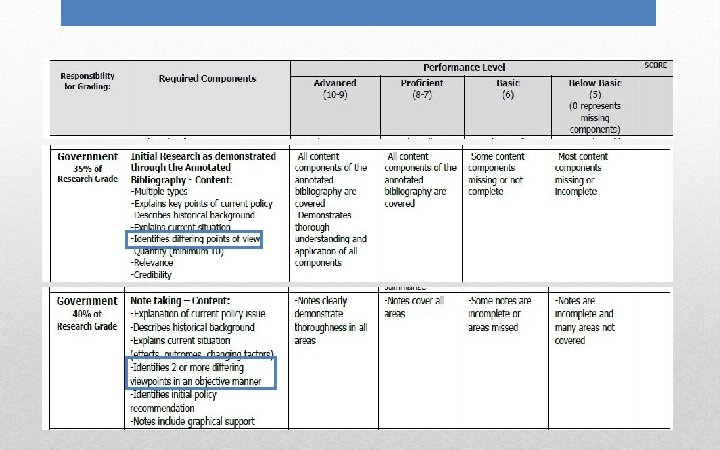
Rubric • Identifies two or more differing viewpoints in an objective manner. Differing Viewpoints
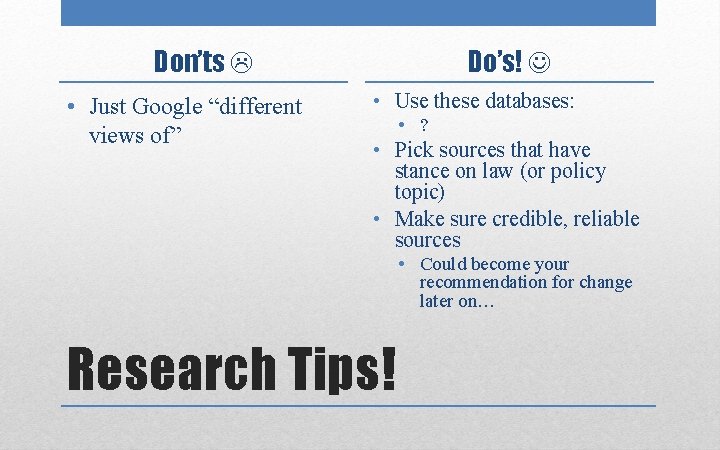
Don’ts • Just Google “different views of” Do’s! • Use these databases: • ? • Pick sources that have stance on law (or policy topic) • Make sure credible, reliable sources • Could become your recommendation for change later on… Research Tips!
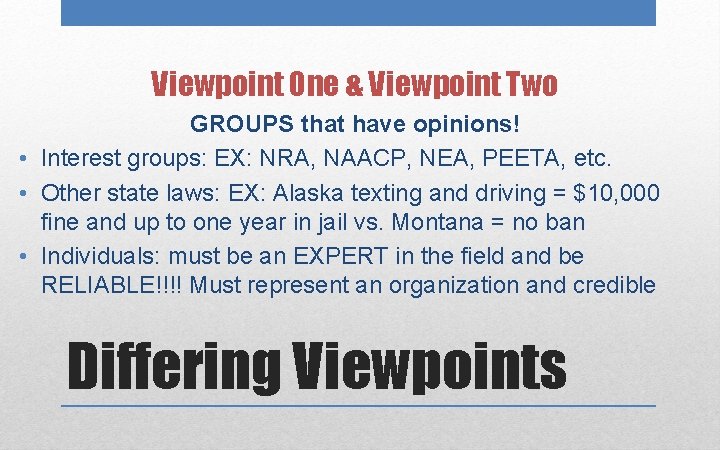
Viewpoint One & Viewpoint Two GROUPS that have opinions! • Interest groups: EX: NRA, NAACP, NEA, PEETA, etc. • Other state laws: EX: Alaska texting and driving = $10, 000 fine and up to one year in jail vs. Montana = no ban • Individuals: must be an EXPERT in the field and be RELIABLE!!!! Must represent an organization and credible Differing Viewpoints
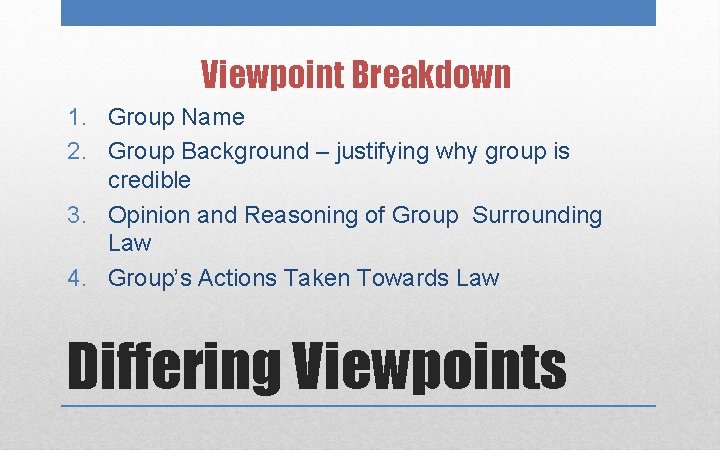
Viewpoint Breakdown 1. Group Name 2. Group Background – justifying why group is credible 3. Opinion and Reasoning of Group Surrounding Law 4. Group’s Actions Taken Towards Law Differing Viewpoints
Citations: 1. Does each section contain a citation? • Can use same reference more than once 2. Do all sources appear credible? 3. Are citations listed in back of packet? Differing Viewpoints
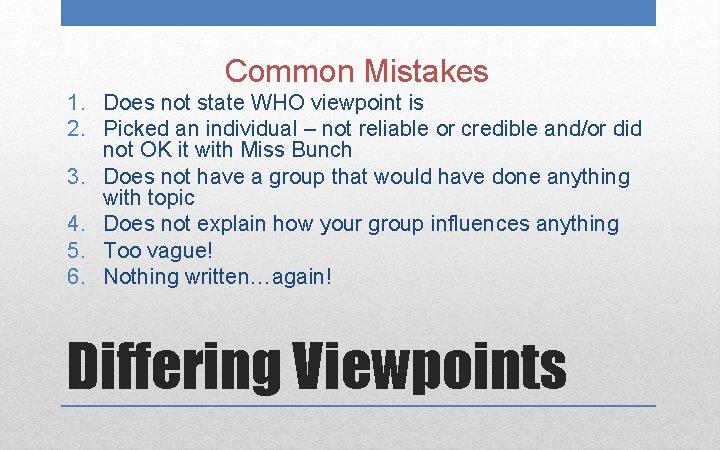
Common Mistakes 1. Does not state WHO viewpoint is 2. Picked an individual – not reliable or credible and/or did not OK it with Miss Bunch 3. Does not have a group that would have done anything with topic 4. Does not explain how your group influences anything 5. Too vague! 6. Nothing written…again! Differing Viewpoints
Policy Recommendation Step Seven- Why was your law needed? Due: 2/8 (A) 2/9 (B)
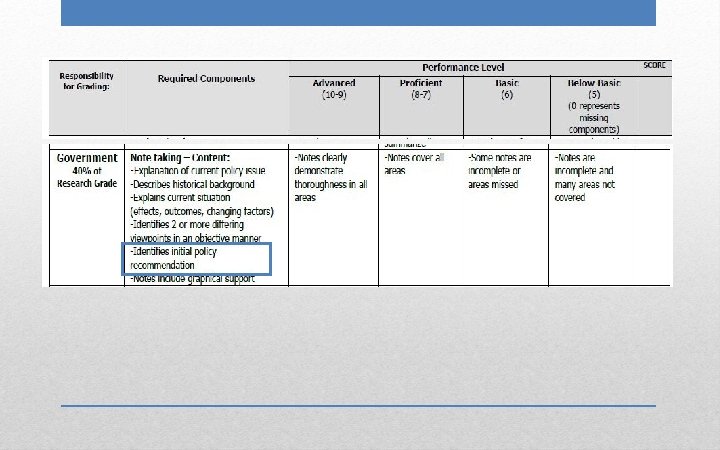
Rubric • Identifies initial policy recommendation • Recommend changes to current policy OR the need for the policy to remain the same Policy Recommendation
Don’ts Do’s! • Make up your recommendation without research • Bring new information up – you have everything you need already • Use your current situation data to back up your view Research Tips!
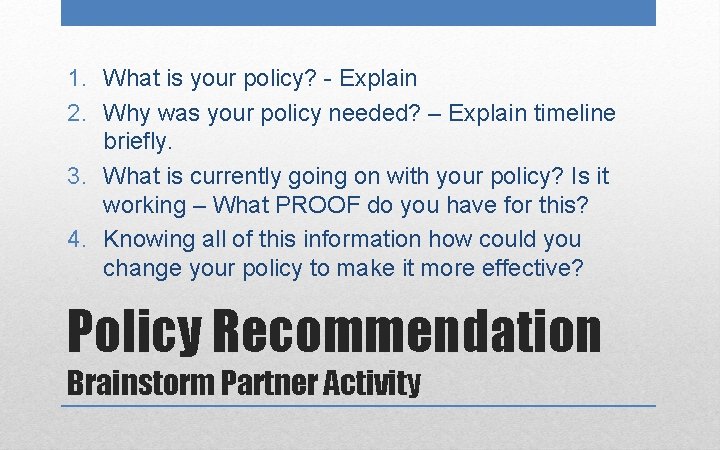
1. What is your policy? - Explain 2. Why was your policy needed? – Explain timeline briefly. 3. What is currently going on with your policy? Is it working – What PROOF do you have for this? 4. Knowing all of this information how could you change your policy to make it more effective? Policy Recommendation Brainstorm Partner Activity
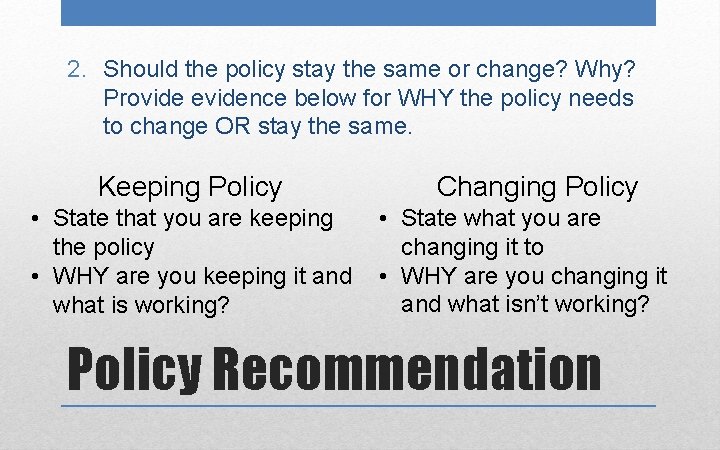
2. Should the policy stay the same or change? Why? Provide evidence below for WHY the policy needs to change OR stay the same. Keeping Policy • State that you are keeping the policy • WHY are you keeping it and what is working? Changing Policy • State what you are changing it to • WHY are you changing it and what isn’t working? Policy Recommendation
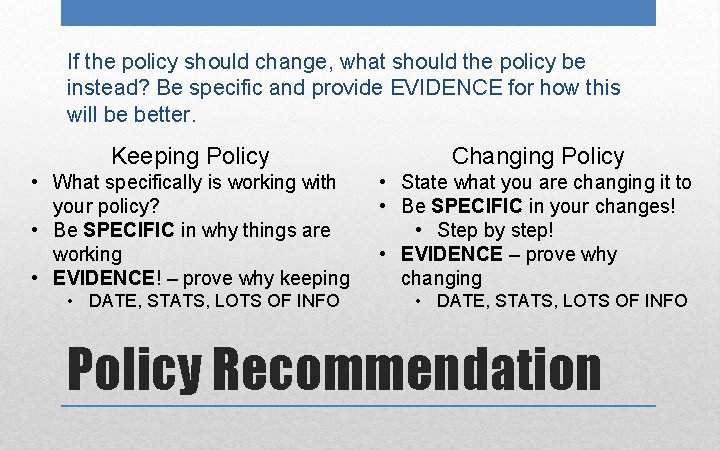
If the policy should change, what should the policy be instead? Be specific and provide EVIDENCE for how this will be better. Keeping Policy Changing Policy • What specifically is working with your policy? • Be SPECIFIC in why things are working • EVIDENCE! – prove why keeping • State what you are changing it to • Be SPECIFIC in your changes! • Step by step! • EVIDENCE – prove why changing • DATE, STATS, LOTS OF INFO Policy Recommendation
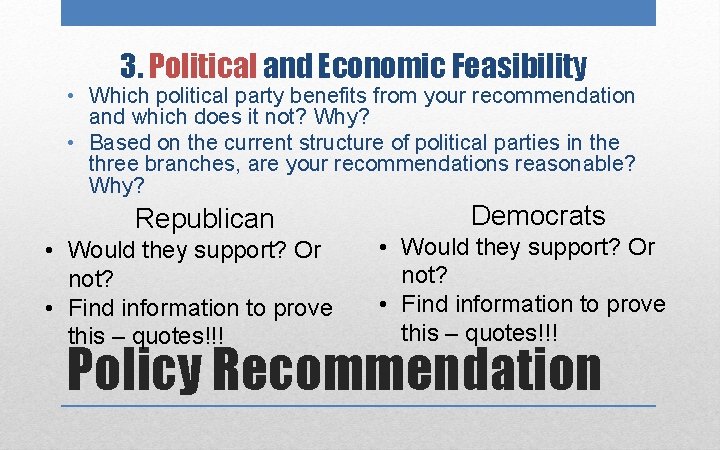
3. Political and Economic Feasibility • Which political party benefits from your recommendation and which does it not? Why? • Based on the current structure of political parties in the three branches, are your recommendations reasonable? Why? Republican • Would they support? Or not? • Find information to prove this – quotes!!! Democrats • Would they support? Or not? • Find information to prove this – quotes!!! Policy Recommendation
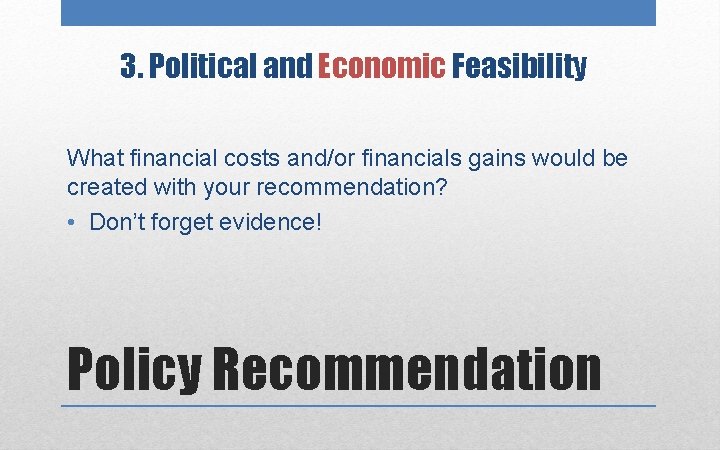
3. Political and Economic Feasibility What financial costs and/or financials gains would be created with your recommendation? • Don’t forget evidence! Policy Recommendation
Citations: 1. Does each section contain a citation? • Can use same reference more than once 2. Do all sources appear credible? 3. Are citations listed in back of packet? Policy Recommendation
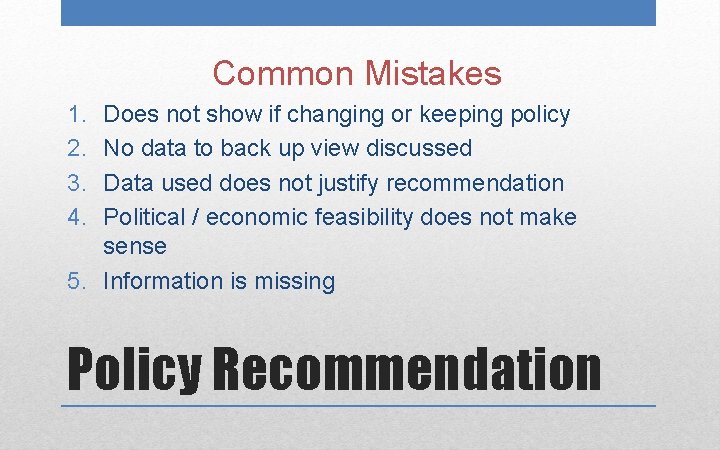
Common Mistakes 1. 2. 3. 4. Does not show if changing or keeping policy No data to back up view discussed Data used does not justify recommendation Political / economic feasibility does not make sense 5. Information is missing Policy Recommendation
Wahoo! Research is DONE!