
Welcome to the webinar Preparedness Can we learn
Welcome to the webinar! Preparedness Can we learn from the Nepal earthquake response? Does preparedness work? How does it work? Are we doing it right? Make sure you are connected to the audio: Click on the box with the headphones icon for “Call Using Computer”. If you don’t immediately see the Audio Connection box in front of you, go to the Quick Start tab and find it there. If your computer audio is not working during the event, you can also listen by phone instead. Dial +1 -650 -429 -3300 or find the global call-in number for your location at: www. humanitarianresponse. info/system/files/documents/fil es/Webex%20 Global%20 call-in%20 numbers. pdf Access code: 649 421 288 In case you are unable to connect to the event, a noninteractive live stream is available as a back-up at www. youtube. com/watch? v=BRBHr. Z_5 z 5 k All webinar recordings are available on the website: www. humanitarianresponse. info/topics/transformative -agenda First webinar will start at 10: 00, Geneva-time Second webinar will start at 15: 00, Geneva-time
Co-Chair IASC Task Team on Preparedness and Resilience Preparedness in the IASC
IASC Preparedness Bodies § § § Pre 2014 – SWG on Preparedness 2014 -2015 Task Team on Preparedness and Resilience 2016 >Reference Group on (Risk), Early Warning and Preparedness
Lines of Work § Operational • Early Warning Reports (Anticipate, do not wait) § § Norms and Technical IASC Readiness (Retain Emergency Capacity) • Emergency Response Preparedness (ERP) • Simulation methodology • Making the case § § IASC Support to Others (Reinforce, do not replace) Transcend Humanitarian-Development Divides) • Common Framework on Preparedness § Linking the two (as local as possible – as international as necessary)
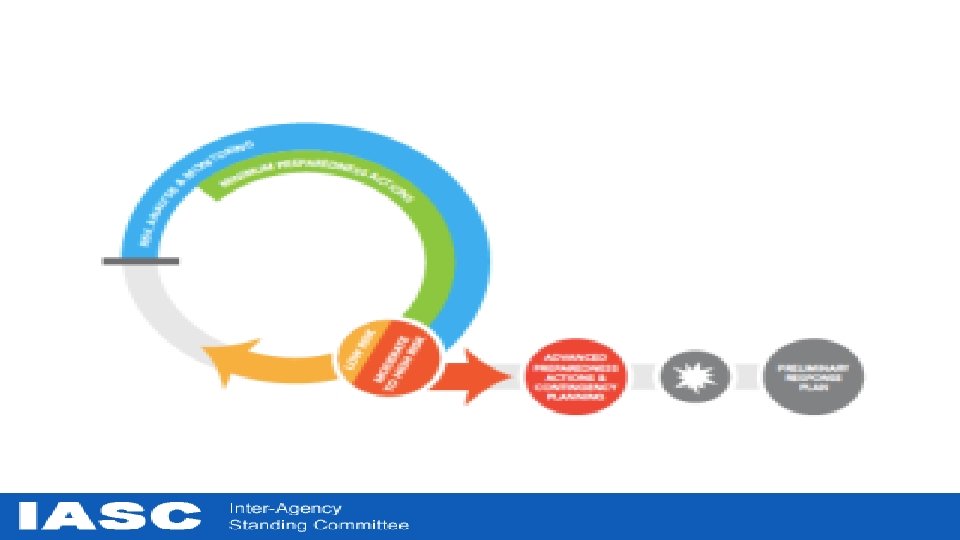
ERP : overview § § § Part of Humanitarian Programme Cycle Understand Risk All Hazard Minimum Preparedness Actions Monitor Risk Manifest Risk – Advanced Preparedness Actions & Contingency Planning Refugee and IHR Situations
Nepal Grouped Takeaways The Basics Matter Savvy Investment Coherence Familiarity
Preparedness: Can we learn from the Nepal Earthquake? Victoria Stodart SHELTER CLUSTER COORDINATOR, NEPAL (APRIL & MAY, 2015) Global Shelter Cluster Shelter. Cluster. org Coordinating Humanitarian Shelter 8
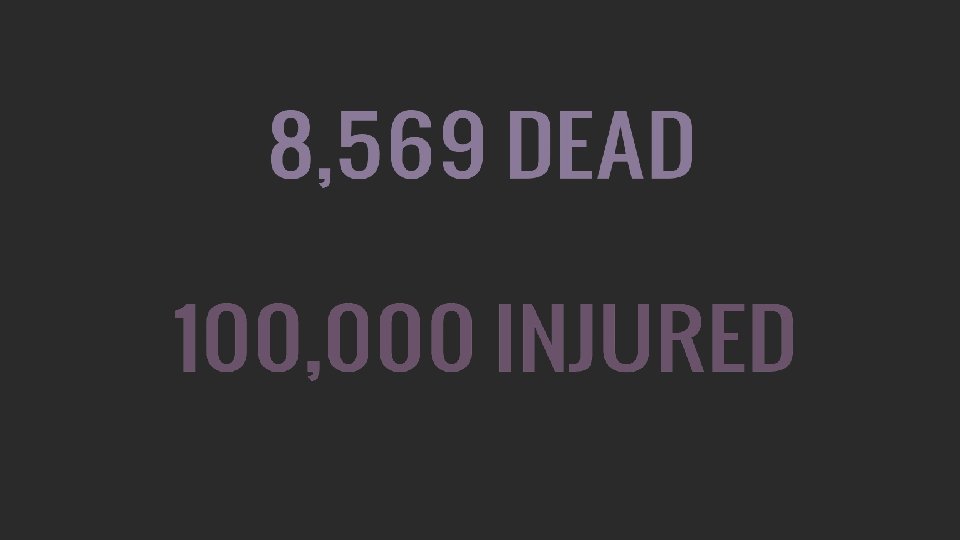
The Shelter Cluster Perspective § Govt lead: DUDBC; co lead IFRC § Over 700, 000 homes destroyed or damaged in 14 priority districts § 25 April 2015 – 31 Dec 2015: 115 operational agencies provided 635, 950 households with shelter and 485, 682 HHs with NFIs § Cluster has returned to its preparedness state Global Shelter Cluster Shelter. Cluster. org Coordinating Humanitarian Shelter 9
Preparedness plans § Active cluster since 2008 § Responded to small and medium scale disasters § Regular shelter cluster meetings § Contingency plan § Scenario planning Global Shelter Cluster Shelter. Cluster. org Coordinating Humanitarian Shelter 10
What worked? § Awareness of the cluster approach and our ‘business’ § Pre existing knowledge and relationships § An agreed approach - contingency plan which included contacts, agreed specs, kits and assessment questions Global Shelter Cluster Shelter. Cluster. org Coordinating Humanitarian Shelter 11
What tested us? § Private sector: both from a market perspective and from capacity to deliver § Cash: inclusion of shelter in the discussion, reporting and build back safer? § Local level coordination and linking to development Global Shelter Cluster Shelter. Cluster. org Coordinating Humanitarian Shelter 12
Ongoing challenges? § People and money: – Funding in country for preparedness and investing appropriately in personnel to ensure they remain – Lack of predictable funding to the global clusters to enable roving capacity to support cluster preparedness and capacity build § Urban…are we really ready? Especially when considering private sector/civil society/municipal coordination as well – Nepal Shelter Cluster: Private Sector Coordination Pilot Study (www. sheltercluster. org ) Global Shelter Cluster Shelter. Cluster. org Coordinating Humanitarian Shelter 13
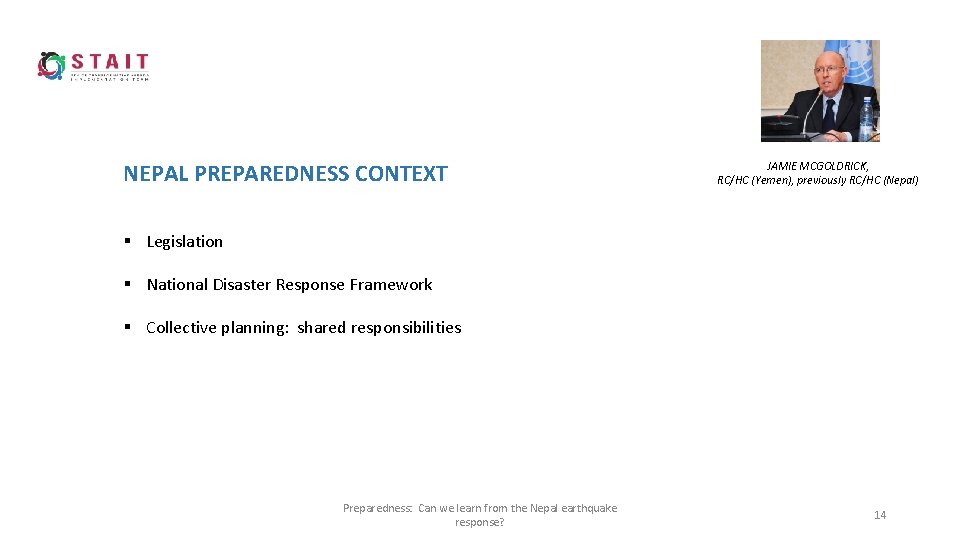
NEPAL PREPAREDNESS CONTEXT JAMIE MCGOLDRICK, RC/HC (Yemen), previously RC/HC (Nepal) § Legislation § National Disaster Response Framework § Collective planning: shared responsibilities Preparedness: Can we learn from the Nepal earthquake response? 14
HUMANITARIAN / DEVELOPMENT LEARNING AND INVESTMENT § Twenty year development plans § Increased awareness on the part of the national Government § Over 800 harmonized Community Disaster Risk Management Programmes § Nationalised clusters § The Humanitarian Staging Area at the airport Preparedness: Can we learn from the Nepal earthquake response? 16
EMERGENCY RESPONSE PREPAREDNESS AND THE HCT § Nepal was a pilot country in Asia for ERP § Trainings and scenarios contributed to good planning and response § Strong OCHA regional support (including ongoing contributions to preparedness) § Protection and gender were central in the response § HCT + and the strong and supportive relationship with donors (small donor group) Preparedness: Can we learn from the Nepal earthquake response? 18
NEW WAYS OF WORKING § Contracts with the private sector § On-Site Operations and Coordination Centre included an Assessment Cell: novel arrangement § Communications with Communities project in the RCO: monitoring rumours at the community level; collect regular data from communities (including perceptions) § Working with the scientific community (relationships already established) § Cash Preparedness: Can we learn from the Nepal earthquake response? 19
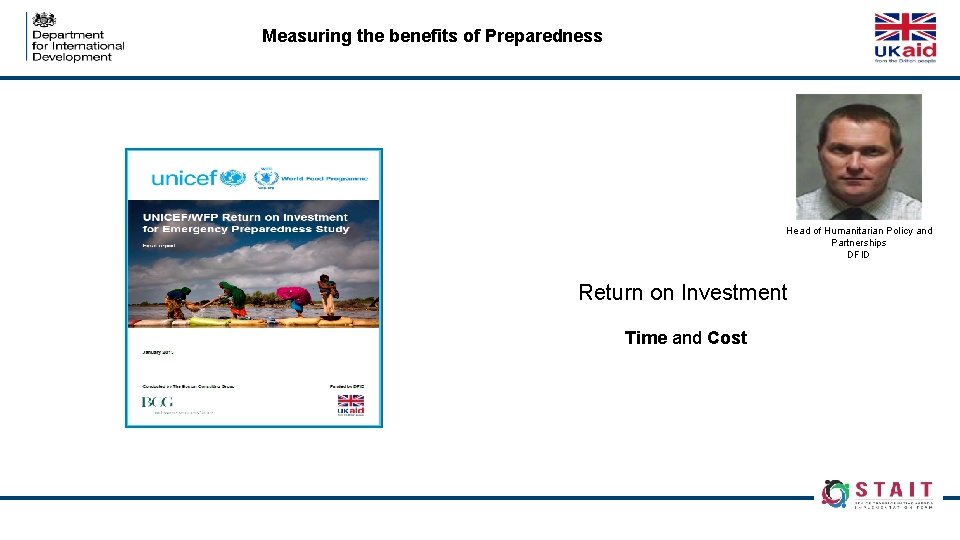
Measuring the benefits of Preparedness Head of Humanitarian Policy and Partnerships DFID Return on Investment Time and Cost
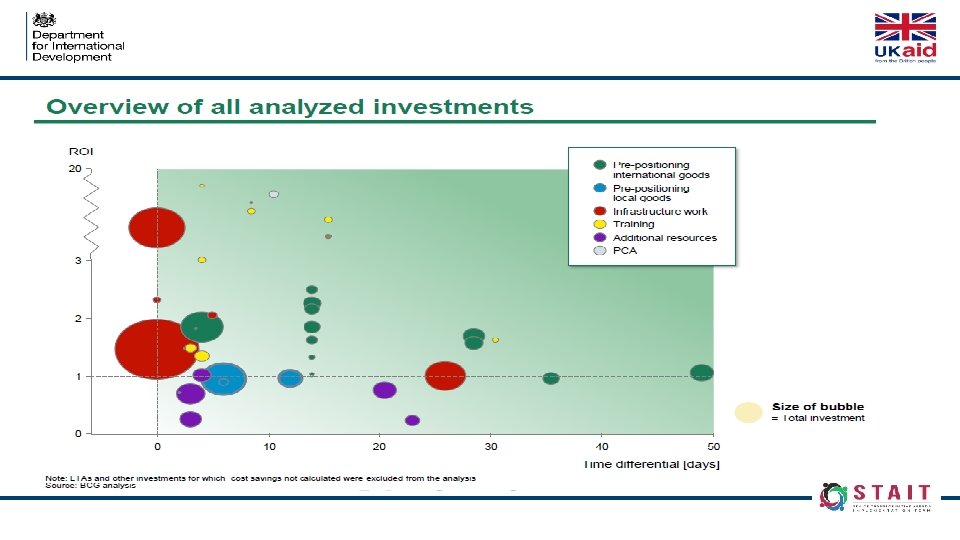
What are the results / findings? • All investments examined saved significant time and/or costs. • 64% saved both costs and time. • Investments made have enabled responses in …. . Cost savings 72% of investments showed cost-savings Time savings 93% of investments saved time $5. 6 million invested saves $12 million toward future humanitarian response (net saving of $6. 4 million). Time gains of 2 to 50 days (one week in average)
- Slides: 23