
WELCOME TO THE TRAINING SESSION ON AUDITING INTANGIBLE
WELCOME TO THE TRAINING SESSION ON “AUDITING INTANGIBLE ASSETS” Presented By Mohammad Mutasim Hossain Slide show development Abul kalam Azad 12 April, 2012
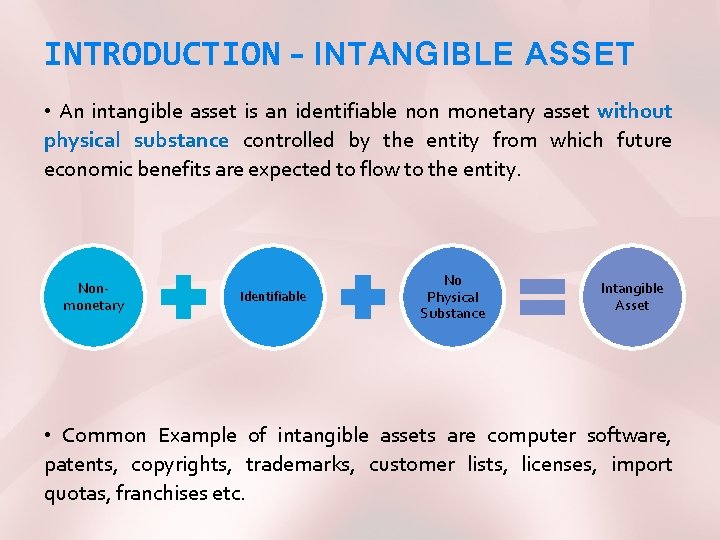
INTRODUCTION – INTANGIBLE ASSET • An intangible asset is an identifiable non monetary asset without physical substance controlled by the entity from which future economic benefits are expected to flow to the entity. Nonmonetary Identifiable No Physical Substance Intangible Asset • Common Example of intangible assets are computer software, patents, copyrights, trademarks, customer lists, licenses, import quotas, franchises etc.
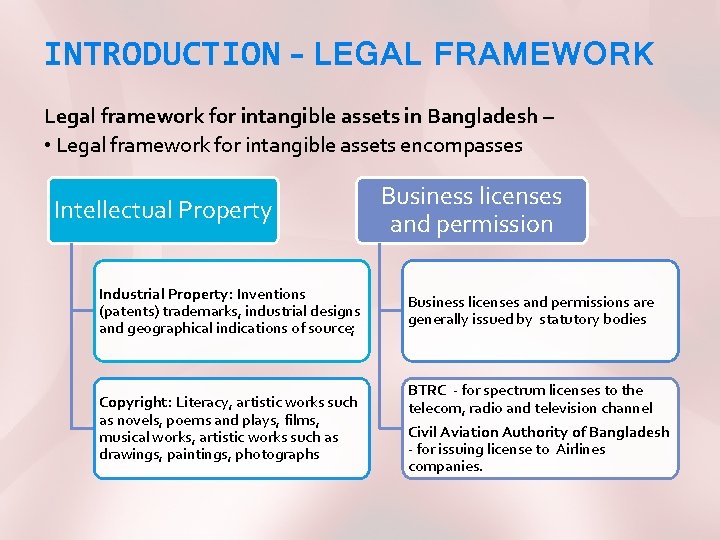
INTRODUCTION – LEGAL FRAMEWORK Legal framework for intangible assets in Bangladesh – • Legal framework for intangible assets encompasses Intellectual Property Industrial Property: Inventions (patents) trademarks, industrial designs and geographical indications of source; Copyright: Literacy, artistic works such as novels, poems and plays, films, musical works, artistic works such as drawings, paintings, photographs Business licenses and permissions are generally issued by statutory bodies BTRC - for spectrum licenses to the telecom, radio and television channel Civil Aviation Authority of Bangladesh - for issuing license to Airlines companies.
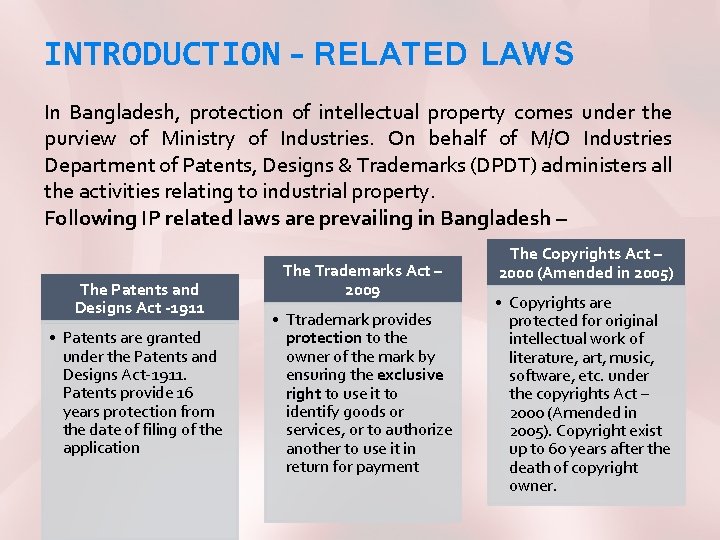
INTRODUCTION – RELATED LAWS In Bangladesh, protection of intellectual property comes under the purview of Ministry of Industries. On behalf of M/O Industries Department of Patents, Designs & Trademarks (DPDT) administers all the activities relating to industrial property. Following IP related laws are prevailing in Bangladesh – The Patents and Designs Act -1911 • Patents are granted under the Patents and Designs Act-1911. Patents provide 16 years protection from the date of filing of the application The Trademarks Act – 2009 • Ttrademark provides protection to the owner of the mark by ensuring the exclusive right to use it to identify goods or services, or to authorize another to use it in return for payment The Copyrights Act – 2000 (Amended in 2005) • Copyrights are protected for original intellectual work of literature, art, music, software, etc. under the copyrights Act – 2000 (Amended in 2005). Copyright exist up to 60 years after the death of copyright owner.
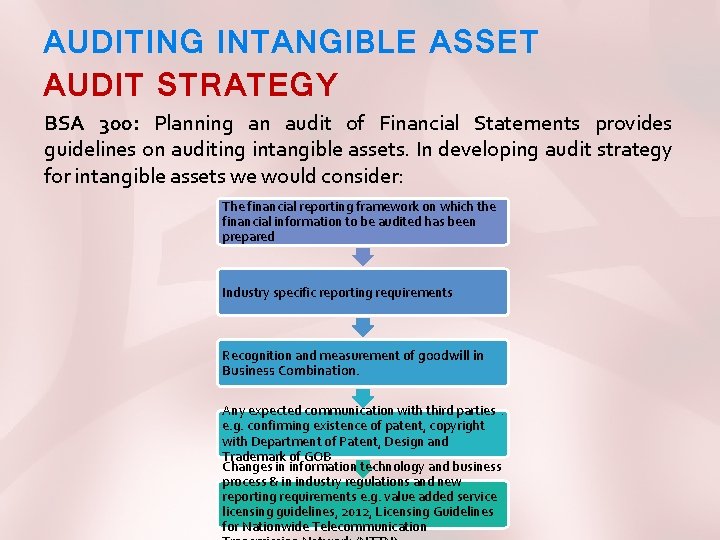
AUDITING INTANGIBLE ASSET AUDIT STRATEGY BSA 300: Planning an audit of Financial Statements provides guidelines on auditing intangible assets. In developing audit strategy for intangible assets we would consider: The financial reporting framework on which the financial information to be audited has been prepared Industry specific reporting requirements Recognition and measurement of goodwill in Business Combination. Any expected communication with third parties. e. g. confirming existence of patent, copyright with Department of Patent, Design and Trademark of GOB Changes in information technology and business process & in industry regulations and new reporting requirements e. g. value added service licensing guidelines, 2012, Licensing Guidelines for Nationwide Telecommunication
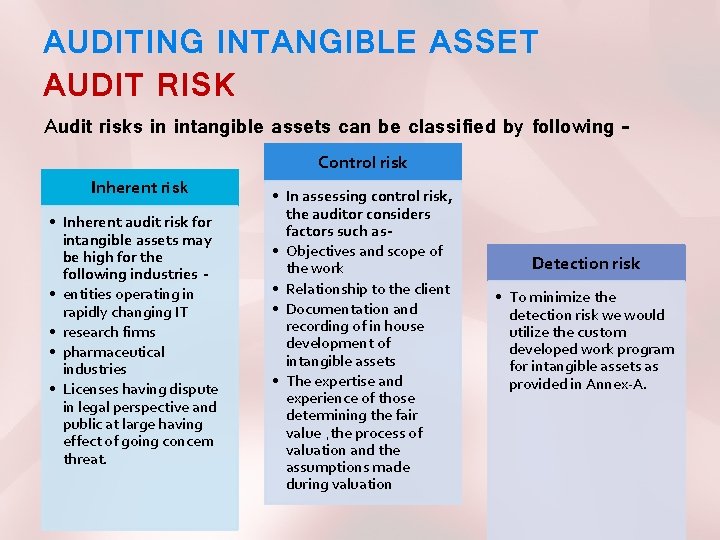
AUDITING INTANGIBLE ASSET AUDIT RISK Audit risks in intangible assets can be classified by following Control risk Inherent risk • Inherent audit risk for intangible assets may be high for the following industries • entities operating in rapidly changing IT • research firms • pharmaceutical industries • Licenses having dispute in legal perspective and public at large having effect of going concern threat. • In assessing control risk, the auditor considers factors such as • Objectives and scope of the work • Relationship to the client • Documentation and recording of in house development of intangible assets • The expertise and experience of those determining the fair value , the process of valuation and the assumptions made during valuation Detection risk • To minimize the detection risk we would utilize the custom developed work program for intangible assets as provided in Annex-A.
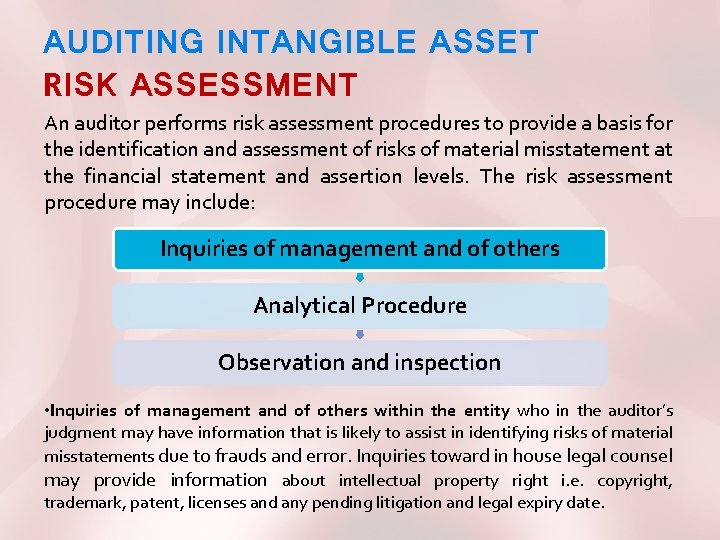
AUDITING INTANGIBLE ASSET RISK ASSESSMENT An auditor performs risk assessment procedures to provide a basis for the identification and assessment of risks of material misstatement at the financial statement and assertion levels. The risk assessment procedure may include: Inquiries of management and of others Analytical Procedure Observation and inspection • Inquiries of management and of others within the entity who in the auditor’s judgment may have information that is likely to assist in identifying risks of material misstatements due to frauds and error. Inquiries toward in house legal counsel may provide information about intellectual property right i. e. copyright, trademark, patent, licenses and any pending litigation and legal expiry date.
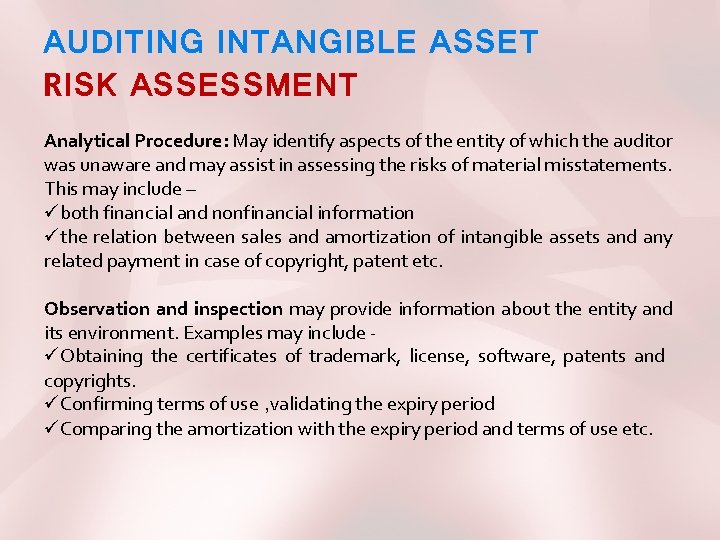
AUDITING INTANGIBLE ASSET RISK ASSESSMENT Analytical Procedure: May identify aspects of the entity of which the auditor was unaware and may assist in assessing the risks of material misstatements. This may include – üboth financial and nonfinancial information üthe relation between sales and amortization of intangible assets and any related payment in case of copyright, patent etc. Observation and inspection may provide information about the entity and its environment. Examples may include üObtaining the certificates of trademark, license, software, patents and copyrights. üConfirming terms of use , validating the expiry period üComparing the amortization with the expiry period and terms of use etc.
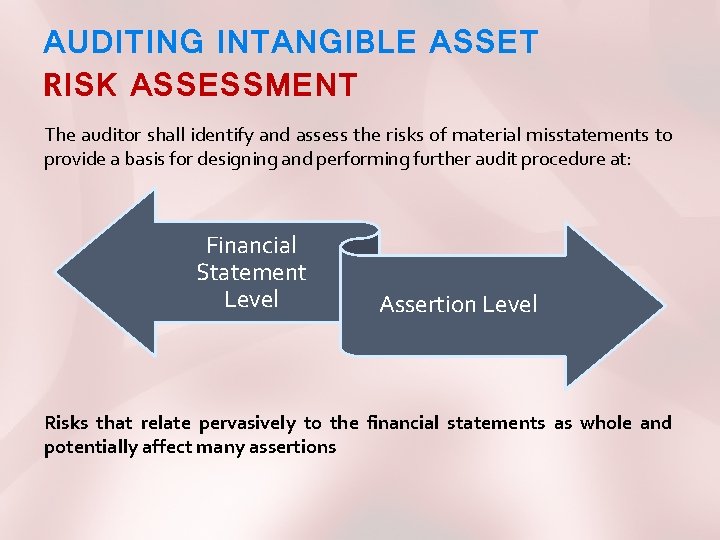
AUDITING INTANGIBLE ASSET RISK ASSESSMENT The auditor shall identify and assess the risks of material misstatements to provide a basis for designing and performing further audit procedure at: Financial Statement Level Assertion Level Risks that relate pervasively to the financial statements as whole and potentially affect many assertions
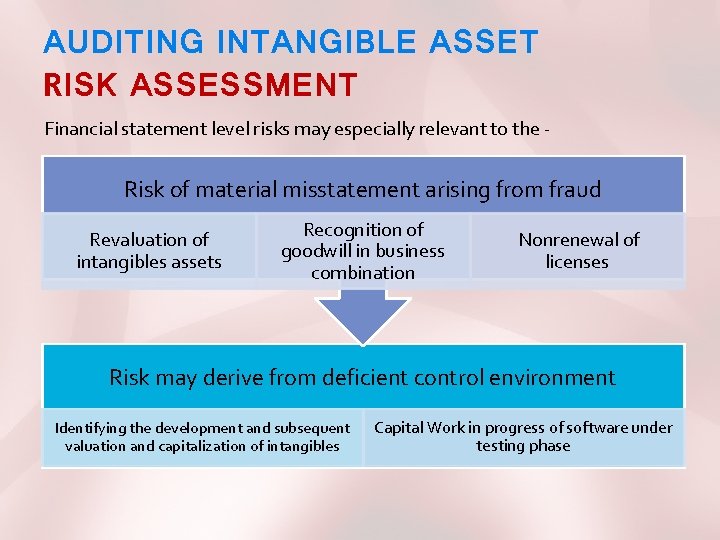
AUDITING INTANGIBLE ASSET RISK ASSESSMENT Financial statement level risks may especially relevant to the - Risk of material misstatement arising from fraud Revaluation of intangibles assets Recognition of goodwill in business combination Nonrenewal of licenses Risk may derive from deficient control environment Identifying the development and subsequent valuation and capitalization of intangibles Capital Work in progress of software under testing phase
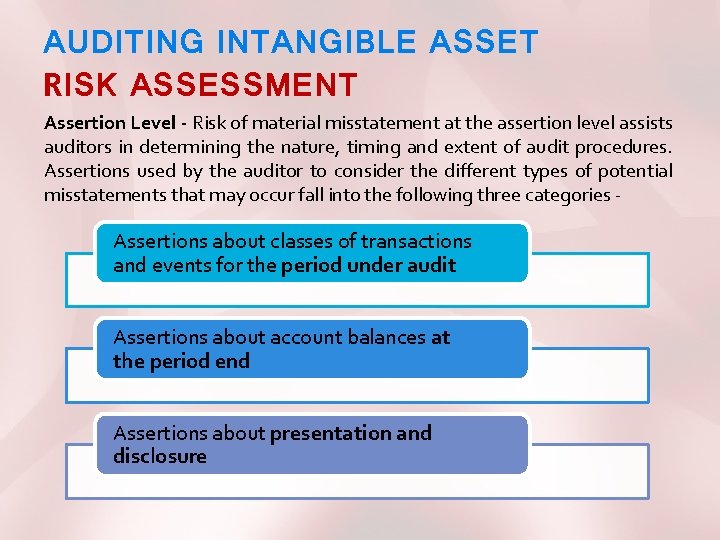
AUDITING INTANGIBLE ASSET RISK ASSESSMENT Assertion Level - Risk of material misstatement at the assertion level assists auditors in determining the nature, timing and extent of audit procedures. Assertions used by the auditor to consider the different types of potential misstatements that may occur fall into the following three categories - Assertions about classes of transactions and events for the period under audit Assertions about account balances at the period end Assertions about presentation and disclosure
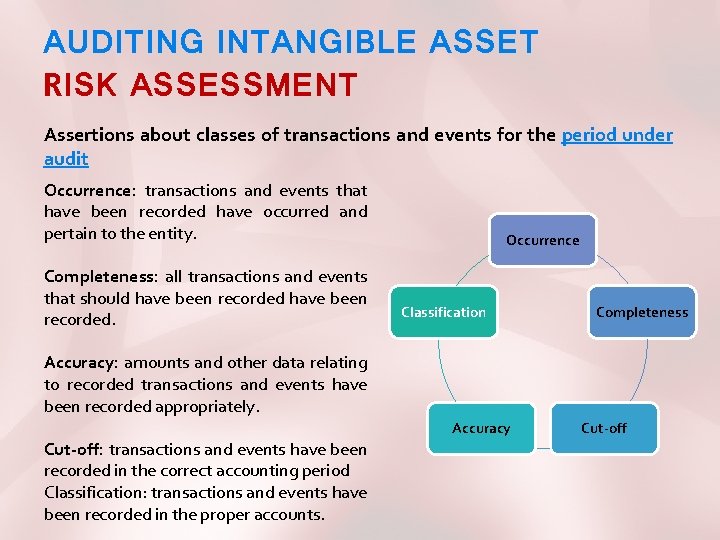
AUDITING INTANGIBLE ASSET RISK ASSESSMENT Assertions about classes of transactions and events for the period under audit Occurrence: transactions and events that have been recorded have occurred and pertain to the entity. Completeness: all transactions and events that should have been recorded. Occurrence Classification Completeness Accuracy: amounts and other data relating to recorded transactions and events have been recorded appropriately. Accuracy Cut-off: transactions and events have been recorded in the correct accounting period Classification: transactions and events have been recorded in the proper accounts. Cut-off
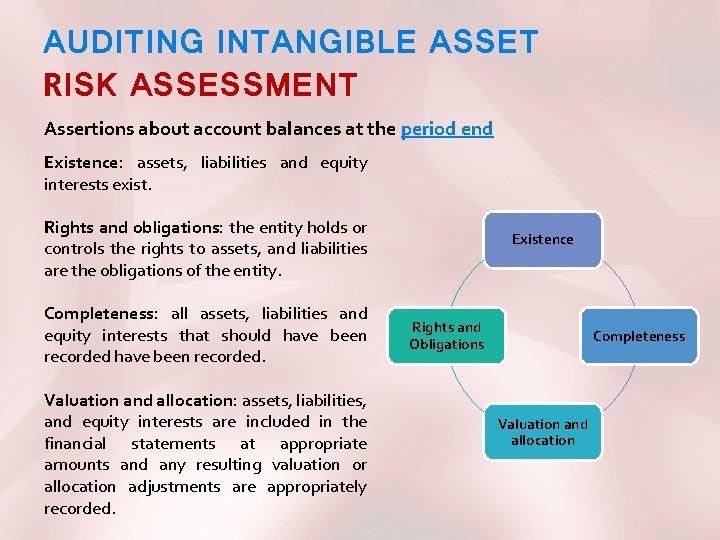
AUDITING INTANGIBLE ASSET RISK ASSESSMENT Assertions about account balances at the period end Existence: assets, liabilities and equity interests exist. Rights and obligations: the entity holds or controls the rights to assets, and liabilities are the obligations of the entity. Completeness: all assets, liabilities and equity interests that should have been recorded. Valuation and allocation: assets, liabilities, and equity interests are included in the financial statements at appropriate amounts and any resulting valuation or allocation adjustments are appropriately recorded. Existence Rights and Obligations Completeness Valuation and allocation
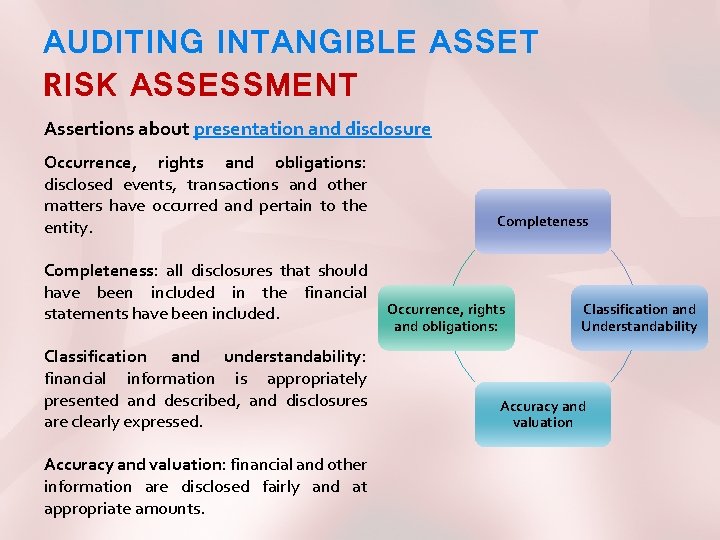
AUDITING INTANGIBLE ASSET RISK ASSESSMENT Assertions about presentation and disclosure Occurrence, rights and obligations: disclosed events, transactions and other matters have occurred and pertain to the entity. Completeness: all disclosures that should have been included in the financial statements have been included. Classification and understandability: financial information is appropriately presented and described, and disclosures are clearly expressed. Accuracy and valuation: financial and other information are disclosed fairly and at appropriate amounts. Completeness Occurrence, rights and obligations: Classification and Understandability Accuracy and valuation
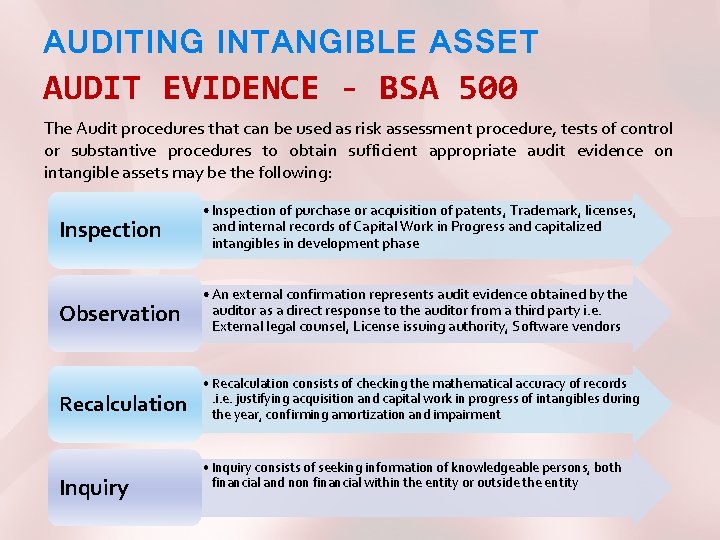
AUDITING INTANGIBLE ASSET AUDIT EVIDENCE - BSA 500 The Audit procedures that can be used as risk assessment procedure, tests of control or substantive procedures to obtain sufficient appropriate audit evidence on intangible assets may be the following: Inspection • Inspection of purchase or acquisition of patents, Trademark, licenses, and internal records of Capital Work in Progress and capitalized intangibles in development phase Observation • An external confirmation represents audit evidence obtained by the auditor as a direct response to the auditor from a third party i. e. External legal counsel, License issuing authority, Software vendors Recalculation • Recalculation consists of checking the mathematical accuracy of records. i. e. justifying acquisition and capital work in progress of intangibles during the year, confirming amortization and impairment Inquiry • Inquiry consists of seeking information of knowledgeable persons, both financial and non financial within the entity or outside the entity
IAS 38 – INTANGIBLE ASSETS OBJECTIVE AND SCOPE Objective – The objective of this Standard is to prescribe the accounting treatment for intangible assets that are not dealt with specifically in another Standard Scope – This Standard shall be applied in accounting for intangible assets, except: • intangible assets that are within the scope of another Standard; • financial assets, as defined in IAS 32 Financial Instruments: Presentation; • the recognition and measurement of exploration and evaluation assets • expenditure on the development and extraction of minerals, oil, natural gas and similar non-regenerative resources. In determining whether an asset that incorporates both intangible and tangible elements should be treated under IAS 16 - Property, Plant and Equipment. Is such case organization should use judgment regarding which element is significant. For example – Operating System (windows XP, Vista, 7) with a Computer is treated as Tangible Fixed Assets as the OS is an integral part of the Computer
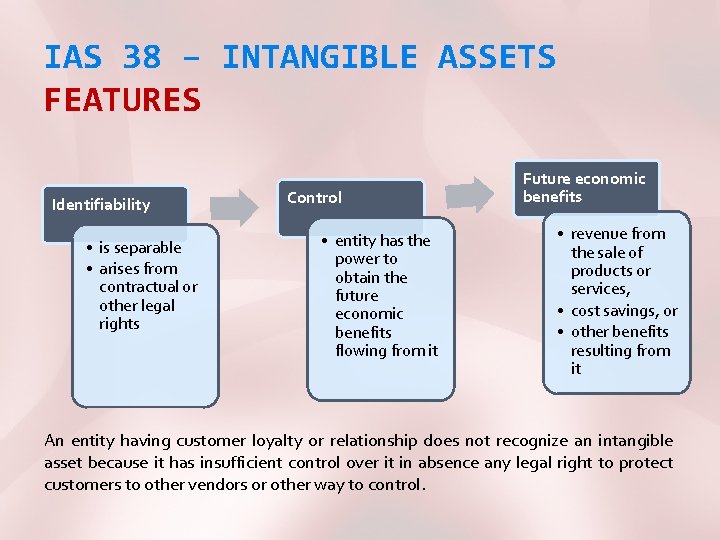
IAS 38 – INTANGIBLE ASSETS FEATURES Identifiability • is separable • arises from contractual or other legal rights Control • entity has the power to obtain the future economic benefits flowing from it Future economic benefits • revenue from the sale of products or services, • cost savings, or • other benefits resulting from it An entity having customer loyalty or relationship does not recognize an intangible asset because it has insufficient control over it in absence any legal right to protect customers to other vendors or other way to control.
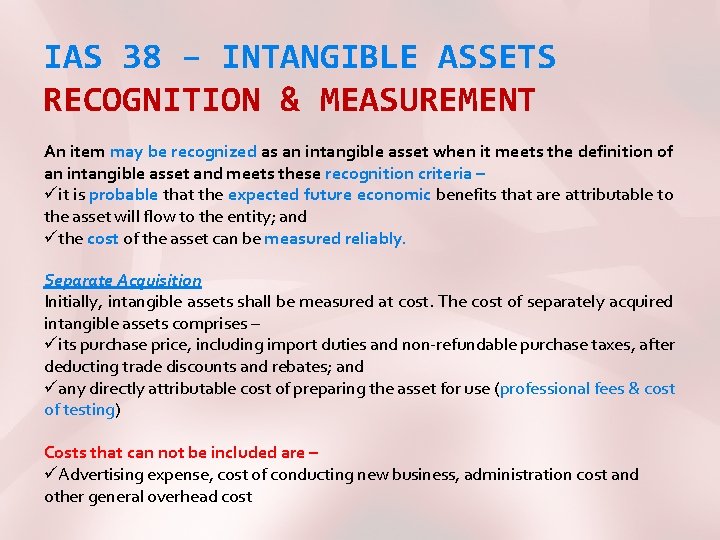
IAS 38 – INTANGIBLE ASSETS RECOGNITION & MEASUREMENT An item may be recognized as an intangible asset when it meets the definition of an intangible asset and meets these recognition criteria – üit is probable that the expected future economic benefits that are attributable to the asset will flow to the entity; and üthe cost of the asset can be measured reliably. Separate Acquisition Initially, intangible assets shall be measured at cost. The cost of separately acquired intangible assets comprises – üits purchase price, including import duties and non-refundable purchase taxes, after deducting trade discounts and rebates; and üany directly attributable cost of preparing the asset for use (professional fees & cost of testing) Costs that can not be included are – üAdvertising expense, cost of conducting new business, administration cost and other general overhead cost
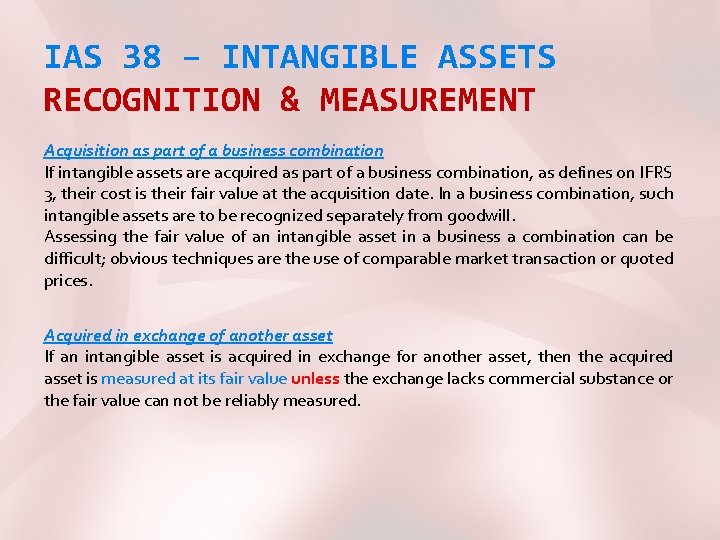
IAS 38 – INTANGIBLE ASSETS RECOGNITION & MEASUREMENT Acquisition as part of a business combination If intangible assets are acquired as part of a business combination, as defines on IFRS 3, their cost is their fair value at the acquisition date. In a business combination, such intangible assets are to be recognized separately from goodwill. Assessing the fair value of an intangible asset in a business a combination can be difficult; obvious techniques are the use of comparable market transaction or quoted prices. Acquired in exchange of another asset If an intangible asset is acquired in exchange for another asset, then the acquired asset is measured at its fair value unless the exchange lacks commercial substance or the fair value can not be reliably measured.

IAS 38 – INTANGIBLE ASSETS INTERNALLY GENERATED Goodwill Internally generated goodwill shall not be recognized as an asset because it is not an identifiable resource controlled by the entity that can be measured reliably at cost. Other Internally Generated Assets The standard sets out rules for the recognition of other internally generated intangible assets. To assess whether an internally generated intangible asset meets the criteria for recognition, an entity classifies the generation of the asset into – Research Phase If • Can not be recognized as an intangible asset. • Shall be recognized as an expense & to be written off the two phases cannot be distinguished, then the entire Development • An intangible asset arising from development shall be expenditure is classified as Research recognized if, and only if, an entity can demonstrate following Phase üthe technical feasibility of completing the intangible asset üits intention to complete the intangible asset üits ability to use or sell the intangible asset. üthe availability of adequate technical, financial and other resources to complete the development üits ability to measure reliably the expenditure attributable to the intangible asset
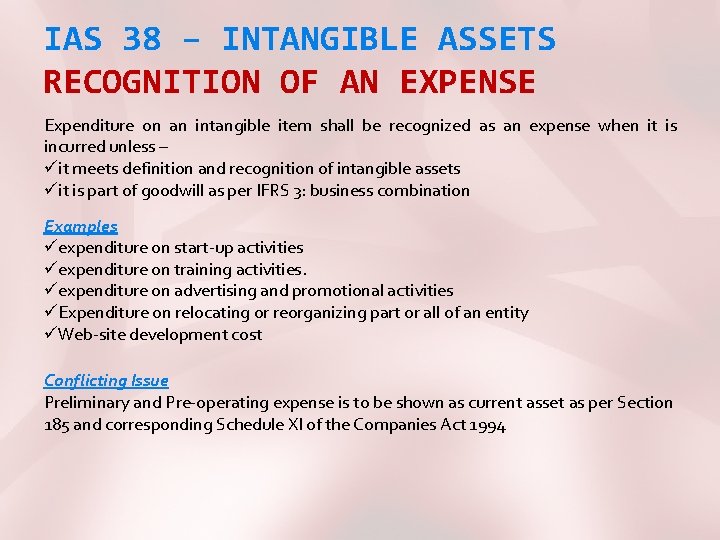
IAS 38 – INTANGIBLE ASSETS RECOGNITION OF AN EXPENSE Expenditure on an intangible item shall be recognized as an expense when it is incurred unless – üit meets definition and recognition of intangible assets üit is part of goodwill as per IFRS 3: business combination Examples üexpenditure on start-up activities üexpenditure on training activities. üexpenditure on advertising and promotional activities üExpenditure on relocating or reorganizing part or all of an entity üWeb-site development cost Conflicting Issue Preliminary and Pre-operating expense is to be shown as current asset as per Section 185 and corresponding Schedule XI of the Companies Act 1994
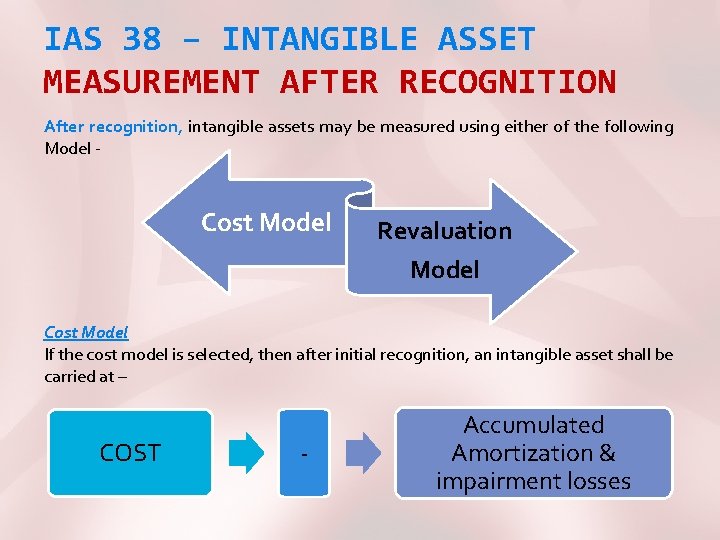
IAS 38 – INTANGIBLE ASSET MEASUREMENT AFTER RECOGNITION After recognition, intangible assets may be measured using either of the following Model - Cost Model Revaluation Model Cost Model If the cost model is selected, then after initial recognition, an intangible asset shall be carried at – COST - Accumulated Amortization & impairment losses
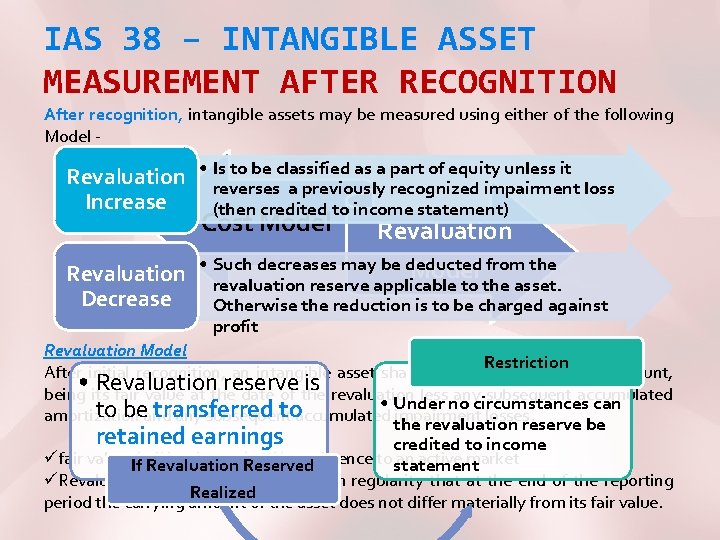
IAS 38 – INTANGIBLE ASSET MEASUREMENT AFTER RECOGNITION After recognition, intangible assets may be measured using either of the following Model - to be classified as a part of equity unless it Revaluation • Is reverses a previously recognized impairment loss Increase (then credited to income statement) Cost Model Revaluation decreases may be deducted Model from the Revaluation • Such revaluation reserve applicable to the asset. Decrease Otherwise the reduction is to be charged against profit Revaluation Model Restriction After initial recognition, an intangible asset shall be carried at a revalued amount, • Revaluation reserve is being its fair value at the date of the revaluation less any subsequent accumulated no circumstances can to beand transferred toaccumulated • Under amortization any subsequent impairment losses. the revaluation reserve be retained earnings credited to income üfair value shall be determined by reference to statement an active market If Revaluation Reserved üRevaluations shall be made with such regularity that at the end of the reporting Realized period the carrying amount of the asset does not differ materially from its fair value.
IAS 38 – INTANGIBLE ASSET MEASUREMENT AFTER RECOGNITION An entity shall assess whether the useful life of an intangible asset is finite or indefinite. Finite Life I f the assessment determines the life to be finite, then the length of life or number of units to be produced must be determined also. Indefinite Life An indefinite life may be determined when there is no foreseeable limit to the period over which the entity will continue to receive economic benefit from the asset. All relevant factors must be considered in this assessment and may include – üExpected usage by the entity üProduct life cycle üIndustry stability üLegal restrictions üLikely actions by competitors The term 'indefinite' does not mean 'infinite'.
IAS 38 – INTANGIBLE ASSET AMORTIZATION Period & Method The depreciable amount of an intangible asset with a finite useful life shall be allocated on a systematic basis over its useful life. Amortization shall begin when the asset is available for use. The amortization method used shall reflect the pattern in which the asset's future economic benefits are expected to be consumed by the entity. If that pattern cannot be determined reliably, the straight-line method shall be used. Residual Value The residual value of an intangible asset with a finite useful life shall be assumed to be zero unless: üthere is a commitment by a third party to purchase the asset after useful life üthere is an active market for the asset
IAS 38 – INTANGIBLE ASSET AMORTIZATION The amortization period and the amortization method for an intangible asset with a finite useful life shall be reviewed at least at each financial year-end. Intangible assets with indefinite useful lives are not to be amortized. However, the asset must be tested for impairment annually and whenever there is an indication that it may be impaired. Entities are to apply the provisions of IAS 36 in assessing the recoverable amount of intangible assets and when and how to determine whether an asset is impaired An intangible asset shall be derecognized – üon disposal; or üwhen no future economic benefits are expected from its use or disposal.
IAS 38 – INTANGIBLE ASSET DISCLOSURE An entity shall disclose the following for each class of intangible assets, distinguishing between internally generated intangible assets and other intangible assets – Useful Life • whether the useful lives are indefinite or finite Method • the amortization methods used for intangible assets with finite useful lives Assertion • the gross carrying amount and any accumulated amortization at the beginning and end of the period; A reconciliation of the carrying amount at the beginning and end of the period showing üAdditions, üAssets classified as held for sale, üincrease or decrease due to revaluation and impairment

If intangible assets are accounted for at revalued amounts, an entity shall disclose the following: by class of intangible assets: the effective date of the revaluation; carrying amount of revalued intangible assets; and the carrying amount that would have been recognized had the revalued class of intangible assets been measured after recognition using the cost model;
amount of the revaluation surplus that relates to intangible assets at the beginning and end of the period, indicating the changes during the period any restrictions on the distribution of the balance to shareholders; and the methods and significant assumption applied in estimating the assets' fair values.

Thank You All
- Slides: 30