
Welcome to the Science Department Hello and welcome



- Slides: 10
Welcome to the Science Department
Hello and welcome to Wrotham School Science Department. At the moment we are all learning from home and so I hope you enjoy learning about indicators, acids and alkalis with Year 7 at home too. Click on the speaker to hear from our Head of Science
Making your own Indicator • HEALTH and SAFETY • Clear a large working surface and cover with newspaper or a cloth that is easily washed • Make sure all your equipment and materials are ready to use. • I know you wont have safety goggles like you would if we were in school so I will just say – be careful not to splash anything in your face • If you spill something, wipe it up straight away • Tidy all your equipment away and wash your hands carefully after finishing
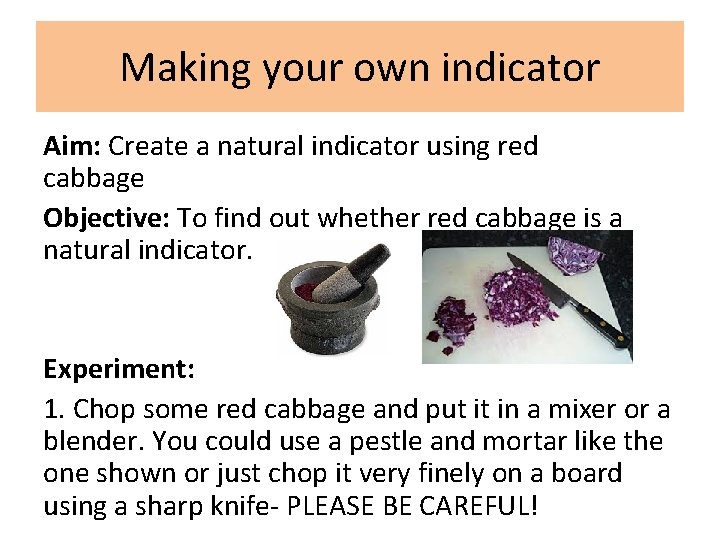
Making your own indicator Aim: Create a natural indicator using red cabbage Objective: To find out whether red cabbage is a natural indicator. Experiment: 1. Chop some red cabbage and put it in a mixer or a blender. You could use a pestle and mortar like the one shown or just chop it very finely on a board using a sharp knife- PLEASE BE CAREFUL!
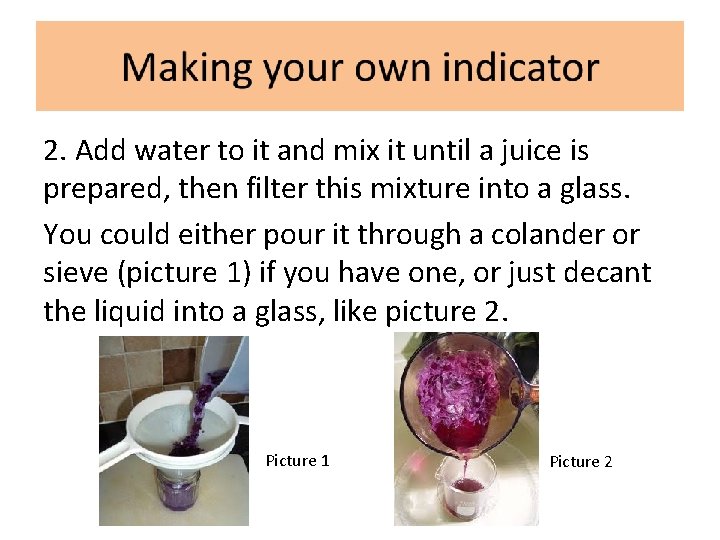
2. Add water to it and mix it until a juice is prepared, then filter this mixture into a glass. You could either pour it through a colander or sieve (picture 1) if you have one, or just decant the liquid into a glass, like picture 2. Picture 1 Picture 2
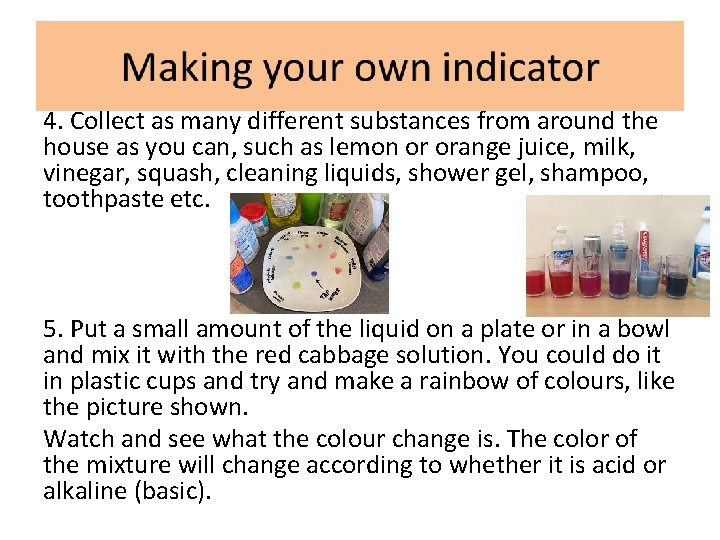
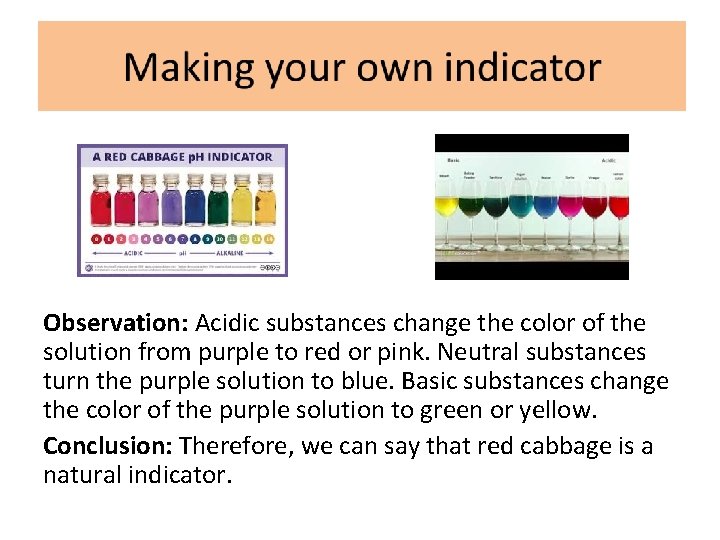
4. Collect as many different substances from around the house as you can, such as lemon or orange juice, milk, vinegar, squash, cleaning liquids, shower gel, shampoo, toothpaste etc. 5. Put a small amount of the liquid on a plate or in a bowl and mix it with the red cabbage solution. You could do it in plastic cups and try and make a rainbow of colours, like the picture shown. Watch and see what the colour change is. The color of the mixture will change according to whether it is acid or alkaline (basic).
Observation: Acidic substances change the color of the solution from purple to red or pink. Neutral substances turn the purple solution to blue. Basic substances change the color of the purple solution to green or yellow. Conclusion: Therefore, we can say that red cabbage is a natural indicator.
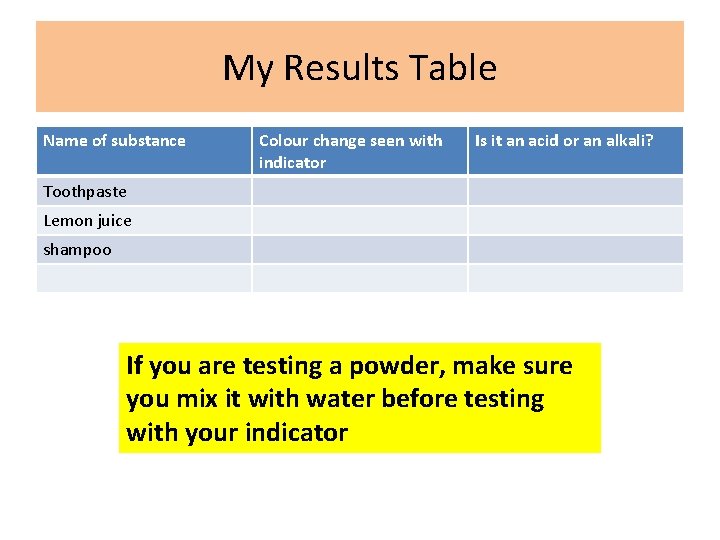
My Results Table Name of substance Colour change seen with indicator Is it an acid or an alkali? Toothpaste Lemon juice shampoo If you are testing a powder, make sure you mix it with water before testing with your indicator
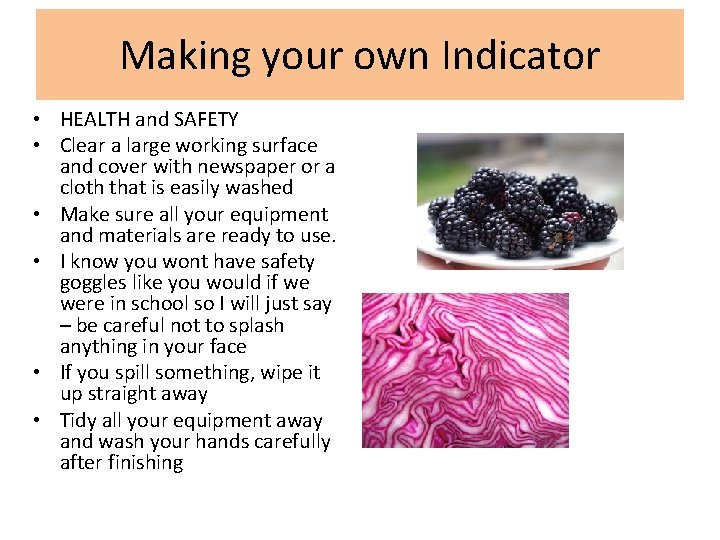
Other Indicators • Some examples of natural indicators are turmeric, grape juice, turnip skin, curry powder, cherries, beetroots, onion, tomato, blueberries or raspberries • Why not experiment with coloured leaves and petals from your garden • Pink geranium petals work well • Let us know if you find anything else that works well
Presentation of your work 1. Take a picture/video of your experiments or draw them out. 2. Use the links below to help in your explanations https: //www. bbc. co. uk/bitesize/guides/zyn 3 b 9 q/re vision/1 https: //www. bbc. co. uk/bitesize/guides/z 89 jq 6 f/rev ision/1 3. Send your work into our Head of Science Mrs Zdzylowski – the best ones may feature on our website!