
Welcome to the SC State Firefighters Associations First

- Slides: 41
Welcome to the SC State Firefighters’ Association’s First Responders’ Assistance & Support Team Behavioral Health Awareness
Discussion Points of Today’s Presentation Firefighter Life Safety Initiative Number 13 Introduction of the “Reaching Out” Program and the First Responders’ Assistance & Support Team Discussion of the Stressors in the Lives of First Responders
Firefighter Life Safety Initiative Number 13 Firefighters and their families must have access to counseling and psychological support.
“Reaching Out” HELPING OUR OWN A Program Dedicated to the Emotional Health and Well-Being of our First Responders and their Families Presented in Cooperation with the South Carolina State Firefighters’ Association, the South Carolina Fire Academy, the National Fallen Firefighters Foundation and the South Carolina Department of Mental Health. First Responder’s Assistance & Support Team F. A. S. T. (800) 277 -2732
“Reaching Out - Helping our Own” S. C. State Firefighters’ Association Overall Administration of the Program Coordination of Insurance Benefits First Responders’ Assistance & Support Team (F. A. S. T. ) Contact Number: (800) 277 -2732 South Carolina Fire Academy Coordination of Training Components Awareness Training Stress & Psychological First Aid Peer Team Training
“Reaching Out - Helping our Own” National Fallen Firefighters Foundation Development of the Training Curriculum through coordination with our Fire Academy SC Department of Mental Health Provide and train therapists to deliver clinical services Provide MHC locations for clinical support of the program
First Responders’ Assistance & Support Team F. A. S. T. Dedicated to the Emotional Health and Well-Being of our First Responders and their Families The First Responders’ Assistance and Support Team is comprised of Emergency Service personnel from all over the State of South Carolina. It is our mission to be able to provide peer support to our brothers and sisters and to assist them in receiving appropriate clinical behavioral health care in their time of need.
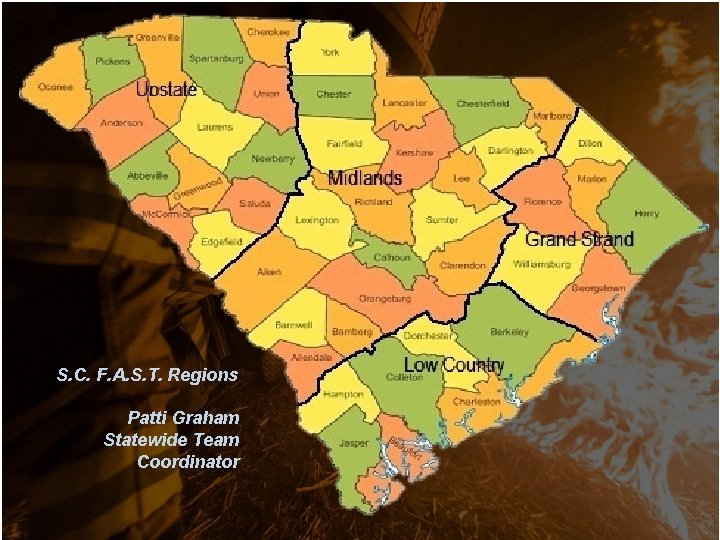
S. C. F. A. S. T. Regions Patti Graham Statewide Team Coordinator
Questions?
A Behavioral Health Awareness Program Stress in the Life of Emergency Services
A Behavioral Health Awareness Program Special thanks to Christopher B. Wells, M. Ed. Trauma Initiative Coordinator South Carolina Department of Mental Health Clinician/Peer Trainer for the Lowcountry Firefighter Support Team for his contributions to the development of this program.
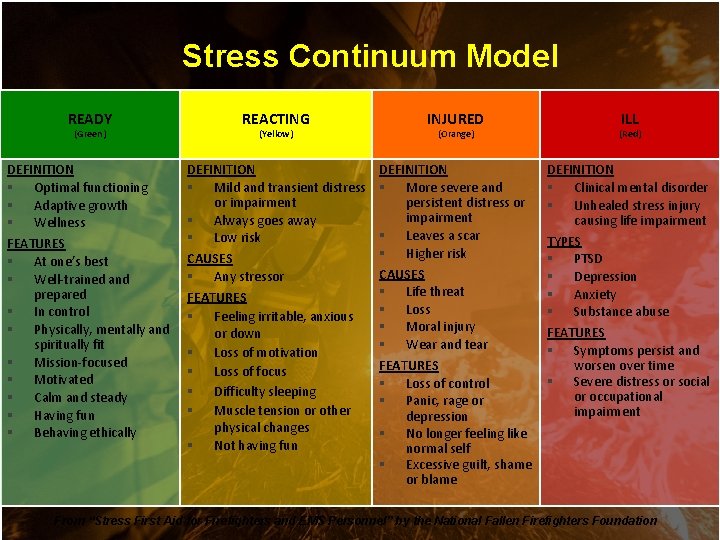
Stress Continuum Model READY REACTING INJURED (Orange) (Red) DEFINITION § Optimal functioning § Adaptive growth § Wellness FEATURES § At one’s best § Well-trained and prepared § In control § Physically, mentally and spiritually fit § Mission-focused § Motivated § Calm and steady § Having fun § Behaving ethically DEFINITION § Mild and transient distress or impairment § Always goes away § Low risk CAUSES § Any stressor FEATURES § Feeling irritable, anxious or down § Loss of motivation § Loss of focus § Difficulty sleeping § Muscle tension or other physical changes § Not having fun DEFINITION § More severe and persistent distress or impairment § Leaves a scar § Higher risk CAUSES § Life threat § Loss § Moral injury § Wear and tear FEATURES § Loss of control § Panic, rage or depression § No longer feeling like normal self § Excessive guilt, shame or blame DEFINITION § Clinical mental disorder § Unhealed stress injury causing life impairment TYPES § PTSD § Depression § Anxiety § Substance abuse FEATURES § Symptoms persist and worsen over time § Severe distress or social or occupational impairment (Green) (Yellow) ILL From “Stress First Aid for Firefighters and EMS Personnel” by the National Fallen Firefighters Foundation
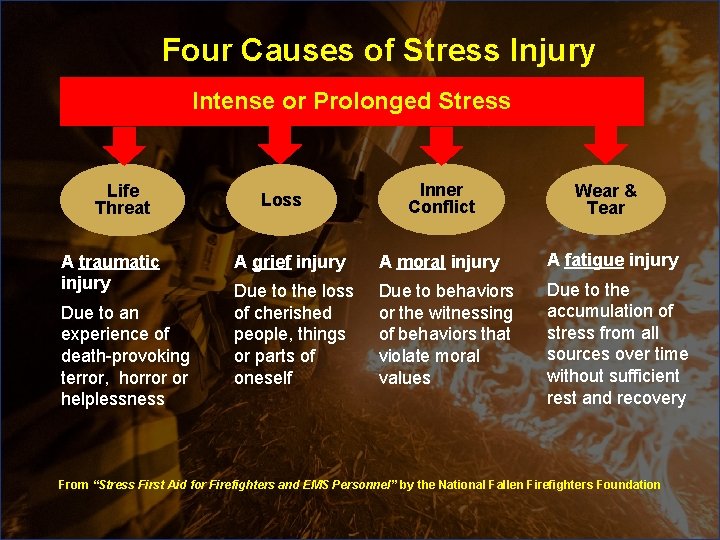
Four Causes of Stress Injury Intense or Prolonged Stress Life Threat A traumatic injury Due to an experience of death-provoking terror, horror or helplessness Loss Inner Conflict Wear & Tear A grief injury A moral injury A fatigue injury Due to the loss of cherished people, things or parts of oneself Due to behaviors or the witnessing of behaviors that violate moral values Due to the accumulation of stress from all sources over time without sufficient rest and recovery From “Stress First Aid for Firefighters and EMS Personnel” by the National Fallen Firefighters Foundation
Types of Stress • Cumulative: • Off duty Stress • On duty Stress • Potentially Traumatic Events (PTEs)
Off Duty Cumulative Stress Family and relationship issues Finances Health issues Change Loss No time for relaxation Adverse effects of attempts to cope
On Duty Cumulative Stress Departmental Issues: • • Multiple and difficult incidents Personnel conflicts Overtime or long hours Policies are not followed On Scene Issues: • Pandemonium / Chaos • Equipment failure • Family member’s reactions to loss: • “Death defying scream”
Common Effects Stress on Your Body Sleep problems Headaches Muscle tension and pain Chest pain Fatigue Stomach upset Changes in sex drive Stress Symptoms: Effects on body and behavior. - The Mayo Clinic
Common Effects of Stress on Your Mood Anxiety Restlessness Lack of Motivation or focus Feeling overwhelmed Irritability or anger Sadness or depression Stress Symptoms: Effects on body and behavior. - The Mayo Clinic
Common Effects of Stress on Your Behavior Overeating or undereating Angry outbursts Drug or alcohol abuse Tobacco use Social withdrawal Exercising less often Stress Symptoms: Effects on body and behavior. - The Mayo Clinic
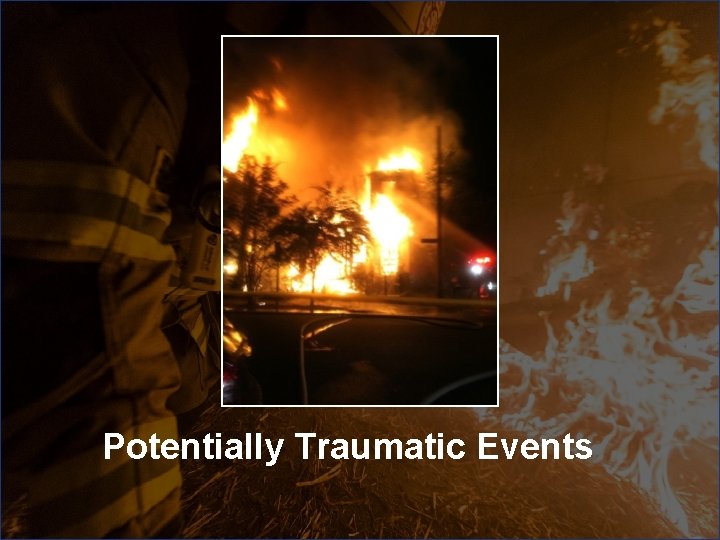
Potentially Traumatic Events
Potentially Traumatic Events (PTEs) • Differences from Civilians We are expected to have higher tolerance Those potentially more impacted when not on scene • The Big Four: Critical incident involving a child Mass casualty event Injury or death of another First Responder Threat of injury or death to yourself
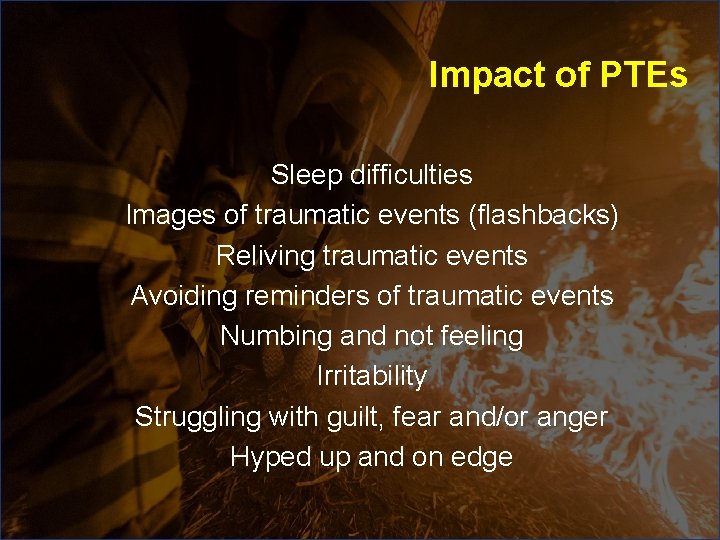
Impact of PTEs Sleep difficulties Images of traumatic events (flashbacks) Reliving traumatic events Avoiding reminders of traumatic events Numbing and not feeling Irritability Struggling with guilt, fear and/or anger Hyped up and on edge
When “The Shield” Protects Them versus Us Dark humor The Brotherhood
When “The Shield” is Shattered AM I THE ONLY ONE AFFECTED LIKE THIS? “WHAT’S WRONG WITH ME? ” RELUCTANCE TO ADMIT WHEN WE ARE AFFECTED BY PTES SYMPTOMS MAY INCREASE IN FREQUENCY AND INTENSITY OVER TIME
“I wish my mind could forget what my eyes have seen. ” Quote by Detroit Firefighter David Parnell in the documentary movie “Burn”.
Your “File Folder” • A way to think about how memories are stored • Most of your memories: • Easily opened • Memories are processed at different times • The Critical Incident Drawer • Closed tight • Memories are not processed
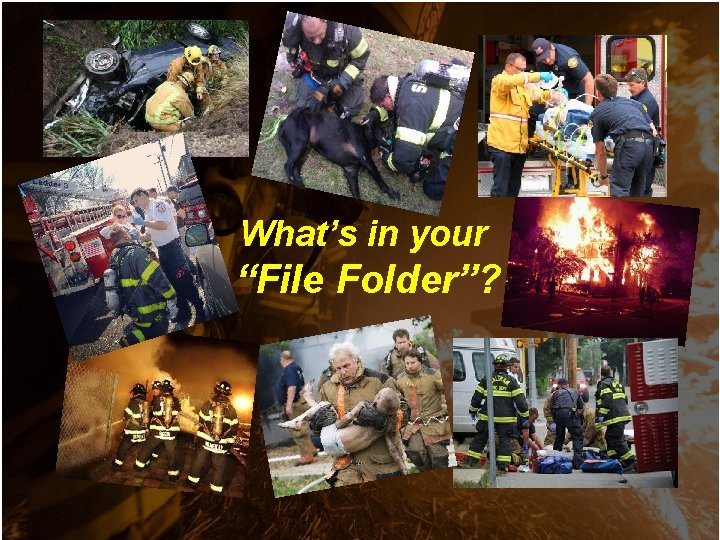
What’s in your “File Folder”?
Managing Your “File Folder” • Being aware of what might open your file • Have strategies available if file is opened • Provide yourself with opportunities to process these memories
So, What Can We Do?
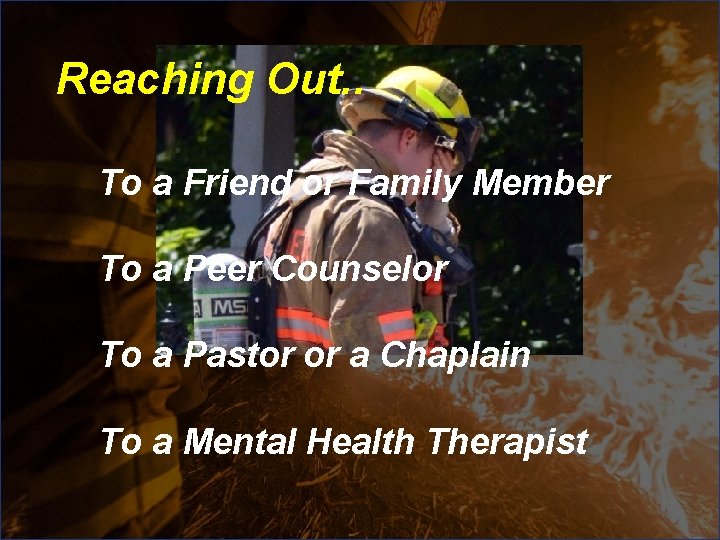
Reaching Out. . To a Friend or Family Member To a Peer Counselor To a Pastor or a Chaplain To a Mental Health Therapist
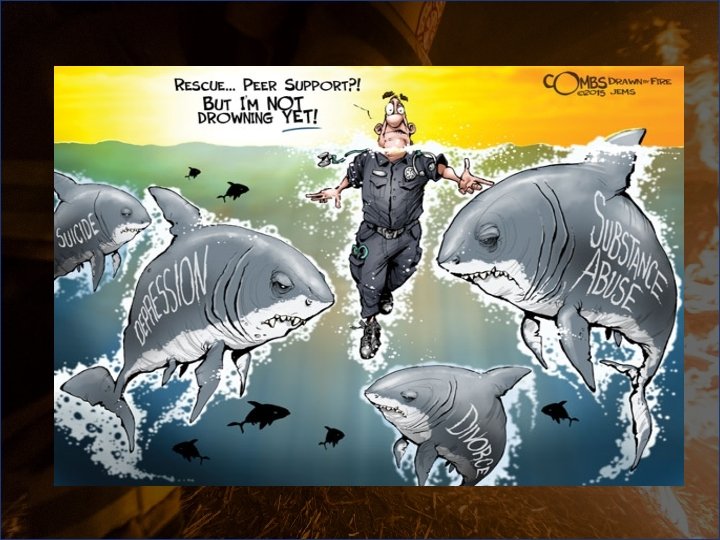
Resistance to Reaching Out Afraid the word will get out Others seem to be handling this by themselves and so “maybe I should too? ” The “Suck It Up” culture of the department discourages it.
Reaching out to a Friend/Family Member Finding a Listener / Being a Listener; Familiar with your situation; Describe what you need from the conversation; “Just being there”
Reaching Out to a Peer Counselor Someone who can… relate to what you are going through understands your situation You need to know… what you tell them stays with them
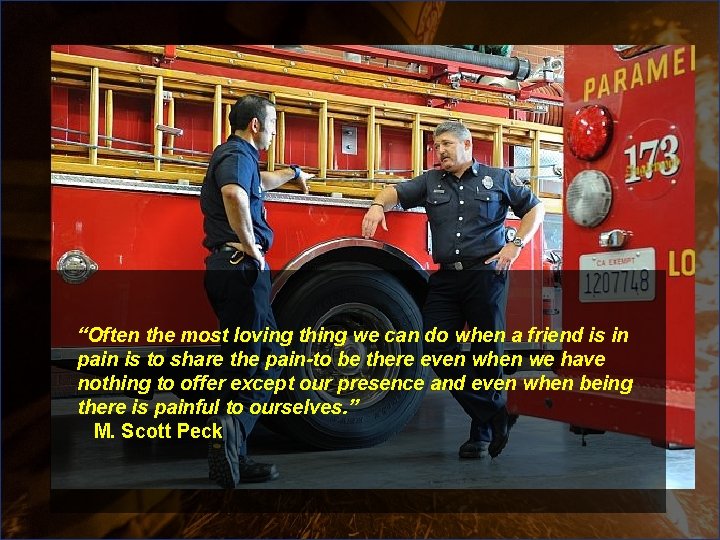
“Often the most loving thing we can do when a friend is in pain is to share the pain-to be there even when we have nothing to offer except our presence and even when being there is painful to ourselves. ” M. Scott Peck
Reaching Out to Clergy or a Chaplain Trusted individual Familiar influence Many organizations have strong chaplain programs “Cultural comfort”
Reaching Out to a Mental Health Therapist Opportunity to open up and process file folders Receive reflection and guidance Assistance in implementing effective coping techniques Specific treatments for PTSD Referral for medication if needed
Taking Care of Each Other Talking about incidents Express concerns assertively Offer to walk with individual through the process
REMEMBER! • Regardless of what role you are filing, don’t forget: “People don’t want to be fixed, they want to be heard”
“Reaching Out” HELPING OUR OWN A Program Dedicated to the Emotional Health and Well-Being of our First Responders and their Families Presented in Cooperation with the South Carolina State Firefighters’ Association, the South Carolina Fire Academy, the National Fallen Firefighters Foundation and the South Carolina Department of Mental Health. First Responder’s Assistance & Support Team F. A. S. T. (800) 277 -2732