
Welcome to the RA SAS Chain of Custody







- Slides: 55
Welcome to the RA SAS Chain of Custody course Co. C Standard Exercises Date | Location | Details
Introduction This module contains different exercises for the application of the concepts and requirements of the Co. C System as well as for the application of certain useful skills for carrying out quality audits. The exercises may be used individually or in a group. Some exercises have several correct answers, mainly for case studies or when it is necessary to design or plan something.
Exercises
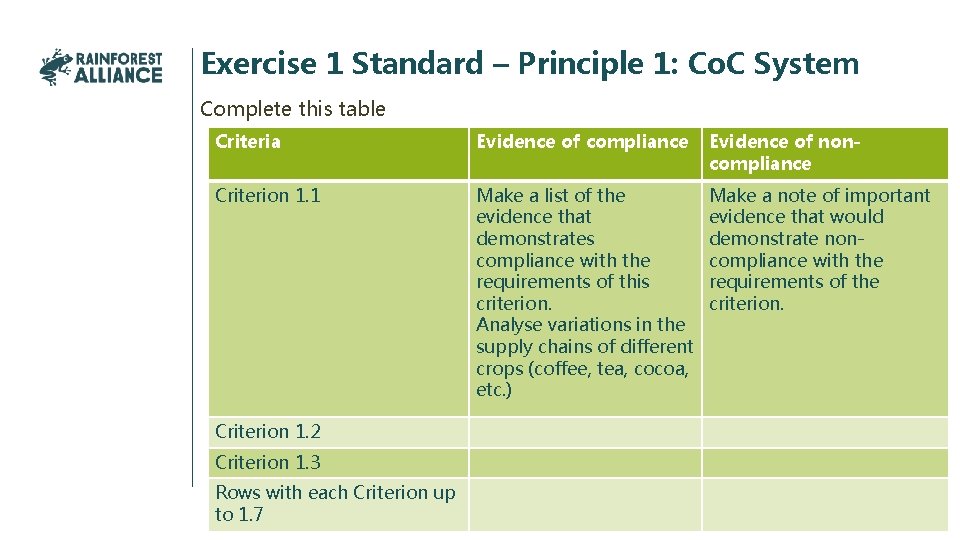
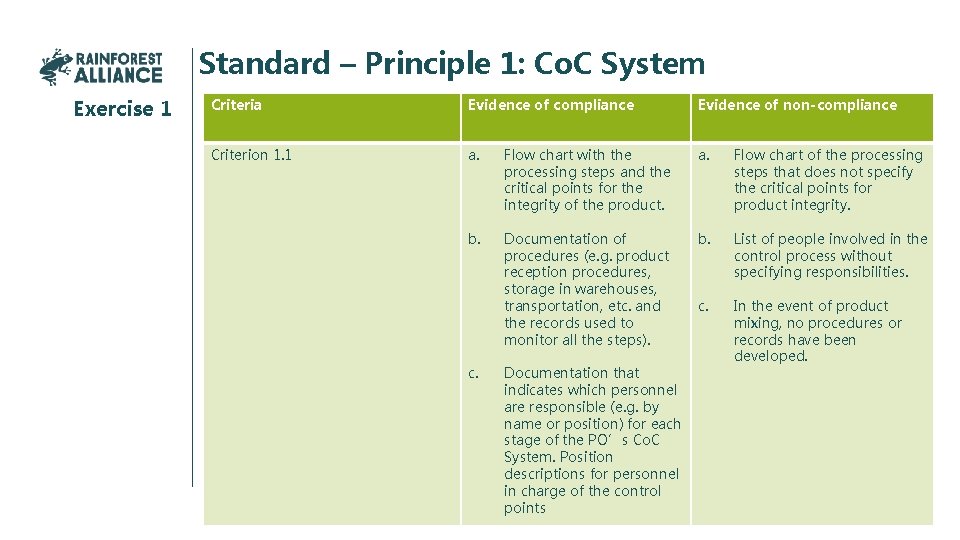
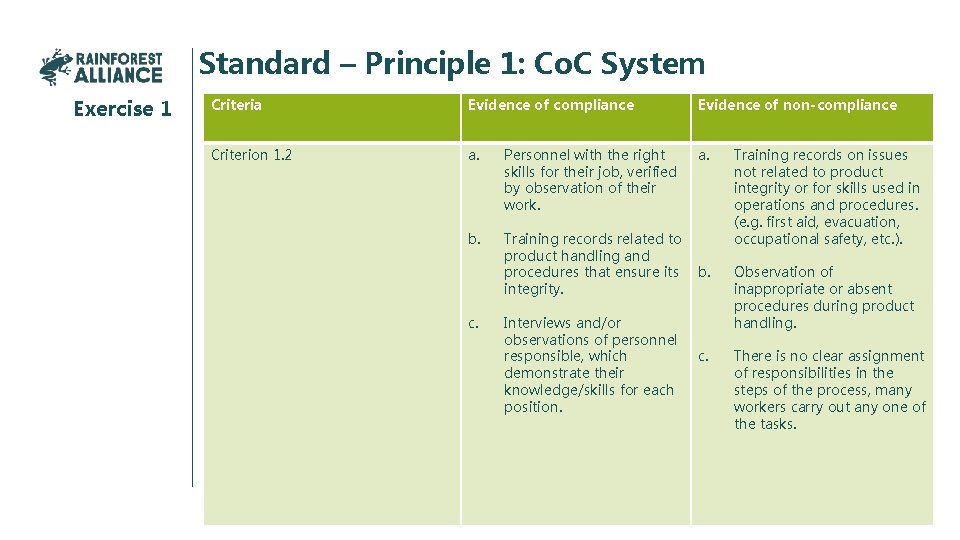
Standard – Principle 1: Co. C System Criteria: Key evidence Exercise 1 This practice helps to analyse the requirements of each criterion and the evidence and findings for the different scenarios encountered by auditors. Recommendations: § Can be done as a group or individually § May be applied in different supply chains to analyse possible variations and challenges
Exercise 1 Standard – Principle 1: Co. C System Instructions: 1. Complete the table in the next slide with evidence that demonstrates compliance with the requirements and some key evidence that would demonstrate non-compliance with them. 2. You may add a column with “evaluation challenges”. 3. Share and analyse the results in a group. Contrast the answers with the information contained in the technical module and the answer section at the end of this module.
Exercise 1 Standard – Principle 1: Co. C System Complete this table Criteria Evidence of compliance Evidence of noncompliance Criterion 1. 1 Make a list of the evidence that demonstrates compliance with the requirements of this criterion. Analyse variations in the supply chains of different crops (coffee, tea, cocoa, etc. ) Make a note of important evidence that would demonstrate noncompliance with the requirements of the criterion. Criterion 1. 2 Criterion 1. 3 Rows with each Criterion up to 1. 7
Standard – Principle 1: Co. C System Exercise 2 Identify a farm that you know well, which receives and processes certified and non-certified product (flowers, coffee, tea, banana, pineapple, single farm, group administrator, cooperative, etc. ). That farm is the basis for carrying out the following exercise.
Standard – Principle 1: Co. C System Criteria: Key evidence Exercise 2 This exercise helps you organise and optimise the evaluation of the criteria. Instructions § Carry out the required activity in a group or individually. § Share and compare results. You will find some correct options in the answer section.
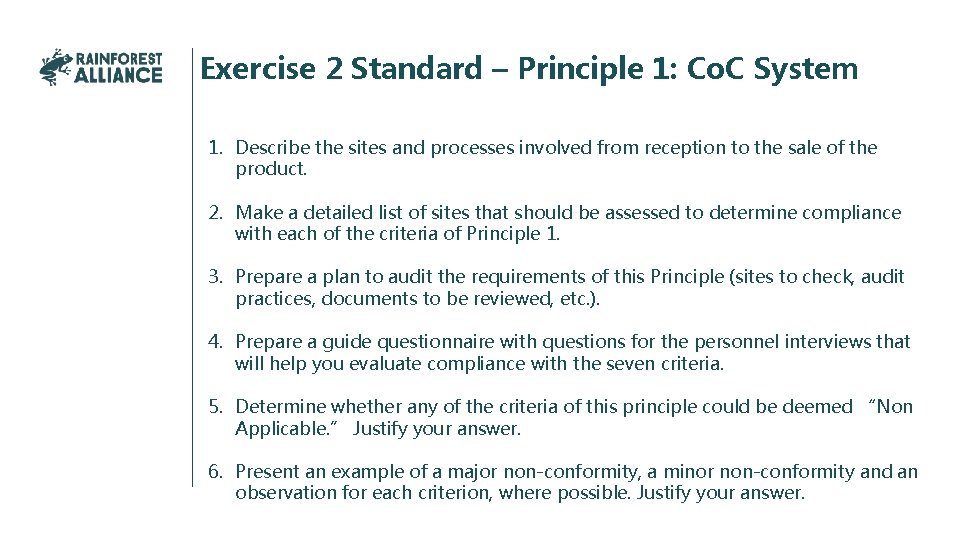
Exercise 2 Standard – Principle 1: Co. C System 1. Describe the sites and processes involved from reception to the sale of the product. 2. Make a detailed list of sites that should be assessed to determine compliance with each of the criteria of Principle 1. 3. Prepare a plan to audit the requirements of this Principle (sites to check, audit practices, documents to be reviewed, etc. ). 4. Prepare a guide questionnaire with questions for the personnel interviews that will help you evaluate compliance with the seven criteria. 5. Determine whether any of the criteria of this principle could be deemed “Non Applicable. ” Justify your answer. 6. Present an example of a major non-conformity, a minor non-conformity and an observation for each criterion, where possible. Justify your answer.
Exercise 2 &3 Standard Principle 1: Co. C System Principle 2: Traceability System Exercise 2 & 3 Apply the previous exercise to a scenario involving a processing or marketing operation. Instructions In groups or individually, carry out the required activity. Share and compare results. You can see some correct options in the answer section.
Standard Exercise 2 & 3 Identify a processing plant or marketing operation that you know well, where certified and non-certified products are received and processed (flower, banana or pineapple packing plant, tea marketing cooperative, coffee processing plant, etc. ). That operation is the basis for carrying out this exercise:
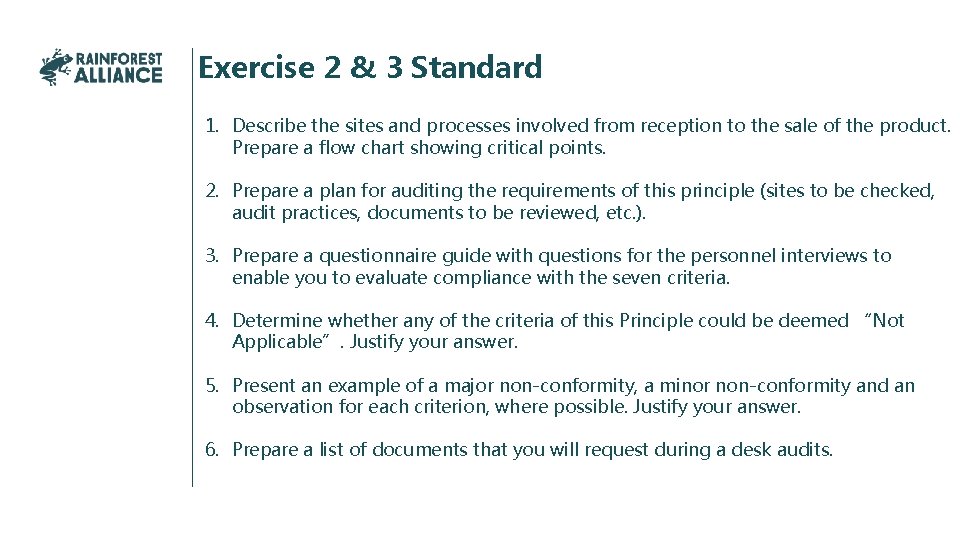
Exercise 2 & 3 Standard 1. Describe the sites and processes involved from reception to the sale of the product. Prepare a flow chart showing critical points. 2. Prepare a plan for auditing the requirements of this principle (sites to be checked, audit practices, documents to be reviewed, etc. ). 3. Prepare a questionnaire guide with questions for the personnel interviews to enable you to evaluate compliance with the seven criteria. 4. Determine whether any of the criteria of this Principle could be deemed “Not Applicable”. Justify your answer. 5. Present an example of a major non-conformity, a minor non-conformity and an observation for each criterion, where possible. Justify your answer. 6. Prepare a list of documents that you will request during a desk audits.
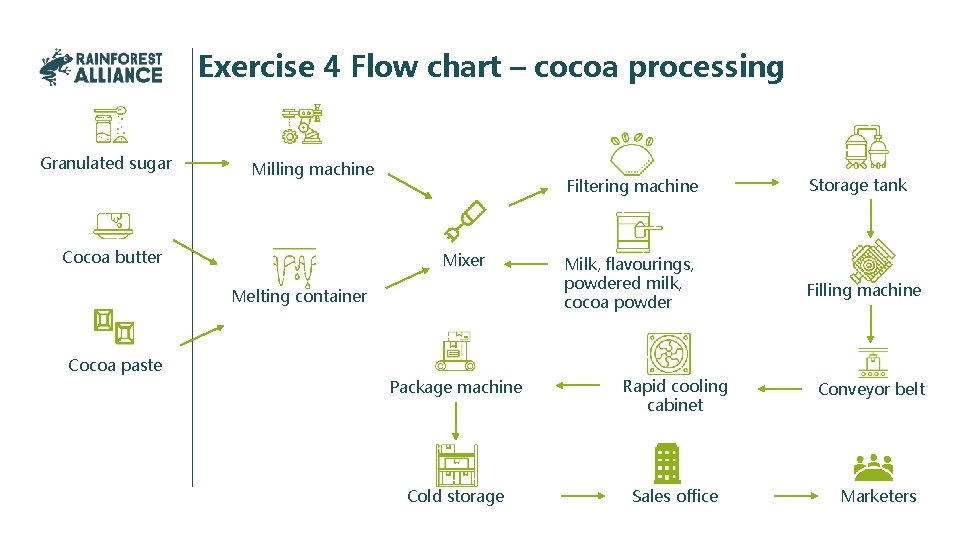
Flow chart – cocoa processing Exercise 4 Refer to the flow chart for a cocoa processing plant that produces chocolate bars in the next slide. The plant processes certified and non-certified cocoa butter and cocoa paste and the end product is chocolate bars with 70% certified cocoa.
Exercise 4 Flow chart – cocoa processing Granulated sugar Milling machine Cocoa butter Mixer Melting container Filtering machine Storage tank Milk, flavourings, powdered milk, cocoa powder Filling machine Cocoa paste Package machine Rapid cooling cabinet Cold storage Sales office Conveyor belt Marketers
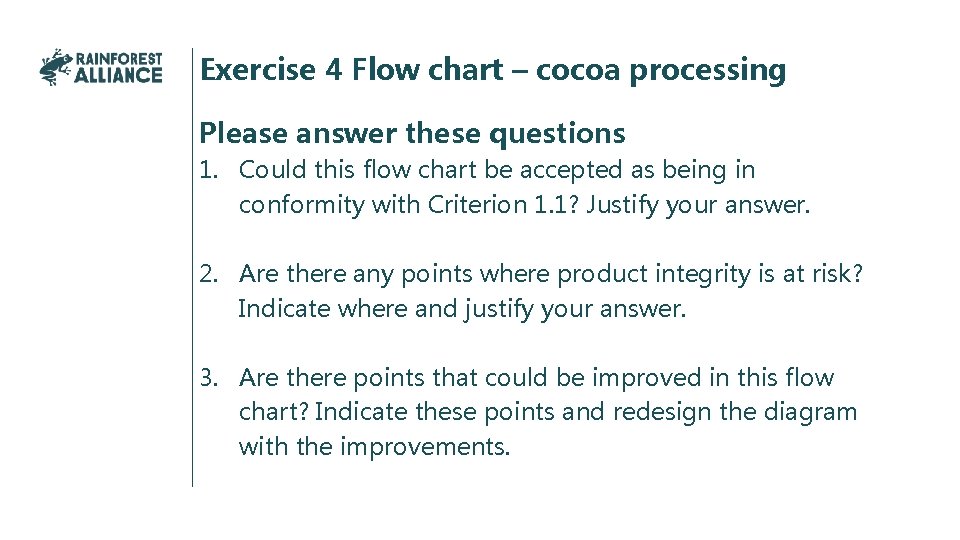
Exercise 4 Flow chart – cocoa processing Please answer these questions 1. Could this flow chart be accepted as being in conformity with Criterion 1. 1? Justify your answer. 2. Are there any points where product integrity is at risk? Indicate where and justify your answer. 3. Are there points that could be improved in this flow chart? Indicate these points and redesign the diagram with the improvements.
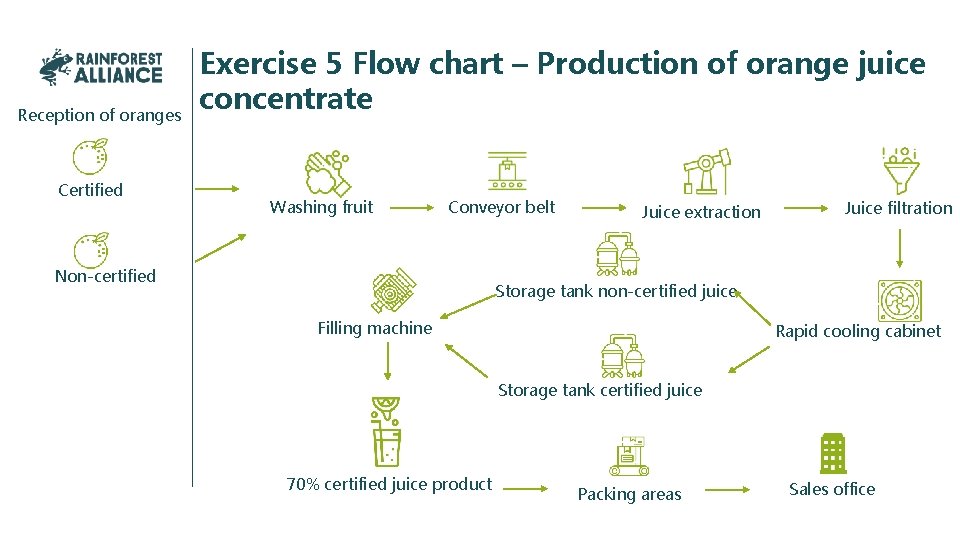
Flow chart – Production of orange juice concentrate Exercise 5 In a plant that produces orange juice concentrate, oranges from certified and non-certified farms are processed. The final product is orange juice containing 70% certified juice. The flow chart is presented in the next slide.
Reception of oranges Certified Exercise 5 Flow chart – Production of orange juice concentrate Washing fruit Conveyor belt Non-certified Juice extraction Juice filtration Storage tank non-certified juice Filling machine Rapid cooling cabinet Storage tank certified juice 70% certified juice product Packing areas Sales office
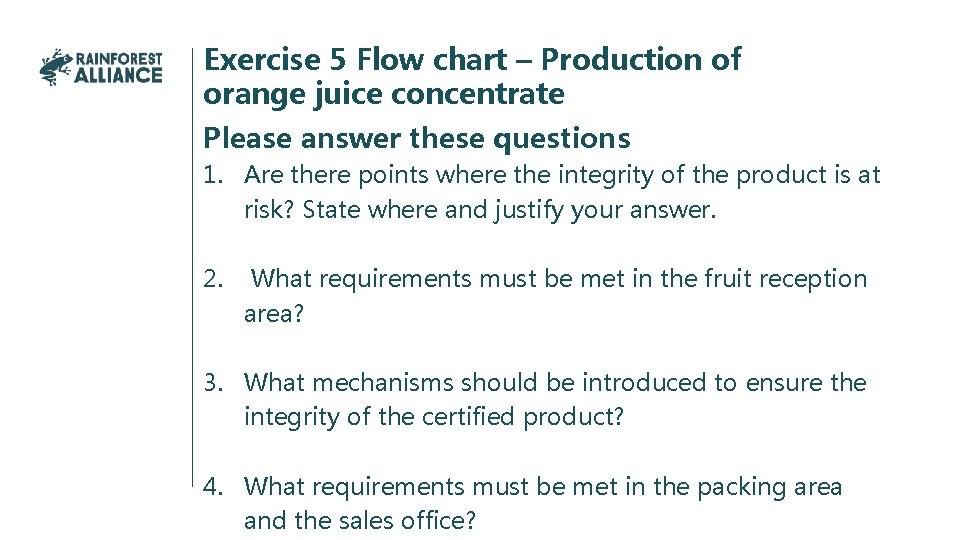
Exercise 5 Flow chart – Production of orange juice concentrate Please answer these questions 1. Are there points where the integrity of the product is at risk? State where and justify your answer. 2. What requirements must be met in the fruit reception area? 3. What mechanisms should be introduced to ensure the integrity of the certified product? 4. What requirements must be met in the packing area and the sales office?
Principle 2 Traceability Criteria: Key evidence Exercise 6 This exercise helps with: • Selecting the best audit techniques to find evidence for each criterion; • Analysing the evidence of conformity and nonconformity for each criterion. Recommendations: This practice exercise can be done as a group or individually. It may be applied to different supply chains analyse possible variations and challenges.
Exercise 6 Principle 2 Traceability Instructions For each criterion in the traceability section, complete the table in the next slide with: 1. Appropriate audit techniques to find evidence for each criterion 2. Evidence that would demonstrate conformity with the requirements 3. Evidence that would demonstrate non-conformity with the requirements 4. Share and analyse the results in a group. Compare the answers with the information in the technical module and the answer section at the end of this document.
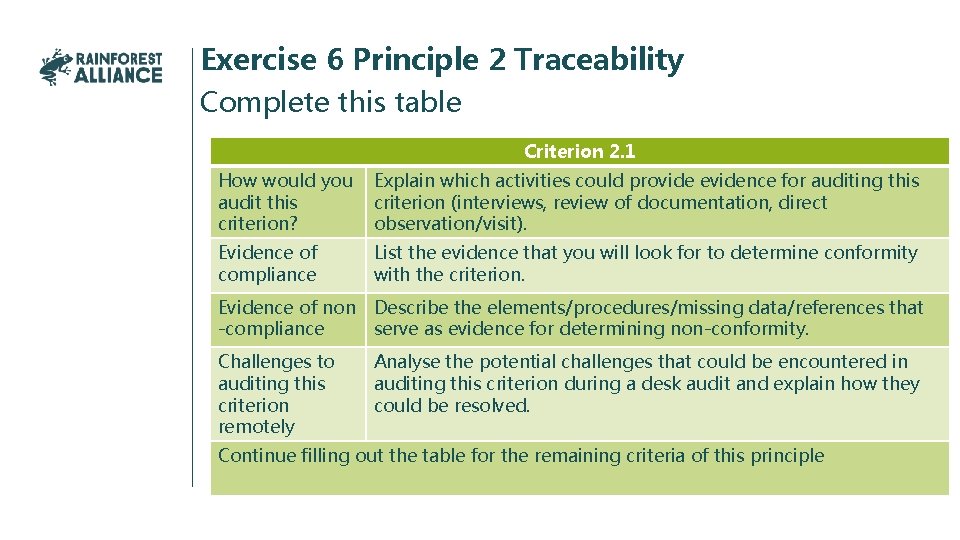
Exercise 6 Principle 2 Traceability Complete this table Criterion 2. 1 How would you audit this criterion? Explain which activities could provide evidence for auditing this criterion (interviews, review of documentation, direct observation/visit). Evidence of compliance List the evidence that you will look for to determine conformity with the criterion. Evidence of non Describe the elements/procedures/missing data/references that -compliance serve as evidence for determining non-conformity. Challenges to auditing this criterion remotely Analyse the potential challenges that could be encountered in auditing this criterion during a desk audit and explain how they could be resolved. Continue filling out the table for the remaining criteria of this principle
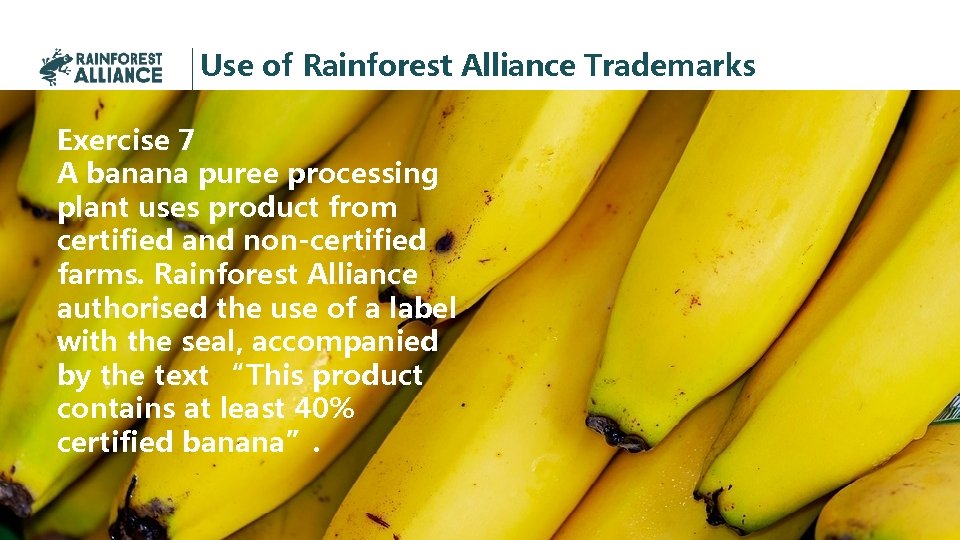
Use of Rainforest Alliance Trademarks Exercise 7 A banana puree processing plant uses product from certified and non-certified farms. Rainforest Alliance authorised the use of a label with the seal, accompanied by the text “This product contains at least 40% certified banana”.
Exercise 7 Use of Rainforest Alliance Trademarks The process 1. Reception: The product is weighed and the origin of each load of fruit is verified. 2. The product in each container is classified based on its ripeness and origin status (certified/non-certified farm). 3. Warehousing: There are three warehouses for storing the fruit according to its degree of ripeness; inside these warehouses, there is a storage area for certified bananas and another for conventional bananas. 4. After the ripe bananas have been cleaned, the process of preparing the puree begins. From this point on, bananas of different origins are mixed.
Exercise 7 Use of Rainforest Alliance Trademarks The process 5. Each banana is peeled by hand then sent to a machine that purees it and extracts the seeds. 6. The puree passes to another machine where it undergoes homogenization. 7. Finally, the product is packed in 100 ml glass jars and labelled. All the labels are identical and indicate that at least 40% of the bananas used to prepare the product come from certified farms. 8. The glass jars are stored in boxes that remain in the last warehouse until they are dispatched in trucks.
Exercise 7 Use of Rainforest Alliance Trademarks What you need to do Part I 1. Prepare a flow chart with the steps of the process and indicate which points may be considered critical for the integrity of the product. 2. What should you check in the process to ensure compliance with the authorised use of the seal? 3. What questions should you ask to confirm that the Rainforest Alliance seals are being used correctly?
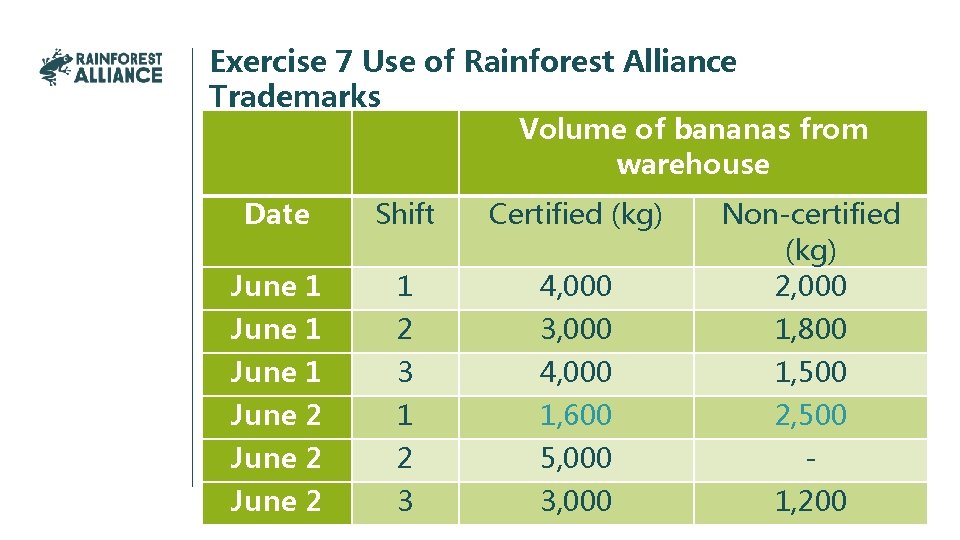
Exercise 7 Use of Rainforest Alliance Trademarks What you need to do Part II This processing plant works three shifts. Each one produces a batch of different size, prepared using certified and noncertified fruit. The table in the next slide shows how much certified product and non-certified product was used to prepare each batch by each shift on the different dates. Indicate whether the content of certified product present in each batch complies with the specific claim made on the label, as authorised by Rainforest Alliance.
Exercise 7 Use of Rainforest Alliance Trademarks Volume of bananas from warehouse Date Shift Certified (kg) June 1 1 4, 000 Non-certified (kg) 2, 000 June 1 2 3, 000 1, 800 June 1 3 4, 000 1, 500 June 2 1 1, 600 2, 500 June 2 2 5, 000 - June 2 3 3, 000 1, 200
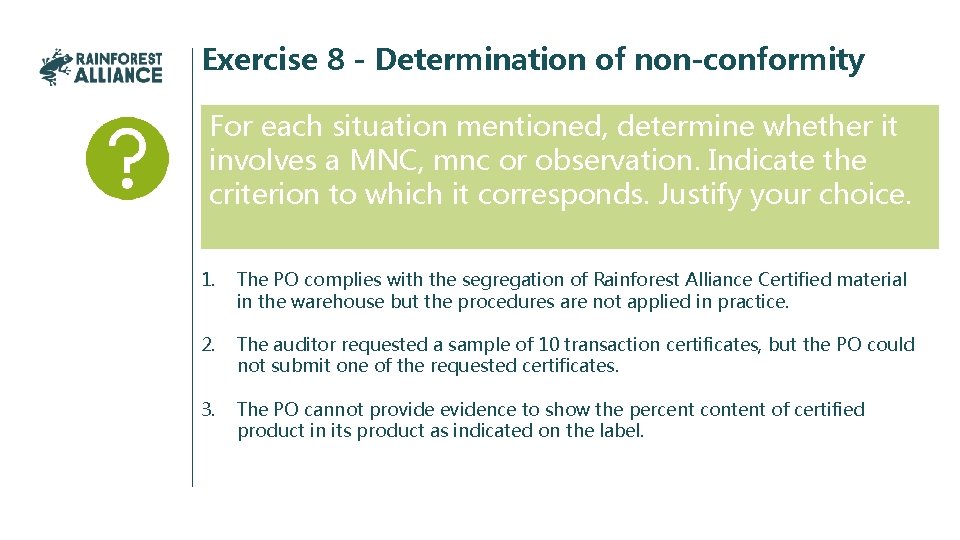
Exercise 8 - Determination of non-conformity For each situation mentioned, determine whether it involves a MNC, mnc or observation. Indicate the criterion to which it corresponds. Justify your choice. 1. The PO complies with the segregation of Rainforest Alliance Certified material in the warehouse but the procedures are not applied in practice. 2. The auditor requested a sample of 10 transaction certificates, but the PO could not submit one of the requested certificates. 3. The PO cannot provide evidence to show the percent content of certified product in its product as indicated on the label.
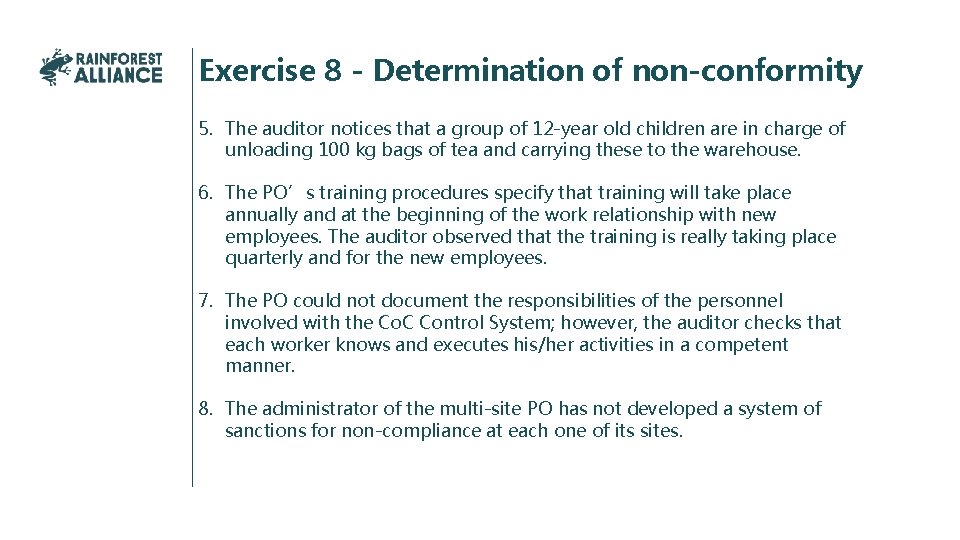
Exercise 8 - Determination of non-conformity 5. The auditor notices that a group of 12 -year old children are in charge of unloading 100 kg bags of tea and carrying these to the warehouse. 6. The PO’s training procedures specify that training will take place annually and at the beginning of the work relationship with new employees. The auditor observed that the training is really taking place quarterly and for the new employees. 7. The PO could not document the responsibilities of the personnel involved with the Co. C Control System; however, the auditor checks that each worker knows and executes his/her activities in a competent manner. 8. The administrator of the multi-site PO has not developed a system of sanctions for non-compliance at each one of its sites.
Certification audit in a tea cooperative in Rwanda Exercise 9 A tea cooperative in Rwanda is made up of 350 producers. Only 125 of them are in a project to produce tea that will be sold with the Rainforest Alliance Certified seal.
Certification audit in a tea cooperative in Rwanda Situation The product is picked in the producers’ small plots and amassed first in the “kitchen gardens” at the home of each producer. These gardens are managed by the women of the family. The producers tend to combine the tea that they harvest. In the field, the product is separated using marks or trunks to determine who owns the production; in the end, it resembles a giant tea field. These batches of tea are managed by the cooperative and the producer pays for picking services and transportation to the processing plant. In the processing plant, batches from certified and non-certified parcels are received and properly identified according to their type. Each batch then undergoes natural withering through exposure to partial shade in the plant’s yards. There, the batch is fermented, dried and bagged for delivery to the wholesaler. Throughout this process, the batches are identified and remain separated.
Certification audit in a tea cooperative in Rwanda You are conducting the first certification audit for the cooperative. Using your skills as an auditor: 1. List the different types of records related to the Co. C Control System that the PO should have in its files and available for inspection. 2. What information should you look for in the Control System records and how will you use it to verify compliance with the standards? 3. What information should you check to know whether the cooperative is complying with the requirements for traceability and integrity of the certified product? 4. Which facilities of the cooperative and the farm will you visit? How do you verify that product integrity is being protected in each one? 5. The certified and non-certified tea should be identifiable from the tea fields to its sale. Describe the characteristics that the product identification systems should have in order to comply with the requirements of the standards. Analyze the situation in the production area, tea gardens, fields where the tea is accumulated, transportation and processing plant.
Interviews at the tea cooperative in Rwanda Exercise 10 You should organise the interviews to be conducted as part of the certification audit. 1. In what situations do you use an interview as a source of information? 2. How do you determine the size and composition of the sample of interviewees? 3. Which people should be interviewed to check that the product’s integrity is protected from its cultivation until its sale? Write a list of people to be interviewed and two key questions that you would ask each one. 4. How do you know whether the cooperative has planned what to do in the event of an unintentional mixing of certified and conventional product?
Answers
Standard – Principle 1: Co. C System Exercise 1 Criteria Evidence of compliance Evidence of non-compliance Criterion 1. 1 a. Flow chart with the processing steps and the critical points for the integrity of the product. a. Flow chart of the processing steps that does not specify the critical points for product integrity. b. Documentation of procedures (e. g. product reception procedures, storage in warehouses, transportation, etc. and the records used to monitor all the steps). b. List of people involved in the control process without specifying responsibilities. c. In the event of product mixing, no procedures or records have been developed. c. Documentation that indicates which personnel are responsible (e. g. by name or position) for each stage of the PO’s Co. C System. Position descriptions for personnel in charge of the control points
Standard – Principle 1: Co. C System Exercise 1 Criteria Evidence of compliance Evidence of non-compliance Criterion 1. 2 a. Personnel with the right skills for their job, verified by observation of their work. a. b. Training records related to product handling and procedures that ensure its integrity. Training records on issues not related to product integrity or for skills used in operations and procedures. (e. g. first aid, evacuation, occupational safety, etc. ). b. Observation of inappropriate or absent procedures during product handling. c. There is no clear assignment of responsibilities in the steps of the process, many workers carry out any one of the tasks. c. Interviews and/or observations of personnel responsible, which demonstrate their knowledge/skills for each position.
Co. C Farm Audit Exercise 2 The farm selected in this case is a coffee farm that uses wet mill processing. Please see next slide for answers.
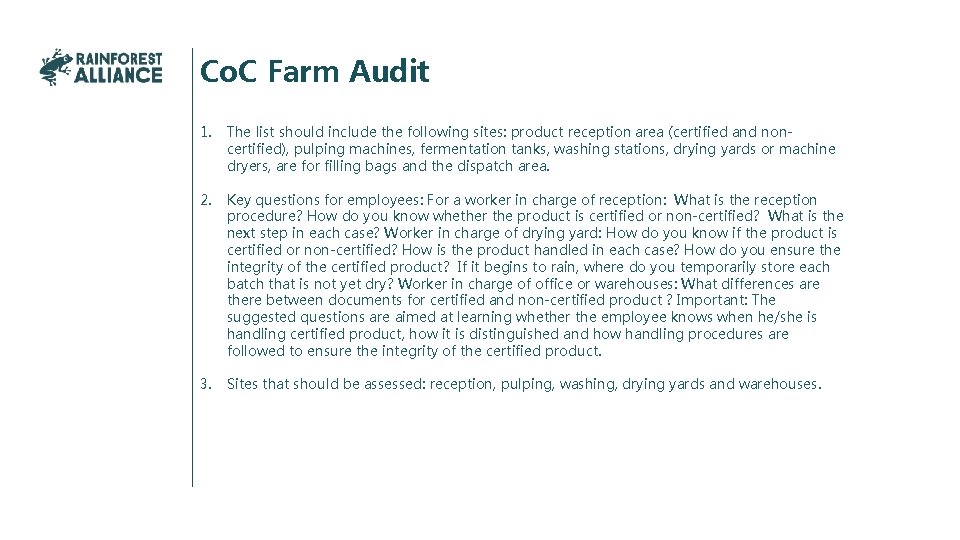
Co. C Farm Audit 1. The list should include the following sites: product reception area (certified and noncertified), pulping machines, fermentation tanks, washing stations, drying yards or machine dryers, are for filling bags and the dispatch area. 2. Key questions for employees: For a worker in charge of reception: What is the reception procedure? How do you know whether the product is certified or non-certified? What is the next step in each case? Worker in charge of drying yard: How do you know if the product is certified or non-certified? How is the product handled in each case? How do you ensure the integrity of the certified product? If it begins to rain, where do you temporarily store each batch that is not yet dry? Worker in charge of office or warehouses: What differences are there between documents for certified and non-certified product ? Important: The suggested questions are aimed at learning whether the employee knows when he/she is handling certified product, how it is distinguished and how handling procedures are followed to ensure the integrity of the certified product. 3. Sites that should be assessed: reception, pulping, washing, drying yards and warehouses.
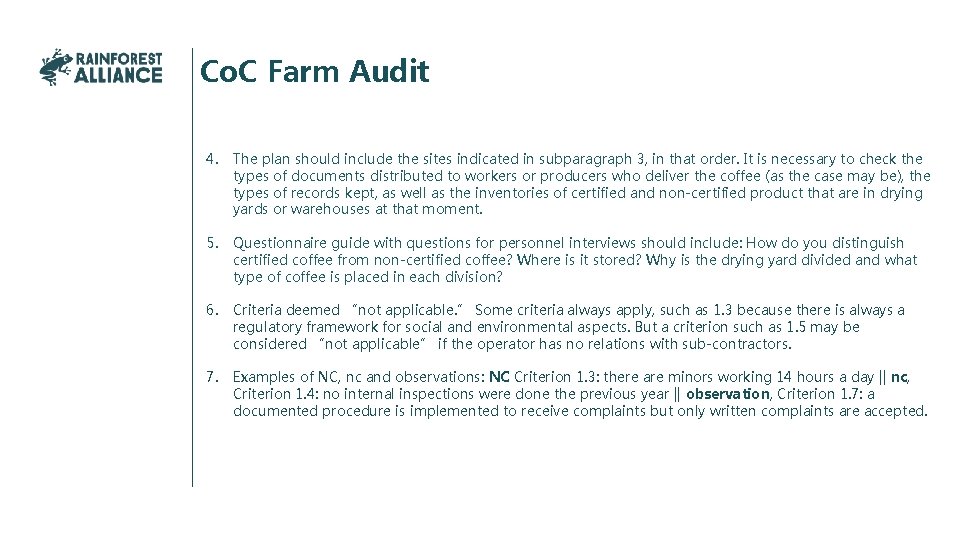
Co. C Farm Audit 4. The plan should include the sites indicated in subparagraph 3, in that order. It is necessary to check the types of documents distributed to workers or producers who deliver the coffee (as the case may be), the types of records kept, as well as the inventories of certified and non-certified product that are in drying yards or warehouses at that moment. 5. Questionnaire guide with questions for personnel interviews should include: How do you distinguish certified coffee from non-certified coffee? Where is it stored? Why is the drying yard divided and what type of coffee is placed in each division? 6. Criteria deemed “not applicable. ” Some criteria always apply, such as 1. 3 because there is always a regulatory framework for social and environmental aspects. But a criterion such as 1. 5 may be considered “not applicable” if the operator has no relations with sub-contractors. 7. Examples of NC, nc and observations: NC Criterion 1. 3: there are minors working 14 hours a day || nc, Criterion 1. 4: no internal inspections were done the previous year || observation, Criterion 1. 7: a documented procedure is implemented to receive complaints but only written complaints are accepted.
Co. C Farm Audit Exercise 3 Answer Processing plant or marketing facility audit This exercise is the same as the previous one (Exercise 2) except that it is based on a processing or marketing operation. You can use the answers from the previous exercise as reference and adapt them to the chosen scenario.
Flow chart – cocoa processing Exercise 4 Answers in the next slide
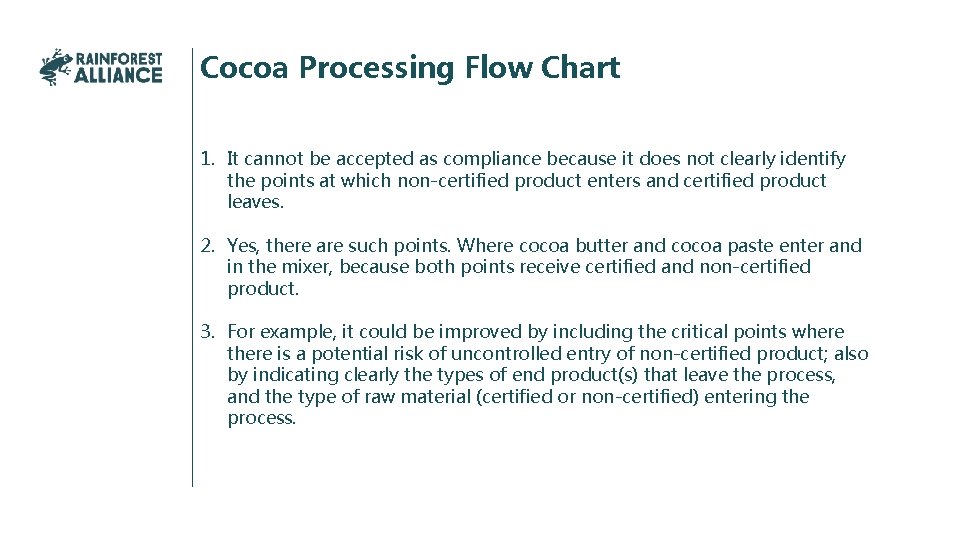
Cocoa Processing Flow Chart 1. It cannot be accepted as compliance because it does not clearly identify the points at which non-certified product enters and certified product leaves. 2. Yes, there are such points. Where cocoa butter and cocoa paste enter and in the mixer, because both points receive certified and non-certified product. 3. For example, it could be improved by including the critical points where there is a potential risk of uncontrolled entry of non-certified product; also by indicating clearly the types of end product(s) that leave the process, and the type of raw material (certified or non-certified) entering the process.
Orange Juice Processing Plant Flow Chart Exercise 5 Answers in the next slide.
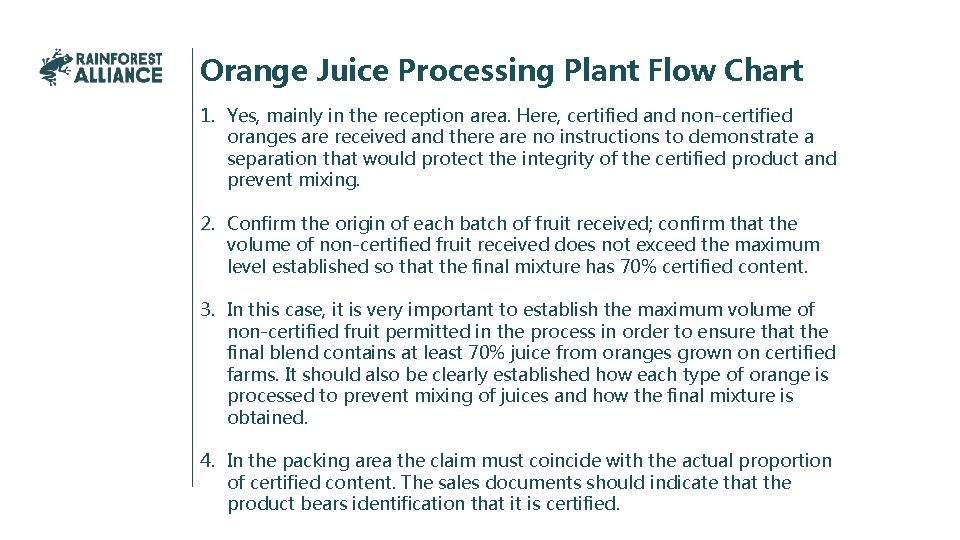
Orange Juice Processing Plant Flow Chart 1. Yes, mainly in the reception area. Here, certified and non-certified oranges are received and there are no instructions to demonstrate a separation that would protect the integrity of the certified product and prevent mixing. 2. Confirm the origin of each batch of fruit received; confirm that the volume of non-certified fruit received does not exceed the maximum level established so that the final mixture has 70% certified content. 3. In this case, it is very important to establish the maximum volume of non-certified fruit permitted in the process in order to ensure that the final blend contains at least 70% juice from oranges grown on certified farms. It should also be clearly established how each type of orange is processed to prevent mixing of juices and how the final mixture is obtained. 4. In the packing area the claim must coincide with the actual proportion of certified content. The sales documents should indicate that the product bears identification that it is certified.
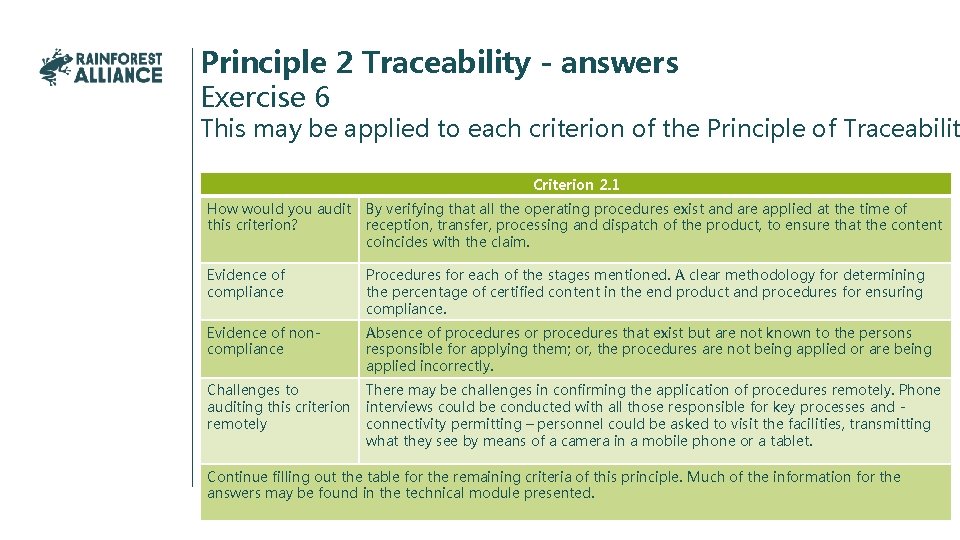
Principle 2 Traceability - answers Exercise 6 This may be applied to each criterion of the Principle of Traceabilit Criterion 2. 1 How would you audit this criterion? By verifying that all the operating procedures exist and are applied at the time of reception, transfer, processing and dispatch of the product, to ensure that the content coincides with the claim. Evidence of compliance Procedures for each of the stages mentioned. A clear methodology for determining the percentage of certified content in the end product and procedures for ensuring compliance. Evidence of noncompliance Absence of procedures or procedures that exist but are not known to the persons responsible for applying them; or, the procedures are not being applied or are being applied incorrectly. Challenges to auditing this criterion remotely There may be challenges in confirming the application of procedures remotely. Phone interviews could be conducted with all those responsible for key processes and connectivity permitting – personnel could be asked to visit the facilities, transmitting what they see by means of a camera in a mobile phone or a tablet. Continue filling out the table for the remaining criteria of this principle. Much of the information for the answers may be found in the technical module presented.
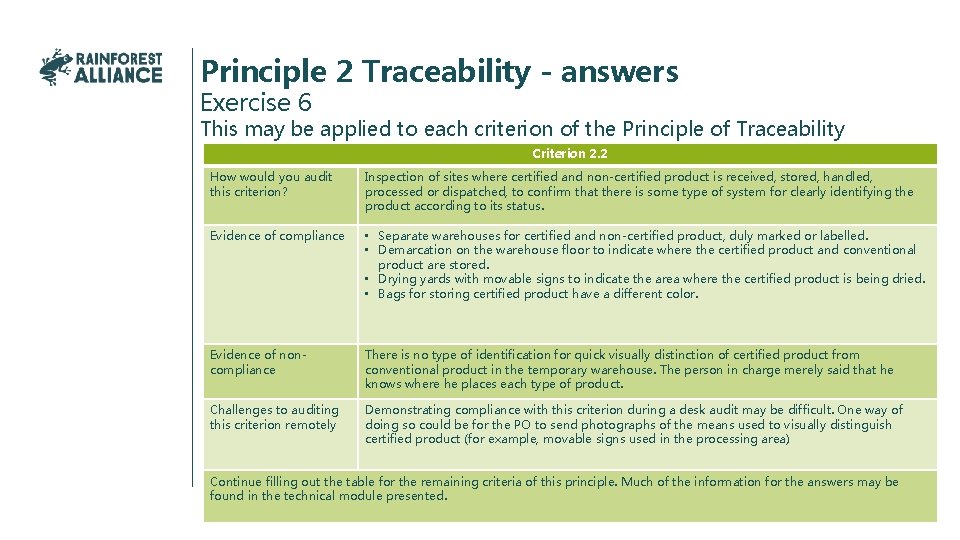
Principle 2 Traceability - answers Exercise 6 This may be applied to each criterion of the Principle of Traceability Criterion 2. 2 How would you audit this criterion? Inspection of sites where certified and non-certified product is received, stored, handled, processed or dispatched, to confirm that there is some type of system for clearly identifying the product according to its status. Evidence of compliance • Separate warehouses for certified and non-certified product, duly marked or labelled. • Demarcation on the warehouse floor to indicate where the certified product and conventional product are stored. • Drying yards with movable signs to indicate the area where the certified product is being dried. • Bags for storing certified product have a different color. Evidence of noncompliance There is no type of identification for quick visually distinction of certified product from conventional product in the temporary warehouse. The person in charge merely said that he knows where he places each type of product. Challenges to auditing this criterion remotely Demonstrating compliance with this criterion during a desk audit may be difficult. One way of doing so could be for the PO to send photographs of the means used to visually distinguish certified product (for example, movable signs used in the processing area) Continue filling out the table for the remaining criteria of this principle. Much of the information for the answers may be found in the technical module presented.
Use of Rainforest Alliance Trademarks Exercise 7 Answers in the next slide.
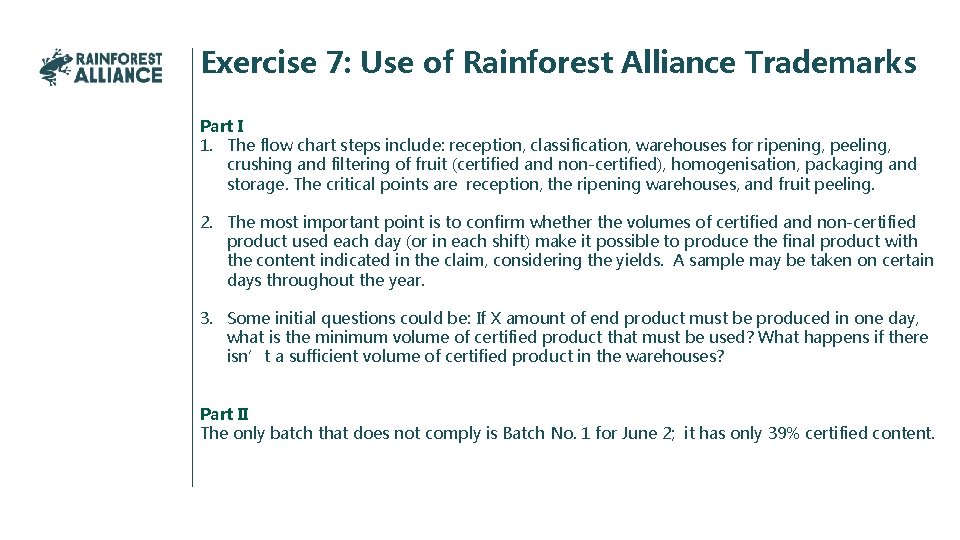
Exercise 7: Use of Rainforest Alliance Trademarks Part I 1. The flow chart steps include: reception, classification, warehouses for ripening, peeling, crushing and filtering of fruit (certified and non-certified), homogenisation, packaging and storage. The critical points are reception, the ripening warehouses, and fruit peeling. 2. The most important point is to confirm whether the volumes of certified and non-certified product used each day (or in each shift) make it possible to produce the final product with the content indicated in the claim, considering the yields. A sample may be taken on certain days throughout the year. 3. Some initial questions could be: If X amount of end product must be produced in one day, what is the minimum volume of certified product that must be used? What happens if there isn’t a sufficient volume of certified product in the warehouses? Part II The only batch that does not comply is Batch No. 1 for June 2; it has only 39% certified content.
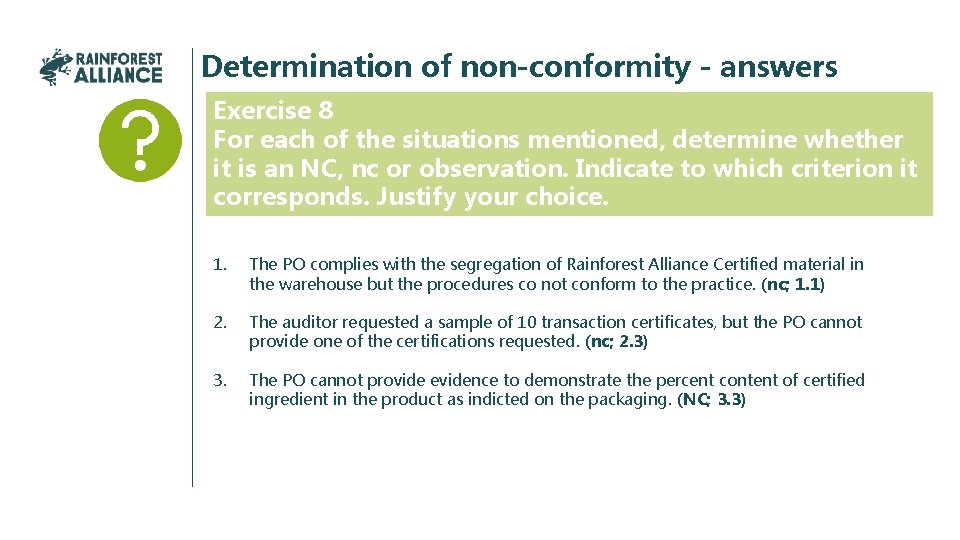
Determination of non-conformity - answers Exercise 8 For each of the situations mentioned, determine whether it is an NC, nc or observation. Indicate to which criterion it corresponds. Justify your choice. 1. The PO complies with the segregation of Rainforest Alliance Certified material in the warehouse but the procedures co not conform to the practice. (nc; 1. 1) 2. The auditor requested a sample of 10 transaction certificates, but the PO cannot provide one of the certifications requested. (nc; 2. 3) 3. The PO cannot provide evidence to demonstrate the percent content of certified ingredient in the product as indicted on the packaging. (NC; 3. 3)
Determination of non-conformity - answers 4. The auditor notices that a group of 12 year-old children are in charge of unloading 100 kg sacks of tea and carrying them to the warehouse. (NC; 1. 3) 5. The PO’s training procedures establish that training will take place annually and at the start of the working relationship with new employees. The auditor observed that the training is really taking place every three months and for new employees. (Observation for improving procedures and conforming them to the practice; 1. 2) 6. The PO could not document the responsibilities of the personnel involved with the Co. C Control System. However, the auditor checks that each worker is familiar with his tasks and carries them out in a competent manner. Observation for improving the procedure and conforming it to the practice; 1. 1) 7. The administrator of the multi-site PO has not developed a system of sanctions for non-compliance at each of the sites (nc; 4. 3)
Certification audit in a tea cooperative in Rwanda Exercise 9 Answers in the next slide.
Certification audit in a tea cooperative in Rwanda 1. Among other points: each producer should keep records of what has been harvested and delivered; the cooperative administrator should keep records of the tea received from the members. There should be an easy and clear way to differentiate (in documents) certified tea from conventional tea. The cooperative should also know the exact volume of product at each stage of the process. Finally, the cooperative should have receipts for the tea that it sends to the wholesaler (exporter). These documents should also show the volume of tea that was marketed with claims of being certified. 2. Finally, after analysing the information in all the records, it should be possible to calculate the volume of product that came in (certified and conventional) and the volume of product that went out (also for both categories), and to confirm that the outgoing volume did not exceed the incoming volume, considering the applicable transformation ratios. 3. Volume and type of product received (certified and conventional), as well as volume and type of product delivered (certified and conventional). 4. The kitchen gardens, the area in the field where the product is accumulated, the transportation and each of the processing stages within the plant, from the point where raw material is received until the end product is delivered, including storage. It is necessary to check that product integrity is preserved by keeping it physically separate at all times (physical segregation) or by storing, transporting and processing it at different times (segregation by time).
Interviews at the tea cooperative in Rwanda 1. To confirm that the people understand their roles and responsibilities. For example, the importance of product separation and knowing how to do this at each stage (i. e. knowing how to differentiate it and what paperwork to complete, where applicable). 2. The sample size could be the square root of the total number of people involved in the process (from the field to final delivery – an estimate could work if this information is not known beforehand), and then it should be stratified to interview a representative number of producers, transport providers, warehouse managers and those responsible for different stages of the process. Special emphasis should be given to interviewing those in charge of critical points for the integrity of the product. 3. Producers – How is certified product distinguished from conventional product? – How does the receipt that the cooperative gives a producer who delivers certified tea differ from the receipt given to a producer of conventional tea (a seal, a claim, a different color, etc. )? The same goes for transport providers, workers in charge of reception, storage and each stage of the process, and the office manager. In each case, the questions are asked to confirm that they know and apply the procedures to protect product integrity. 4. Ask if there is a procedure for accidental mixing, read it carefully and interview the various people in charge to see whether they are familiar with the procedure and know how to apply the part that corresponds to each one.
Thank you
rainforest-alliance. org 233 Broadway, 28 th Floor New York, NY 10279 USA De Ruyterkade 6 1013 AA, Amsterdam, The Netherlands