
WELCOME TO THE PLANNING TOOLS REFRESH Overview Presented

- Slides: 17
WELCOME TO THE PLANNING TOOLS REFRESH: Overview Presented by the Office of the Associate Vice-President, Academic Planning
Overview • • Welcome to the launch of the updated Planning Tools Apex platform, formerly Enhanced Planning Tools. The new Planning Tools Apex Platform will improve the overall experience of users by: – paring down the number of questions each unit is asked – establishing clear ties between the questions and their purpose within the larger university framework – incorporating the ability to easily access old reports. The project team has gathered feedback from the UVic Community Engagement Group, chairs and directors, and various other Planning Tools stakeholders and taken their feedback into account in the design process. Many of you have been extensively involved in the consultation and testing process, and for this we are extremely grateful.
Background • • • In fall of 2019, the EPT Refresh Working Group, led by Susan Lewis, met with various EPT user groups including the VPAC Community Engagement Group, Chairs and Directors, LTSI, EQHR, and other stakeholders to solicit feedback and recommendations on their experiences using the EPT application. The feedback received during these consultation sessions was used to refine and prepare recommendations to renew the Planning Tools application by summer 2020. The original EPT application was built in 2015 -16 to deliver central data and to collect and archive data from units and faculties. The purpose of the Planning Tools application is to facilitate planning and match resources with university priorities.
Priorities The key objectives of the Planning Tools Refresh Project are as follows: • To ensure that the tool is open year-round, with the exception of a brief closure period to signal the end of the Planning Tools cycle. This is a significant change from the current system, which has an open and closed cycle linked to the university’s budget planning cycle, and is only editable in October; • To reduce the number of questions and to ensure that questions asked have clear purpose and ties to the University Strategic Framework; • To develop custom reports or enable the data to be pulled from the tool for use by the AVP AP office for external reviews.
Scope The scope of the current project is limited to revising the question sets and the application. No changes to the data packets will be made at this time, although future revisions are being considered in a Phase 2 project in the coming years. Phase 1 of the Planning Tools Refresh includes: 1. 2. 3. 4. 5. 6. Maintain access to old EPT system so faculties and units can see archival responses. Make the Planning Tools system open year round and include a roll over date. Questions in the former tool to be removed and/or put into new groupings and new questions substituted into the tool. Ability to extract all responses from selected question(s ). Increase character limit to 4000 for select questions (roughly 400 words). New system to allow for the upload of Word and Excel documents in response to certain questions. The upload will support External Reviews for units and the Excel documents will contain information about carryforward balances. Out of scope: 1. Development of workflow functionality within the Planning Tools. 2. Searching capability across the Planning Tools reports. 3. Changes to the graphs within the Data Packets.
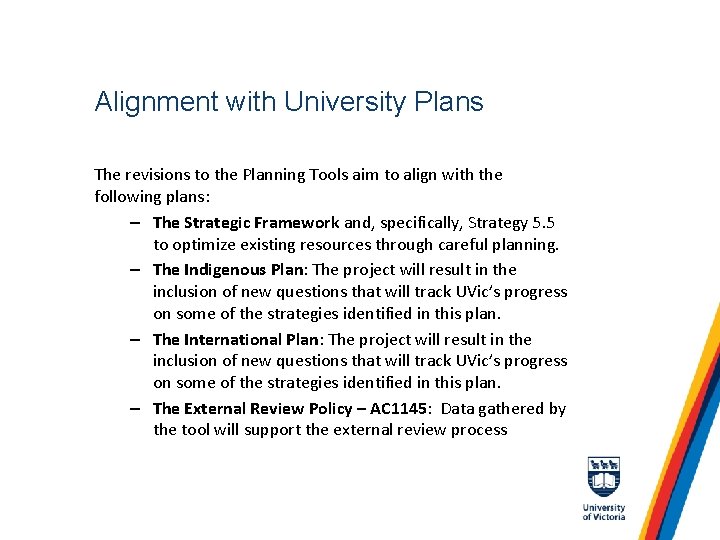
Alignment with University Plans The revisions to the Planning Tools aim to align with the following plans: – The Strategic Framework and, specifically, Strategy 5. 5 to optimize existing resources through careful planning. – The Indigenous Plan: The project will result in the inclusion of new questions that will track UVic’s progress on some of the strategies identified in this plan. – The International Plan: The project will result in the inclusion of new questions that will track UVic’s progress on some of the strategies identified in this plan. – The External Review Policy – AC 1145: Data gathered by the tool will support the external review process
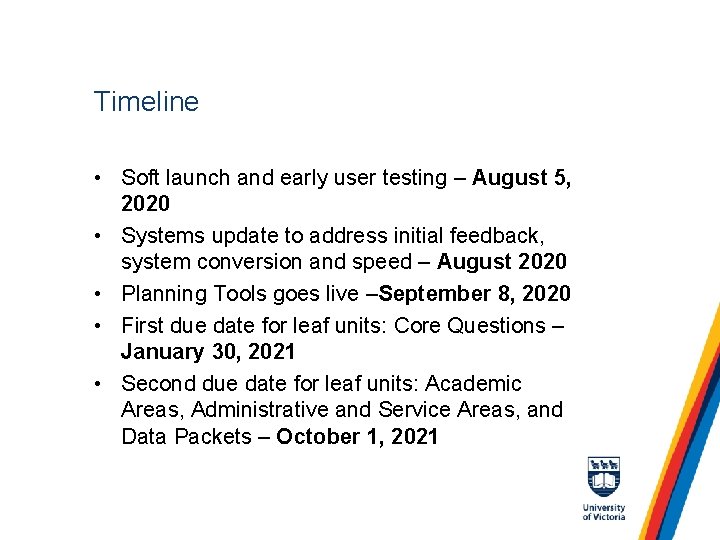
Timeline • Soft launch and early user testing – August 5, 2020 • Systems update to address initial feedback, system conversion and speed – August 2020 • Planning Tools goes live –September 8, 2020 • First due date for leaf units: Core Questions – January 30, 2021 • Second due date for leaf units: Academic Areas, Administrative and Service Areas, and Data Packets – October 1, 2021
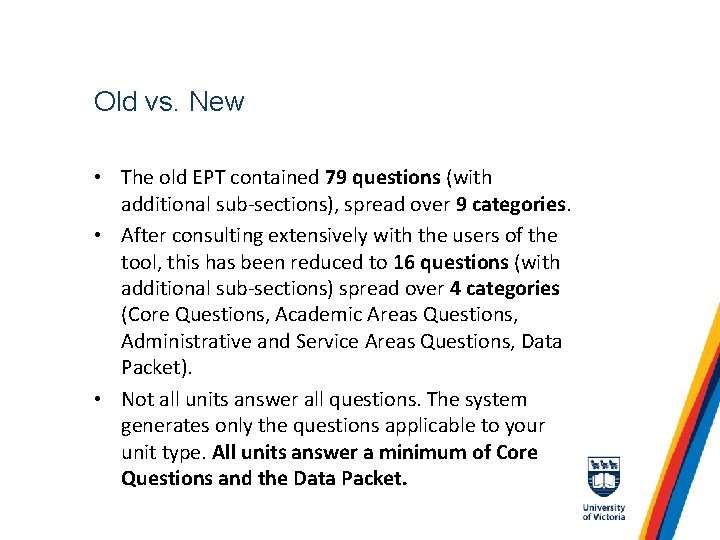
Old vs. New • The old EPT contained 79 questions (with additional sub-sections), spread over 9 categories. • After consulting extensively with the users of the tool, this has been reduced to 16 questions (with additional sub-sections) spread over 4 categories (Core Questions, Academic Areas Questions, Administrative and Service Areas Questions, Data Packet). • Not all units answer all questions. The system generates only the questions applicable to your unit type. All units answer a minimum of Core Questions and the Data Packet.
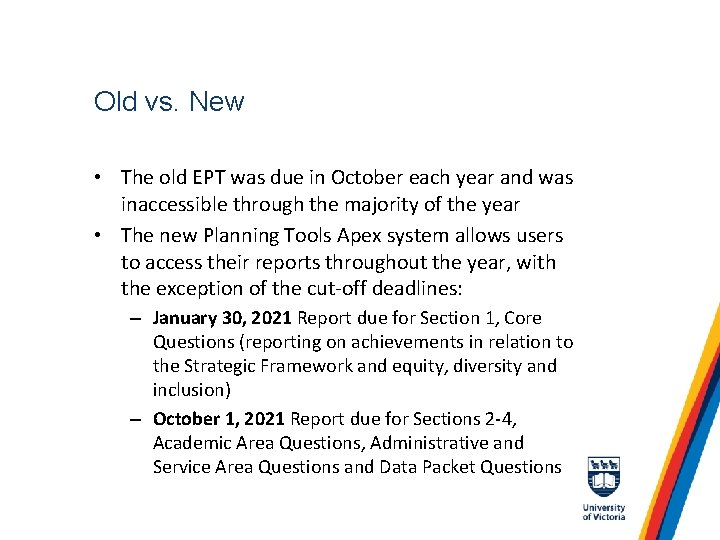
Old vs. New • The old EPT was due in October each year and was inaccessible through the majority of the year • The new Planning Tools Apex system allows users to access their reports throughout the year, with the exception of the cut-off deadlines: – January 30, 2021 Report due for Section 1, Core Questions (reporting on achievements in relation to the Strategic Framework and equity, diversity and inclusion) – October 1, 2021 Report due for Sections 2 -4, Academic Area Questions, Administrative and Service Area Questions and Data Packet Questions
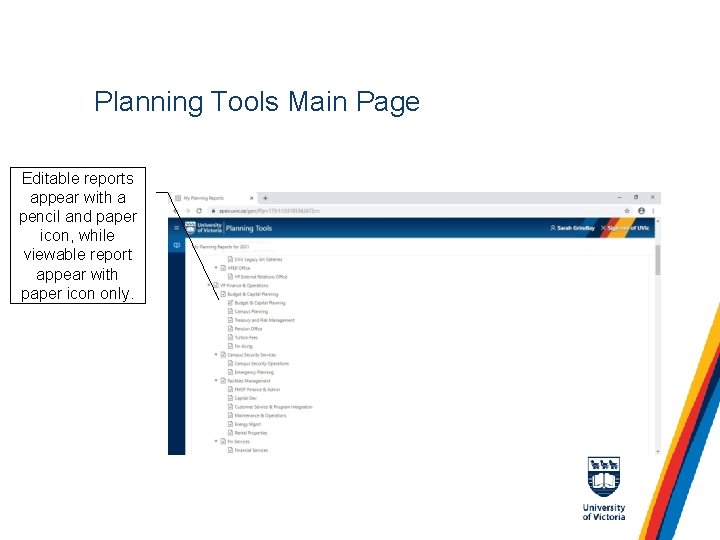
Planning Tools Main Page Editable reports appear with a pencil and paper icon, while viewable report appear with paper icon only.
Addressing Feedback • During two open consultation sessions on December 17, 2019 and January 13, 2020, facilitators Susan Lewis, AVP Academic Planning; Tony Eder, Executive Director, Academic Resource Planning; Kristi Simpson, AVP Finance and Operations met with EPT stakeholders, including chairs, deans, directors, and executives, to consult on the old EPT system and discuss what changes users wanted in the new. • The full summary is available on the Planning Tools website.
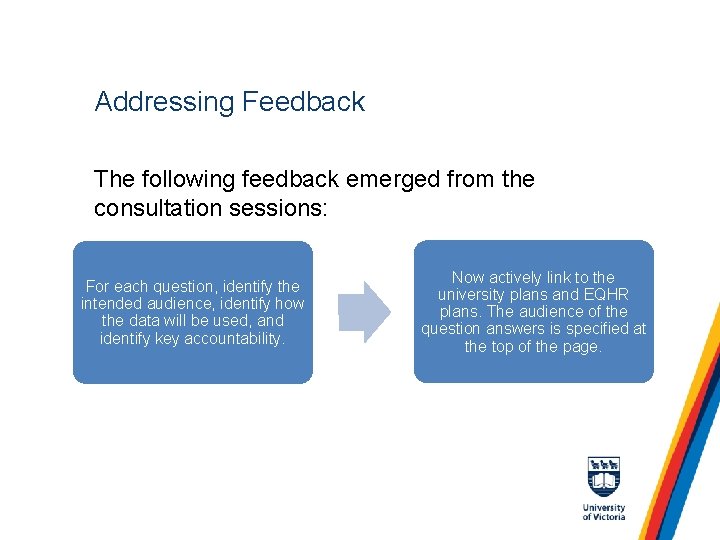
Addressing Feedback The following feedback emerged from the consultation sessions: For each question, identify the intended audience, identify how the data will be used, and identify key accountability. Now actively link to the university plans and EQHR plans. The audience of the question answers is specified at the top of the page.
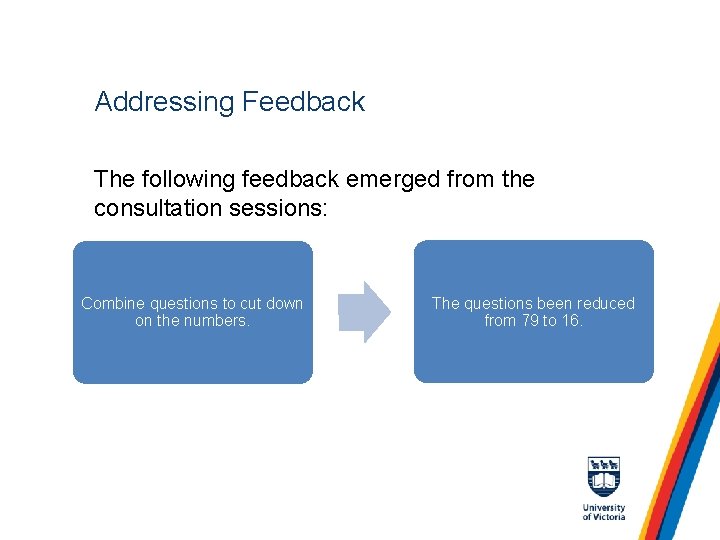
Addressing Feedback The following feedback emerged from the consultation sessions: Combine questions to cut down on the numbers. The questions been reduced from 79 to 16.
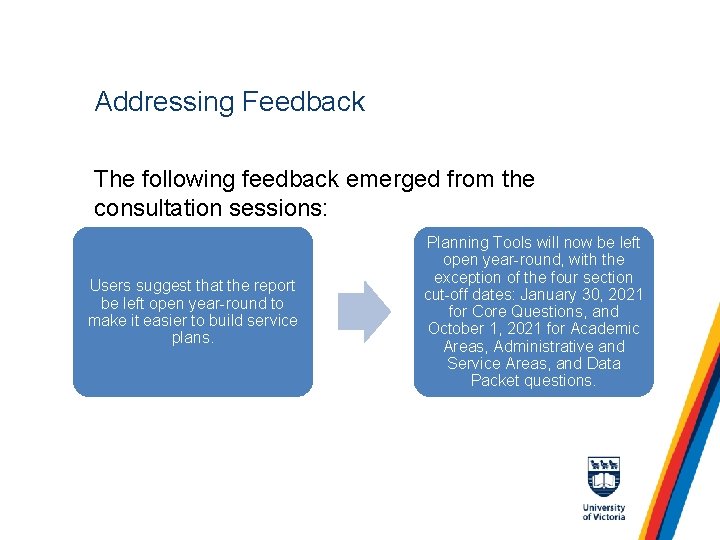
Addressing Feedback The following feedback emerged from the consultation sessions: Users suggest that the report be left open year-round to make it easier to build service plans. Planning Tools will now be left open year-round, with the exception of the four section cut-off dates: January 30, 2021 for Core Questions, and October 1, 2021 for Academic Areas, Administrative and Service Areas, and Data Packet questions.
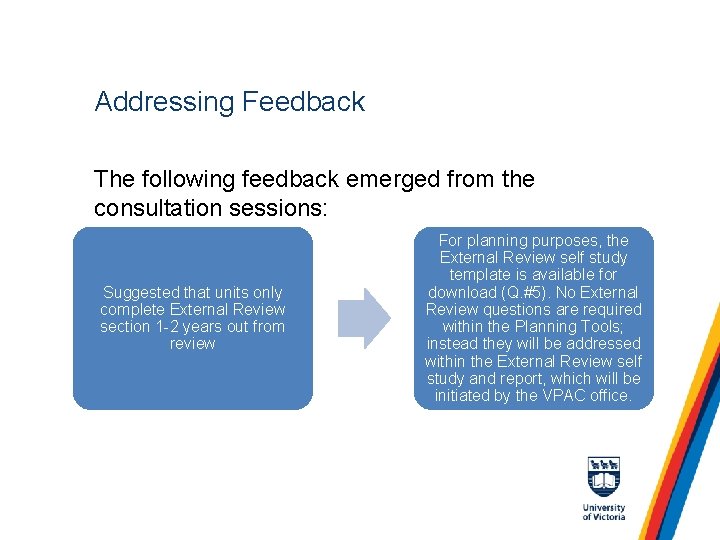
Addressing Feedback The following feedback emerged from the consultation sessions: Suggested that units only complete External Review section 1 -2 years out from review For planning purposes, the External Review self study template is available for download (Q. #5). No External Review questions are required within the Planning Tools; instead they will be addressed within the External Review self study and report, which will be initiated by the VPAC office.
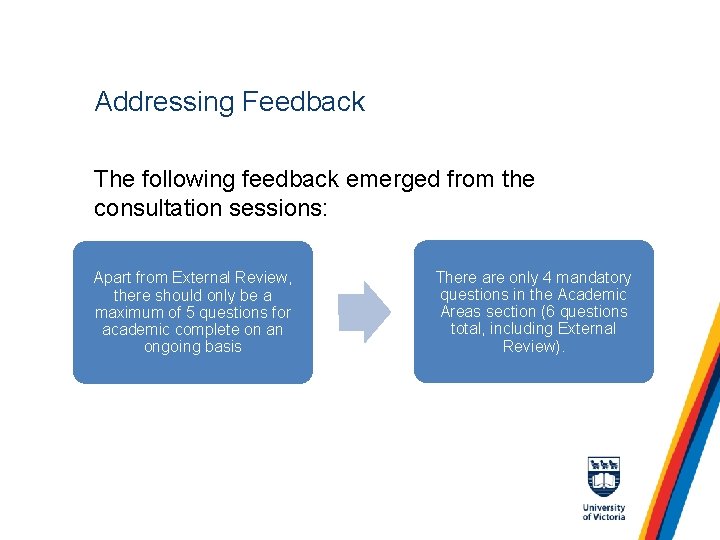
Addressing Feedback The following feedback emerged from the consultation sessions: Apart from External Review, there should only be a maximum of 5 questions for academic complete on an ongoing basis There are only 4 mandatory questions in the Academic Areas section (6 questions total, including External Review).
Need more help? For further assistance with the Planning Tools, please contact planningtools@uvic. ca.