
Welcome to the Life Cycle Assessment LCA Learning
- Slides: 31
Welcome to the Life Cycle Assessment (LCA) Learning Module Series Liv Haselbach Quinn Langfitt For current modules email haselbach@wsu. edu or visit cem. uaf. edu/CESTi. CC ACKNOWLEDGEMENTS: CESTICC WASHINGTON STATE UNIVERSITY FULBRIGHT
LCA Module Series Group A: ISO Compliant LCA Overview Modules Group α: ISO Compliant LCA Detailed Modules Group B: Environmental Impact Categories Overview Modules Group β: Environmental Impact Categories Detailed Modules Group G: General LCA Tools Overview Modules Group γ: General LCA Tools Detailed Modules Group T: Transportation-Related LCA Overview Modules Group τ: Transportation-Related LCA Detailed Modules 02/2015 LCA MODULE A 1 2
Introduction to Life Cycle Assessment and International Standard ISO 14040 MODULE A 1 02/2015 LCA MODULE A 1 3
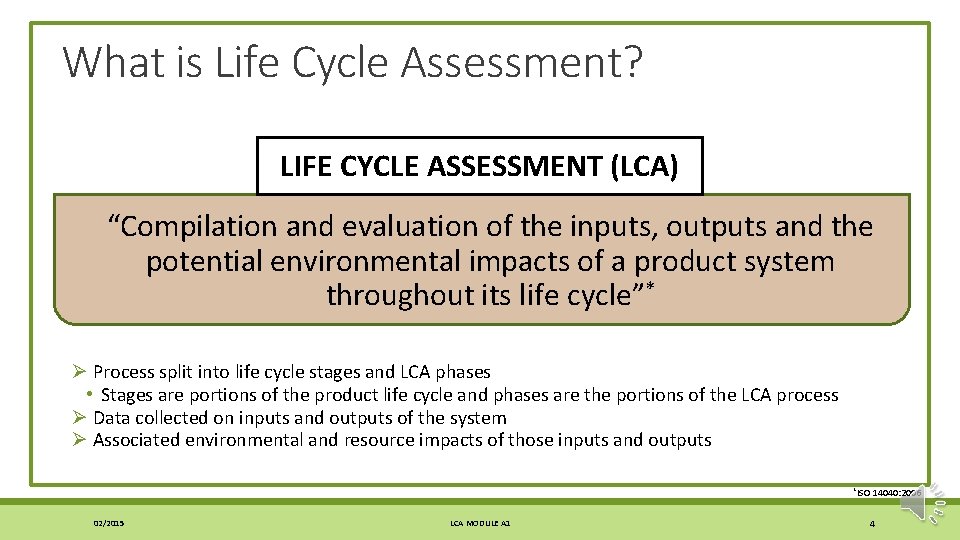
What is Life Cycle Assessment? LIFE CYCLE ASSESSMENT (LCA) “Compilation and evaluation of the inputs, outputs and the potential environmental impacts of a product system throughout its life cycle”* Ø Process split into life cycle stages and LCA phases • Stages are portions of the product life cycle and phases are the portions of the LCA process Ø Data collected on inputs and outputs of the system Ø Associated environmental and resource impacts of those inputs and outputs *ISO 02/2015 LCA MODULE A 1 14040: 2006 4
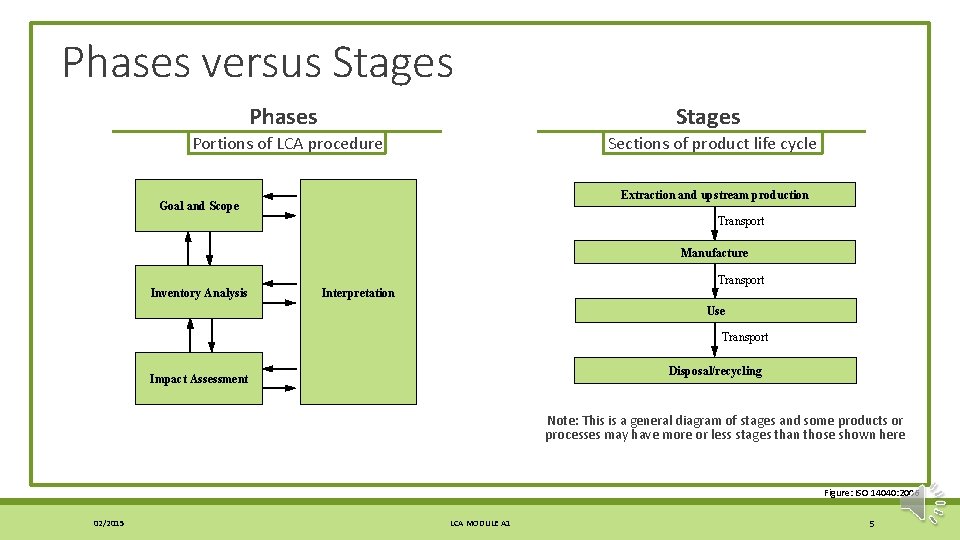
Phases versus Stages Phases Stages Portions of LCA procedure Sections of product life cycle Extraction and upstream production Goal and Scope Transport Manufacture Inventory Analysis Transport Interpretation Use Transport Disposal/recycling Impact Assessment Note: This is a general diagram of stages and some products or processes may have more or less stages than those shown here Figure: ISO 14040: 2006 02/2015 LCA MODULE A 1 5
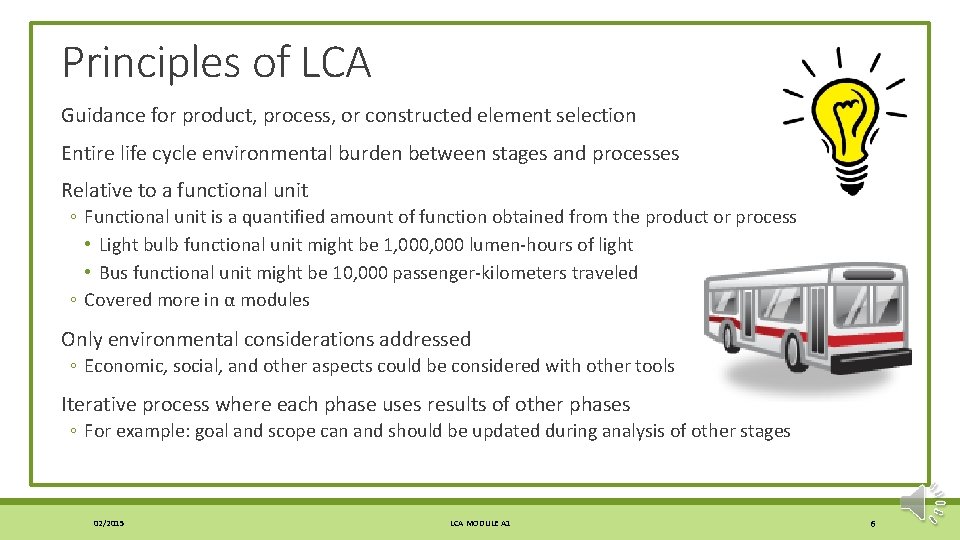
Principles of LCA Guidance for product, process, or constructed element selection Entire life cycle environmental burden between stages and processes Relative to a functional unit ◦ Functional unit is a quantified amount of function obtained from the product or process • Light bulb functional unit might be 1, 000 lumen-hours of light • Bus functional unit might be 10, 000 passenger-kilometers traveled ◦ Covered more in α modules Only environmental considerations addressed ◦ Economic, social, and other aspects could be considered with other tools Iterative process where each phase uses results of other phases ◦ For example: goal and scope can and should be updated during analysis of other stages 02/2015 LCA MODULE A 1 6
LCA Science Comprehensiveness ◦ Attempt to cover all attributes or aspects of natural environment, human health and resources! ◦ Therefore, include a wide range of potential environmental impacts in LCA studies ◦ Coverage of every conceivable impact not possible No scientific basis for generating a single overall score ◦ Must report individual impact scores Priority of scientific approach to characterize impacts: ◦ First: Natural science ◦ Next: Social or economic science or International convention ◦ Last: Value choices (opinion, preferences) 02/2015 LCA MODULE A 1 7
Why Do An LCA? Identify opportunities to improve environmental performance Inform decision-makers Select relevant indicators of environmental performance Marketing e. g. ecolabel 02/2015 LCA MODULE A 1 8
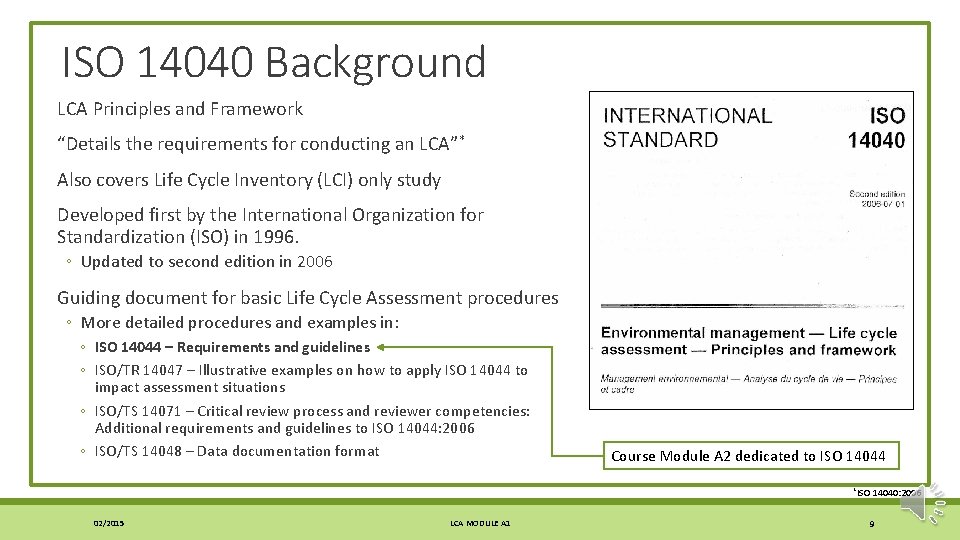
ISO 14040 Background LCA Principles and Framework “Details the requirements for conducting an LCA”* Also covers Life Cycle Inventory (LCI) only study Developed first by the International Organization for Standardization (ISO) in 1996. ◦ Updated to second edition in 2006 Guiding document for basic Life Cycle Assessment procedures ◦ More detailed procedures and examples in: ◦ ISO 14044 – Requirements and guidelines ◦ ISO/TR 14047 – Illustrative examples on how to apply ISO 14044 to impact assessment situations ◦ ISO/TS 14071 – Critical review process and reviewer competencies: Additional requirements and guidelines to ISO 14044: 2006 ◦ ISO/TS 14048 – Data documentation format Course Module A 2 dedicated to ISO 14044 *ISO 02/2015 LCA MODULE A 1 14040: 2006 9
Scope of ISO 14040 contains general information on: a. b. c. d. e. f. g. h. Goal and scope of LCA LCI phase Phases of an LCA LCIA phase Interpretation phase Reporting and critical review Limitations Relationship between phases Conditions for use of value choices and optional elements Normative references: Need to use 14044 to apply 14040 02/2015 LCA MODULE A 1 10
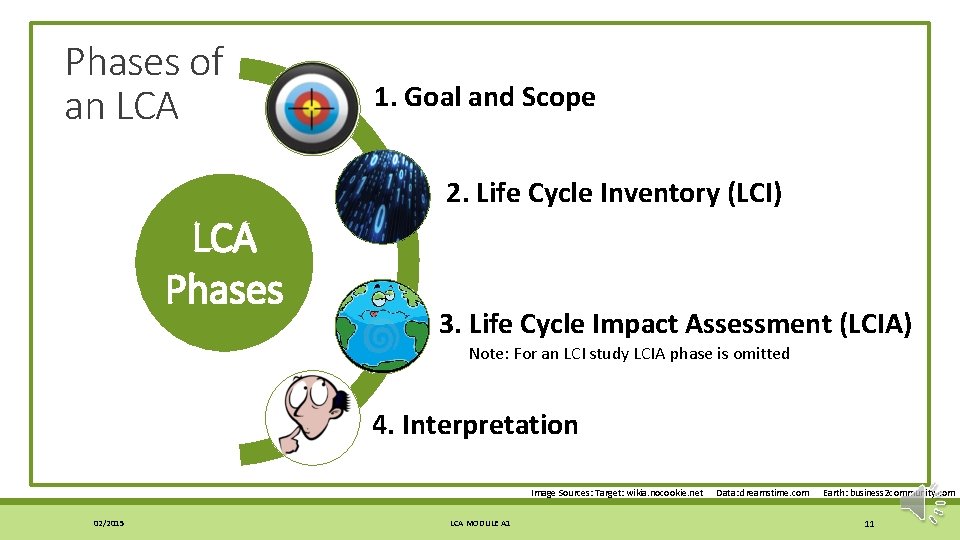
Phases of an LCA Phases 1. Goal and Scope 2. Life Cycle Inventory (LCI) 3. Life Cycle Impact Assessment (LCIA) Note: For an LCI study LCIA phase is omitted 4. Interpretation Image Sources: Target: wikia. nocookie. net 02/2015 LCA MODULE A 1 Data: dreamstime. com Earth: business 2 community. com 11
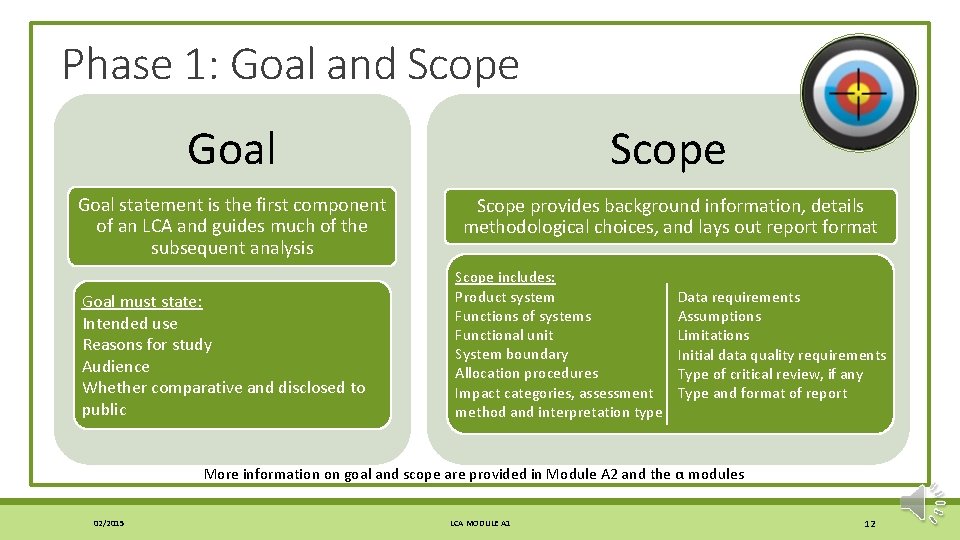
Phase 1: Goal and Scope Goal statement is the first component of an LCA and guides much of the subsequent analysis Goal must state: Intended use Reasons for study Audience Whether comparative and disclosed to public Scope follows the goal and provides background information, details methodological choices, and tells Scope provides how background information, details the report will be formatted. methodological choices, and lays out report format Scope includes: Product system Functions of systems Functional unit System boundary Allocation procedures Impact categories, assessment method and interpretation type Data requirements Assumptions Limitations Initial data quality requirements Type of critical review, if any Type and format of report More information on goal and scope are provided in Module A 2 and the α modules 02/2015 LCA MODULE A 1 12
Phases 2 and 3: LCI and LCIA Life Cycle Inventory (LCI) Phase Data collection As much input and output data as possible is collected Can be presented in report or kept private, such as if confidentiality agreements warrant Useful for other researchers that could use that data Life Cycle Impact Assessment (LCIA) Phase Conversion of inventory data into environmental impact potentials Impact categories, indication, and characterization models are chosen Data are grouped based on potential to cause certain environmental impacts (classification) Input and output quantities converted to potential impacts based on characterization factors (characterization) Optional steps: Normalization, grouping, weighting (more details in α modules) 02/2015 LCA MODULE A 1 13
Phase 4: Interpretation Continually ongoing during assessment to help guide other phases Discussion of inventory analysis and impact assessment results in LCA study ◦ In an LCI study, only inventory needs to be discussed Can be modeled as conclusions and recommendations to the decision maker Should be consistent with and based on goal and scope of the study Should reflect the various uncertainties inherent in LCA including: ◦ LCA is based on a relative approach using a functional unit ◦ Impacts are “potential” 02/2015 LCA MODULE A 1 14
Limitations of LCA “Not a complete assessment of all environmental issues”* because only those identified in the goal and scope are considered LCI can rarely, if ever, include every single process and capture every single input and output due to system boundaries, data gaps, cut-off criteria, etc. LCI data collected contains uncertainty Characterization models are far from perfect Sensitivity and other uncertainty analyses are not fully developed *ISO 02/2015 LCA MODULE A 1 15 14040: 2006
Critical Review Necessary component for comparative studies disclosed to the public Verifies process and consistency with principles ◦ Not an endorsement ◦ Does not verify or validate goals Can improve credibility of study Critical review process defined in goal and scope! External independent chair person and at least two other members Image: shenandoahchiropractic. com 02/2015 LCA MODULE A 1 16
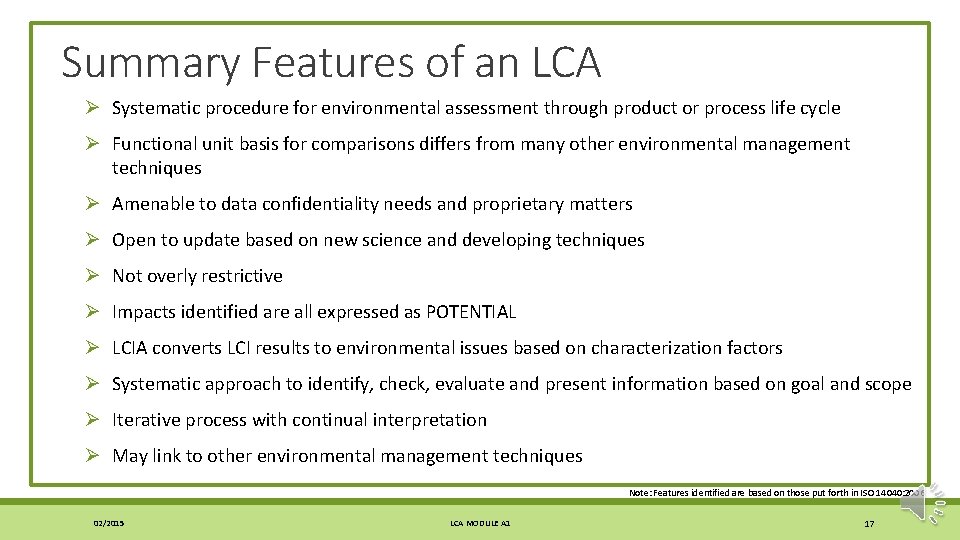
Summary Features of an LCA Ø Systematic procedure for environmental assessment through product or process life cycle Ø Functional unit basis for comparisons differs from many other environmental management techniques Ø Amenable to data confidentiality needs and proprietary matters Ø Open to update based on new science and developing techniques Ø Not overly restrictive Ø Impacts identified are all expressed as POTENTIAL Ø LCIA converts LCI results to environmental issues based on characterization factors Ø Systematic approach to identify, check, evaluate and present information based on goal and scope Ø Iterative process with continual interpretation Ø May link to other environmental management techniques Note: Features identified are based on those put forth in ISO 14040: 2006 02/2015 LCA MODULE A 1 17
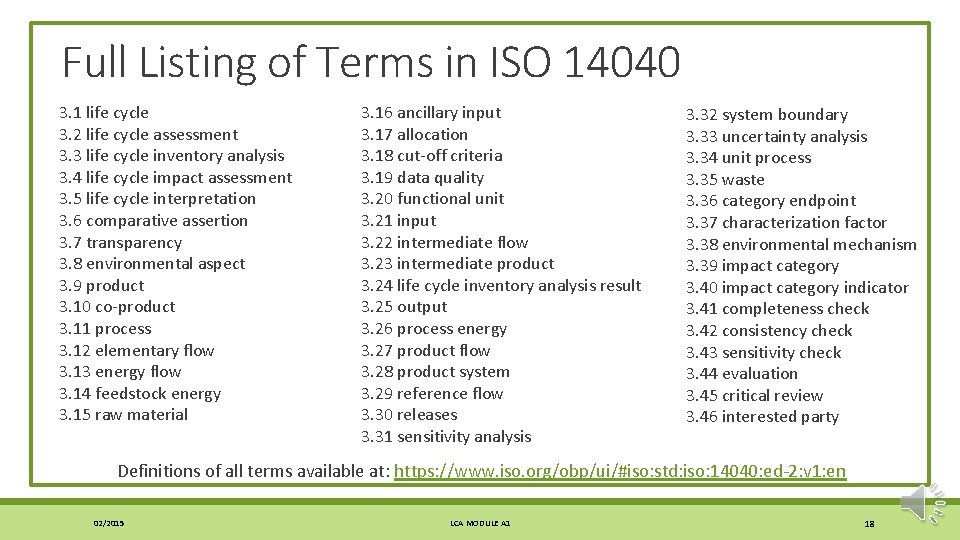
Full Listing of Terms in ISO 14040 3. 1 life cycle 3. 2 life cycle assessment 3. 3 life cycle inventory analysis 3. 4 life cycle impact assessment 3. 5 life cycle interpretation 3. 6 comparative assertion 3. 7 transparency 3. 8 environmental aspect 3. 9 product 3. 10 co-product 3. 11 process 3. 12 elementary flow 3. 13 energy flow 3. 14 feedstock energy 3. 15 raw material 3. 16 ancillary input 3. 17 allocation 3. 18 cut-off criteria 3. 19 data quality 3. 20 functional unit 3. 21 input 3. 22 intermediate flow 3. 23 intermediate product 3. 24 life cycle inventory analysis result 3. 25 output 3. 26 process energy 3. 27 product flow 3. 28 product system 3. 29 reference flow 3. 30 releases 3. 31 sensitivity analysis 3. 32 system boundary 3. 33 uncertainty analysis 3. 34 unit process 3. 35 waste 3. 36 category endpoint 3. 37 characterization factor 3. 38 environmental mechanism 3. 39 impact category 3. 40 impact category indicator 3. 41 completeness check 3. 42 consistency check 3. 43 sensitivity check 3. 44 evaluation 3. 45 critical review 3. 46 interested party Definitions of all terms available at: https: //www. iso. org/obp/ui/#iso: std: iso: 14040: ed-2: v 1: en 02/2015 LCA MODULE A 1 18
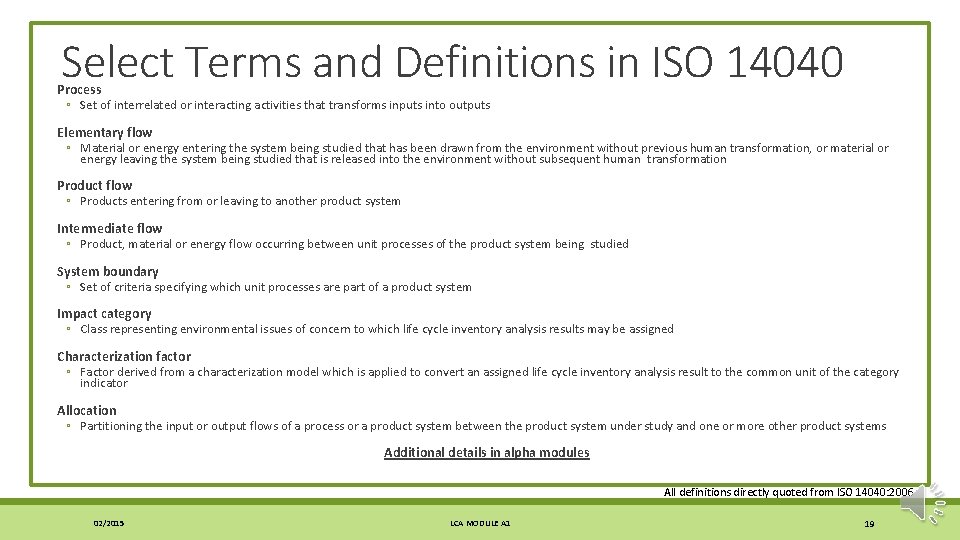
Select Terms and Definitions in ISO 14040 Process ◦ Set of interrelated or interacting activities that transforms inputs into outputs Elementary flow ◦ Material or energy entering the system being studied that has been drawn from the environment without previous human transformation, or material or energy leaving the system being studied that is released into the environment without subsequent human transformation Product flow ◦ Products entering from or leaving to another product system Intermediate flow ◦ Product, material or energy flow occurring between unit processes of the product system being studied System boundary ◦ Set of criteria specifying which unit processes are part of a product system Impact category ◦ Class representing environmental issues of concern to which life cycle inventory analysis results may be assigned Characterization factor ◦ Factor derived from a characterization model which is applied to convert an assigned life cycle inventory analysis result to the common unit of the category indicator Allocation ◦ Partitioning the input or output flows of a process or a product system between the product system under study and one or more other product systems Additional details in alpha modules All definitions directly quoted from ISO 14040: 2006 02/2015 LCA MODULE A 1 19
Thank you for completing Module A 1! Group A: ISO Compliant LCA Overview Modules Group α: ISO Compliant LCA Detailed Modules Group B: Environmental Impact Categories Overview Modules Group β: Environmental Impact Categories Detailed Modules Group G: General LCA Tools Overview Modules Group γ: General LCA Tools Detailed Modules Group T: Transportation-Related LCA Overview Modules Group τ: Transportation-Related LCA Detailed Modules
Self-Assessment Quiz MODULE A 1: INTRODUCTION TO LIFE CYCLE ASSESSMENT AND ISO 14040
What does LCI stand for? Life Cycle Interpretation Life Cycle Inventory Life Cycle Introduction
Correct! LCI stands for Life Cycle Inventory
How many phases are there in an LCA? 4 6 8
Correct! The phases a re: 1. Go al and Scope 2. Lif e Cycle Inv entory 3. Lif e Cycle Im pa ct Asses sm ent 4. Interpret ati on
What is one of the intended benefits of a critical review? Improves credibility by showing adherence to the Standard Provides an endorsement of the product by the review panel Validates goals and intended use of the results All of the above
Correct! The critical review can make the study more credible by demonstrating adherence to ISO 14040 and 14044, but does not endorse products or validate goals and intended uses of the LCA.
Can the Goal and Scope be updated while completing the LCI stage? No, it must be left as originally written Yes, but it should be avoided if possible Yes, this type of iterative process is encouraged and can strengthen results
Correct! The entire process of life cycle assessment is iterative between each phase to accommodate incorporation of new information at any point.
What is the first priority of the scientific approach to characterizing impacts? Social and economic science Value choices Natural science
Correct! Natural sciences tend to be more objective and therefore are the first priority in characterizing impacts.