
Welcome to the IAP 2 USA Professional Certification

- Slides: 21
Welcome to the IAP 2 USA Professional Certification Program!
A Bit of Background • IAP 2 USA, with support from the Canadian and Southern Africa affiliates, has worked for nearly two years to develop a Certification Program. • Convened a Task Force to develop recommendations for a program • The Task Force’s goal: to create a professional certification program for IAP 2 USA that could also serve as a template for other Affiliates that want to define their own programs. • Task Force has met 39 times including a two-day face-to-face meeting in Minneapolis, MN in late May and numerous sub-group meetings
Our Work to Date • November 2013 to May 2014 – researched other professional certification programs • May – June 2014 – three information webinars and a survey of members in US, Canada and Southern Africa. • June to September 2014 – Used survey results to frame draft Core Competencies
Our Work to Date (continued) • September 2014 – Draft Core Competencies introduced at the 2015 IAP 2 North American Conference in Winnipeg • Fall 2014 – Task Force invited input on the draft Core Competencies • November 2014 - Information webinar • December 2014 – Core Competencies finalized • Since January, 2015 - Developed assessment process
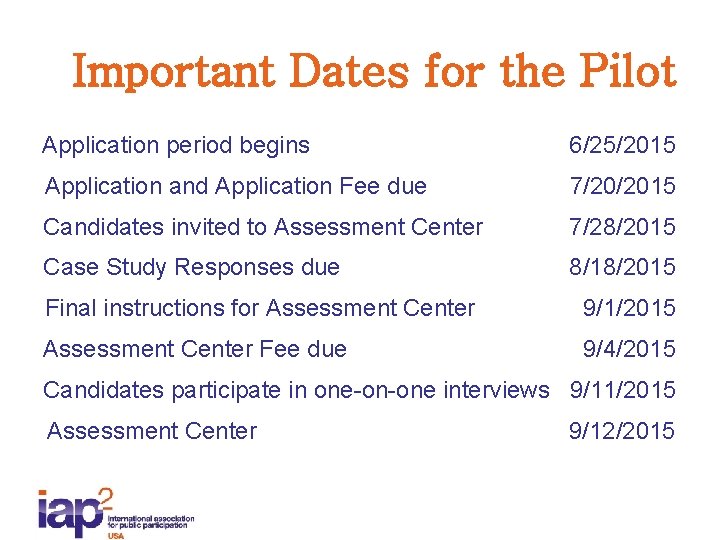
Pilot Announced! • IAP 2 USA will conduct a pilot of a Certification Assessment Center after the North American conference in September in Portland, Oregon • Applications to attend the USA Pilot Assessment Center are due July 20, 2015. • The program will be conducted starting on Friday, September 11 (after the conference ends) and continuing on Saturday, September 12
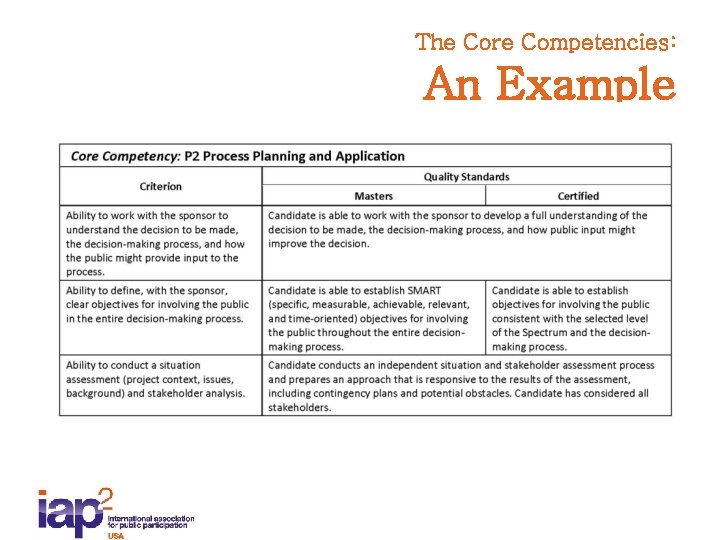
The Core Competencies The core competencies were developed, based on member input and include those skills that are essential for professionals working in this field. Five core competencies • P 2 Process Design and Application • P 2 Event Planning and Implementation • Appropriate Use of Tools and Techniques • P 2 Communication Skills • P 2 People Skills
Three Step Certification Process The Certification Process entails three steps, all of which are designed to look for evidence of a candidates skills in the five core competencies. The three steps in the certification process are: 1. Submit an Application 2. Prepare a Response to a Case Study 3. Participate in an Assessment Center
Two Levels of Certification • Certified Public Participation Professional • Master Certified Public Participation Professional • Assessors will determine which level is appropriate for each candidate based on performance against five core competencies • Successful candidates will become thoroughly familiar with the core competencies and look for opportunities to demonstrate their skills and competencies throughout the assessment process
Assessment Process Pre-Requisites • Applicants must be an active member of IAP 2 • Applicants must have completed the IAP 2 5 -day training, Foundations in Public Participation (formerly Certificate Course) • Applicants must complete a knowledge test based on the IAP 2 5 -day training. – Note that the knowledge test will be waived for the pilot because it is still in development.
Assessment Process Step 1. Application Applicants will submit an on-line application documenting: • Standard information, including education and job history • Other certifications, memberships, and relevant accomplishments and experiences • Statement of why seeking certification • A matrix of p 2 techniques to provide the opportunity to indicate level of experience
Assessment Process Step 1. Application Project Descriptions Each applicant will submit three project descriptions. Each project description should describe a prior p 2 project in 750 words or less. Include: • Overall description of the program and your role • Level of the IAP 2 Spectrum and rationale • Techniques chosen and rationale • Description of how techniques were implemented • What you learned from the project.
Assessment Process Step 1. Application Project Descriptions (cont) Project Descriptions should elaborate on: • How you worked with the project sponsor • How the input was used and how you communicated with stakeholders about how the input was used • How techniques were adapted, and why • How communication objectives were developed to support p 2 objectives • How communication products were developed to effectively communicate with diverse stakeholder groups.
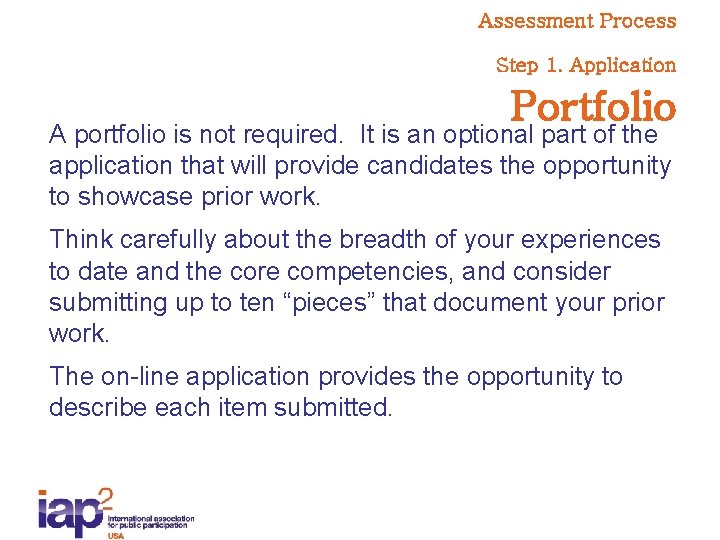
Assessment Process Step 1. Application Portfolio A portfolio is not required. It is an optional part of the application that will provide candidates the opportunity to showcase prior work. Think carefully about the breadth of your experiences to date and the core competencies, and consider submitting up to ten “pieces” that document your prior work. The on-line application provides the opportunity to describe each item submitted.
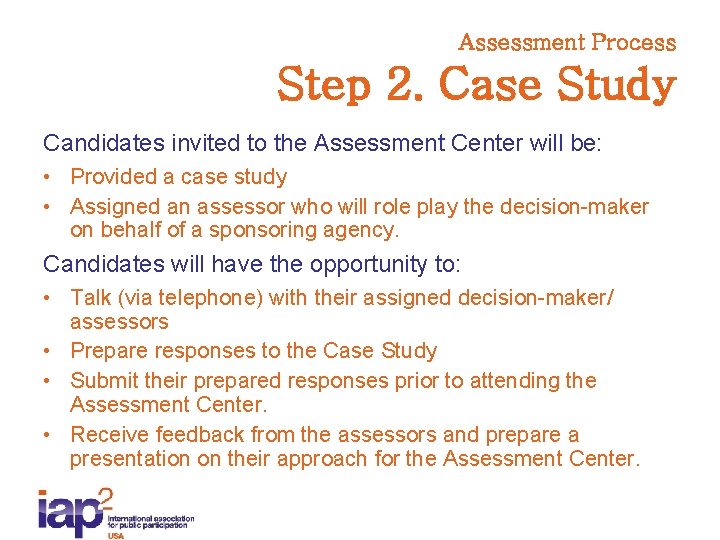
Assessment Process Step 2. Case Study Candidates invited to the Assessment Center will be: • Provided a case study • Assigned an assessor who will role play the decision-maker on behalf of a sponsoring agency. Candidates will have the opportunity to: • Talk (via telephone) with their assigned decision-maker/ assessors • Prepare responses to the Case Study • Submit their prepared responses prior to attending the Assessment Center. • Receive feedback from the assessors and prepare a presentation on their approach for the Assessment Center.
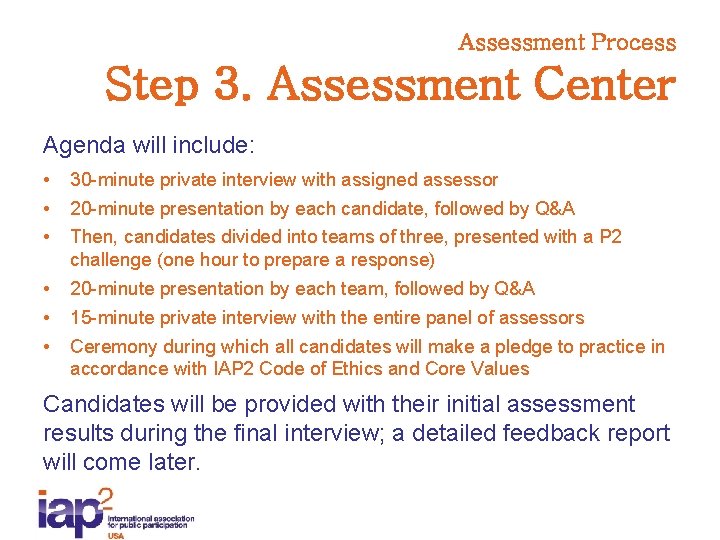
Assessment Process Step 3. Assessment Center Agenda will include: • • • 30 -minute private interview with assigned assessor • • • 20 -minute presentation by each team, followed by Q&A 20 -minute presentation by each candidate, followed by Q&A Then, candidates divided into teams of three, presented with a P 2 challenge (one hour to prepare a response) 15 -minute private interview with the entire panel of assessors Ceremony during which all candidates will make a pledge to practice in accordance with IAP 2 Code of Ethics and Core Values Candidates will be provided with their initial assessment results during the final interview; a detailed feedback report will come later.
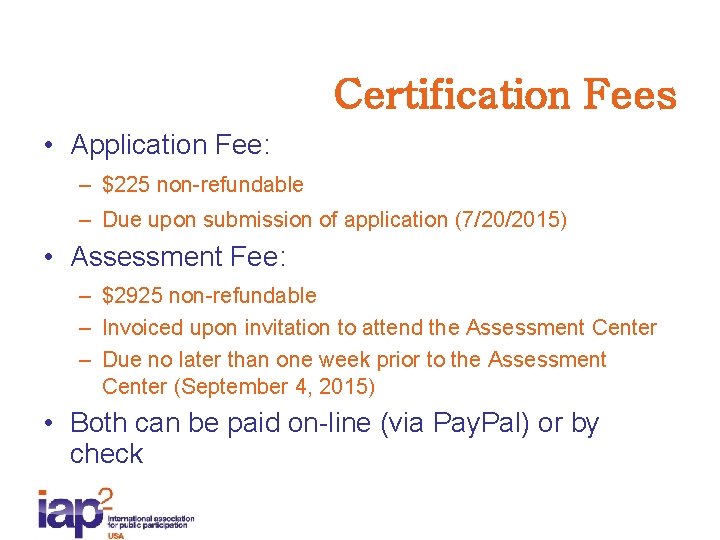
Certification Fees • Application Fee: – $225 non-refundable – Due upon submission of application (7/20/2015) • Assessment Fee: – $2925 non-refundable – Invoiced upon invitation to attend the Assessment Center – Due no later than one week prior to the Assessment Center (September 4, 2015) • Both can be paid on-line (via Pay. Pal) or by check
Important Dates for the Pilot Application period begins 6/25/2015 Application and Application Fee due 7/20/2015 Candidates invited to Assessment Center 7/28/2015 Case Study Responses due 8/18/2015 Final instructions for Assessment Center 9/1/2015 Assessment Center Fee due 9/4/2015 Candidates participate in one-on-one interviews 9/11/2015 Assessment Center 9/12/2015
The Core Competencies: An Example
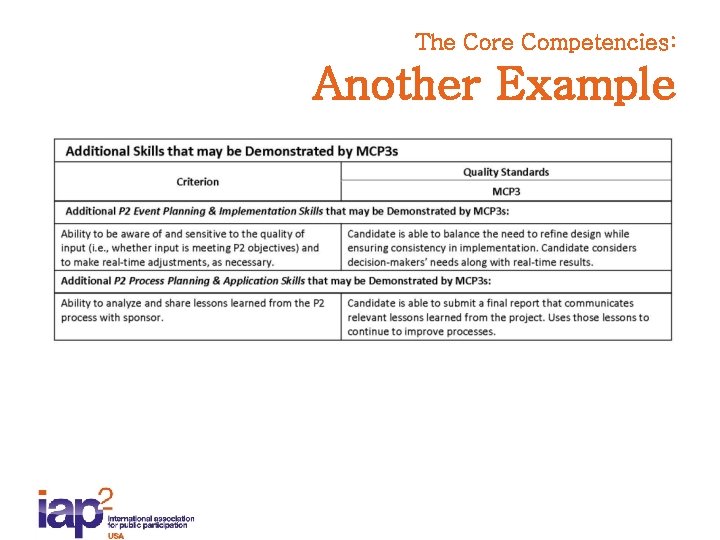
The Core Competencies: Another Example
Questions?
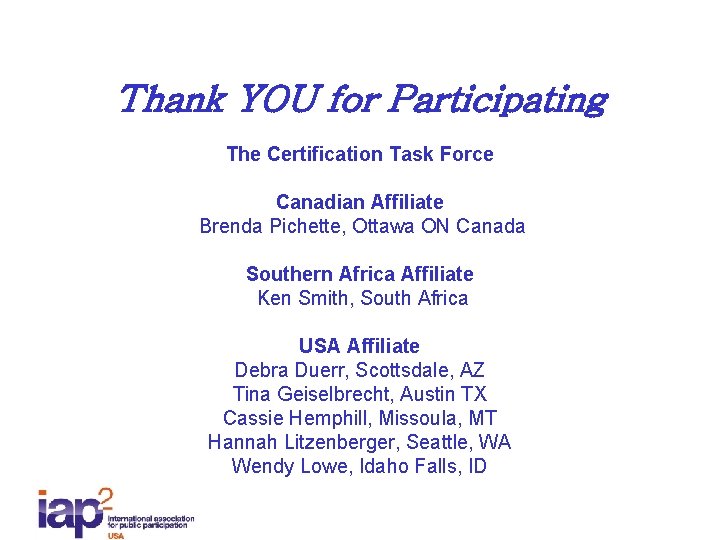
Thank YOU for Participating The Certification Task Force Canadian Affiliate Brenda Pichette, Ottawa ON Canada Southern Africa Affiliate Ken Smith, South Africa USA Affiliate Debra Duerr, Scottsdale, AZ Tina Geiselbrecht, Austin TX Cassie Hemphill, Missoula, MT Hannah Litzenberger, Seattle, WA Wendy Lowe, Idaho Falls, ID