
Welcome to the Early Years Foundation Stage How
- Slides: 24
Welcome to the Early Years Foundation Stage How can I help my child?
What is the Early Years Foundation Stage Nurseries Pre-schools Reception Classes Childminders Early Years Foundation Stage Framework • • Established by early years experts and parents Statutory, legal requirement
The EYFS Framework A unique curriculum 7 areas of learning and development (17 areas in total) Fundamentally based on play and child-centred learning Teaching based around age and ability Observations
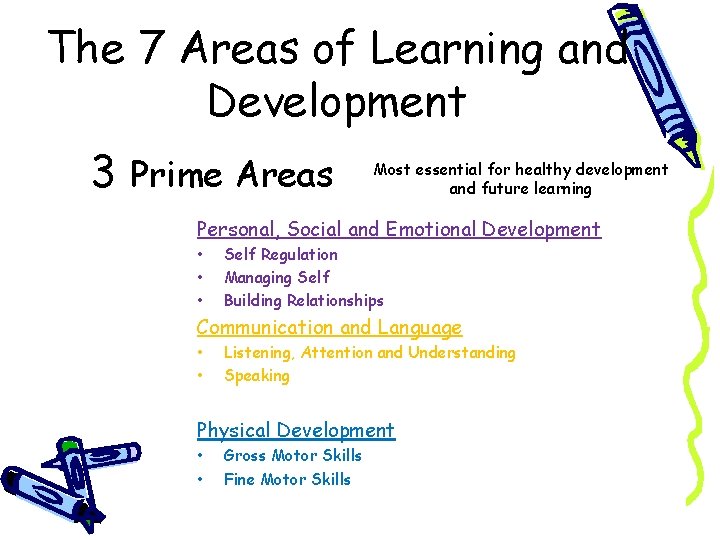
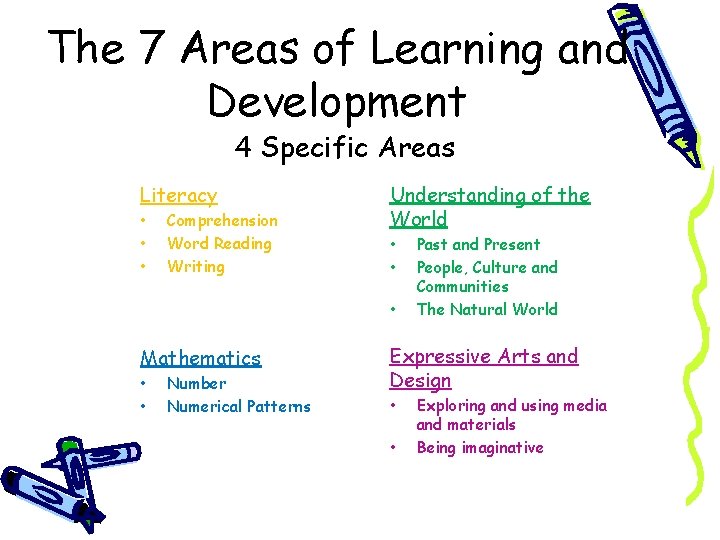
The 7 Areas of Learning and Development • • Personal, Social and Emotional Development Communication and Language Physical Development Literacy Mathematics Understanding the World Expressive Arts and Design
The 7 Areas of Learning and Development 3 Prime Areas Most essential for healthy development and future learning Personal, Social and Emotional Development • • • Self Regulation Managing Self Building Relationships Communication and Language • • Listening, Attention and Understanding Speaking Physical Development • • Gross Motor Skills Fine Motor Skills
The 7 Areas of Learning and Development 4 Specific Areas Literacy • • • Comprehension Word Reading Writing Understanding of the World • • • Mathematics • • Number Numerical Patterns Past and Present People, Culture and Communities The Natural World Expressive Arts and Design • • Exploring and using media and materials Being imaginative
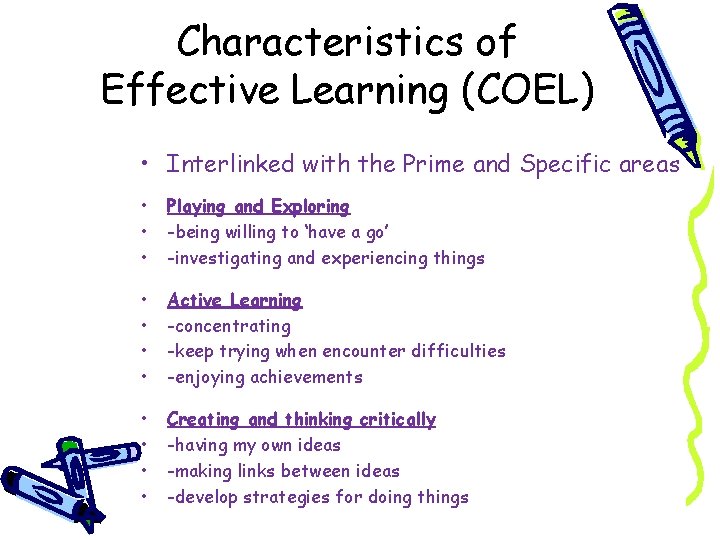
Characteristics of Effective Learning (COEL) • Interlinked with the Prime and Specific areas • • • Playing and Exploring -being willing to ‘have a go’ -investigating and experiencing things • • Active Learning -concentrating -keep trying when encounter difficulties -enjoying achievements • • Creating and thinking critically -having my own ideas -making links between ideas -develop strategies for doing things
Why are the Characteristics of Effective Learning (COEL) important? • Life long learners • Self motivation • Independence
How can you help at home? • The importance of Prime areas • Value play • Be specific with praise (value effort) • Talk about the process- not the product • Reading, Writing, People, Cultures and Communities, The Natural World
Sharing books at home Enjoy and share books together – read and re-read those they love best! Listen to story CDs. Teach nursery rhymes or action songs. Let them see you reading. Read, read! Books will be matched according to the phonic stage of your child.
Readings tips • Let your child hold the book and turn the pages and take ownership of the book. • Encourage your child to follow the text with their finger. At first your child will be taught to point at each word, moving on to sliding their finger smoothly under the text. • When your child is trying to sound out an unfamiliar word, give them time to do so. Remind your child to look closely at the sounds of the word to help them. Say each sound and then blend it back together again. If they are still stuck, say the sounds for them to hear.
Reading tips • Gently encourage your child to re-read a word or sentence to check that it makes sense. • As your child becomes more confident they will start to self-correct, give them time to do this. • Ask questions about the book you have read, such as, “Why did the cat do that? ” • As they progress, you could ask your child to make predictions as they read.
How to support reading at home • Play sound games such as I Spy • Give a selection of words that begin with the same sound an odd one out, ask the children to identify it. • Play snap or pairs with letter cards, this helps with letter recognition • Reading on a regular basis.
Writing 1. 2. 3. 4. Part of everyday phonics Focused writing groups Writing opportunities around the classroom Handwriting • Pencil grip • Letter shapes and letter formation • Whole words • Short sentences (capital letters, finger spaces etc. ) • Different forms of writing –labels, lists, cards, captions
How can you help? • Pre-writing and gross motor opportunities • Varied writing opportunities s • Modelling e. g. lists, notes, letters
Ideas for home Write sounds/ words on concrete using chalk then call them out and they run to the correct one. Practise writing the sounds/ words on the floor using water in a squirty water bottle. Play pairs to match the sounds- we will eventually do this with words! Play snap with the sounds and get your child to say the sounds as they puts the cards down Using magnetic letters and board to find the sounds and eventually make words Go onto the phonics play website www. phonicsplay. co. uk and look at phase 2 games. Gross motor movements.
Ideas for home • Make letters/ words using playdough • Play noughts and crosses with sounds in the grid and get your child to choose one and say the sound/word to win the square. • Talk to your child like a robot and get them to put the words back together. • Write sounds/ words on paper and put around the room or outside, call a sound and get your child to run to it • Play sound/ word bingo. Make a bingo grid with sounds/ words on it and call out. • Get your child to help write the shopping list asking them to sound out words with sounds that they can hear don't worry at this stage if it looks wrong e. g. apul instead of apple.
Maths 1. Teacher directed daily lessons 2. Focused maths groups 3. Maths opportunities around the classroom • Have a deeper understanding of the composition of numbers to 10 • Subitising to 5 (recognising quantities without counting) • Automatic recall of number bonds to 5 and some to ten • Odd and Even numbers, double facts, comparing quantities
Pre-School Maths • • Finger rhymes Mathematical language: more, same, fewer Fast recognition of up to 3 objects (subitising) Accurate counting of sets up to 5 (say one number for each item. The last number said is the size of the set • Shapes, size, length, weight and capacity in the environment • ‘Position’ and spatial words, e. g. ‘under the table’, ‘down the drain’, ‘beside the river’ • Patterns in the environment
How can you help? Modelling and finding opportunities for: • Reciting numbers accurately • • Recognising numerals 0 -10 and beyond One-to-one counting Shape, Capacity, Time, Money, Weight Numberblocks is a great programme that children enjoy watching.
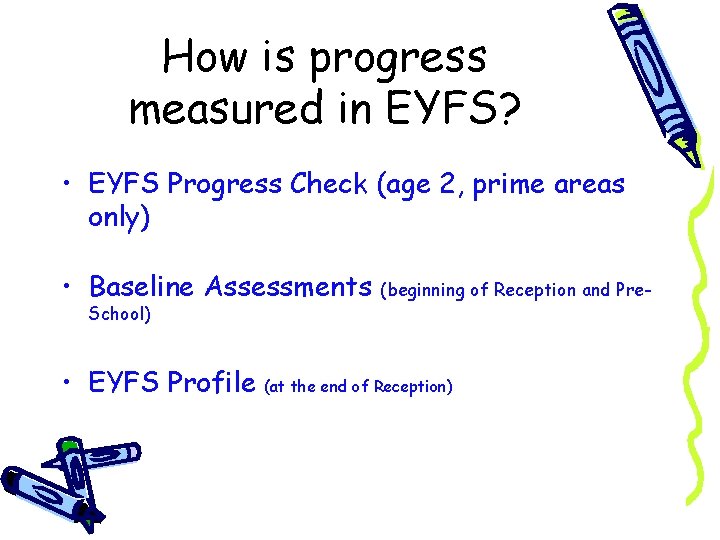
How is progress measured in EYFS? • EYFS Progress Check (age 2, prime areas only) • Baseline Assessments School) • EYFS Profile (beginning of Reception and Pre- (at the end of Reception)
The EYFS Profile • Attainment at the end of EYFS (Reception year only) • 17 Early Learning Goals • Characteristics of Effective Learning summary
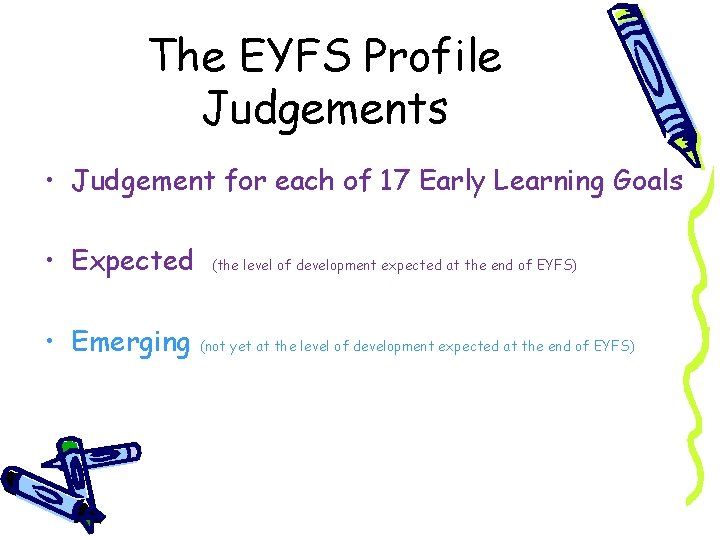
The EYFS Profile Judgements • Judgement for each of 17 Early Learning Goals • Expected (the level of development expected at the end of EYFS) • Emerging (not yet at the level of development expected at the end of EYFS)
Thank you for your time.