
Welcome to the Early Childhood SEL Leadership Series





- Slides: 60
Welcome to the Early Childhood SEL Leadership Series! As you join the call, please: • Mute your microphone (for now)! • Turn your video on so we can all see each other! • Pull up: • Session 6 handouts • “The Heart of Good Guidance” • SEL Observation Tool • Know that you do not need to worry if pets, children, spouses, or other family members make guest appearances during our call today. /1
Opening & Reflection Nevada Early Childhood SEL Series Session 6
Session Objectives Preview the scope of work for the day Build our relationships Check in on our own social-emotional well-being Share and reflect on where we are with our learnings from the previous session /3
Cohort Agreements Stay child-centered Stay present mentally, but take care of yourself Give each other grace Challenge yourself to step outside your comfort zone Seek to understand be understood Lead with equity in mind and voice What’s learned here leaves here (PS: Please stay on mute when not speaking! ) /4
Agenda Opening and Icebreaker Checking In, Sharing, and Reflecting /5
Icebreaker Part 1: Gifts of the Head, Hands, and Heart We all have gifts of the heads, hands, and heart! Pick one of yours to share and enter it into the chat. These do not have to be work-related! HEAD: HEART: HANDS: Something you know a lot care deeply know how to about do well Examples: WWII history, 90 s R&B, science fiction Examples: knitting, Examples: voting rights, climate changing a tire, change sailing, gardening Part 2: Breakout Group Share • Share more information about your gift of the head, hands, and/or heart! Why is that gift special to you? /6
Agenda Opening and Icebreaker Checking In, Sharing, and Reflecting /7
Checking In Handouts, Page 1 Spend the next few minutes silently journaling in response to the questions below: 1. Where am I emotionally today? What is fueling those emotions? How is my body physically responding to those emotions? (Pro tip: Check in with, but don’t dive into, your emotions. As you’re looking at yourself and assessing how you feel, back up a little. Consciously ‘look at’ your feelings as if you were viewing them from the outside. The goal is to acknowledge your emotions. Allow them to inform you, not overwhelm you. ) 2. What do I most need from my colleagues today, to successfully engage in the work ahead of me? 3. What do I need to do to take care of myself today, so I can successfully engage in the work ahead of me? /8
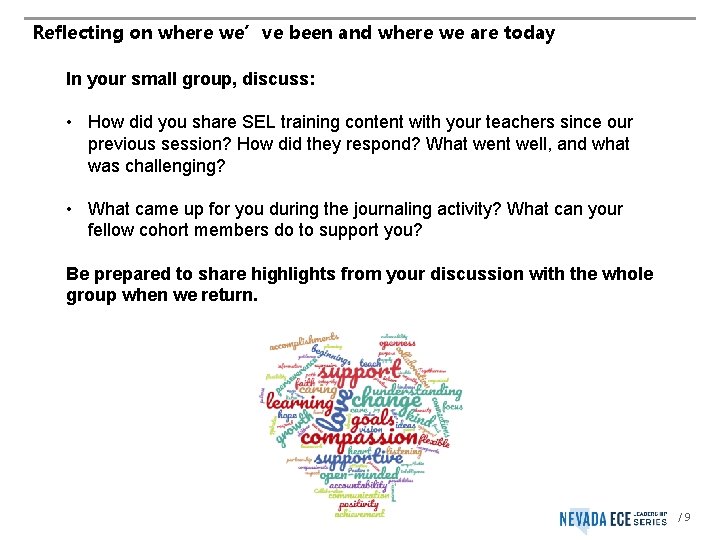
Reflecting on where we’ve been and where we are today In your small group, discuss: • How did you share SEL training content with your teachers since our previous session? How did they respond? What went well, and what was challenging? • What came up for you during the journaling activity? What can your fellow cohort members do to support you? Be prepared to share highlights from your discussion with the whole group when we return. /9
Break / 10
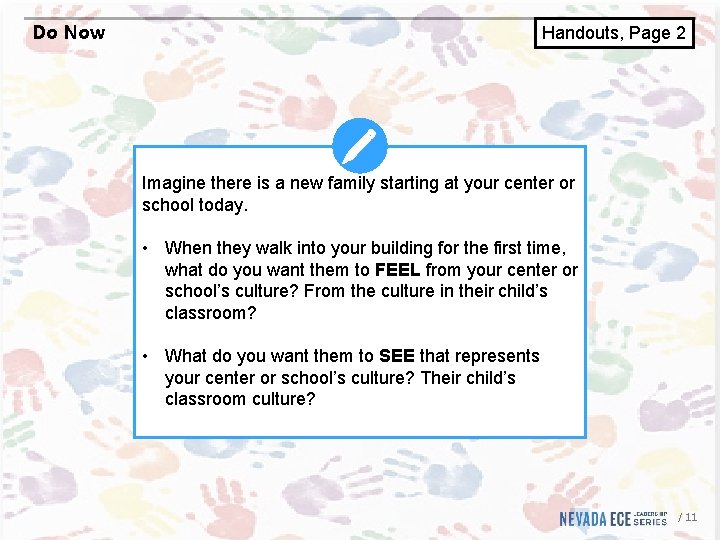
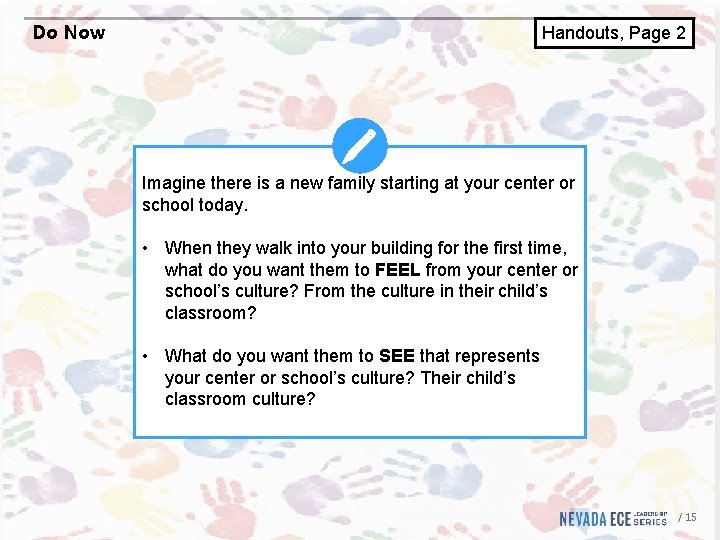
Do Now Handouts, Page 2 Imagine there is a new family starting at your center or school today. • When they walk into your building for the first time, what do you want them to FEEL from your center or school’s culture? From the culture in their child’s classroom? • What do you want them to SEE that represents your center or school’s culture? Their child’s classroom culture? / 11
Integrating Social-Emotional Skills Into Center/School and Classroom Culture Nevada Early Childhood SEL Series Session 6
Objectives • Understand how to build social-emotional teaching practices into center- or school-wide culture and classroom culture • Identify existing opportunities in centers, schools, and classrooms to increase social-emotional development • Plan to support teachers in building social-emotional learning into the fabric of their classroom environments and culture • Plan for next steps to continue to use and improve on the strategies learned throughout the course / 13
Agenda Opening Building a Culture of Social-Emotional Learning Supporting Teachers in Creating a Culture of SEL Planning to Carry Social-Emotional Learning Forward Closing / 14
Do Now Handouts, Page 2 Imagine there is a new family starting at your center or school today. • When they walk into your building for the first time, what do you want them to FEEL from your center or school’s culture? From the culture in their child’s classroom? • What do you want them to SEE that represents your center or school’s culture? Their child’s classroom culture? / 15
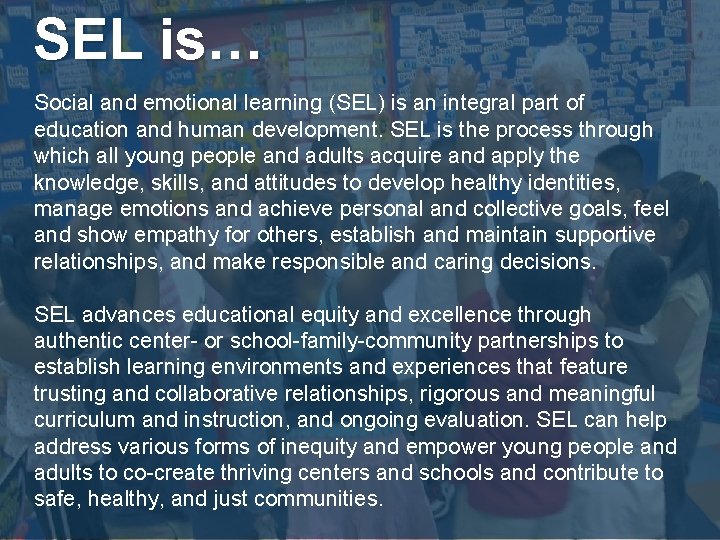
SEL is… Social and emotional learning (SEL) is an integral part of education and human development. SEL is the process through which all young people and adults acquire and apply the knowledge, skills, and attitudes to develop healthy identities, manage emotions and achieve personal and collective goals, feel and show empathy for others, establish and maintain supportive relationships, and make responsible and caring decisions. SEL advances educational equity and excellence through authentic center- or school-family-community partnerships to establish learning environments and experiences that feature trusting and collaborative relationships, rigorous and meaningful curriculum and instruction, and ongoing evaluation. SEL can help address various forms of inequity and empower young people and adults to co-create thriving centers and schools and contribute to safe, healthy, and just communities. / 16
Putting the pieces together “The Heart of Good Guidance” Read “The Heart of Good Guidance”: Put a checkmark beside quotes/passages that stand out to you Put a star next to new learning ? Put a question mark next to anything you’d like to learn more about / 17
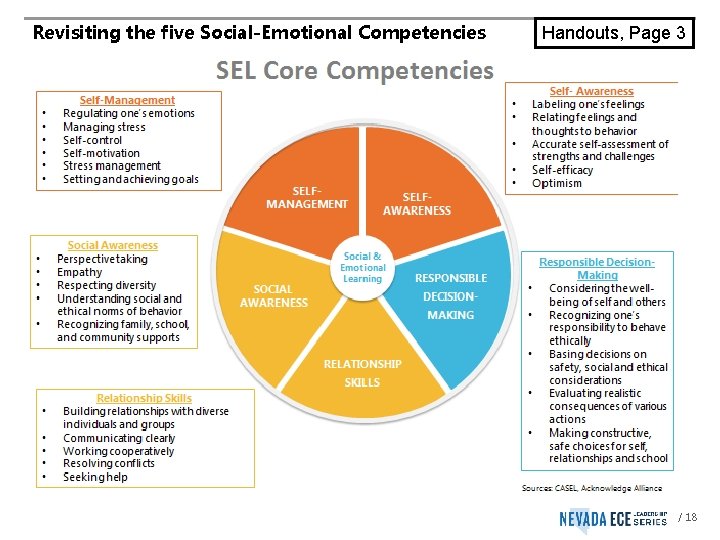
Revisiting the five Social-Emotional Competencies Handouts, Page 3 / 18
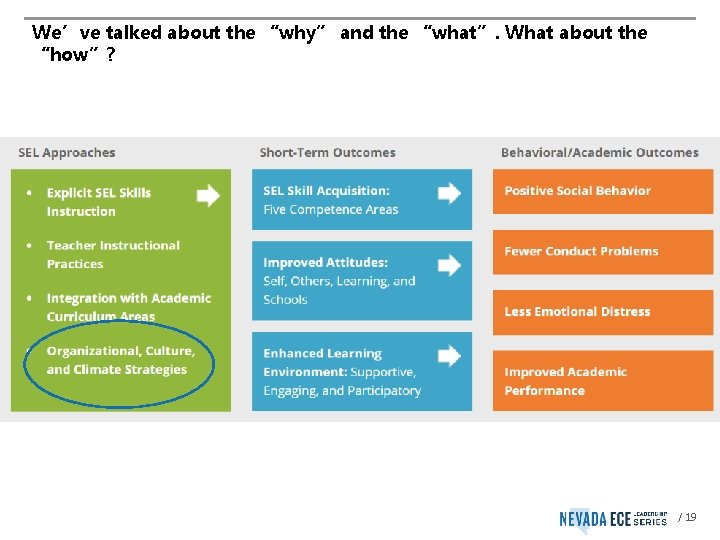
We’ve talked about the “why” and the “what”. What about the “how”? / 19
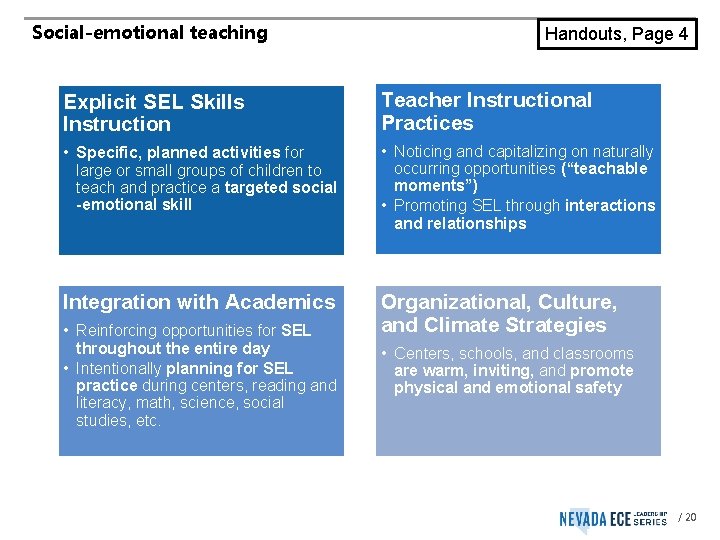
Social-emotional teaching Handouts, Page 4 Explicit SEL Skills Instruction Teacher Instructional Practices • Specific, planned activities for large or small groups of children to teach and practice a targeted social -emotional skill • Noticing and capitalizing on naturally occurring opportunities (“teachable moments”) • Promoting SEL through interactions and relationships Integration with Academics Organizational, Culture, and Climate Strategies • Reinforcing opportunities for SEL throughout the entire day • Intentionally planning for SEL practice during centers, reading and literacy, math, science, social studies, etc. • Centers, schools, and classrooms are warm, inviting, and promote physical and emotional safety / 20
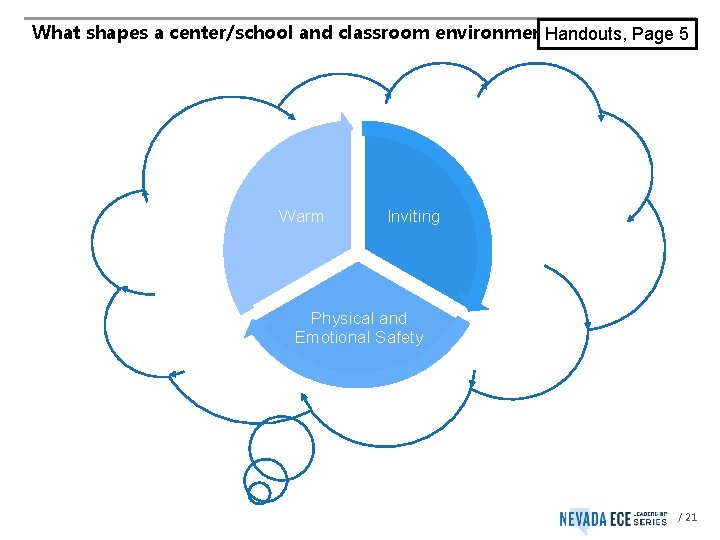
What shapes a center/school and classroom environment? Handouts, Page 5 Warm Inviting Physical and Emotional Safety / 21
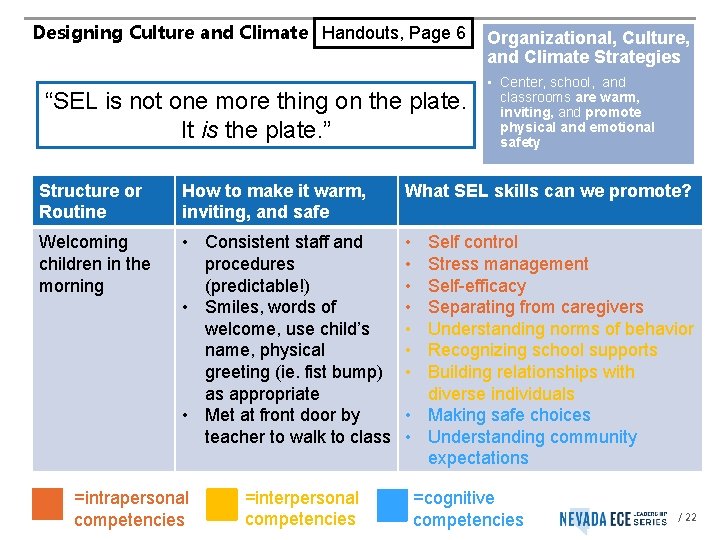
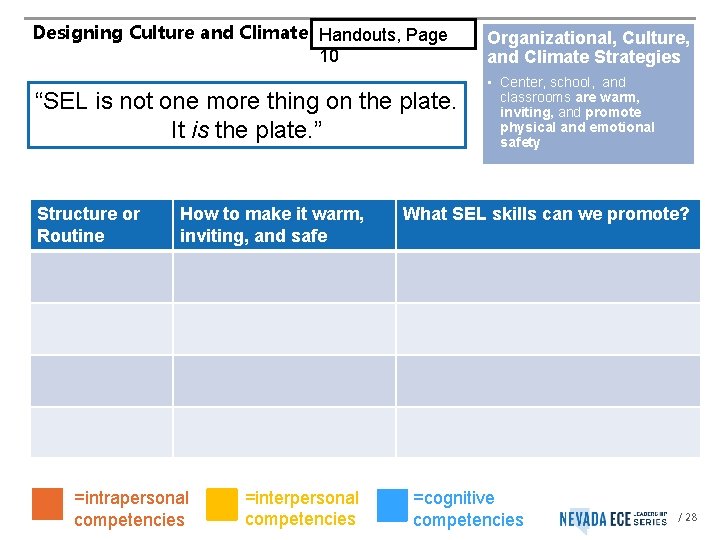
Designing Culture and Climate Handouts, Page 6 “SEL is not one more thing on the plate. It is the plate. ” Organizational, Culture, and Climate Strategies • Center, school, and classrooms are warm, inviting, and promote physical and emotional safety Structure or Routine How to make it warm, inviting, and safe What SEL skills can we promote? Welcoming children in the morning • Consistent staff and procedures (predictable!) • Smiles, words of welcome, use child’s name, physical greeting (ie. fist bump) as appropriate • Met at front door by teacher to walk to class • • =intrapersonal competencies =interpersonal competencies Self control Stress management Self-efficacy Separating from caregivers Understanding norms of behavior Recognizing school supports Building relationships with diverse individuals • Making safe choices • Understanding community expectations =cognitive competencies / 22
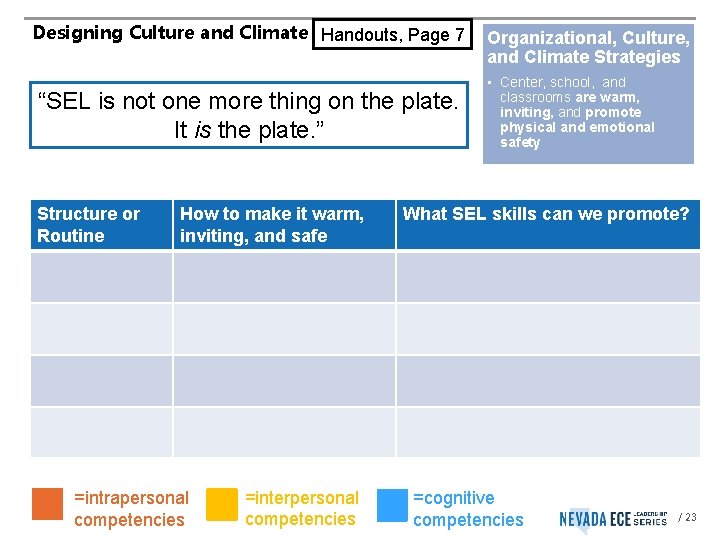
Designing Culture and Climate Handouts, Page 7 “SEL is not one more thing on the plate. It is the plate. ” Structure or Routine How to make it warm, inviting, and safe =intrapersonal competencies =interpersonal competencies Organizational, Culture, and Climate Strategies • Center, school, and classrooms are warm, inviting, and promote physical and emotional safety What SEL skills can we promote? =cognitive competencies / 23
Reflect Handouts, Page 8 What are the biggest opportunities in your center or school to increase social-emotional learning through site-wide culture and climate? / 24
Agenda Opening Building a Culture of Social-Emotional Learning Supporting Teachers in Creating a Culture of SEL Planning to Carry Social-Emotional Learning Forward Closing / 25
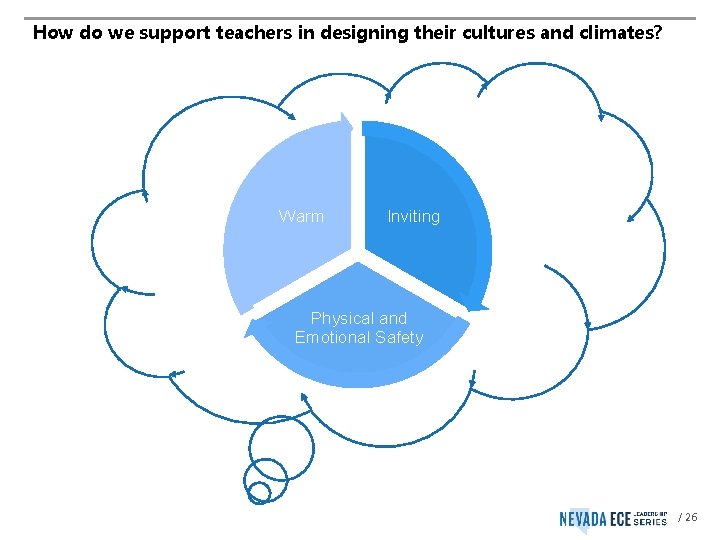
How do we support teachers in designing their cultures and climates? Warm Inviting Physical and Emotional Safety / 26
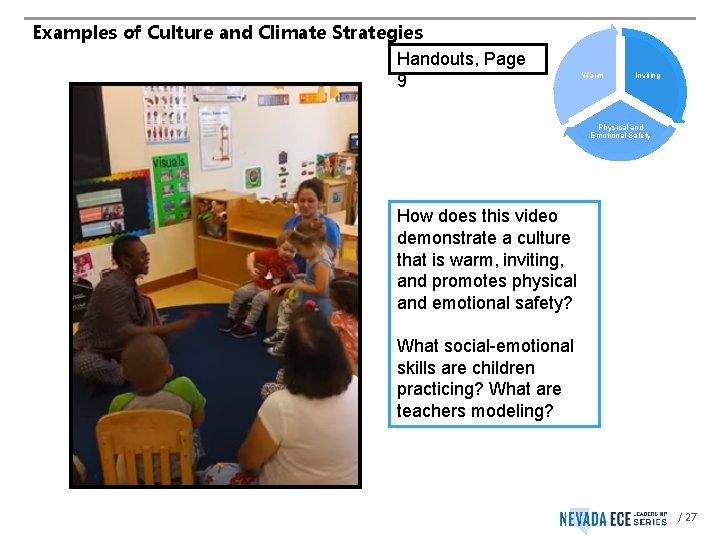
Examples of Culture and Climate Strategies Handouts, Page 9 Warm Inviting Physical and Emotional Safety How does this video demonstrate a culture that is warm, inviting, and promotes physical and emotional safety? What social-emotional skills are children practicing? What are teachers modeling? / 27
Designing Culture and Climate Handouts, Page 10 Organizational, Culture, and Climate Strategies “SEL is not one more thing on the plate. It is the plate. ” • Center, school, and classrooms are warm, inviting, and promote physical and emotional safety Structure or Routine How to make it warm, inviting, and safe =intrapersonal competencies =interpersonal competencies What SEL skills can we promote? =cognitive competencies / 28
Reflect Handouts, Page 11 How might planning in this way support social-emotional learning across the classrooms in your center or school? / 29
Agenda Opening Building a Culture of Social-Emotional Learning Supporting Teachers in Creating a Culture of SEL Planning to Carry Social-Emotional Learning Forward Closing / 30
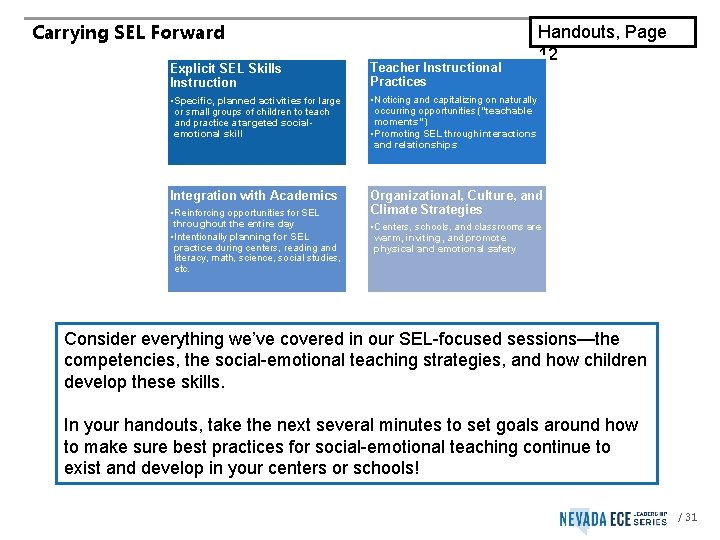
Carrying SEL Forward Handouts, Page 12 Explicit SEL Skills Instruction Teacher Instructional Practices • Specific, planned activities for large or small groups of children to teach and practice a targeted socialemotional skill • Noticing and capitalizing on naturally occurring opportunities (“teachable moments”) • Promoting SEL through interactions and relationships Integration with Academics Organizational, Culture, and Climate Strategies • Reinforcing opportunities for SEL throughout the entire day • Intentionally planning for SEL practice during centers, reading and literacy, math, science, social studies, etc. • Centers, schools, and classrooms are warm, inviting, and promote physical and emotional safety Consider everything we’ve covered in our SEL-focused sessions—the competencies, the social-emotional teaching strategies, and how children develop these skills. In your handouts, take the next several minutes to set goals around how to make sure best practices for social-emotional teaching continue to exist and develop in your centers or schools! / 31
Agenda Opening Building a Culture of Social-Emotional Learning Supporting Teachers in Creating a Culture of SEL Planning to Carry Social-Emotional Learning Forward Closing / 32
“What’s Learned Here, Leaves Here” With your partner(s), share what you are planning for making sure you carry this learning forward in your center or school beyond this training series! / 33
Break / 34
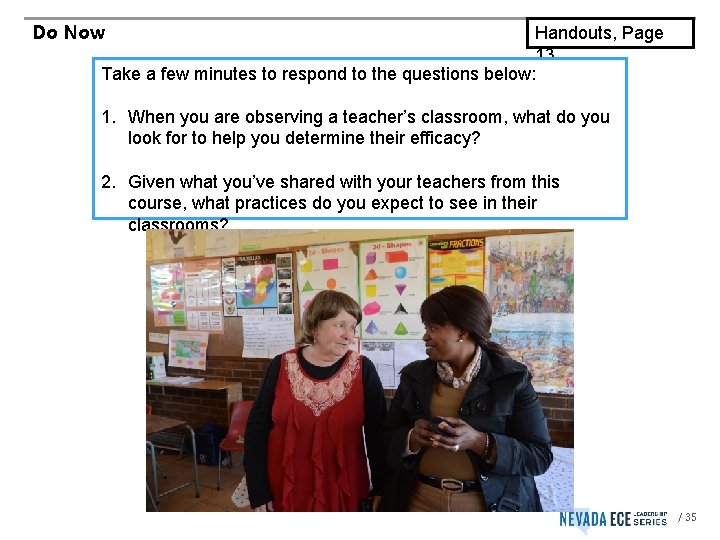
Do Now Handouts, Page 13 Take a few minutes to respond to the questions below: 1. When you are observing a teacher’s classroom, what do you look for to help you determine their efficacy? 2. Given what you’ve shared with your teachers from this course, what practices do you expect to see in their classrooms? / 35
Observing for Social-Emotional Development Nevada Early Childhood SEL Series Session 6
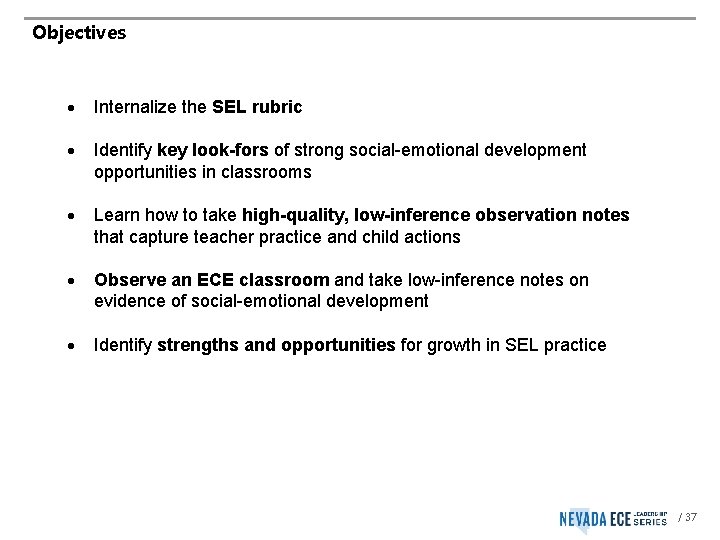
Objectives Internalize the SEL rubric Identify key look-fors of strong social-emotional development opportunities in classrooms Learn how to take high-quality, low-inference observation notes that capture teacher practice and child actions Observe an ECE classroom and take low-inference notes on evidence of social-emotional development Identify strengths and opportunities for growth in SEL practice / 37
Agenda Opening Internalizing the SEL Rubric Observing for SEL Best Practices Identifying Strengths and Opportunities for Growth in SEL Practice Closing / 38
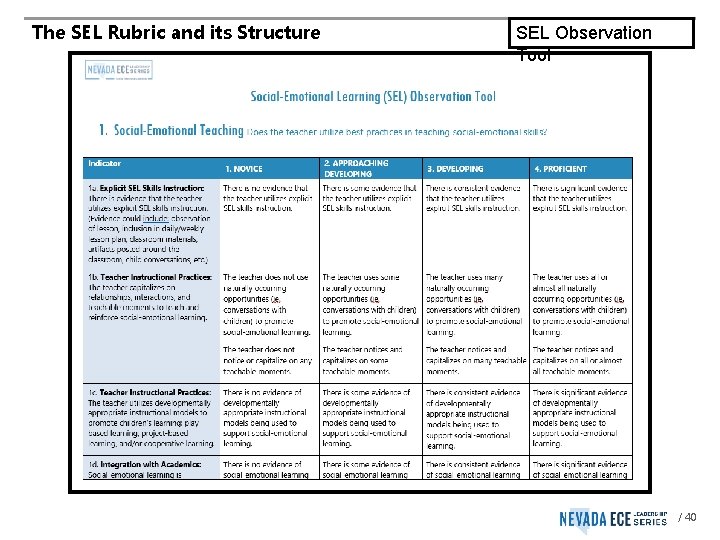
Why Use Rubrics? When observing classrooms, you want to absorb as much as possible about what is happening so that you leave with an accurate understanding of teacher performance and children’s learning. A rubric helps to provide that clear, accurate, and objective picture. • They provide both teachers and leaders clear guidelines for what to do and what to look for in classrooms • All staff have a common language to use to talk about classroom success • Rubrics provide a clear structure for teachers to understand where they are performing and what they should do to grow and improve • Helps leaders identify trends (both strengths and growth areas) across classrooms and throughout the center or school • The rubric we will use allows teachers and leaders to focus on instruction and child learning, as opposed to compliance / 39
The SEL Rubric and its Structure SEL Observation Tool / 40
Reflect Handouts, Page 14 How will the SEL rubric support you and your teachers in growing socialemotional learning opportunities for children across your center or school? / 41
Agenda Opening Internalizing the SEL Rubric Observing for SEL Best Practices Identifying Strengths and Opportunities for Growth in SEL Practice Closing / 42
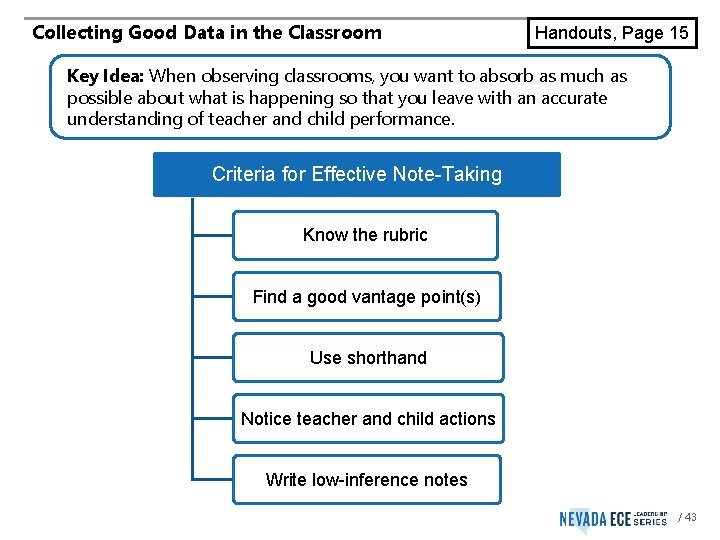
Collecting Good Data in the Classroom Handouts, Page 15 Key Idea: When observing classrooms, you want to absorb as much as possible about what is happening so that you leave with an accurate understanding of teacher and child performance. Criteria for Effective Note-Taking Know the rubric Find a good vantage point(s) Use shorthand Notice teacher and child actions Write low-inference notes / 43
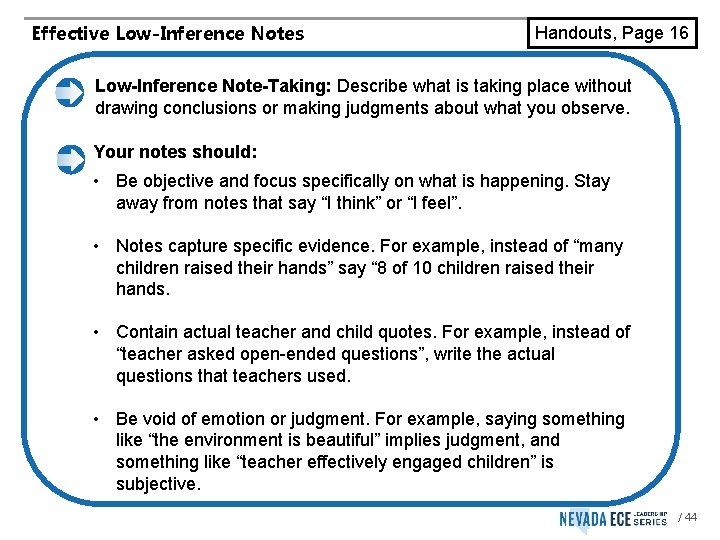
Effective Low-Inference Notes Handouts, Page 16 Low-Inference Note-Taking: Describe what is taking place without drawing conclusions or making judgments about what you observe. Your notes should: • Be objective and focus specifically on what is happening. Stay away from notes that say “I think” or “I feel”. • Notes capture specific evidence. For example, instead of “many children raised their hands” say “ 8 of 10 children raised their hands. • Contain actual teacher and child quotes. For example, instead of “teacher asked open-ended questions”, write the actual questions that teachers used. • Be void of emotion or judgment. For example, saying something like “the environment is beautiful” implies judgment, and something like “teacher effectively engaged children” is subjective. / 44
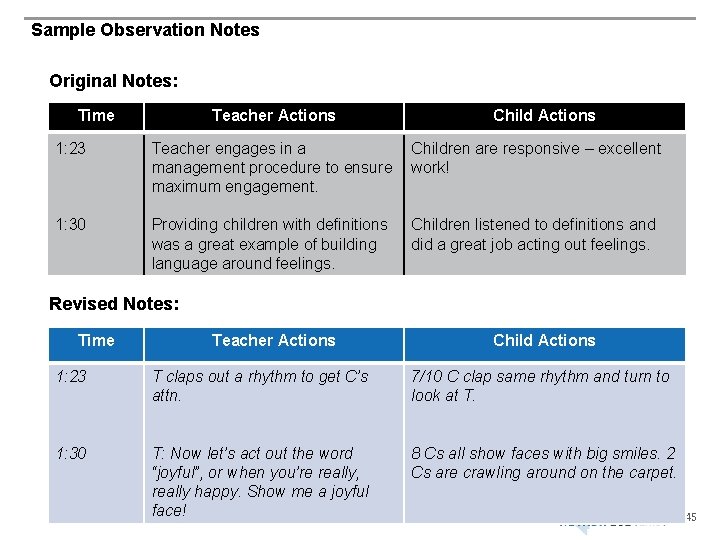
Sample Observation Notes Original Notes: Time Teacher Actions Child Actions 1: 23 Teacher engages in a management procedure to ensure maximum engagement. Children are responsive – excellent work! 1: 30 Providing children with definitions was a great example of building language around feelings. Children listened to definitions and did a great job acting out feelings. Revised Notes: Time Teacher Actions Child Actions 1: 23 T claps out a rhythm to get C’s attn. 7/10 C clap same rhythm and turn to look at T. 1: 30 T: Now let’s act out the word “joyful”, or when you’re really, really happy. Show me a joyful face! 8 Cs all show faces with big smiles. 2 Cs are crawling around on the carpet. / 45
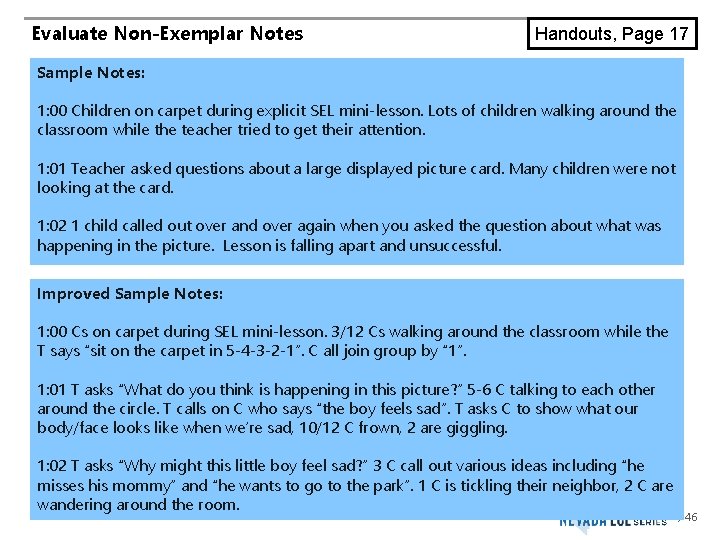
Evaluate Non-Exemplar Notes Handouts, Page 17 Sample Notes: 1: 00 Children on carpet during explicit SEL mini-lesson. Lots of children walking around the classroom while the teacher tried to get their attention. 1: 01 Teacher asked questions about a large displayed picture card. Many children were not looking at the card. 1: 02 1 child called out over and over again when you asked the question about what was happening in the picture. Lesson is falling apart and unsuccessful. Improved Sample Notes: 1: 00 Cs on carpet during SEL mini-lesson. 3/12 Cs walking around the classroom while the T says “sit on the carpet in 5 -4 -3 -2 -1”. C all join group by “ 1”. 1: 01 T asks “What do you think is happening in this picture? ” 5 -6 C talking to each other around the circle. T calls on C who says “the boy feels sad”. T asks C to show what our body/face looks like when we’re sad, 10/12 C frown, 2 are giggling. 1: 02 T asks “Why might this little boy feel sad? ” 3 C call out various ideas including “he misses his mommy” and “he wants to go to the park”. 1 C is tickling their neighbor, 2 C are wandering around the room. / 46
Check Your Understanding Consider what we have just gone over about criteria for effective note-taking during observations and the characteristics of low-inference notes. • What are the five criteria for effective note-taking during classroom observations? • What characteristics make your notes “low-inference”? Why is it important for your notes to be low-inference? / 47
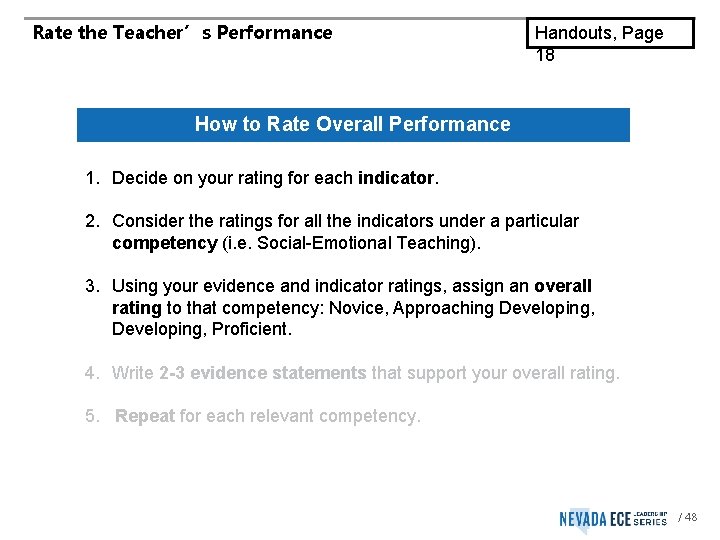
Rate the Teacher’s Performance Handouts, Page 18 How to Rate Overall Performance 1. Decide on your rating for each indicator. 2. Consider the ratings for all the indicators under a particular competency (i. e. Social-Emotional Teaching). 3. Using your evidence and indicator ratings, assign an overall rating to that competency: Novice, Approaching Developing, Proficient. 4. Write 2 -3 evidence statements that support your overall rating. 5. Repeat for each relevant competency. / 48
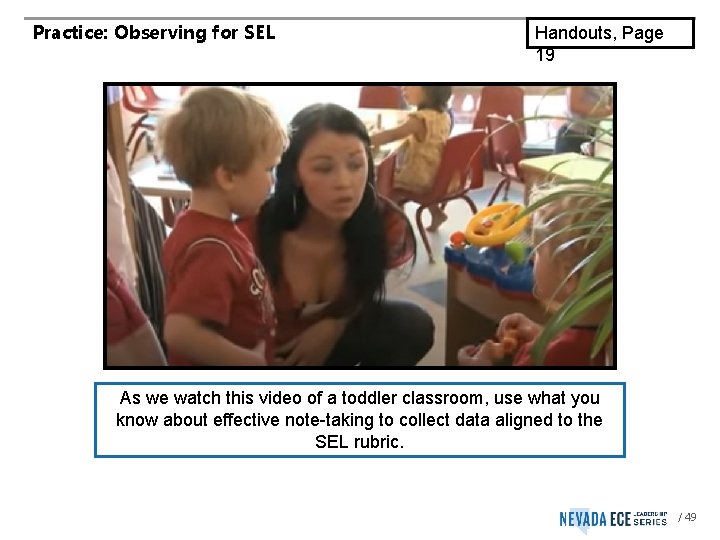
Practice: Observing for SEL Handouts, Page 19 As we watch this video of a toddler classroom, use what you know about effective note-taking to collect data aligned to the SEL rubric. / 49
Break / 50
Agenda Opening Internalizing the SEL Rubric Observing for SEL Best Practices Identifying Strengths and Opportunities for Growth in SEL Practice Closing / 51
Strengths and Opportunities for Growth Handouts, Page 20 Considering how you just rated this teacher across the rubric: 1. What are the 1 -2 biggest strengths you noticed in this teacher’s classroom as related specifically to the SEL rubric? 2. What is the one thing, that if improved, would have the biggest impact on social-emotional learning in this teacher’s classroom? Remember to ground your thinking in the specific indicators and language of the rubric! Be prepared to share in small groups. / 52
Agenda Opening Internalizing the SEL Rubric Observing for SEL Best Practices Identifying Strengths and Opportunities for Growth in SEL Practice Closing / 53
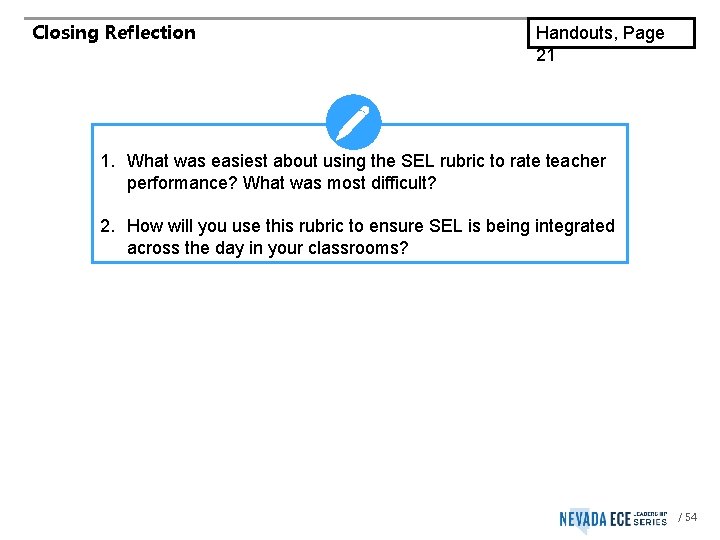
Closing Reflection Handouts, Page 21 1. What was easiest about using the SEL rubric to rate teacher performance? What was most difficult? 2. How will you use this rubric to ensure SEL is being integrated across the day in your classrooms? / 54
Closing and Reflection Nevada Early Childhood Leadership Series Session 6
Session Objectives • Complete reflective self-assessment on growth over the course of the SEL Series • Provide feedback on the day’s sessions and the SEL Series as a whole / 56
Agenda Reflecting on the Day Self-Assessment and Feedback Survey / 57
Let’s look back at the content we covered today. Choose one of the questions below and put your answer in the chat: What are your biggest take-aways from the content that was covered throughout the day today? What will you do to make sure that you “live the learning” from today’s session? What will you do next week? Next month? Throughout the rest of the year? How will your learning from this series as a whole impact your center or school moving forward? / 58
Agenda Reflecting on the Day Self-Assessment and Feedback Survey / 59
Providing Feedback Please take the next ten minutes to complete the self-assessment and feedback survey for today’s session and the series as a whole. It is posted in the chat—please complete the survey before logging off. / 60