
Welcome to the class Todays Lecture Chapter 1
- Slides: 24
Welcome to the class Today’s Lecture Chapter 1 Global marketing
Marketing Management • The text book MARKETING MANGAGEMENT written by Philip Kotler • The Reference book MARKETING concept and cases written by M. J. Etzel, B. J. Walker, W. J. Stanton
Global/International Marketing We would not be surprised to hear about a German Business man wearing an Italian suit meeting an English friend at a Japanese restaurant who later return home to drink Swiss coffee and watch American TV. . .
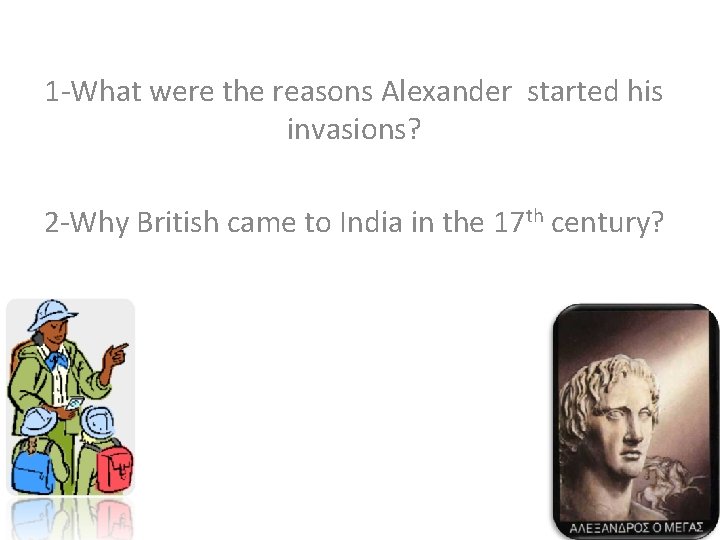
1 -What were the reasons Alexander started his invasions? 2 -Why British came to India in the 17 th century?
Reasons for going International 1 -Access to products otherwise unavailable Access to products which are not available in the domestic market. For example: Fuel Oil 2 -Comparative Advantage Competitive human/natural resources In some countries there might have been economical (cheap) labour or resources which are not available in the home country For Example: Chinese labour, Indian Labour or African gold/diamonds
Attraction of International marketing. i. To seek revenue growth opportunities a) ii. To earn more money due to difference in cost of production or seeking new markets To compete against global competitors a) In order to compete against the rivals iii. To support global customers a) In order to supply your products to your customers abroad iv. To access global knowledge i. v. To understands the like/and dislikes of people in other countries To achieve efficiency in value chain i. To get more efficient that is to access cheaper/economical labour or economical resources
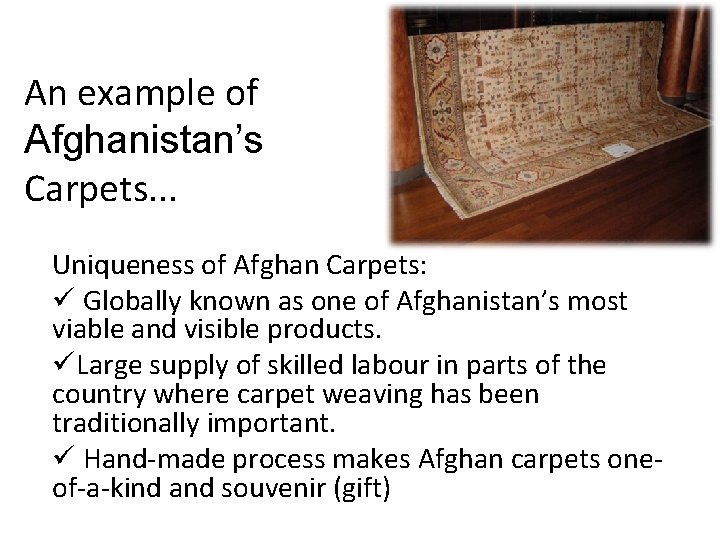
An example of Afghanistan’s Carpets. . . Uniqueness of Afghan Carpets: ü Globally known as one of Afghanistan’s most viable and visible products. üLarge supply of skilled labour in parts of the country where carpet weaving has been traditionally important. ü Hand-made process makes Afghan carpets oneof-a-kind and souvenir (gift)
Analysing the exportation Demand: Due to the uniqueness of Afghanistan’s Carpet there is a high demand in foreign markets Saturation (local demands are fulfilled): The local market is saturated therefore the makers needs expansion Customer Expectation: Global Afghans: Afghans are scattered around the world and could make a good market for exportation, being Global customers
Global Strategy Definition: Global strategy consist of a dispersed location (another country) of each or some part of a value-chain (production process) that are performed OR An efficient approach that involve a company launching production on global basis
Regional Strategy Instead of having similarities among human beings, there are some differences which changes from people to people and culture to culture. Therefore the local culture needs understanding. Definition: The global organisation which changes their global strategy due to difference in local customs, climate or taste is called regional strategy
Two points to remember before going Global 1 - Understanding business environment in the HOST (foreign) country. Local tastes, like & Dislikes, culture, religion etc 2 - Making necessary changes in the marketing strategy necessary for the HOST country. In order to make attachment in the foreign culture we need to make some changes in our own strategy
Sociocultural Culture: It is the collective programming of mind that distinguish between group of people It includes: 1 - Norms-What to do and what not to do 2 - Values-What is right what is wrong 3 - Beliefs-What is true what is false 4 - Symbols- Artefact • Some famous conflict raised due to cartoon issues • Nike and the infamous shoe design
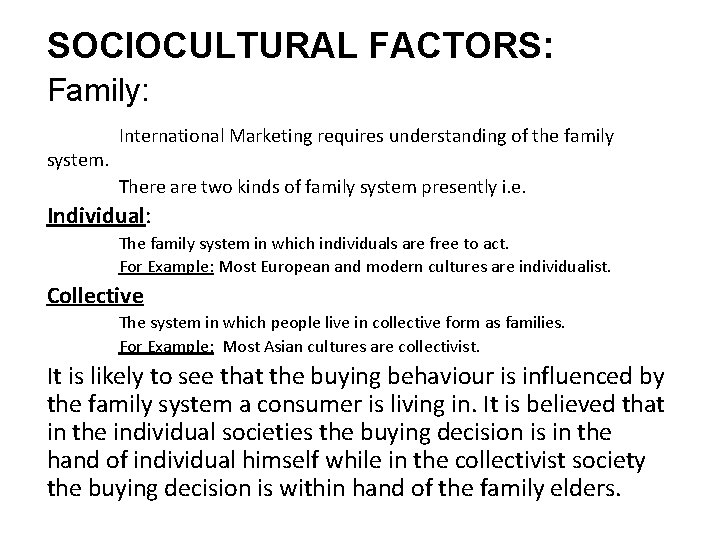
SOCIOCULTURAL FACTORS: Family: International Marketing requires understanding of the family system. There are two kinds of family system presently i. e. Individual: The family system in which individuals are free to act. For Example: Most European and modern cultures are individualist. Collective The system in which people live in collective form as families. For Example: Most Asian cultures are collectivist. It is likely to see that the buying behaviour is influenced by the family system a consumer is living in. It is believed that in the individual societies the buying decision is in the hand of individual himself while in the collectivist society the buying decision is within hand of the family elders.
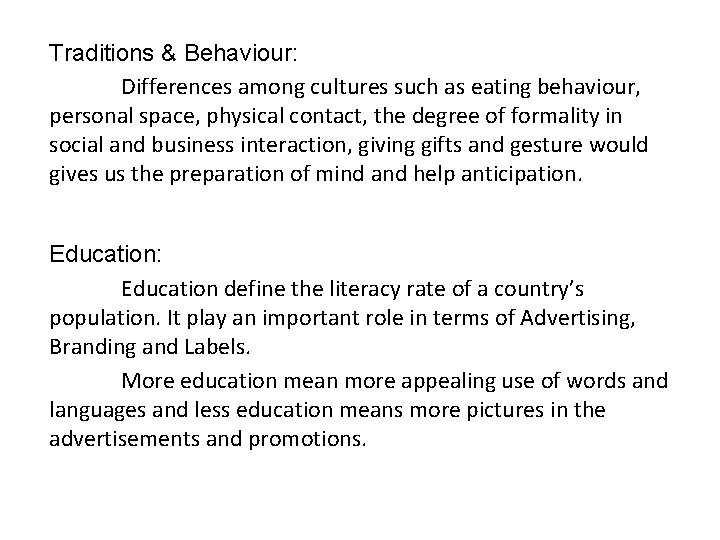
Traditions & Behaviour: Differences among cultures such as eating behaviour, personal space, physical contact, the degree of formality in social and business interaction, giving gifts and gesture would gives us the preparation of mind and help anticipation. Education: Education define the literacy rate of a country’s population. It play an important role in terms of Advertising, Branding and Labels. More education mean more appealing use of words and languages and less education means more pictures in the advertisements and promotions.
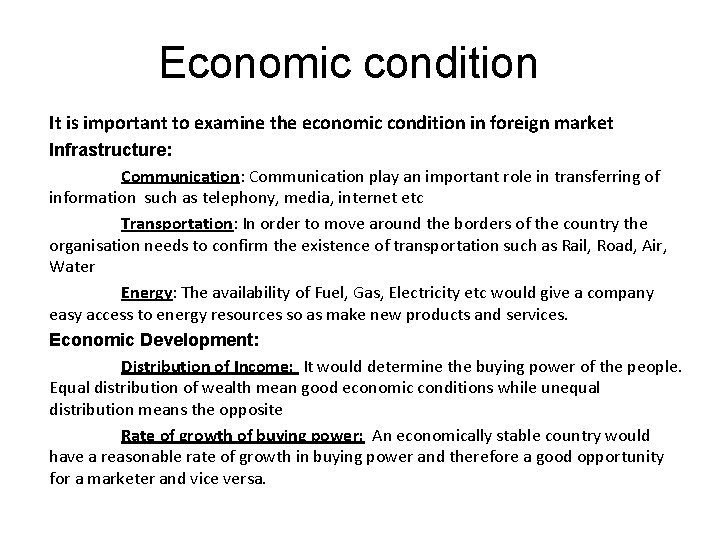
Economic condition It is important to examine the economic condition in foreign market Infrastructure: Communication play an important role in transferring of information such as telephony, media, internet etc Transportation: In order to move around the borders of the country the organisation needs to confirm the existence of transportation such as Rail, Road, Air, Water Energy: The availability of Fuel, Gas, Electricity etc would give a company easy access to energy resources so as make new products and services. Economic Development: Distribution of Income: It would determine the buying power of the people. Equal distribution of wealth mean good economic conditions while unequal distribution means the opposite Rate of growth of buying power: An economically stable country would have a reasonable rate of growth in buying power and therefore a good opportunity for a marketer and vice versa.
Language Differences: Language may cause sometimes ambiguity (confusing) especially when making translation of the marketing brands For Example the Nani Chocolate and currys in India. .
Competitor Local brand may have been strongly bonded due to nationalism. People may not encourage foreign products due to strong attachment with the products produced in the local country. • Such as Arabian Zam Cola • Indian Tata
Deciding Whether to go Global • Operating domestically is easier and safer, otherwise a company needs to learn foreign laws and languages, dealing fluctuation in foreign currencies, face political and legal problems. • Before going global a company shall answer the following questions: – – – Can company understand behaviours of consumer in foreign country? Can a company offer competitive products/services? Can a company adopt other country business culture? Do the company have international experience? Has the company calculated the impact of other country political and legal environment on businesses?
Deciding which market to enter • The possible global markets shall be decided on the following bases: – Market size i. e. the size of population and the growth factor in relation to the products being launched – The cost of doing business in the international markets – The competitive advantage – The risk of investement
Deciding how to enter International Market • Marketing of products on international basis. • International marketing is carried out in the following means: – Exporting – Joint Venture – Licensing – Joint Ownership – Direct Investment
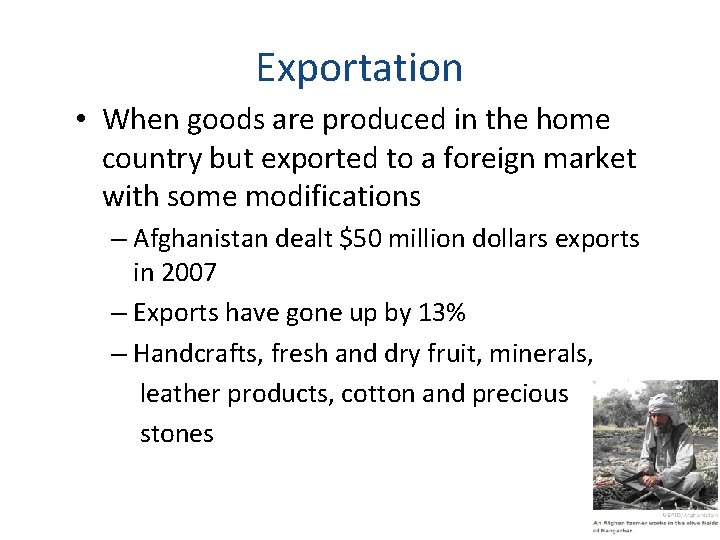
Exportation • When goods are produced in the home country but exported to a foreign market with some modifications – Afghanistan dealt $50 million dollars exports in 2007 – Exports have gone up by 13% – Handcrafts, fresh and dry fruit, minerals, leather products, cotton and precious stones
Joint Venturing • When a company in home country joins a company in foreign country to produce product and services is called joint venture – Afghan Wireless Communications Company (AWCC), a joint venture between Telephone Systems International, Inc. in New York and the Ministry of Communications of the Afghan government – New York-based JWT has signed a joint venture with Kabul-based advertiser Altai Communication.
Licensing – A method in which a company provide licence to a foreign company for manufacturing/service while the licence offer Royalty (fee) and home company share manufacturing process, trade mark, patents and trade secrets • Patent: Government licence to an individual or body giving a right or title for a set period • Trademarks or marks are words, symbols, designs, combinations of letters or numbers, or other devices that identify and distinguish products and services in the marketplace. When trademarks are presented to the public via advertising, marketing, trade shows, or other means, they become one of a company's most valuable assets—potential customers identify a company by its trademark . – Mobile Networks – Cable Operators
Direct Investment • Entering a foreign market developing foreign based assembly or manufacturing facilities • Chinese companies ZTE and Huawei partnered with the Afghan government to implement Afghanistan's digital telephone switches, providing 200, 000 subscriber lines. • China Metallurgical Group Corporation won a $3 billion bid to develop the Aynak copper deposits; the mine is the largest foreign direct investment in Afghanistan.