
Welcome to the CDCA Training Academy Virtual Housekeeping










- Slides: 46
Welcome to the CDCA Training Academy • Virtual Housekeeping: • Bridget Sherman will be tracking the attendance and coordinating the Chat box for at the beginning of the presentation today to help mediate/resolve any technology issues. • To receive CEU’s for this presentation it is important that you stay for the entirety of the presentation. • The following presentation/course will be placed under the “Theories of Addiction” section of the CDCA education grid fulfilling 1. 5 credit hours of the required 5 hours.
Welcome to the CDCA Training Academy • Virtual Housekeeping: • The CDCA Training Academy will provide 33. 50 of the required 40 hours of continuing education to obtain a CDCA. Resources such as the P. A. R. T. conference and “Ebased Academy” can be obtained on the Ashtabula Mental Health and Recovery Services Board website: • https: //www. ashtabulamhrs. org • After the formal presentation is over, I will be providing important information regarding the required code for the course and the evaluation survey that you will need in order to receive the CEU credits.
Diedre R. Fleming, MSW, MS, LSW, LICDC • MH/SUD THERAPIST • MASTER OF SOCIAL WORK 2020 • MASTER OF SCIENCE IN CRIMINOLOGY 2017 • TREATMENT TEAM MEMBER OR ADJUNCT TEAM MEMBER ON SPECIALIZED DOCKETS • PRESENTER FOR THE STATE BAR OF SOUTH DAKOTA CONVENTION 2019 • PRESENTER FOR THE OHIO SUPREME COURT DRUG COURT CONFERENCE 2018
• Substance Use Disorder • Tolerance/Withdrawal • Comorbidity Objectives • Adverse Childhood Experiences • Relationship between environmental experiences and substance use disorder • Trauma-Informed Care • How we can make a difference
Substance Use Disorder: A Trauma Response
Substance Use Disorder The Whys and Wherefores
Why Do People Start Using Substances?
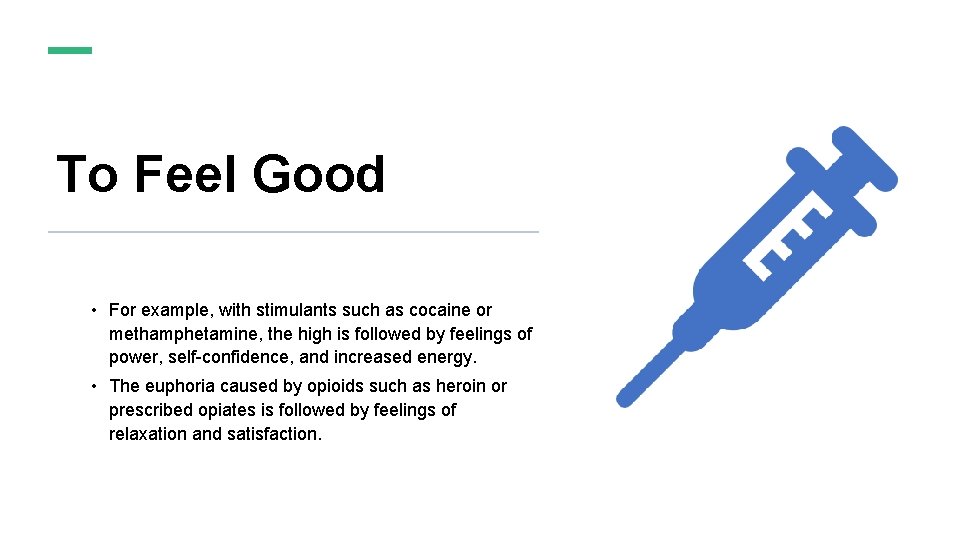
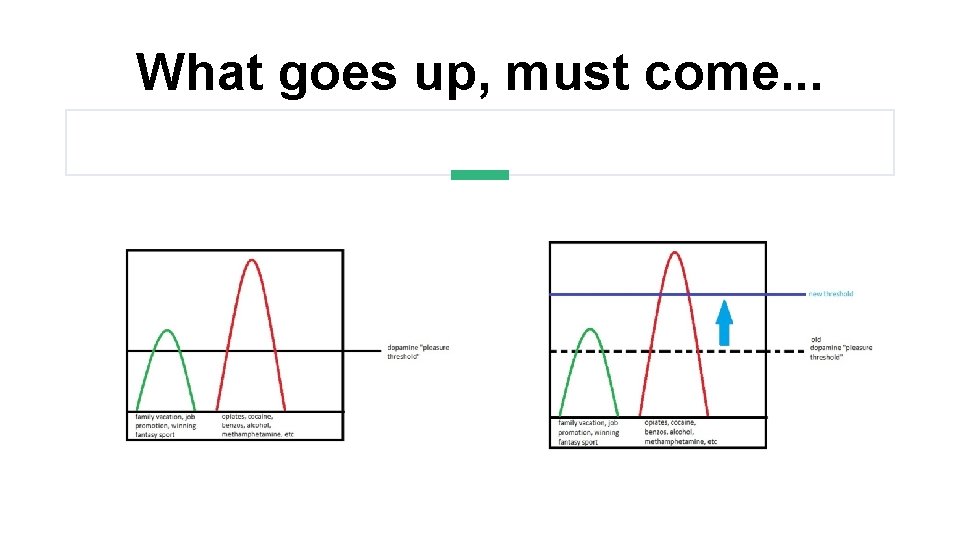
To Feel Good • For example, with stimulants such as cocaine or methamphetamine, the high is followed by feelings of power, self-confidence, and increased energy. • The euphoria caused by opioids such as heroin or prescribed opiates is followed by feelings of relaxation and satisfaction.
Duh
What goes up, must come. . .
To Feel Better • Some people who struggle with mental health start using substances to alleviate the symptoms.
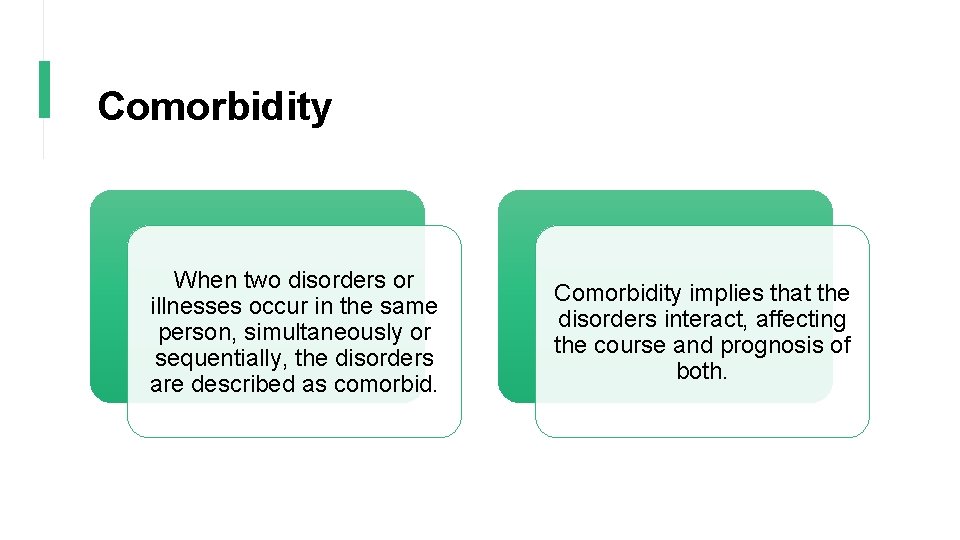
Comorbidity When two disorders or illnesses occur in the same person, simultaneously or sequentially, the disorders are described as comorbid. Comorbidity implies that the disorders interact, affecting the course and prognosis of both.
To Survive • A person’s environment (community, home, school, peer group, etc. ) will affect their likelihood of developing a substance use disorder.
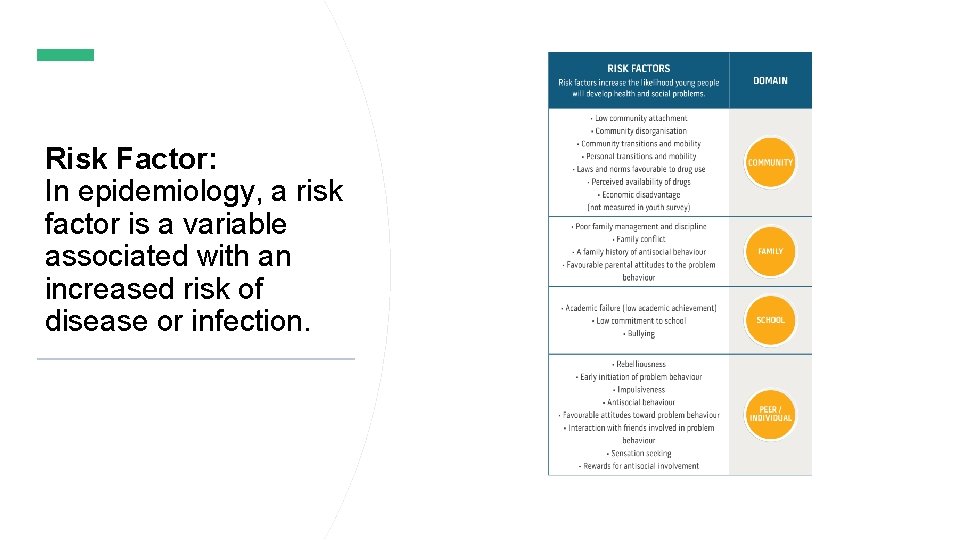
Risk Factor: In epidemiology, a risk factor is a variable associated with an increased risk of disease or infection.
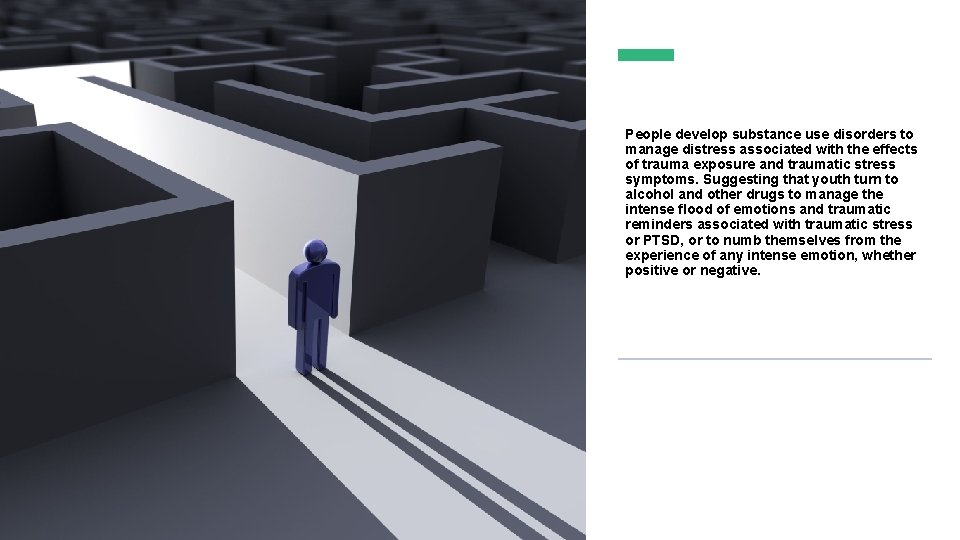
People develop substance use disorders to manage distress associated with the effects of trauma exposure and traumatic stress symptoms. Suggesting that youth turn to alcohol and other drugs to manage the intense flood of emotions and traumatic reminders associated with traumatic stress or PTSD, or to numb themselves from the experience of any intense emotion, whether positive or negative.
“Running from your problems”
“Substance use is ritualized comfort seeking” -Amber Stiles-Bodnar
Research supports theory of trauma as a risk factor for substance using behaviors.
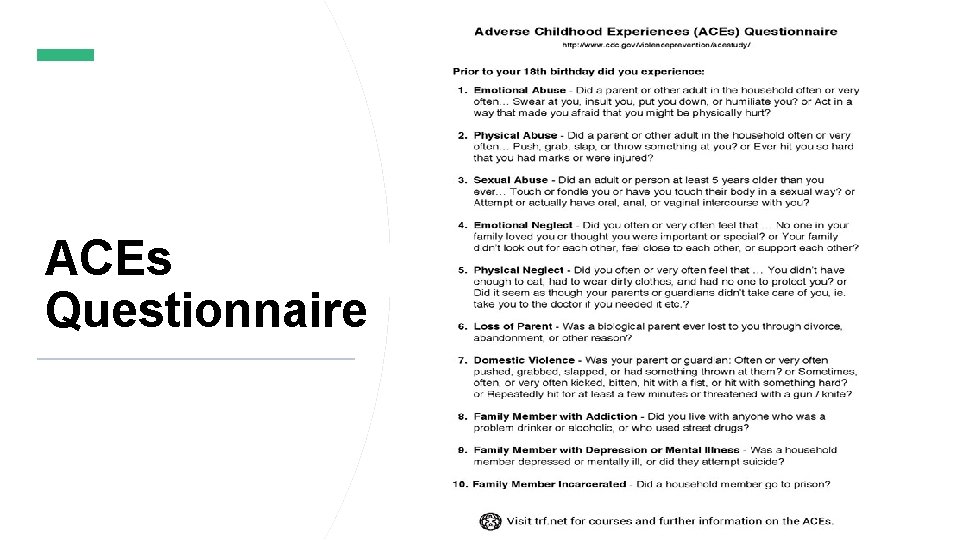
ACEs • Adverse Childhood Experiences: • Study conducted by Kaiser Permanente that is one of the largest investigations of the impact of childhood abuse/ neglect on later-life health/well-being. • The original ACE Study was conducted at Kaiser Permanente from 1995 to 1997 with two waves of data collection. • Over 17, 000 patients receiving physical exams completed confidential surveys regarding their childhood experiences and current health status and behaviors.
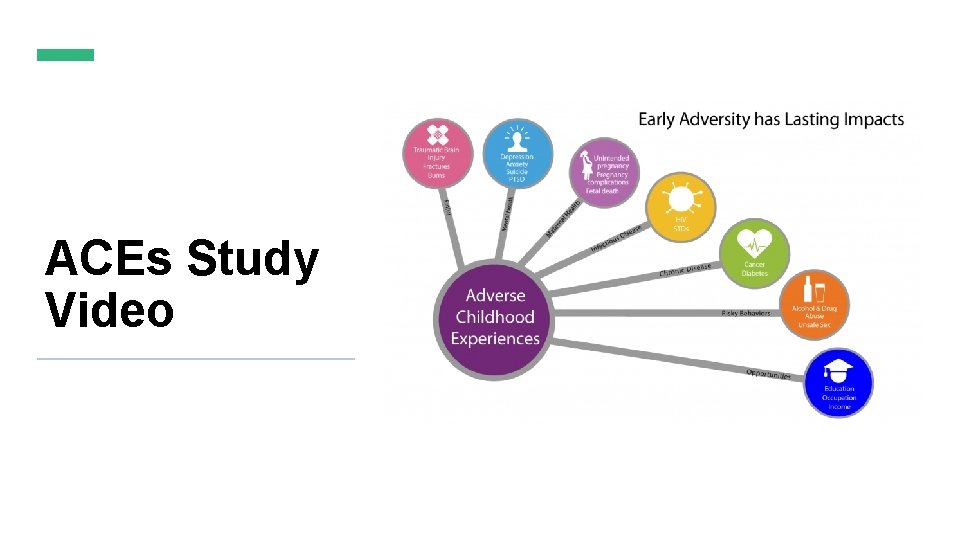
ACEs • Adverse Childhood Experiences: • These experiences can increase: • risks of injury • sexually transmitted infections • maternal and child health problem • teen pregnancy • involvement in sex trafficking • wide range of chronic diseases and leading causes of death such as cancer, diabetes, heart disease, and suicide. • Children growing up with toxic stress may have difficulty: • forming healthy and stable relationships. • unstable work histories as adults • struggle with finances, jobs, and depression throughout life.
ACEs Study Video
ACEs Questionnaire
What the heck did I just say for the last 23 slides?
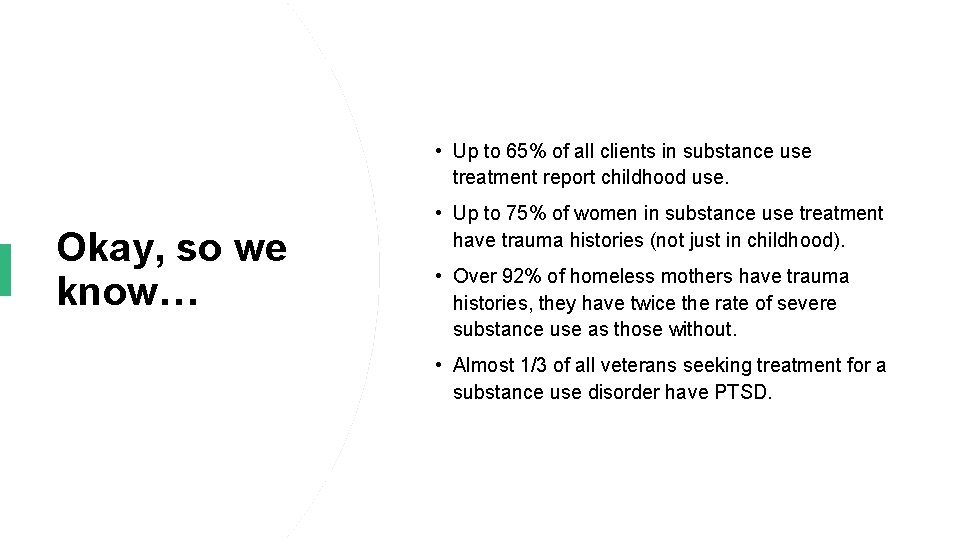
• Up to 65% of all clients in substance use treatment report childhood use. Okay, so we know… • Up to 75% of women in substance use treatment have trauma histories (not just in childhood). • Over 92% of homeless mothers have trauma histories, they have twice the rate of severe substance use as those without. • Almost 1/3 of all veterans seeking treatment for a substance use disorder have PTSD.
Now What?
How do we work with this population?
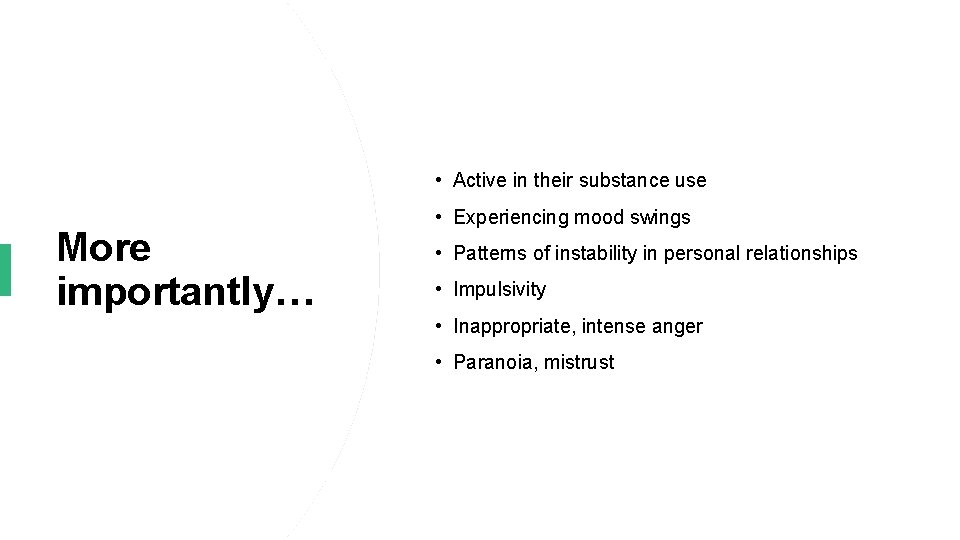
• Active in their substance use More importantly… • Experiencing mood swings • Patterns of instability in personal relationships • Impulsivity • Inappropriate, intense anger • Paranoia, mistrust
When we are treating substance use disorder, we need to remember it’s not…
“What is wrong with you? ”
“What happened to you? ”
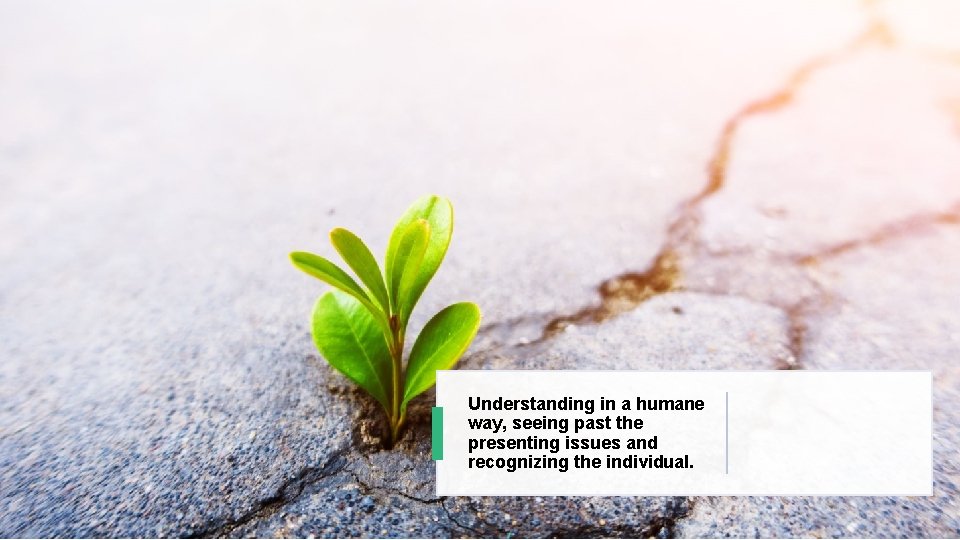
Understanding in a humane way, seeing past the presenting issues and recognizing the individual.
TRAUMAINFORMED CARE THE LENS IN WHICH WE SEE THE CLIENTS
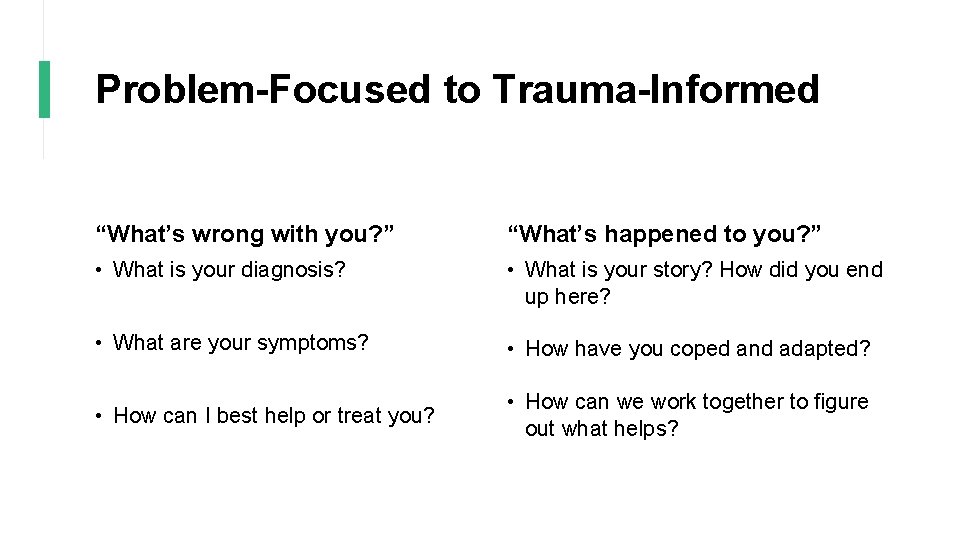
Problem-Focused to Trauma-Informed “What’s wrong with you? ” “What’s happened to you? ” • What is your diagnosis? • What is your story? How did you end up here? • What are your symptoms? • How have you coped and adapted? • How can I best help or treat you? • How can we work together to figure out what helps?
How does being trauma-informed help establish a therapeutic relationship?
What are some other ways we can help?
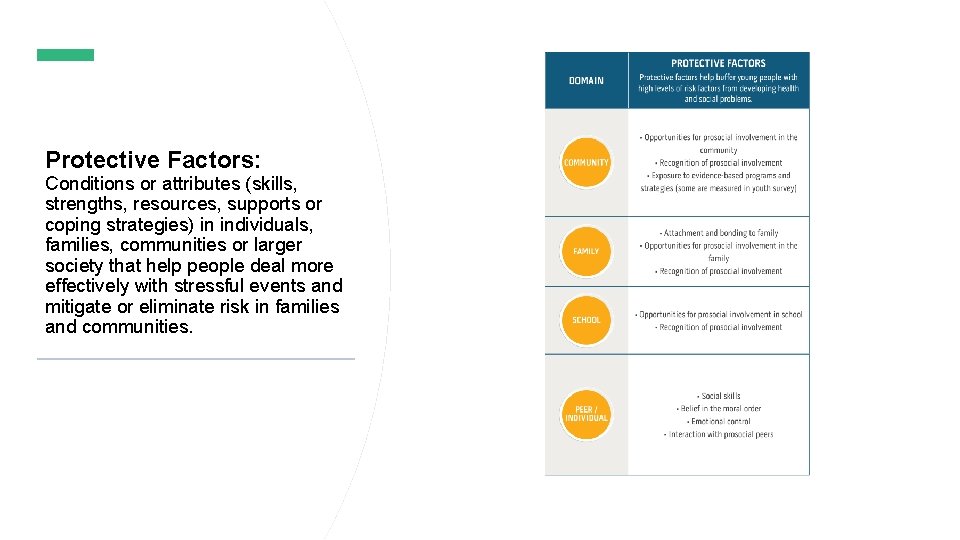
Protective Factors: Conditions or attributes (skills, strengths, resources, supports or coping strategies) in individuals, families, communities or larger society that help people deal more effectively with stressful events and mitigate or eliminate risk in families and communities.
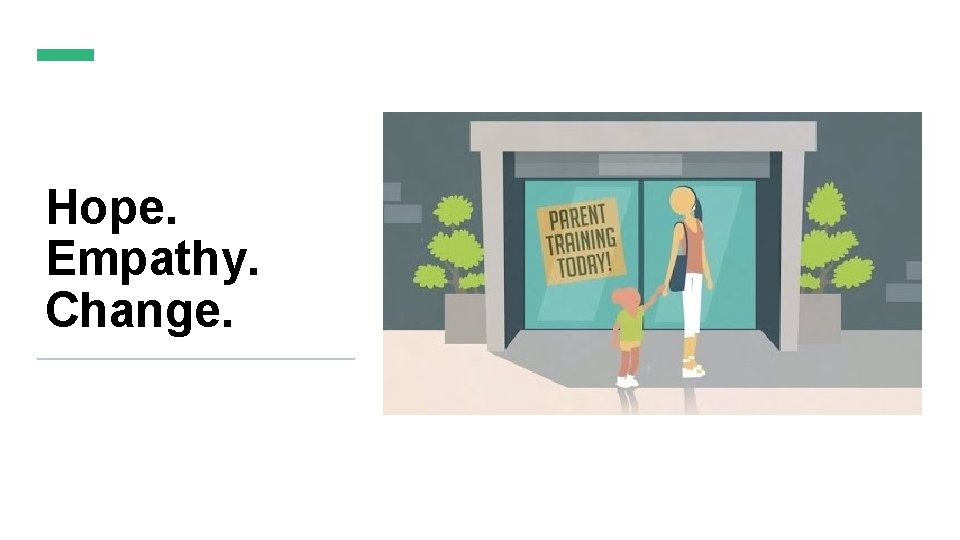
Hope. Empathy. Change.
What are some protective factors in your community/agency?
Final Thought…
Will you ever regret being kind?
Ceu code and evaluation survey • You will receive an email with a course evaluation that you will need to complete in order to receive the continuing education credits. You will need to complete this evaluation form within 24 hours. • You will need to enter this code on the above-mentioned evaluation email: • Code for course completion: SDR 20 D • Reminder to fill this course in on the CDCA grid and keep all continuing education certificates.
References Ardino, V. , Milani, L. , & Di Blasio, P. (2013). PTSD and re-offending risk: the mediating role of worry and a negative perception of other people’s support. European Journal Of Psychotraumatology, 4, 1 -12. Briere, J. N. , & Scott, C. (2015). Principles of trauma therapy: A guide to the symptoms, evaluation, and treatment. Thousand Oaks, CA: SAGE Publications, Inc. Hepworth, D. H. et al. (2016). Direct social work practice: Theory and skills (10 th ed. ). Boston, MA: Cengage Learning. Miller, W. R. , & Rollnick, S. (2013). Motivational interviewing (3 rd ed. ). New York, NY: The Guilford Press. Khoury, L. , Tang, Y. L. , Bradley, B. , Cubells, J. F. , & Ressler, K. J. (2010). Substance use, childhood traumatic experience, and Posttraumatic Stress Disorder in an urban civilian population. Depression and anxiety, 27(12), 1077– 1086. doi: 10. 1002/da. 20751
References Substance Abuse and Mental Health Services Administration. (2018). Trauma-informed approach and trauma-specific interventions. Retrieved from https: //www. samhsa. gov/nctic/trauma-interventions Lane, M. (2019). 2019 Opiate conference. [Power. Point slides]. Labor, N. (2019). The neurobiology of addiction: Addiction 101 [Power. Point slides]. Sundquist, J. (2019). Trauma-informed care. [Power. Point slides]. Parker, M. , & Uraine, M. (2019). Making effective use of your recovery story in peer support relationships. [Power. Point slides].
References National Institute of Health. (2018). Drugs, brains, and behavior: The science of addiction. National Institute on Drug Abuse. Retrieved from https: //www. drugabuse. gov/publications/drugs-brains-behavior-science-addiction on 2019, May 4 Substance Abuse and Mental Health Service Administration (2017). Key substance use and mental health indicators in the United States: Results from the 2016 national survey on drug use and health [Data file]. Retrieved from https: //www. samhsa. gov/data/report/2017 -nsduh-annual-nationalreport Centers for Disease Control and Prevention. (2018). Understanding the epidemic [PDF]. Retrieved from https: //www. cdc. gov/drugoverdose/epidemic/index. html Centers for Disease Control and Prevention. (2018). Wide-ranging online data for epidemiologic research (WONDER). [DATA file]. Retrieved from https: //wonder. cdc. gov/ Scholl L, Seth P, Kariisa M, Wilson N, Baldwin G. Drug and Opioid-Involved Overdose Deaths — United States, 2013– 2017. MMWR Morb Mortal Wkly Rep 2019; 67: 1419– 1427. DOI: http: //dx. doi. org/10. 15585/mmwr. mm 675152 e 1 external icon Kolodny et al. (2015). The prescription opioid and heroin crisis: A public health approach to an epidemic of addiction. Annual Review of Public Health, 36, 559 -74 Rudd RA, Aleshire N, Zibbell JE, Gladden RM. Increases in Drug and Opioid Overdose Deaths – United States, 2000 -2014. MMWR 2016, 64(50); 1378 -82
References National Institute of Health. (2019). Opioid-involved overdose deaths. National Institute on Drug Abuse. Retrieved from https: //www. drugabuse. gov/opioid-summaries-by-state/ohio-opioid-summary Kolb, B. , Gibb, R. , & Robinson, T. (ND). Brain plasticity and behavior. Retrieved from https: //www. psychologicalscience. org/journals/cd/12_1/kolb. cfm Khoury, L. , Tang, Y. L. , Bradley, B. , Cubells, J. F. , & Ressler, K. J. (2010). Substance use, childhood traumatic experience, and Posttraumatic Stress Disorder in an urban civilian population. Depression and anxiety, 27(12), 1077– 1086. doi: 10. 1002/da. 20751 National Drug Early Warning System. (2018). Methamphetamine: A regional drug crisis. Retrieved from https: //ndews. umd. edu/sites/ndews. umd. edu/files/ndews-scs-methamphetamine-report-september-2018 -final. pdf National Alliance on Mental Health. (2019). South Dakota. Retrieved from https: //namisouthdakota. org/nimh-updates/ Myers, D. G. (2013). Psychology in modules (10 th ed). New York, NY: Worth Publishers.