
Welcome to SNOLAB And to the Neutrino Geoscience
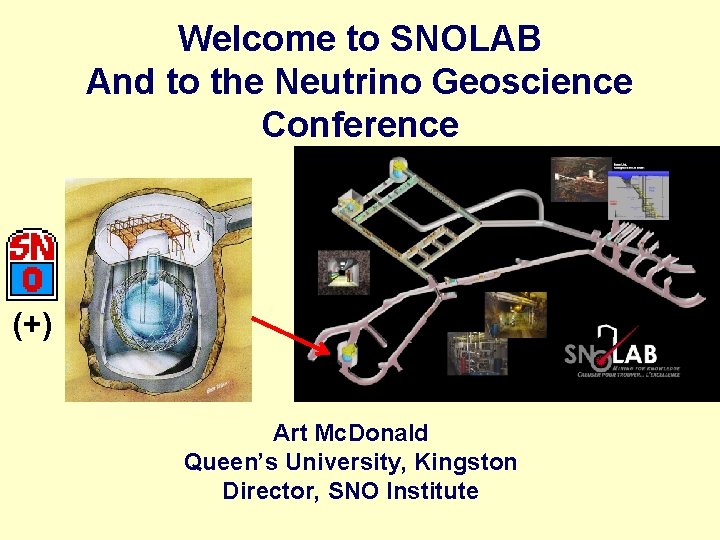
Welcome to SNOLAB And to the Neutrino Geoscience Conference (+) Art Mc. Donald Queen’s University, Kingston Director, SNO Institute
The Enigmatic Neutrino I have done a terrible thing. I have postulated a particle that cannot be detected. W. Pauli 1930
What are Neutrinos? • Neutrinos, along with electrons and quarks are the basic particles of nature that we do not know how to sub-divide further. Neutrinos come in three types (electron, mu, tau) as described in The Standard Model of Elementary Particles, the accepted basic theory of particle physics. They have a mass, but it is more than 5 million times smaller than an electron. • Neutrinos are made in very large numbers in the nuclear reactions that power the Sun. Neutrinos only stop if they hit the nucleus of any atom or an electron head-on. They can pass through a lightyear of lead without stopping. Therefore they are very difficult to detect and far less is known about them than the other basic particles. • Anti-neutrinos are created in the beta decays such as U and Th and in nuclear reactors. Geo-neutrinos are electron anti-neutrinos.
A short summary of Neutrino History 1914 Continuous Beta Spectra Observed: Chadwick 1930 Pauli invents the neutrino to save Energy Conservation 1933 Fermi baptizes the “neutrino”: The Little Neutral one. 1948 Pontecorvo (Chalk River Report): Detection of Neutrinos from Reactors and the Sun 1950 Pontecorvo, Hanna: Neutrino mass limit from Tritium beta decay. 1956 Reines & Cowan observe electron anti-neutrinos from a reactor 1957 Pontecorvo: Postulates Neutrino Oscillations 1962 Lederman, Schwartz, Steinberger observe muon neutrinos 1968 Solar Neutrino flux is too low: Davis measurements with Chlorine, Bahcall calculations 1968 Solar Neutrino Oscillations? : Pontecorvo 1974 Discovery of Electroweak neutral currents via neutrino beams 1987 Neutrinos from Supernova 1987 a: IMB, Kamiokande 1989 Low Solar Neutrino 8 B flux: Kamiokande with water 1992 Low solar neutrino pp flux: Gallex, SAGE with Gallium 1991 LEP experiments show that there are only three light neutrinos 1998 Atmospheric muon neutrino disappearance: Super-Kamiokande
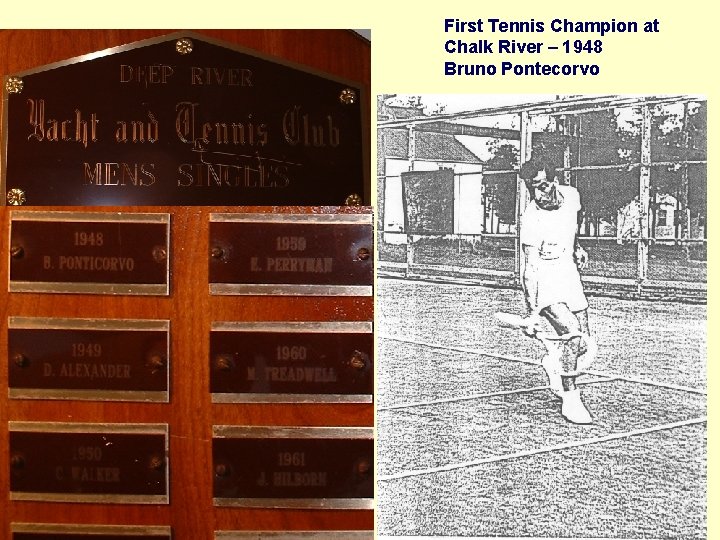
First Tennis Champion at Chalk River – 1948 Bruno Pontecorvo
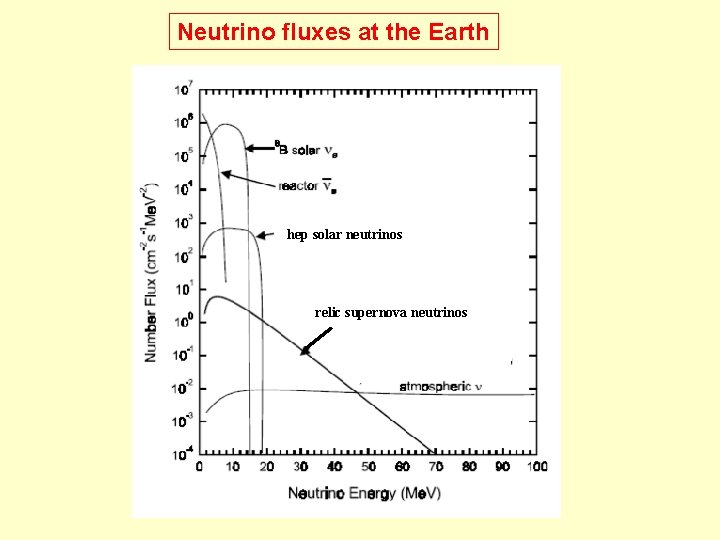
Neutrino fluxes at the Earth hep solar neutrinos relic supernova neutrinos
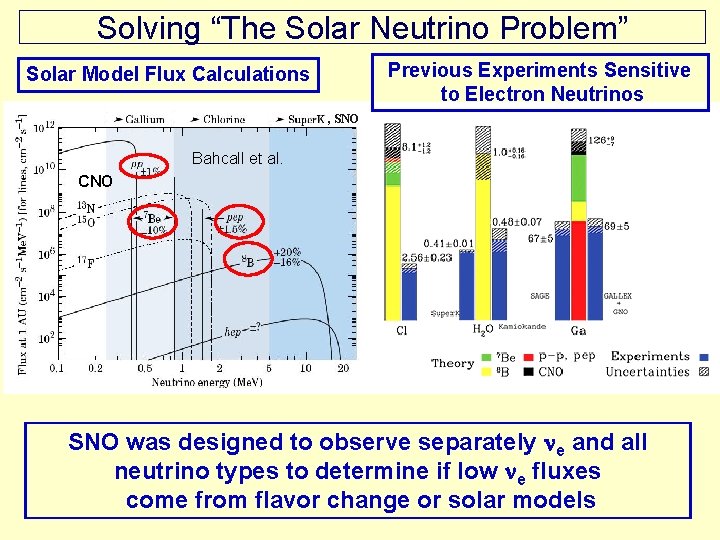
Solving “The Solar Neutrino Problem” Previous Experiments Sensitive to Electron Neutrinos Solar Model Flux Calculations , SNO Bahcall et al. CNO SNO was designed to observe separately ne and all neutrino types to determine if low ne fluxes come from flavor change or solar models
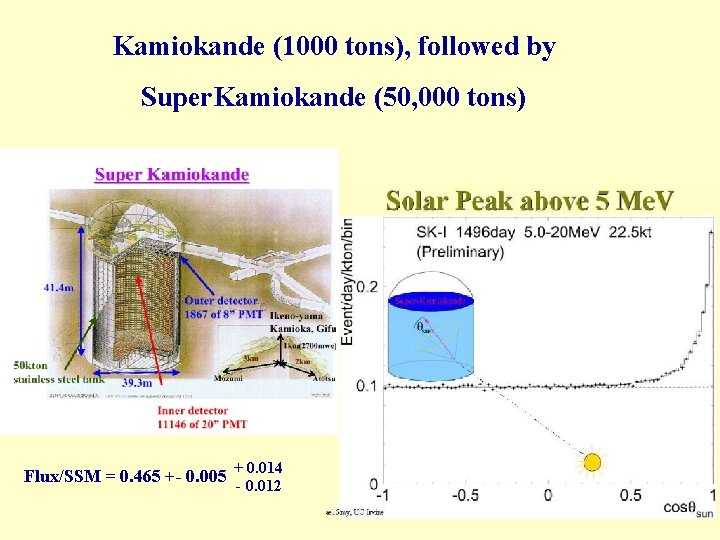
Kamiokande (1000 tons), followed by Super. Kamiokande (50, 000 tons) + 0. 014 Flux/SSM = 0. 465 +- 0. 005 - 0. 012
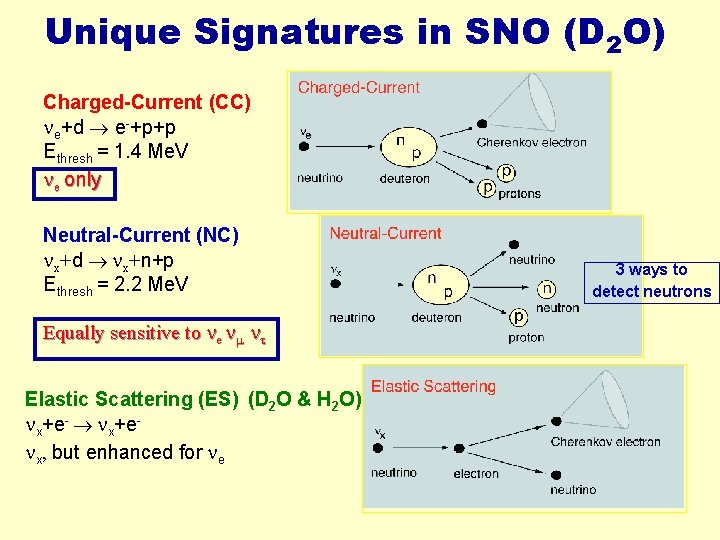
Unique Signatures in SNO (D 2 O) Charged-Current (CC) e+d e-+p+p Ethresh = 1. 4 Me. V e only Neutral-Current (NC) x+d x+n+p Ethresh = 2. 2 Me. V Equally sensitive to e m t Elastic Scattering (ES) (D 2 O & H 2 O) x+e- x+e x, but enhanced for e 3 ways to detect neutrons
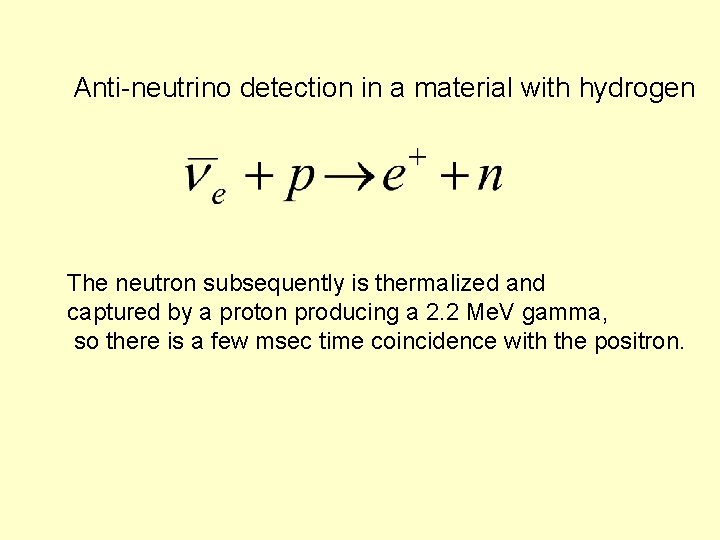
Anti-neutrino detection in a material with hydrogen The neutron subsequently is thermalized and captured by a proton producing a 2. 2 Me. V gamma, so there is a few msec time coincidence with the positron.
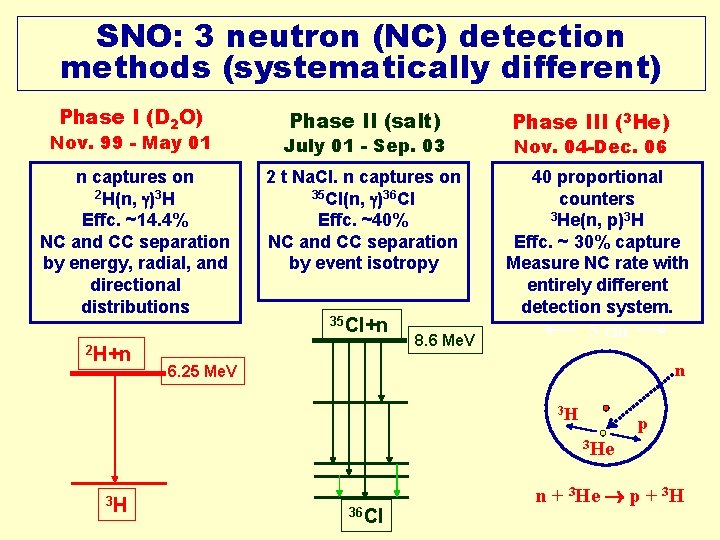
SNO: 3 neutron (NC) detection methods (systematically different) Phase I (D 2 O) Phase II (salt) Nov. 99 - May 01 July 01 - Sep. 03 n captures on 2 H(n, g)3 H Effc. ~14. 4% NC and CC separation by energy, radial, and directional distributions 2 t Na. Cl. n captures on 35 Cl(n, g)36 Cl Effc. ~40% NC and CC separation by event isotropy 2 H+n 35 Cl+n Phase III (3 He) Nov. 04 -Dec. 06 40 proportional counters 3 He(n, p)3 H Effc. ~ 30% capture Measure NC rate with entirely different detection system. 5 cm 8. 6 Me. V n 6. 25 Me. V 3 H p 3 He 3 H 36 Cl n + 3 He p + 3 H
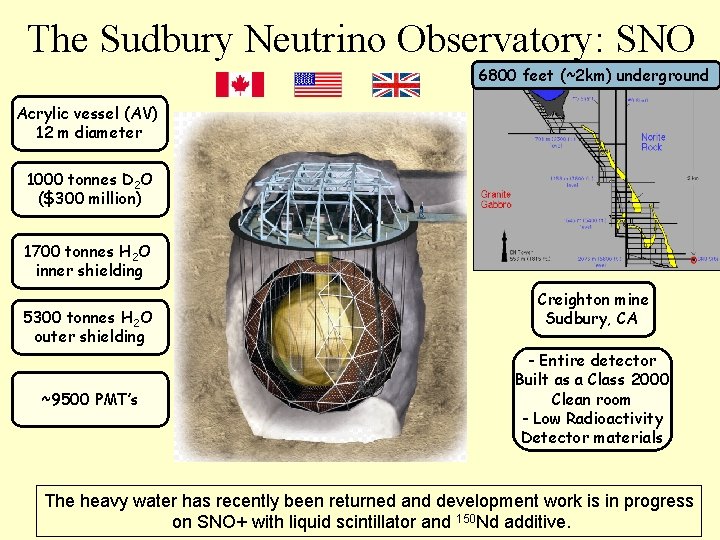
The Sudbury Neutrino Observatory: SNO 6800 feet (~2 km) underground Acrylic vessel (AV) 12 m diameter 1000 tonnes D 2 O ($300 million) 1700 tonnes H 2 O inner shielding 5300 tonnes H 2 O outer shielding ~9500 PMT’s Creighton mine Sudbury, CA - Entire detector Built as a Class 2000 Clean room - Low Radioactivity Detector materials The heavy water has recently been returned and development work is in progress on SNO+ with liquid scintillator and 150 Nd additive.
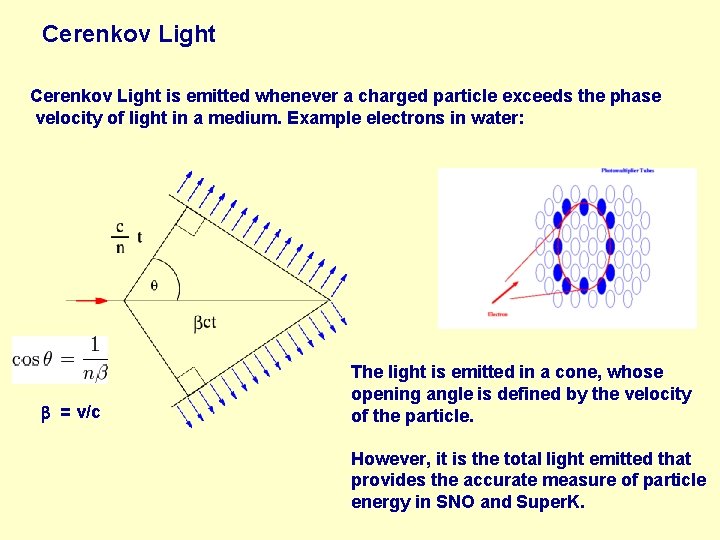
Cerenkov Light is emitted whenever a charged particle exceeds the phase velocity of light in a medium. Example electrons in water: b = v/c The light is emitted in a cone, whose opening angle is defined by the velocity of the particle. However, it is the total light emitted that provides the accurate measure of particle energy in SNO and Super. K.
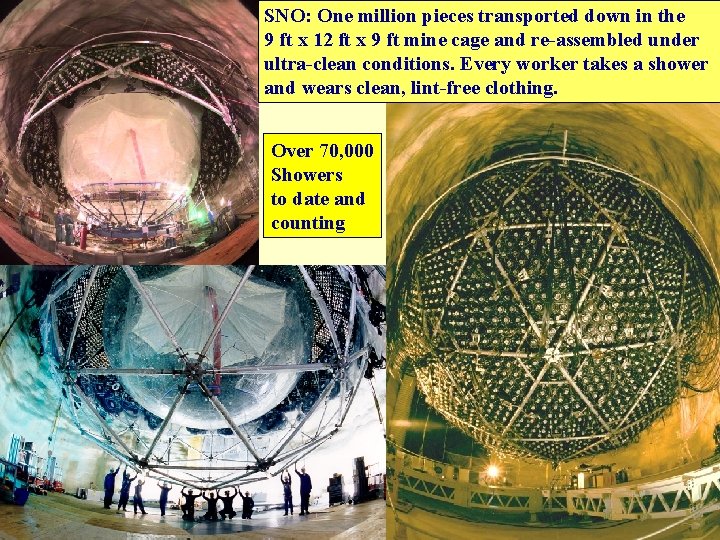
SNO: One million pieces transported down in the 9 ft x 12 ft x 9 ft mine cage and re-assembled under ultra-clean conditions. Every worker takes a shower and wears clean, lint-free clothing. Over 70, 000 Showers to date and counting
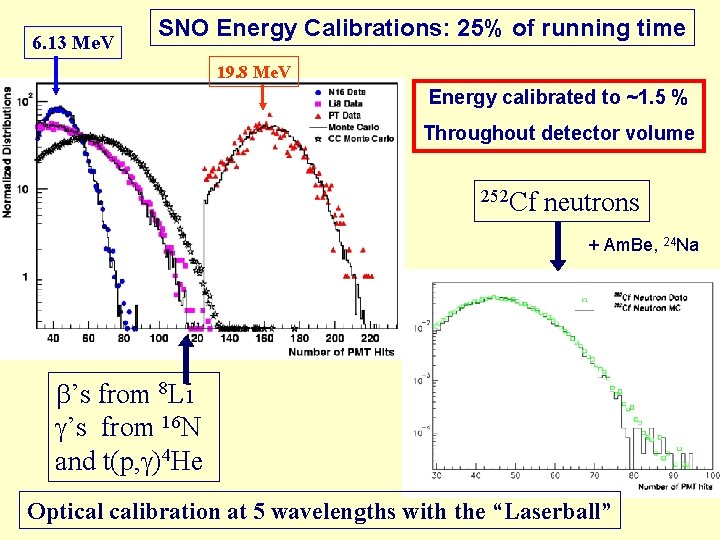
6. 13 Me. V SNO Energy Calibrations: 25% of running time 19. 8 Me. V Energy calibrated to ~1. 5 % Throughout detector volume 252 Cf neutrons + Am. Be, 24 Na b’s from 8 Li g’s from 16 N and t(p, g)4 He Optical calibration at 5 wavelengths with the “Laserball”
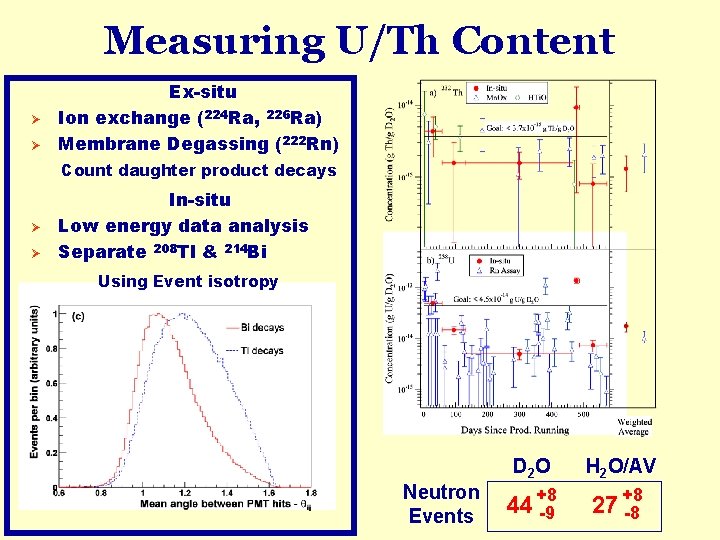
Measuring U/Th Content Ø Ø Ex-situ Ion exchange (224 Ra, 226 Ra) Membrane Degassing (222 Rn) Count daughter product decays Ø Ø In-situ Low energy data analysis Separate 208 Tl & 214 Bi Using Event isotropy Neutron Events D 2 O H 2 O/AV 44 +8 -9 27 +8 -8
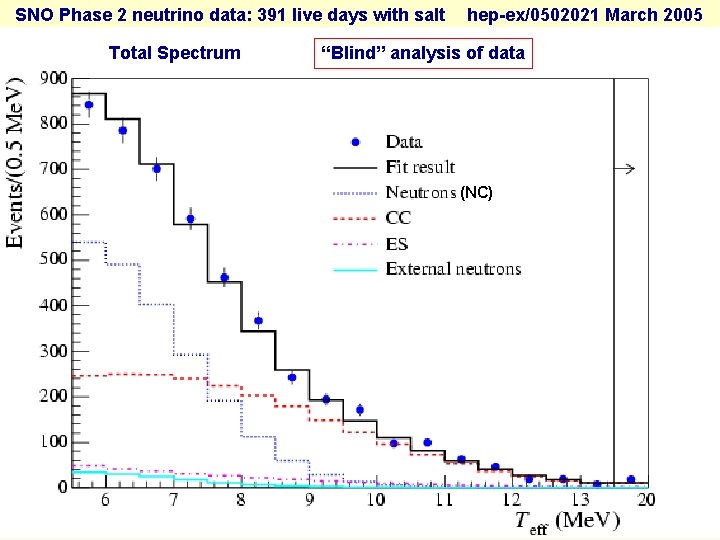
SNO Phase 2 neutrino data: 391 live days with salt Total Spectrum hep-ex/0502021 March 2005 “Blind” analysis of data (NC)
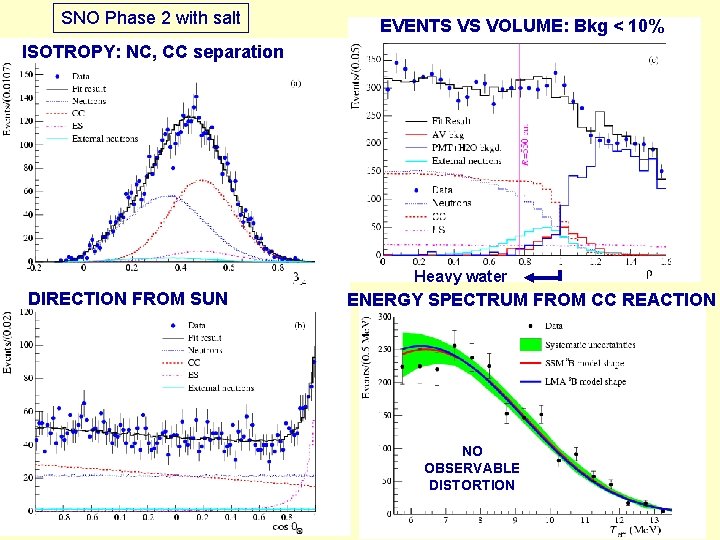
SNO Phase 2 with salt EVENTS VS VOLUME: Bkg < 10% ISOTROPY: NC, CC separation Heavy water DIRECTION FROM SUN ENERGY SPECTRUM FROM CC REACTION NO OBSERVABLE DISTORTION
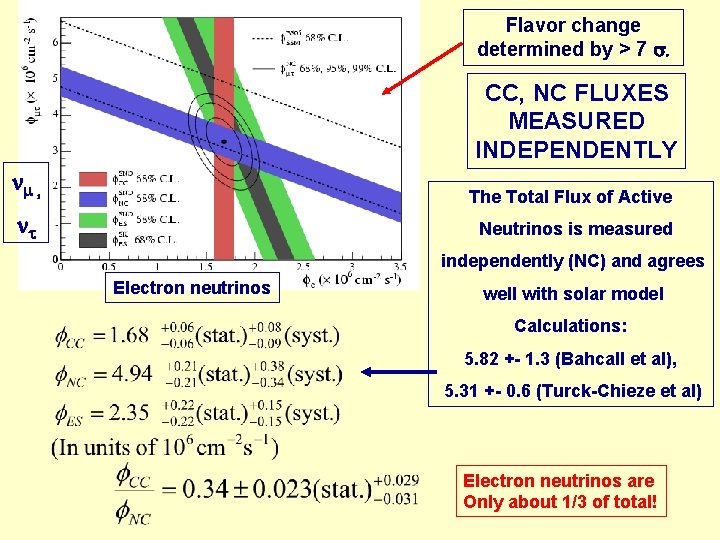
Flavor change determined by > 7 s. CC, NC FLUXES MEASURED INDEPENDENTLY nm , The Total Flux of Active nt Neutrinos is measured independently (NC) and agrees Electron neutrinos well with solar model Calculations: 5. 82 +- 1. 3 (Bahcall et al), 5. 31 +- 0. 6 (Turck-Chieze et al) Electron neutrinos are Only about 1/3 of total!
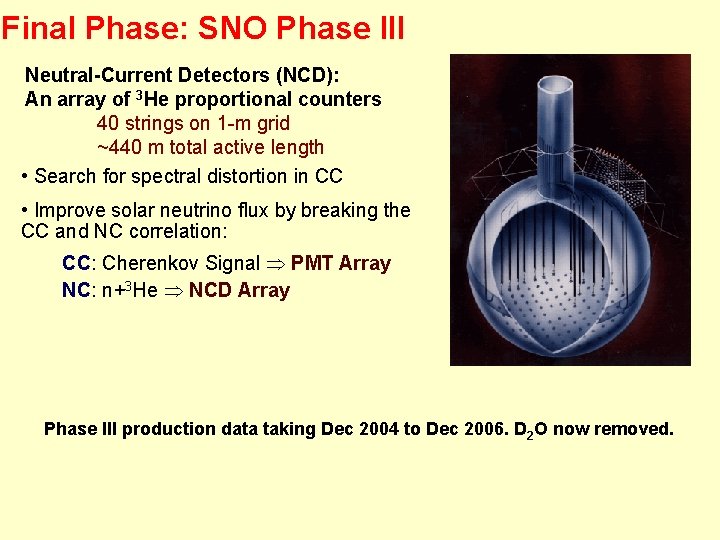
Final Phase: SNO Phase III Neutral-Current Detectors (NCD): An array of 3 He proportional counters 40 strings on 1 -m grid ~440 m total active length • Search for spectral distortion in CC • Improve solar neutrino flux by breaking the CC and NC correlation: CC: Cherenkov Signal PMT Array NC: n+3 He NCD Array Phase III production data taking Dec 2004 to Dec 2006. D 2 O now removed.
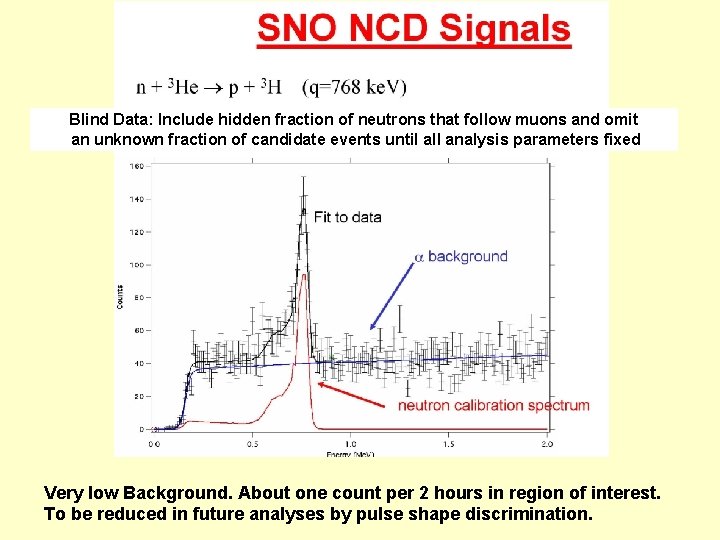
Blind Data: Include hidden fraction of neutrons that follow muons and omit an unknown fraction of candidate events until all analysis parameters fixed Very low Background. About one count per 2 hours in region of interest. To be reduced in future analyses by pulse shape discrimination.
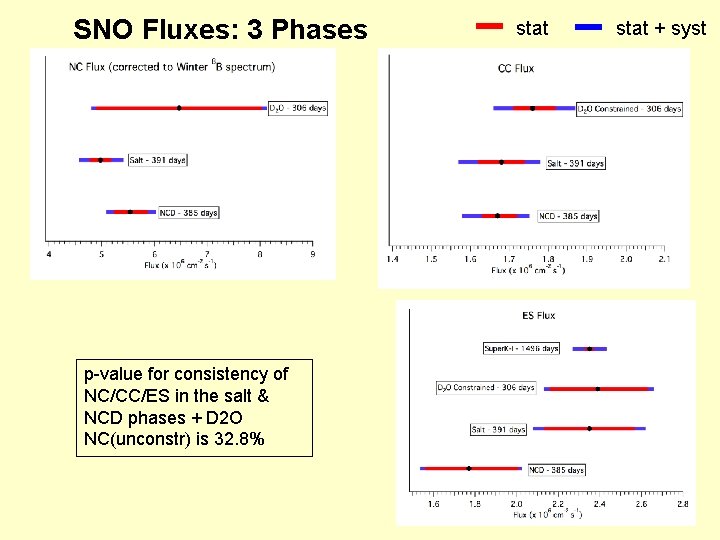
SNO Fluxes: 3 Phases p-value for consistency of NC/CC/ES in the salt & NCD phases + D 2 O NC(unconstr) is 32. 8% stat + syst
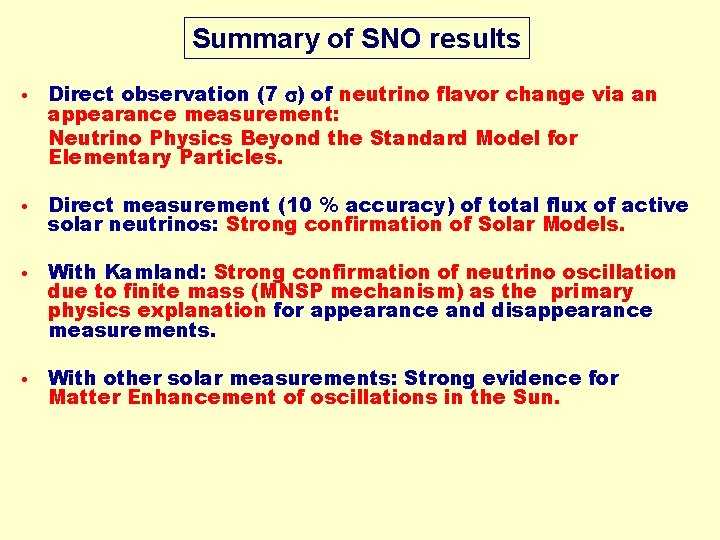
Summary of SNO results • Direct observation (7 s) of neutrino flavor change via an appearance measurement: Neutrino Physics Beyond the Standard Model for Elementary Particles. • Direct measurement (10 % accuracy) of total flux of active solar neutrinos: Strong confirmation of Solar Models. • With Kamland: Strong confirmation of neutrino oscillation due to finite mass (MNSP mechanism) as the primary physics explanation for appearance and disappearance measurements. • With other solar measurements: Strong evidence for Matter Enhancement of oscillations in the Sun.
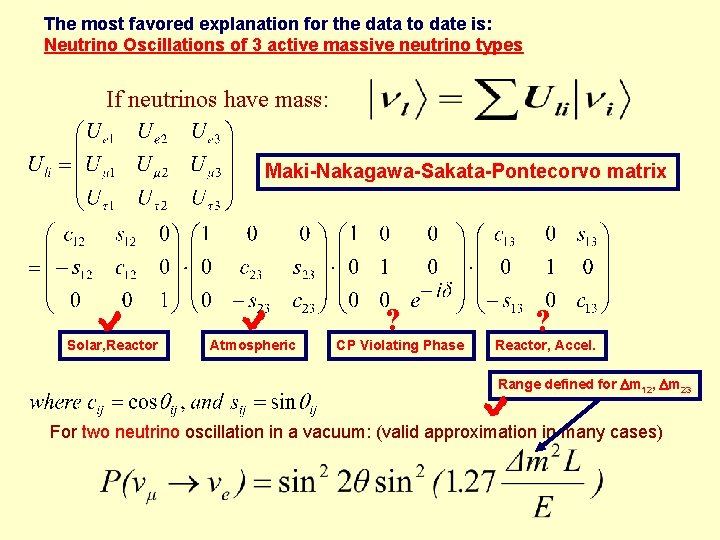
The most favored explanation for the data to date is: Neutrino Oscillations of 3 active massive neutrino types If neutrinos have mass: Maki-Nakagawa-Sakata-Pontecorvo matrix Solar, Reactor Atmospheric ? CP Violating Phase ? Reactor, Accel. Range defined for Dm 12, Dm 23 For two neutrino oscillation in a vacuum: (valid approximation in many cases)
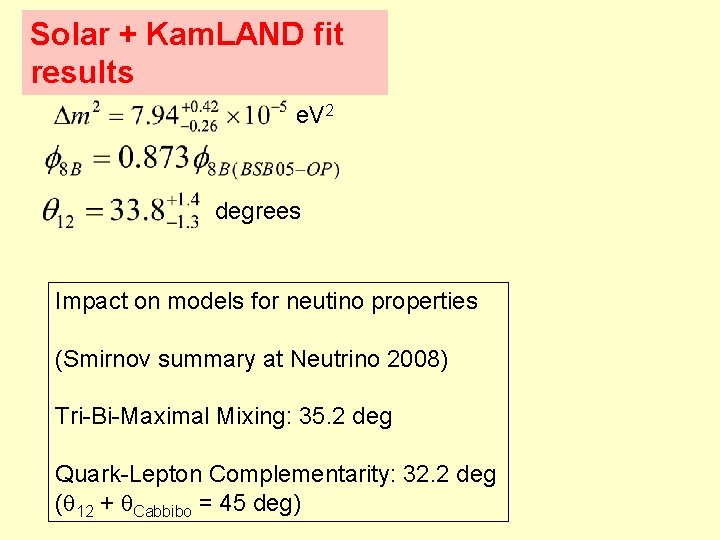
Solar + Kam. LAND fit results e. V 2 degrees Impact on models for neutino properties (Smirnov summary at Neutrino 2008) Tri-Bi-Maximal Mixing: 35. 2 deg Quark-Lepton Complementarity: 32. 2 deg (q 12 + q. Cabbibo = 45 deg)
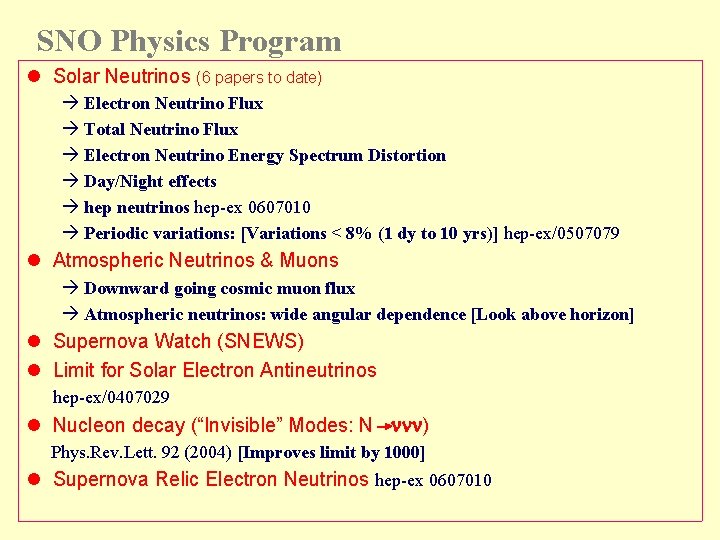
SNO Physics Program l Solar Neutrinos (6 papers to date) à Electron Neutrino Flux à Total Neutrino Flux à Electron Neutrino Energy Spectrum Distortion à Day/Night effects à hep neutrinos hep-ex 0607010 à Periodic variations: [Variations < 8% (1 dy to 10 yrs)] hep-ex/0507079 l Atmospheric Neutrinos & Muons à Downward going cosmic muon flux à Atmospheric neutrinos: wide angular dependence [Look above horizon] l Supernova Watch (SNEWS) l Limit for Solar Electron Antineutrinos hep-ex/0407029 l Nucleon decay (“Invisible” Modes: N nnn) Phys. Rev. Lett. 92 (2004) [Improves limit by 1000] l Supernova Relic Electron Neutrinos hep-ex 0607010
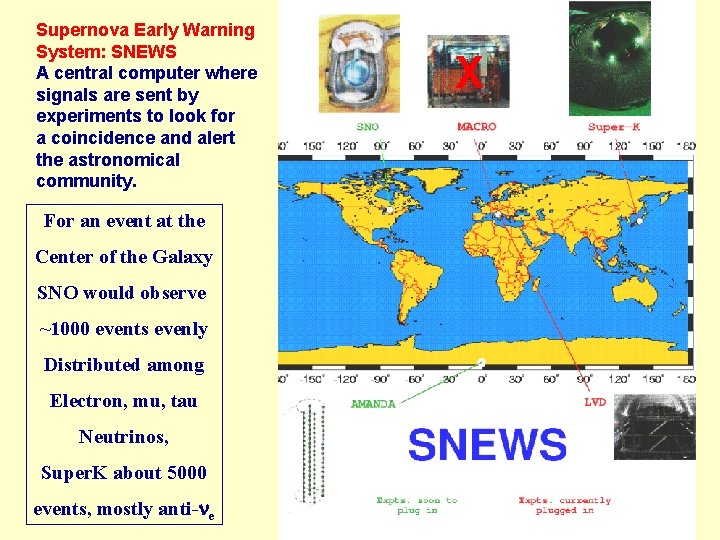
Supernova Early Warning System: SNEWS A central computer where signals are sent by experiments to look for a coincidence and alert the astronomical community. For an event at the Center of the Galaxy SNO would observe ~1000 events evenly Distributed among Electron, mu, tau Neutrinos, Super. K about 5000 events, mostly anti-ne X
- Slides: 27