
WELCOME TO SENIORJUNIOR NIGHT 2016 Presented by Fruita

WELCOME TO SENIOR/JUNIOR NIGHT 2016 Presented by Fruita Monument High School Counseling Department
Catharine Mudd Brian Shaver Kristen Rutkowski Tanya Pearce Lori Fairfield Julie Whitehead Counselor, Registrar Secretary Todd Mc. Claskey Brian Pendleton Bob Corneille Nikki Johnston Principal Assistant Principal A-E F-K L-Q R-Z Who is on Your Team?
Agenda v v v Important Dates Senior Year Timeline Senior ICAP meetings overview Junior Year Timeline $Paying for College$ Naviance overview
Important Dates Ø Ø Ø Ø Western Slope College Fair/Aspen Oct. 2 nd Senior Pictures due-October 20 th Unified Financial Aid Night – CMU, November 1, 2016 FMHS FAFSA Night-Nov. 29 th, in the Library College Application deadlines-Check college websites Baccalaureate – May 14 th Commencement – May 16 th
Senior Tasks ü ü ü ü ü Order graduation items Update your personal essay Update resume Request Letters of Recommendation (allow at least 2 weeks) Add colleges to which you are applying to Naviance Retake the ACT/SAT, if necessary – By Dec. 2016 Request letters of recommendation (allow at least 2 weeks) Apply for scholarships Complete FAFSA –Opens October 1 st 2016 Schedule your senior ICAP meeting with your counselor by the end of the first semester
Senior ICAP Meetings Ø Ø Ø Ø Review transcript Review volunteers hours Discussion of post secondary choices (college, tech school, military, career) NCAA requirements Review Naviance procedures Explore scholarship/financial aid options Apply to COF Address any questions and/or concerns
Junior Tasks (ICAP) ü ü ü Review Transcript (GPA, Proficiencies, credits needed) Join School Clubs, Community Activities, Sports College exploration ü ü ü Research colleges and careers Virtual tours of schools Update goals/profile on Naviance Take ASVAB – Military Interest and aptitude inventory FREE of charge Oct. 27, 2016 sign up in counseling office State mandated SAT– April 2017, date TBD Register with NCAA Clearinghouse
Paying for College: Scholarships and Financial Aid
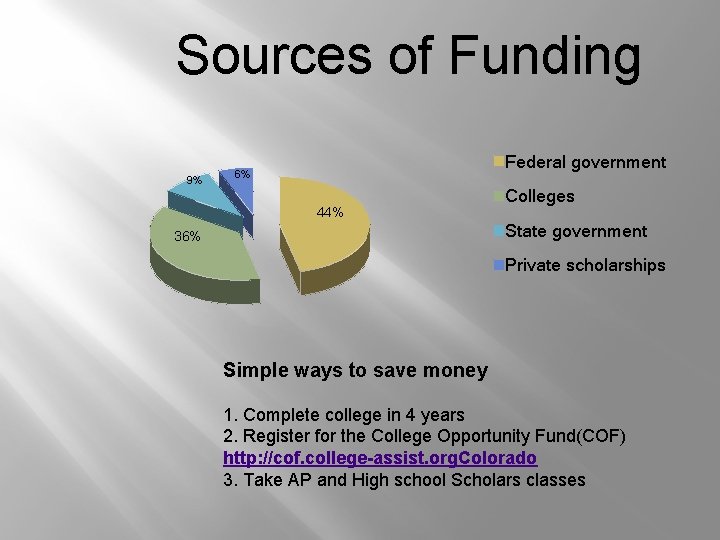
Sources of Funding 9% Federal government 6% 44% Colleges State government 36% Private scholarships Simple ways to save money 1. Complete college in 4 years 2. Register for the College Opportunity Fund(COF) http: //cof. college-assist. org. Colorado 3. Take AP and High school Scholars classes
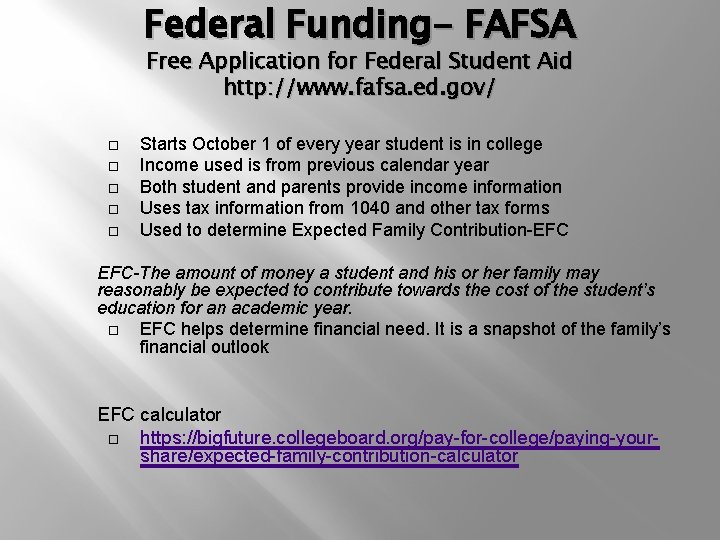
Federal Funding- FAFSA Free Application for Federal Student Aid http: //www. fafsa. ed. gov/ Starts October 1 of every year student is in college Income used is from previous calendar year Both student and parents provide income information Uses tax information from 1040 and other tax forms Used to determine Expected Family Contribution-EFC EFC-The amount of money a student and his or her family may reasonably be expected to contribute towards the cost of the student’s education for an academic year. EFC helps determine financial need. It is a snapshot of the family’s financial outlook EFC calculator https: //bigfuture. collegeboard. org/pay-for-college/paying-yourshare/expected-family-contribution-calculator
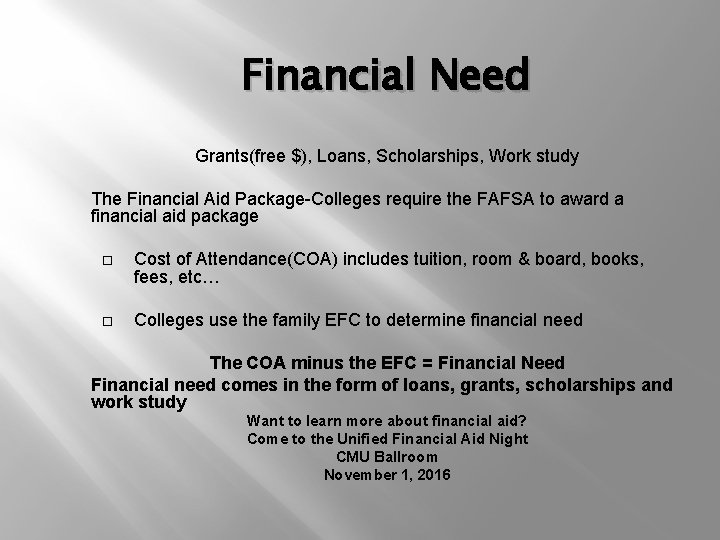
Financial Need Grants(free $), Loans, Scholarships, Work study The Financial Aid Package-Colleges require the FAFSA to award a financial aid package Cost of Attendance(COA) includes tuition, room & board, books, fees, etc… Colleges use the family EFC to determine financial need The COA minus the EFC = Financial Need Financial need comes in the form of loans, grants, scholarships and work study Want to learn more about financial aid? Come to the Unified Financial Aid Night CMU Ballroom November 1, 2016
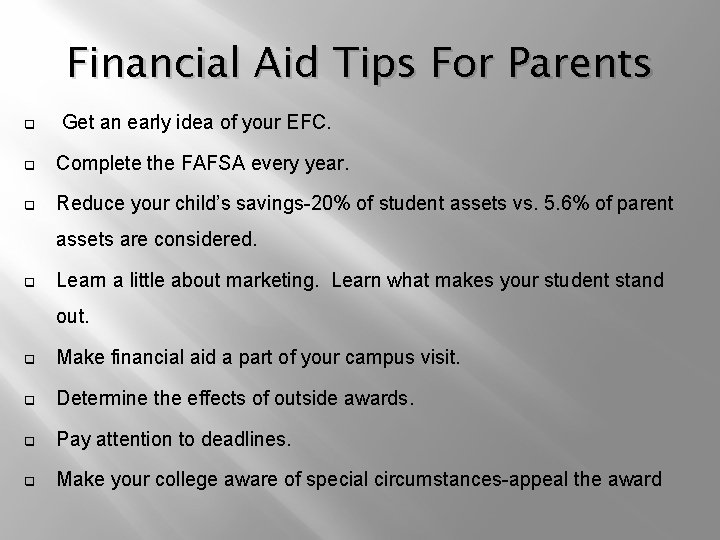
Financial Aid Tips For Parents q Get an early idea of your EFC. q Complete the FAFSA every year. q Reduce your child’s savings-20% of student assets vs. 5. 6% of parent assets are considered. q Learn a little about marketing. Learn what makes your student stand out. q Make financial aid a part of your campus visit. q Determine the effects of outside awards. q Pay attention to deadlines. q Make your college aware of special circumstances-appeal the award
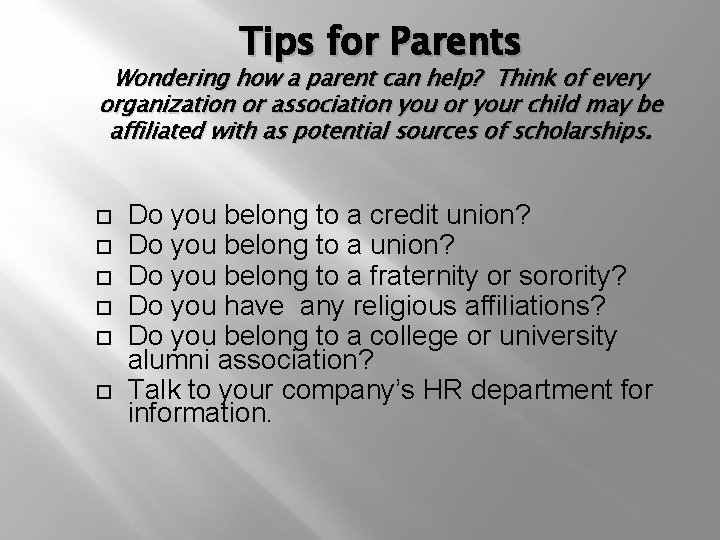
Tips for Parents Wondering how a parent can help? Think of every organization or association you or your child may be affiliated with as potential sources of scholarships. Do you belong to a credit union? Do you belong to a fraternity or sorority? Do you have any religious affiliations? Do you belong to a college or university alumni association? Talk to your company’s HR department for information.
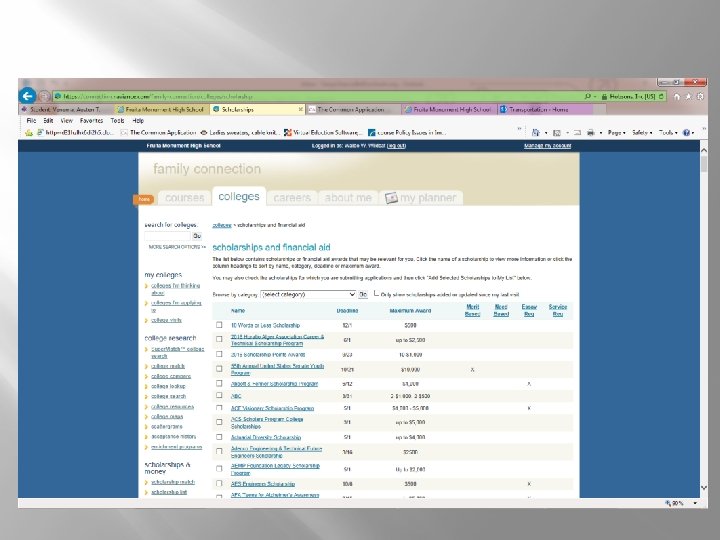
Scholarship Sources College websites Naviance Scholarship page FMHS Counseling Website Internet searches Workplace, church, banks, organizations
Scholarship advice for students q Start Early- be aware of deadlines. q Participate!- stand out among the crowd. q Don’t Consider Limits- applying for 2 or 3 large scholarships is not enough. q Professional Email Address- as an example: First name. Last name@gmail. com q Social Media- Clean up the content of your Facebook/Instagram account, removing inappropriate and immature material. q The Perfect Essay-should reflect more than the information in a student resume or transcript. Focus on yourself not just your test scores and GPA. q Save a copy of your application
Scholarships-Getting Noticed q q Strong Academics-A strong GPA indicates the student takes school seriously Work Experience-Internships, part time jobs q Summer Camps-Music camps, science camps, summer travel, foreign language immersion experiences, leadership camps. q Community Service-making a difference matters! q Leadership-Demonstrate through academics, work or volunteerism.
Colleges-Great Sources for Aid q Competition for the best students. q Compare financial award packages. q Private colleges vs. Public colleges q Advantages of small liberal arts colleges. q Geographic diversity. q Requirement of separate application from the admissions application. q Some scholarships are automatically reviewed with admissions applications.
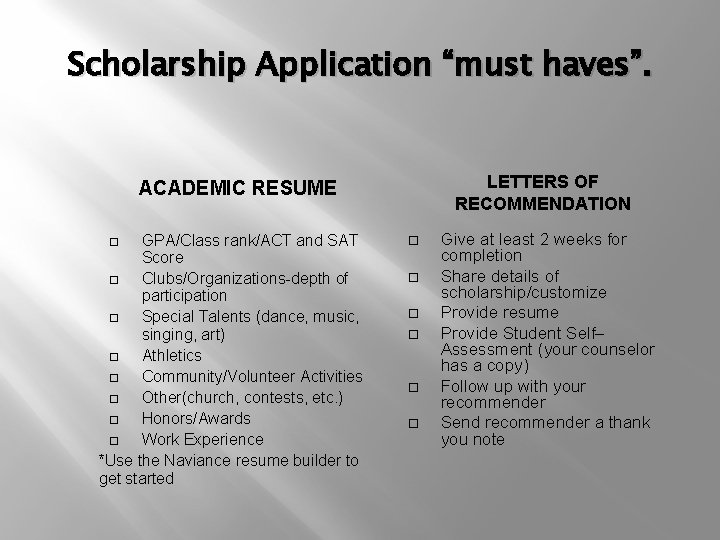
Scholarship Application “must haves”. LETTERS OF RECOMMENDATION ACADEMIC RESUME GPA/Class rank/ACT and SAT Score Clubs/Organizations-depth of participation Special Talents (dance, music, singing, art) Athletics Community/Volunteer Activities Other(church, contests, etc. ) Honors/Awards Work Experience *Use the Naviance resume builder to get started Give at least 2 weeks for completion Share details of scholarship/customize Provide resume Provide Student Self– Assessment (your counselor has a copy) Follow up with your recommender Send recommender a thank you note
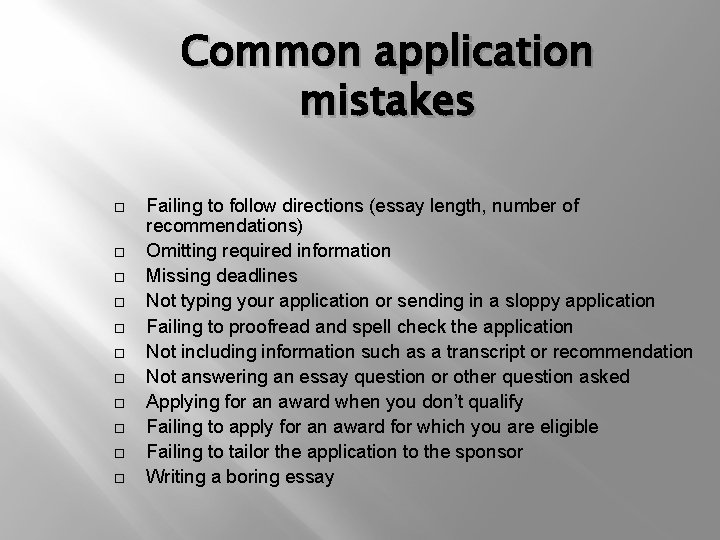
Common application mistakes Failing to follow directions (essay length, number of recommendations) Omitting required information Missing deadlines Not typing your application or sending in a sloppy application Failing to proofread and spell check the application Not including information such as a transcript or recommendation Not answering an essay question or other question asked Applying for an award when you don’t qualify Failing to apply for an award for which you are eligible Failing to tailor the application to the sponsor Writing a boring essay
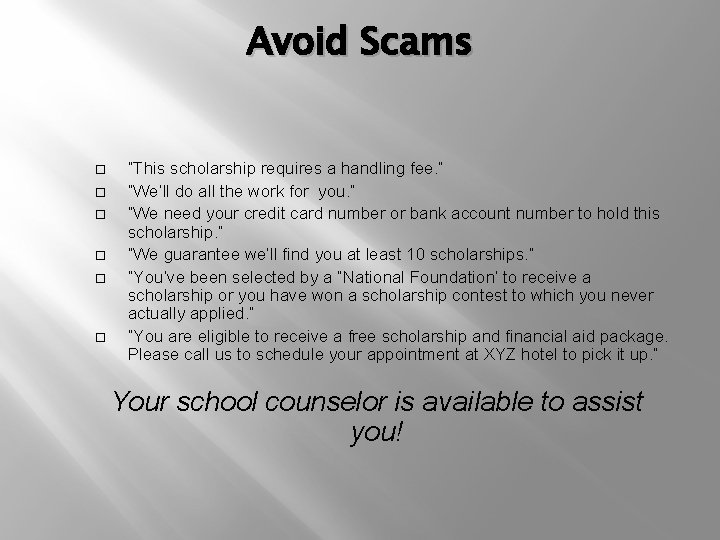
Avoid Scams “This scholarship requires a handling fee. ” “We’ll do all the work for you. ” “We need your credit card number or bank account number to hold this scholarship. ” “We guarantee we’ll find you at least 10 scholarships. ” “You’ve been selected by a “National Foundation’ to receive a scholarship or you have won a scholarship contest to which you never actually applied. ” “You are eligible to receive a free scholarship and financial aid package. Please call us to schedule your appointment at XYZ hotel to pick it up. ” Your school counselor is available to assist you!
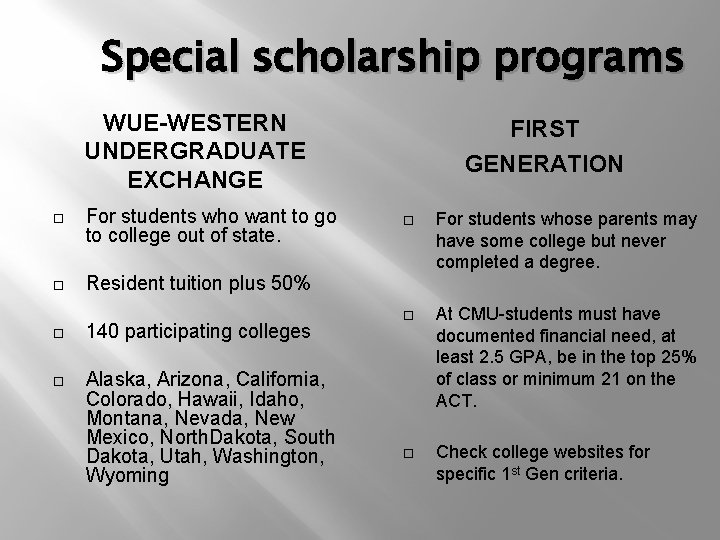
Special scholarship programs WUE-WESTERN UNDERGRADUATE EXCHANGE For students who want to go to college out of state. Resident tuition plus 50% 140 participating colleges Alaska, Arizona, California, Colorado, Hawaii, Idaho, Montana, Nevada, New Mexico, North. Dakota, South Dakota, Utah, Washington, Wyoming FIRST GENERATION For students whose parents may have some college but never completed a degree. At CMU-students must have documented financial need, at least 2. 5 GPA, be in the top 25% of class or minimum 21 on the ACT. Check college websites for specific 1 st Gen criteria.
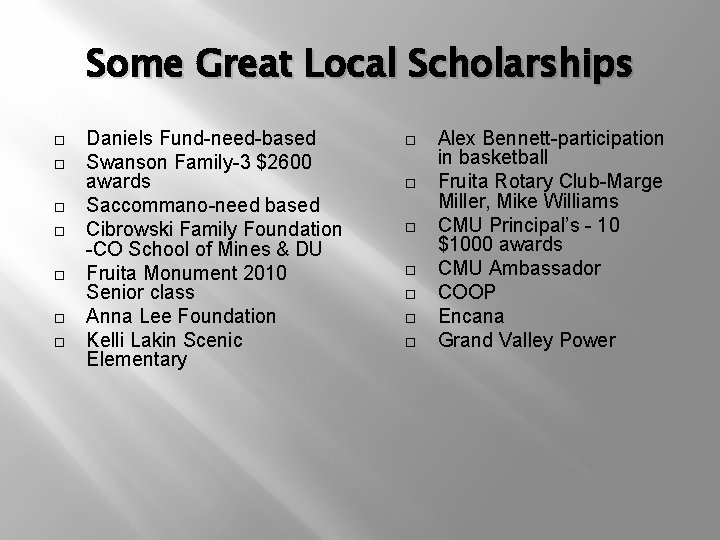
Some Great Local Scholarships Daniels Fund-need-based Swanson Family-3 $2600 awards Saccommano-need based Cibrowski Family Foundation -CO School of Mines & DU Fruita Monument 2010 Senior class Anna Lee Foundation Kelli Lakin Scenic Elementary Alex Bennett-participation in basketball Fruita Rotary Club-Marge Miller, Mike Williams CMU Principal’s - 10 $1000 awards CMU Ambassador COOP Encana Grand Valley Power
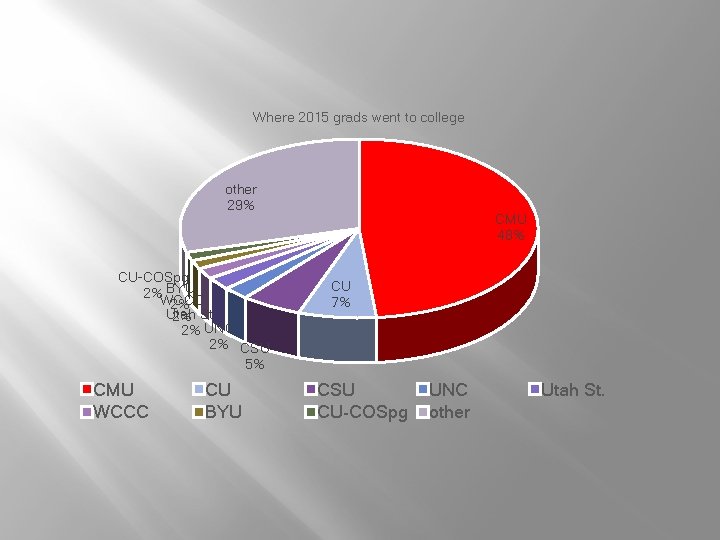
Where 2015 grads went to college other 29% CU-COSpg BYU 2%WCCC 2% Utah 2% St. 2% UNC 2% CSU 5% CMU WCCC CU BYU CMU 48% CU 7% CSU CU-COSpg UNC other Utah St.
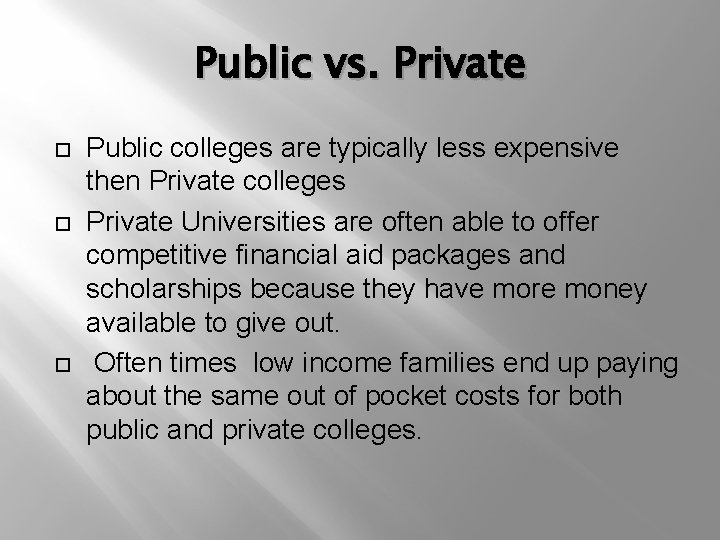
Public vs. Private Public colleges are typically less expensive then Private colleges Private Universities are often able to offer competitive financial aid packages and scholarships because they have more money available to give out. Often times low income families end up paying about the same out of pocket costs for both public and private colleges.
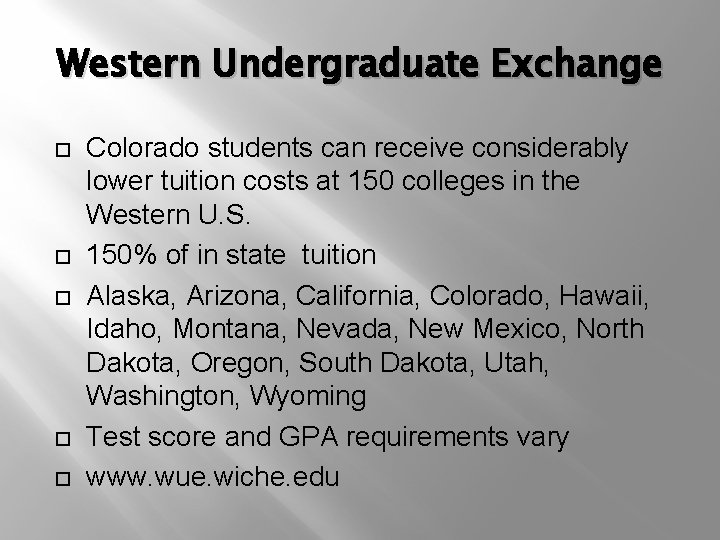
Western Undergraduate Exchange Colorado students can receive considerably lower tuition costs at 150 colleges in the Western U. S. 150% of in state tuition Alaska, Arizona, California, Colorado, Hawaii, Idaho, Montana, Nevada, New Mexico, North Dakota, Oregon, South Dakota, Utah, Washington, Wyoming Test score and GPA requirements vary www. wue. wiche. edu
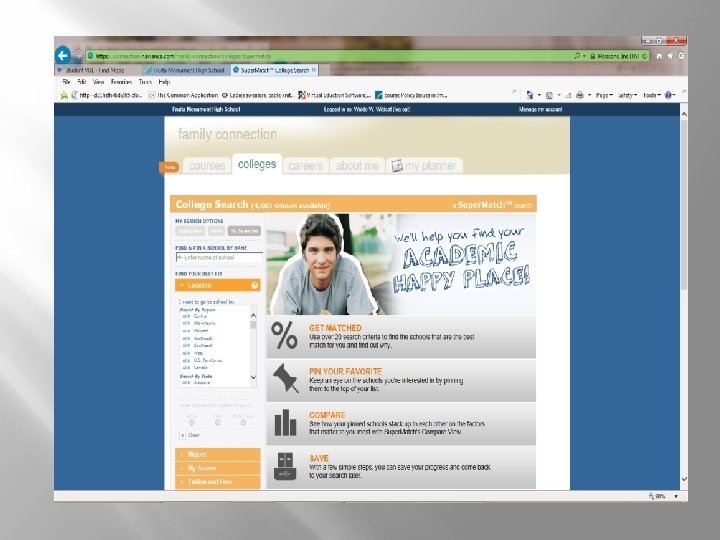
WHAT IS NAVIANCE? Ø Ø The state has mandated that every student have an ICAP (Individual Career and Academic Plan) Naviance offers a multi-functional online tool to manage ICAPS and help students create and plan for their own post-secondary goals
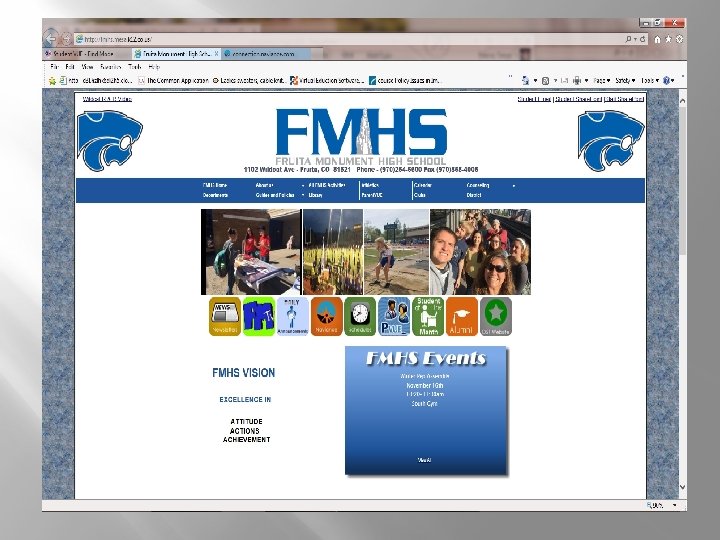
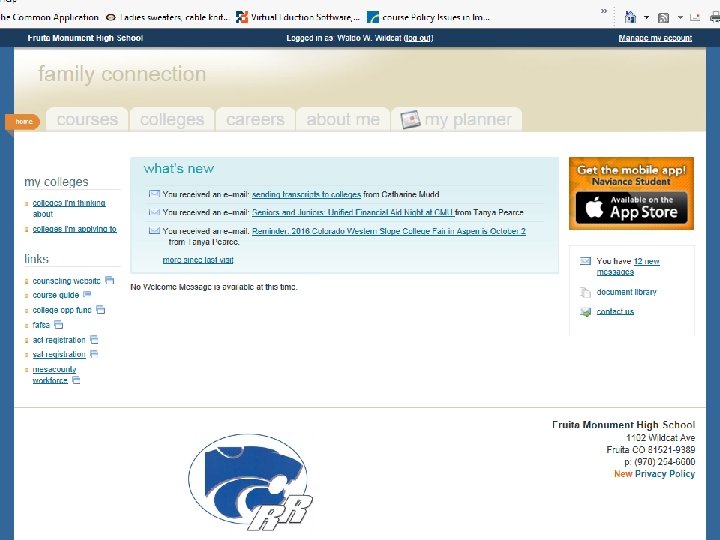
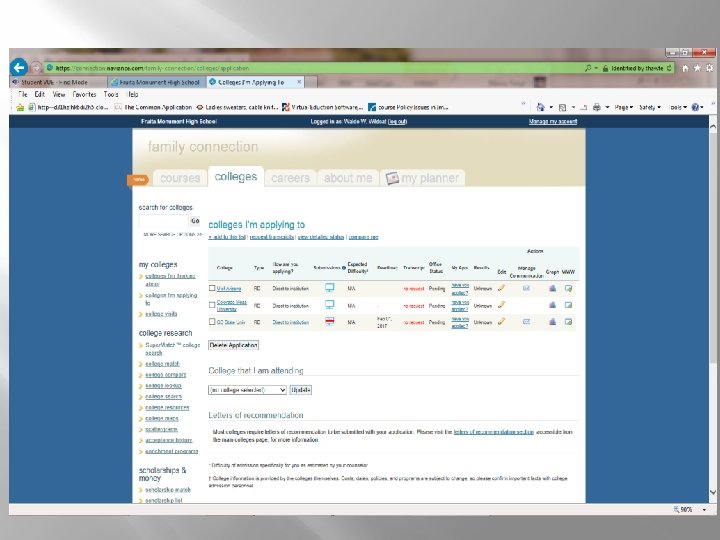
NOW FOR A NAVIANCE OVERVIEW…

Questions?
- Slides: 32