
Welcome to Science 4 Class Mr Jaypee T



- Slides: 22
Welcome to Science 4 Class! Mr. Jaypee T. Jonas Teacher
Plant Adaptations Lesson Objective: 1. Describe the body parts of plants that make them adapt to living on land or in water
Opening Song & Prayer Dear Lord and Father of all, Thank you for today. Thank you for ways in which you provide for us all. For Your protection and love we thank you. Help us to focus our hearts and minds now on what we are about to learn. Inspire us by Your Holy Spirit as we listen and write. Guide us by your eternal light as we discover more about the world around us. We ask all this in the name of Jesus. Amen.
Greetings
Lesson Proper Activity – Observing Aqua Plants Problem: How do plants adapt to living in water? Materials: pictures/videos of water plants Procedure: 1. Compile pictures or watch videos of some water plants. 2. Examine the special characteristics of these plants that help them adapt in living in water.
Observation: 1. Which parts are partly submerged or floating? _________________________________________________________ _________________ 2. What structures do you think help keep the plants afloat? _________________________________________________________ _________________
Observation: 3. Do you think the shape, size, and texture of the stems and leaves help keep the plants in the water? Why? _________________________________________________________ _________________ 4. Which parts of each plant are in contact with the water? Do they have a wax-like coating? _________________________________________________________
Observation: 5. How do the plants get the water and dissolved substance they need to survive in water? _________________________________________________________ _________________ Conclusion: How do plants adapt to living in water? _________________________________________________________ _________________
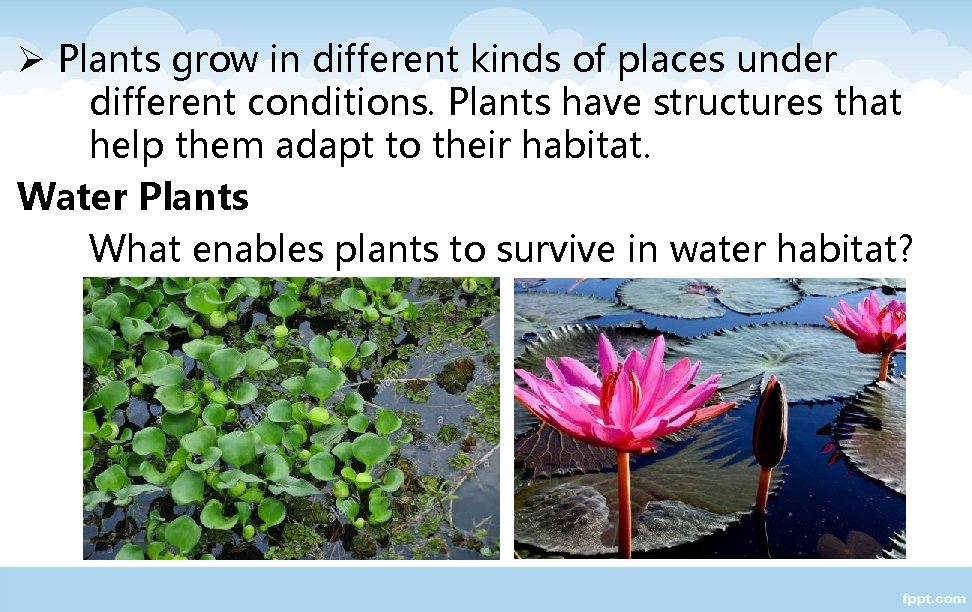
Ø Plants grow in different kinds of places under different conditions. Plants have structures that help them adapt to their habitat. Water Plants What enables plants to survive in water habitat?
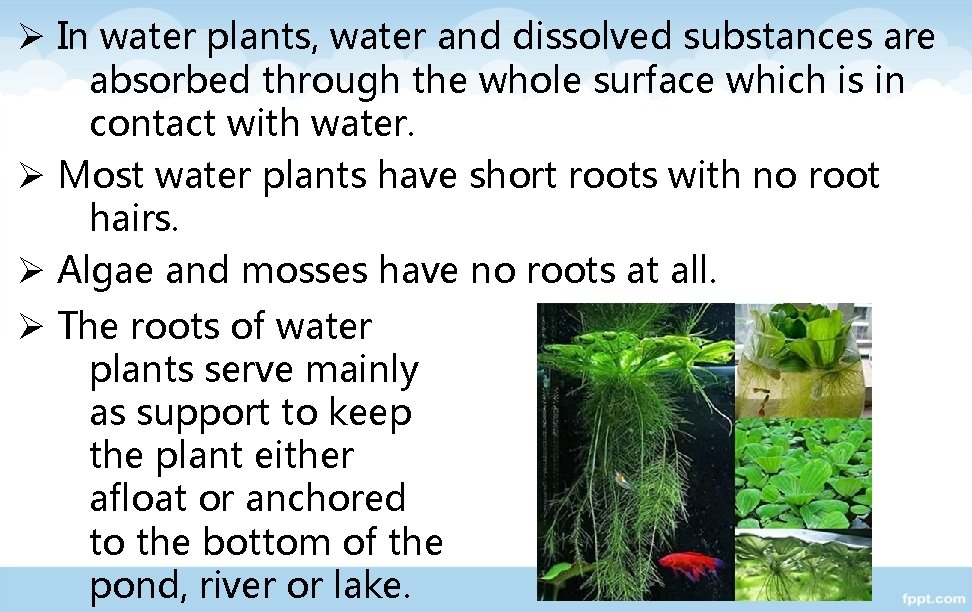
Ø In water plants, water and dissolved substances are absorbed through the whole surface which is in contact with water. Ø Most water plants have short roots with no root hairs. Ø Algae and mosses have no roots at all. Ø The roots of water plants serve mainly as support to keep the plant either afloat or anchored to the bottom of the pond, river or lake.
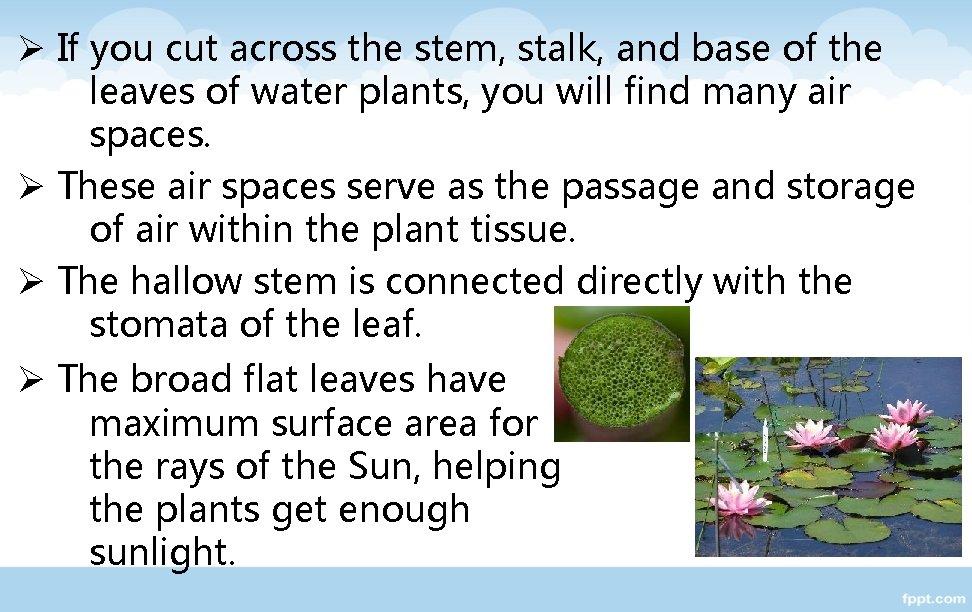
Ø If you cut across the stem, stalk, and base of the leaves of water plants, you will find many air spaces. Ø These air spaces serve as the passage and storage of air within the plant tissue. Ø The hallow stem is connected directly with the stomata of the leaf. Ø The broad flat leaves have maximum surface area for the rays of the Sun, helping the plants get enough sunlight.
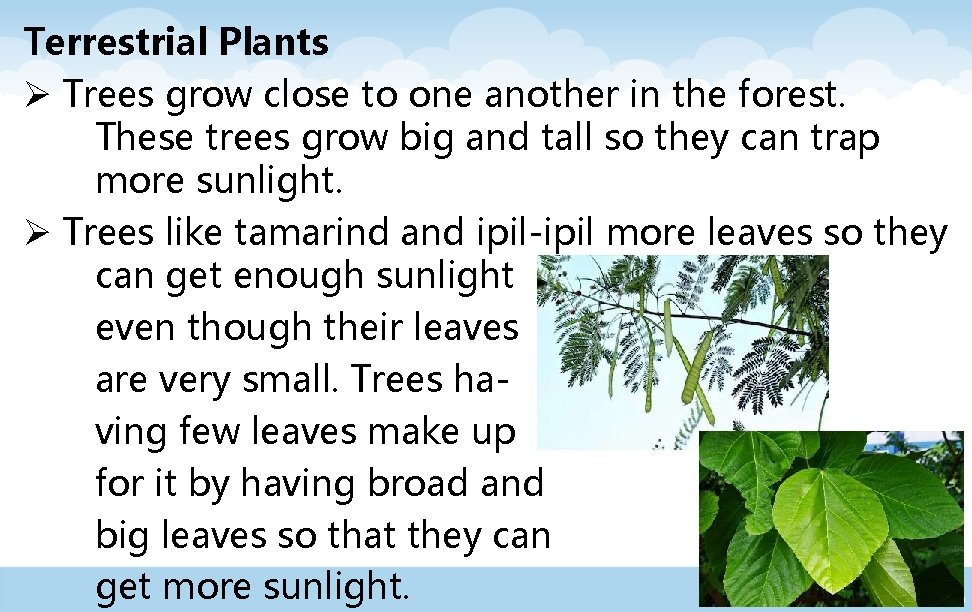
Terrestrial Plants Ø Trees grow close to one another in the forest. These trees grow big and tall so they can trap more sunlight. Ø Trees like tamarind and ipil-ipil more leaves so they can get enough sunlight even though their leaves are very small. Trees having few leaves make up for it by having broad and big leaves so that they can get more sunlight.
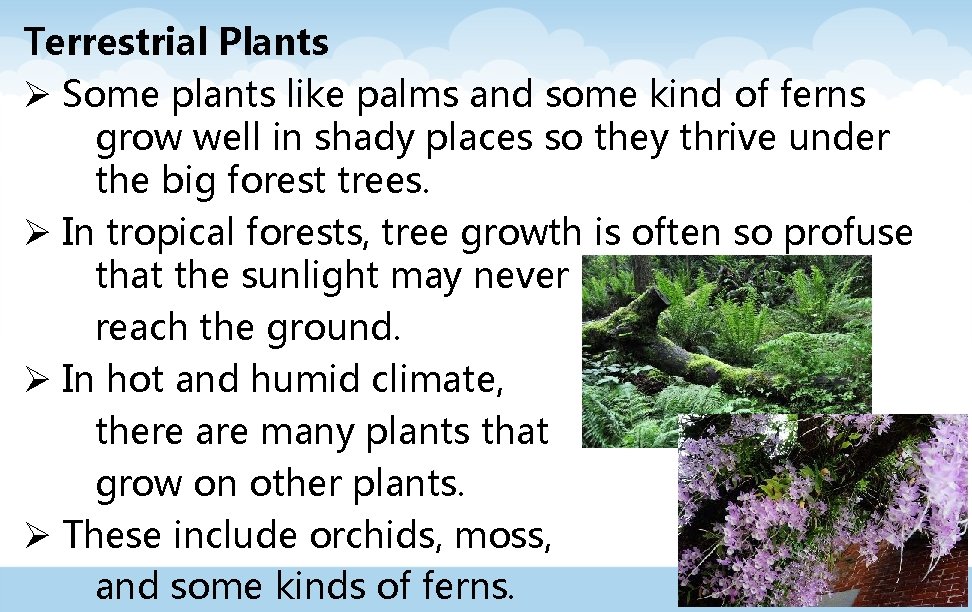
Terrestrial Plants Ø Some plants like palms and some kind of ferns grow well in shady places so they thrive under the big forest trees. Ø In tropical forests, tree growth is often so profuse that the sunlight may never reach the ground. Ø In hot and humid climate, there are many plants that grow on other plants. Ø These include orchids, moss, and some kinds of ferns.
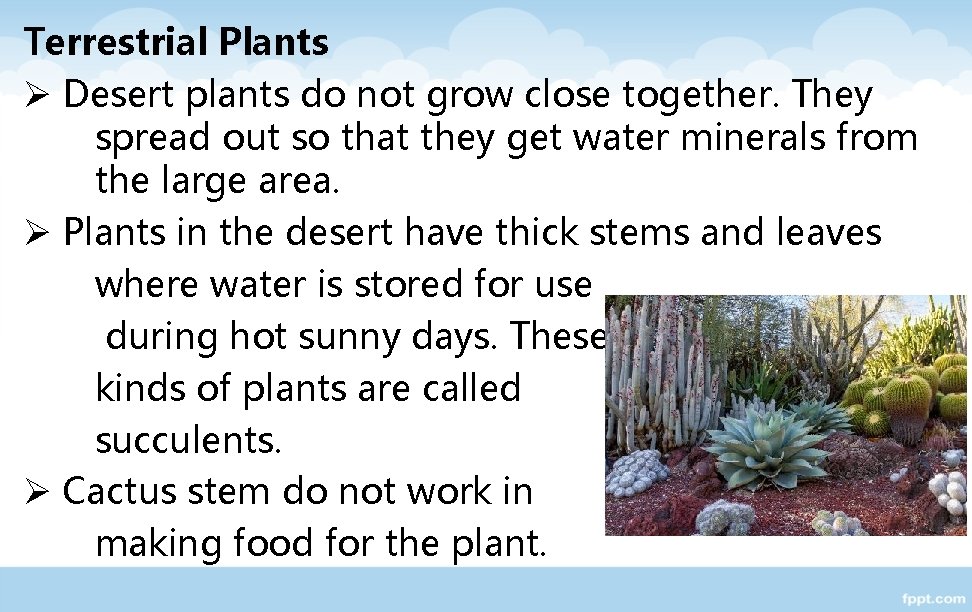
Terrestrial Plants Ø Desert plants do not grow close together. They spread out so that they get water minerals from the large area. Ø Plants in the desert have thick stems and leaves where water is stored for use during hot sunny days. These kinds of plants are called succulents. Ø Cactus stem do not work in making food for the plant.
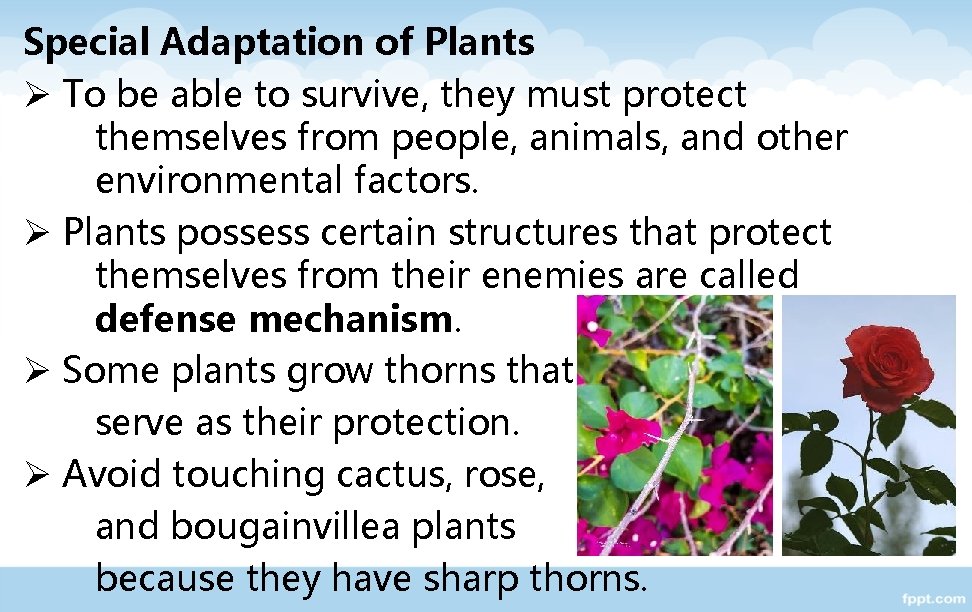
Special Adaptation of Plants Ø To be able to survive, they must protect themselves from people, animals, and other environmental factors. Ø Plants possess certain structures that protect themselves from their enemies are called defense mechanism. Ø Some plants grow thorns that serve as their protection. Ø Avoid touching cactus, rose, and bougainvillea plants because they have sharp thorns.
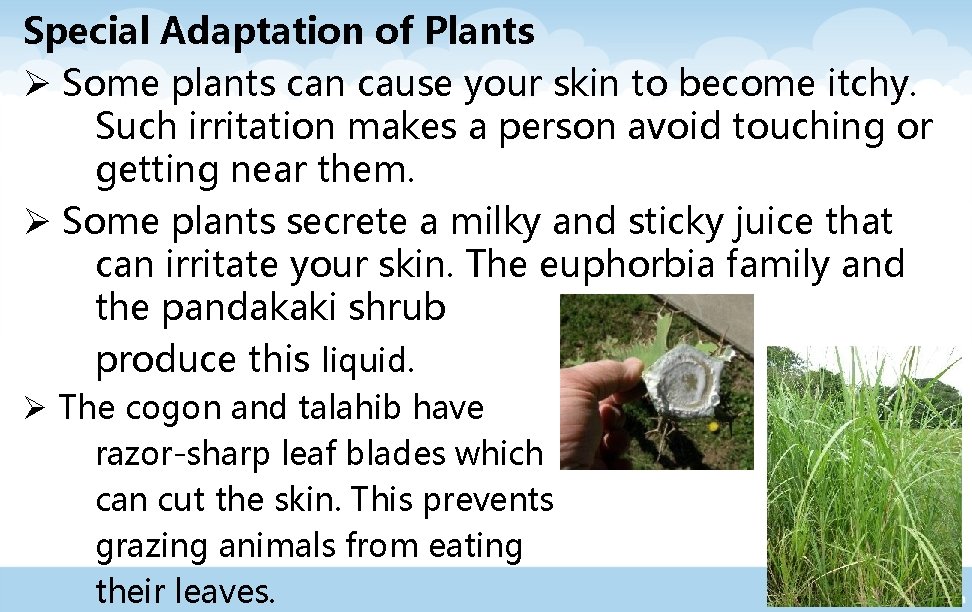
Special Adaptation of Plants Ø Some plants can cause your skin to become itchy. Such irritation makes a person avoid touching or getting near them. Ø Some plants secrete a milky and sticky juice that can irritate your skin. The euphorbia family and the pandakaki shrub produce this liquid. Ø The cogon and talahib have razor-sharp leaf blades which can cut the skin. This prevents grazing animals from eating their leaves.
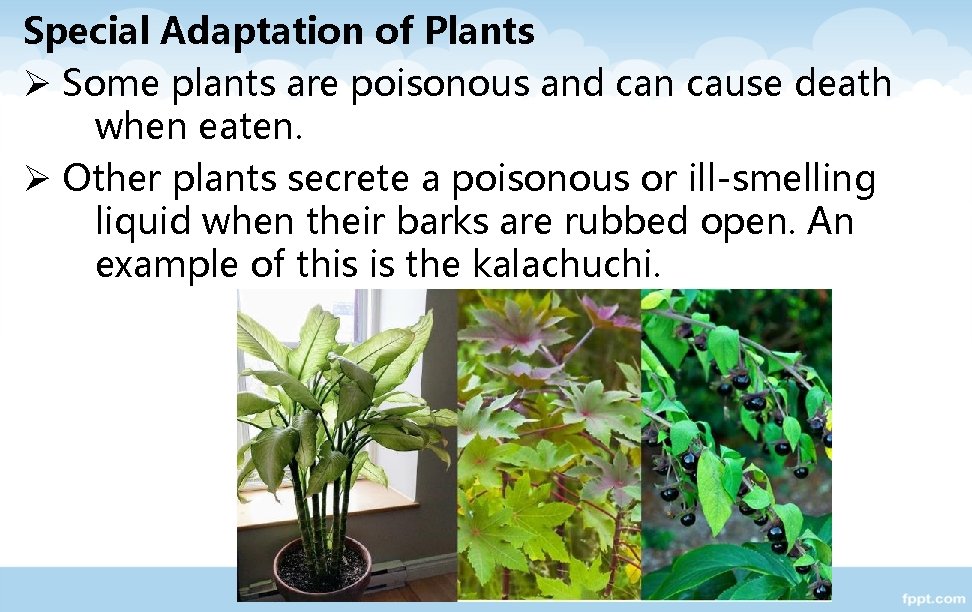
Special Adaptation of Plants Ø Some plants are poisonous and can cause death when eaten. Ø Other plants secrete a poisonous or ill-smelling liquid when their barks are rubbed open. An example of this is the kalachuchi.
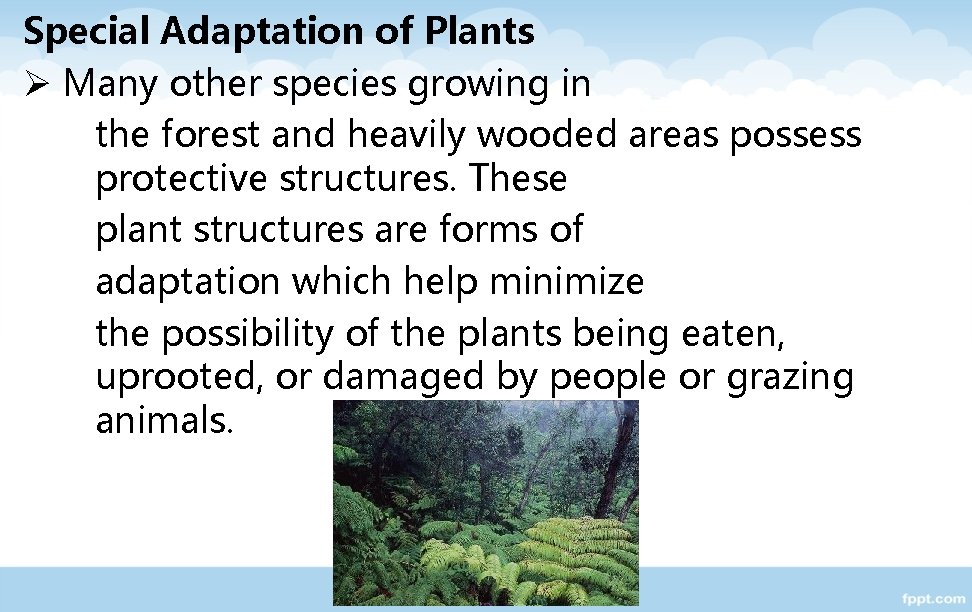
Special Adaptation of Plants Ø Many other species growing in the forest and heavily wooded areas possess protective structures. These plant structures are forms of adaptation which help minimize the possibility of the plants being eaten, uprooted, or damaged by people or grazing animals.
Generalization Ø Plants adapt themselves to live in their habitat. Ø Plants have specialized structures that help them protect themselves from enemies.
Evaluation I. Describe the specialized structures of the following plants. 1. cactus - _________________________________________ 2. water lily - _________________________________________ 3. pine tree - __________________________________________ 4. talahib - ______________________________________________
Evaluation I. Describe the specialized structures of the following plants. 5. rose - _____________________________________________ 6. makahiya- _________________________________________ 7. gumamela - _________________________________________ 8. malunggay - _________________________________________
Assignment Read answer. (10 points) 1. How do plants protect themselves? Write your answer in here.