
Welcome to SACE Stage 1 Psychology Stage 1
- Slides: 47
Welcome to SACE Stage 1 Psychology
Stage 1 Psychology • Psychology is an academic subject, in line with the other SACE science subjects available. As such, from this point forward, it is expected that you work hard, contribute to the class discussions and activities and show respect for the subject, yourselves and others within the class
Class Expectations • It is your choice whether you have a folder or an exercise book, however it is expected that you keep it neat and tidy. All handouts received need to be filed appropriately as they will assist you when working on assessment tasks and revision for tests and exams
Class Expectations • It is your responsibility to catch up on any work missed due to absence. Seek out your teacher and ask what you have missed, and check Seqta regularly.
Class Expectations • All work must be handed up on time. If an extension is required, discuss this with your teacher in advance of the due date. • Extensions will be given on reasonable grounds, but must be requested as early as possible. • Refer to the non-submission of work policy if you have forgotten what happens when you don’t submit.
Class Expectations • If you are absent for a test, expect to sit the test during your next study lesson.
Class Expectations • It is expected that each student will show respect for themselves, other class members and the class as a whole. During psychology many issues that may be sensitive are discussed. It is expected that all students show the respect of confidentiality. What is discussed in class - stays in class.
Some important notes… • Studying Stage 1 or 2 Psychology does not qualify you to psychologically analyse yourself or others in any way. The course is a basis to the extensive field of psychology. It requires many years of tertiary study to become qualified and practice as a Psychologist.
• Please seek help from a counsellor or other organisations such as ‘Kids Helpline (1800 55 1800 or www. Kidshelp. com. au) if you feel there any personal issues that arise that you would like to discuss.
Introduction to Psychology
What do you already know about Psychology? • Take a couple of minutes to think on your own of anything you may know about psychology.
Defining Psychology • The term psychology comes originally from two Greek words: • Psyche - meaning mind, and • Logos - meaning study or knowledge
• Psychology therefore is defined as the systematic study of thoughts, feelings and behaviour and the factors that influence these.
Defining Behaviour • The term behaviour refers to any observable action (able to be seen) made by a living person or animal • Psychologists describe behaviour as any kind of response that can actually be seen and measured
Thoughts and feelings • Thoughts and feelings are internal responses and cannot be directly seen or measured. • Thoughts, feelings and behaviour influence one another continuously. • Think of an example of when thoughts, feelings and behaviour interact
Textbook? • Look at the Learning Activity 1. 1 on pg 3 of your text book • Draw the table into your book, for each activity decide whether or not it is a behaviour and then give a reason for each answer.
How is a Psychologist different to a Psychiatrist? • The main differences are: • Qualifications • Views on mental health problems • Services and treatments they provide
What is a psychiatrist? • A psychiatrist is a qualified medical doctor who has obtained additional qualifications to specialise in the diagnosis, treatment and prevention of mental illness and emotional problems
What do psychologists do? • Psychologists work with people who are experiencing a problem with which they need assistance helping them to find a way to function better in their everyday lives.
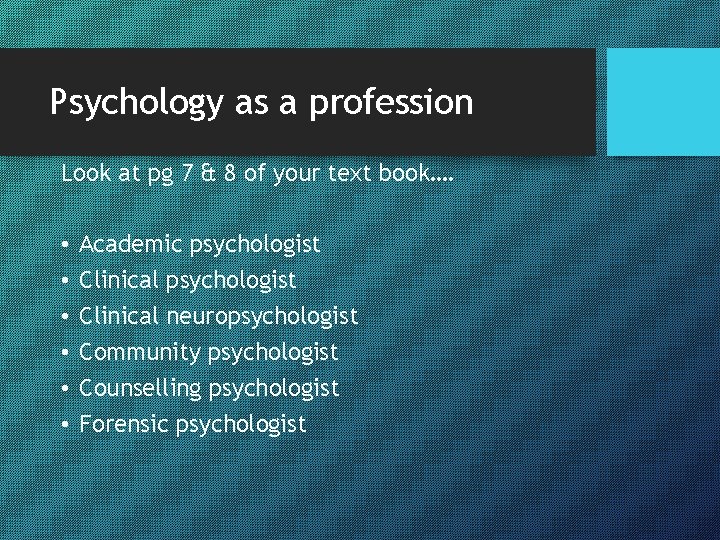
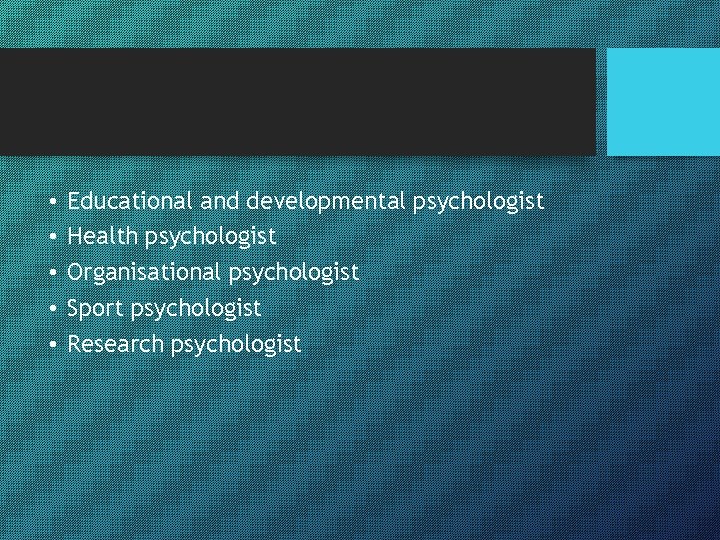
Psychology as a profession • There a variety of areas of specialisation within the discipline of psychology. It is important for you to remember a few different specialisations.
Psychology as a profession Look at pg 7 & 8 of your text book…. • • • Academic psychologist Clinical neuropsychologist Community psychologist Counselling psychologist Forensic psychologist
• • • Educational and developmental psychologist Health psychologist Organisational psychologist Sport psychologist Research psychologist
Learning Activity 1. 3 • Match the specialist area of psychology with the correct description.
Scientific Nature of Psychology • Read pgs 13 - 14 of the textbook
Scientific Nature of Psychology • In research, Psychology uses scientific method. • Scientific method refers to the systematic approach for planning, conducting and reporting research that involves collecting empirical evidence
Scientific Nature of Psychology • Empirical Evidence is data (information) collected directly by observation, or more frequently in psychology, through experimentation. • Collecting data through empirically based research allows psychologists to draw accurate conclusions, which tend to be free from personal bias.
Scientific Nature of Psychology • Scientific research is not free from error. Psychologists are people, and like all people, can make mistakes. It is important therefore to repeat research studies to ensure the results are accurate or can be applied in other situations…. .
Scientific Nature of Psychology • Replication involves repeating a study to establish whether the results obtained can be duplicated and are therefore reliable and able to be generalised - ie - able to be applied to other people across a range of situations and settings.
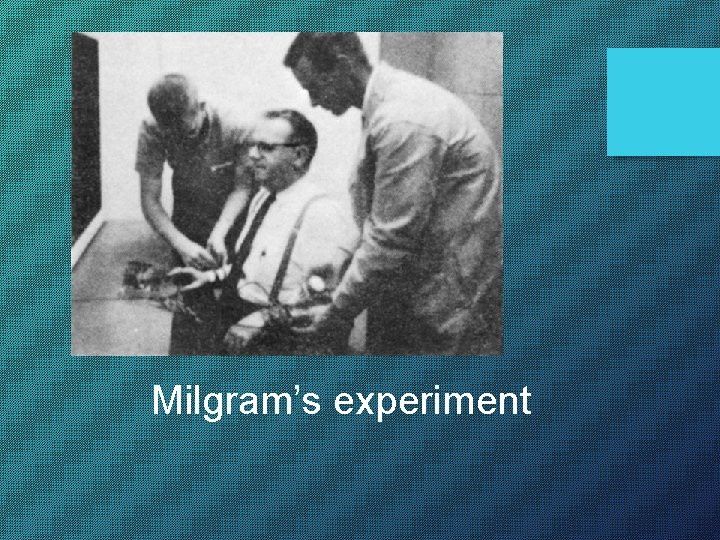
Milgram’s experiment
Review Questions • Learning Activity 1. 5 on pg 14. • With a partner, discuss the questions and then write your own answers.
Pseudoscience & ‘Commonsense Psychology’ • Where people collect information about behavior informally or non-scientifically, potentially leading to inaccurate conclusions about behaviour • Discuss in pairs one example of ‘commonsense psychology’ that may not have any scientific proof. Do you think it is accurate or not?
Pseudoscience & ‘Commonsense Psychology’ • Watch the following clip • • Take note of: -Any statistics/data mentioned -Any explanations for behaviour cited -Any methods they use to get their point across
Pseudoscience & ‘Commonsense Psychology’ • https: //www. youtube. com/watch? v=Yu. NJDcf. X Ix. A
Today Tonight Video • What kind of things does this video lead us to think about the behaviour of teenagers? • What kind of statistics did they use? Are these credible? Are there any other ways we can look at them? • Was there any scientific evidence used to support their claims?
Pseudoscience & ‘Commonsense Psychology’ • Means fake or false science • Methods and collection of results are generally considered unreliable • Often base conclusions on commonsense, faith or personal beliefs not scientific process
Scientific vs non-scientific explanations of behaviour • Psychology uses a scientific approach when conducting research. This enables psychologists to draw valid (accurate) and reliable (consistent) conclusions about the behaviour they study.
Scientific vs non-scientific explanations of behaviour • There are many other ways of explaining human behaviour that are not based on science. Among them are astrology, numerology, graphology and palmistry. • Read pgs 14 -19, taking notes of the nonscientific ways of explaining human behaviour.
Scientific vs non-scientific explanations of behaviour • Scientific vs non-scientific explanations of behaviour activity sheet
Four levels of explanation • Human behaviour can be observed and studied from different view points. This subject concentrates on four perspectives and refers to them as levels of explanation. You could say each level is like a different window.
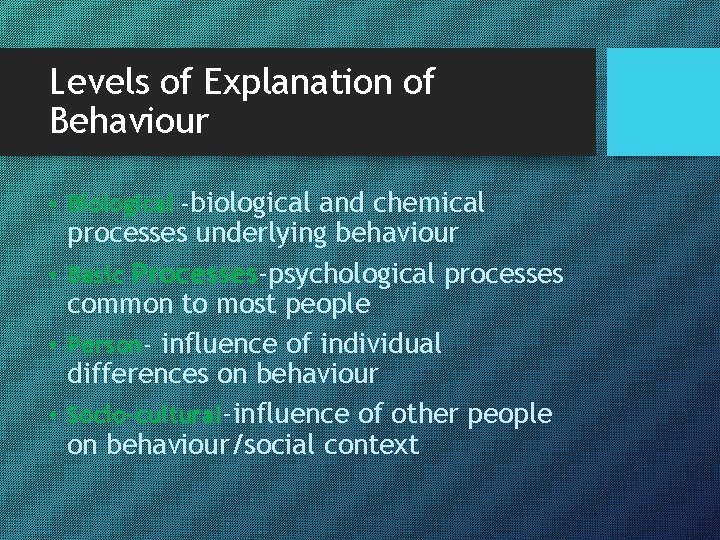
Levels of Explanation of Behaviour • Biological –biological and chemical processes underlying behaviour • Basic Processes-psychological processes common to most people • Person- influence of individual differences on behaviour • Socio-cultural-influence of other people on behaviour/social context
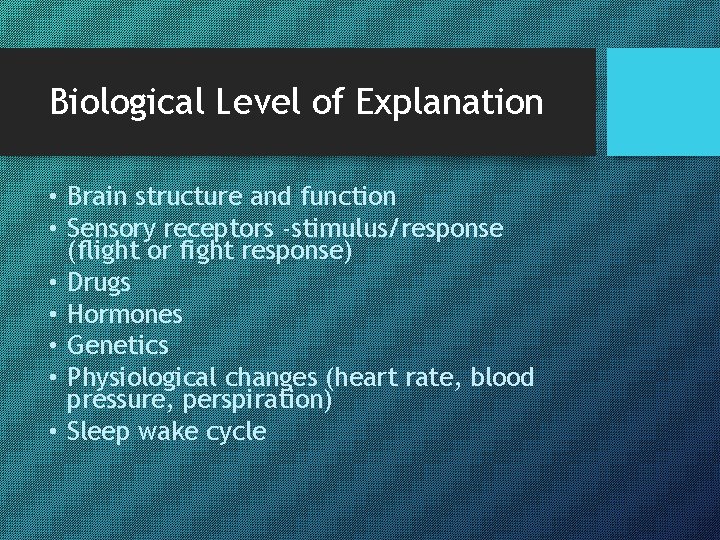
Biological Level of Explanation • Brain structure and function • Sensory receptors -stimulus/response (flight or fight response) • Drugs • Hormones • Genetics • Physiological changes (heart rate, blood pressure, perspiration) • Sleep wake cycle
• Ie. Biological processes and chemicals such as hormones influence our levels of sleepiness and stress.
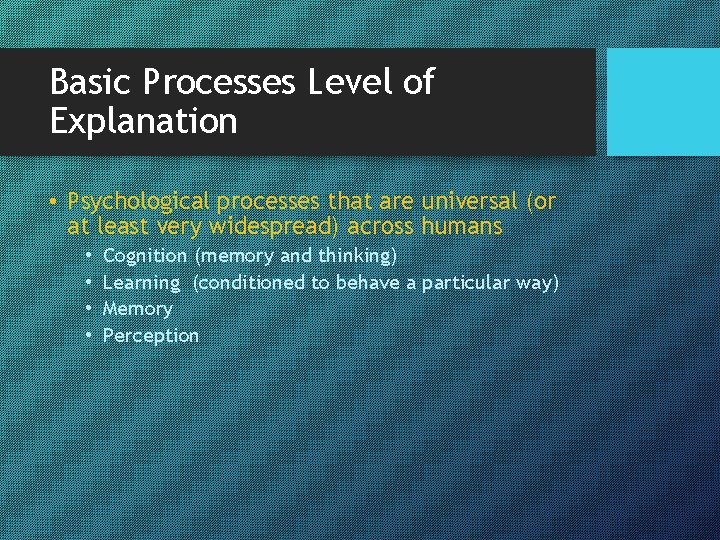
Basic Processes Level of Explanation • Psychological processes that are universal (or at least very widespread) across humans • • Cognition (memory and thinking) Learning (conditioned to behave a particular way) Memory Perception
• Ie. An unrealistic fear of open spaces might be better understood through considering: • The original event – memory • What kind of learning may have taken place • What thoughts are taking place
Person Level of Explanation • Personality types (introvert/extrovert) • Personality traits (cheerful, organised, anxious) • Age • Gender • Preferences (ie favourite music style) • Ie. How does someone’s personality influence their behaviour
Socio-cultural Level of Explanation • The influence other people exert on behaviour • • Culture/community Peer groups Stereotypes Ethnicity • Ie. how do family, friends , wider community and media influence our attitudes and behaviour?
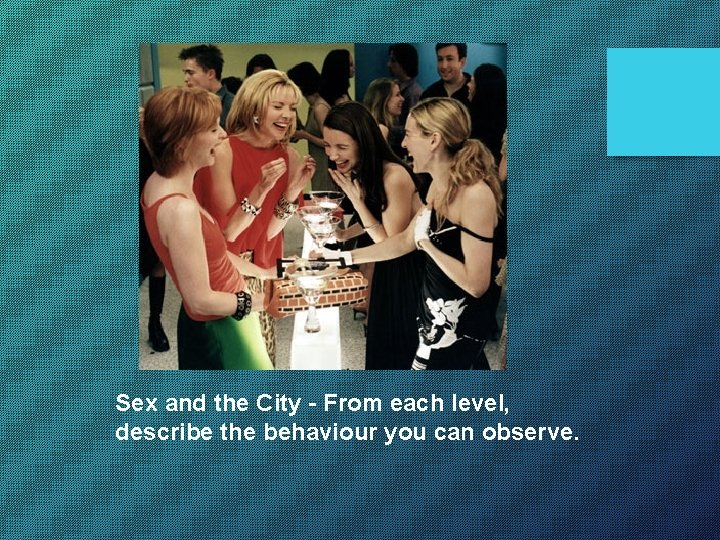
Sex and the City - From each level, describe the behaviour you can observe.