
Welcome to Research Methods and Experimentation How do
















- Slides: 75
Welcome to Research Methods and Experimentation
How do psychologists collect data about behavior?
• Regardless of the method used, all research is based on the Scientific Method of Psychology • Scientific means systematic, testable, and objective.
What are three main principles that guide the Scientific Method of Psychology?
• Step 1 – Theory • Step 2 – Hypotheses • Step 3 – Research and Observation
• Theories organize known facts and summarizes current research in the field.
• A hypothesis is then created as a testable prediction based on what is currently known and what we want to find out.
• Research or observation or experiments are generated to collect data, which then goes into evaluating the hypothesis, which may or may not add to the existing theory.
What are the most common methods used by psychologists to collect data?
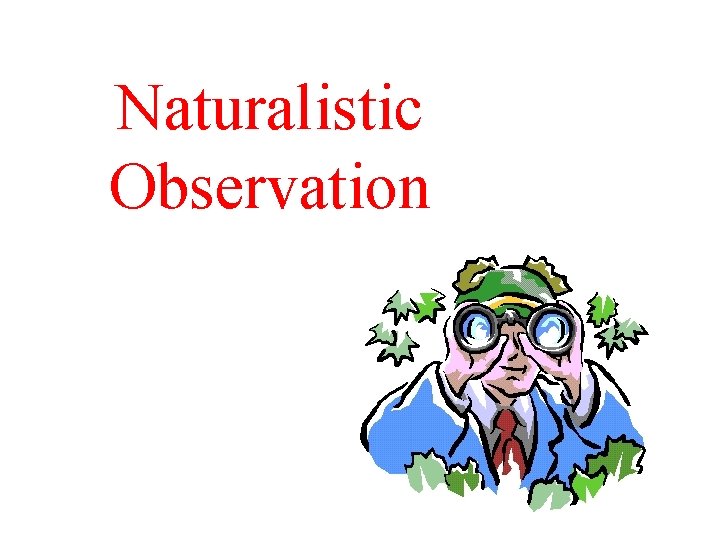
Naturalistic Observation
Naturalistic Observation • Study behavior in its natural context. Spontaneous behavior in a subject’s natural environment. No interaction with the subject.
What are some potential problems with this type of research?
Bias • Situation in which a factor unfairly increases the likelihood of a researcher reaching a particular conclusion
Example of Bias I am researching teenagers behavior and I was recently mugged by a group of teenagers… am I likely to observe teenage behaviors as being motivated by evil versus good? Why?
Researcher Bias • The tendency to notice evidence which supports one particular point of view or hypothesis
Example of Researcher Bias If my hypothesis is that excessive sugar intake causes poor test performance, I will readily conclude this as fact when three students who failed the test were observed drinking a soda prior to the test. Other students who failed and other factors are ignored.
Participant Bias • Tendency of research subjects to respond in certain ways because they know they are being observed. The subjects might try to behave in ways they believe the researcher wants them to behave.
Let’s try this out !!!
Going for an “observational” walk • We are going to walk through the building • Your job is to write EVERY behavior you see… • When we come back to the room, ask yourself “Why was ____ doing ____? ” • Please do not communicate with anyone during this exercise !!!!
Case Studies
Case Study • In depth study of one individual with the hopes of determining universal principles • This technique is very open to bias • Difficulty of applying data from one person to everyone
• IE. I want to know why Bart killed thirty-five people over a twenty-year period of time. I will examine the police files, observe and interview Bart, talk to his and the victims families, etc.
Surveys
Survey Method • Research method that relies on self-reports; uses questionnaires, interviews. • Usually a very efficient and inexpensive method to collect a lot of information and create basic assumptions about behaviors.
Correlation
Correlational Study • Research study designed to determine the degree to which two variables are related to one another
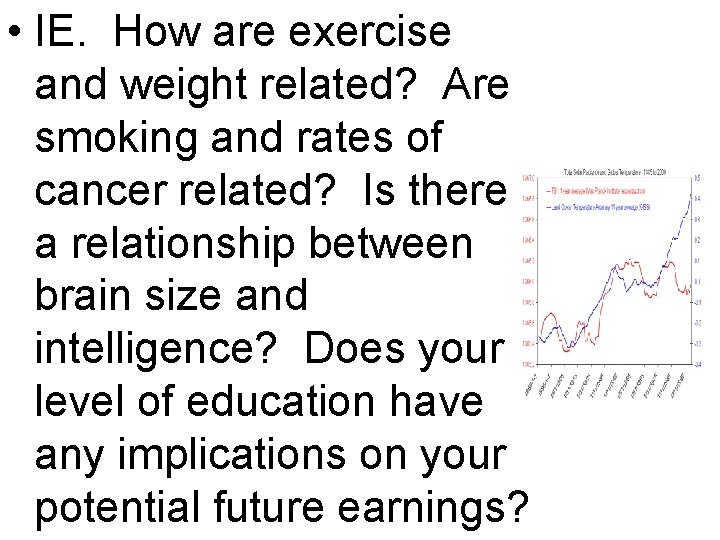
• IE. How are exercise and weight related? Are smoking and rates of cancer related? Is there a relationship between brain size and intelligence? Does your level of education have any implications on your potential future earnings?
Correlational Study • Correlation studies DO NOT prove causation. They can only suggest that there is or is not a relationship between the two variables.
• IE. – A correlation study may suggest that people who earn higher levels of education generally earn higher salaries, but it can’t definitively say that getting a degree will get you a higher paying job. – A correlation study may suggest that smoking increases an individuals chances of getting cancer, but it can’t definitely say that everyone who smokes will get cancer.
Graphing Correlation Relationships
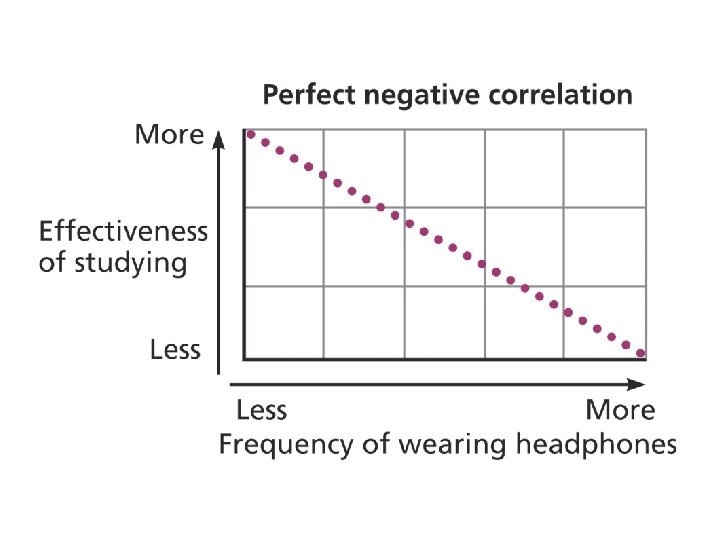
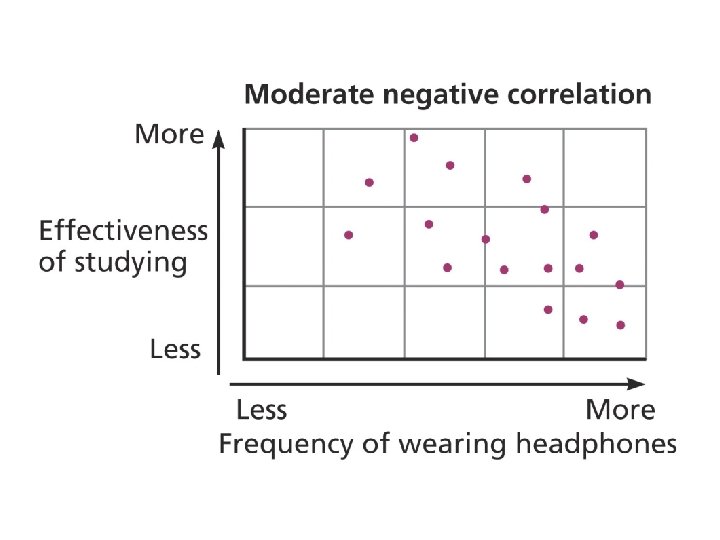
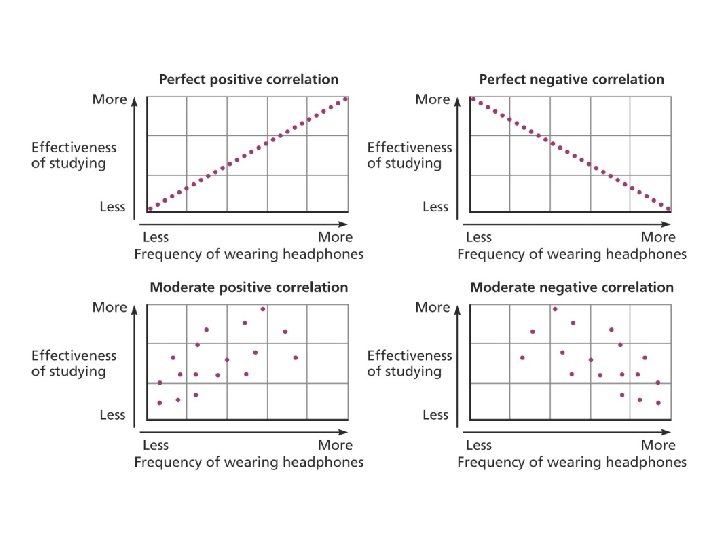
• After you plot the data that you’ve collected, the slope (direction) of the line indicates whether or not there is a positive, negative, or no relationship between variables. • How close the dots are together along the slope indicates how close the relationship between the variables is.
Positive Correlation • As the value of one variable increases (or decreases) so does the value of the other variable.
• Studying and Grades – As students study more, their grades increase. • Practice and Athletics – As athletes practice more, their batting averages increase • Dieting and Weight Loss – As dieters ate less, their weight dropped.
Negative Correlation • As the value of one variable increases, the value of the other variable decreases. – The more you exercise, the less you weigh – The more you study, the less your teachers yell at you
Zero Correlation • There is no relationship whatsoever between the two variables. –The length of your hair has no influence on your level of intelligence.
Correlational Study • Important NOT to imply a cause and effect relationship between the variables • Correlational study does not determine why the two variables are related--just that they are related. • Correlational studies are helpful in making predictions.
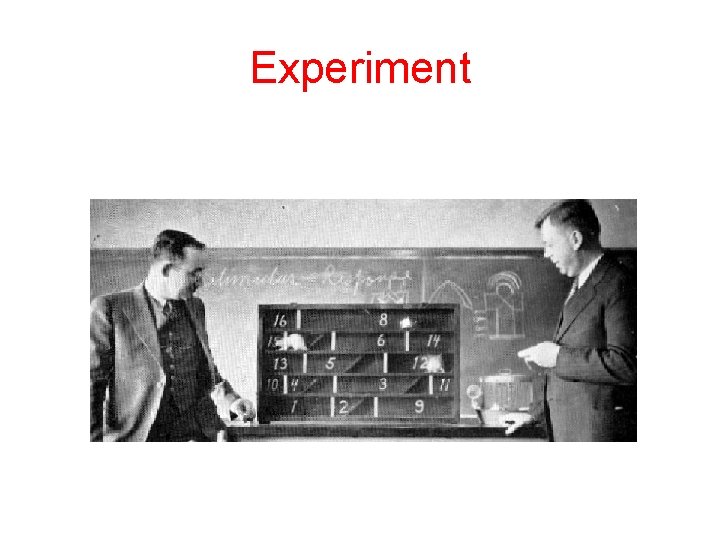
Experiment
Experiment • An investigation seeking to understand relations of cause and effect.
• IE. I want to know if new drug A will help to alleviate the symptoms of insomnia. Patients will be given different doses at different times to see what works and what doesn’t. I need to control other factors, like mattress softness and room temperature, to eliminate them as causes of sleep deprivation.
How do I create a valid and reliable experiment?
• The Hawthorne Effect refers to the fact that some subjects will alter their behaviors simply because they know that they are part of an experiment, regardless of what is being done to them.
Step 1: Choose a Hypothesis A hypothesis is a statement that expresses a perceived relationship between two variables. – IE. My hypothesis is that watching violent television programs makes people more aggressive.
Step Two: Choose Variables • Variables are things that are measured, controlled, or manipulated in research.
• The independent variable is the manipulated variable. • IE. Watching television violence is the independent variable because I can adjust what shows are viewed, for how long, by whom, etc.
• The dependent variable is measured for change. • IE. Measuring the change in aggression levels is the dependent variable in our experiment because it changes based on what is viewed, for how long, etc.
Step Three: Identify Potential Extraneous Variables/Confounding Variables • It is important to make sure that during the experiment as many other factors that are NOT part of the experiment are NOT included. Any factor or variable that causes an effect (or potential affects) other than the variable being studied is considered an extraneous variable.
• IE. An extraneous variable in our experiment would be a phone call from a solicitor during a program that might make the viewer angry, the viewer receiving mail including a poor report card, a viewer stubbing their toe during a show, alcohol abuse, etc. All of these could increase aggressiveness, but are not related to viewing violent television.
Step Four: Identify Who You Will Be Testing • The individuals on which the research will be conducted are called subjects (or participants). • A small group of subjects are drawn from a larger potential population. • IE. Our subjects will be drawn from the overall population of 12 th grade students at Middletown High School.
Step Five: How Do We Decide Who Will Be Subjects, and Who Won’t? • Since we can’t realistically include all 12 th graders at Middletown High School in our study, we have to somehow narrow down the population to more manageable numbers. But how?
Method 1: Rigorous Control Design • Designing an experiment with specific, hand-picked groups in mind. • IE. Only testing males, 18 years old, in AP Psychology. Remember, though, the results then can only be applied to this group as a whole. It says nothing about female aggression, or even males younger than 18.
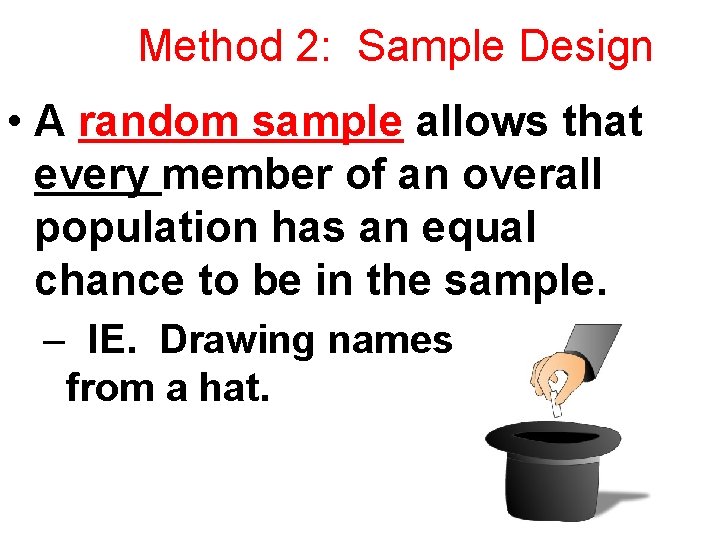
Method 2: Sample Design • A random sample allows that every member of an overall population has an equal chance to be in the sample. – IE. Drawing names from a hat.
Step Six: Assignment • Once you have chosen your subjects to study, you must assign them to one of two groups; those that will be manipulated, and those that won’t.
Group 1: Experimental Group • The experimental group receives the independent variable and is manipulated throughout the experiment.
Group 2: Control Group • The control group does not receive the independent variable.
• IE. In our television violence experiment, those in the experiment group will watch varying degrees of violent program, for varying lengths of time, etc. , and their changes in levels of aggression measured.
• IE. In our television violence experiment, the control group will be shown a variety of non-violent programming in order to create a baseline to compare the experiment group against.
Blind Procedure • An experimental procedure where the research participants are ignorant (blind) to the expected outcome of the experiment • Sometimes called single blind procedure
Double Blind Procedure • An experimental procedure where both the research participants and those collecting the data are ignorant (blind) to the expected outcome of the experiment
Step Seven: Replication • Repeating the experiment to determine if similar results are found • If so, the research is considered reliable.
Ethics
Ethics: Human Research (Four Basic Principles)
1. Informed Consent • Participants must be informed, in advance, about: – the general nature of the research, and – any potential risk. – Participants must have the right to refuse participation or withdraw at any time.
2. Right to be Protected from Harm and Discomfort • Studies involving harm or discomfort may be conducted only under certain circumstances, and only with the informed consent of the participants.
3. Right of Confidentiality • Individual data about research participants should never be discussed or released.
4. Right to Debriefing • Participants have a right to receive a complete explanation of the research at the end of the study. • This is extremely important if the research involves deception.
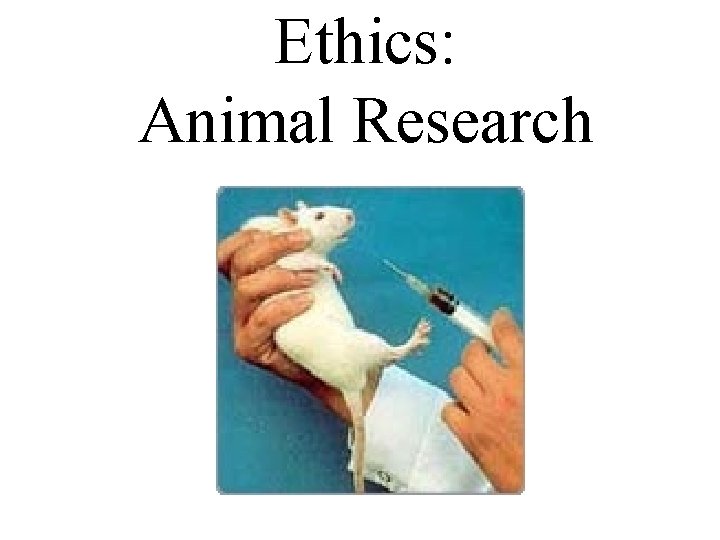
Ethics: Animal Research
Reasons for Animal Research • Interest in animal behavior as a topic of study • Data from animal studies may apply to humans. • Easier to do some type of studies (genetics) due to the shorter life span of animals
Reasons for Animal Research • Easier to exercise more control over experiments with animals as compared to humans • Procedures that are not ethical to perform on humans may be considered acceptable when performed on animals
Care of Animals used in Research • Animals used in research must: – Have clean housing with adequate ventilation – Have appropriate food – Be well cared for