
Welcome to Psychology Assoc Prof Murray Maybery Head

Welcome to Psychology Assoc Prof Murray Maybery Head of School

Why choose UWA Psychology for PG Study? § School’s Commitment to Professional Training – 1 st Australian university to provide a Master of Psychology (Clinical) program – We now offer professional courses in Clinical Psychology, Neuropsychology, Industrial & Organizational Psychology, and Autism Diagnosis 2
Why choose UWA Psychology for PG Study? § Recent staff appointments – Industrial and Organizational Psychology (Marylene Gagne; Pat Dunlop) – Clinical/Neuropsychology (Jeneva Ohan, Carmela Pestell) – Autism Diagnosis (Lauren Taylor) 3
Why choose UWA Psychology for PG Study? § National rating – UWA Psychology has consistently received the top ranking of 5 (“well above world standard”) in Australia’s research assessment exercise (ERA) § International rating – UWA ranked 27 th in the world for the Psychology discipline in the 2015 QS World Rankings of Universities 4
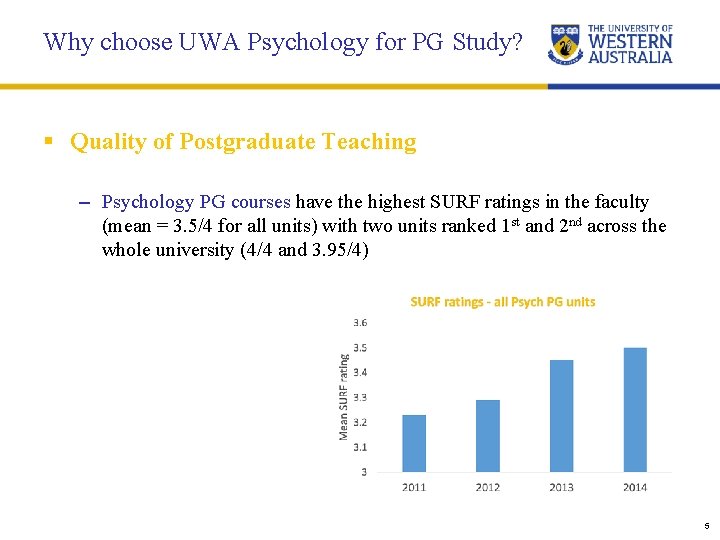
Why choose UWA Psychology for PG Study? § Quality of Postgraduate Teaching – Psychology PG courses have the highest SURF ratings in the faculty (mean = 3. 5/4 for all units) with two units ranked 1 st and 2 nd across the whole university (4/4 and 3. 95/4) 5

Why choose UWA Psychology for PG Study? § Facilities – Psychology Hub including the Robin Winkler Clinic – Accelerated Learning Lab & Centre for Safety – Major partner in the Autism CRC 6
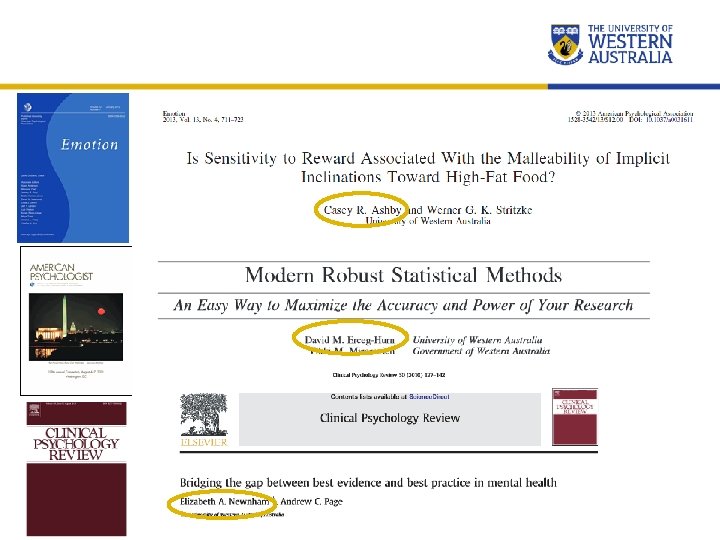
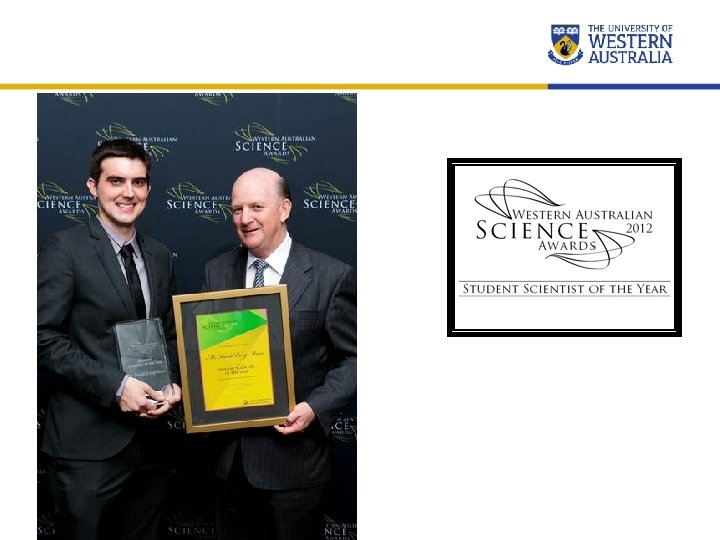
Why choose UWA Psychology for PG Study? § Outstanding achievements of our students – 2015 Society for Pediatric and Perinatal Research (SPER) Heinz Berendes Travel Award: Jessica Tearne – 2015 UWA Robert Street Prize: Ben Grafton – 2015 Fulbright Scholarship: Briony Swire-Thompson – 2014 UWA publication prizes for higher degree students: Nadia Cunningham (winner) & Michelle Olaithe (special commendation) – 2014 UWA Three Minute Thesis Award: Bronwyn Milkins – 2014 David Meister Memorial Award for Best Paper in Systems Development, International Meeting of the Human Factors and Ergonomics Society, Chicago: Stephanie Chen – 2012 WA Student Scientist of the Year: David Erceg-Hurn – 2012 Trans Tasman 3 Minute Thesis competition: Lauren Hollier (runner-up) – APS Awards for Excellent Ph. D Thesis: Amy Lampard (2012), Renita Almeida (2011), Elizabeth Newnham (2010) 7
Why choose UWA Psychology for PG Study? ü Quality of research and teaching ü First rate facilities for professional training ü Consistent evidence of excellence of graduates 8

Postgraduate Programs Application Processes Maria P. Puerta Francos Postgraduate Administrative Officer
Application process for 2016 entry Applications open Monday 28 th September 2015 Applications close Saturday 31 st October 2015 5. 00 pm Application information for all postgraduate programs: http: //www. psychology. uwa. edu. au/courses/postgraduate
Admission requirements § Check the admission requirements for the chosen program before submitting an application http: //www. psychology. uwa. edu. au/courses/postgraduate § Applicants must hold, or expect to gain, at least a 2 A class Honours degree (or equivalent) in Psychology from an approved University. § Current honours students who expect to qualify before the beginning of the next academic year are encouraged to apply. § Candidates for the Ph. D (Doctor of Philosophy), Master of Philosophy (by research), and combined Master/Ph. D programs must secure potential supervisors before submitting their application.
Admission requirements • For entry into an accredited postgraduate coursework degree (e. g. Master in Industrial and Organisational Psychology, combined MPsych/Ph. D or Graduate Diplomas) the Australian Psychology Accrediting Council requires that applicants must be eligible for provisional registration as a psychologist. • Enrolled students are also responsible for maintaining provisional registration for the duration of their enrolment in the program. • To be eligible for admission to an accredited postgraduate program, applicants must meet the Psychology Board of Australia IELTS requirements. • To be eligible for admission to a HDR program applicants must meet UWA minimum English language competency requirements.
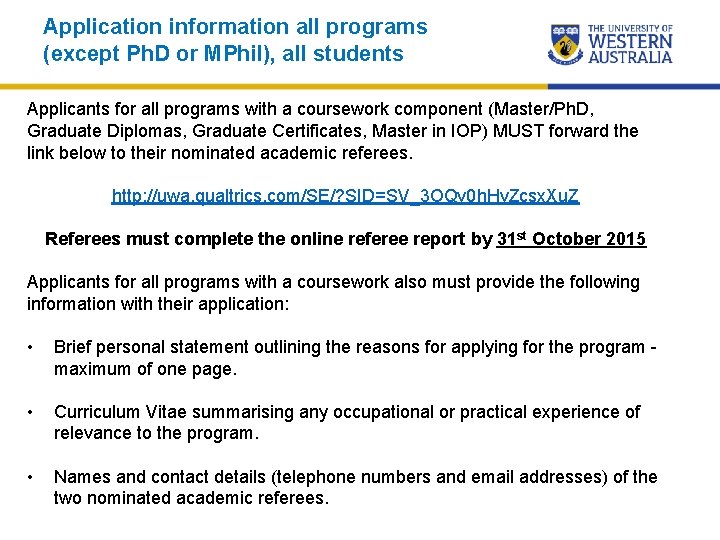
Application information all programs (except Ph. D or MPhil), all students Applicants for all programs with a coursework component (Master/Ph. D, Graduate Diplomas, Graduate Certificates, Master in IOP) MUST forward the link below to their nominated academic referees. http: //uwa. qualtrics. com/SE/? SID=SV_3 OQv 0 h. Hv. Zcsx. Xu. Z Referees must complete the online referee report by 31 st October 2015 Applicants for all programs with a coursework also must provide the following information with their application: • Brief personal statement outlining the reasons for applying for the program - maximum of one page. • Curriculum Vitae summarising any occupational or practical experience of relevance to the program. • Names and contact details (telephone numbers and email addresses) of the two nominated academic referees.
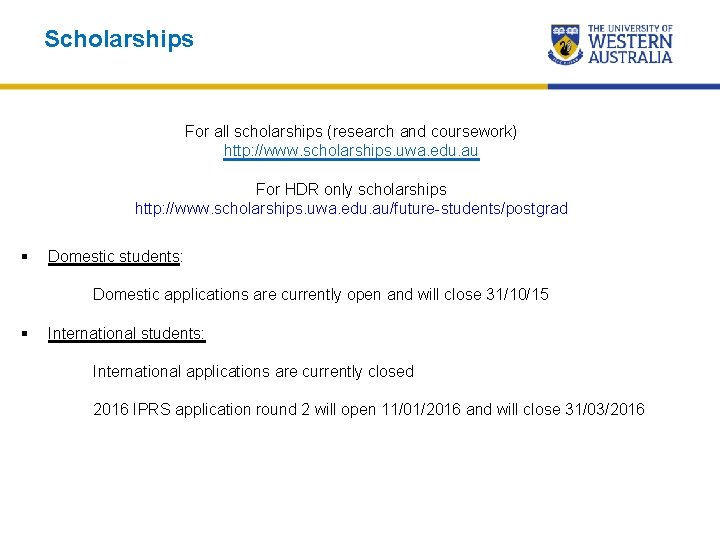
Scholarships For all scholarships (research and coursework) http: //www. scholarships. uwa. edu. au For HDR only scholarships http: //www. scholarships. uwa. edu. au/future-students/postgrad § Domestic students: Domestic applications are currently open and will close 31/10/15 § International students: International applications are currently closed 2016 IPRS application round 2 will open 11/01/2016 and will close 31/03/2016
Application enquiries: postgradinfo-psy@uwa. edu. au Phone (+61) 8 6488 3933
Post Graduate Research in Psychology at UWA Neil Mc. Lean, Graduate Research Coordinator
Two offerings § Ph. D (Doctor of Philosophy) § M. Phil. (Masters by Research)
What is involved? • 3 -4 yr research degree • any topic, subject to support from: supervisor & School of Psychology • principal assessment: thesis
Eligibility • IIA Honours (minimum) • Supervisor (and co-supervisor)

Finding a supervisor § § § Critical step Topic must be of interest Person must “fit” Do your research Discuss possibilities http: //www. psychology. uwa. edu. au/courses/honours/supervisors 2
Two modes Straight Ph. D. • 3 -4 years • apply: anytime Combined Masters/Ph. D. • M. Psych Clinical Psychology • M. Psych Industrial & Organisational • M. Psych Neuropsychology • 4 years • apply: October only
Why do a Ph. D? § Develop advanced research skills § Pursue a topic of interest in close collaboration with a supervisor/lab § Gain an internationally recognised qualification § Open up job opportunities in Academia and research establishments § Win the Nobel prize
Fees & Scholarships • no domestic student fees for a Ph. D at UWA • domestic scholarships at UWA • Australian/University Postgraduate Awards • $25, 392. 00 tax free • ~10 to Psychology each year • international scholarships at UWA • International Postgraduate Research Scholarship • covers fees and provides living allowance • Scholarship for International Research Fees • covers fees only
Other support/resources Share office, desk and computer Photocopying, stationery etc Ongoing support costs Travel Teaching Training courses Test Library
How it unfolds • (before submitting application): find area, supervisors, topic • (by 5 months): submit thesis proposal • (by 1 year): research, writing, annual report • (by 2 years): more research, writing, conferences etc. • (by 3 -4 years): submit thesis (collection of papers)
Ph. D topics… § The effects of direct to consumer pharmaceutical industry advertising on public attitudes towards depression and its treatment § Mental control in social phobia. § Neurocognitive disturbance in obstructive sleep apnoea: Mechanisms of harm. § The role of self-objectification in the development of body image disturbance and eating disorder symptomatology in young children. § An investigation into the opposing inclinations of alcohol craving, risky decision-making and alcohol consumption behaviour
Ph. D topics… § Unusual visual experiences and hallucinations in the non clinical healthy population: the role of perception and cognitive control processes § Perceptions of facial expressions of emotion in Parkinson’s disease § Development of global processing of visual stimuli in Autism spectrum disorders § Self talk during planning and problem solving in young children with specific language impairment § Mothers of children with intellectual disability or autism spectrum disorder: pre-existing differences, health and quality of life”
Topics cont… § The effect of maternal and paternal age on mental health and cognitive outcomes in offspring: A longitudinal cohort study § Minimizing the disruptive effects of prospective memory in simulated air traffic control § Examining motivation at work: the role of Achievement goal theory in the work place § The praxis of pre environmental behaviour research: applying values-basis theories to individuals’ climate change response § Is income inequality harmful to national environmental performance? Cross-sectional and longitudinal analysis § Construction and validation of habit measures for fruit and vegetable consumption

Questions? ?

The Clinical Post Graduate Training Programmes at UWA Werner Stritzke (Clinical Psychology Programme) Mike Weinborn (Neuropsychology Programme)
Our aim § To train practitioners who have the ability to integrate: – The high-level clinical skills required to practice as clinical psychologists and clinical neuropsychologists § AND – The high-level research capabilities necessary to advance knowledge and understanding
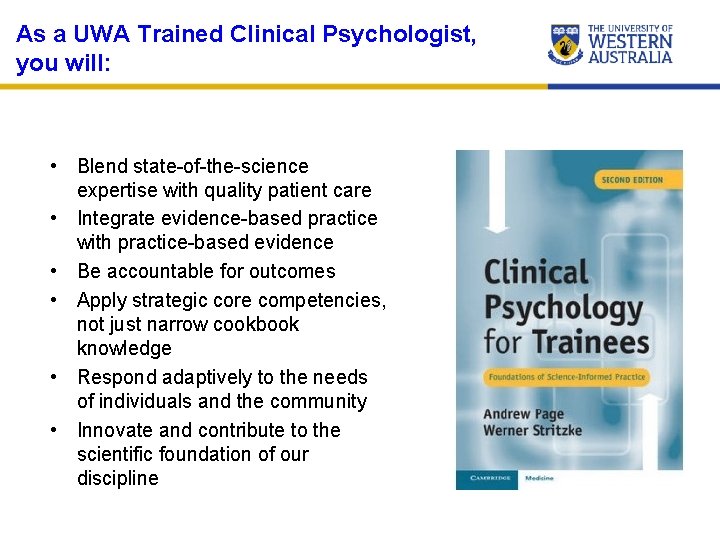
As a UWA Trained Clinical Psychologist, you will: • Blend state-of-the-science expertise with quality patient care • Integrate evidence-based practice with practice-based evidence • Be accountable for outcomes • Apply strategic core competencies, not just narrow cookbook knowledge • Respond adaptively to the needs of individuals and the community • Innovate and contribute to the scientific foundation of our discipline
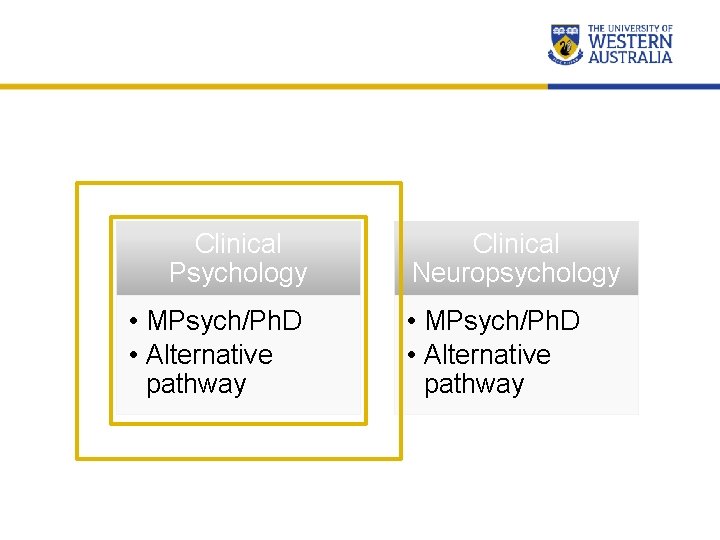
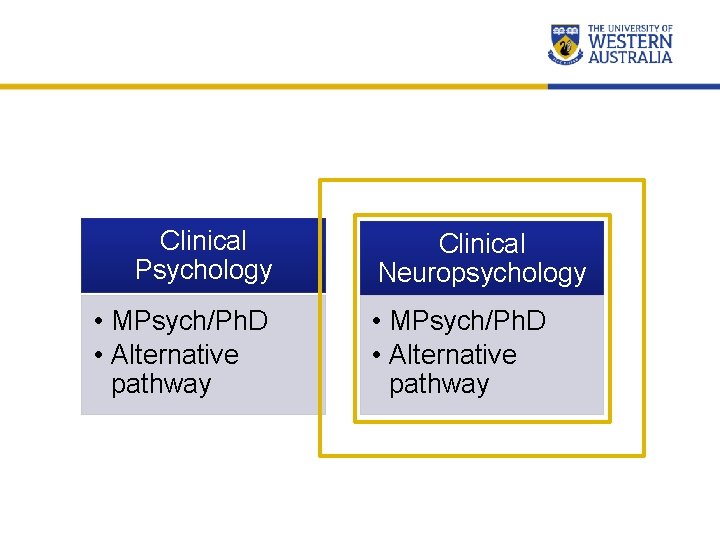
Clinical Psychology • MPsych/Ph. D • Alternative pathway Clinical Neuropsychology • MPsych/Ph. D • Alternative pathway

Common to all programmes Three interrelated components: § Coursework § Placements § Research
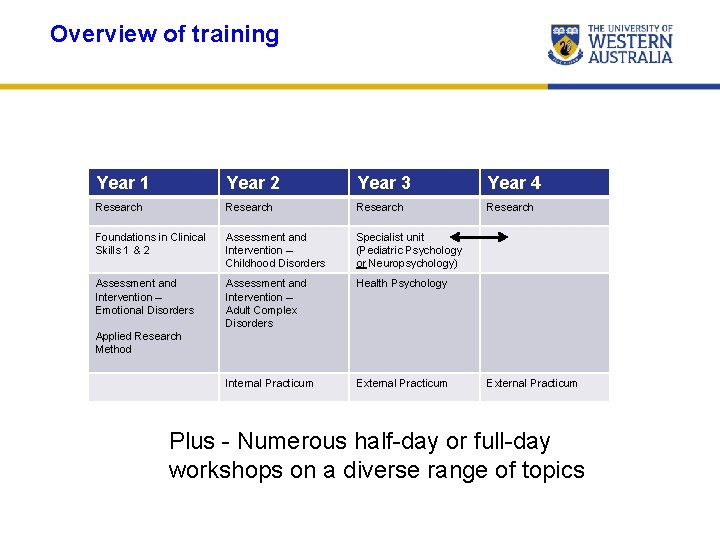
Overview of training Year 1 Year 2 Year 3 Year 4 Research Foundations in Clinical Skills 1 & 2 Assessment and Intervention – Childhood Disorders Specialist unit (Pediatric Psychology or Neuropsychology) Assessment and Intervention – Emotional Disorders Assessment and Intervention – Adult Complex Disorders Health Psychology Internal Practicum External Practicum Applied Research Method External Practicum Plus - Numerous half-day or full-day workshops on a diverse range of topics
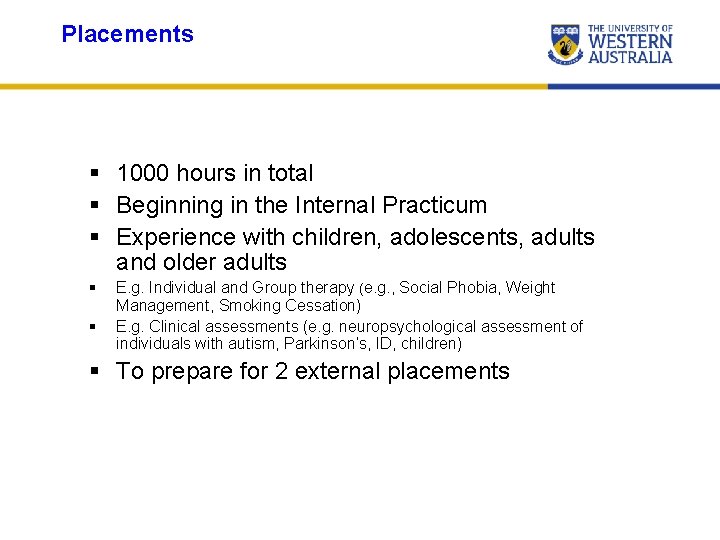
Placements § 1000 hours in total § Beginning in the Internal Practicum § Experience with children, adolescents, adults and older adults § § E. g. Individual and Group therapy (e. g. , Social Phobia, Weight Management, Smoking Cessation) E. g. Clinical assessments (e. g. neuropsychological assessment of individuals with autism, Parkinson’s, ID, children) § To prepare for 2 external placements
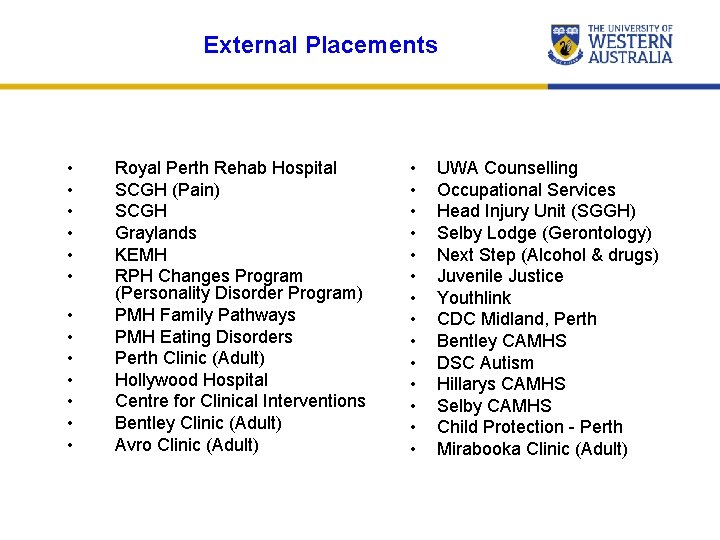
External Placements • • • • Royal Perth Rehab Hospital SCGH (Pain) SCGH Graylands KEMH RPH Changes Program (Personality Disorder Program) PMH Family Pathways PMH Eating Disorders Perth Clinic (Adult) Hollywood Hospital Centre for Clinical Interventions Bentley Clinic (Adult) Avro Clinic (Adult) • • • • UWA Counselling Occupational Services Head Injury Unit (SGGH) Selby Lodge (Gerontology) Next Step (Alcohol & drugs) Juvenile Justice Youthlink CDC Midland, Perth Bentley CAMHS DSC Autism Hillarys CAMHS Selby CAMHS Child Protection - Perth Mirabooka Clinic (Adult)
Research • MPsych/Ph. D • 3 year programme of research spread over the 4 years • Research thesis topic should have a specialist clinical focus • Very broad view of what is relevant!
Summary of MPsych/Ph. D § § Approximately 4 years full time (72 points + Ph. D) 48 points of teaching units 24 points of placement units (1000 hours) Ph. D research (3 years FTE)
Career Destinations § UWA graduates in high demand § Excellent employment options – – – – § § Health Department Justice Community Development Disability Services Private health clinics/hospitals Private Practice Universities E. g. Trauma in child soldiers in Sierra Leone (Harvard University) E. g. Ante and post natal care (King Edward Memorial Hospital) E. g. Head of Neurosciences (Graylands Hospital) E. g. Mental Health Commissioner



Clinical Psychology • MPsych/Ph. D • Alternative pathway Clinical Neuropsychology • MPsych/Ph. D • Alternative pathway
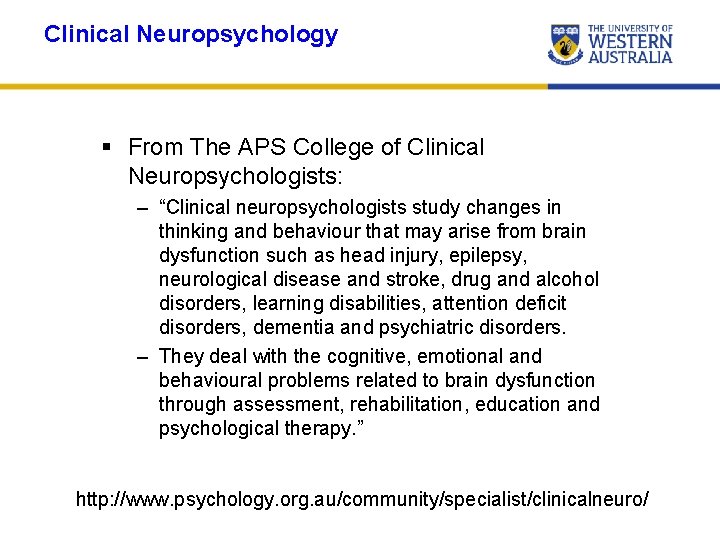
Clinical Neuropsychology § From The APS College of Clinical Neuropsychologists: – “Clinical neuropsychologists study changes in thinking and behaviour that may arise from brain dysfunction such as head injury, epilepsy, neurological disease and stroke, drug and alcohol disorders, learning disabilities, attention deficit disorders, dementia and psychiatric disorders. – They deal with the cognitive, emotional and behavioural problems related to brain dysfunction through assessment, rehabilitation, education and psychological therapy. ” http: //www. psychology. org. au/community/specialist/clinicalneuro/
Clinical Neuropsychology § Provide evaluations to assist – Diagnosis (e. g. , ADHD or dementia) – Treatment planning (e. g. , ability to return to work, succeed in school, live alone, manage finances) – Criminal forensic decisions (assist court with information regarding competency to stand trial, mental state at the time of offense) – Civil forensic issues (opinions regarding damage to cognitive abilities, cause and prognosis)
Clinical Neuropsychology § Provide rehabilitation treatment based on evaluation – Identify cognitive strengths & weaknesses – Assist patient with identifying and implementing compensatory strategies & devices – Provide education to patient, family & support system – Work with schools and voc rehab services
MPsych/Ph. D § Much is similar across programs: § Approximately 4 years full time (72 points + Ph. D) § 54 points of teaching units – Overlapping clinical psychology units – Specialty clinical neuropsychology units (e. g. , neuroanatomy, assessment on treatment of neuropsychological disorders) § Ph. D research (3 years FTE) – Topic relevant to Neuropsychology § 1000 hours of placement – Internal placement – At least 2 external placements
Placements (and Career Destinations) § Some examples: – the Neurosciences Unit at Graylands Hospital (Adult and Paediatric teams) – Sir Charles Gairdner (General Medicine dept. and State Head Injury Unit – Princess Margaret Hospital – Next Step Drug and Alcohol Treatment Centre – Brightwater Oats Street – Private practice

3 components (Clinical Neuropsychology) § Neuropsychology Coursework – neuroanatomy, neuropsychopathology, neuropsychological assessment and rehabilitation – Overlap with Clinical Psychology training § Neuropsychology placements – (Neurosciences Unit, Shenton Park, State Head Injury Unit, Next Step, Princess Margaret Hospital, Fremantle Older Adult Mental Health Service, internal prac, interstate options) § Research project relevant to CN

Do you have to decide on just one specialty? § For those of you who can’t get enough of a good thing…
Alternative pathways – Clinical and Clin Neuro - § MPsych/Ph. D in Clinical Psychology OR Clinical Neuropsychology – Note: your thesis topic must be chosen carefully – relevant to BOTH areas PLUS § Graduate Diploma in the other specialty (Clinical Neuropsychology or Clinical Psychology) – 48 points (one year FTE) of specialty coursework units and specialty placement units (must have 1000 hours of specialty placement across both degrees) – Most of our graduates will get advanced standing in at least some of these units
Alternative pathway – Clinical to Neuro - For Example: § If completed the current UWA MPsych/Ph. D in Clinical Psychology WITH Clinical Neuropsychology specialist unit as their elective AND § 1 placement in clinical neuropsychology relevant setting PLUS § Graduate Diploma in Clinical Neuropsychology – would typically be granted advanced standing in 18 of 48 points
Alternative pathway – Neuro to Clinical - For example § If completed the current UWA MPsych/Ph. D in Clinical Neuropsychology PLUS § Graduate Diploma in Clinical Psychology – Would typically be granted advanced standing in 24 of 48 points
Endorsement § § Clinical Psychology trainees (MPsych/Ph. D) will be eligible for endorsement by the Clinical College Clinical Neuropsychology trainees (MPsych/Ph. D) will be eligible for endorsement by the Clinical Neuropsychology College By following the alternative pathway, Clinical Psychology trainees may also gain post qualification eligibility for endorsement by the Clinical Neuropsychology College By following the alternative pathway, Clinical Neuropsychology trainees may also gain post qualification eligibility for endorsement by the Clinical Psychology College
Selection § Competitive but not impossible! § Intake of around 14 students across clinical and clinical neuropsychology programmes § Academic record and personal suitability considered, as well as research skills and enthusiasm § MPsych/Ph. D applicants need to secure supervision before applying
Further information – Clinical § Australian Psychological Society College of Clinical Psychologists: – http: //www. psychology. org. au/community/ specialist/clinical/ § Australian Association for Cognitive and Behaviour Therapy – http: //www. aacbt. org/ § Contact Program Director – Werner. stritzke@uwa. edu. au
Further information - Neuropsychology § Australian Psychological Society College of Clinical Neuropsychologists: – http: //www. psychology. org. au/community/speciali st/clinicalneuro/ § International Neuropsychological Society – http: //www. the-ins. org/ § National Academy of Neuropsychology – http: //www. nanonline. org § Contact Program Director – michael. weinborn@uwa. edu. au
Graduate Certificate in Autism Diagnosis Dr Lauren Taylor Assoc Prof Murray Maybery
Autism CRC § National, cooperative research effort § Program 1 – Better Start through Early Diagnosis § Training in Autism assessment and diagnosis
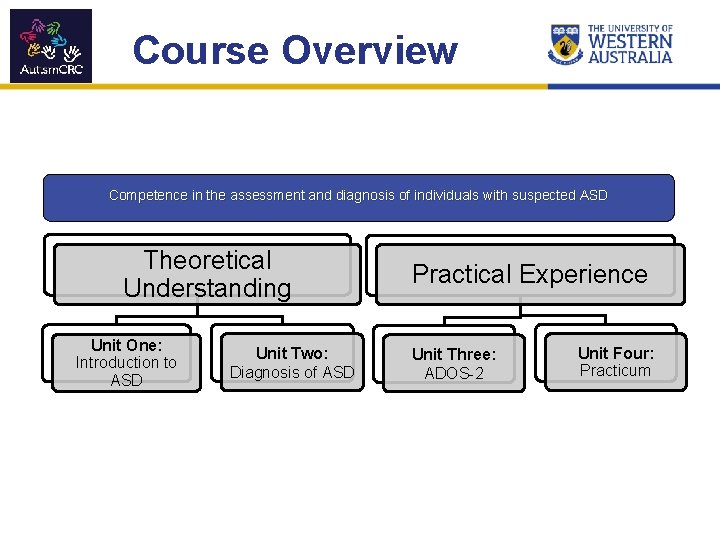
Course Overview Competence in the assessment and diagnosis of individuals with suspected ASD Theoretical Understanding Unit One: Introduction to ASD Unit Two: Diagnosis of ASD Practical Experience Unit Three: ADOS-2 Unit Four: Practicum
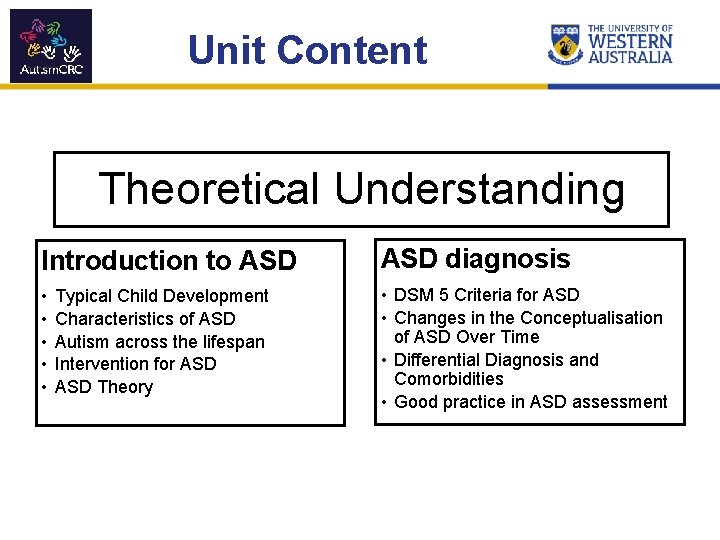
Unit Content Theoretical Understanding Introduction to ASD diagnosis • • • DSM 5 Criteria for ASD • Changes in the Conceptualisation of ASD Over Time • Differential Diagnosis and Comorbidities • Good practice in ASD assessment Typical Child Development Characteristics of ASD Autism across the lifespan Intervention for ASD Theory
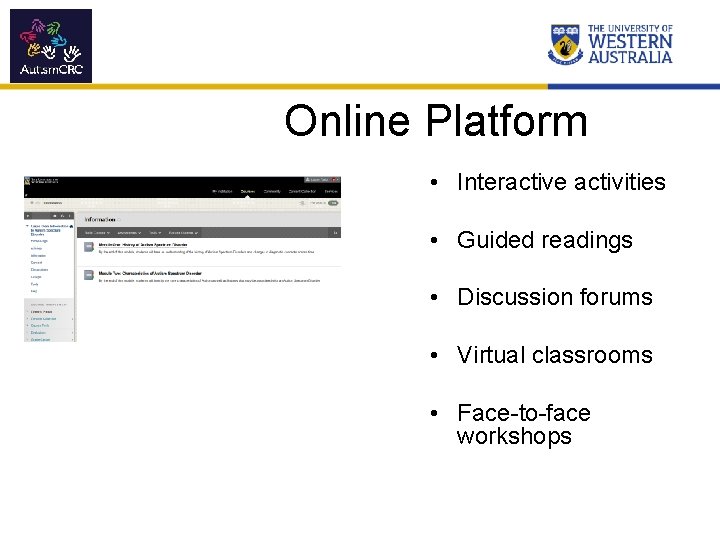
Online Platform • Interactive activities • Guided readings • Discussion forums • Virtual classrooms • Face-to-face workshops
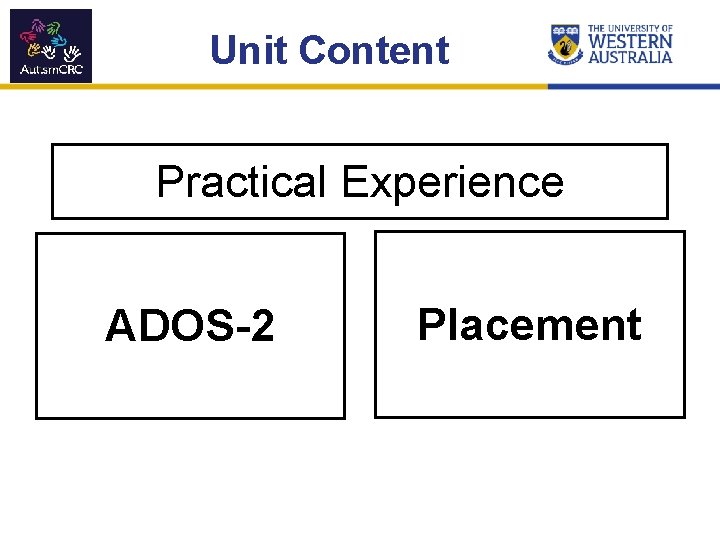
Unit Content Practical Experience ADOS-2 Placement
Eligibility § Honours degree in Psychology § Speech Pathologist § Medical Background (Paediatrician, Psychiatrist)
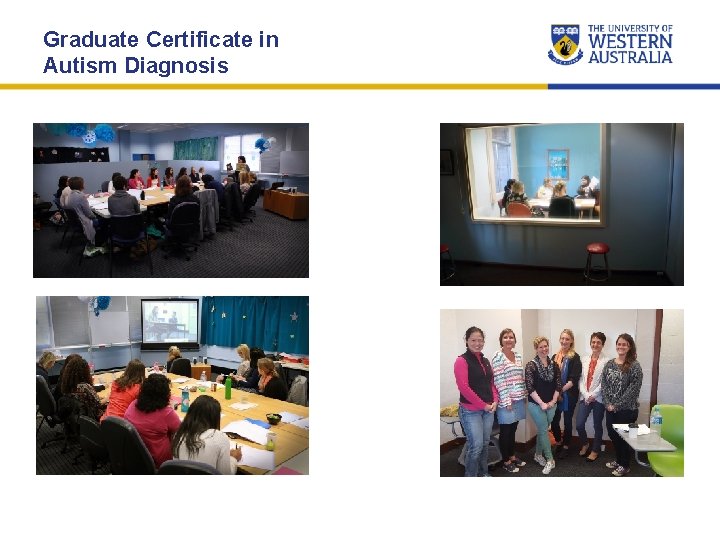
Graduate Certificate in Autism Diagnosis

FOR MORE INFORMATION Associate Professor Murray Maybery University of Western Australia School of Psychology Dr Lauren Taylor University of Western Australia School of Psychology murray. maybery@uwa. edu. au lauren. taylor@uwa. edu. au Autism CRC http: //www. autismcrc. com. au/

Industrial and Organisational Psychology The Science of People at Work Associate Professor Marylène Gagne Program Co-Chair Professor Mark Griffin Director, Centre for Safety & Accelerated Learning Laboratory Associate Professor Shayne Loft Director, Human Factors Laboratory Mrs Karina Jorritsma Placement Coordinator

What is Industrial and Organisational Psychology?
What is Industrial and Organisational Psychology? § Application of psychological principles to the workplace § Goals are: – Improving organisational effectiveness, and – Improving the quality of work life! 72
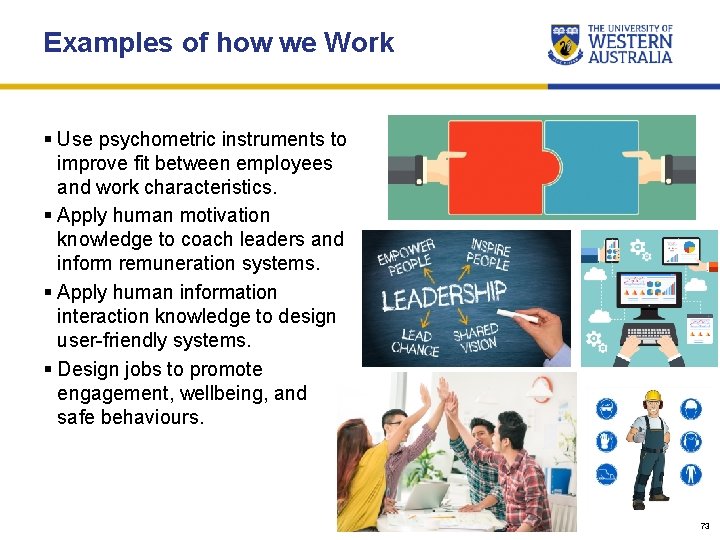
Examples of how we Work § Use psychometric instruments to improve fit between employees and work characteristics. § Apply human motivation knowledge to coach leaders and inform remuneration systems. § Apply human information interaction knowledge to design user-friendly systems. § Design jobs to promote engagement, wellbeing, and safe behaviours. 73
Degree Offerings at UWA § APAC Accredited § Combined MPsych/Ph. D (Industrial and Organisational Psychology) – 4 years § Master of Industrial and Organisational Psychology – 2 years
Master of Industrial and Organisational Psychology § Intake of around 10 -15 a year § Acceptance rate varies – Generally 15%-30% Involves three components: 1. Coursework 2. Placements in Industry 3. Thesis
Coursework units § Methods: – Statistics for Field Research – Research Methods in Applied Settings § Content: – – – Psychology of Training Organisational Development & Work Design Assessment and Selection Occupational Health, Safety & Well-being Professional Issues in I/O Psychology § 2 elective units (UWA Business School)
Thesis § Demonstrate your ability to independently design, execute, and analyse a high quality research study with relevance to I/O Psychology. § Work alongside leading academic scholars
Examples of Theses Topics § The development of a new measure of faking behaviour in high-stakes assessments. § The impact of transformational leadership training on employee autonomous motivation. § Minimising the disruptive effects of prospective memory in simulated air traffic control. § Using the principles of Self-Determination Theory to improve the retention of volunteer workers.
Placements § 1000 hours in total § 3 separate placements § Approx 45 days each § Individualised placements depending on career stage and interests § Individual and group meetings within a peer coaching framework
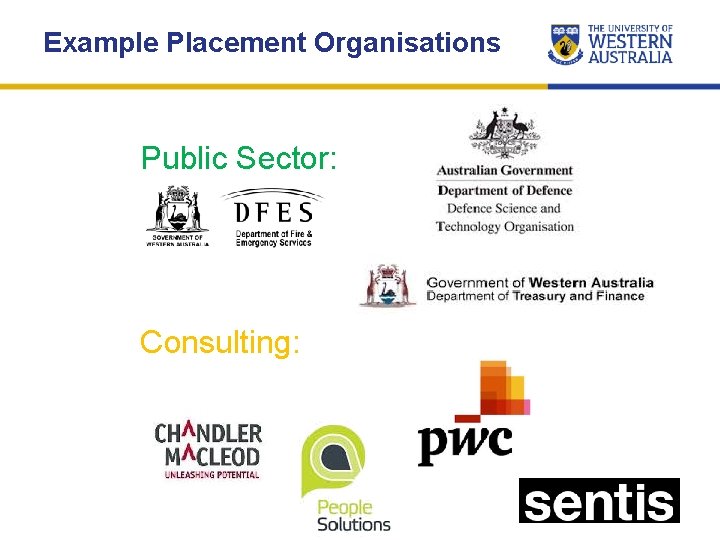
Example Placement Organisations Public Sector: Consulting:

Example Placement Organisations Industry: Not for Profit:
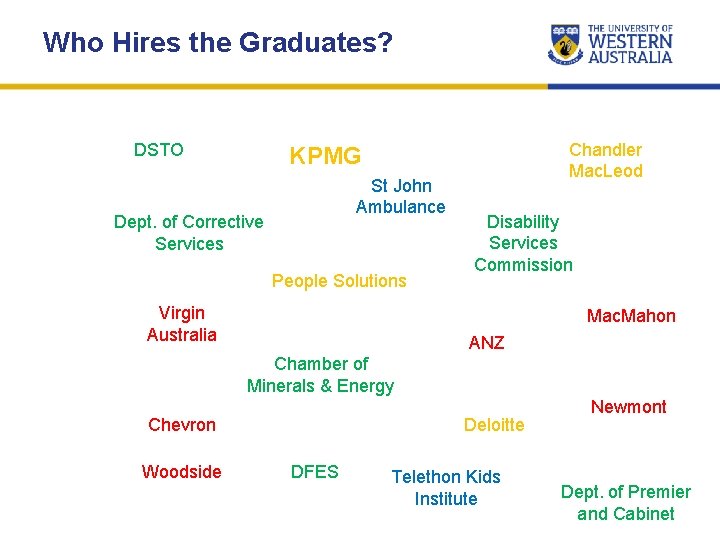
Who Hires the Graduates? DSTO Chandler Mac. Leod KPMG St John Ambulance Dept. of Corrective Services People Solutions Virgin Australia Disability Services Commission Mac. Mahon ANZ Chamber of Minerals & Energy Chevron Woodside Deloitte DFES Telethon Kids Institute Newmont Dept. of Premier and Cabinet
Types of Jobs § Consulting: – – § § Recruitment, Selection, Human Resources, Coaching Injury Management Human Factors Organisation Development Training

More information about I/O Psychology at UWA? Call or email Maria Puerta Francos in the School of Psychology 6488 3247 postgradinfo-psy@uwa. edu. au
- Slides: 84