
Welcome to Physics Main Principal 1 Physics is
- Slides: 16
Welcome to Physics
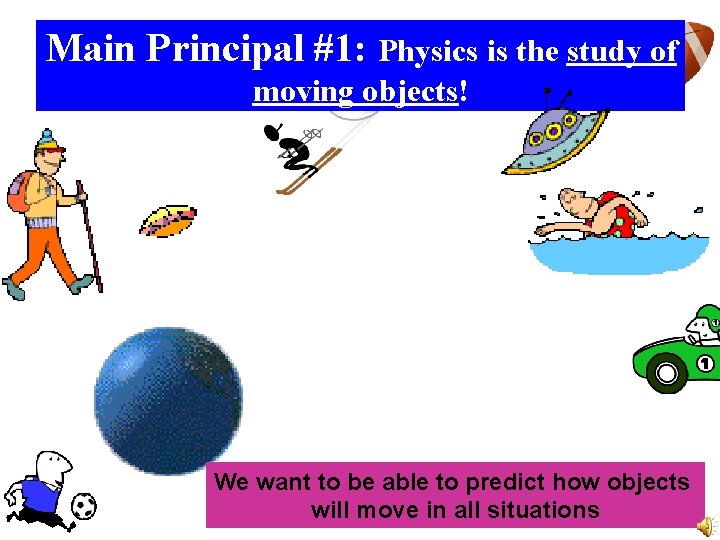
Main Principal #1: Physics is the study of moving objects! We want to be able to predict how objects will move in all situations
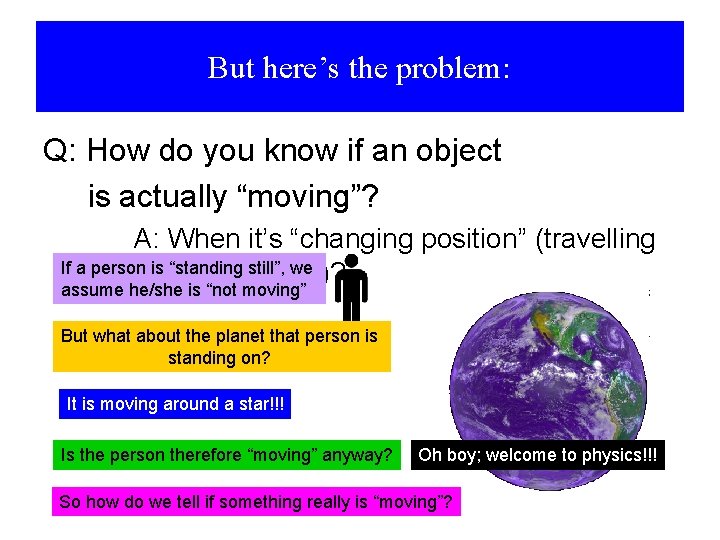
But here’s the problem: Q: How do you know if an object is actually “moving”? A: When it’s “changing position” (travelling If a person is “standing still”, we a certain distance)? assume he/she is “not moving” But what about the planet that person is standing on? It is moving around a star!!! Is the person therefore “moving” anyway? Oh boy; welcome to physics!!! So how do we tell if something really is “moving”?
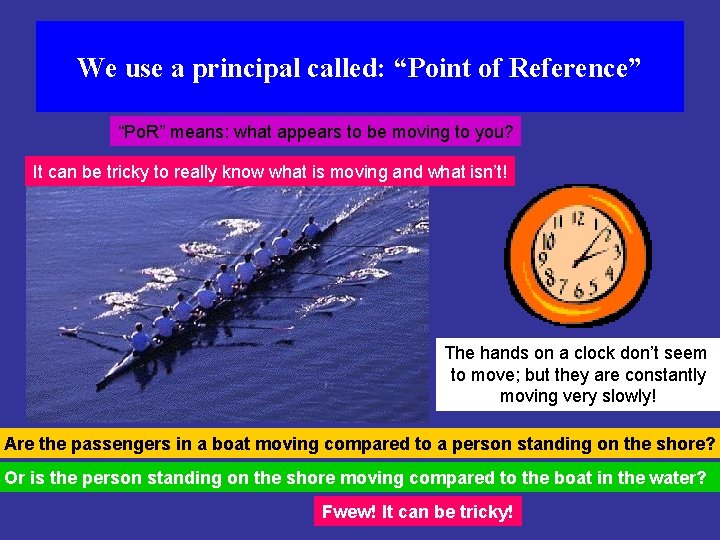
We use a principal called: “Point of Reference” “Po. R” means: what appears to be moving to you? It can be tricky to really know what is moving and what isn’t! The hands on a clock don’t seem to move; but they are constantly moving very slowly! Are the passengers in a boat moving compared to a person standing on the shore? Or is the person standing on the shore moving compared to the boat in the water? Fwew! It can be tricky!
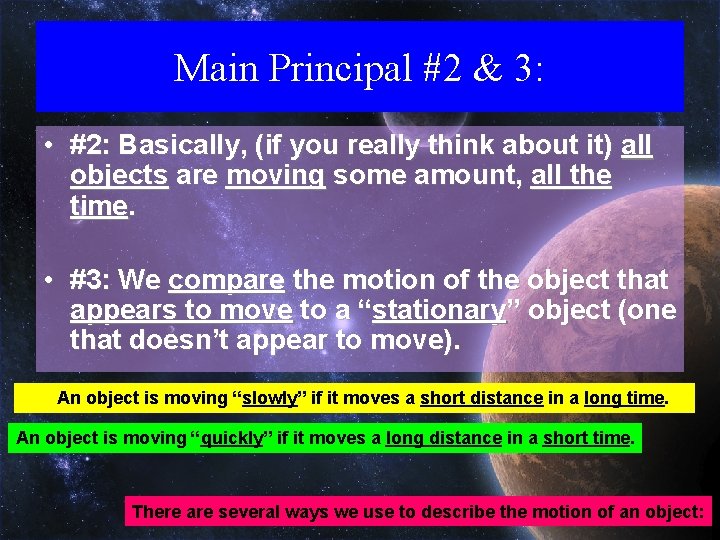
Main Principal #2 & 3: • #2: Basically, (if you really think about it) all objects are moving some amount, all the time. • #3: We compare the motion of the object that appears to move to a “stationary” object (one that doesn’t appear to move). An object is moving “slowly” if it moves a short distance in a long time. An object is moving “quickly” if it moves a long distance in a short time. There are several ways we use to describe the motion of an object:
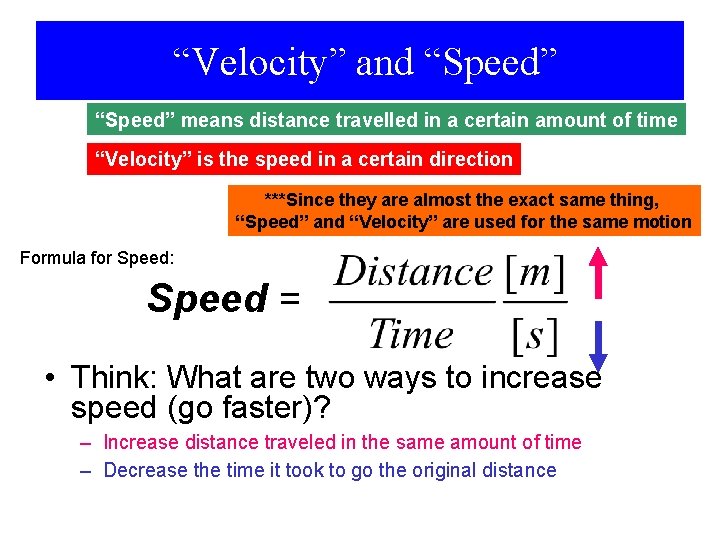
“Velocity” and “Speed” means distance travelled in a certain amount of time “Velocity” is the speed in a certain direction ***Since they are almost the exact same thing, “Speed” and “Velocity” are used for the same motion Formula for Speed: Speed = • Think: What are two ways to increase speed (go faster)? – Increase distance traveled in the same amount of time – Decrease the time it took to go the original distance
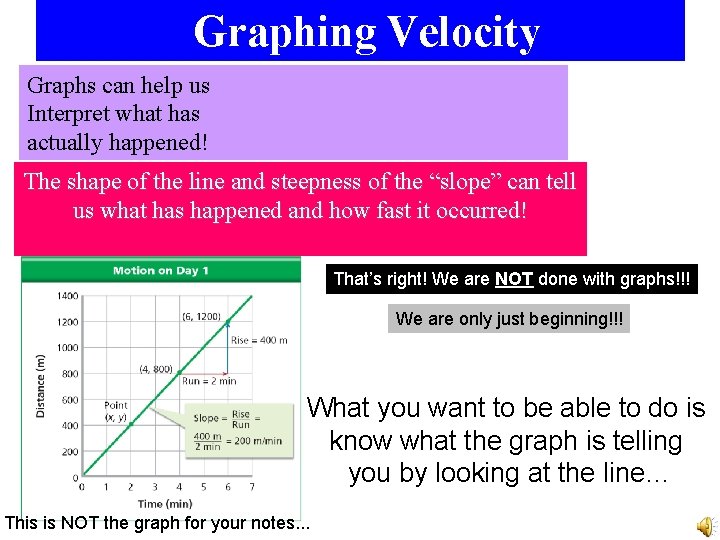
Graphing Velocity Graphs can help us Interpret what has actually happened! The shape of the line and steepness of the “slope” can tell us what has happened and how fast it occurred! That’s right! We are NOT done with graphs!!! We are only just beginning!!! What you want to be able to do is know what the graph is telling you by looking at the line… This is NOT the graph for your notes. . .
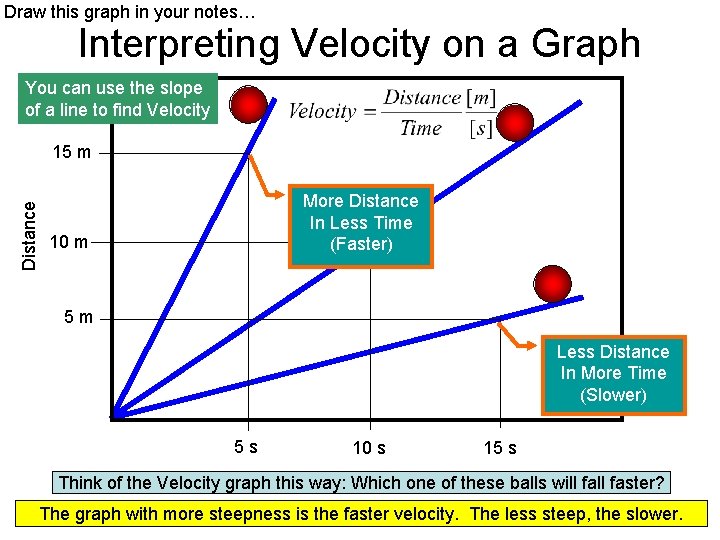
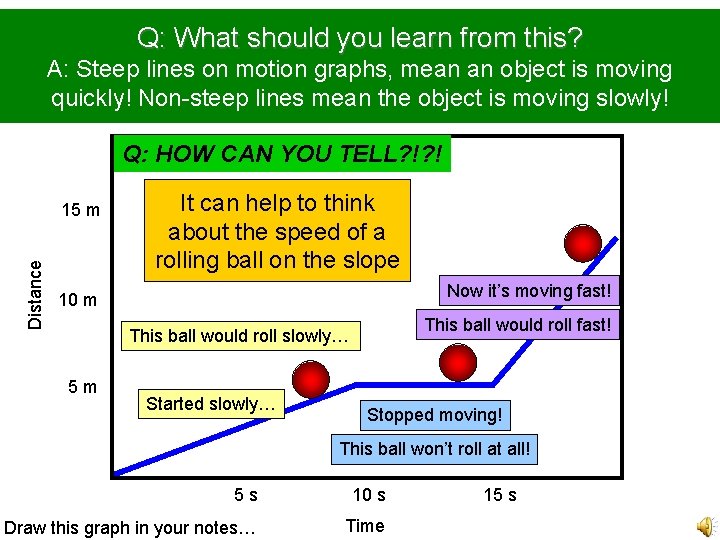
Draw this graph in your notes… Interpreting Velocity on a Graph You can use the slope of a line to find Velocity Distance 15 m More Distance In Less Time (Faster) 10 m 5 m Less Distance In More Time (Slower) 5 s 10 s 15 s Think of the Velocity graph this way: Time Which one of these balls will faster? The graph with more steepness is the faster velocity. The less steep, the slower.
Q: What should you learn As a group, describe how fast the from objectthis? is probably A: Steep lines on motion graphs, ana object moving Interpreting Speed on Graph: moving as you travel along mean the line (left tois right) (After you try it together, clickthe to see the real is motion) quickly! Non-steep lines mean object moving slowly! Q: HOW CAN YOU TELL? !? ! Distance 15 m It can help to think about the speed of a rolling ball on the slope Now it’s moving fast! 10 m This ball would roll fast! This ball would roll slowly… 5 m Started slowly… Stopped moving! This ball won’t roll at all! 5 s 10 s Draw this graph in your notes… Time 15 s
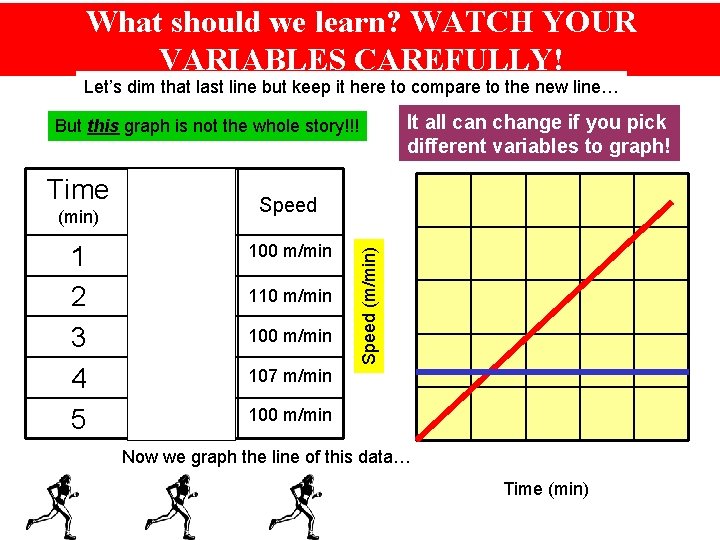
What should learn? WATCH YOUR the The two lines lookwe different, but still describe Graphing Speed: VARIABLES CAREFULLY! same objects motion! Let’s that lastthe line butofkeep it here tosee compare the new line… This dim is basically the data you in the to table… But this graph is not the whole story!!! Dist. (min) (meters) 1 2 3 4 5 Speed 100 m/min 220 110 m/min 300 100 m/min 430 107 m/min 500 100 m/min Speed Distance (m/min) (m) Time It all can change if you pick different variables to graph! Now we graph the line of this data… Time (min)
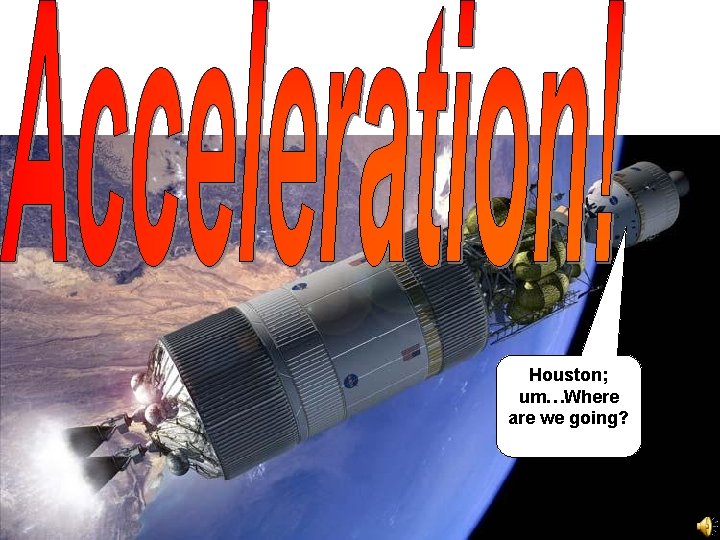
Houston; um…Where are we going?
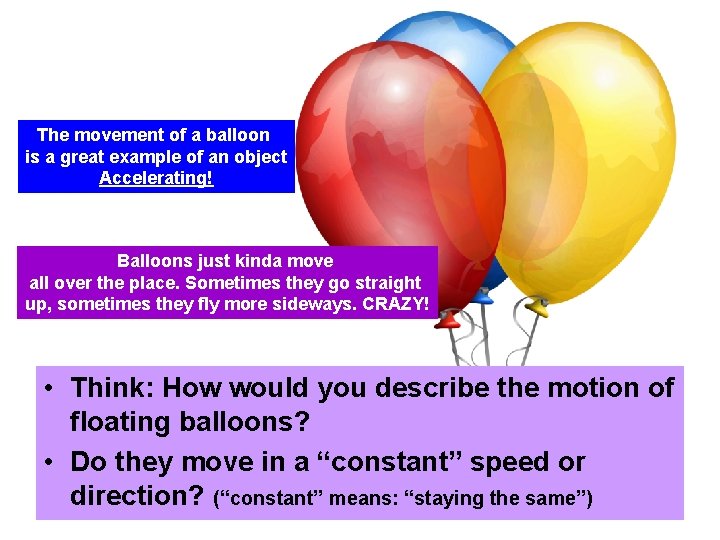
The movement of a balloon is a great example of an object Accelerating! Balloons just kinda move all over the place. Sometimes they go straight up, sometimes they fly more sideways. CRAZY! • Think: How would you describe the motion of floating balloons? • Do they move in a “constant” speed or direction? (“constant” means: “staying the same”)
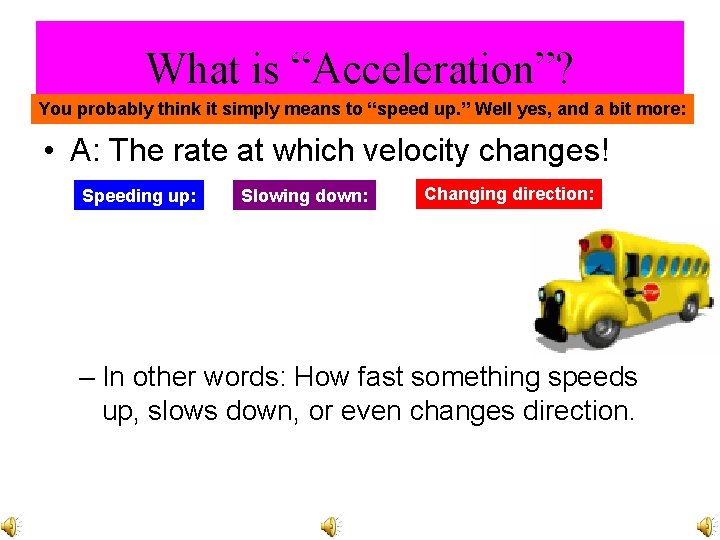
What is “Acceleration”? You probably think it simply means to “speed up. ” Well yes, and a bit more: • A: The rate at which velocity changes! Speeding up: Slowing down: Changing direction: – In other words: How fast something speeds up, slows down, or even changes direction.
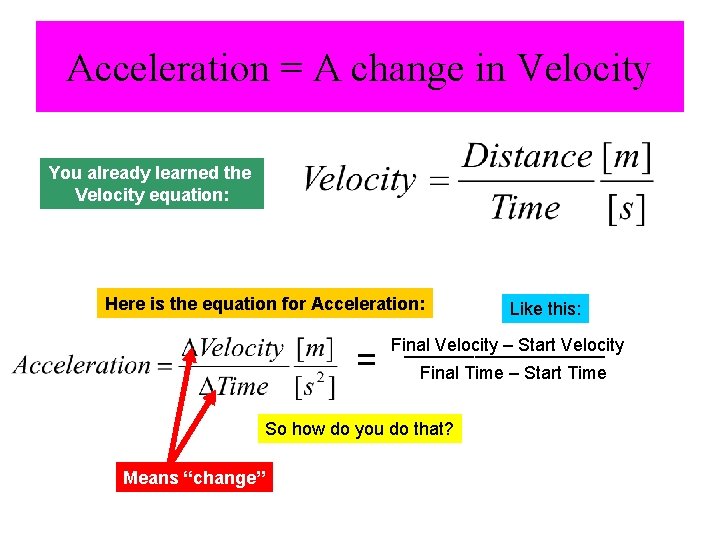
Acceleration = A change in Velocity You already learned the Velocity equation: Here is the equation for Acceleration: = Final Velocity – Start Velocity __________ Final Time – Start Time So how do you do that? Means “change” Like this:
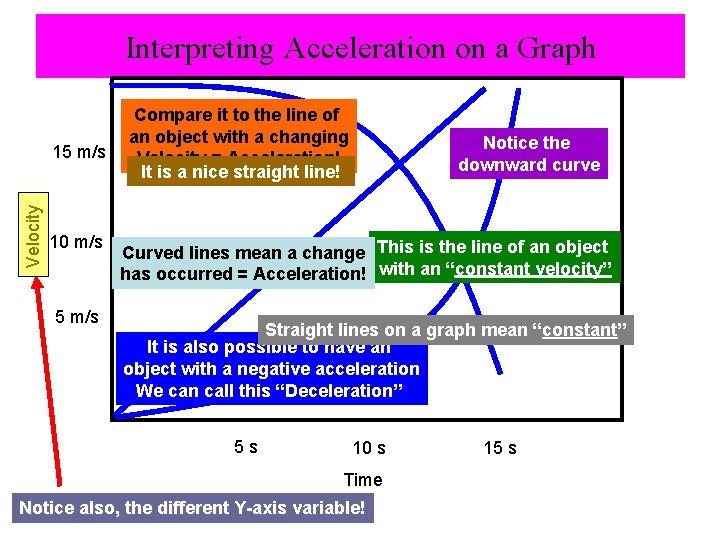
Interpreting Acceleration on a Graph Distance Velocity 15 m/s 10 m/s 5 m/s Compare it to the line of an object with a changing Velocity = Acceleration! It is a nice straight line! Notice the downward curve Curved lines mean a change This is the line of an object has occurred = Acceleration! with an “constant velocity” Straight lines on a graph mean “constant” It is also possible to have an object with a negative acceleration We can call this “Deceleration” 5 s 10 s Time Notice also, the different Y-axis variable! 15 s
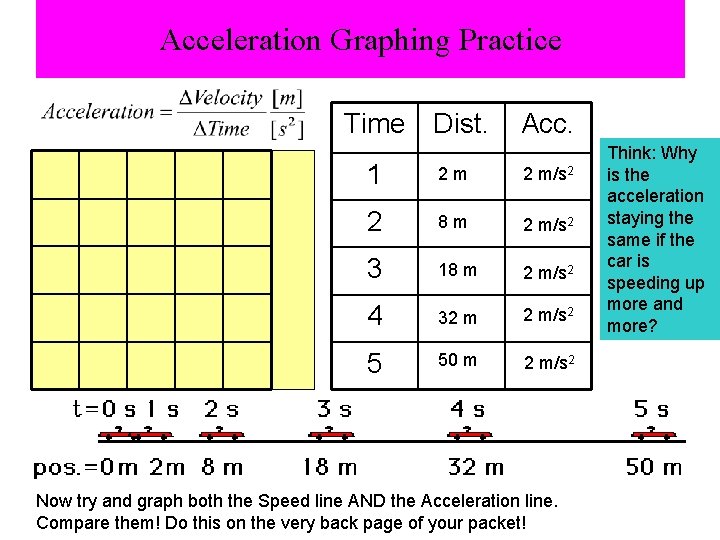
Acceleration Graphing Practice Time Dist. Acc. 1 2 m 2 m/s 2 2 8 m 2 m/s 2 3 18 m 2 m/s 2 4 32 m 2 m/s 2 5 50 m 2 m/s 2 Now try and graph both the Speed line AND the Acceleration line. Compare them! Do this on the very back page of your packet! Think: Why is the acceleration staying the same if the car is speeding up more and more?