
Welcome to Physics 272 Electricity and Magnetism EM




- Slides: 50
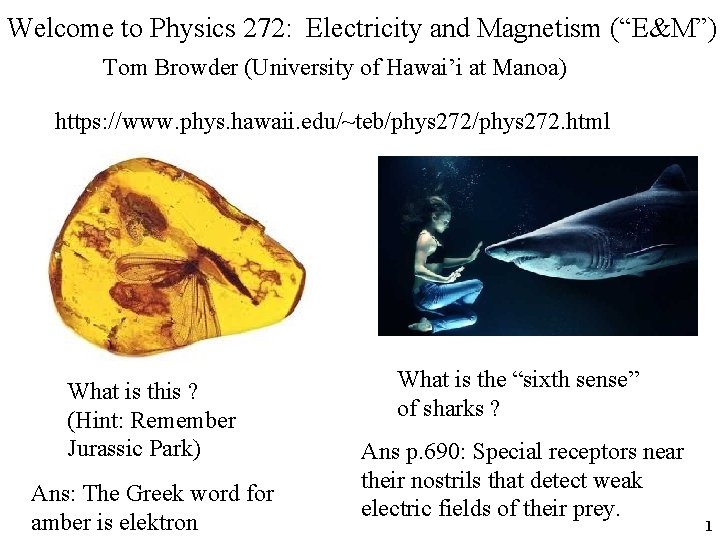
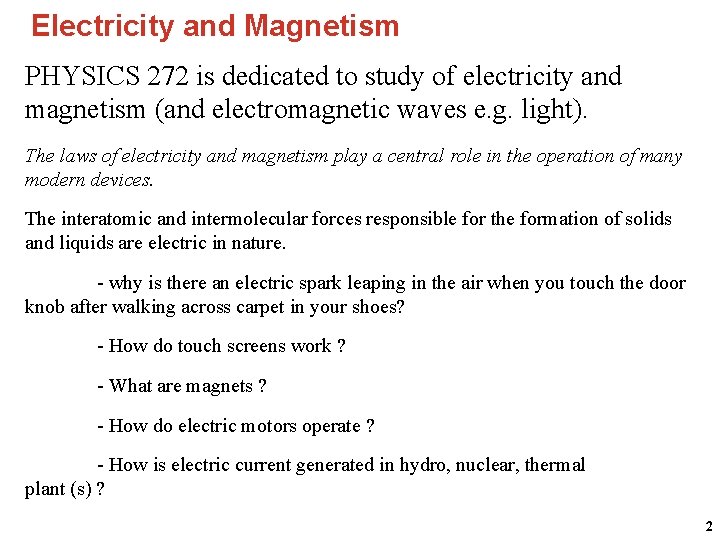
Welcome to Physics 272: Electricity and Magnetism (“E&M”) Tom Browder (University of Hawai’i at Manoa) https: //www. phys. hawaii. edu/~teb/phys 272. html What is this ? (Hint: Remember Jurassic Park) Ans: The Greek word for amber is elektron What is the “sixth sense” of sharks ? Ans p. 690: Special receptors near their nostrils that detect weak electric fields of their prey. 1
Electricity and Magnetism PHYSICS 272 is dedicated to study of electricity and magnetism (and electromagnetic waves e. g. light). The laws of electricity and magnetism play a central role in the operation of many modern devices. The interatomic and intermolecular forces responsible for the formation of solids and liquids are electric in nature. - why is there an electric spark leaping in the air when you touch the door knob after walking across carpet in your shoes? - How do touch screens work ? - What are magnets ? - How do electric motors operate ? - How is electric current generated in hydro, nuclear, thermal plant (s) ? 2
General information Instructor: Prof. Tom Browder, Office Watanabe Hall, Rm 233, Office hours: Tu. Th after class and by arrangement e-mail: teb@phys. hawaii. edu to arrange a meeting. Lecture: Concepts and some problem solving too. Class Hours: T R 10: 30 -11: 45 am WAT 112 Recitations: An important part of the course and learning physics. Please attend or give up 15% of your grade ! (Recitations emphasize physics problem-solving). Course web site: https: //www. phys. hawaii. edu/~teb/phys 272. html PHYS 272 L [Lab] (rules about overrides, starts next week): Lab website: http: //go. hawaii. edu/MNG 3
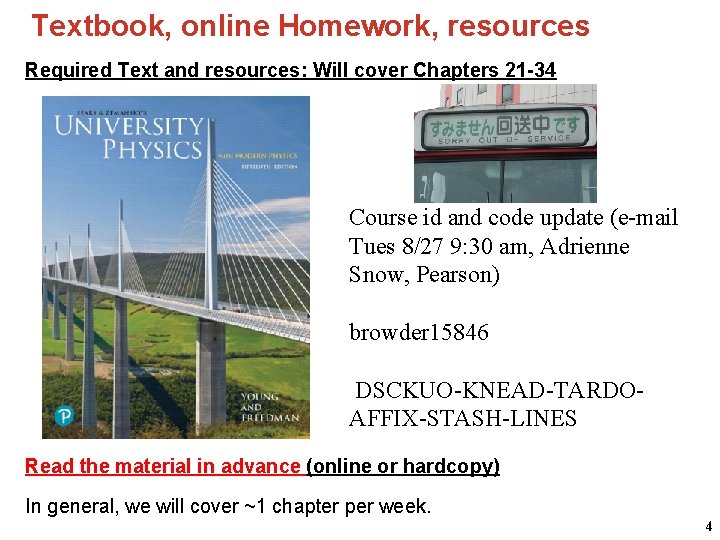
Textbook, online Homework, resources Required Text and resources: Will cover Chapters 21 -34 Course id and code update (e-mail Tues 8/27 9: 30 am, Adrienne Snow, Pearson) browder 15846 DSCKUO-KNEAD-TARDOAFFIX-STASH-LINES Read the material in advance (online or hardcopy) In general, we will cover ~1 chapter per week. 4
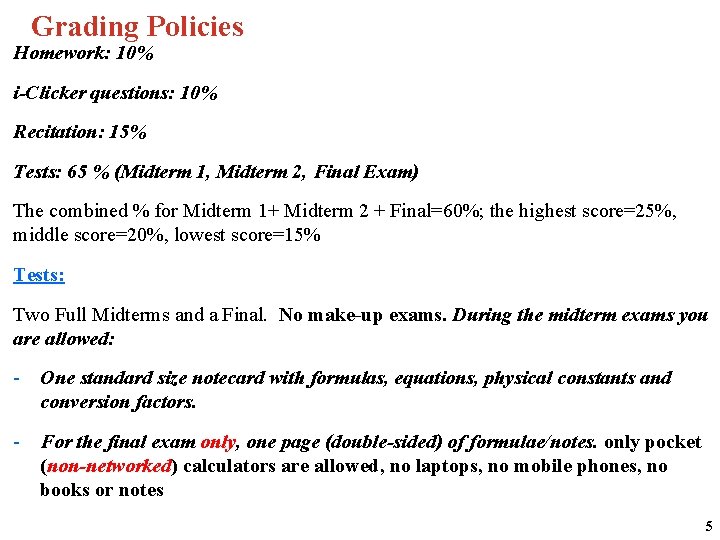
Grading Policies Homework: 10% i-Clicker questions: 10% Recitation: 15% Tests: 65 % (Midterm 1, Midterm 2, Final Exam) The combined % for Midterm 1+ Midterm 2 + Final=60%; the highest score=25%, middle score=20%, lowest score=15% Tests: Two Full Midterms and a Final. No make-up exams. During the midterm exams you are allowed: - One standard size notecard with formulas, equations, physical constants and conversion factors. - For the final exam only, one page (double-sided) of formulae/notes. only pocket (non-networked) calculators are allowed, no laptops, no mobile phones, no books or notes 5
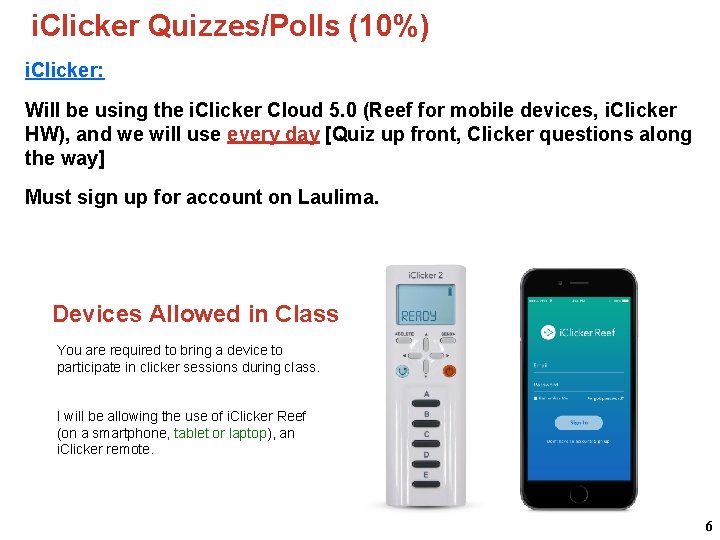
i. Clicker Quizzes/Polls (10%) i. Clicker: Will be using the i. Clicker Cloud 5. 0 (Reef for mobile devices, i. Clicker HW), and we will use every day [Quiz up front, Clicker questions along the way] Must sign up for account on Laulima. Devices Allowed in Class You are required to bring a device to participate in clicker sessions during class. I will be allowing the use of i. Clicker Reef (on a smartphone, tablet or laptop), an i. Clicker remote. 6
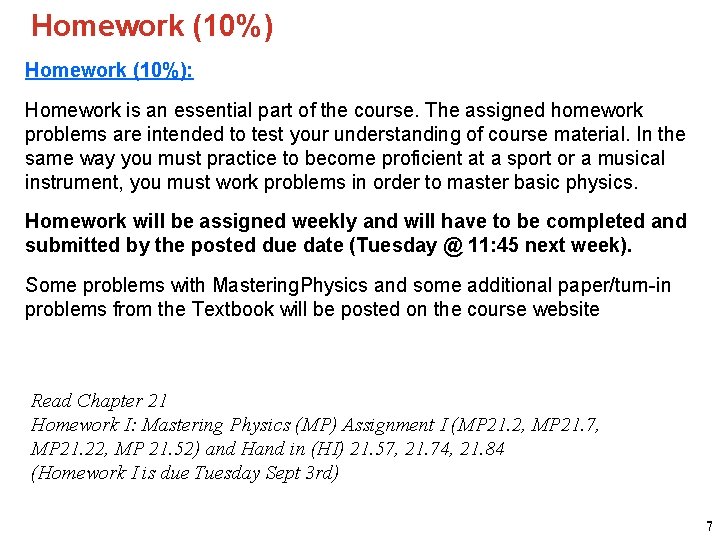
Homework (10%): Homework is an essential part of the course. The assigned homework problems are intended to test your understanding of course material. In the same way you must practice to become proficient at a sport or a musical instrument, you must work problems in order to master basic physics. Homework will be assigned weekly and will have to be completed and submitted by the posted due date (Tuesday @ 11: 45 next week). Some problems with Mastering. Physics and some additional paper/turn-in problems from the Textbook will be posted on the course website Read Chapter 21 Homework I: Mastering Physics (MP) Assignment I (MP 21. 2, MP 21. 7, MP 21. 22, MP 21. 52) and Hand in (HI) 21. 57, 21. 74, 21. 84 (Homework I is due Tuesday Sept 3 rd) 7
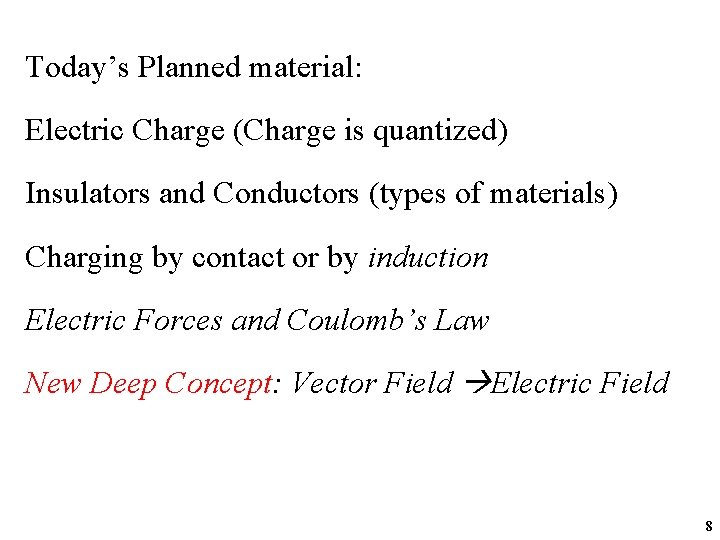
Today’s Planned material: Electric Charge (Charge is quantized) Insulators and Conductors (types of materials) Charging by contact or by induction Electric Forces and Coulomb’s Law New Deep Concept: Vector Field Electric Field 8
ANY QUESTIONS BEFORE WE GET TO SOME PHYSICS. 9
Forces Newton’s Second Law (F = m a) tells us that a force is something that causes an object to accelerate. Examples of forces from Physics 170: • Gravity • Normal force • Friction • Tension • . . . We’ll start this semester by adding a new force or interaction: electric force. 10
Chapter 21 COULOMB’S LAW 11
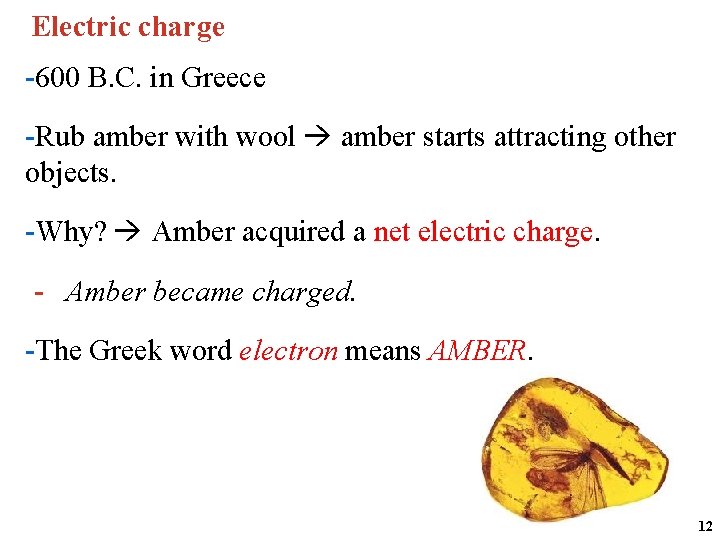
Electric charge -600 B. C. in Greece -Rub amber with wool amber starts attracting other objects. -Why? Amber acquired a net electric charge. - Amber became charged. -The Greek word electron means AMBER. 12
Electric charge – examples of charging objects There are two kinds of charges 13
Electric charge – examples of charging objects • Glass rods, plastic tubes, silk, and fur can be used to demonstrate the movement of charges and how their presence or absence make for powerful forces of attraction and repulsion. Plastic rods acquired net charge. They repel. Glass and plastic rod attract each other. There are two kinds of charges: positive charge and negative charge. Ben Franklin (1706 -1790) named them. 14
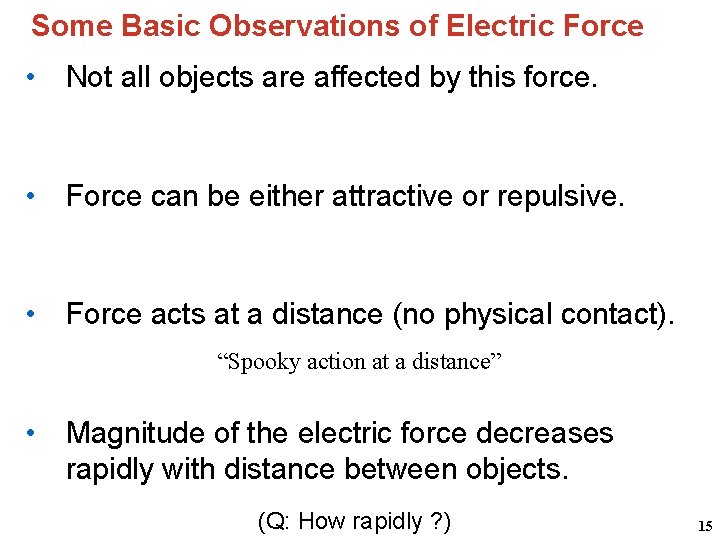
Some Basic Observations of Electric Force • Not all objects are affected by this force. • Force can be either attractive or repulsive. • Force acts at a distance (no physical contact). “Spooky action at a distance” • Magnitude of the electric force decreases rapidly with distance between objects. (Q: How rapidly ? ) 15
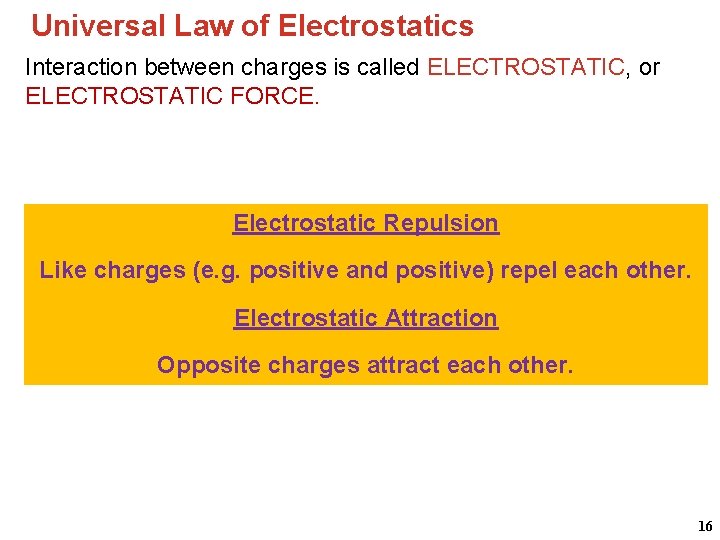
Universal Law of Electrostatics Interaction between charges is called ELECTROSTATIC, or ELECTROSTATIC FORCE. Electrostatic Repulsion Like charges (e. g. positive and positive) repel each other. Electrostatic Attraction Opposite charges attract each other. 16
Movement of Charges What charges are actually moving when we do these experiments (e. g. , rubbing amber with a cloth)? Electrons ! …but why? 17
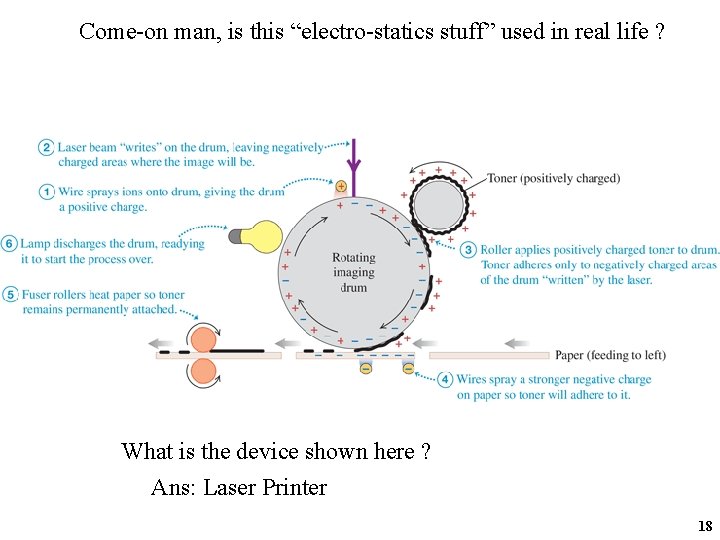
Come-on man, is this “electro-statics stuff” used in real life ? What is the device shown here ? Ans: Laser Printer 18
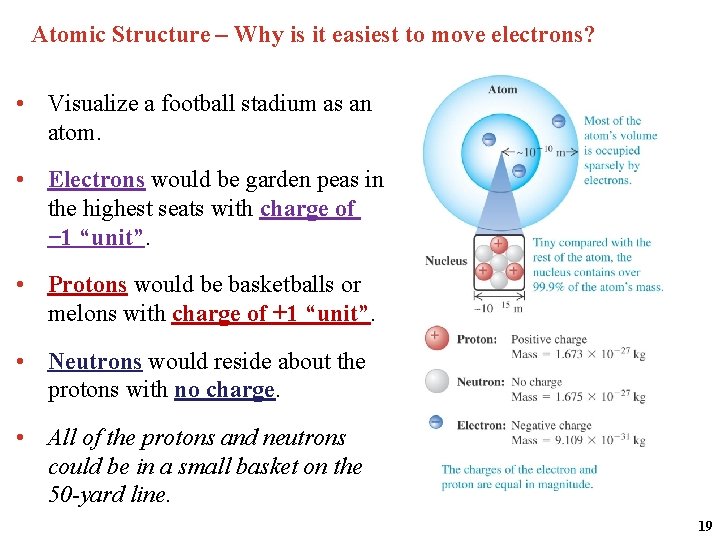
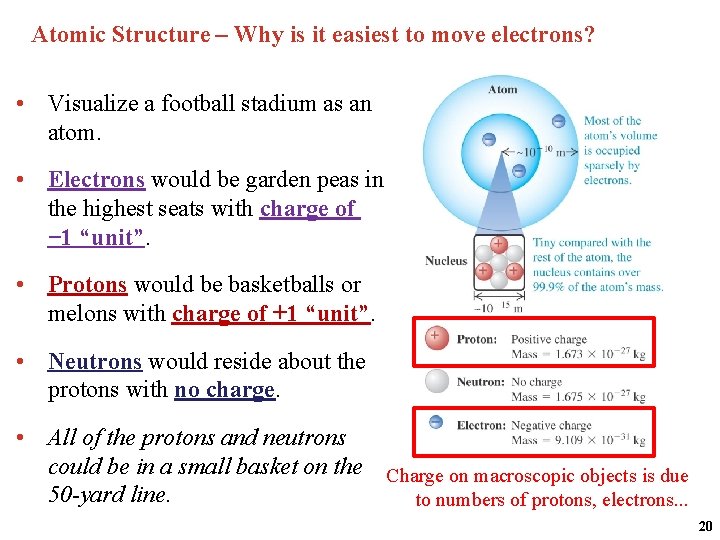
Atomic Structure – Why is it easiest to move electrons? • Visualize a football stadium as an atom. • Electrons would be garden peas in the highest seats with charge of − 1 “unit”. • Protons would be basketballs or melons with charge of +1 “unit”. • Neutrons would reside about the protons with no charge. • All of the protons and neutrons could be in a small basket on the 50 -yard line. 19
Atomic Structure – Why is it easiest to move electrons? • Visualize a football stadium as an atom. • Electrons would be garden peas in the highest seats with charge of − 1 “unit”. • Protons would be basketballs or melons with charge of +1 “unit”. • Neutrons would reside about the protons with no charge. • All of the protons and neutrons could be in a small basket on the Charge on macroscopic objects is due 50 -yard line. to numbers of protons, electrons. . . 20
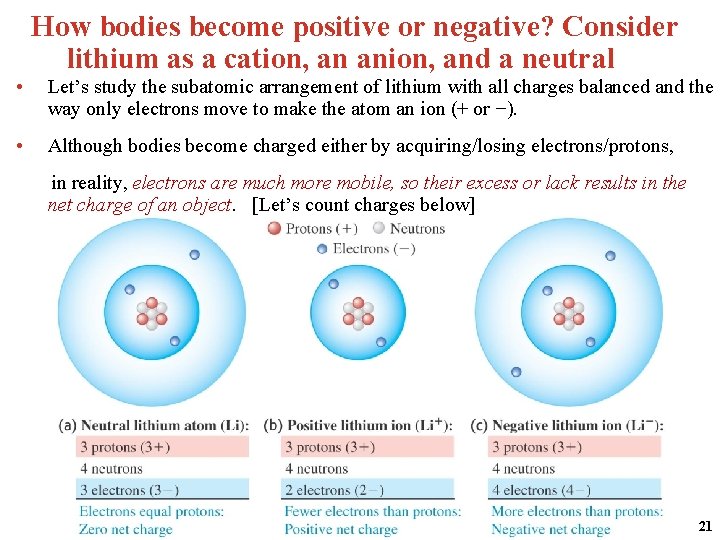
How bodies become positive or negative? Consider lithium as a cation, an anion, and a neutral • Let’s study the subatomic arrangement of lithium with all charges balanced and the way only electrons move to make the atom an ion (+ or −). • Although bodies become charged either by acquiring/losing electrons/protons, in reality, electrons are much more mobile, so their excess or lack results in the net charge of an object. [Let’s count charges below] 21
Unit of charge The SI unit of charge is called a Coulomb (C). It is not possible to split the charge of electron or proton. As a matter of fact: The magnitude of charge of the electron or proton is A NATURAL UNIT OF CHARGE (1. 602 x 10 -19 C) Every observable amount of charge is an integer multiple of the natural unit of charge. Charge is quantized It is just like a cent when paying by cash. Electric interactions keep atoms and molecules together, prevent us from falling through chair, tension, spring force, friction, … 22
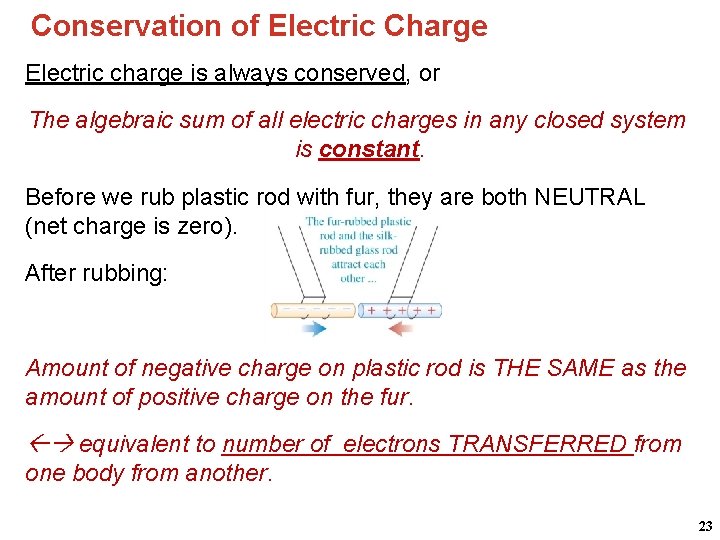
Conservation of Electric Charge Electric charge is always conserved, or The algebraic sum of all electric charges in any closed system is constant. Before we rub plastic rod with fur, they are both NEUTRAL (net charge is zero). After rubbing: Amount of negative charge on plastic rod is THE SAME as the amount of positive charge on the fur. equivalent to number of electrons TRANSFERRED from one body from another. 23
Strictly speaking, does a plastic rod weigh more, less or the same, after being rubbed with fur? (Hint: plastic rod ends up with net negative charge. ) A. More B. Less C. The same 24
Strictly speaking, does a plastic rod weigh more, less or the same, after being rubbed with fur? (Hint: plastic rod ends up with net negative charge. ) A. More B. Less C. The same The plastic rod has ended up with net negative charge. Electrons are mobile (not protons), so they must have moved from the fur to the rod, and now the rod weights more. 25
Conductors and Insulators Conductors have electrons that are loosely bound, called “conduction electrons, ” that can easily move within the material. Insulators are materials through which electrons cannot (easily) move. 26
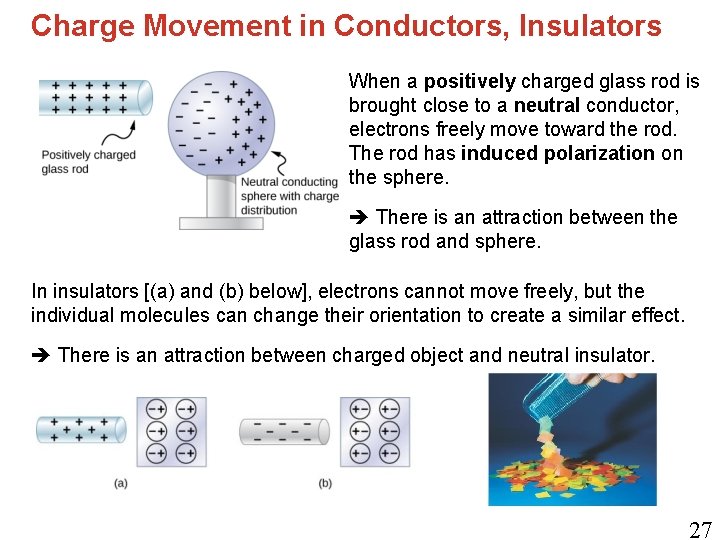
Charge Movement in Conductors, Insulators When a positively charged glass rod is brought close to a neutral conductor, electrons freely move toward the rod. The rod has induced polarization on the sphere. There is an attraction between the glass rod and sphere. In insulators [(a) and (b) below], electrons cannot move freely, but the individual molecules can change their orientation to create a similar effect. There is an attraction between charged object and neutral insulator. 27
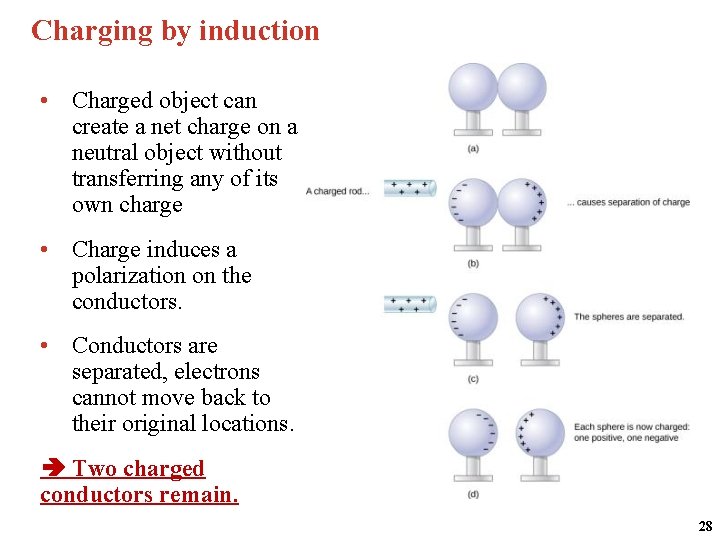
Charging by induction • Charged object can create a net charge on a neutral object without transferring any of its own charge • Charge induces a polarization on the conductors. • Conductors are separated, electrons cannot move back to their original locations. Two charged conductors remain. 28
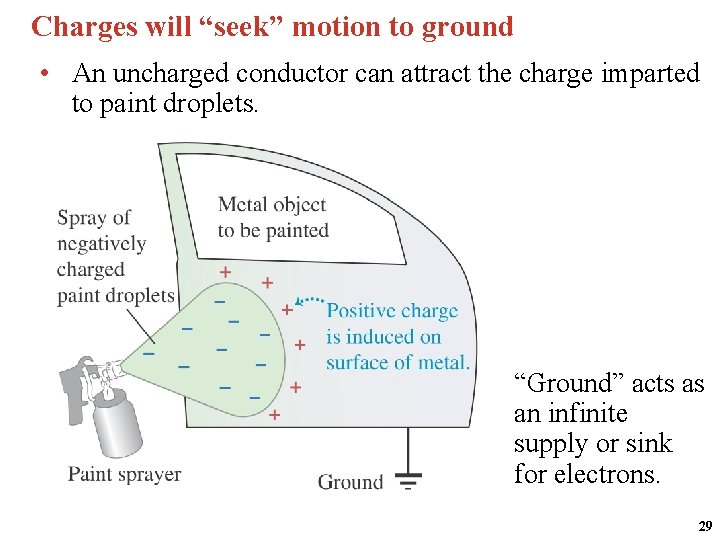
Charges will “seek” motion to ground • An uncharged conductor can attract the charge imparted to paint droplets. “Ground” acts as an infinite supply or sink for electrons. 29
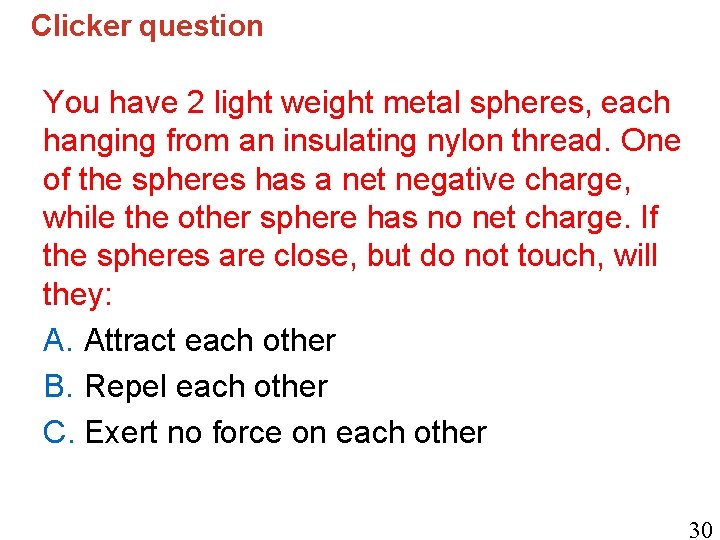
Clicker question You have 2 light weight metal spheres, each hanging from an insulating nylon thread. One of the spheres has a net negative charge, while the other sphere has no net charge. If the spheres are close, but do not touch, will they: A. Attract each other B. Repel each other C. Exert no force on each other 30
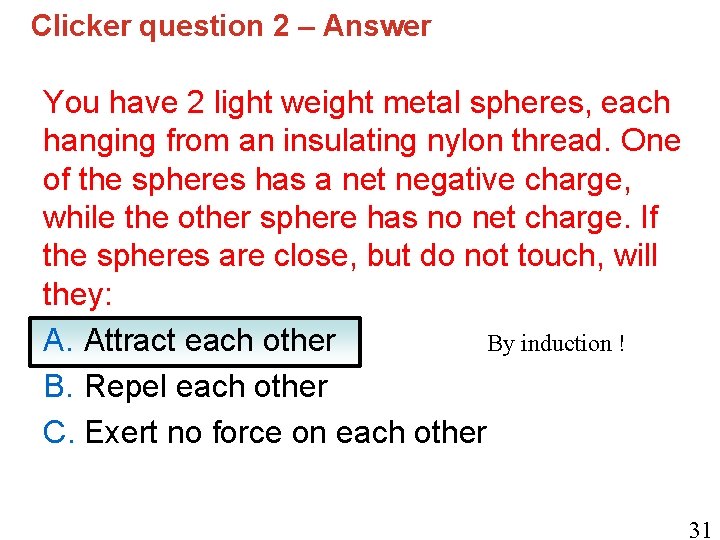
Clicker question 2 – Answer You have 2 light weight metal spheres, each hanging from an insulating nylon thread. One of the spheres has a net negative charge, while the other sphere has no net charge. If the spheres are close, but do not touch, will they: By induction ! A. Attract each other B. Repel each other C. Exert no force on each other 31
Poll 2 You have 2 light weight metal spheres, each hanging from an insulating nylon thread. One of the spheres has a net negative charge, while the other sphere has no net charge. You now allow spheres to touch. Once they have touched, will the two spheres: A. Attract each other B. Repel each other C. Exert no force on each other 32
Poll 2 – Answer You have 2 light weight metal spheres, each hanging from an insulating nylon thread. One of the spheres has a net negative charge, while the other sphere has no net charge. You now allow spheres to touch. Once they have touched, will the two spheres: A. Attract each other Charge is free to move B. Repel each other in conductors, the negative charge C. Exert no force on each other redistributes onto the second sphere. 33
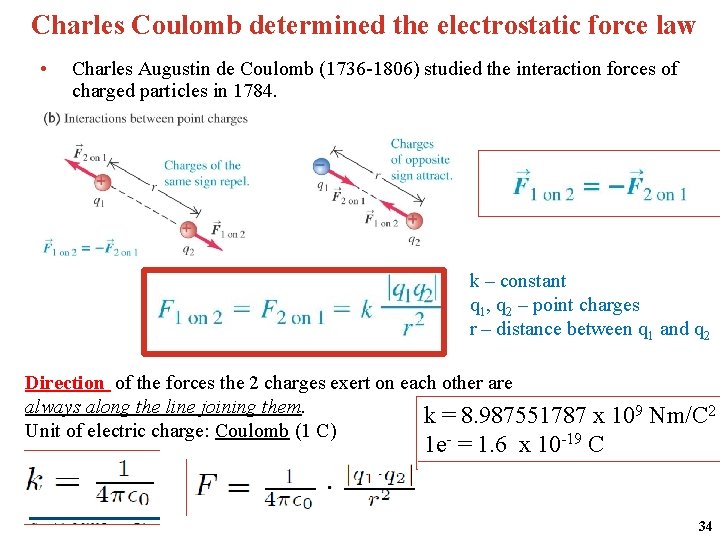
Charles Coulomb determined the electrostatic force law • Charles Augustin de Coulomb (1736 -1806) studied the interaction forces of charged particles in 1784. k – constant q 1, q 2 – point charges r – distance between q 1 and q 2 Direction of the forces the 2 charges exert on each other are always along the line joining them. k = 8. 987551787 x 109 Nm/C 2 Unit of electric charge: Coulomb (1 C) -19 1 e = 1. 6 x 10 C 34
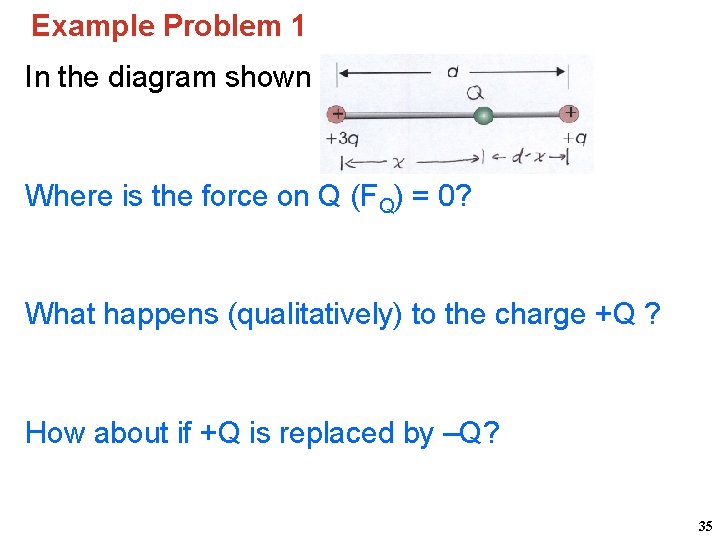
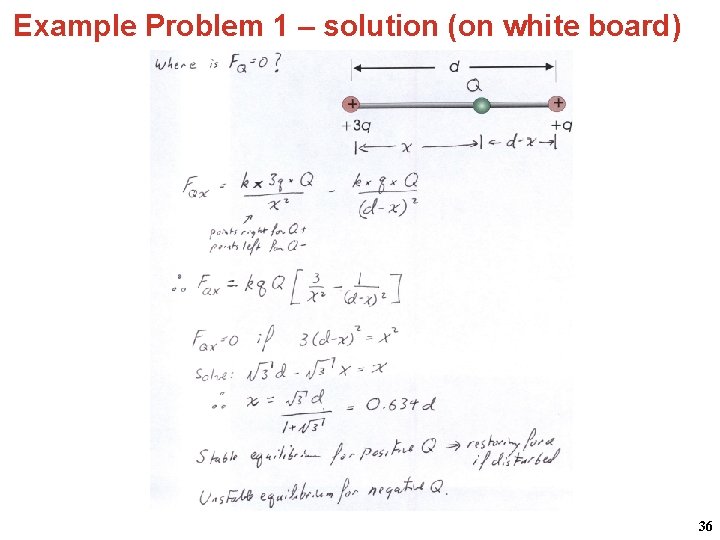
Example Problem 1 In the diagram shown Where is the force on Q (FQ) = 0? What happens (qualitatively) to the charge +Q ? How about if +Q is replaced by –Q? 35
Example Problem 1 – solution (on white board) 36
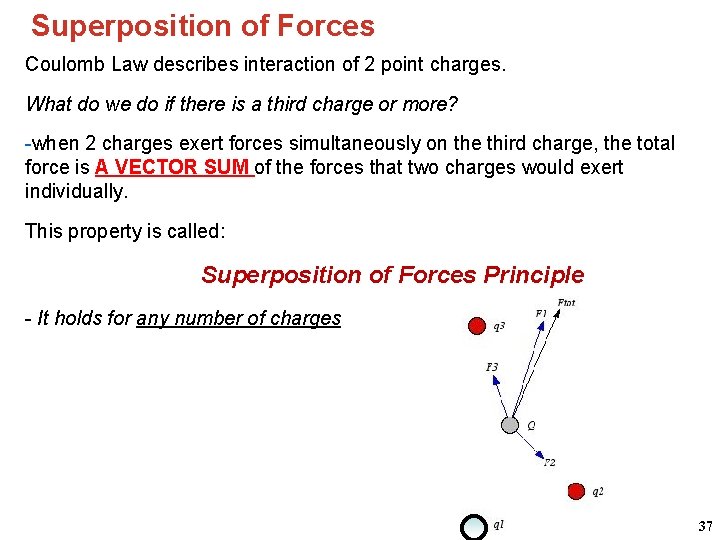
Superposition of Forces Coulomb Law describes interaction of 2 point charges. What do we do if there is a third charge or more? -when 2 charges exert forces simultaneously on the third charge, the total force is A VECTOR SUM of the forces that two charges would exert individually. This property is called: Superposition of Forces Principle - It holds for any number of charges 37
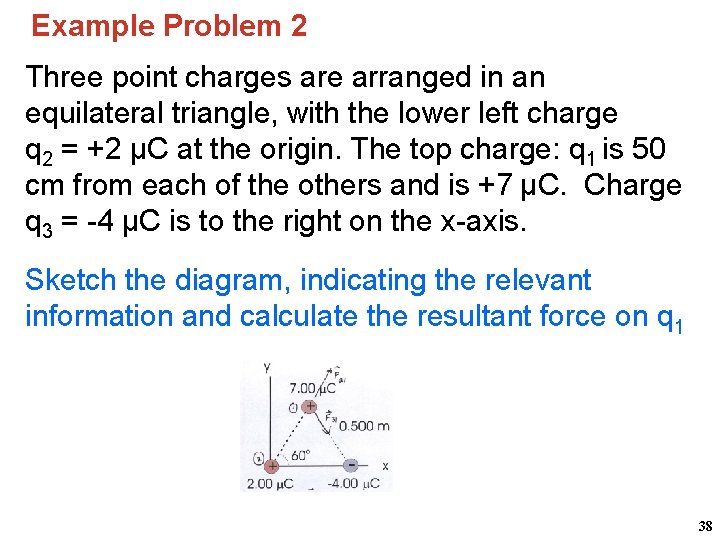
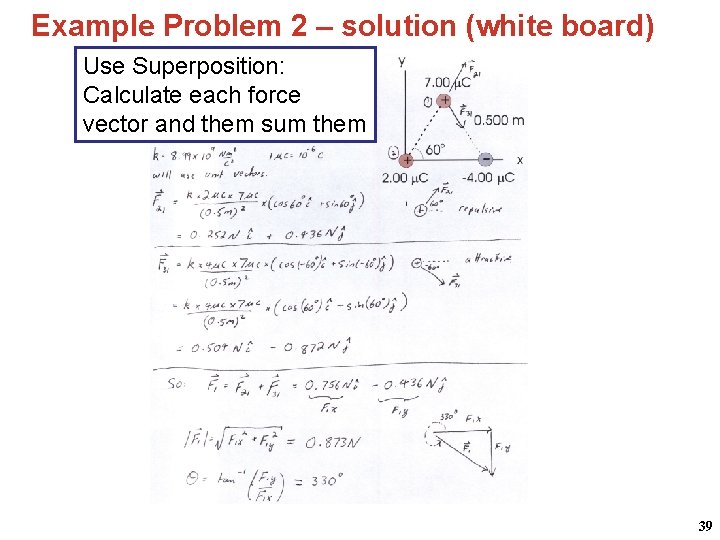
Example Problem 2 Three point charges are arranged in an equilateral triangle, with the lower left charge q 2 = +2 μC at the origin. The top charge: q 1 is 50 cm from each of the others and is +7 μC. Charge q 3 = -4 μC is to the right on the x-axis. Sketch the diagram, indicating the relevant information and calculate the resultant force on q 1 38
Example Problem 2 – solution (white board) Use Superposition: Calculate each force vector and them sum them 39
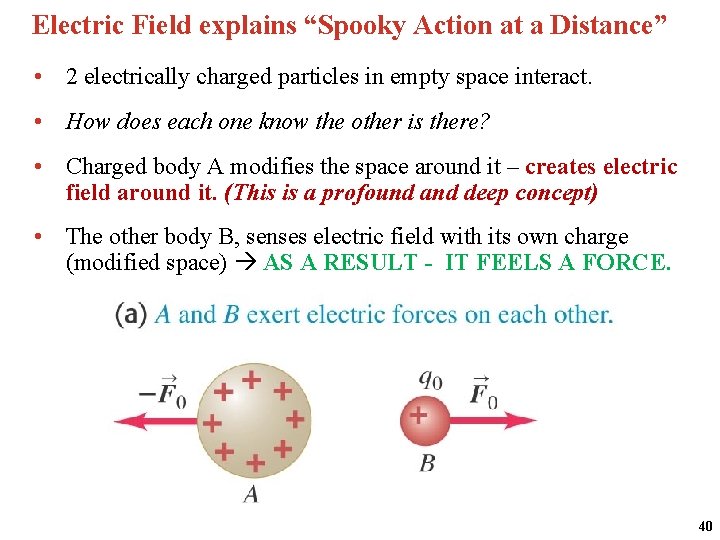
Electric Field explains “Spooky Action at a Distance” • 2 electrically charged particles in empty space interact. • How does each one know the other is there? • Charged body A modifies the space around it – creates electric field around it. (This is a profound and deep concept) • The other body B, senses electric field with its own charge (modified space) AS A RESULT - IT FEELS A FORCE. 40
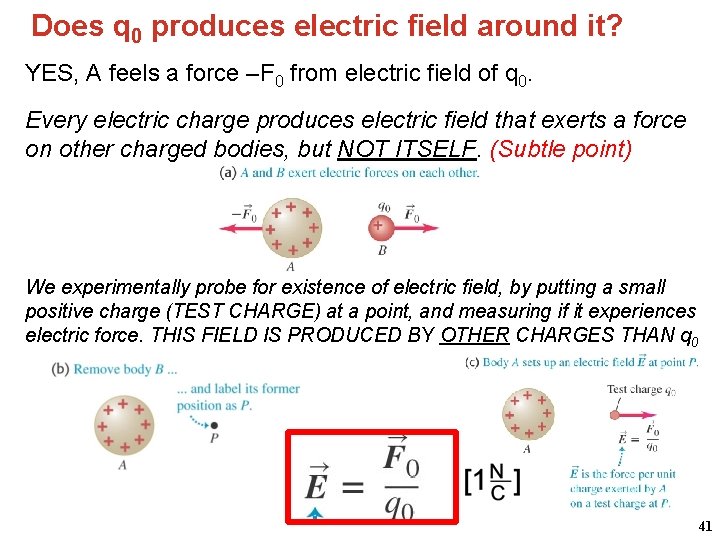
Does q 0 produces electric field around it? YES, A feels a force –F 0 from electric field of q 0. Every electric charge produces electric field that exerts a force on other charged bodies, but NOT ITSELF. (Subtle point) We experimentally probe for existence of electric field, by putting a small positive charge (TEST CHARGE) at a point, and measuring if it experiences electric force. THIS FIELD IS PRODUCED BY OTHER CHARGES THAN q 0 41
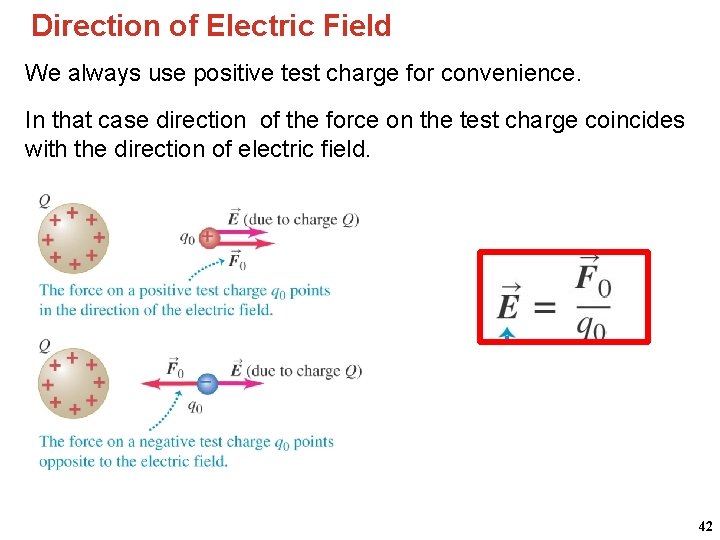
Direction of Electric Field We always use positive test charge for convenience. In that case direction of the force on the test charge coincides with the direction of electric field. 42
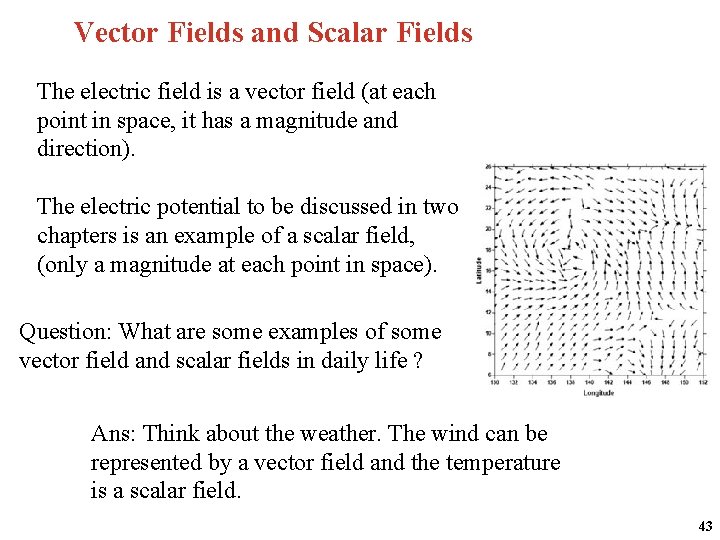
Vector Fields and Scalar Fields The electric field is a vector field (at each point in space, it has a magnitude and direction). The electric potential to be discussed in two chapters is an example of a scalar field, (only a magnitude at each point in space). Question: What are some examples of some vector field and scalar fields in daily life ? Ans: Think about the weather. The wind can be represented by a vector field and the temperature is a scalar field. 43
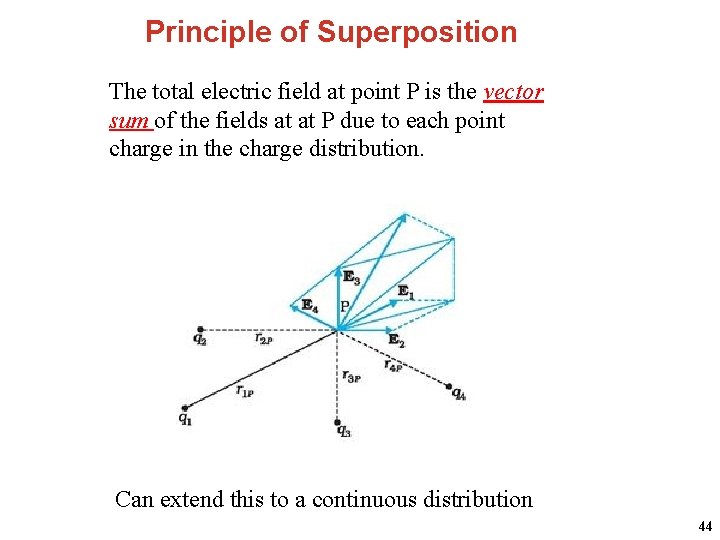
Principle of Superposition The total electric field at point P is the vector sum of the fields at at P due to each point charge in the charge distribution. Can extend this to a continuous distribution 44
For next time • Get ahead of the curve Ø Read material in advance Ø Concepts require wrestling with material • Homework available on Mastering Physics, due next Tuesday • i. Clickers will be graded from Thursday – Sort out any issues ASAP – Additional detail on next couple of slides 45
Create an i. Clicker Reef Account You must create an i. Clicker Reef account to ensure your grades are counted. You can create a Reef account and access it at any time by downloading the mobile app on a smart device via the App Store or Google Play, or by visiting iclicker. com on a web browser. If you already have a Reef account, use it! Do not create and use more than one Reef account as you will only receive credit from a single account.
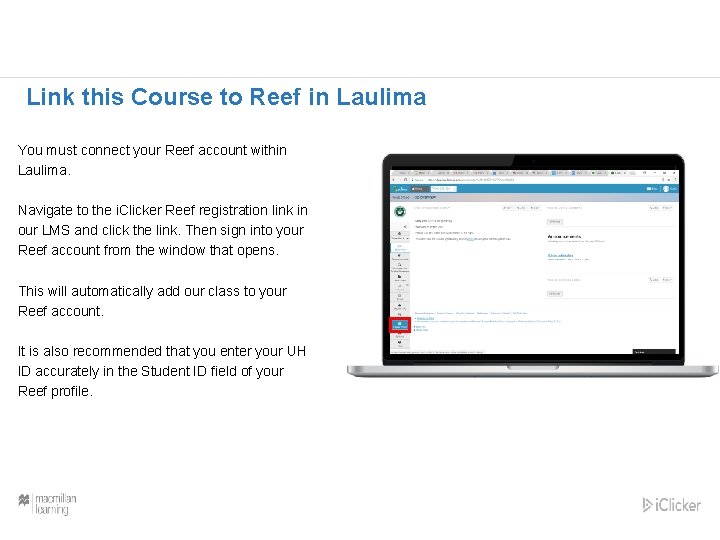
Link this Course to Reef in Laulima You must connect your Reef account within Laulima. Navigate to the i. Clicker Reef registration link in our LMS and click the link. Then sign into your Reef account from the window that opens. This will automatically add our class to your Reef account. It is also recommended that you enter your UH ID accurately in the Student ID field of your Reef profile.
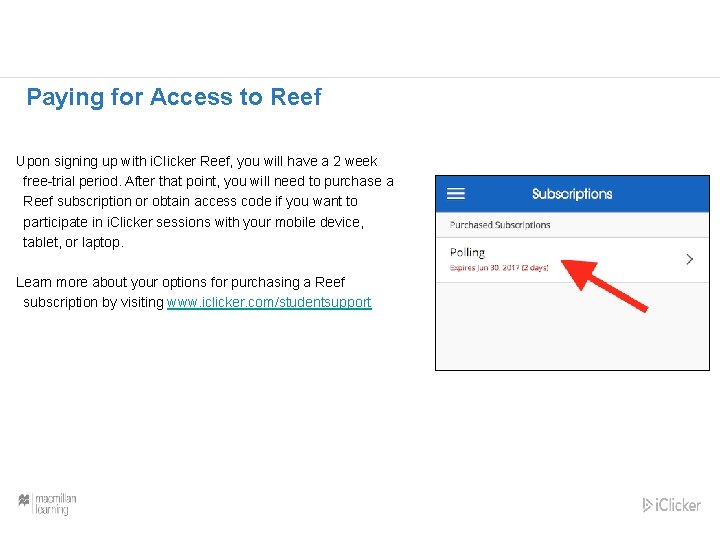
Paying for Access to Reef Upon signing up with i. Clicker Reef, you will have a 2 week free-trial period. After that point, you will need to purchase a Reef subscription or obtain access code if you want to participate in i. Clicker sessions with your mobile device, tablet, or laptop. Learn more about your options for purchasing a Reef subscription by visiting www. iclicker. com/studentsupport
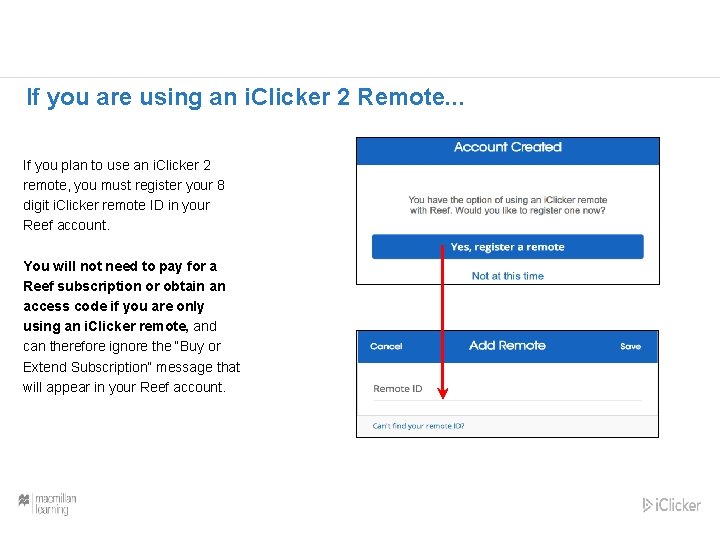
If you are using an i. Clicker 2 Remote. . . If you plan to use an i. Clicker 2 remote, you must register your 8 digit i. Clicker remote ID in your Reef account. You will not need to pay for a Reef subscription or obtain an access code if you are only using an i. Clicker remote, and can therefore ignore the “Buy or Extend Subscription” message that will appear in your Reef account.
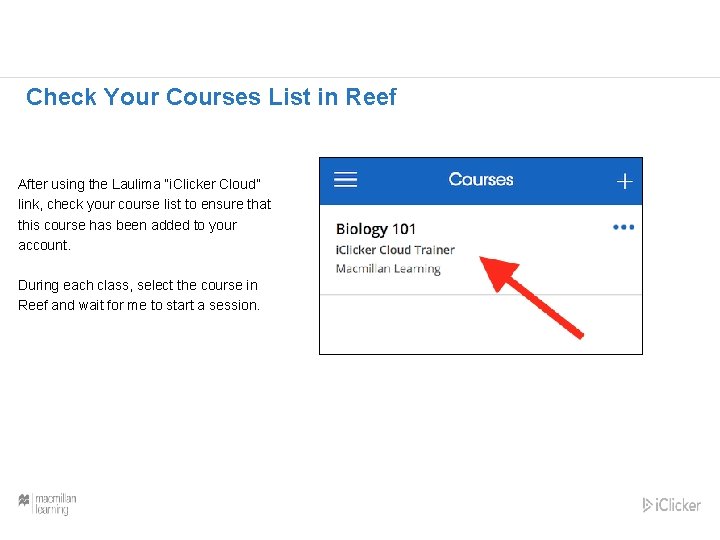
Check Your Courses List in Reef After using the Laulima “i. Clicker Cloud” link, check your course list to ensure that this course has been added to your account. During each class, select the course in Reef and wait for me to start a session.