
WELCOME TO PHARMACOLOGY PHARMACOLOGY Zhang Xiumei 8325 Tel
![(2) Kinetics of Receptor and Drug [D] + [R] = [DR] →→ E KD](https://slidetodoc.com/presentation_image_h2/09111c2ba53d711ffa0d7021074ac588/image-118.jpg "(2) Kinetics of Receptor and Drug [D] + [R] = [DR] →→ E KD")
![Kinetics of Receptor and Drug Because only DR is effective, E/Emax = [DR]/[RT] =](https://slidetodoc.com/presentation_image_h2/09111c2ba53d711ffa0d7021074ac588/image-119.jpg "Kinetics of Receptor and Drug Because only DR is effective, E/Emax = [DR]/[RT] =")
![Kinetics of Receptor and Drug KD = [D] KD express affinity (mole) of D](https://slidetodoc.com/presentation_image_h2/09111c2ba53d711ffa0d7021074ac588/image-120.jpg "Kinetics of Receptor and Drug KD = [D] KD express affinity (mole) of D")
![Antagonist拮抗药 A. Competitive antagonist 竞争性拮抗药 Ligand (L) Inhibitor(I) [RT] = [R] + [LR] +](https://slidetodoc.com/presentation_image_h2/09111c2ba53d711ffa0d7021074ac588/image-127.jpg "Antagonist拮抗药 A. Competitive antagonist 竞争性拮抗药 Ligand (L) Inhibitor(I) [RT] = [R] + [LR] +")
![Competitive Antagonist p. A 2 is the antagonism parameter p. A 2 = -log[I]](https://slidetodoc.com/presentation_image_h2/09111c2ba53d711ffa0d7021074ac588/image-131.jpg "Competitive Antagonist p. A 2 is the antagonism parameter p. A 2 = -log[I]")




- Slides: 153
WELCOME TO PHARMACOLOGY
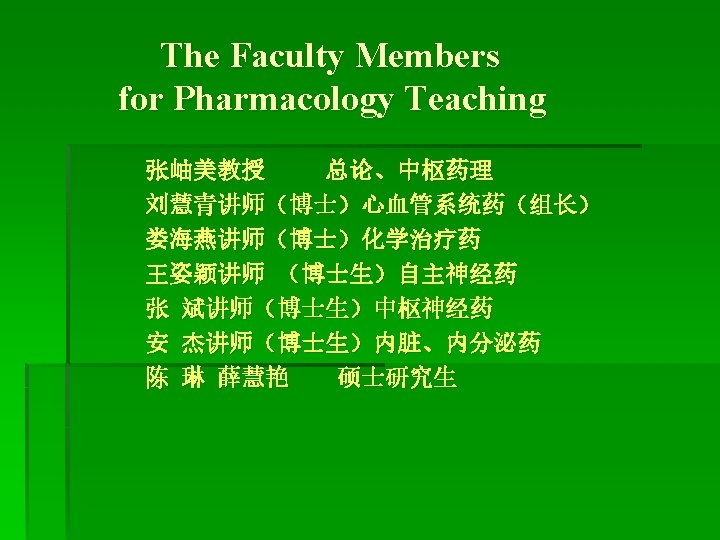
PHARMACOLOGY 药 理 学 张岫美 Zhang Xiu-mei 山东大学医学院 药理学研究所 教学八楼 8325 Tel: 83146 Email: zhangxm@sdu. edu. cn
CHAPTER 1 INTRODUCTION 1. The Nature and Duties of Pharmacology(药理学) To study the principles of interactions between drug and living system which includes human body, tumor cells and microorganisms and its mechanisms.
Drug (药物,medicine, pharmakon, remedy, materia medica) Chemical substances (exogenous or endogenous substances e. g. , synthetic drugs, hormones, antibiotics, peptides, and DNA fragments etc. ) used to treat, prevent and diagnosis diseases. Even including family planning chemicals and rat poisons.
Poison (毒物) Chemical substances to harm or injure human health in small dose. Some times poison can be used as a drug in suitable dose, such as toxins from plant or animals(snake venom). Drug may be a poison when use overdose or long term use. Barbiturates usually as sleeping drug, when use over dose it may cause intoxication.
Poison Sometimes, the differences between drug and poison is dose. The dose makes the poison. If something is not a poison, it is not a drug.
Sources of drugs Plant - alkaloids, glycoside Animal – insulin Microorganisms – antibiotics Synthetic chemicals Genetic engineering drugs Preparations(制剂)
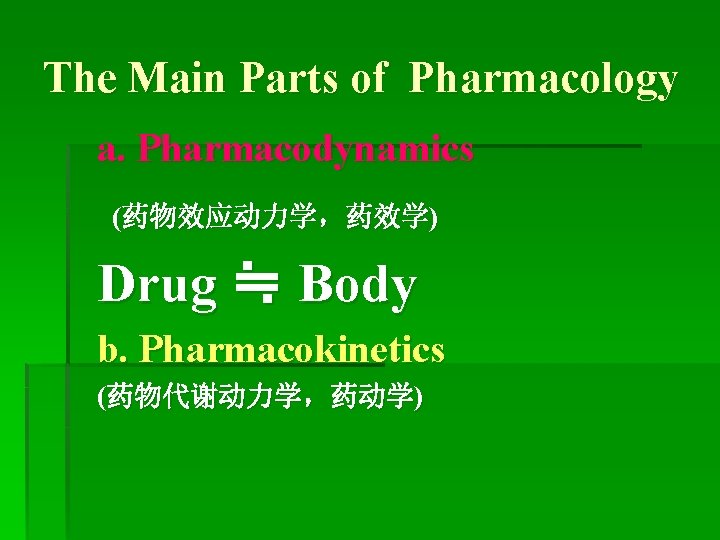
The Main Parts of Pharmacology a. Pharmacodynamics (药物效应动力学,药效学) Drug ≒ Body b. Pharmacokinetics (药物代谢动力学,药动学)
Pharmacodynamics 药效动力学 To explain the biochemical or physical actions of drugs on the body. Include action, mechanisms, indications, adverse reactions, contraindications of the drug.
Pharmacokinetics 药代动力学 To reveal the principles of dynamic changes of drug in the body. What drugs do on the body.
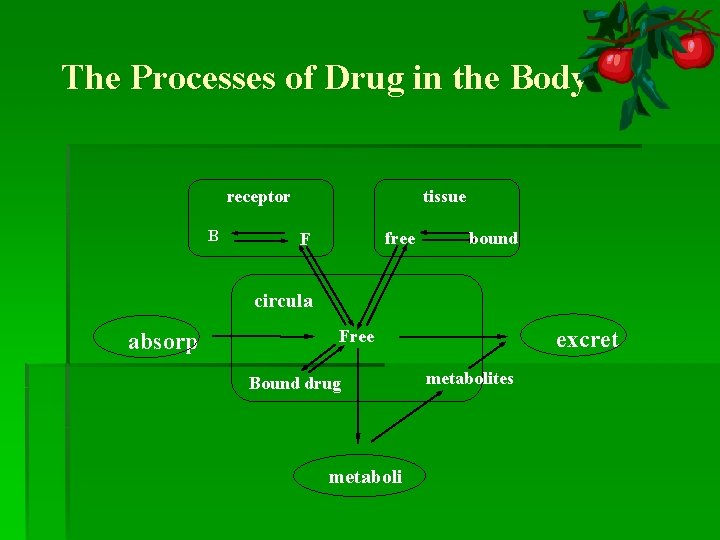
The Processes of Drug in the Body receptor B tissue free F bound circula absorp excret Free Bound drug metabolites
Pharmacokinetics 药代动力学 Mainly dealing with the change of drug concentration in the human or animal body following administration, i. e. , the changes of concentration in the dynamic system of liberation, absorption, distribution, metabolism and excretion (ADME).
The Duties of Pharmacology a. To explain the action and its mechanisms of the drug, to provide theoretical basis for clinic, enhancing the drug efficacy and reducing adverse drug reaction. b. To develop new drug and new indications of drug. c. To explore the pathway of physio-, biochemi- and pathology of the cells.
The Roles of Pharmacology Key subject of basic medical sciences. Part of pharmacy. Bridges桥梁学科: Basic and clinic, medical and pharmacy. The Aims for Pharmacology Learning Exactly important for a physician to treat patients by drugs.
The Roles of Pharmacology If you have learned Pharmacology, you can become a half of physician.
2. History and Development of Pharmacology Materia Medica in China: long history Pen Tsao(本草) by Shennong, 100 B. C. Pen Tsao Gang Mu (本草纲目)by Li Shizhen (1596), 52 vols, 1 900 000 characters, 1 892 drugs, 1 160 figures, 11 000 prescriptions.
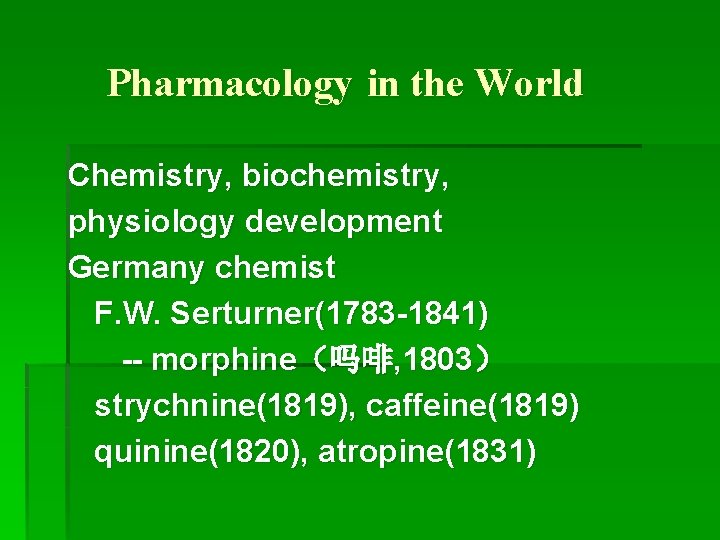
Pharmacology in the World Chemistry, biochemistry, physiology development Germany chemist F. W. Serturner(1783 -1841) -- morphine(吗啡, 1803) strychnine(1819), caffeine(1819) quinine(1820), atropine(1831)
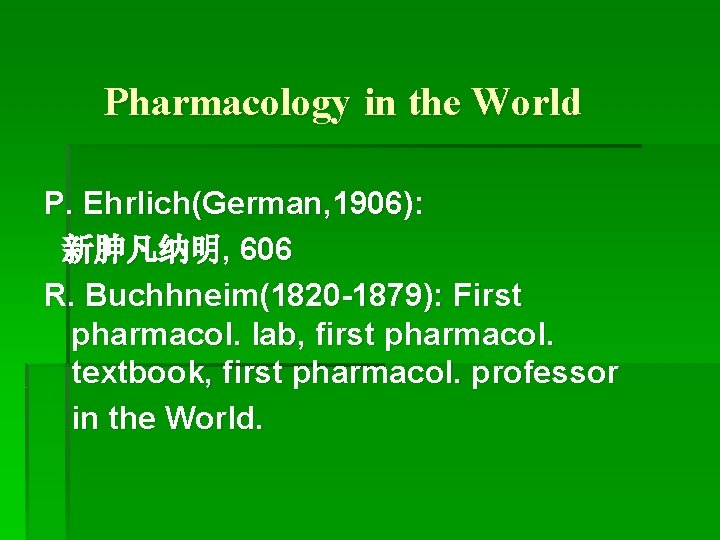
Pharmacology in the World P. Ehrlich(German, 1906): 新胂凡纳明, 606 R. Buchhneim(1820 -1879): First pharmacol. lab, first pharmacol. textbook, first pharmacol. professor in the World.
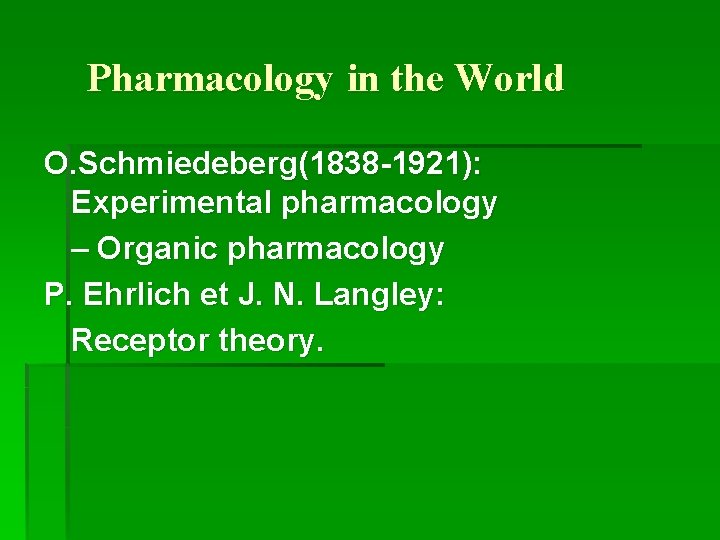
Pharmacology in the World O. Schmiedeberg(1838 -1921): Experimental pharmacology – Organic pharmacology P. Ehrlich et J. N. Langley: Receptor theory.
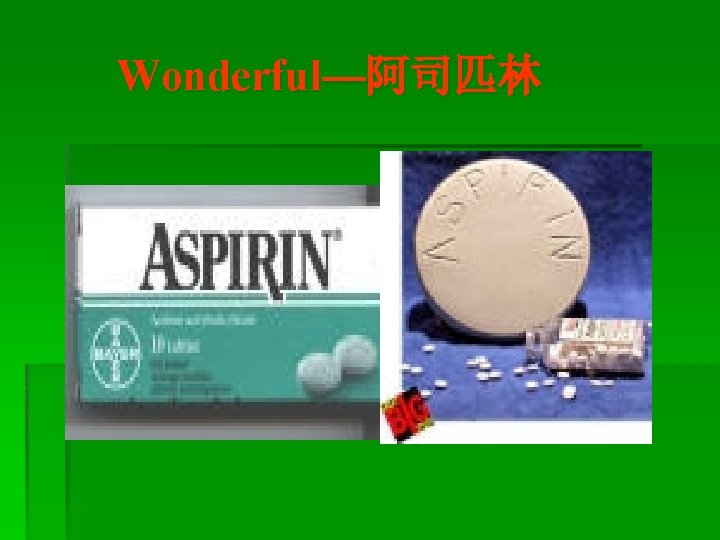
Wonderful—阿司匹林
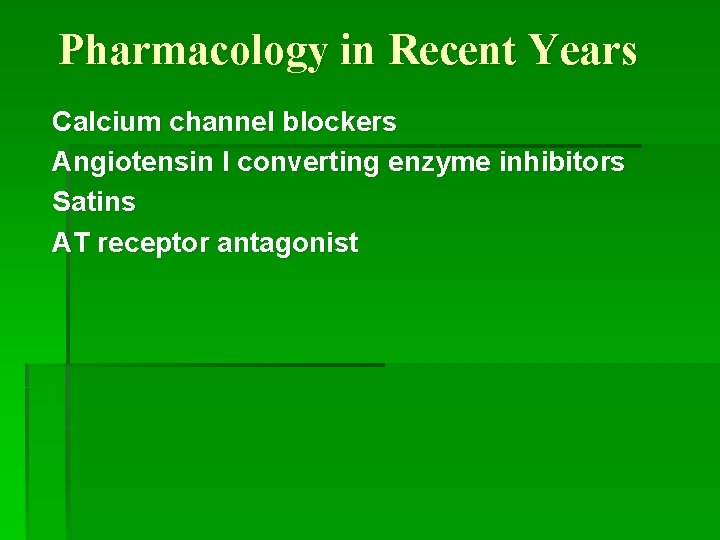
Pharmacology in Recent Years Calcium channel blockers Angiotensin I converting enzyme inhibitors Satins AT receptor antagonist
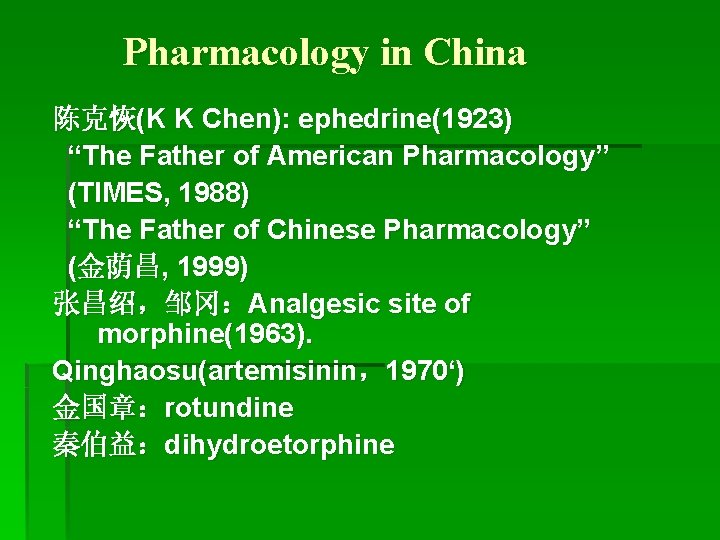
Pharmacology in China 陈克恢(K K Chen): ephedrine(1923) “The Father of American Pharmacology” (TIMES, 1988) “The Father of Chinese Pharmacology” (金荫昌, 1999) 张昌绍,邹冈:Analgesic site of morphine(1963). Qinghaosu(artemisinin,1970‘) 金国章:rotundine 秦伯益:dihydroetorphine
The Main Branches of Pharmacology 临床药理学:Clinical pharmacology 生化药理学:Biochemical pharmacology 分子药理学:Molecular pharmacology 免疫药理学:Immunopharmacology 心血管药理学:Cardiovascular pharmacology 神经药理学:Neuropharmacology 遗传药理学:Pharmacogenetics 化学治疗学:Chemotherapy
3. Pharmacology in New Drug Research and Development New drugs(新药):Drugs without marketing in China defined as new drug by Sino Food and Drug Administration(SFDA, 在中国未上 市销售的药物) Western medicines Traditional Chinese medicines Biochemicals
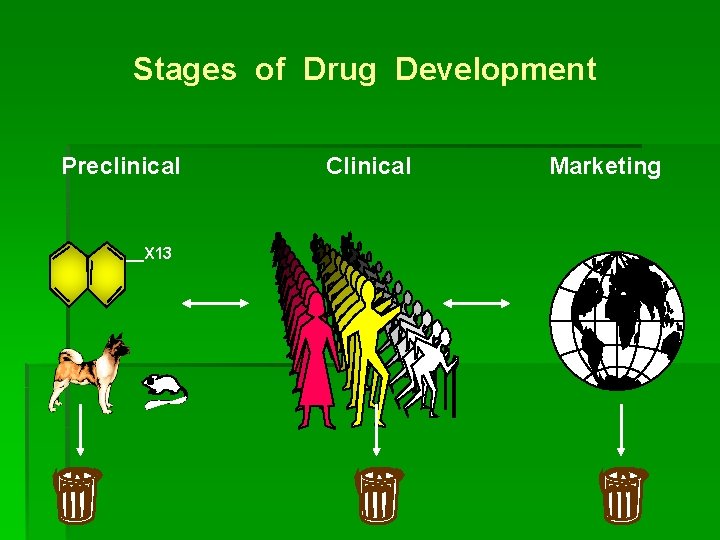
Stages of Drug Development Preclinical __X 13 Clinical Marketing
The Steps for Drug Research and Development(R&D) Preclinical Research: 临床前研究 Pharmaceutical studies药学研究 Pharmacological studies药理学研究
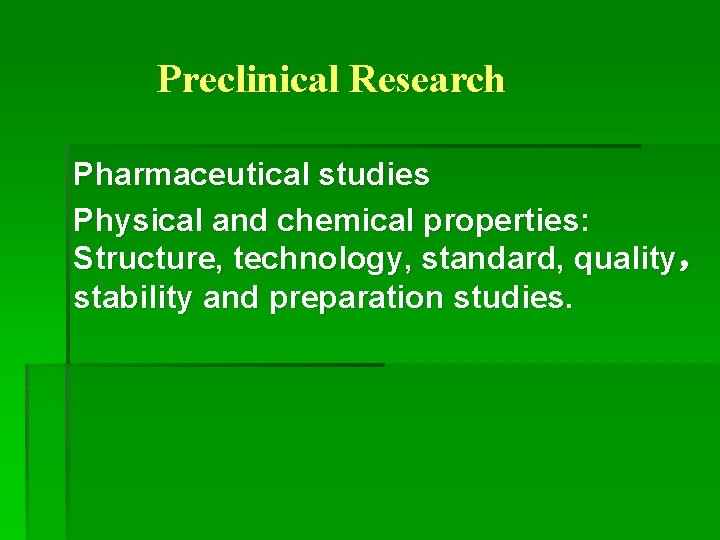
Preclinical Research Pharmaceutical studies Physical and chemical properties: Structure, technology, standard, quality, stability and preparation studies.
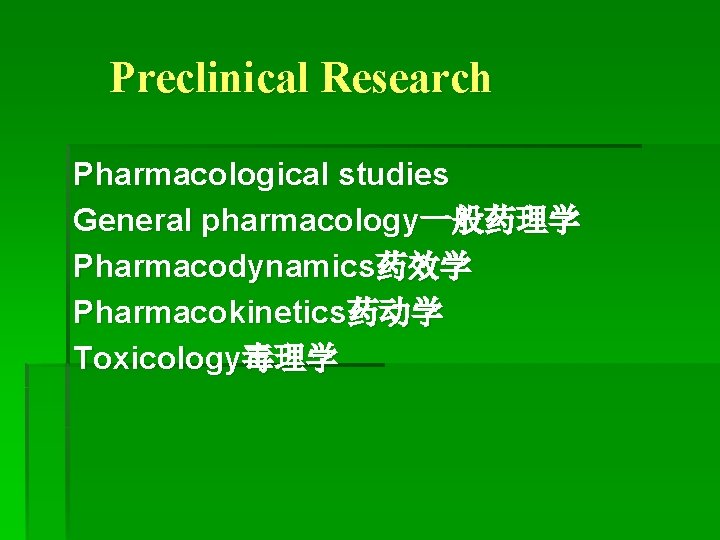
Preclinical Research Pharmacological studies General pharmacology一般药理学 Pharmacodynamics药效学 Pharmacokinetics药动学 Toxicology毒理学
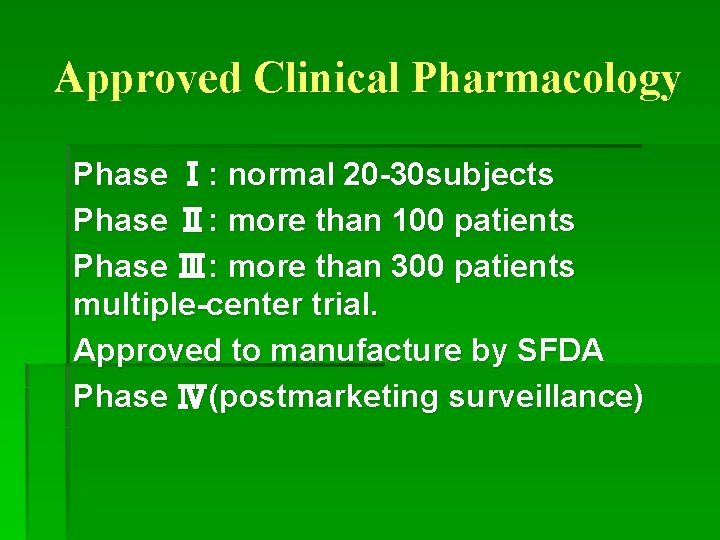
Approved Clinical Pharmacology Phase Ⅰ: normal 20 -30 subjects Phase Ⅱ: more than 100 patients Phase Ⅲ: more than 300 patients multiple-center trial. Approved to manufacture by SFDA Phase Ⅳ(postmarketing surveillance)
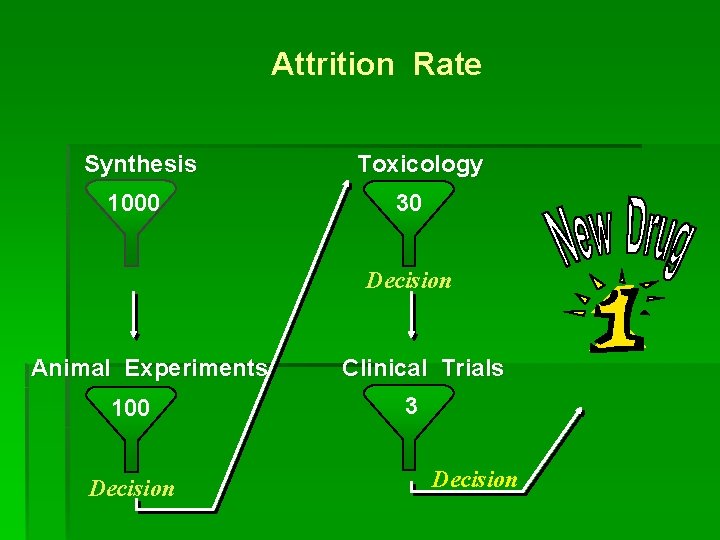
Attrition Rate Synthesis 1000 Toxicology 30 Decision Animal Experiments 100 Decision Clinical Trials 3 Decision
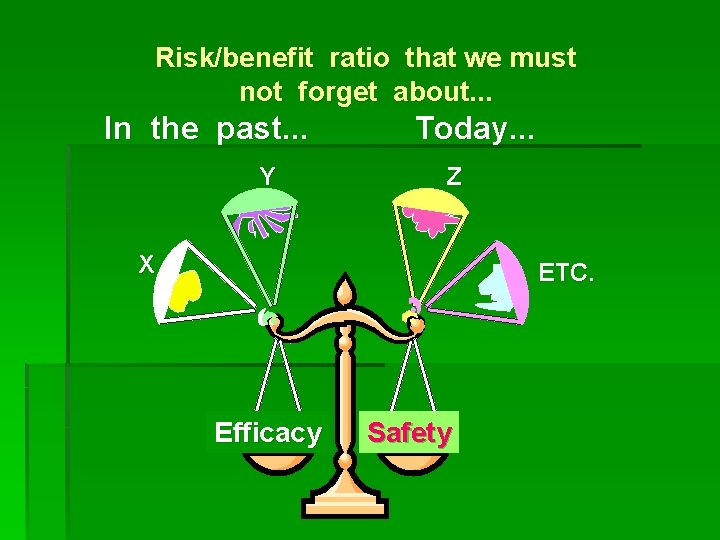
Risk/benefit ratio that we must not forget about. . . In the past. . . Y Today. . . Z X ETC. Efficacy Safety
The Organizations and Regulation for New Drug Research and Development Food and Drug Administration (FDA, USA) Sino Food Drug Administration (SFDA, China) The Center for New Drug Evaluation. GLP(good laboratory practice), GCP(G. clinical P. ), GMP(G manufacture P)
4. How to Learn Pharmacology Dr. AJ Lehman, Chairman, Department of Pharmacology, FDA, USA “You too can learn pharmacology, in only three lessons: each of them lasting ten years(学习药理学也许仅需3节课,但 每节课却需要10年时间)” 。
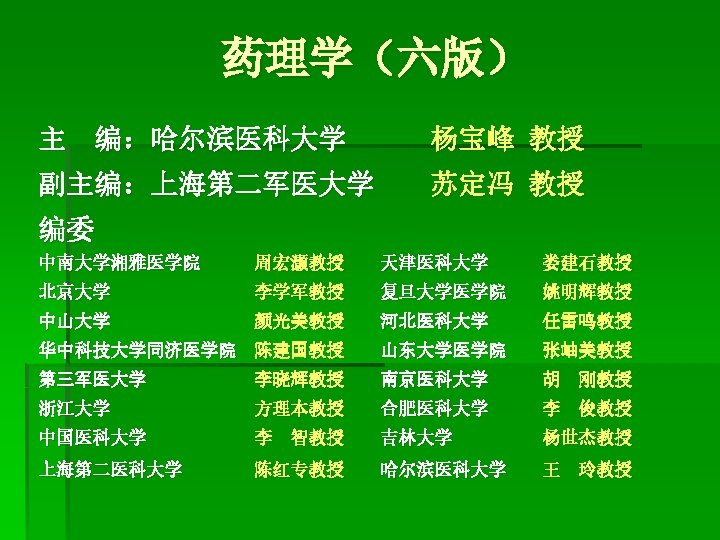
How to Learn Pharmacology a. Lectures 72 hours b. Textbook 药理学,杨宝峰主编,第六版; 2003 Basic and Clinical Pharmacology, Nineth edition, 2004 ,B. G. Katzung. Mc. Graw Hill Co. c. Experiments
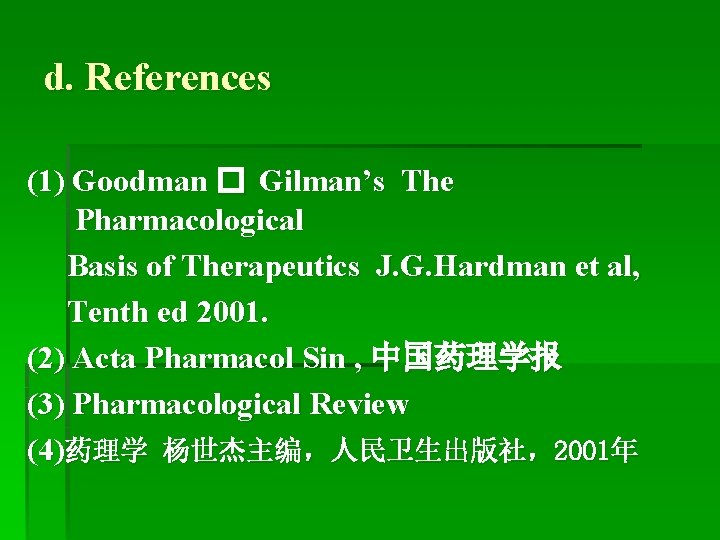
d. References (1) Goodman � Gilman’s The Pharmacological Basis of Therapeutics J. G. Hardman et al, Tenth ed 2001. (2) Acta Pharmacol Sin , 中国药理学报 (3) Pharmacological Review (4)药理学 杨世杰主编,人民卫生出版社,2001年
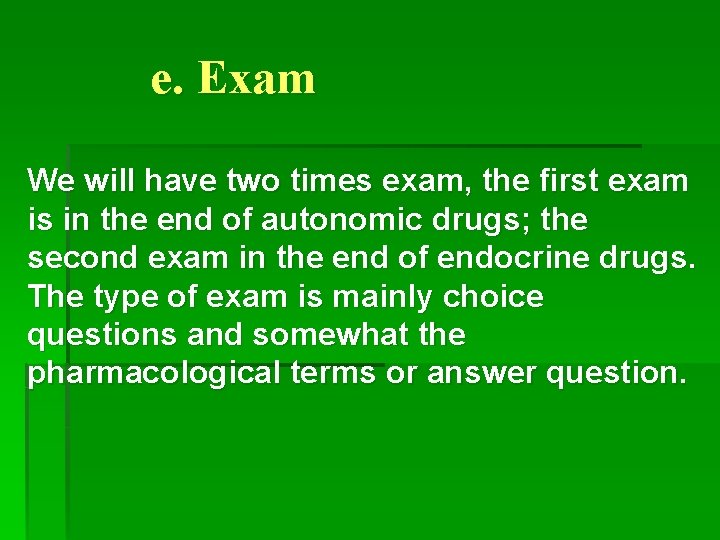
e. Exam We will have two times exam, the first exam is in the end of autonomic drugs; the second exam in the end of endocrine drugs. The type of exam is mainly choice questions and somewhat the pharmacological terms or answer question.
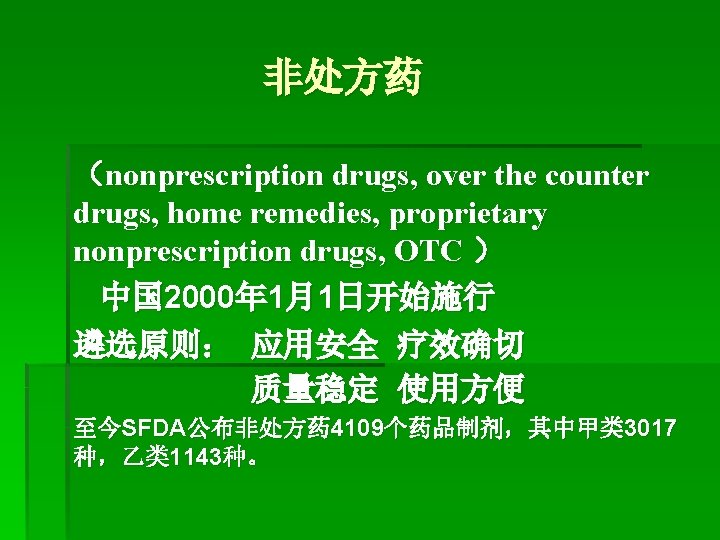
非处方药 (nonprescription drugs, over the counter drugs, home remedies, proprietary nonprescription drugs, OTC ) 中国 2000年 1月1日开始施行 遴选原则: 应用安全 疗效确切 质量稳定 使用方便 至今SFDA公布非处方药 4109个药品制剂,其中甲类 3017 种,乙类 1143种。
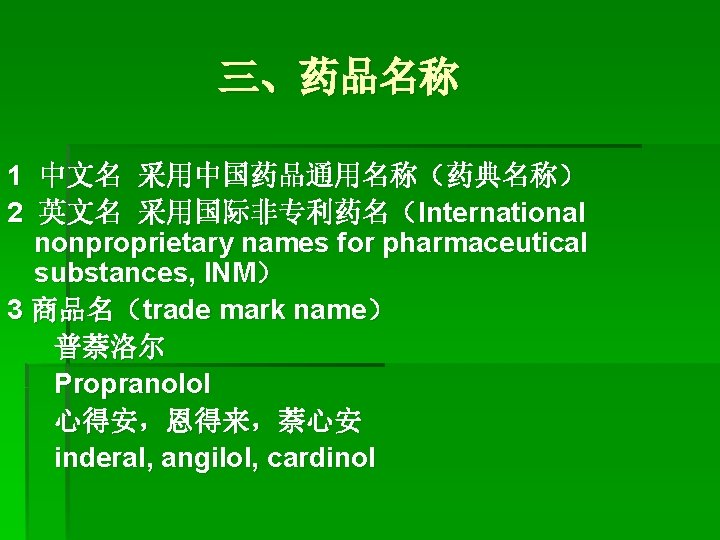
三、药品名称 1 中文名 采用中国药品通用名称(药典名称) 2 英文名 采用国际非专利药名(International nonproprietary names for pharmaceutical substances, INM) 3 商品名(trade mark name) 普萘洛尔 Propranolol 心得安,恩得来,萘心安 inderal, angilol, cardinol
CHAPTER 3 PHARMCODYNAMICS 药物效应动力学 SECTION 1 Basic Actions of Drug
1. Drug Actions and Effects of Pharmacological on the body作用与效应 Action(作用) referred to the initial or primary interaction between drug molecule with receptors on the cells. Adrenaline(肾上腺素) stimulate βreceptors on the myocardial cell to stimulate the heart.
Effects(效应) Pharmacological effect: physical effects secondary to initial drug action. Adrenaline act on β receptors called action of adrenaline, stimulating heart called effects of adrenaline.
Effects Excitation(stimulation,兴奋): the body function increase or potentiated by the drug. Adrenaline accelerate the heart rate and output. Acetylcholine contracts the gastrointestinal smooth muscle. These effects are called stimulation. With the dose increase of the drug it may induce augmentation(亢进). For example, overdose of adrenaline may cause heart failure.
Effects Inhibition(抑制): the body function decrease or suppressed by the drug. If dose increase largely it may produce paralysis(麻痹) or failure(衰竭). For instances, diazepam安定 induce sedation and hypnosis. Aspirin lowers the elevated body temperature.
Selectivity or specificity of drug action Selectivity or specificity(选择性,特异性) Ideally, specificity means that a drug only binds to one single type of receptor and cause one single effect. Selectivity means that a drug binds to one or a few types of receptors with higher affinity than to other receptors.
2. Therapeutic Effects of Drugs治疗效果 Therapeutic Effects治疗作用 The effects produced by the drug are the purposes for the drug use, i. e. , the beneficial effects of the drug. Therapeutic effects are useful to prevent or treat diseases.
Therapeutic Effects of Drugs Etiological treatment 对因治疗(治本) Symptomatical treatments 对症治疗(治标)
(1)Etiological treatment对因治疗 Elimination of the etiological factors by using drug to cure diseases a. Therapy by killing pathogens If an inflammation is caused by the invasion of pathogens, the application of suitable antibiotics is preferred. Antibiotics selectively kill bacteria without harming the body. Gene therapy, immunotherapy.
b. Supplementary (replacement) therapy Lack of endogenous substance may cause many kinds of diseases. For example, lack of vitamin A may cause night blindness; lack of thyroid hormones congenitally may cause cretinism. In these cases, supplement of the corresponding substances is an effective way to restore the body to normal function. The supplement of vitamins, hormones and other necessary substances of the body is called replacement therapy.
(2) Symptomatic treatment对症治疗 The disease symptom improvement without eliminating the cause of the disease. For instance, pain relieved by aspirin; hypertension lowered by anti-hypertensive drugs.
3. Adverse Drug Reactions(ADR) 药物不良反应 The World Health Organization(WHO) defined the drug adverse reaction: “Any response to drug that is noxious and unintended and that occurs at dose used in man for prophylaxis, diagnosis or therapy of a disease, or for the modification of physiological function”.
(1) Side effects副反应 In the range of therapeutic doses, the drug effects, which are not related to the current therapeutic purpose, are called side effects. The pharmacological basis of the presence of side effects is low selectivity of the drug.
Side effects副反应 For instance, if a muscarine receptor antagonist, atropine is used to prevent airway secretion caused by anesthetics, all other effects of atropine, such as mydriasis, dry mouth, belong to the side effects; however, if it is used in ophthalmology (eye), all other effects such as, dry mouth, accelerate cardiac rate etc. , belong to the side effects.
(2) Toxic reaction毒性反应 All drugs are capable of producing toxic reactions if the dose is high enough or drugs long term used. A. According to on-speed of drug toxicity: if toxicity caused by short term use of a drug, it is called acute toxicity, and if caused by long term use, called chronic toxicity.
Toxic reaction毒性反应 B. According to the distribution of drug toxicity: drug toxicity may be classified local or systemic toxicity. C. According to the extent of drug toxicity: Pharmacological toxicity(most cases are reversible) and pathological toxicity(part of cases irreversible)
Toxic reaction毒性反应 Special toxications特殊毒性: Carcinogenesis致癌: some drug may cause cancer. Teratogenesis致畸: in few cases some drug may induce teratogenesis, such as thalidomide. Mutagenesis致 突 变 : some special drug can induce DNA change, resulting in carcinogenesis or teratogenesis.
(3) After effect (residual effect) 后遗效应 After withdrawal of the drug, the drug concentration is below the threshold, the effect still exists, such as after taking barbiturates, the second morning, the patient feels hangover, drowsiness, and fatigue.
After effect后遗效应 For instance, stop administration of hydrocortisone after its long-term use will cause hypoadrenocorticism which need several months to recover.
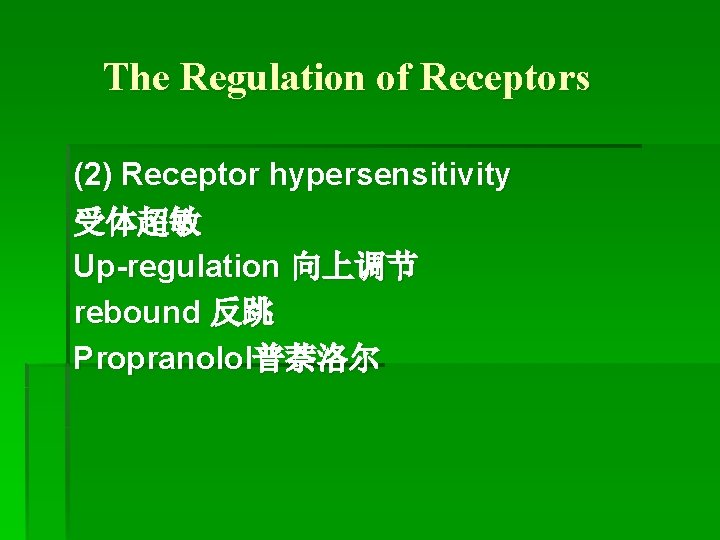
(4)Withdrawal reaction (rebound) 停药反应 Rapid withdrawal when long-term use some drug may lead to accelerate the symptoms of ordinary disease, such as when stop use propranolol for its longterm use in angina patients, which can provoke angina attacks, arrhythmias, or myocardial infarction, even more severe than before.
(5) Allergic reaction变态反应 Hypersensitive reaction: drug allergy is an altered response to a drug resulting from a previous sensitizing exposure and an immunological mechanism. It is also a pathological allergic reaction of a drug.
Allergic reaction变态反应 Drug induced allergy have been reported for almost every drug in extensively clinical use. Some agents, such as streptokinase, penicillin, iodides, phenytoin, and sulfonamides are truly allergic in nature. (过敏反应, hypersensitivity)
Allergic reaction变态反应 The drug allergies are manifested as skin eruption, edema, anaphylactoid reactions, eosinophilia, immune complex disorders and contact dermatitis, and may be most severe allergic shock in some cases, such as penicillin caused allergic shock.
(6)Idiosyncrasy特异质反应 Drug idiosyncrasy refers to an abnormal response to a drug by an individual. It is quite likely that idiosyncrasy are genetically abnormalities of enzymes and receptors. Therefore, these abnormal response are often referred to as phamacogenetic disorders.
Idiosyncrasy特异质反应 For example, hemolytic anemia elicited by primaquine in patients whose red blood cells are deficient in glucose-6 phosphate dehydrogenase; apnea caused by succinylcholine in patients with abnormal serum ACh esterase which is incapable of destroying succinylcholine as usual.
SECTION 2 Drug Dose and Dose-Effect Relationship Drug dose(dosage): Amount of drug used in the prevention or treatment of diseases.
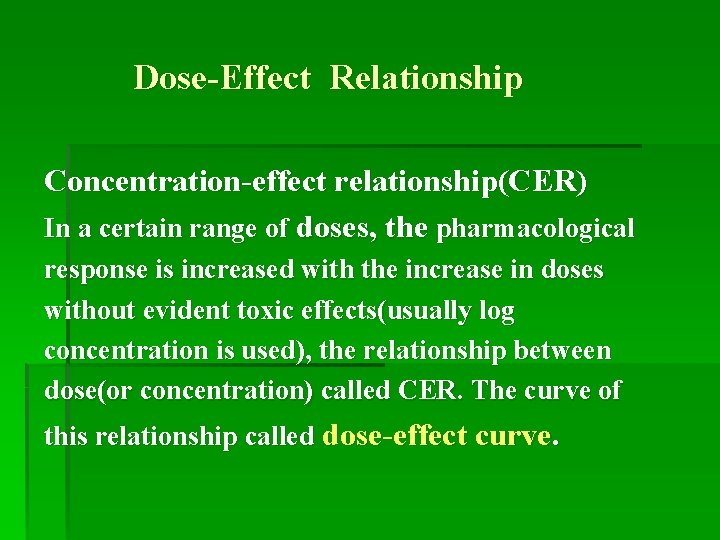
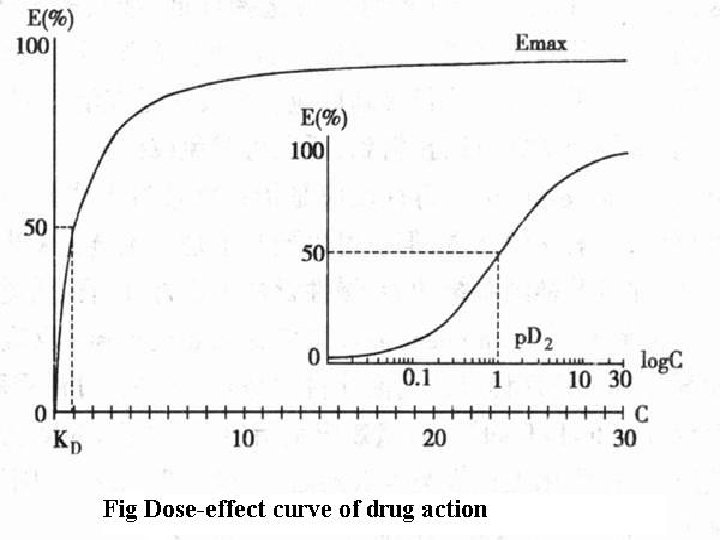
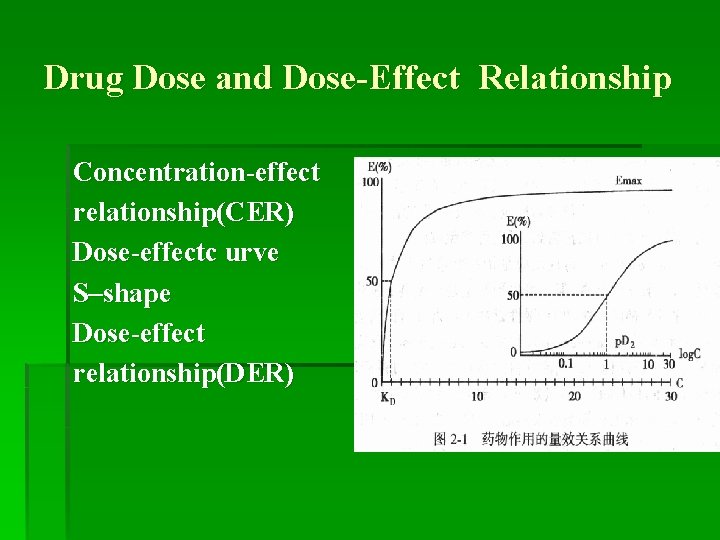
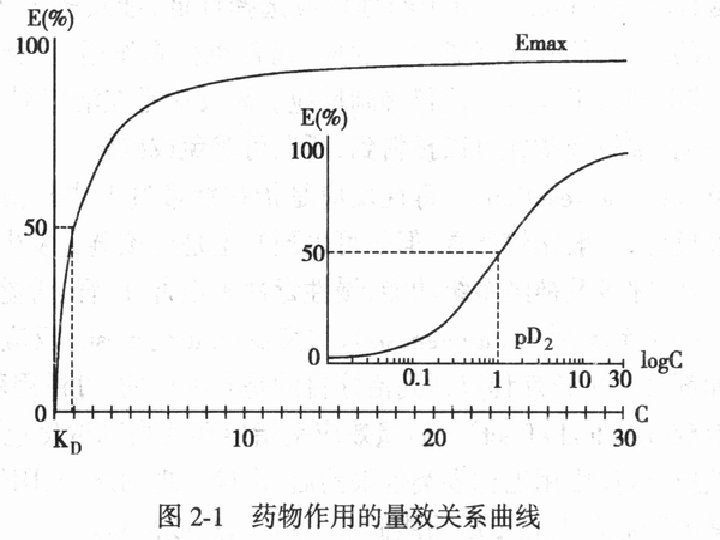
Dose-Effect Relationship Concentration-effect relationship(CER) In a certain range of doses, the pharmacological response is increased with the increase in doses without evident toxic effects(usually log concentration is used), the relationship between dose(or concentration) called CER. The curve of this relationship called dose-effect curve.
Drug Dose and Dose-Effect Relationship Concentration-effect relationship(CER) Dose-effectc urve S–shape Dose-effect relationship(DER)
1. Graded Dose Response量反应 Graded dose response means the pharmacological effects of the drugs expressed in quantity or number, such as the heart rate by beat, blood pressure by mm. Hg, also the contract of ileum in height effected by the drugs.
Graded Dose Response量反应 (1)Minimum effective dose最小有效量 (最小有效浓度,minimum effective concentration, threshold concentration, 阈浓度, Cmin) Cmin means in that minimum dose can cause the pharmacological effect, indicate the least amount of drug needed to exert therapeutic effects.
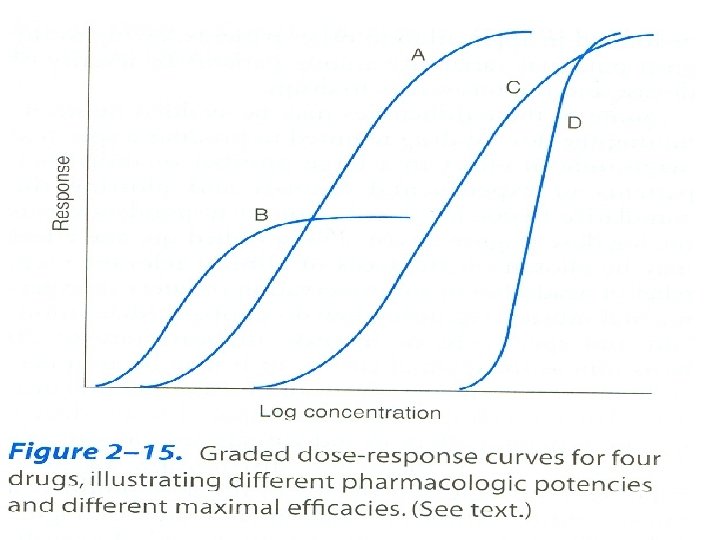
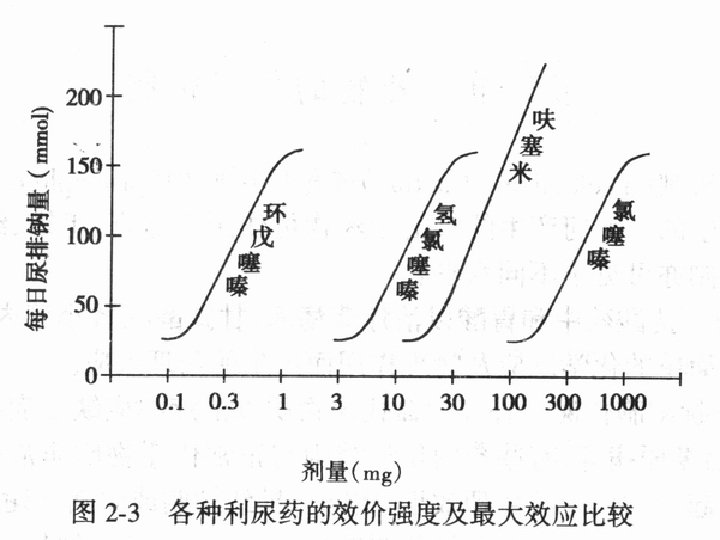
Graded Dose Response (2)Maximum efficacy(最大效应,效能, efficacy, Emax) Emax means the drug is capable of exerting maximal effect. The term describes the maximal biological response produced by a drug. Efficacy of a drug depends on the receptor density or the number of active receptors.
Graded Dose Response (3)Concentration for 50% of maximum effect(半最大效应浓度, EC 50) The concentration of a drug that gives rise to to one-half of the maximum response (continuous effect)is called median effective concentration.
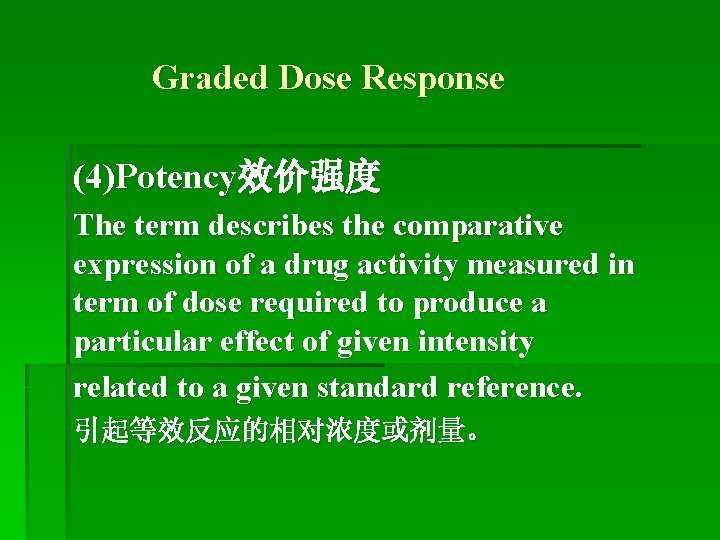
Graded Dose Response (4)Potency效价强度 The term describes the comparative expression of a drug activity measured in term of dose required to produce a particular effect of given intensity related to a given standard reference. 引起等效反应的相对浓度或剂量。
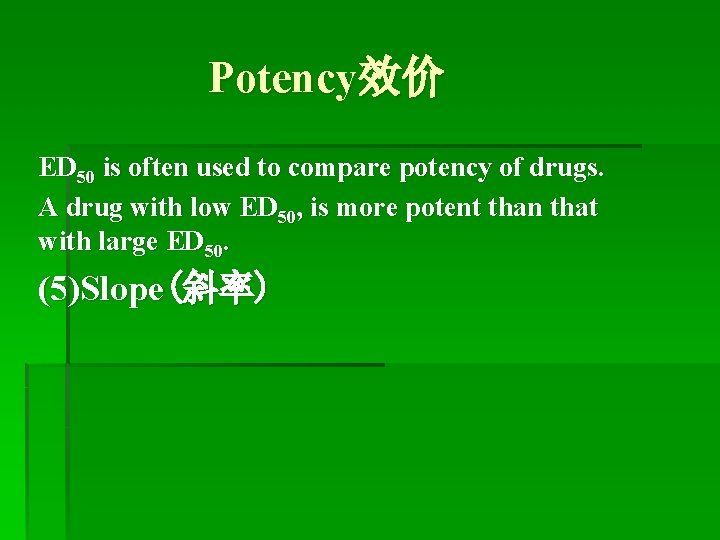
Potency效价 ED 50 is often used to compare potency of drugs. A drug with low ED 50, is more potent than that with large ED 50. (5)Slope(斜率)
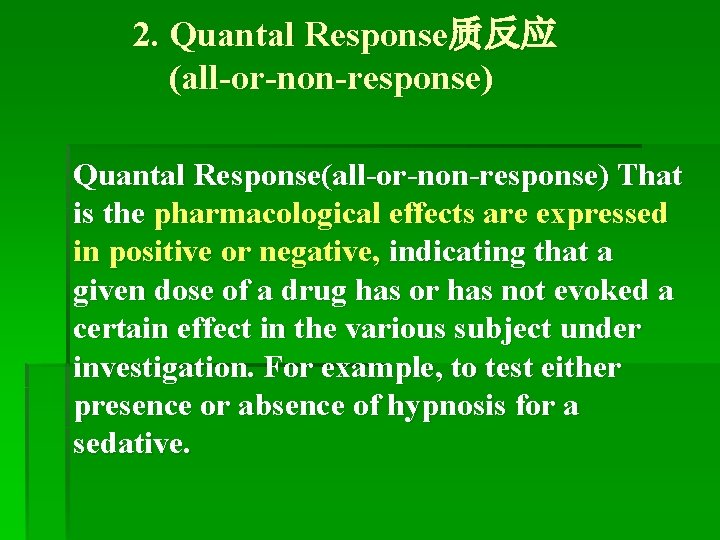
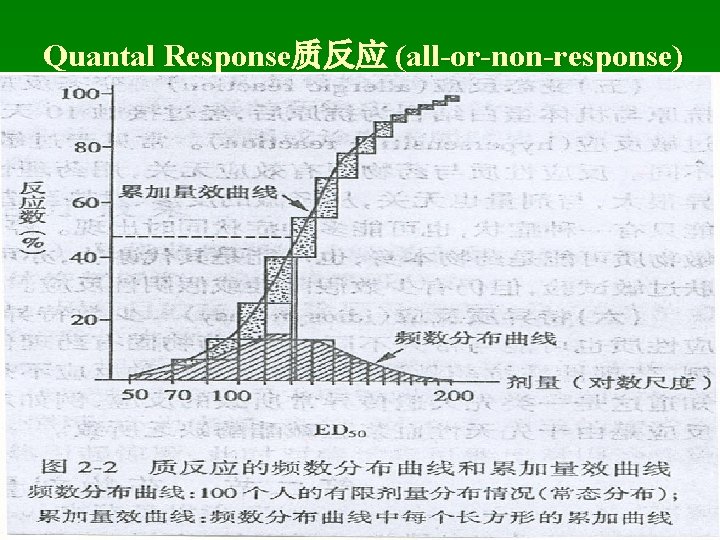
2. Quantal Response质反应 (all-or-non-response) Quantal Response(all-or-non-response) That is the pharmacological effects are expressed in positive or negative, indicating that a given dose of a drug has or has not evoked a certain effect in the various subject under investigation. For example, to test either presence or absence of hypnosis for a sedative.
Quantal Response质反应 (all-or-non-response)
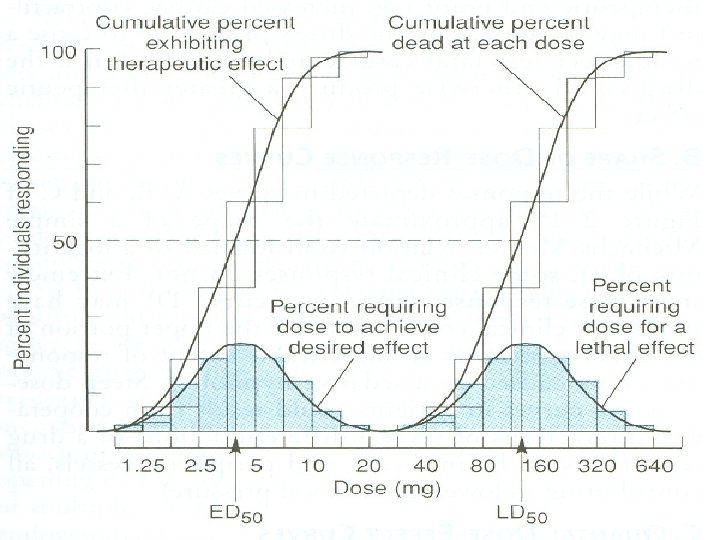
Quantal Response (1) Median effective dose(半数有效量, ED 50): For all-or-none response, the dose of a drug that gives rise to a positive response in 50% of the subject. The more potent the drug, the lower its ED 50.
Quantal Response (2) Lethal dose致死量 The dose of a drug can cause the experimental animal to death. (3) Median lethal dose(半数致死量,LD 50) A dose of a drug that gives rise to the death of 50% of experimental animals is called LD 50.
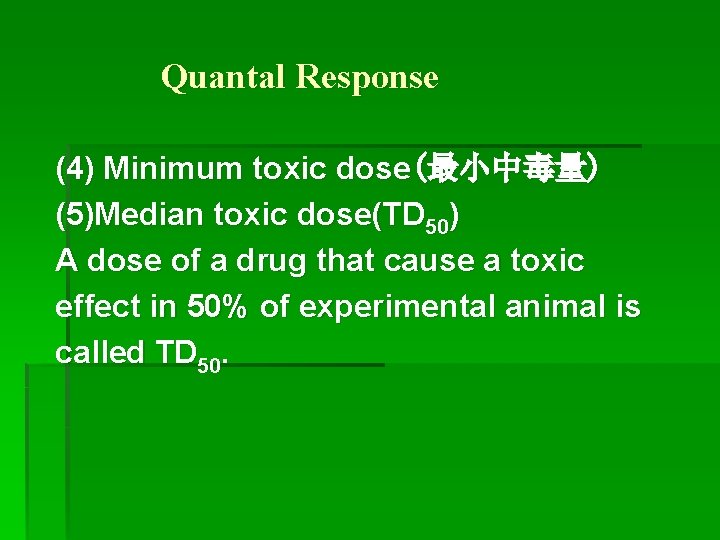
Quantal Response (4) Minimum toxic dose(最小中毒量) (5)Median toxic dose(TD 50) A dose of a drug that cause a toxic effect in 50% of experimental animal is called TD 50.
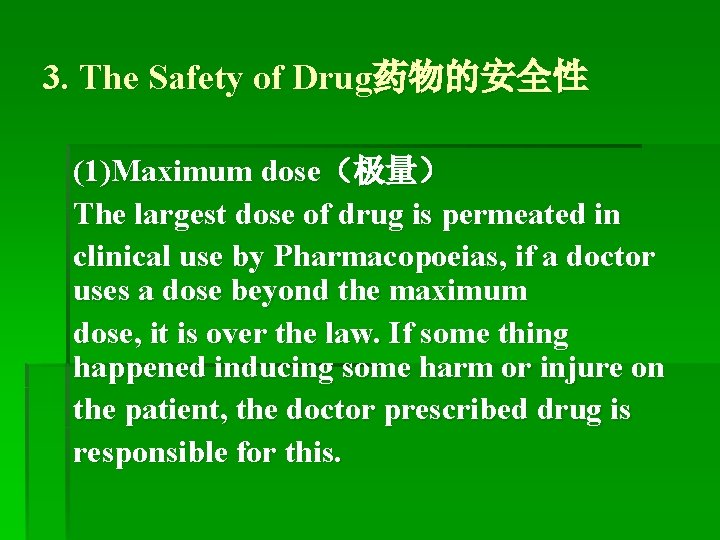
3. The Safety of Drug药物的安全性 (1)Maximum dose(极量) The largest dose of drug is permeated in clinical use by Pharmacopoeias, if a doctor uses a dose beyond the maximum dose, it is over the law. If some thing happened inducing some harm or injure on the patient, the doctor prescribed drug is responsible for this.
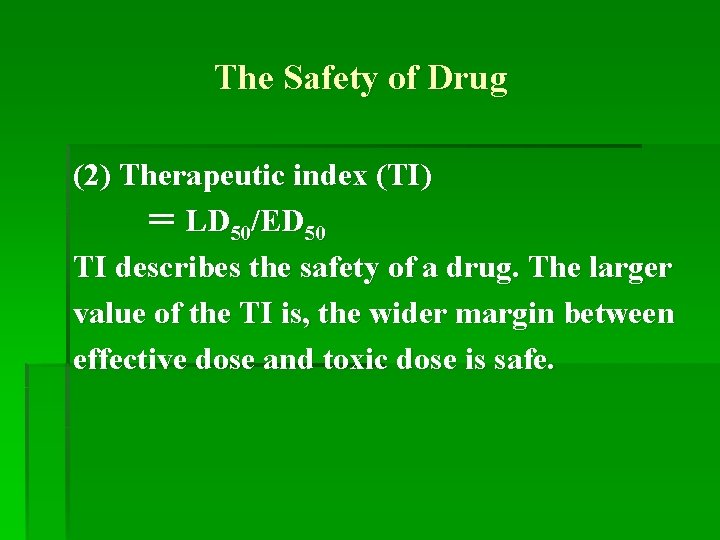
The Safety of Drug (2) Therapeutic index (TI) = LD 50/ED 50 TI describes the safety of a drug. The larger value of the TI is, the wider margin between effective dose and toxic dose is safe.
安全范围 (3) Margin of safety of the drug is also described as. ED 99 ~ LD 1 or ED 95 ~ LD 5
SECTION 3 DRUG AND RECEPTORS Drugs can do two things to recepters: (1) bind to them (affinity) and (2) possibly change their behavior toward the host cell system (efficacy).
1. Mechanisms of Drug Action The Types of Mechanism of Drug Action: (1) Physical and chemical reaction Some drugs are used to treat diseases by physical and chemical reaction in the body. Such as antacids neutralizing gastric acid are used to treat ulcer and osmotic diuretic dextran increasing osmolarity of plasma, is used to treat edema; and metal chelating agents combine to toxic metals.
(2)Joining or interfering with cell metabolism Vitamins, iron preparations and some anticancer drugs whose chemical structure resemble purine or pyrimidine are called counterfeit incorporation or antimetabolite. The effects of these substances are through joining or interfering with cell metabolism.
(3) Affecting transportation of physical substances The actions of ephedrine and aramine induce partly the release of norepinephrine from noradrenergic nerve endings. And reserpine, a hypotensive agent, affect the uptake of norepinephrine.
(4) Affecting enzyme activity Many drugs produce their effects by selectively interacting with corresponding enzymes, for example, neostigmine exerts its cholinergic effect by inhibiting activity of ACh. E; digitalis enhance the cardiac contraction by inhibiting Na/K-ATPase activity on myocardial membrane; sulfonamides produce bacteriostatic effects by inhibiting the activity of dihydrofolate synthase of bacteria.
(5) Affecting ion channels on the cell membrane Calcium, sodium and potassium ion channels may be affected by drugs and then to exert its pharmacological effects. Calcium and sodium channel blockers, and potassium channel openers used in the treatment of cardiovascular diseases because of the affection to these ion channels.
(6) Affecting immunology function The immunosuppressive and immunomodulating agents result in efficiency by influencing body immunity function.
(7)Affecting nucleotide metabolism The DNA and RNA are vital substances which control DNA reproduce protein synthesis and cell split, many anticancer drugs exert effective action on cancer cells by interrupting DNA and RNA metabolism of cancer cells.
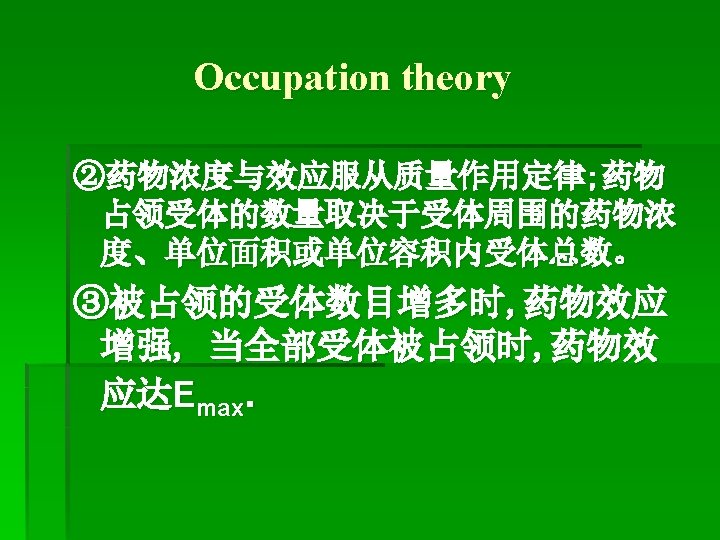
(8) Drugs and receptors A (specific) receptor can be defined as many biologic target macromolecule in cells that interacts specifically with extracellular signal, e. g. , a drug and converts it into intracellular effects. Receptor determine the maximum effect of a drug, i. e. , the response extent is proportional to the number of drugreceptor interaction.
2. Drug and Receptors (1) Development of Receptor theory a. Langley(1878): Intercounter of atropine with pilocarpine in salivary excretion.
Development of Receptors therory b. Langley(1906): Intercounter tubocurarine with nicotine in skeletal muscle – “receptive substance” c. Ehrlich(1908): “lock and key (receptor)”
Receptor Theory: the Pride of Pharmacologists! d. Clark(1926 -33): Acetylcholine on heart contraction. e. Dale, Ahlquist, Gaddum, Schild, Sutherland, et al.
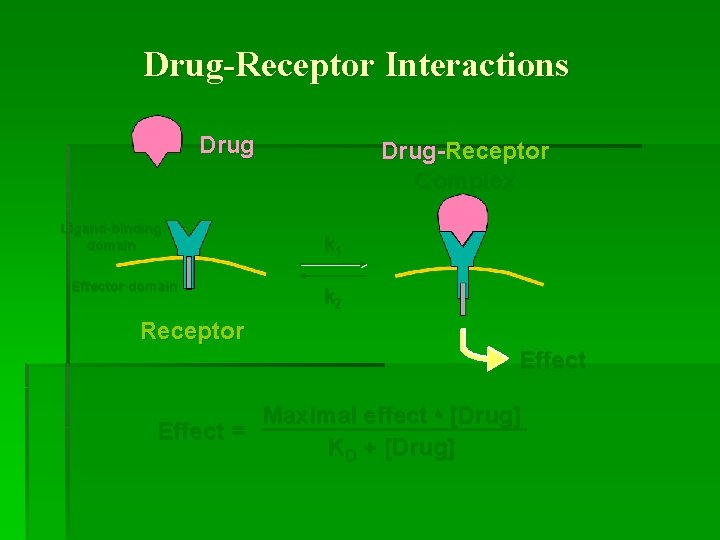
Drug-Receptor Interactions Drug Ligand-binding domain Effector domain Drug-Receptor Complex k 1 k 2 Receptor Effect Maximal effect • [Drug] Effect = KD + [Drug]
3. The Concept and Properties of Receptors (1)Concept A specific receptor can be defined as any biological component of cells that specifically with a endogenous ligand or with a exogenous drug, and induce pharmacological effects.
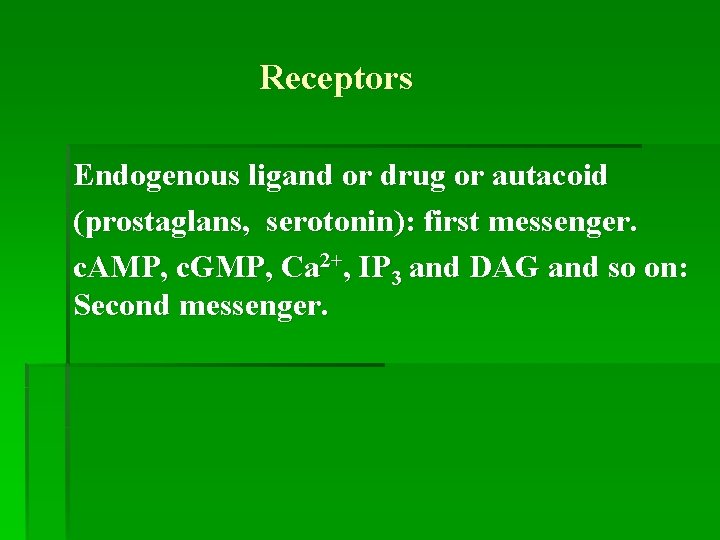
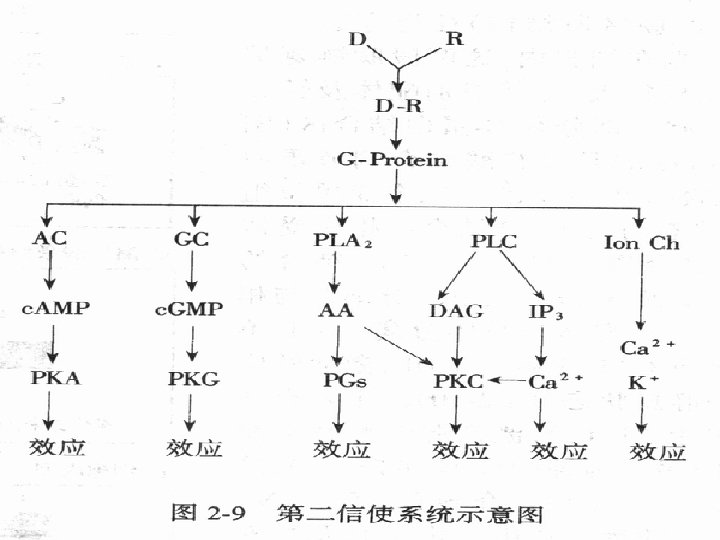
Receptors Endogenous ligand or drug or autacoid (prostaglans, serotonin): first messenger. c. AMP, c. GMP, Ca 2+, IP 3 and DAG and so on: Second messenger.
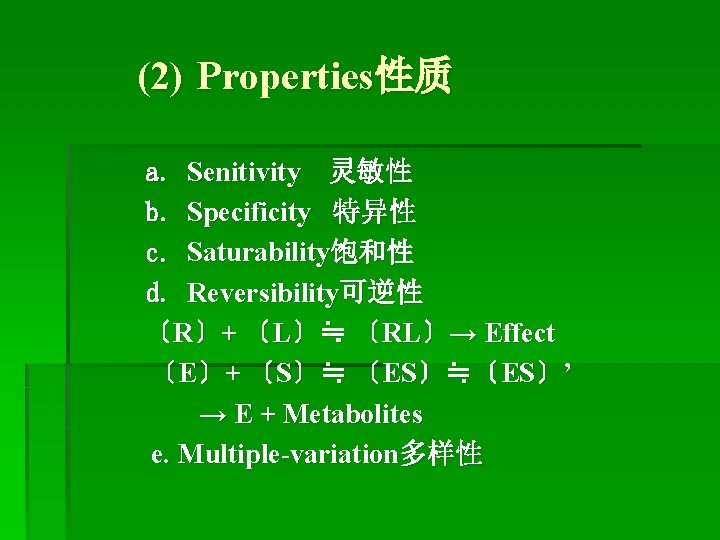
(2) Properties性质 a. Senitivity 灵敏性 b. Specificity 特异性 c. Saturability饱和性 d. Reversibility可逆性 〔R〕+ 〔L〕≒ 〔RL〕→ Effect 〔E〕+ 〔S〕≒ 〔ES〕≒〔ES〕’ → E + Metabolites e. Multiple-variation多样性
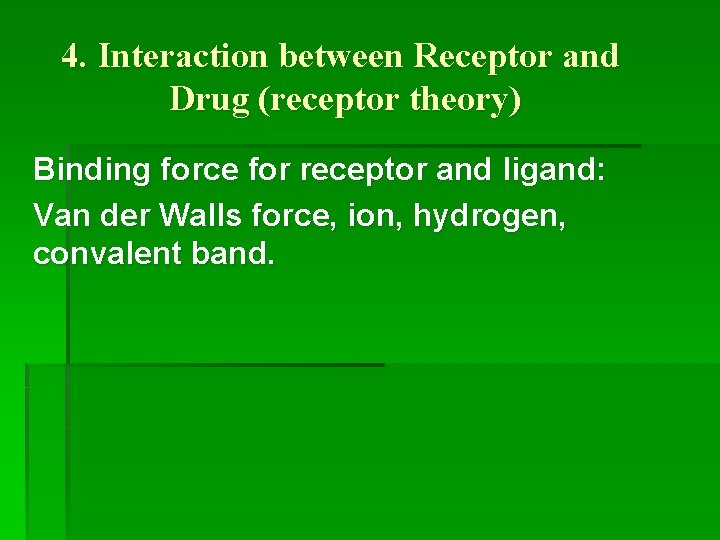
4. Interaction between Receptor and Drug (receptor theory) Binding force for receptor and ligand: Van der Walls force, ion, hydrogen, convalent band.
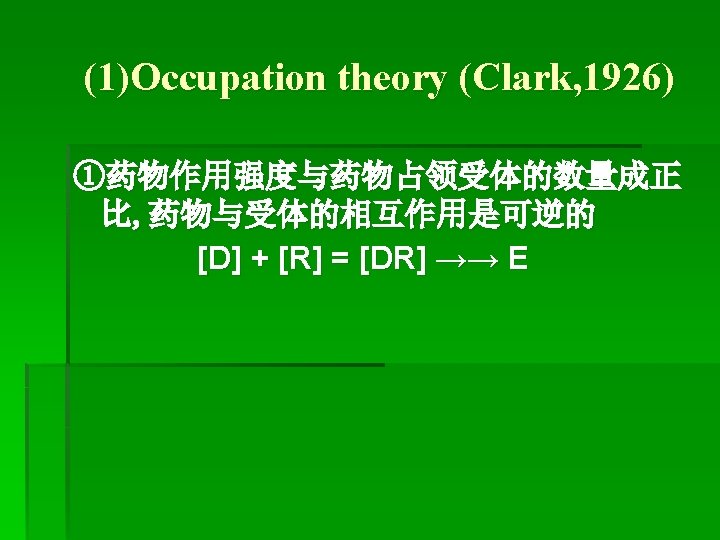
(2) Kinetics of Receptor and Drug [D] + [R] = [DR] →→ E KD = [D][R]/[ DR] KD: dissociation constant Because [RT] = [R] + [ DR] (RT: total receptors) [DR]/[RT] = [D]/KD + [D]
Kinetics of Receptor and Drug Because only DR is effective, E/Emax = [DR]/[RT] = [D]/ KD + [D] When [D] = 0, E = 0 When [D] >> KD, [DR]/[RT] = 100%, Emax [DR]max = [RT] When [DR]/[RT] = 50%, EC 50, KD = [D]
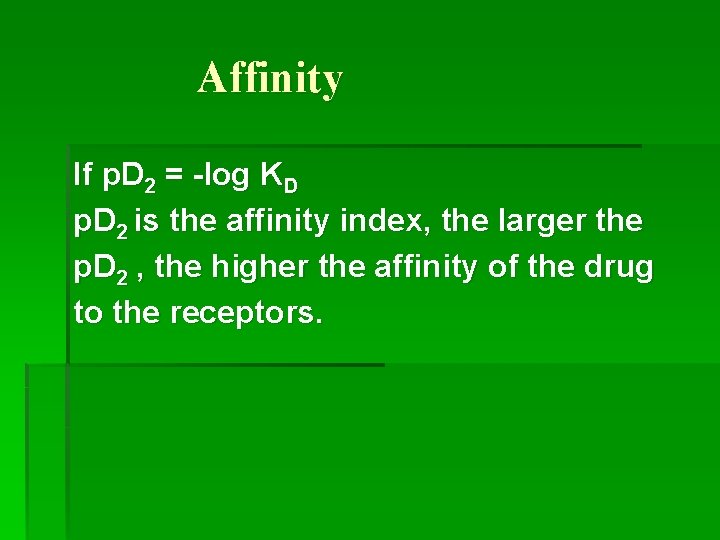
Kinetics of Receptor and Drug KD = [D] KD express affinity (mole) of D to R. The more the KD, the little the affinity. Affinity means the measure of the propensity of a drug to bind with a given receptor.
Affinity If p. D 2 = -log KD p. D 2 is the affinity index, the larger the p. D 2 , the higher the affinity of the drug to the receptors.
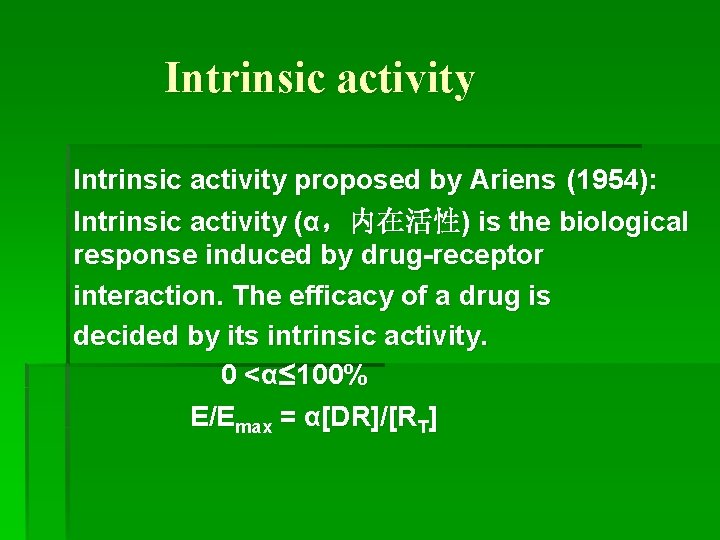
Intrinsic activity proposed by Ariens (1954): Intrinsic activity (α,内在活性) is the biological response induced by drug-receptor interaction. The efficacy of a drug is decided by its intrinsic activity. 0 <α≤ 100% E/Emax = α[DR]/[RT]
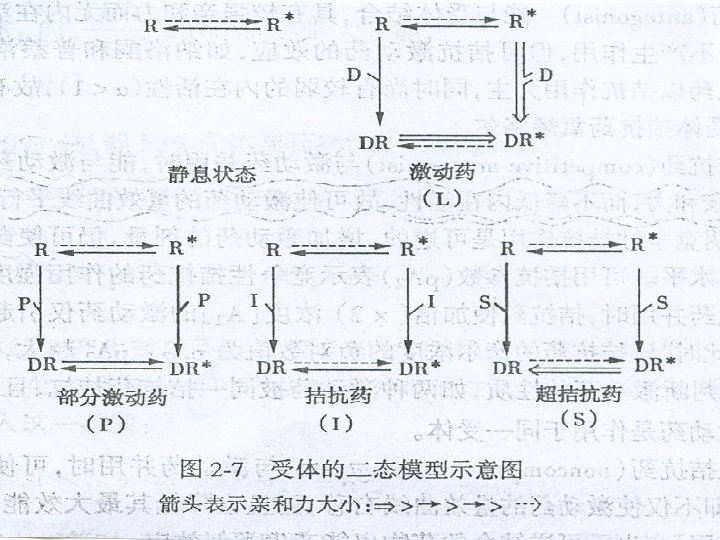
Other Theories (2) Two-model Theory二态模型学说
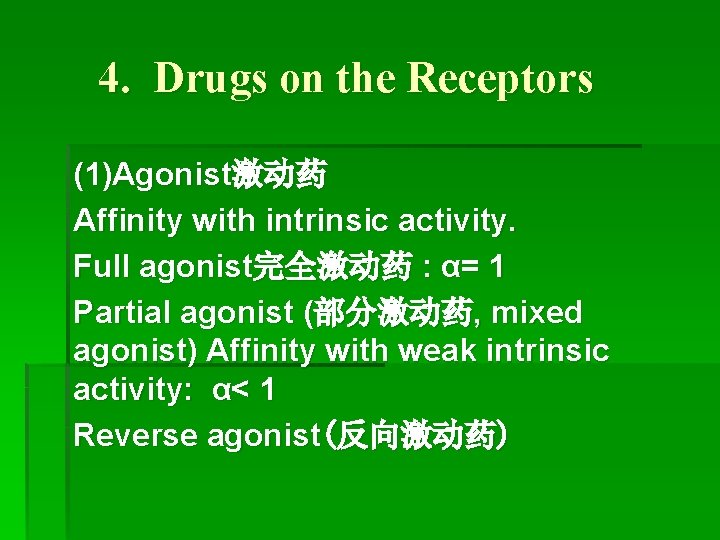
4. Drugs on the Receptors (1)Agonist激动药 Affinity with intrinsic activity. Full agonist完全激动药 : α= 1 Partial agonist (部分激动药, mixed agonist) Affinity with weak intrinsic activity: α< 1 Reverse agonist(反向激动药)
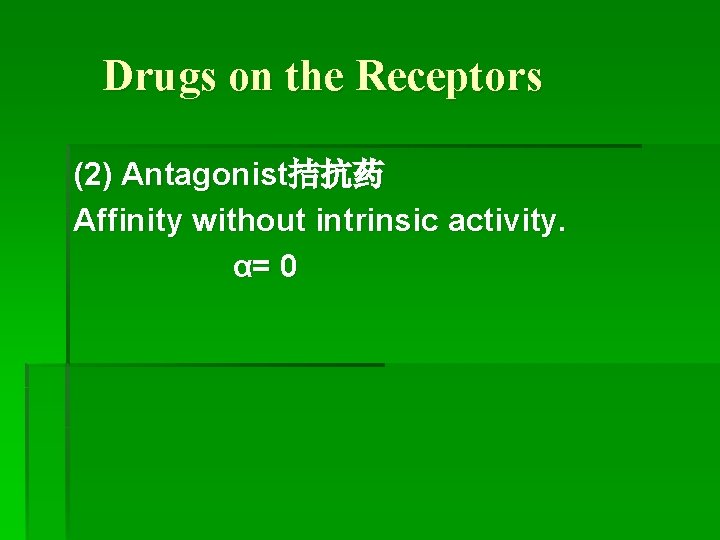
Drugs on the Receptors (2) Antagonist拮抗药 Affinity without intrinsic activity. α= 0
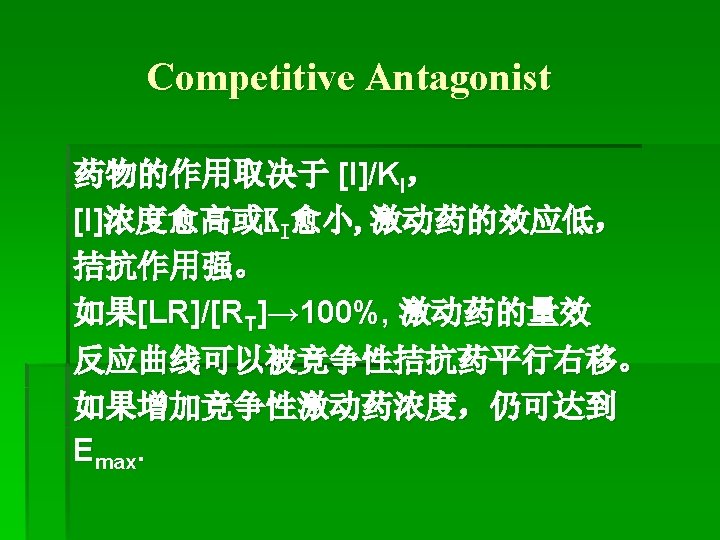
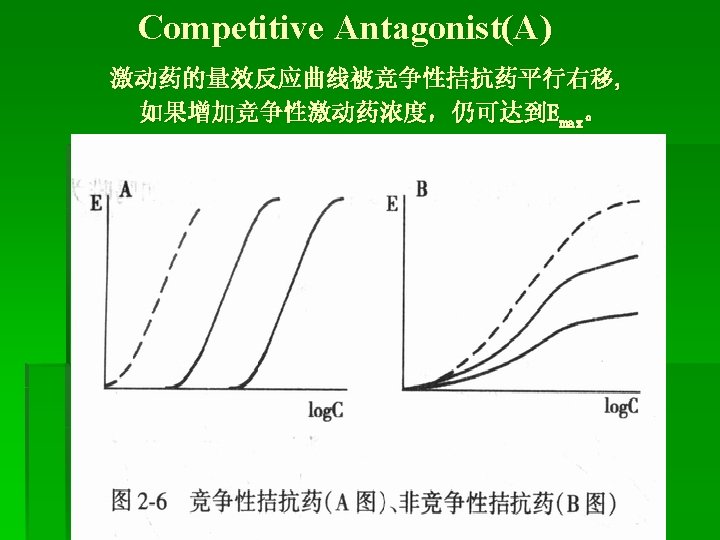
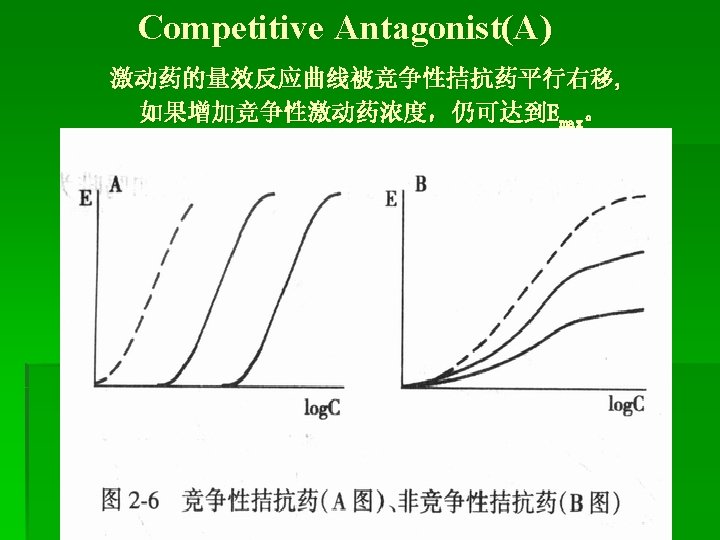
Antagonist拮抗药 A. Competitive antagonist 竞争性拮抗药 Ligand (L) Inhibitor(I) [RT] = [R] + [LR] + [IR] [LR]/[RT] = [L]/KD + [L] [LR]/[RT] = [L]/[L] + KD(1 + [I]/KI)
Competitive Antagonist p. A 2 is the antagonism parameter p. A 2 = -log[I] = -log. KI p. A 2 Express the extent of antagonism of a given antagonist, when the agonist and antagonist are used in same preparation, two times concentration (X 2) of agonist(A 2) only produce ordinary concentration of that agonist effect, in that time the negative log concentration of antagonist is called as p. A 2.
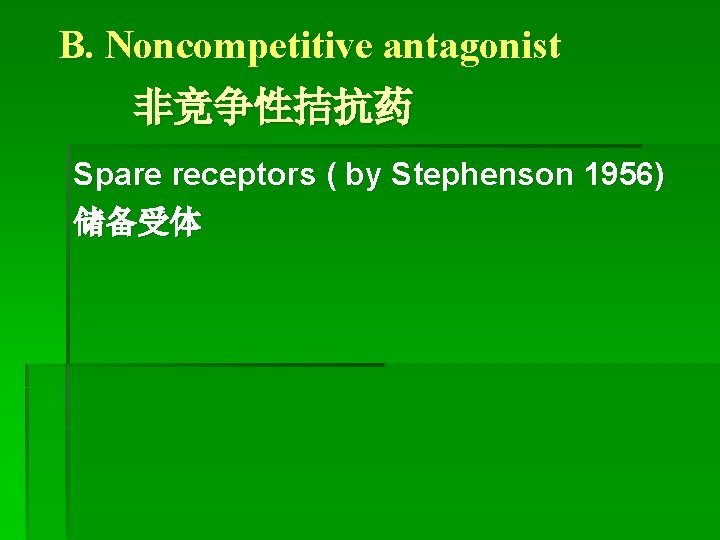
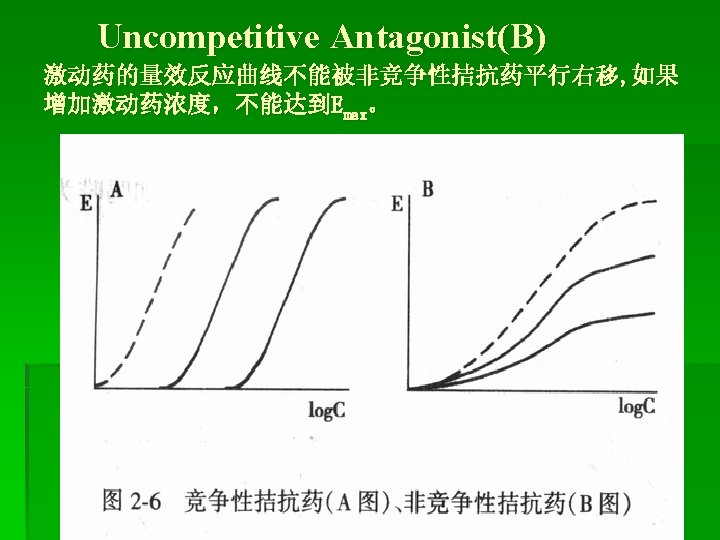
B. Noncompetitive antagonist 非竞争性拮抗药 Spare receptors ( by Stephenson 1956) 储备受体
5. The Types of Receptors According to protein structure, transmembrane signaling mechanisms, effect properties and sites of receptors, the classifications of receptors as follows:
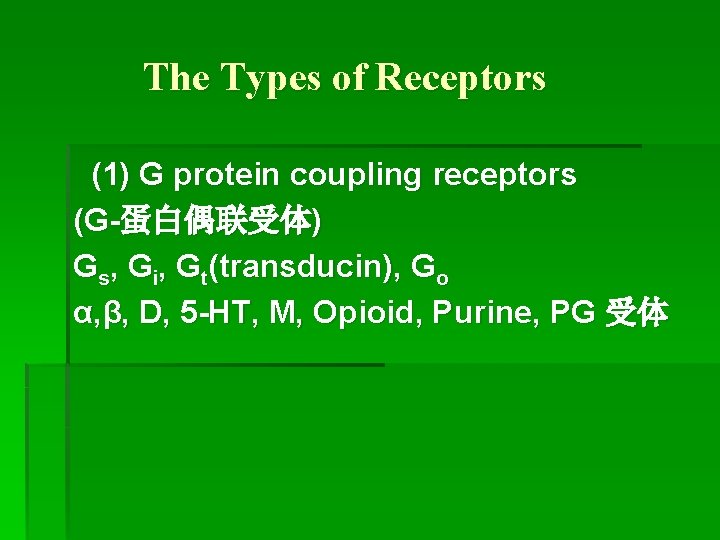
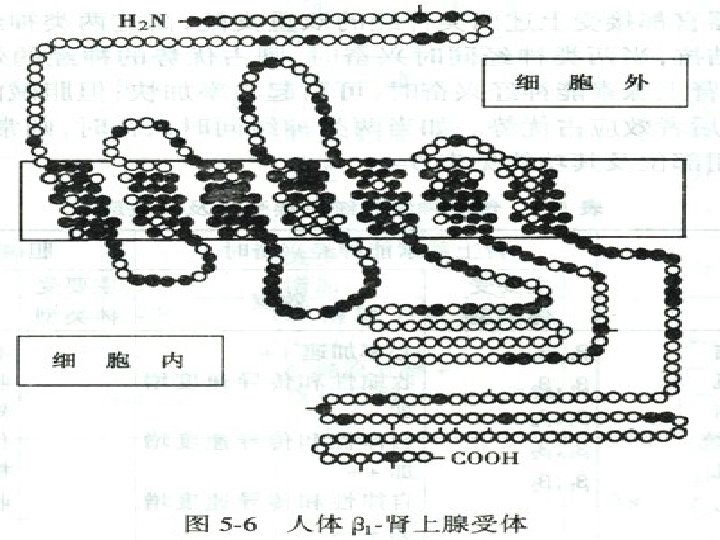
The Types of Receptors (1) G protein coupling receptors (G-蛋白偶联受体) Gs, Gi, Gt(transducin), Go α, β, D, 5 -HT, M, Opioid, Purine, PG 受体
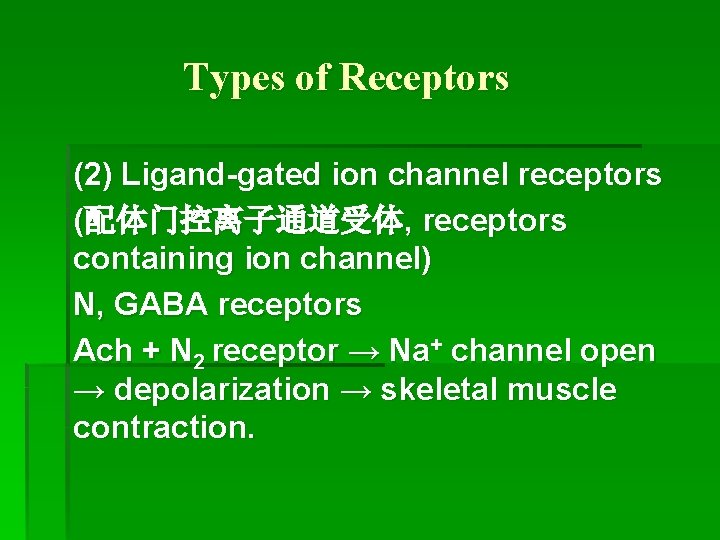
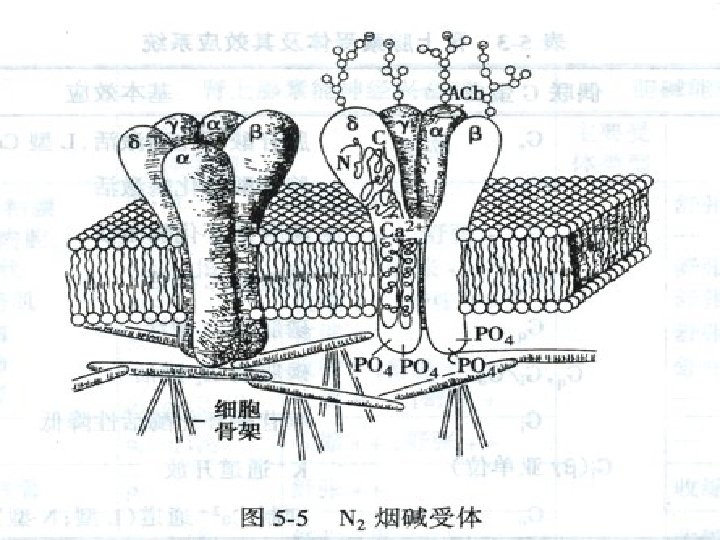
Types of Receptors (2) Ligand-gated ion channel receptors (配体门控离子通道受体, receptors containing ion channel) N, GABA receptors Ach + N 2 receptor → Na+ channel open → depolarization → skeletal muscle contraction.
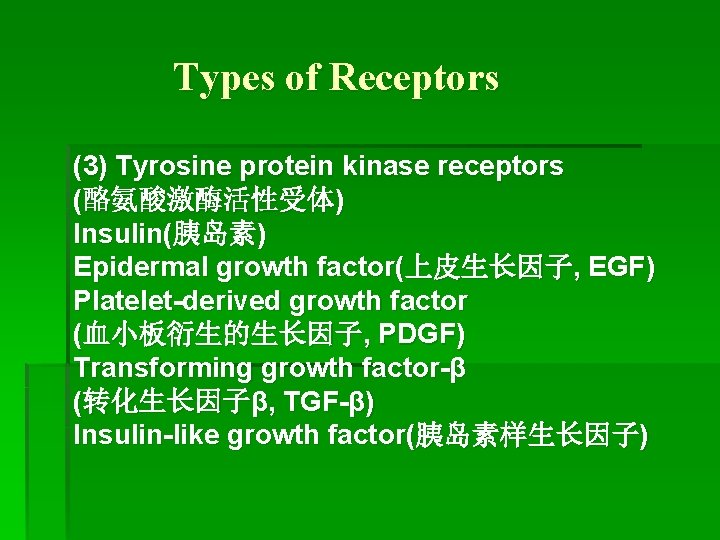
Types of Receptors (3) Tyrosine protein kinase receptors (酪氨酸激酶活性受体) Insulin(胰岛素) Epidermal growth factor(上皮生长因子, EGF) Platelet-derived growth factor (血小板衍生的生长因子, PDGF) Transforming growth factor-β (转化生长因子β, TGF-β) Insulin-like growth factor(胰岛素样生长因子)
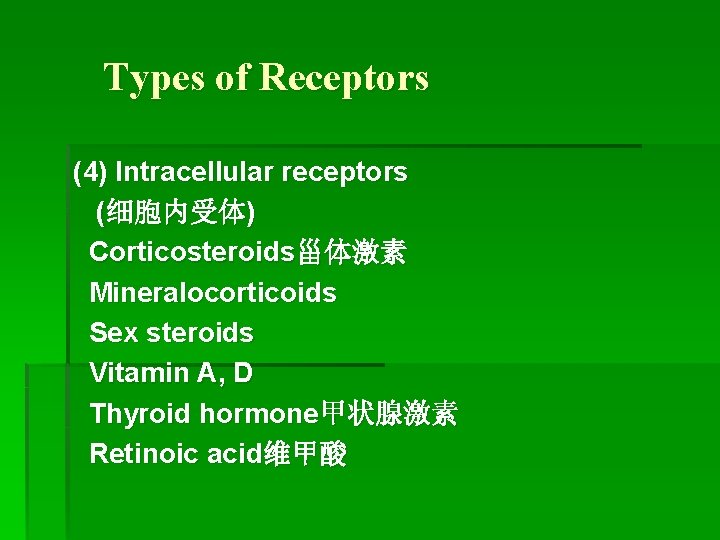
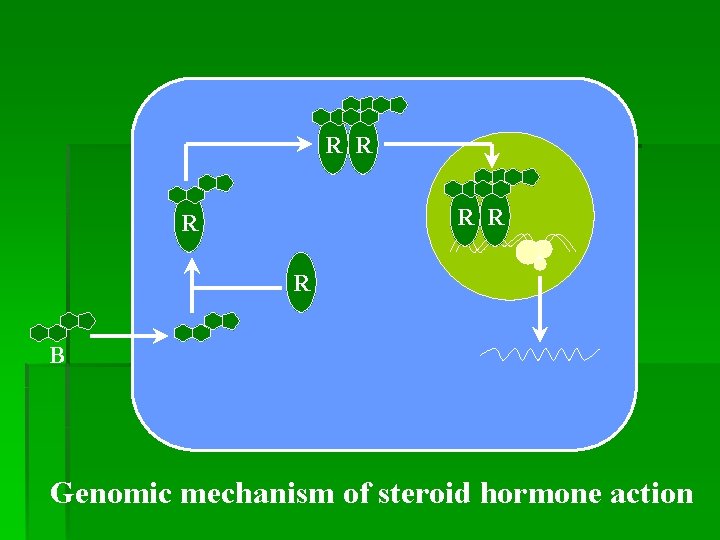
Types of Receptors (4) Intracellular receptors (细胞内受体) Corticosteroids甾体激素 Mineralocorticoids Sex steroids Vitamin A, D Thyroid hormone甲状腺激素 Retinoic acid维甲酸
R R R B Genomic mechanism of steroid hormone action
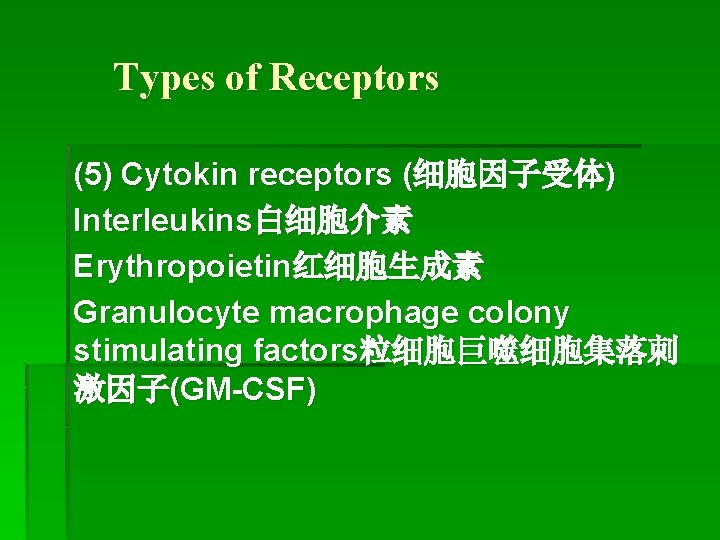
Types of Receptors (5) Cytokin receptors (细胞因子受体) Interleukins白细胞介素 Erythropoietin红细胞生成素 Granulocyte macrophage colony stimulating factors粒细胞巨噬细胞集落刺 激因子(GM-CSF)
Types of Receptors Granulocyte colony stimulating factors 粒细胞集落刺激因子(G-CSF) Prolactin催乳素 Lymphokines淋巴因子
See You !
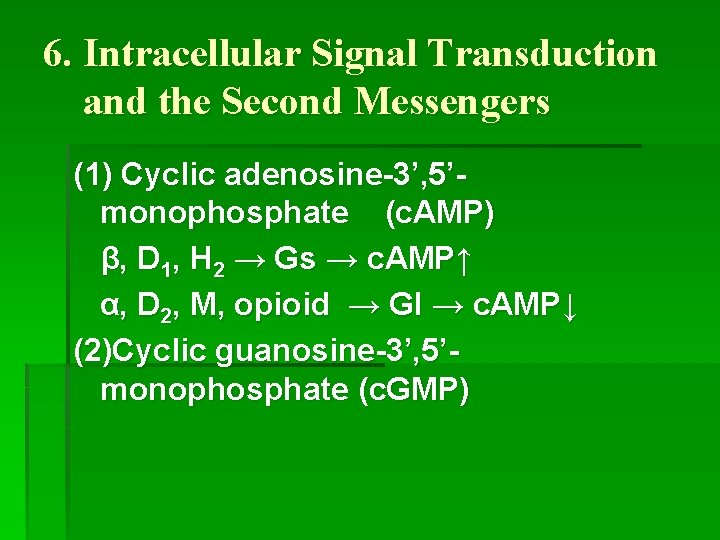
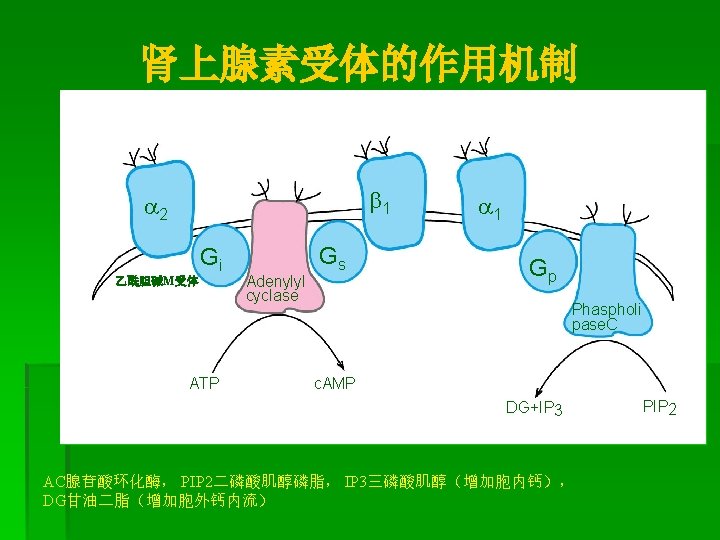
6. Intracellular Signal Transduction and the Second Messengers (1) Cyclic adenosine-3’, 5’monophosphate (c. AMP) β, D 1, H 2 → Gs → c. AMP↑ α, D 2, M, opioid → GI → c. AMP↓ (2)Cyclic guanosine-3’, 5’monophosphate (c. GMP)
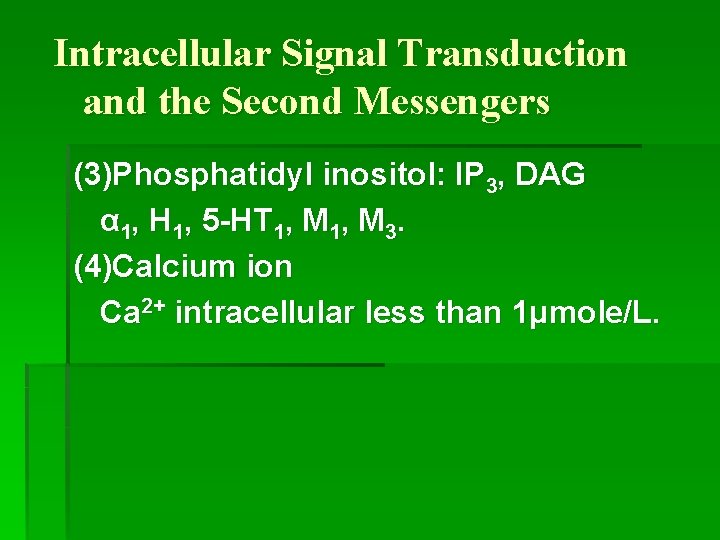
Intracellular Signal Transduction and the Second Messengers (3)Phosphatidyl inositol: IP 3, DAG α 1, H 1, 5 -HT 1, M 3. (4)Calcium ion Ca 2+ intracellular less than 1μmole/L.
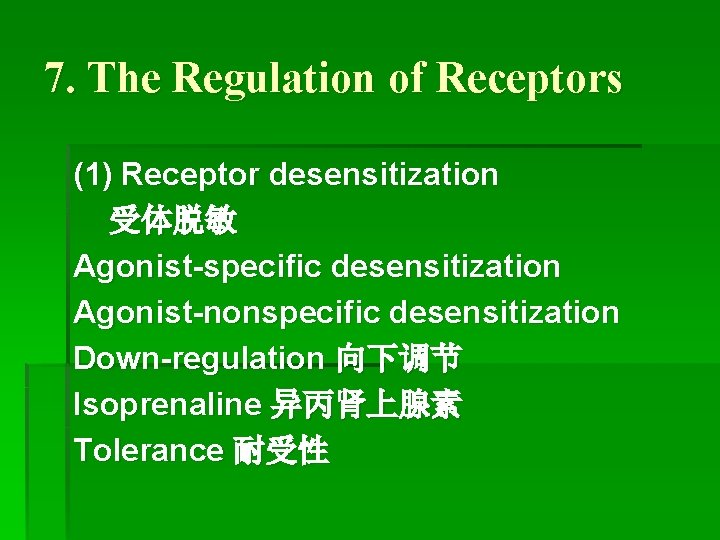
7. The Regulation of Receptors (1) Receptor desensitization 受体脱敏 Agonist-specific desensitization Agonist-nonspecific desensitization Down-regulation 向下调节 Isoprenaline 异丙肾上腺素 Tolerance 耐受性
The Regulation of Receptors (2) Receptor hypersensitivity 受体超敏 Up-regulation 向上调节 rebound 反跳 Propranolol普萘洛尔
Thank You !