
Welcome to P 4 PRIMARY 4 CURRICULUM INFO
- Slides: 20
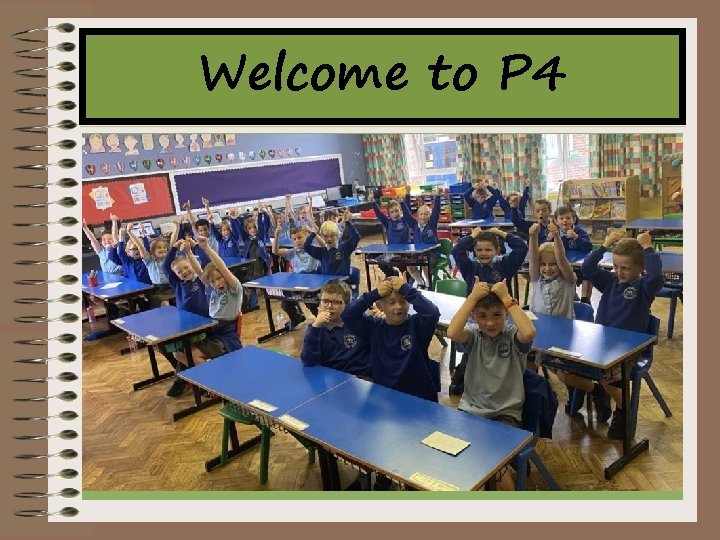
Welcome to P 4
PRIMARY 4 CURRICULUM INFO Ms Murray/Mrs Barr • • Key Stage One: Pupils needs across the class will be addressed and supported throughout year by teachers, classroom assistants and outside agencies (where appropriate). • All children will be encouraged to grow and develop in a positive learning environment where mistakes are addressed positively (the first step of learning) and risk taking is encouraged. • Positive attitudes and the power of ‘yet’
GENERAL INFORMATION • School starts at 8. 55 am and finishes at 3. 00 pm. • Formal learning will begin at 9 am. • Library books- Children may borrow books from class library. The books will be quarantined for 72 hours on return to school • P. E- Tuesday and Friday. Children should come to school in their P. E kits on these days.
CURRICULUM Areas of Learning • • Language and Literacy Mathematics and Numeracy The Arts (Art and Design, Drama and Music) The World Around Us (Geography, History and Science and Technology) • Physical Education • Personal Development and Mutual Understanding (PDMU) • R. E.
Literacy Skills • • • Talking and Listening – Develop vocabulary and language to express ideas and feelings in a range of contexts (extend sentences) – Be understood clearly in communicating ideas and ask and answer questions to enhance understanding (effective questioning) – Become confident in making contributions in group/paired work (roleplay/drama/poetry) Writing – Produce handwriting which is accurately formed and consistent – Use basic punctuation/grammar to express themselves and use dictionaries/thesaurus – Show confidence in talking and planning their own writing with structure (creative writing) – Spell and recognise a range of HFW/Sight words/topic words Reading – Read and recognise a wide range of texts and their many features (fiction/nonfiction) – See merit and enjoyment from reading both in shared/class and independent experiences (books can be fun) – Use a range of reading strategies to develop independence to include sequencing and recounting story events
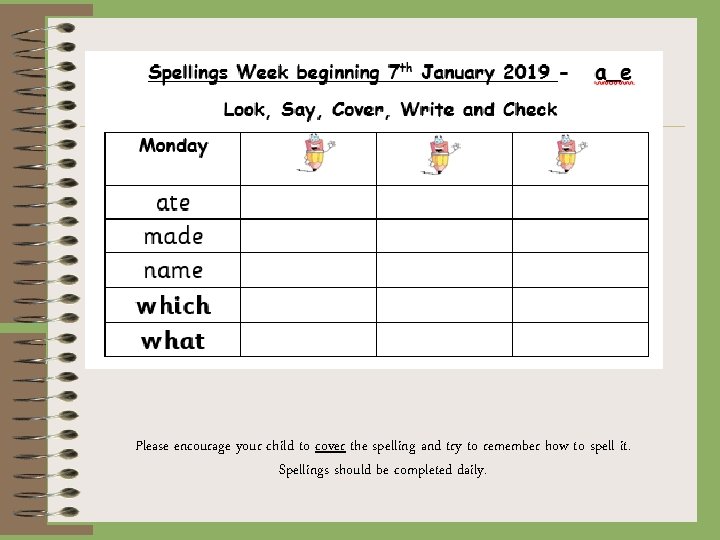
Please encourage your child to cover the spelling and try to remember how to spell it. Spellings should be completed daily.
Reading • Recognising key words • Apply phonics • Fluency • Understand what is read • Expression
AR and my. ON • Books may be read at home and AR quizzes can now be completed at home or in school. • my. On can be used freely at home. • Google search myon. co. uk • www. myon. co. uk (Ensure it is. co. uk and not. com) • Use AR details to log in
Numeracy Skills Numeracy addresses five attainment targets: • Processes – which incorporates mental arithmetic and problem solving • Number – addition, subtraction, multiplication, division, fractions and money • Measures – which includes time, length, capacity, mass (weight), area and perimeter • Shape and Space – properties of 2 D and 3 D shapes, symmetry, angles and direction • Data Handling – collecting and recording data using line graphs, block graphs, Carroll and Venn diagrams
Numeracy Skills Number, Patterns, Money and Operations – Patterns using odd and even numbers, number sequencing on a 100 square, missing numbers. Counting in 2’s, 5’s and 10’s. Identifying and being able to explain a range of patterns on a 100 square – Play board games!! – Place Value - understand how numbers are made up using tens and units. E. g. 27 = two tens and seven units/ones. – Know number bonds/facts to 20. See patterns in numbers e. g. if 4 + 6 = 10 then 4 + 16 = 20 if 10 - 8 = 2 then 20 - 8 = 12 – Addition and subtraction within 100. Count on and backwards accurately – Times Tables – 2, 5 and 10 – Recognise coins and use money in real life practical situations – making totals and finding change – Reasoning – ask your child how they got the answer! Lots of children will say ‘I just know’ They need to explain the process.
Numeracy Skills • Shape and Space – Identifying properties/features of 2 D/3 D shapes in classroom and all around them • Measures – Use a range of standard and non standard units to measure with weight, capacity, length e. g. cups, cubes, centimetres/ litres/kilograms (estimation) – Develop telling the time both analogue and digital – Know the months, days and seasons of the year using a calendar accurately – *Children can wear a watch to school, as long as it aids learning and is not a distraction.
Numeracy Skills Handling Data – Collect information and record results using tally tables, block graphs/pictograms/bar graphs (own class) – Sort and classify objects for two criteria using Venn, Carroll and Tree diagrams Skills developed • Improve number/problem solving skills with mental maths strategies (making numbers enjoyable and fun helping build independence) • Developing awareness of mathematics in everyday life (money, shapes, adding) • Using and developing mathematical language about their work (sum, total, altogether) • Recognising patterns and relationships with numbers and begin to estimate/calculate • Check over work and begin to self evaluate and self-correct
U. I. C. T (Using Information and Communication Technology) and Digital Media Each pupil will perform a set of tasks to help thinking skills and independence taking skills beyond the classroom. . . This will include the following 5 areas • Exploring – gathering together information pictures, words and sounds for topics • Express – plan a simple poster, invitation or presentation and include voice over, text and images • Exchange – communicating digitally through internet • Evaluate – reviewing work and make changes to improve • Exhibit – showcase and save their work using ICT responsibly
W. A. U (World Around Us) World Around Us is taught through a topic-based approach in KS 1. The children will be provided with opportunities to: - v Investigate v Explore v Empathise and examine v Record and collect information Our topic for this term is ‘Tree-mendous Rainforests’.
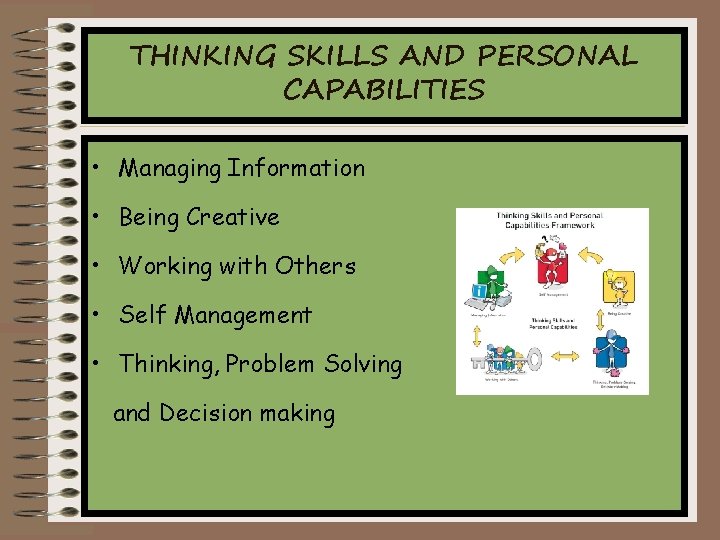
THINKING SKILLS AND PERSONAL CAPABILITIES • Managing Information • Being Creative • Working with Others • Self Management • Thinking, Problem Solving and Decision making
Personal Development and Mutual Understanding (PDMU) • • • Feelings and emotions Developing self-esteem Effective learning strategies Health and safety Friendships Rules, rights and responsibilities Approaches to conflict Cultural diversity Community and environment • Self confidence and self esteem are paramount. We use a range of rewards and incentives to develop your child’s attitude towards leaning and encourage them to be independent learners.
ASSESSMENT FOR LEARNING • Learning Intentions • Success Criteria • Feedback – Oral/Written • Peer Assessment • Self assessment
CLASSROOM RULES (Rewards and Incentives) • Classroom Rules – devised and agreed by children • Incentives/ Rewards/Consequences • Staff at Portstewart Primary are keen to ensure high levels of behaviour and manners across the school. This is to ensure your child is safe and happy at school. • Please do not say to your child that they can not sit beside or talk to another child. It is very difficult in the classroom environment. We need to teach strategies to deal with issues. Children can be the best of friends all day, have a 30 second fallout but that will be the part of the day they remember most. If you have concerns please contact the school.
Homework in KS 1 Keep it positive! Get into a routine! Use phrases like ‘Lets do our homework then we can…’ • 2 written pieces of homework on Seesaw per week (Mon and Wed) – signed please. (Please encourage your child to be independent) • Reading – daily. 1 reading scheme book, 1 assigned my. ON book and a library book per week. • Spellings –Spelling book to be completed Mon- Wed, revision of week’s spellings on Thursday. Seesaw spelling activities. • Number Facts– Booklet to be completed Monday – Wednesday. Thursday is revision. Test on a Friday. • Library / my. ON – Accelerated Reader quizzes may be completed at home independently or in school.
OTHER POINTS • Attendance- please follow guidance • PE/Homework – notes if not completed • Permission slips returned to class teacher • Reading books – £ 5 for lost books • School dinners- £ 2. 65 • Thank you for your support!