
Welcome to our Prep Information Session College Values

- Slides: 23
Welcome to our Prep Information Session
College Values Our college values are based on Values for Australian Schooling - Care and Compassion, Doing your best, Fair go, Freedom, Honesty and Trustworthiness, Integrity, Respect, Responsibility and Understanding, Tolerance and Inclusion. From these values our college focuses on acronym ‘TRUTH’ which stands for: T Tolerance R Respect U Understanding T Trustworthiness H Honesty
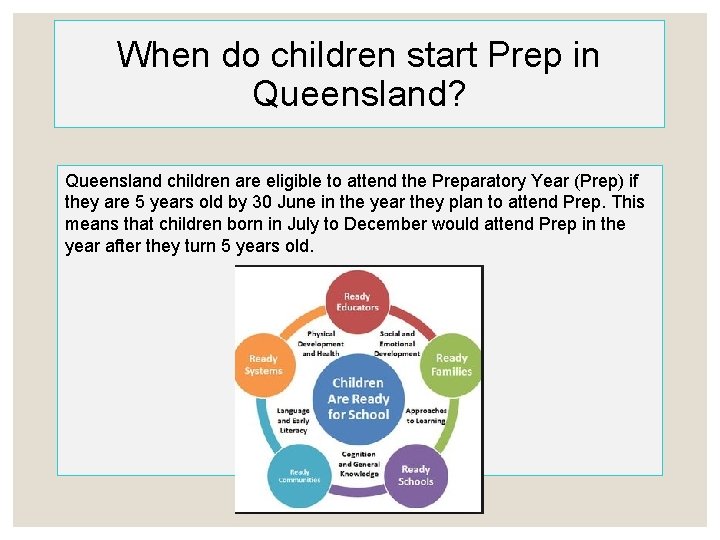
When do children start Prep in Queensland? Queensland children are eligible to attend the Preparatory Year (Prep) if they are 5 years old by 30 June in the year they plan to attend Prep. This means that children born in July to December would attend Prep in the year after they turn 5 years old.
School Readiness ‘School readiness’ is a measure of the knowledge, skills and behaviours that enable children to participate and succeed in school.
ICB Prep Readiness Assessment The purpose of our Prep Readiness test is to give parents and teachers insight as to whether a child is ready to start Prep. We also consider the following aspects: ◦ Physical readiness: Self-sufficient (i. e. toileting, organising belongings, feeding) ◦ Emotional readiness: Separation anxiety, self-soothing behaviours ◦ Social readiness: Socialise and play with their classmates (i. e. take turns, share, compromise and group work) ◦ Academic readiness: Although children do not need to be able to read and write in order to start Prep, We look at whether a child has early skills in alphabet and a general number sense. We also look at whether a child can do things like hold a pencil and use scissors. ◦ Concentration: A child needs to be able to focus on activities for extended period of time. We look at whether a child can sustain concentration on table activities and at mat time. ◦ Language skills: A child needs to understand be able to communicate with teachers and peers as well as follow instructions and directions. We look at whether a child is able to follow three step instructions (e. g. ‘go to the toilet, wash your hands and get your lunch’).
Preparing for Prep: How can I make the Transition Easier? Ensure your child attends a Kindergarten with a Kindergarten Approved Program. Why should my child attend Kindergarten? Kindergarten introduces students to the notion of ‘playing school’. It teaches students basic classroom routines and thus prepares them better for the transition to Prep (i. e. following directions, sitting on the carpet, raising their hand, sharing). Kindergarten as well exposes students to letter and sound connections, numbers and counting and in some cases beginning reading skills.
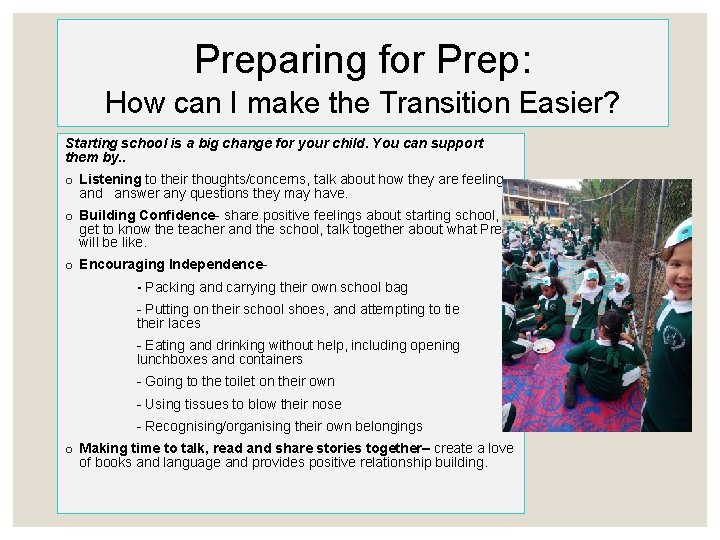
Preparing for Prep: How can I make the Transition Easier? Starting school is a big change for your child. You can support them by. . o Listening to their thoughts/concerns, talk about how they are feeling and answer any questions they may have. o Building Confidence- share positive feelings about starting school, get to know the teacher and the school, talk together about what Prep will be like. o Encouraging Independence- Packing and carrying their own school bag - Putting on their school shoes, and attempting to tie their laces - Eating and drinking without help, including opening lunchboxes and containers - Going to the toilet on their own - Using tissues to blow their nose - Recognising/organising their own belongings o Making time to talk, read and share stories together– create a love of books and language and provides positive relationship building.
Preparing for Prep: How can I make the Transition Easier? ◦ Reading is essential for development of student vocabulary, concentration, stimulates creativity and initiates a love of literature. ◦ Visiting your local library encourages reading in your home and introduces a variety of text types. ◦ Logan City Council Library ◦ Brisbane City Libraries
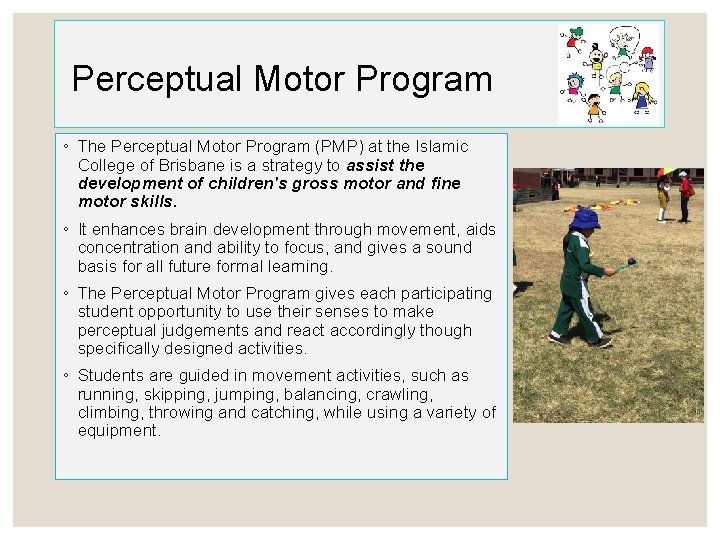
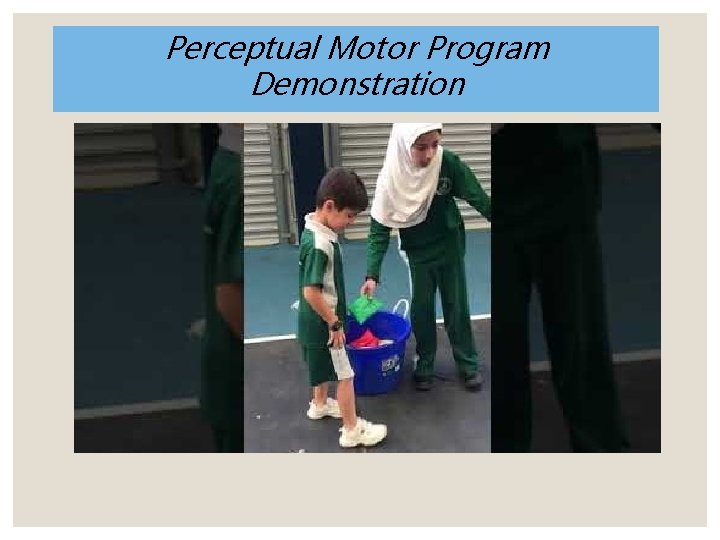
Perceptual Motor Program ◦ The Perceptual Motor Program (PMP) at the Islamic College of Brisbane is a strategy to assist the development of children's gross motor and fine motor skills. ◦ It enhances brain development through movement, aids concentration and ability to focus, and gives a sound basis for all future formal learning. ◦ The Perceptual Motor Program gives each participating student opportunity to use their senses to make perceptual judgements and react accordingly though specifically designed activities. ◦ Students are guided in movement activities, such as running, skipping, jumping, balancing, crawling, climbing, throwing and catching, while using a variety of equipment.
Developing Perceptual Motor Skills ◦ Gross Motor Skills- walking, running, jumping, skipping, balancing, climbing and moving in and out of positions. ◦ Fine Motor Skills- performing refined tasks, isolating various fingers, using tools, copying precise actions without overflow. ◦ Body and Space Awareness- concepts such as behind, between, backwards, forwards and up/down. Demonstrating understanding of their body and how their body can perform controlled movements. ◦ Visual and Spatial Skills- track objects with their eyes, fingers, and feet in all directions, match shapes and copy patterns. ◦ Rhythm Sequence, Memory and Listening-clapping to rhythms, fast vs slow movements, counting claps, steps, jumps, etc.
Perceptual Motor Program Demonstration
Key Learning Areas ◦ English ◦ Mathematics ◦ Science ◦ Humanities and Social Sciences ◦ Health and Physical Education ◦ Digital and Design Technologies ◦ The Arts ◦ Languages – Arabic ◦ Islamic Studies
Homework ◦ Term 1 - Read With Me Packs ◦ Please read the picture book each night with your child and complete the activities. ◦ Term 1 – 4 Rainbow Words ◦ Rainbow Words books contain alphabet sheets and progress into sight words ◦ Revise the letters by name and sound. ◦ Term 2 - 4 Literacy Planet and Math. Seeds (Online) & Home Readers ◦ Class teachers be set online activities that consolidate ◦ Home Readers are sent home weekly and should be read as frequently as possible ◦ Teachers may send home paper homework as well this is up to teacher discretion and the skills students need improvement on ◦ You are encouraged to help your child but please do not complete their homework for them, homework is set to revise their understanding of concepts taught in the classroom
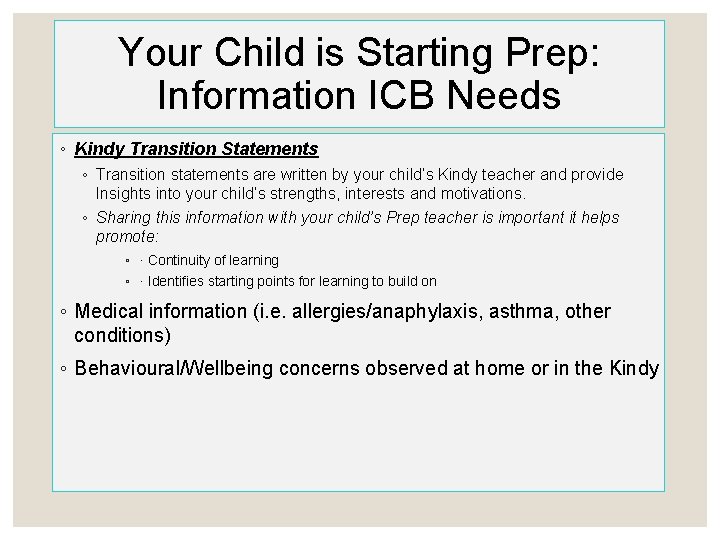
Your Child is Starting Prep: Information ICB Needs ◦ Kindy Transition Statements ◦ Transition statements are written by your child’s Kindy teacher and provide Insights into your child’s strengths, interests and motivations. ◦ Sharing this information with your child’s Prep teacher is important it helps promote: ◦ · Continuity of learning ◦ · Identifies starting points for learning to build on ◦ Medical information (i. e. allergies/anaphylaxis, asthma, other conditions) ◦ Behavioural/Wellbeing concerns observed at home or in the Kindy
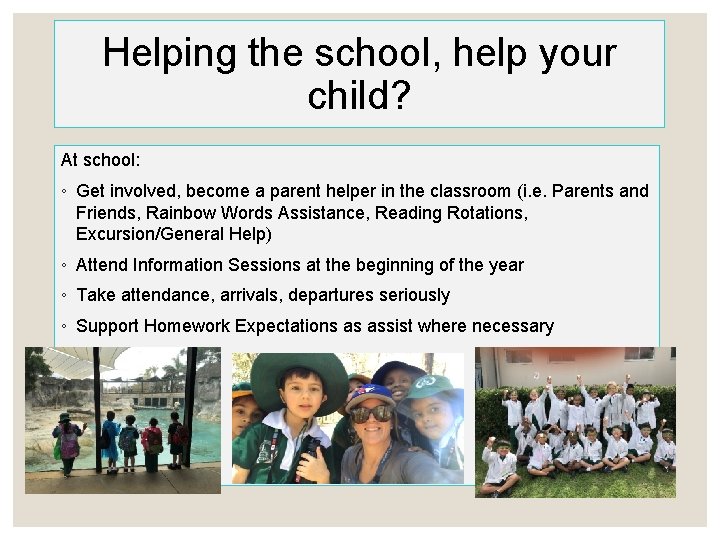
Helping the school, help your child? At school: ◦ Get involved, become a parent helper in the classroom (i. e. Parents and Friends, Rainbow Words Assistance, Reading Rotations, Excursion/General Help) ◦ Attend Information Sessions at the beginning of the year ◦ Take attendance, arrivals, departures seriously ◦ Support Homework Expectations as assist where necessary
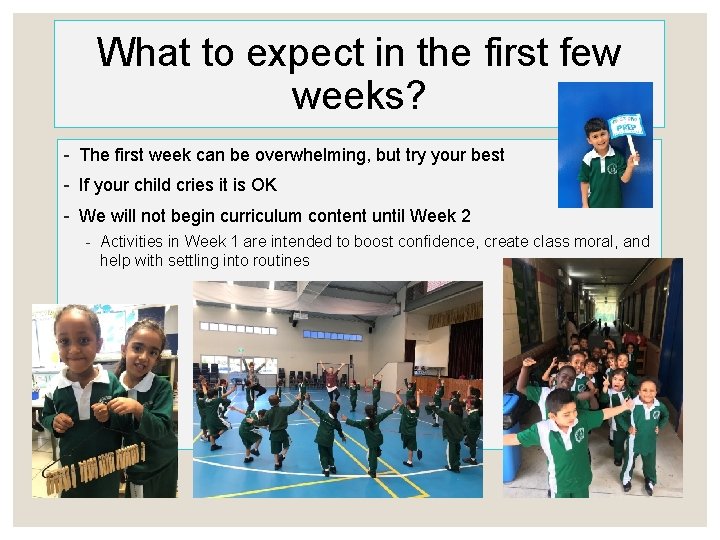
What to expect in the first few weeks? - The first week can be overwhelming, but try your best - If your child cries it is OK - We will not begin curriculum content until Week 2 - Activities in Week 1 are intended to boost confidence, create class moral, and help with settling into routines
Separation Anxiety Separation anxiety in children is when children fear being parted from their parents or carers. It’s common and normal among babies and toddlers. A few pre-schoolers and school-age children develop a more serious form of the condition, called separation anxiety disorder.
Strategies to deal Separation Anxiety For children with normal separation anxiety, there are steps you can take to make the process of separation anxiety easier. ◦ Practice separation: Leave your child with a caregiver for brief periods and short distances at first. As your child gets used to separation, you can gradually leave for longer and travel further. ◦ Schedule separations after naps or feedings: Babies are more susceptible to separation anxiety when they’re tired or hungry. ◦ Develop a quick “goodbye” ritual: Rituals are reassuring and can be as simple as a special wave through the window or a goodbye kiss. Keep things quick, though, so you can: ◦ Leave without fanfare: Tell your child you are leaving and that you will return, then go—don’t stall or make it a bigger deal than it is.
Strategies to deal Separation Anxiety ◦ Follow through on promises: For your child to develop the confidence that they can handle separation, it’s import you return at the time you promised. ◦ Keep familiar surroundings when possible and make new surroundings familiar: Have the sitter come to your house. When your child is away from home, encourage them to bring a familiar object. ◦ Have a consistent primary caregiver: If you hire a caregiver, try to keep them on the job long term to avoid inconsistency in your child’s life. ◦ Minimize scary television: Your child is less likely to be fearful if the shows you watch are not frightening. ◦ Try not to give in: Reassure your child that they will be just fine—setting consistent limits will help your child’s adjustment to separation.
Enrolment Process Please refer to our website.
Before & After school Care All parents are required to register online with Camp Australia ◦ Before School Care Times: 6: 30 am to 8: 15 am ◦ After School Care Times: 3: 10 pm to 6: 00 pm In order to use the service, parents are required to: ◦ Book 7 days prior to the scheduled date of attendance ◦ For emergencies parents can make a booking through their parent portal or by calling 1300 105 343
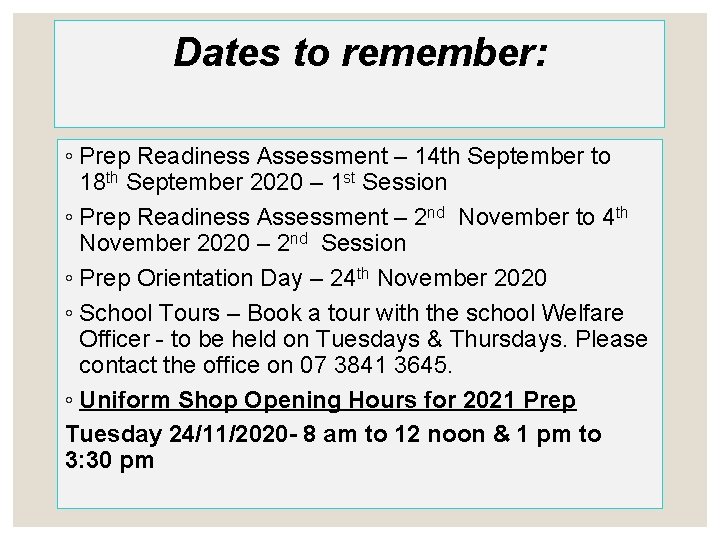
Dates to remember: ◦ Prep Readiness Assessment – 14 th September to 18 th September 2020 – 1 st Session ◦ Prep Readiness Assessment – 2 nd November to 4 th November 2020 – 2 nd Session ◦ Prep Orientation Day – 24 th November 2020 ◦ School Tours – Book a tour with the school Welfare Officer - to be held on Tuesdays & Thursdays. Please contact the office on 07 3841 3645. ◦ Uniform Shop Opening Hours for 2021 Prep Tuesday 24/11/2020 - 8 am to 12 noon & 1 pm to 3: 30 pm
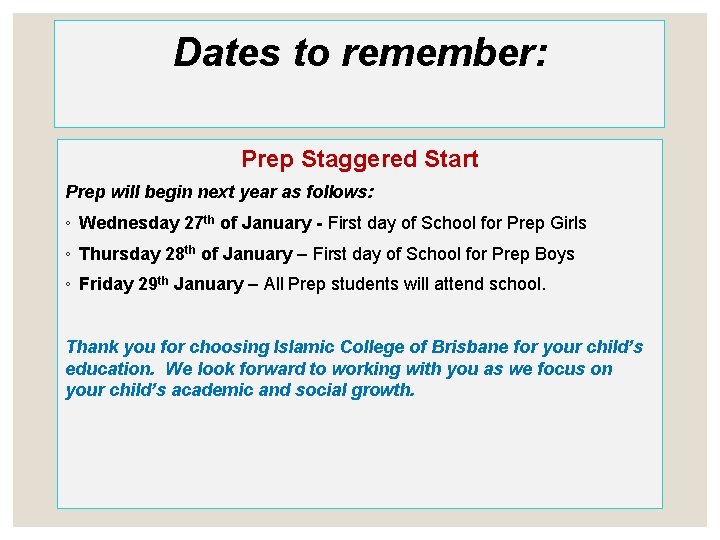
Dates to remember: Prep Staggered Start Prep will begin next year as follows: ◦ Wednesday 27 th of January - First day of School for Prep Girls ◦ Thursday 28 th of January – First day of School for Prep Boys ◦ Friday 29 th January – All Prep students will attend school. Thank you for choosing Islamic College of Brisbane for your child’s education. We look forward to working with you as we focus on your child’s academic and social growth.