
Welcome to Organizational Development Change Maritza R Salazar

- Slides: 40
Welcome to Organizational Development & Change! Maritza R. Salazar, Ph. D. n Course is about how to facilitate, lead, and manage change. n ¨ Change can be self-initiated ¨ Change can be forced upon us ¨ Change can bring threats ¨ Change can lead to opportunities! 1 -1
My Teaching Approach Establish learning objects n Provide you with useful information n Challenge you to facilitate your own learning n To have fun as we learn n Be available to you if you need assistance n 1 -2
Methods to Foster Learning Lecture n Exercises n Videos n Cases n Guest Speakers n Group Project n Cummings & Worley 9 e, (c) 2008 South-Western/Cengage Learning 1 -3
Today’s Agenda n Part I ¨ Organizational Development & Change Course overview: The Open Systems Model n Course mechanics n Getting to know one another n ¨ Strategies n n for case analysis United 173 Part II ¨ Group dynamics 1 -4
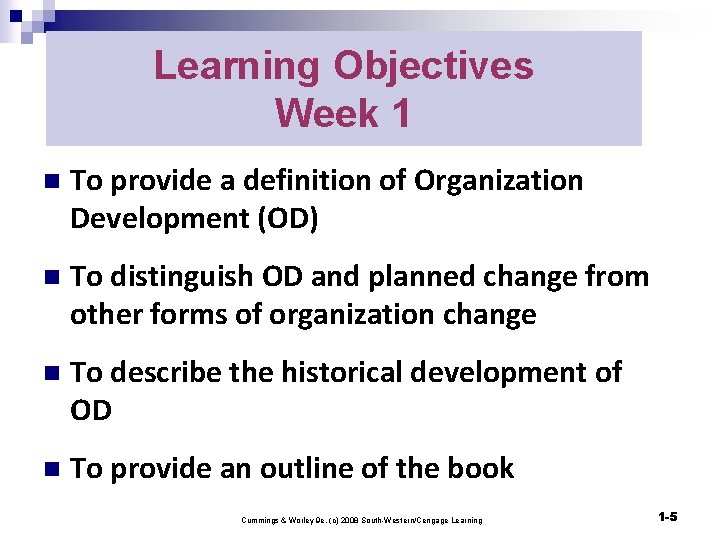
Learning Objectives Week 1 n To provide a definition of Organization Development (OD) n To distinguish OD and planned change from other forms of organization change n To describe the historical development of OD n To provide an outline of the book Cummings & Worley 9 e, (c) 2008 South-Western/Cengage Learning 1 -5
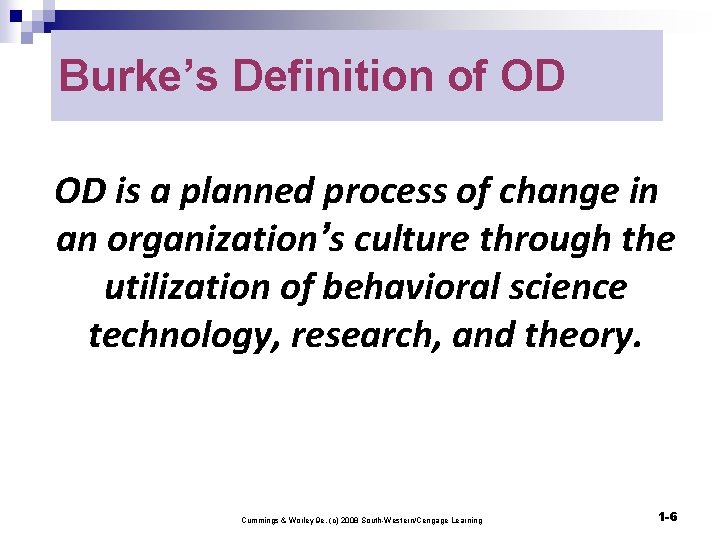
Burke’s Definition of OD OD is a planned process of change in an organization’s culture through the utilization of behavioral science technology, research, and theory. Cummings & Worley 9 e, (c) 2008 South-Western/Cengage Learning 1 -6
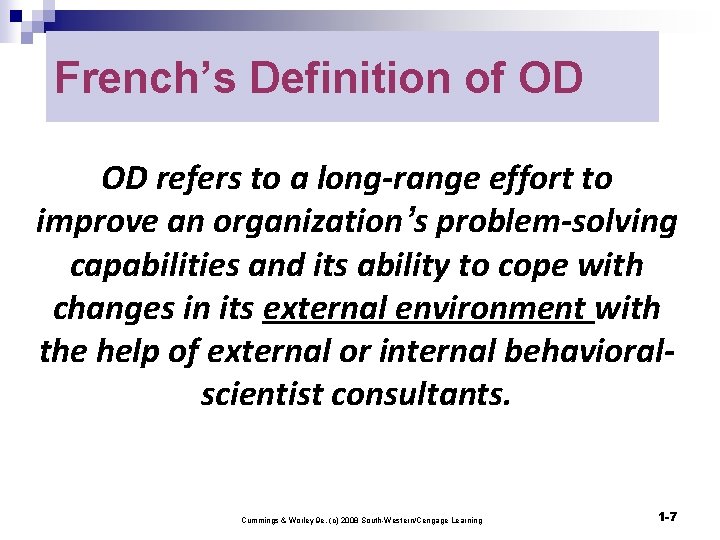
French’s Definition of OD OD refers to a long-range effort to improve an organization’s problem-solving capabilities and its ability to cope with changes in its external environment with the help of external or internal behavioralscientist consultants. Cummings & Worley 9 e, (c) 2008 South-Western/Cengage Learning 1 -7
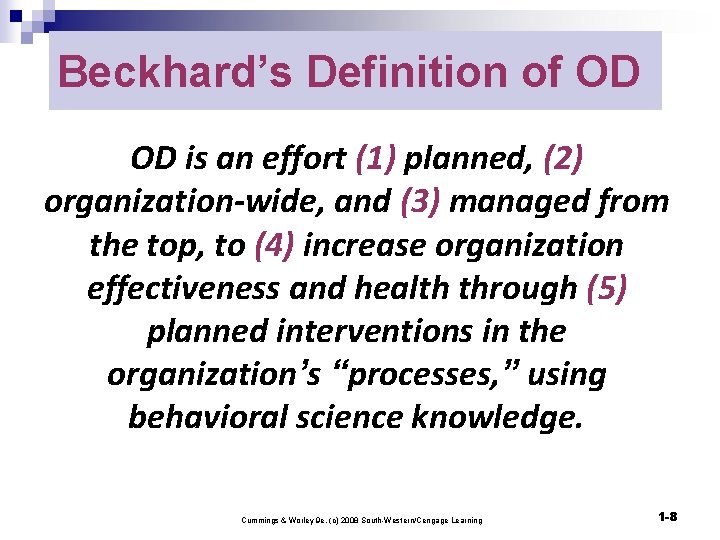
Beckhard’s Definition of OD OD is an effort (1) planned, (2) organization-wide, and (3) managed from the top, to (4) increase organization effectiveness and health through (5) planned interventions in the organization’s “processes, ” using behavioral science knowledge. Cummings & Worley 9 e, (c) 2008 South-Western/Cengage Learning 1 -8
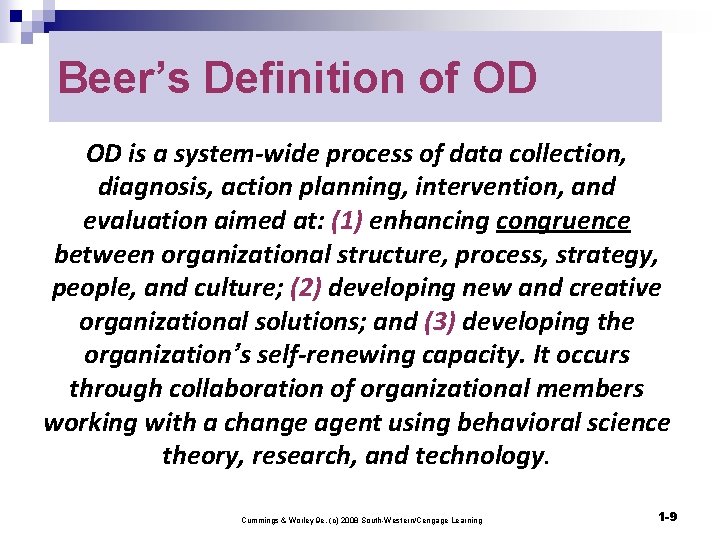
Beer’s Definition of OD OD is a system-wide process of data collection, diagnosis, action planning, intervention, and evaluation aimed at: (1) enhancing congruence between organizational structure, process, strategy, people, and culture; (2) developing new and creative organizational solutions; and (3) developing the organization’s self-renewing capacity. It occurs through collaboration of organizational members working with a change agent using behavioral science theory, research, and technology. Cummings & Worley 9 e, (c) 2008 South-Western/Cengage Learning 1 -9
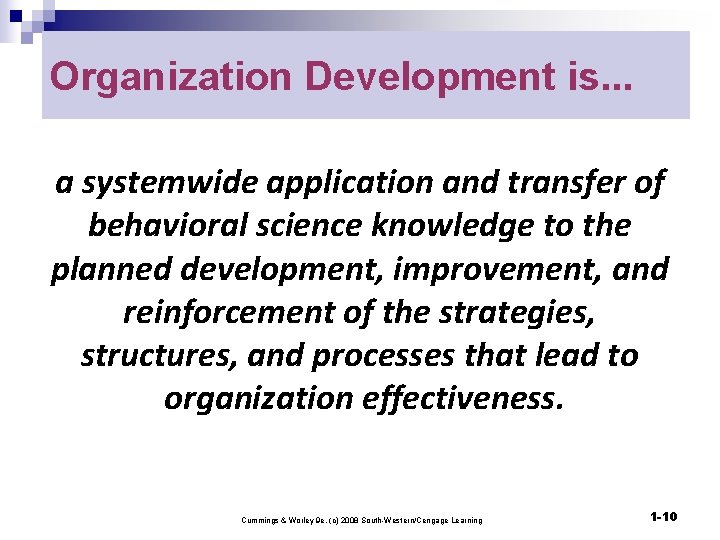
Organization Development is. . . a systemwide application and transfer of behavioral science knowledge to the planned development, improvement, and reinforcement of the strategies, structures, and processes that lead to organization effectiveness. Cummings & Worley 9 e, (c) 2008 South-Western/Cengage Learning 1 -10
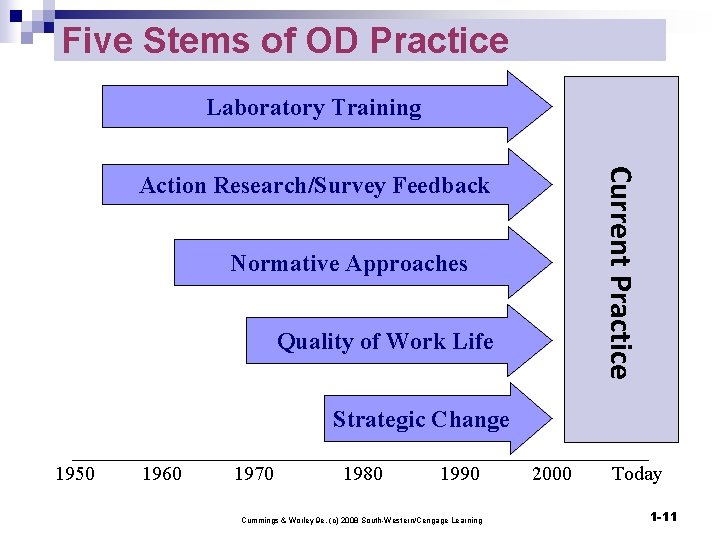
Five Stems of OD Practice Laboratory Training Current Practice Action Research/Survey Feedback Normative Approaches Quality of Work Life Strategic Change 1950 1960 1970 1980 1990 Cummings & Worley 9 e, (c) 2008 South-Western/Cengage Learning 2000 Today 1 -11
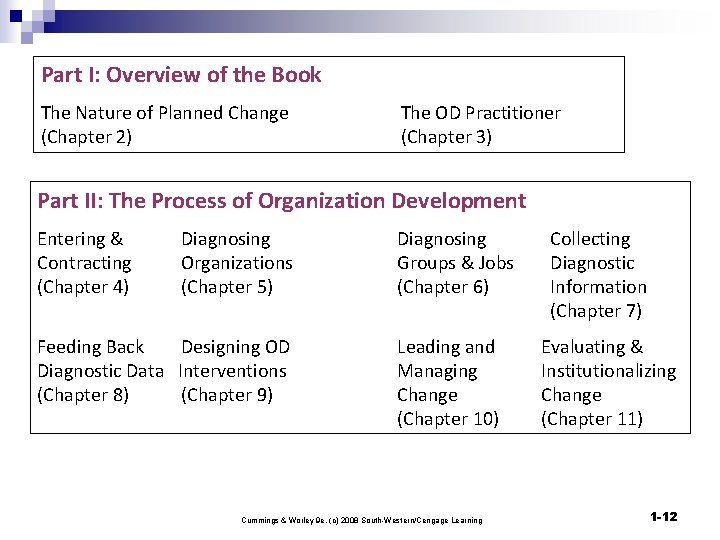
Part I: Overview of the Book The Nature of Planned Change (Chapter 2) The OD Practitioner (Chapter 3) Part II: The Process of Organization Development Entering & Contracting (Chapter 4) Diagnosing Organizations (Chapter 5) Feeding Back Designing OD Diagnostic Data Interventions (Chapter 8) (Chapter 9) Diagnosing Groups & Jobs (Chapter 6) Leading and Managing Change (Chapter 10) Cummings & Worley 9 e, (c) 2008 South-Western/Cengage Learning Collecting Diagnostic Information (Chapter 7) Evaluating & Institutionalizing Change (Chapter 11) 1 -12
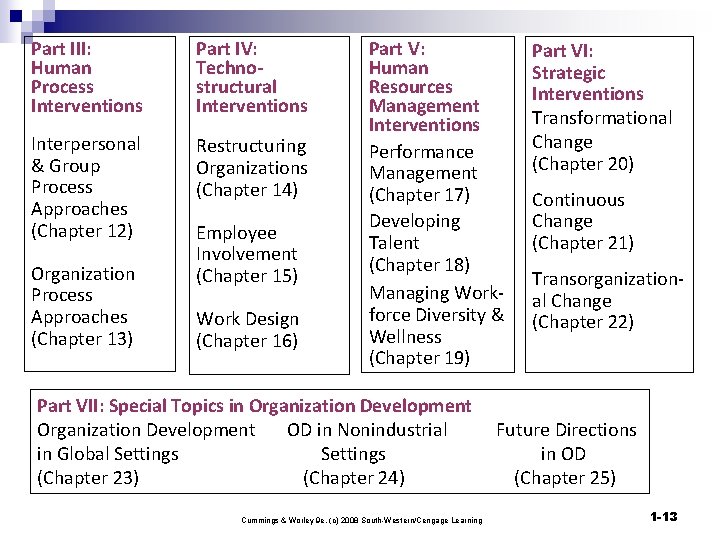
Part III: Human Process Interventions Part IV: Technostructural Interventions Interpersonal & Group Process Approaches (Chapter 12) Restructuring Organizations (Chapter 14) Organization Process Approaches (Chapter 13) Employee Involvement (Chapter 15) Work Design (Chapter 16) Part V: Human Resources Management Interventions Performance Management (Chapter 17) Developing Talent (Chapter 18) Managing Workforce Diversity & Wellness (Chapter 19) Part VII: Special Topics in Organization Development OD in Nonindustrial in Global Settings (Chapter 23) (Chapter 24) Cummings & Worley 9 e, (c) 2008 South-Western/Cengage Learning Part VI: Strategic Interventions Transformational Change (Chapter 20) Continuous Change (Chapter 21) Transorganizational Change (Chapter 22) Future Directions in OD (Chapter 25) 1 -13
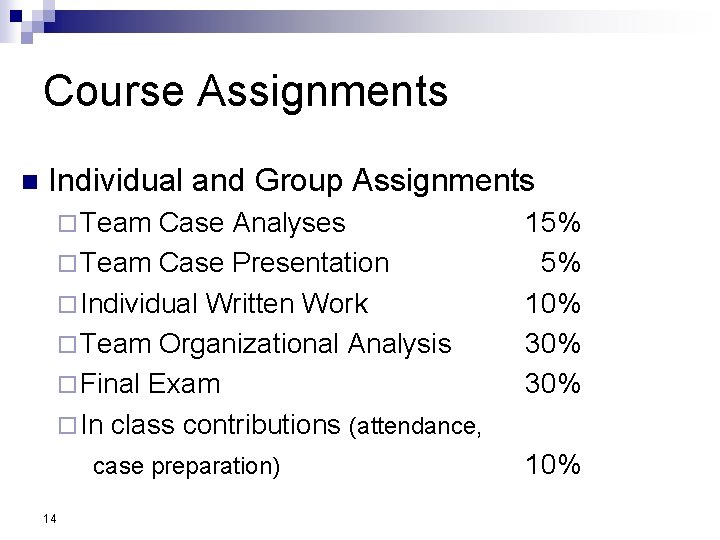
Course Assignments n Individual and Group Assignments ¨ Team Case Analyses ¨ Team Case Presentation ¨ Individual Written Work ¨ Team Organizational Analysis ¨ Final Exam ¨ In class contributions (attendance, case preparation) 14 15% 5% 10% 30% 10%
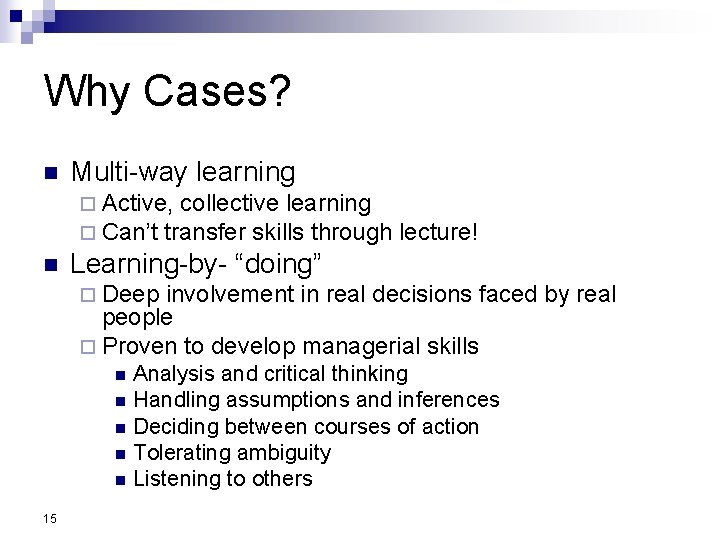
Why Cases? n Multi-way learning ¨ Active, collective learning ¨ Can’t transfer skills through n lecture! Learning-by- “doing” ¨ Deep involvement in real decisions faced by real people ¨ Proven to develop managerial skills n n n 15 Analysis and critical thinking Handling assumptions and inferences Deciding between courses of action Tolerating ambiguity Listening to others
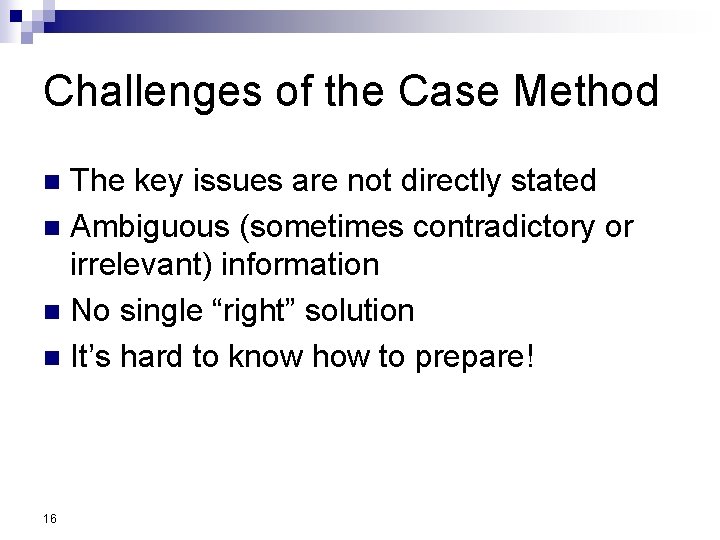
Challenges of the Case Method The key issues are not directly stated n Ambiguous (sometimes contradictory or irrelevant) information n No single “right” solution n It’s hard to know how to prepare! n 16
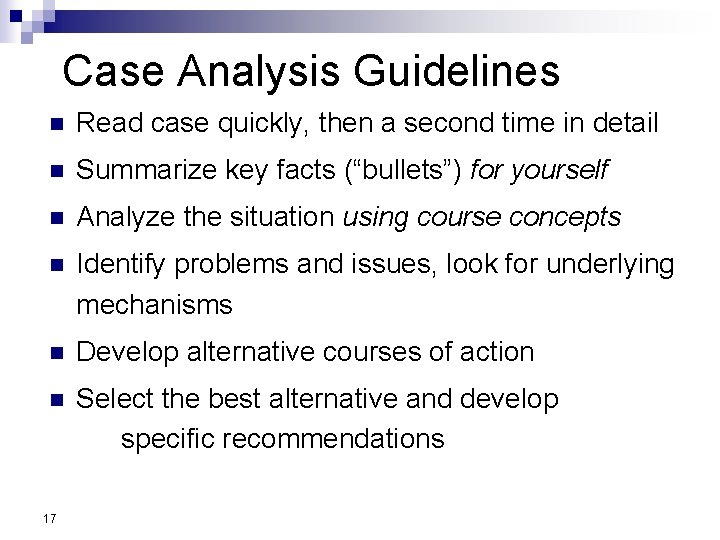
Case Analysis Guidelines n Read case quickly, then a second time in detail n Summarize key facts (“bullets”) for yourself n Analyze the situation using course concepts n Identify problems and issues, look for underlying mechanisms n Develop alternative courses of action n Select the best alternative and develop specific recommendations 17
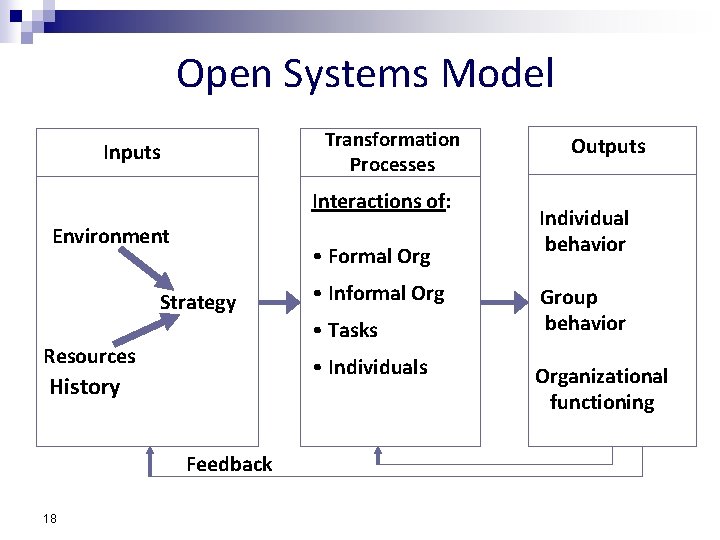
Open Systems Model Transformation Processes Inputs Interactions of: Environment • Formal Org Strategy • Tasks Resources • Individuals History Feedback 18 • Informal Org Outputs Individual behavior Group behavior Organizational functioning
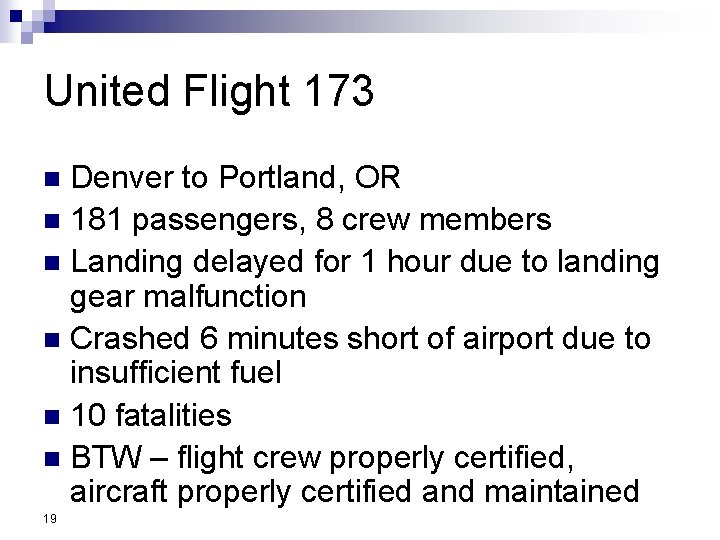
United Flight 173 Denver to Portland, OR n 181 passengers, 8 crew members n Landing delayed for 1 hour due to landing gear malfunction n Crashed 6 minutes short of airport due to insufficient fuel n 10 fatalities n BTW – flight crew properly certified, aircraft properly certified and maintained n 19
United Flight 173 n 20 What are the main reasons the cockpit crew allowed the aircraft to run out of fuel?
21
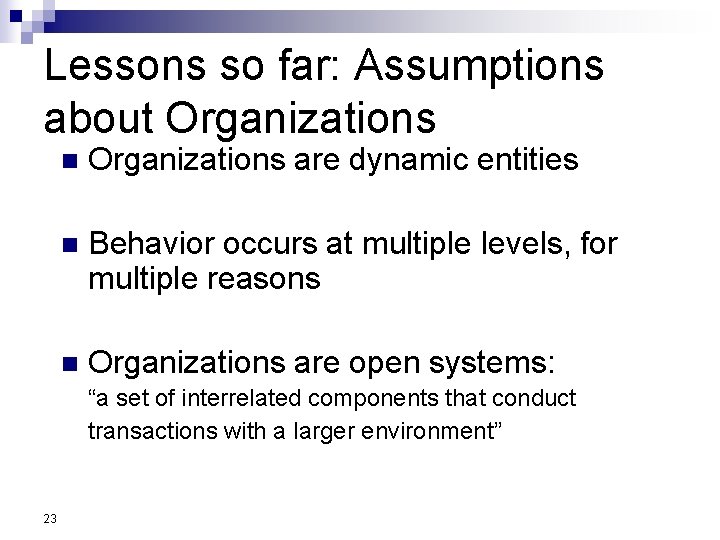
Lessons so far: Assumptions about Organizations n Organizations are dynamic entities n Behavior occurs at multiple levels, for multiple reasons n Organizations are open systems: “a set of interrelated components that conduct transactions with a larger environment” 23
Organization Development and Change The Nature of Planned Change
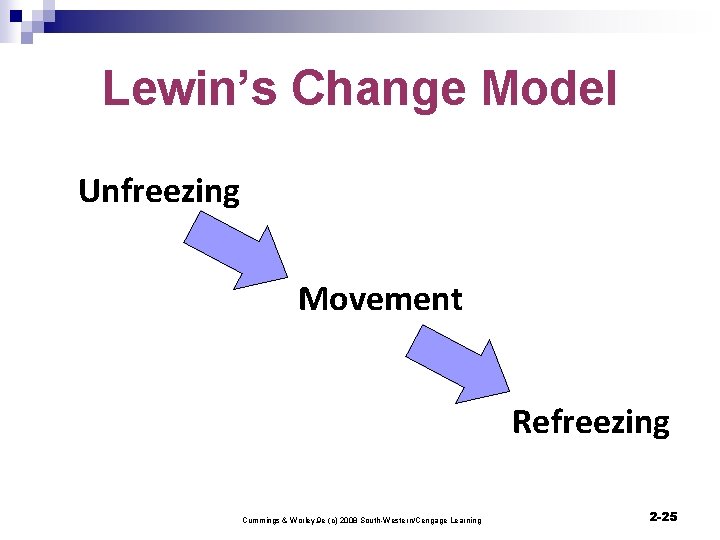
Lewin’s Change Model Unfreezing Movement Refreezing Cummings & Worley, 9 e (c) 2008 South-Western/Cengage Learning 2 -25
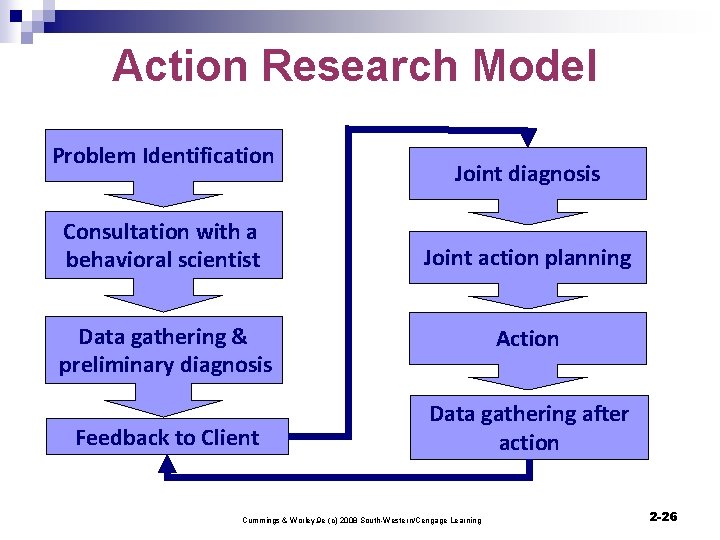
Action Research Model Problem Identification Consultation with a behavioral scientist Joint diagnosis Joint action planning Data gathering & preliminary diagnosis Feedback to Client Action Data gathering after action Cummings & Worley, 9 e (c) 2008 South-Western/Cengage Learning 2 -26
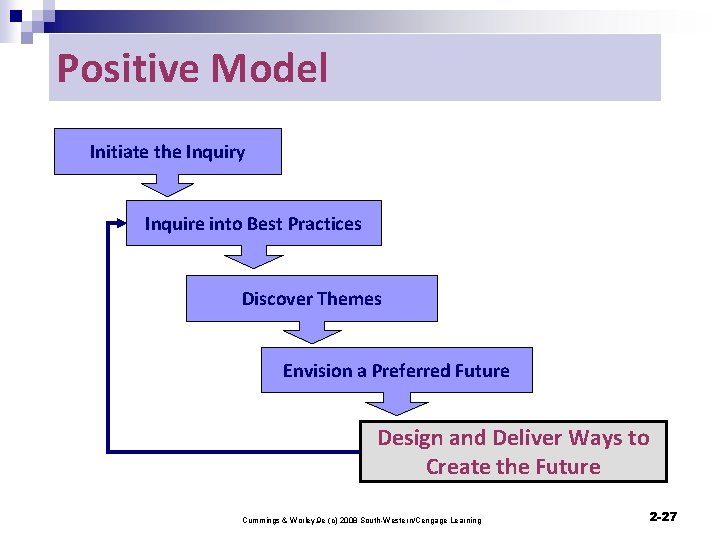
Positive Model Initiate the Inquiry Inquire into Best Practices Discover Themes Envision a Preferred Future Design and Deliver Ways to Create the Future Cummings & Worley, 9 e (c) 2008 South-Western/Cengage Learning 2 -27
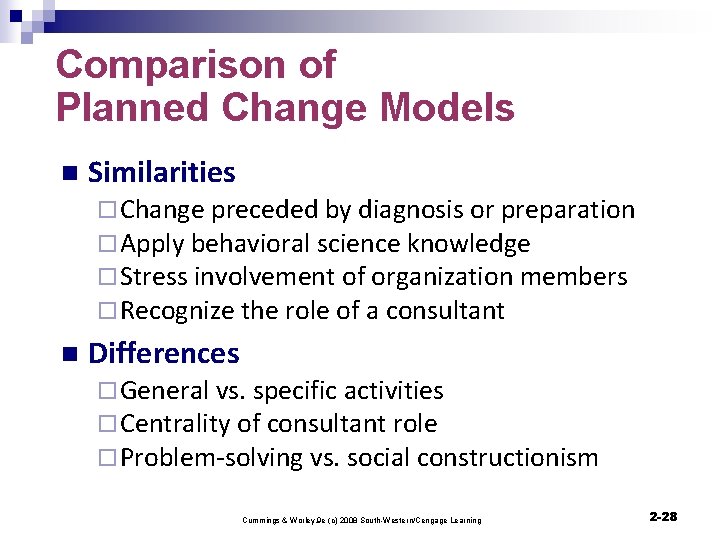
Comparison of Planned Change Models n Similarities ¨ Change preceded by diagnosis or preparation ¨ Apply behavioral science knowledge ¨ Stress involvement of organization members ¨ Recognize the role of a consultant n Differences ¨ General vs. specific activities ¨ Centrality of consultant role ¨ Problem-solving vs. social constructionism Cummings & Worley, 9 e (c) 2008 South-Western/Cengage Learning 2 -28
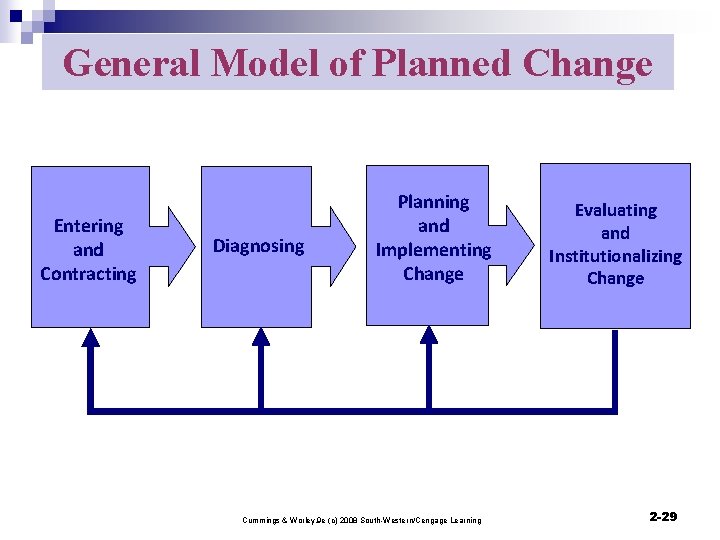
General Model of Planned Change Entering and Contracting Diagnosing Planning and Implementing Change Cummings & Worley, 9 e (c) 2008 South-Western/Cengage Learning Evaluating and Institutionalizing Change 2 -29
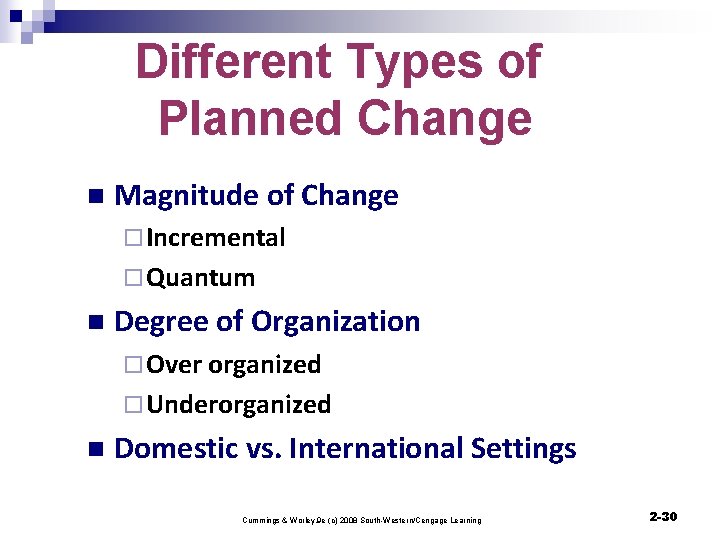
Different Types of Planned Change n Magnitude of Change ¨ Incremental ¨ Quantum n Degree of Organization ¨ Over organized ¨ Underorganized n Domestic vs. International Settings Cummings & Worley, 9 e (c) 2008 South-Western/Cengage Learning 2 -30
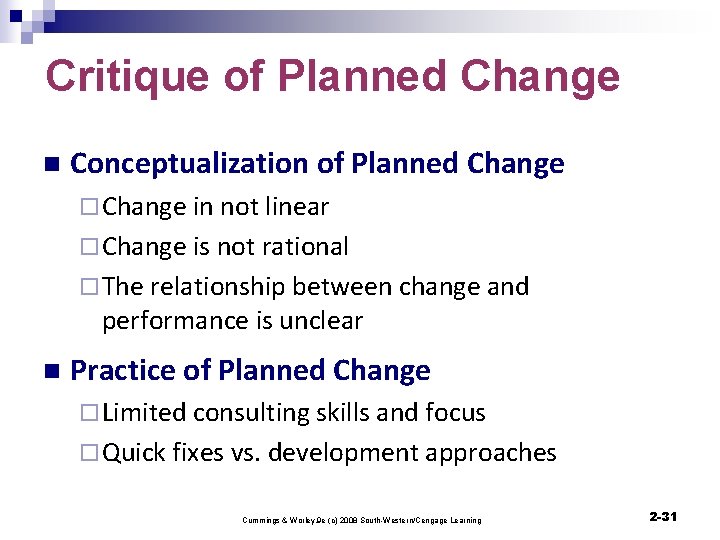
Critique of Planned Change n Conceptualization of Planned Change ¨ Change in not linear ¨ Change is not rational ¨ The relationship between change and performance is unclear n Practice of Planned Change ¨ Limited consulting skills and focus ¨ Quick fixes vs. development approaches Cummings & Worley, 9 e (c) 2008 South-Western/Cengage Learning 2 -31
Waters of Ayole Cummings & Worley 9 e, (c) 2008 South-Western/Cengage Learning 1 -32
Discussion Questions How would you describe the initial approach of solving the water problem for the first town? n How would you describe the change process at Ayole? n What made one change implementation more successful than the other? n
Discussion Questions How would you describe the initial approach of solving the water problem for the first town? n How would you describe the change process at Ayole? n What made one change implementation more successful than the other? n
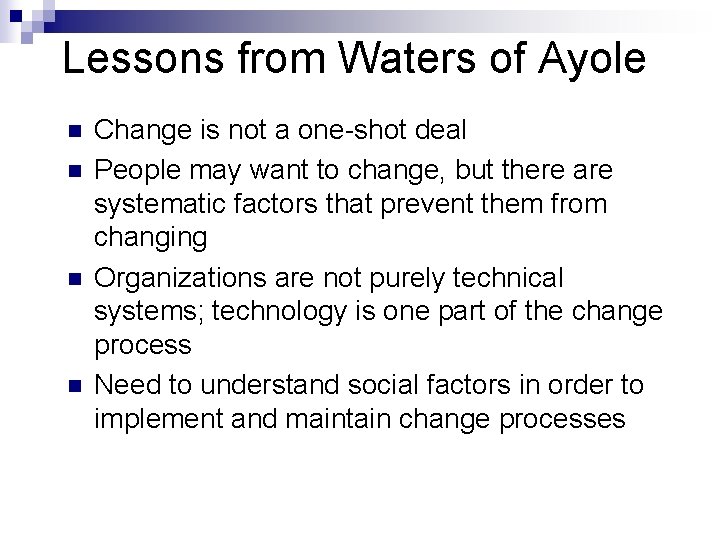
Lessons from Waters of Ayole n n Change is not a one-shot deal People may want to change, but there are systematic factors that prevent them from changing Organizations are not purely technical systems; technology is one part of the change process Need to understand social factors in order to implement and maintain change processes
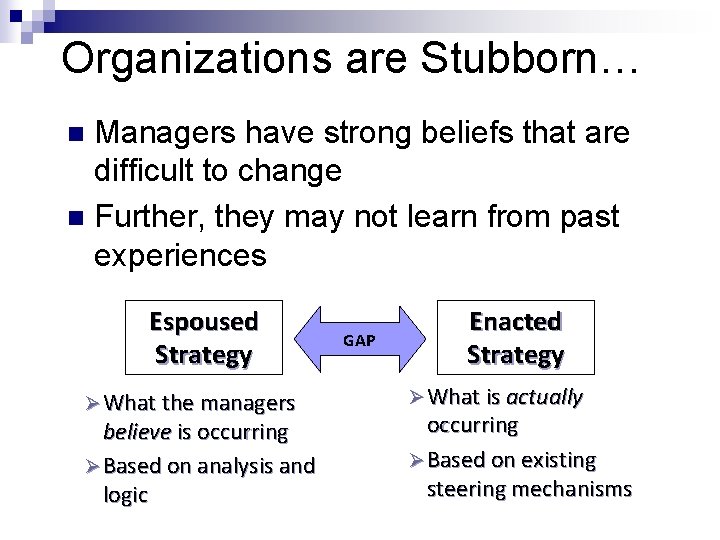
Organizations are Stubborn… Managers have strong beliefs that are difficult to change n Further, they may not learn from past experiences n Espoused Strategy Ø What the managers believe is occurring Ø Based on analysis and logic GAP Enacted Strategy Ø What is actually occurring Ø Based on existing steering mechanisms
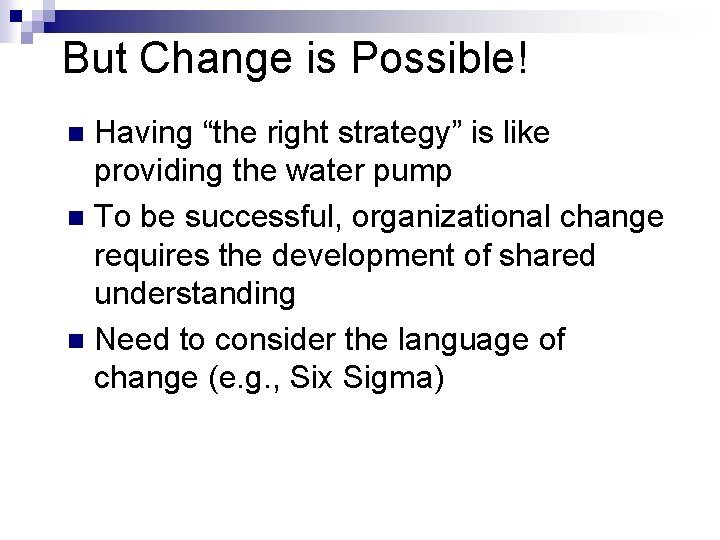
But Change is Possible! Having “the right strategy” is like providing the water pump n To be successful, organizational change requires the development of shared understanding n Need to consider the language of change (e. g. , Six Sigma) n
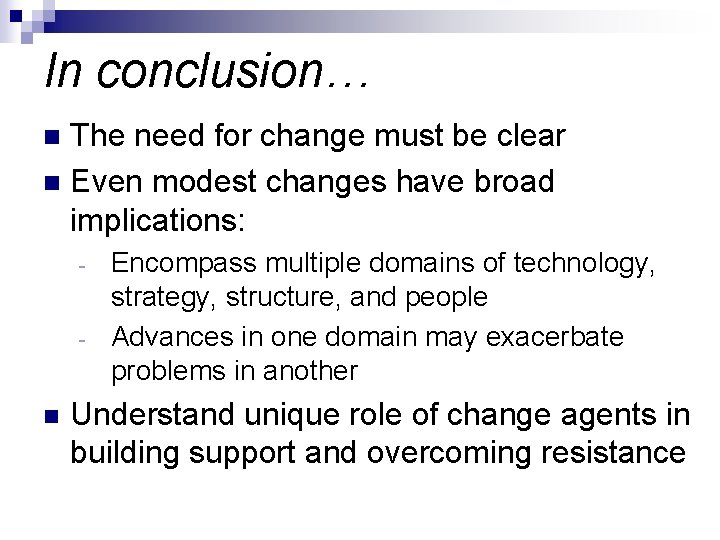
In conclusion… The need for change must be clear n Even modest changes have broad implications: n - - n Encompass multiple domains of technology, strategy, structure, and people Advances in one domain may exacerbate problems in another Understand unique role of change agents in building support and overcoming resistance
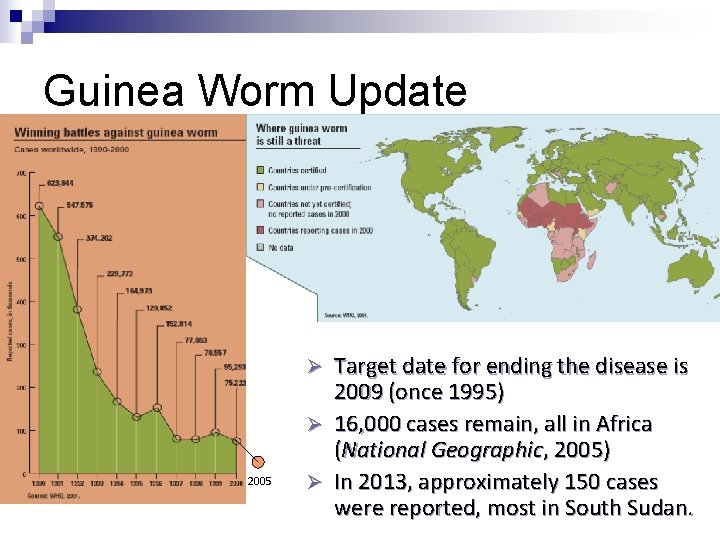
Guinea Worm Update Target date for ending the disease is 2009 (once 1995) Ø 16, 000 cases remain, all in Africa (National Geographic, 2005) Ø In 2013, approximately 150 cases were reported, most in South Sudan. Ø 2005
�Project Team Composition n How should we compose the project teams? ¨ 3 -4 n people teams for this team Constraints: 1. No more than 1 person you know well 2. Must be diverse (men and women; different years; SBOS and other schools, etc). Cummings & Worley 9 e, (c) 2008 South-Western/Cengage Learning 1 -40
Next Week Cummings & Worley Chps. 3 & 4 n Shein (1990) n Homework (1 -3 pages max!) Berg “Failure at Entry” Case n Cummings & Worley 9 e, (c) 2008 South-Western/Cengage Learning 1 -41