
Welcome to OfficeBased Care Online Course Module 3
Welcome to Office-Based Care Online Course Module 3: Communication
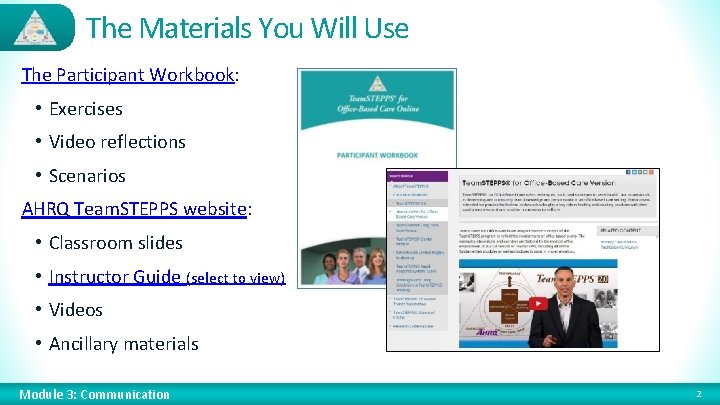
The Materials You Will Use The Participant Workbook: • Exercises • Video reflections • Scenarios AHRQ Team. STEPPS website: • Classroom slides • Instructor Guide (select to view) • Videos • Ancillary materials Module 3: Communication 2

Module Objectives After completing this module, you will be able to: • Define effective communication • Identify communication challenges • Identify Team. STEPPS tools and strategies that can improve a team’s communication Module 3: Communication 3
Communication First of the four main components of Team. STEPPS “The process by which information is clearly and accurately exchanged between two or more team members in the prescribed manner and with proper terminology and the ability to clarify or acknowledge the receipt of information. ” (Cannon-Bowers, Tannenbaum, Salas, & Volpe, 1995) Communication is the lifeline of any team In healthcare, it is the lifeline between patients and any member of the team Module 3: Communication 4
Importance of Communication Joint Commission data continue to demonstrate the importance of communication in patient safety • 1995 - 2005: Ineffective communication identified as root cause for nearly 66 percent of all reported sentinel events (JC Root Causes and Percentages for Sentinel Events (All Categories) January 1995−December 2005) • 2010 - 2013: Communication among top 3 root causes of sentinel events reported (JC Sentinel Event Data (Root Causes by Event Type) 2004 -2012) http: //www. jointcommission. org/sentinel_event. aspx Module 3: Communication 5
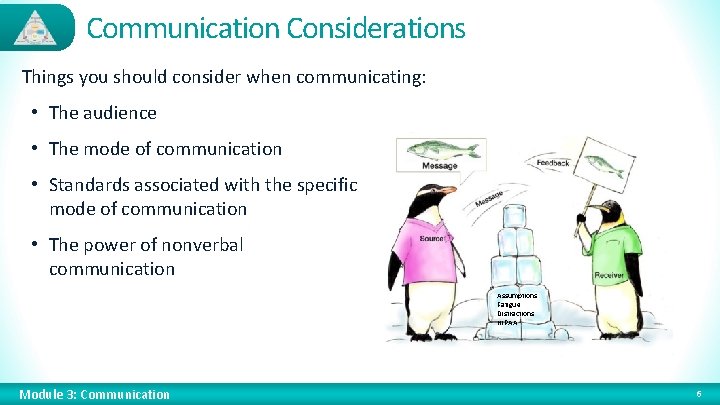
Communication Considerations Things you should consider when communicating: • The audience • The mode of communication • Standards associated with the specific mode of communication • The power of nonverbal communication Assumptions Fatigue Distractions HIPAA Module 3: Communication 6
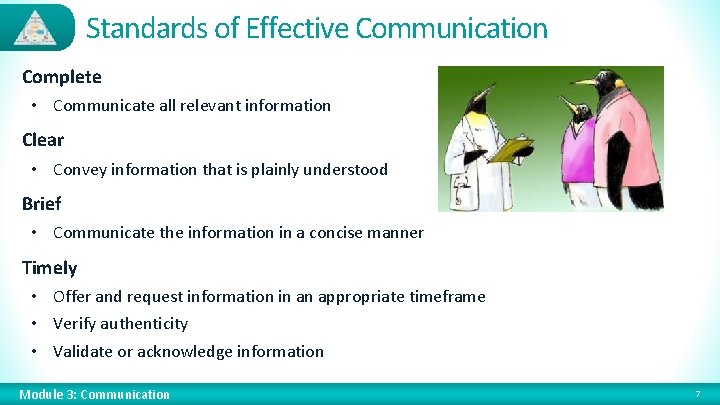
Standards of Effective Communication Complete • Communicate all relevant information Clear • Convey information that is plainly understood Brief • Communicate the information in a concise manner Timely • Offer and request information in an appropriate timeframe • Verify authenticity • Validate or acknowledge information Module 3: Communication 7
SBAR Provides… A framework for team members to effectively communicate information to one another Communicate the following information: • • Situation―What is going on with the patient? Background―What is the clinical background or context? Assessment―What do I think the problem is? Recommendation/Request ―What would I recommend? What do I need from you? Module 3: Communication Remember to introduce yourself… 8
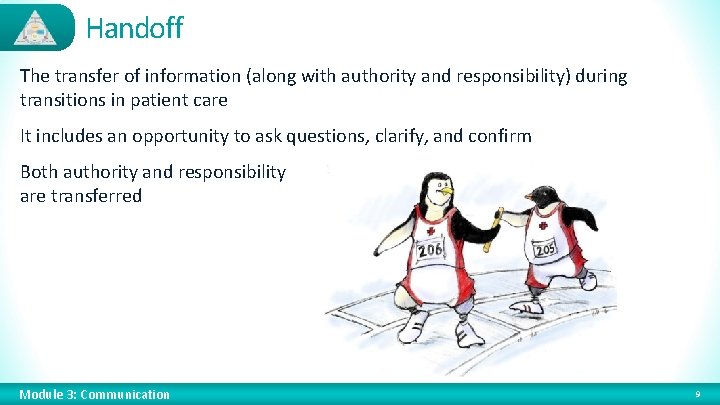
Handoff The transfer of information (along with authority and responsibility) during transitions in patient care It includes an opportunity to ask questions, clarify, and confirm Both authority and responsibility are transferred Module 3: Communication 9
Handoff A proper handoff includes the following components: • Responsibility: Person is aware of assuming responsibility • Accountability: You are accountable until both parties are aware of the transfer • Uncertainty: Clear up all ambiguity before the transfer is complete • Verbal Communication • Acknowledgment: Assure that the handoff is understood and accepted • Opportunity: Evaluate the situation for both safety and quality Module 3: Communication 10
Handoff Exercise Develop a handoff checklist based upon needs of your particular office: • How is your team unique? • Keep in mind core components • Share your handoff checklist with the rest of your team • Discuss how it could be used in your practice Handoff Checklist q Responsibility q Accountability q Uncertainty q Verbal Communication q Acknowledgment q Opportunity See page 9 of the Participant Workbook for a handoff checklist example Module 3: Communication 11

Check-Back is… A closed-loop communication strategy used to verify and validate information exchanged Module 3: Communication 12

Check-Back Technique Example A team member was asked by an office-based care provider to: “Administer the influenza vaccine to Miss Green who is in Room 6. ” “So you want me to give Miss Green, who is in Room 6, an influenza vaccine? ” “Yes, that is exactly right. ” “OK, I will prepare the vaccine. ” Module 3: Communication 13
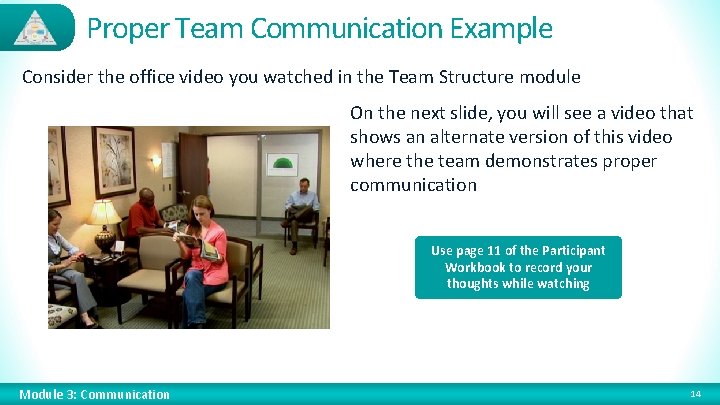
Proper Team Communication Example Consider the office video you watched in the Team Structure module On the next slide, you will see a video that shows an alternate version of this video where the team demonstrates proper communication Use page 11 of the Participant Workbook to record your thoughts while watching Module 3: Communication 14
Proper Team Communication Video https: //www. youtube. com/watch? v=k. Eskfb 2 y. UY 4 Module 3: Communication 15
Review of the Video Now that you have watched the video, think about what went well in this version of the scenario In particular: • Was proper communication demonstrated in this video? • Was this strategy effective? Why was it effective or not effective? • Did you see any other opportunities for better communication in this video? • Have you encountered situations similar to this in your team? If so, how did you overcome it? Module 3: Communication Use page 11 of the Participant Workbook to record your answers 16
Communication Exercise Think about your office team: • What do you think are the opportunities to improve communication in your office? • If you had a magic wand, what strategies would you use to address communication breakdowns? Use page 12 of the Participant Workbook to record your thoughts Module 3: Communication 17
Front Office Scenario For some unknown reason, the electronic health records system was not functioning and the staff had to transition to writing paper notes. Alice had an appointment for followup of labs and x rays. Since there was no way to access the diagnostic data, the provider asked the administrative assistant to call both the laboratory and the radiology service to get the results via telephone. The administrative assistant calls and explains the situation, background, and the assessment, and requests the necessary information. This method of communication expedites the transfer of information from the radiology technician to the administrative assistant. The provider was then able to see Alice on time and discuss her lab and x-ray results. Please continue to the next slide to discuss this scenario Module 3: Communication 18
Discussion: Front Office Scenario Reflecting on what took place in the scenario, did you pick up the use of SBAR? • You should have noted that the administrative assistant calls and explains the situation, the background, the assessment, and requests the necessary information • As with all the other Team. STEPPS concepts, good communication applies to everyone within the office • Remember, teamwork is the responsibility of everyone Module 3: Communication 19
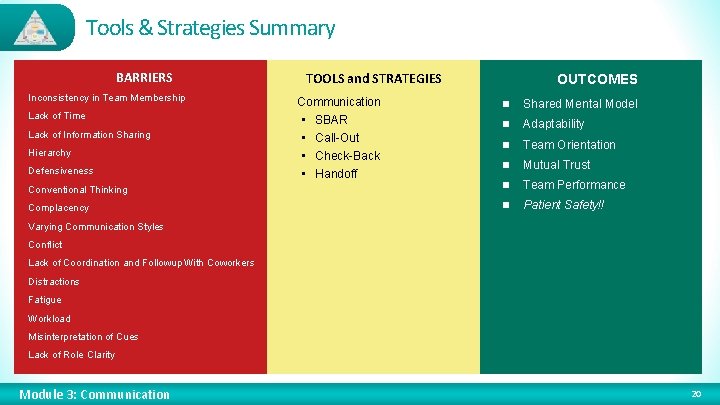
Tools & Strategies Summary BARRIERS Inconsistency in Team Membership TOOLS and STRATEGIES Communication • SBAR • Call-Out • Check-Back • Handoff OUTCOMES n Shared Mental Model n Adaptability n Team Orientation n Mutual Trust Conventional Thinking n Team Performance Complacency n Patient Safety!! Lack of Time Lack of Information Sharing Hierarchy Defensiveness Varying Communication Styles Conflict Lack of Coordination and Followup With Coworkers Distractions Fatigue Workload Misinterpretation of Cues Lack of Role Clarity Module 3: Communication 20
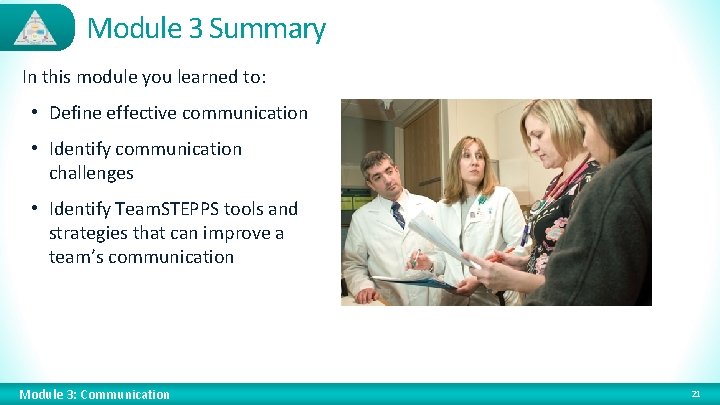
Module 3 Summary In this module you learned to: • Define effective communication • Identify communication challenges • Identify Team. STEPPS tools and strategies that can improve a team’s communication Module 3: Communication 21
- Slides: 21