
Welcome to my Communication Passport This book is
Welcome to my Communication Passport This book is All About Me! My name is …… Insert Picture of Child It will help you to get to know me and how I communicate.
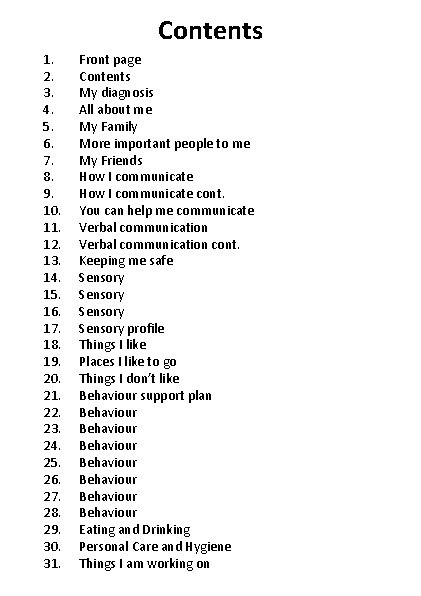
Contents 1. 2. 3. 4. 5. 6. 7. 8. 9. 10. 11. 12. 13. 14. 15. 16. 17. 18. 19. 20. 21. 22. 23. 24. 25. 26. 27. 28. 29. 30. 31. Front page Contents My diagnosis All about me My Family More important people to me My Friends How I communicate cont. You can help me communicate Verbal communication cont. Keeping me safe Sensory profile Things I like Places I like to go Things I don’t like Behaviour support plan Behaviour Behaviour Eating and Drinking Personal Care and Hygiene Things I am working on
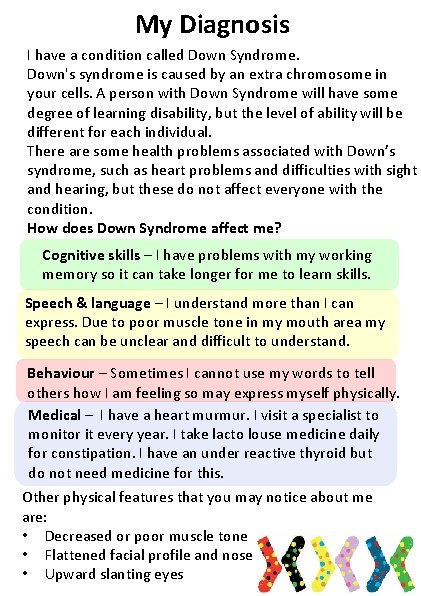
My Diagnosis I have a condition called Down Syndrome. Down's syndrome is caused by an extra chromosome in your cells. A person with Down Syndrome will have some degree of learning disability, but the level of ability will be different for each individual. There are some health problems associated with Down’s syndrome, such as heart problems and difficulties with sight and hearing, but these do not affect everyone with the condition. How does Down Syndrome affect me? Cognitive skills – I have problems with my working memory so it can take longer for me to learn skills. Speech & language – I understand more than I can express. Due to poor muscle tone in my mouth area my speech can be unclear and difficult to understand. Behaviour – Sometimes I cannot use my words to tell others how I am feeling so may express myself physically. Medical – I have a heart murmur. I visit a specialist to monitor it every year. I take lacto louse medicine daily for constipation. I have an under reactive thyroid but do not need medicine for this. Other physical features that you may notice about me are: • Decreased or poor muscle tone • Flattened facial profile and nose • Upward slanting eyes
All About Me! • • • I also like to be called ‘xxxxx’ I am x years old. My date of birth is xxxxx I live in xxxxx. I have a cheeky personality. I am usually happy and full of life so there’s usually a good reason if I am upset. I have Down Syndrome and significant learning difficulties, which impact on lots of areas of my life. So, my family & I have made this passport to help you get to know and understand me.
My Family I love my Family I like to talk about them so you need to know who everybody is!! This is my Mum and Dad. Their names are X and X. This is my brother X. This is my sister X, and her boyfriend X. This is our dog X he is a golden retriever cross cocker spaniel so has lots of energy! We all live together!!!
More important people to me… This is my sister X and her husband X. Every Tuesday I go to their house for tea. They live in X. This is my niece X who is X years old and my Nephew X who is X years old.
My Friends • • • My best friend is X My other friends are: X X X We met and all went to X Primary School together. Insert school logo?
Communication • I like talking but sometimes people find it hard to understand what I am saying as my speech can be unclear. • It helps to ask me to ‘show you’ what I mean; either physically or by signing it. Please do: • Show me what you want me to do instead of just telling me – modelling the activity. • Use key words to explain things to me. • Give me plenty of time to respond to questions. • Aid my understanding through using Visual supports, gestures/signs and repetition. Examples of things that help me communicate: Music, Computer/Ipad, Body Language, Gestures, Photographs and Books.
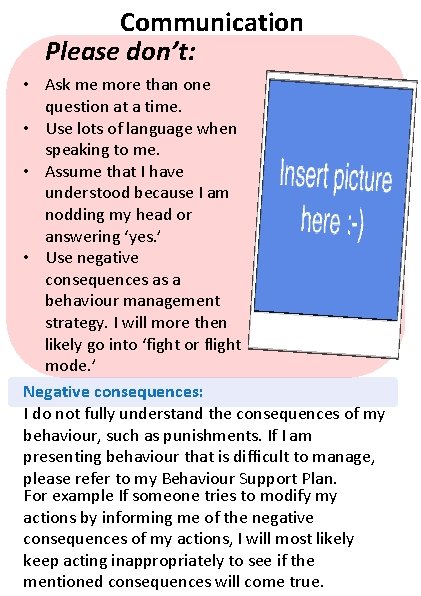
Communication Please don’t: • Ask me more than one question at a time. • Use lots of language when speaking to me. • Assume that I have understood because I am nodding my head or answering ‘yes. ’ • Use negative consequences as a behaviour management strategy. I will more then likely go into ‘fight or flight mode. ’ Negative consequences: I do not fully understand the consequences of my behaviour, such as punishments. If I am presenting behaviour that is difficult to manage, please refer to my Behaviour Support Plan. For example If someone tries to modify my actions by informing me of the negative consequences of my actions, I will most likely keep acting inappropriately to see if the mentioned consequences will come true.

Communication I understand more than I can express. When talking to me: • Call my name • Get down at my level • Keep the question short & simple • Give me time to answer Sometimes I may push or hit others. I am embarrassed to say ‘sorry’ straight away Help me make better choices, reminding me what I could do not what I should stop. • I also use some Makaton signs. This makes my speech clearer and easier to understand. • Visual timetable/ photographs. • I haven't learnt to recognize symbols yet.
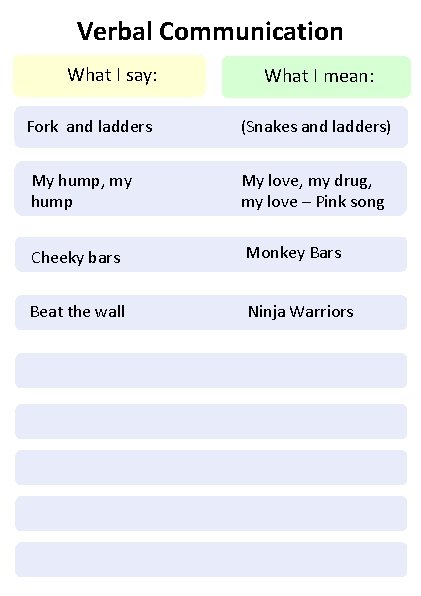
Verbal Communication What I say: What I mean: Fork and ladders (Snakes and ladders) My hump, my hump My love, my drug, my love – Pink song Cheeky bars Monkey Bars Beat the wall Ninja Warriors
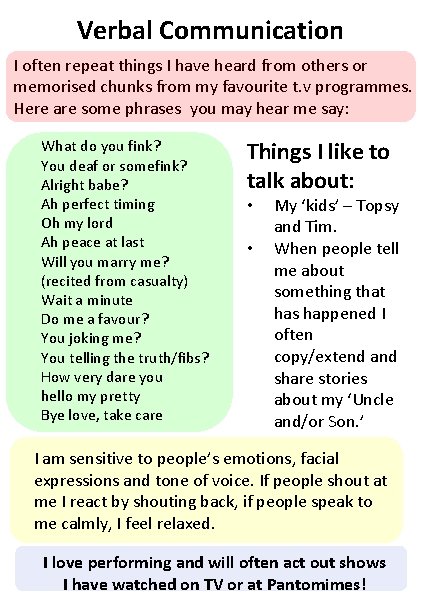
Verbal Communication I often repeat things I have heard from others or memorised chunks from my favourite t. v programmes. Here are some phrases you may hear me say: What do you fink? You deaf or somefink? Alright babe? Ah perfect timing Oh my lord Ah peace at last Will you marry me? (recited from casualty) Wait a minute Do me a favour? You joking me? You telling the truth/fibs? How very dare you hello my pretty Bye love, take care Things I like to talk about: • • My ‘kids’ – Topsy and Tim. When people tell me about something that has happened I often copy/extend and share stories about my ‘Uncle and/or Son. ’ I am sensitive to people’s emotions, facial expressions and tone of voice. If people shout at me I react by shouting back, if people speak to me calmly, I feel relaxed. I love performing and will often act out shows I have watched on TV or at Pantomimes!
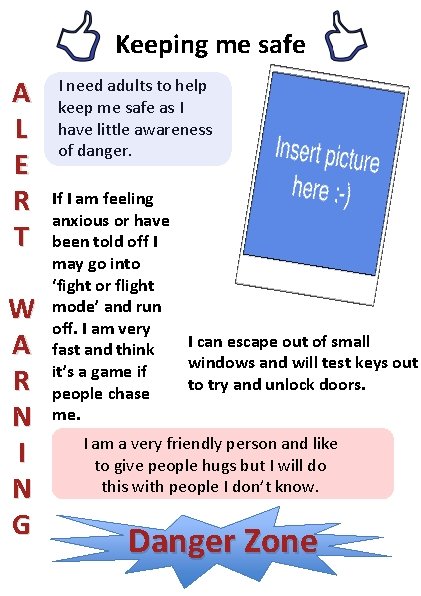
Keeping me safe A L E R T W A R N I N G I need adults to help keep me safe as I have little awareness of danger. If I am feeling anxious or have been told off I may go into ‘fight or flight mode’ and run off. I am very I can escape out of small fast and think windows and will test keys out it’s a game if to try and unlock doors. people chase me. I am a very friendly person and like to give people hugs but I will do this with people I don’t know. Danger Zone
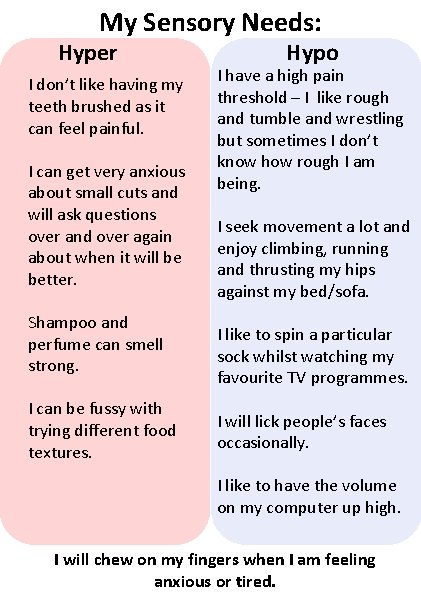
My Sensory Needs: Hyper I don’t like having my teeth brushed as it can feel painful. I can get very anxious about small cuts and will ask questions over and over again about when it will be better. Shampoo and perfume can smell strong. I can be fussy with trying different food textures. Hypo I have a high pain threshold – I like rough and tumble and wrestling but sometimes I don’t know how rough I am being. I seek movement a lot and enjoy climbing, running and thrusting my hips against my bed/sofa. I like to spin a particular sock whilst watching my favourite TV programmes. I will lick people’s faces occasionally. I like to have the volume on my computer up high. I will chew on my fingers when I am feeling anxious or tired.
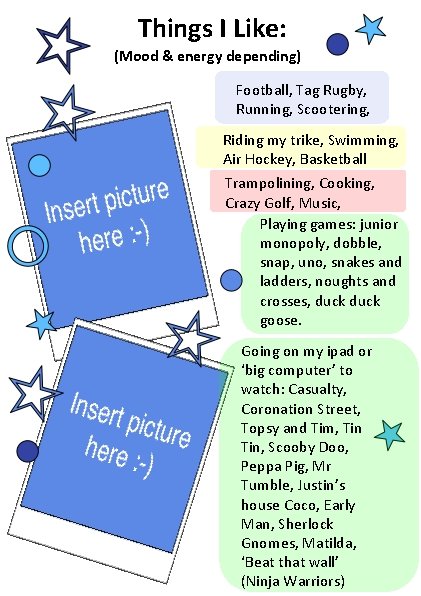
Things I Like: (Mood & energy depending) Football, Tag Rugby, Running, Scootering, Riding my trike, Swimming, Air Hockey, Basketball Trampolining, Cooking, Crazy Golf, Music, Playing games: junior monopoly, dobble, snap, uno, snakes and ladders, noughts and crosses, duck goose. Going on my ipad or ‘big computer’ to watch: Casualty, Coronation Street, Topsy and Tim, Tin, Scooby Doo, Peppa Pig, Mr Tumble, Justin’s house Coco, Early Man, Sherlock Gnomes, Matilda, ‘Beat that wall’ (Ninja Warriors)
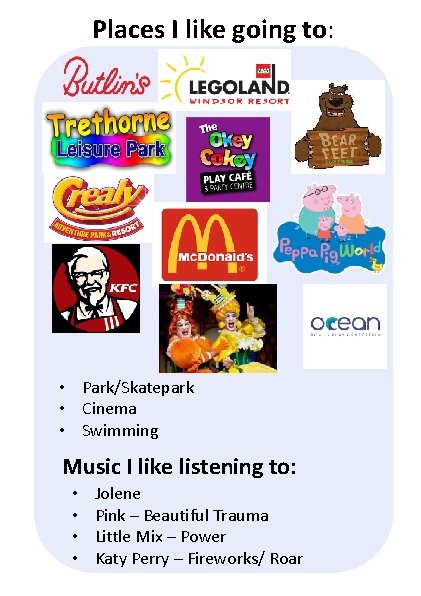
Places I like going to: • Park/Skatepark • Cinema • Swimming Music I like listening to: • • Jolene Pink – Beautiful Trauma Little Mix – Power Katy Perry – Fireworks/ Roar
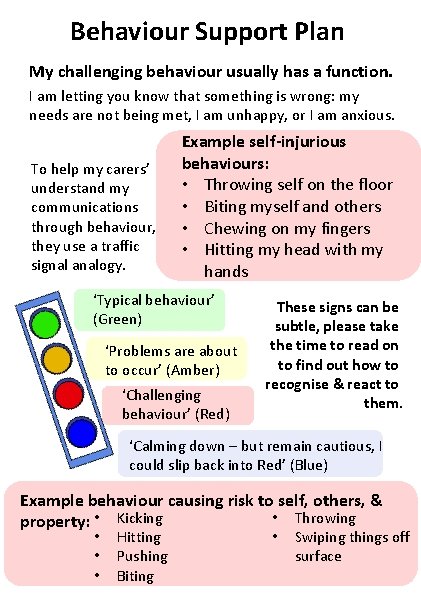
Behaviour Support Plan My challenging behaviour usually has a function. I am letting you know that something is wrong: my needs are not being met, I am unhappy, or I am anxious. To help my carers’ understand my communications through behaviour, they use a traffic signal analogy. Example self-injurious behaviours: • Throwing self on the floor • Biting myself and others • Chewing on my fingers • Hitting my head with my hands ‘Typical behaviour’ (Green) ‘Problems are about to occur’ (Amber) ‘Challenging behaviour’ (Red) These signs can be subtle, please take the time to read on to find out how to recognise & react to them. ‘Calming down – but remain cautious, I could slip back into Red’ (Blue) Example behaviour causing risk to self, others, & • Throwing property: • Kicking • • • Hitting Pushing Biting • Swiping things off surface

Proactive Plan – Green Phase Behaviours: ü ü ü I like to laugh I like playing games with others I like talking I like to do new things I can follow simple instructions well Positive Support Strategies For example: ü Keep activities to a minimum; no more than 2 activities a day ü Make sure I am in good health & free from pain (I often get a sore tummy from constipation) Tips • Be explicit – give concrete examples of phrases, lengths of time, or numbers of repetition if relevant. • Explain the strategies if possible – it’s easier to remember the best way to do things if it makes sense to the reader in a bigger picture.
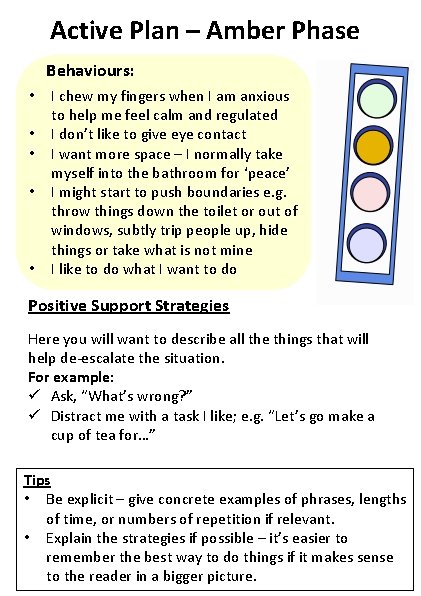
Active Plan – Amber Phase Behaviours: • • • I chew my fingers when I am anxious to help me feel calm and regulated I don’t like to give eye contact I want more space – I normally take myself into the bathroom for ‘peace’ I might start to push boundaries e. g. throw things down the toilet or out of windows, subtly trip people up, hide things or take what is not mine I like to do what I want to do Positive Support Strategies Here you will want to describe all the things that will help de-escalate the situation. For example: ü Ask, “What’s wrong? ” ü Distract me with a task I like; e. g. “Let’s go make a cup of tea for…” Tips • Be explicit – give concrete examples of phrases, lengths of time, or numbers of repetition if relevant. • Explain the strategies if possible – it’s easier to remember the best way to do things if it makes sense to the reader in a bigger picture.
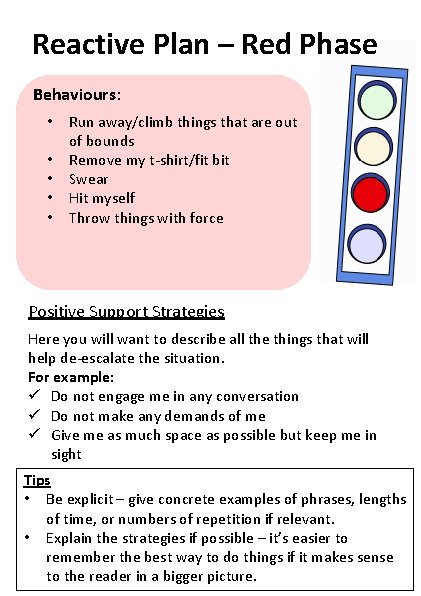
Reactive Plan – Red Phase Behaviours: • • • Run away/climb things that are out of bounds Remove my t-shirt/fit bit Swear Hit myself Throw things with force Positive Support Strategies Here you will want to describe all the things that will help de-escalate the situation. For example: ü Do not engage me in any conversation ü Do not make any demands of me ü Give me as much space as possible but keep me in sight Tips • Be explicit – give concrete examples of phrases, lengths of time, or numbers of repetition if relevant. • Explain the strategies if possible – it’s easier to remember the best way to do things if it makes sense to the reader in a bigger picture.
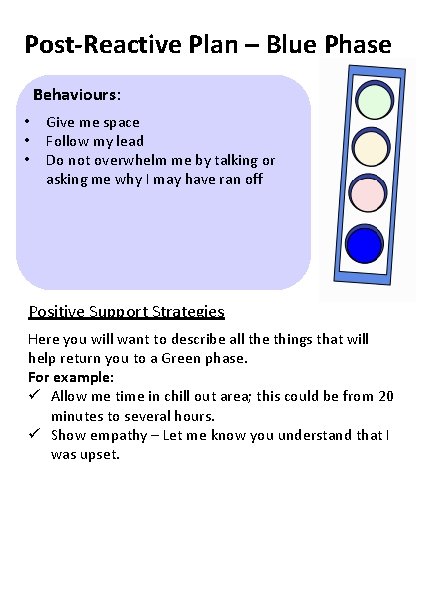
Post-Reactive Plan – Blue Phase Behaviours: • • • Give me space Follow my lead Do not overwhelm me by talking or asking me why I may have ran off Positive Support Strategies Here you will want to describe all the things that will help return you to a Green phase. For example: ü Allow me time in chill out area; this could be from 20 minutes to several hours. ü Show empathy – Let me know you understand that I was upset.
Challenging Behaviour My challenging behaviour usually has a function: Examples: Boredom If I am bored, I might rock myself back & forth to self-stimulate. Frustration If I am trying to do a task that is too complicated or overwhelming for me, I may hit out because I cannot cope & wish to leave. I use my behaviour to get more control over my circumstances. When things are too noisy or too loud, I will get anxious & more likely to be disruptive. Other examples: • • • Communication/comprehension difficulties Change in routine/events Special events (hospital appointments, dentist, parties, etc. ) Ill health (constipation) or lack of sleep Choice – too little/too much www. mycommpass. com
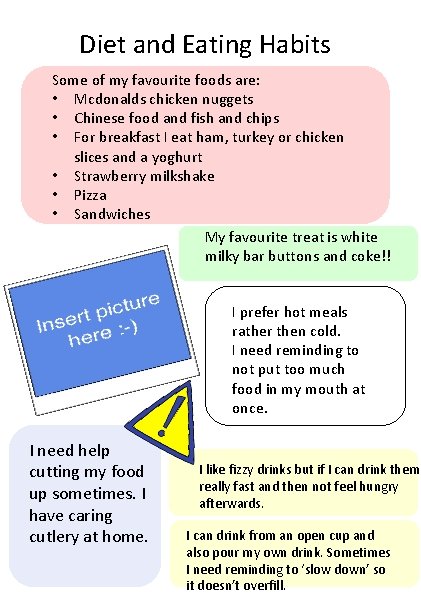
Diet and Eating Habits Some of my favourite foods are: • Mcdonalds chicken nuggets • Chinese food and fish and chips • For breakfast I eat ham, turkey or chicken slices and a yoghurt • Strawberry milkshake • Pizza • Sandwiches My favourite treat is white milky bar buttons and coke!! I prefer hot meals rather then cold. I need reminding to not put too much food in my mouth at once. I need help cutting my food up sometimes. I have caring cutlery at home. I like fizzy drinks but if I can drink them really fast and then not feel hungry afterwards. I can drink from an open cup and also pour my own drink. Sometimes I need reminding to ‘slow down’ so it doesn’t overfill.
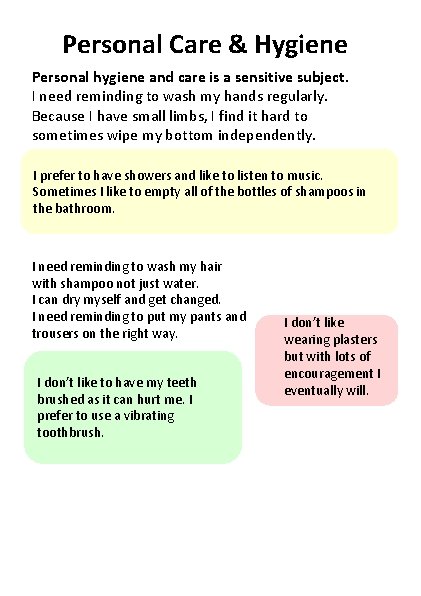
Personal Care & Hygiene Personal hygiene and care is a sensitive subject. I need reminding to wash my hands regularly. Because I have small limbs, I find it hard to sometimes wipe my bottom independently. I prefer to have showers and like to listen to music. Sometimes I like to empty all of the bottles of shampoos in the bathroom. I need reminding to wash my hair with shampoo not just water. I can dry myself and get changed. I need reminding to put my pants and trousers on the right way. I don’t like to have my teeth brushed as it can hurt me. I prefer to use a vibrating toothbrush. I don’t like wearing plasters but with lots of encouragement I eventually will.
Things I’m working on • • • Communication – Clapping syllables so my speech is clearer. Physical – Riding my trike Self care – Putting my clothes on the right way round. Maths – Telling the time and understanding money concepts. Literacy – Learning to read and spell key words that are meaningful to me. Personal, social and emotional – Respecting peoples bodies ‘private. ’ www. mycommpass. co m
- Slides: 25