
Welcome to Mrs Cardiles Third Grade Class What
- Slides: 28
Welcome to Mrs. Cardile’s Third Grade Class
What is inclusion? Inclusive education means that all students in a school, regardless of their strengths or weaknesses in any area, become part of the school community in the general education classroom. Special needs students are included in the feeling of belonging among other students, teachers, and support staff in a way that ensures success for all students.
What does inclusion look like? • Inclusion classrooms are student-centered. • Students must meet individualized expectations for the same curriculum. • Team-teaching: Both the Special Education teacher and the General Education teacher work together to teach the lesson to the whole group, before meeting with individual students or groups during independent work. • Instruction in separate setting: Although the goal in an inclusive classroom is for most instruction to occur in general settings, occasionally student needs indicate this is not appropriate. At these times some students with special needs will be pulled to a separate location to receive services by a Special Education consultant teacher. While the other students will be supported by the General Education teacher.
What are the benefits of inclusion? • More individualized support for all students. • Provides opportunities to experience diversity. • Develops an appreciation that everyone has unique and beautiful characteristics and qualities. • Teaching focuses on a variety of methods to enhance differentiated instruction.
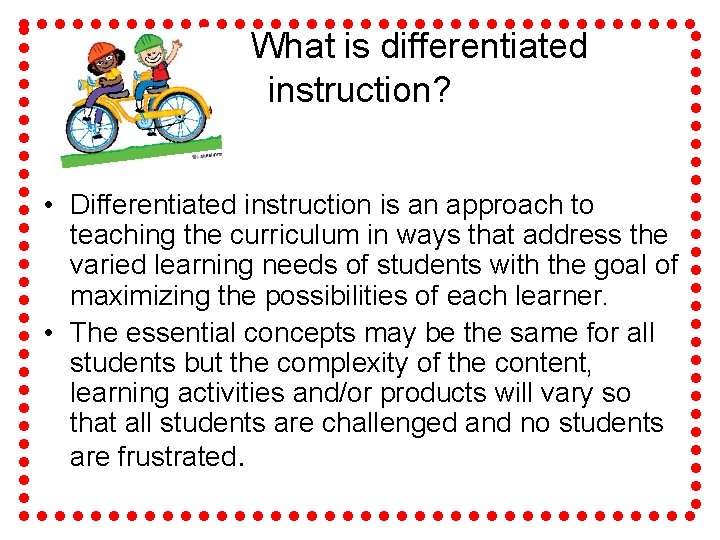
What is differentiated instruction? • Differentiated instruction is an approach to teaching the curriculum in ways that address the varied learning needs of students with the goal of maximizing the possibilities of each learner. • The essential concepts may be the same for all students but the complexity of the content, learning activities and/or products will vary so that all students are challenged and no students are frustrated.
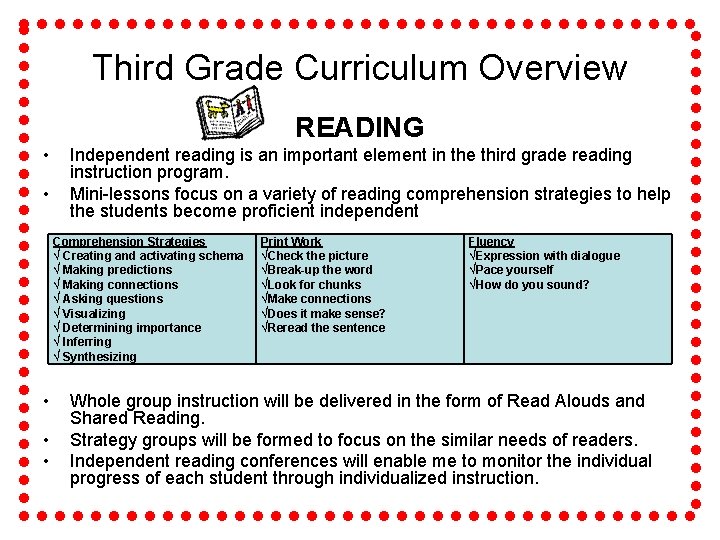
Third Grade Curriculum Overview READING • • Independent reading is an important element in the third grade reading instruction program. Mini-lessons focus on a variety of reading comprehension strategies to help the students become proficient independent Comprehension Strategies √ Creating and activating schema √ Making predictions √ Making connections √ Asking questions √ Visualizing √ Determining importance √ Inferring √ Synthesizing • • • Print Work √Check the picture √Break-up the word √Look for chunks √Make connections √Does it make sense? √Reread the sentence Fluency √Expression with dialogue √Pace yourself √How do you sound? Whole group instruction will be delivered in the form of Read Alouds and Shared Reading. Strategy groups will be formed to focus on the similar needs of readers. Independent reading conferences will enable me to monitor the individual progress of each student through individualized instruction.
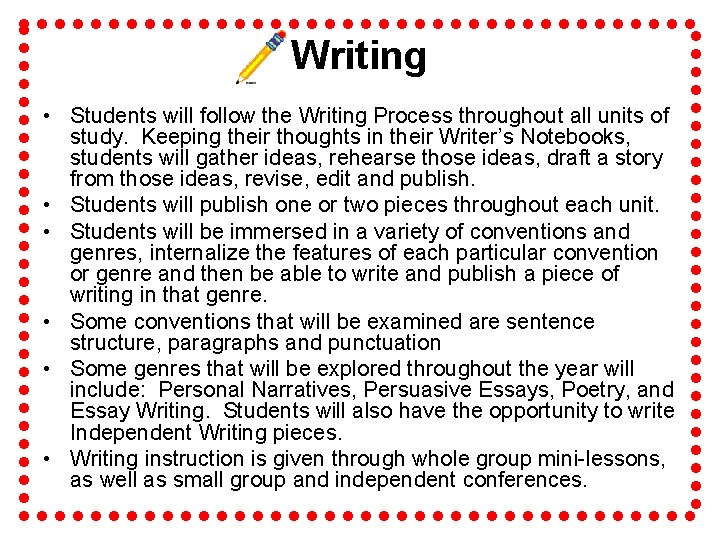
Writing • Students will follow the Writing Process throughout all units of study. Keeping their thoughts in their Writer’s Notebooks, students will gather ideas, rehearse those ideas, draft a story from those ideas, revise, edit and publish. • Students will publish one or two pieces throughout each unit. • Students will be immersed in a variety of conventions and genres, internalize the features of each particular convention or genre and then be able to write and publish a piece of writing in that genre. • Some conventions that will be examined are sentence structure, paragraphs and punctuation • Some genres that will be explored throughout the year will include: Personal Narratives, Persuasive Essays, Poetry, and Essay Writing. Students will also have the opportunity to write Independent Writing pieces. • Writing instruction is given through whole group mini-lessons, as well as small group and independent conferences.
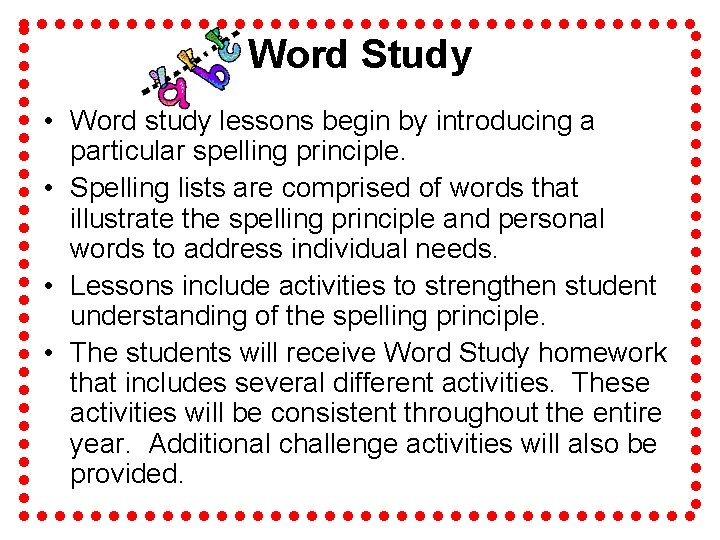
Word Study • Word study lessons begin by introducing a particular spelling principle. • Spelling lists are comprised of words that illustrate the spelling principle and personal words to address individual needs. • Lessons include activities to strengthen student understanding of the spelling principle. • The students will receive Word Study homework that includes several different activities. These activities will be consistent throughout the entire year. Additional challenge activities will also be provided.
Intervention Block • Intervention Block serves as another way to support the students’ efforts in the classroom. • All the 3 rd grade students are divided among the 3 rd grade teachers, so that they can receive individualized reading instruction. • These groupings are determined by the data from the Developmental Reading Assessment (DRA), as well as teacher observations through reading conferences. • As the students grow in their learning, the groupings are adjusted according to their needs.
Math • Third grade math instruction focuses on several areas: Number & Operations in Base Ten, Operations & Algebraic Thinking, Number & Operations in Fractions, Measurement & Data and Geometry. • The students will be expected to add and subtract fluently within 1000 and round to the nearest ten and hundred. • A heavy focus will center on multiplication and division. Students will be expected to become fluent in their multiplication and division facts to provide them with a solid foundation. • The identification of fractions will be built upon as the students will be expected to order fractions and determine fraction equivalence. • Measurement will focus on telling time and measuring volume and mass of objects using the metric measurement system. • The students will be expected to read, analyze and create their own graphs. • In geometry the students will recognize the characteristics of plane figures, as it relates to area. •
Social Studies • Multicultural learning highlights the differences and similarities that exist among various cultures. • The Social Studies curriculum will focus on communities around the world, such as America, Brazil, and China. • Student will thoroughly explore people of the world communities and their culture. • The students will also learn how to use various map skills and discover how the world communities are influenced by geographical and environmental factors. • Students will also uncover the values of each world community and how those values govern their society.
Science • Science instruction in third grade is implemented through the use of the FOSS science investigation kits, which engages students in inquiry. • Students develop an understanding of science concepts, through their own in-depth investigations and analysis, using laboratory equipment and interactive technology. • Students will foster their observation, comparison and communication skills through several units of study, including the Human Body, • Metric Measurements, and Soils.
Technology • Students will have the opportunity to practice their computer skills in the Computer Lab, as well as in the classroom on our classroom computers. • Students will use the computers to practice their typing skills, publish writing pieces, while also learning how to access Internet websites for both research and learning. • Technology strengthens the home-school connection which can enhance the development of all learners.
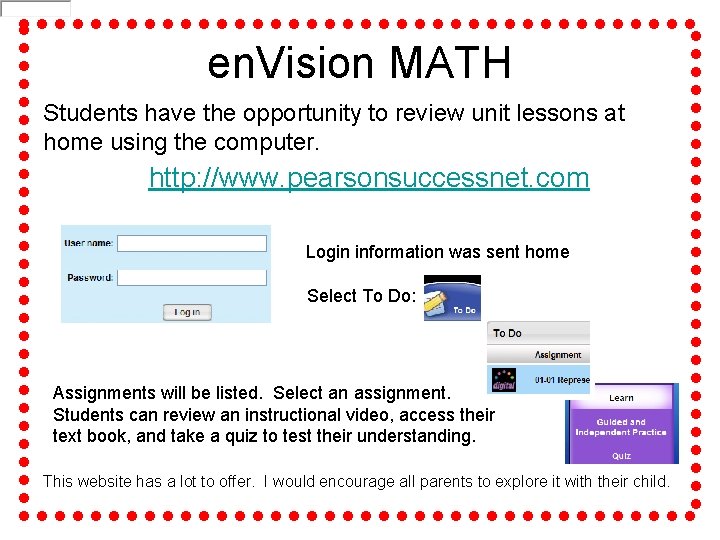
en. Vision MATH Students have the opportunity to review unit lessons at home using the computer. http: //www. pearsonsuccessnet. com Login information was sent home Select To Do: Assignments will be listed. Select an assignment. Students can review an instructional video, access their text book, and take a quiz to test their understanding. This website has a lot to offer. I would encourage all parents to explore it with their child.
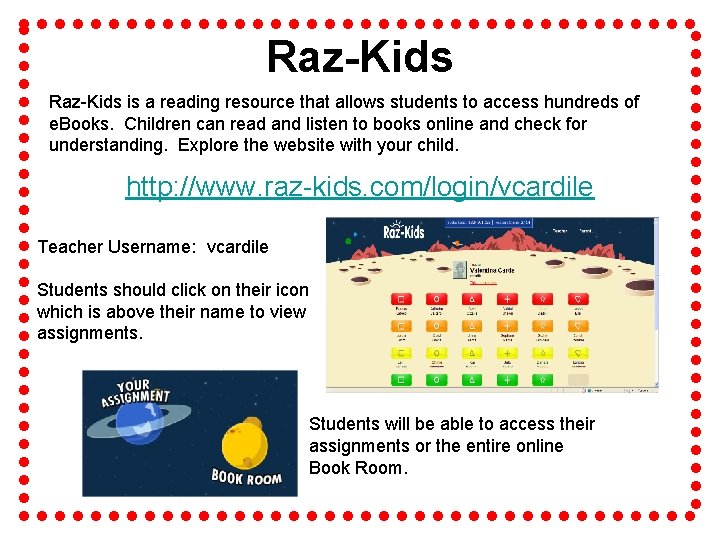
Raz-Kids is a reading resource that allows students to access hundreds of e. Books. Children can read and listen to books online and check for understanding. Explore the website with your child. http: //www. raz-kids. com/login/vcardile Teacher Username: vcardile Students should click on their icon which is above their name to view assignments. Students will be able to access their assignments or the entire online Book Room.
Cursive Writing • The students will begin to study cursive handwriting this year. • The students will begin their study by learning cursive letter formation and gradually progressing to writing words and sentences. • The students will practice writing cursive both in and out of the classroom.
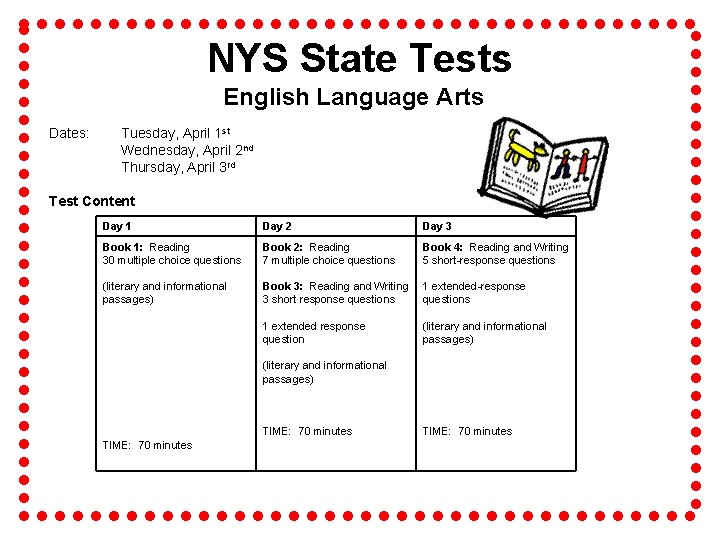
NYS State Tests English Language Arts Dates: Tuesday, April 1 st Wednesday, April 2 nd Thursday, April 3 rd Test Content Day 1 Day 2 Day 3 Book 1: Reading 30 multiple choice questions Book 2: Reading 7 multiple choice questions Book 4: Reading and Writing 5 short-response questions (literary and informational passages) Book 3: Reading and Writing 3 short response questions 1 extended-response questions 1 extended response question (literary and informational passages) TIME: 70 minutes
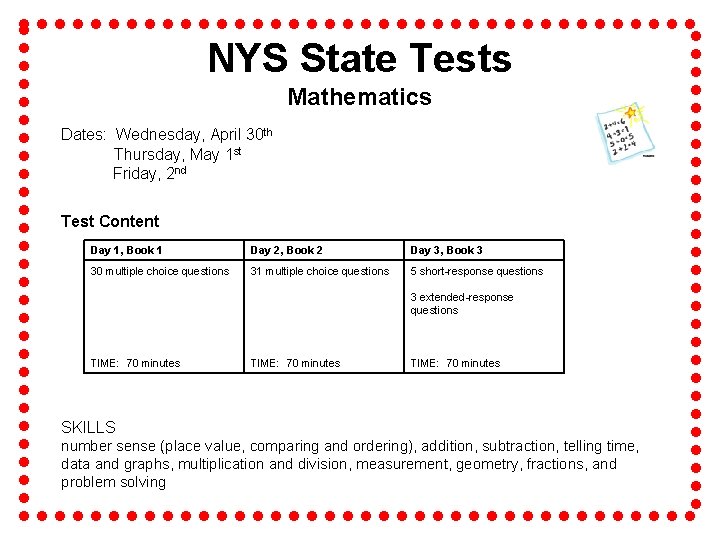
NYS State Tests Mathematics Dates: Wednesday, April 30 th Thursday, May 1 st Friday, 2 nd Test Content Day 1, Book 1 Day 2, Book 2 Day 3, Book 3 30 multiple choice questions 31 multiple choice questions 5 short-response questions 3 extended-response questions TIME: 70 minutes SKILLS number sense (place value, comparing and ordering), addition, subtraction, telling time, data and graphs, multiplication and division, measurement, geometry, fractions, and problem solving
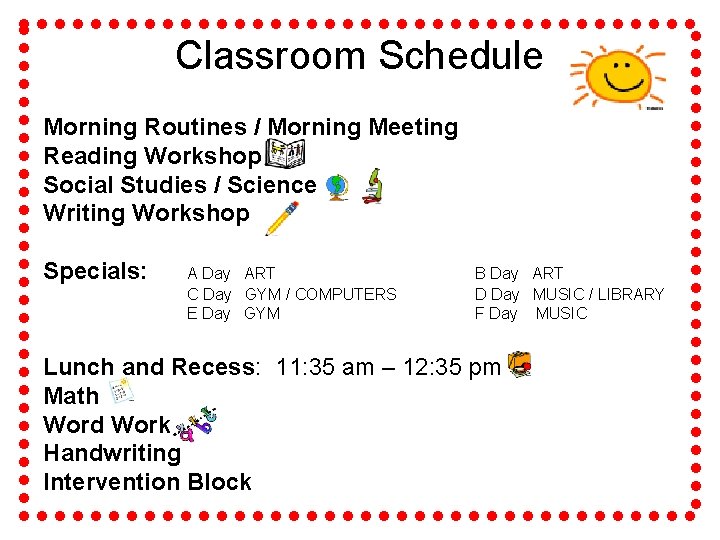
Classroom Schedule Morning Routines / Morning Meeting Reading Workshop Social Studies / Science Writing Workshop Specials: A Day ART C Day GYM / COMPUTERS E Day GYM B Day ART D Day MUSIC / LIBRARY F Day MUSIC Lunch and Recess: 11: 35 am – 12: 35 pm Math Word Work Handwriting Intervention Block
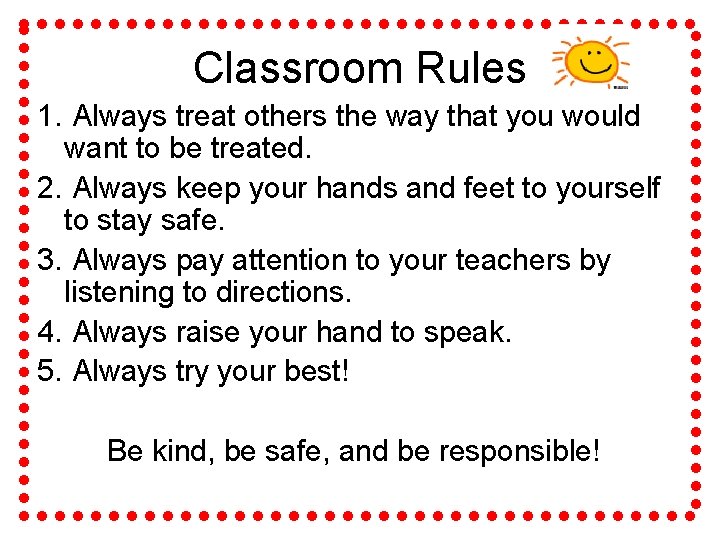
Classroom Rules 1. Always treat others the way that you would want to be treated. 2. Always keep your hands and feet to yourself to stay safe. 3. Always pay attention to your teachers by listening to directions. 4. Always raise your hand to speak. 5. Always try your best! Be kind, be safe, and be responsible!
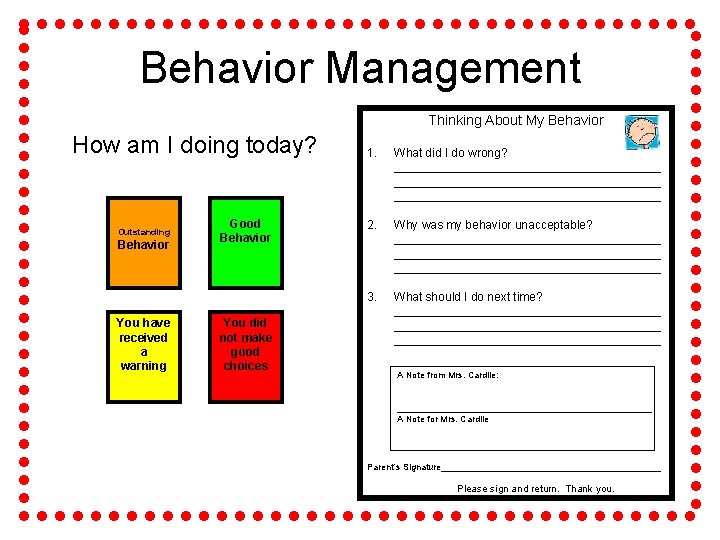
Behavior Management Thinking About My Behavior How am I doing today? Outstanding Behavior You have received a warning Good Behavior You did not make good choices 1. What did I do wrong? ________________________________________ 2. Why was my behavior unacceptable? ________________________________________ 3. What should I do next time? ________________________________________ A Note from Mrs. Cardile: __________________________ A Note for Mrs. Cardile Parent’s Signature______________________ Please sign and return. Thank you.
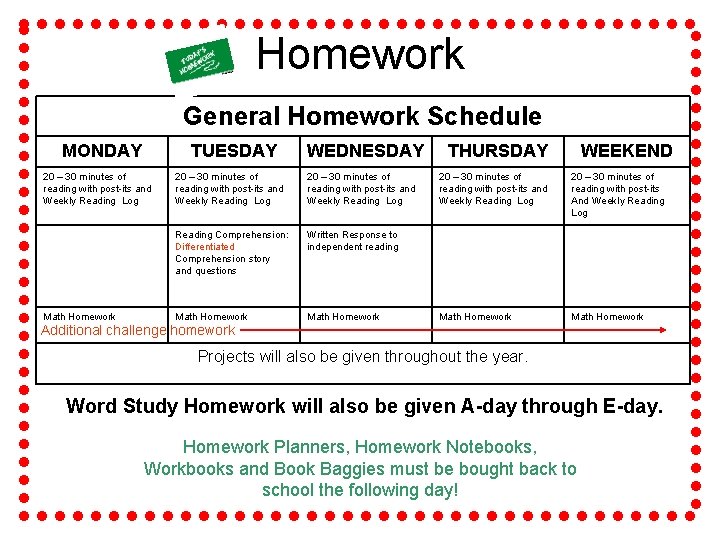
Homework General Homework Schedule MONDAY TUESDAY 20 – 30 minutes of reading with post-its and Weekly Reading Log Math Homework WEDNESDAY 20 – 30 minutes of reading with post-its and Weekly Reading Log Reading Comprehension: Differentiated Comprehension story and questions Written Response to independent reading Math Homework THURSDAY WEEKEND 20 – 30 minutes of reading with post-its and Weekly Reading Log 20 – 30 minutes of reading with post-its And Weekly Reading Log Math Homework Additional challenge homework Projects will also be given throughout the year. Word Study Homework will also be given A-day through E-day. Homework Planners, Homework Notebooks, Workbooks and Book Baggies must be bought back to school the following day!
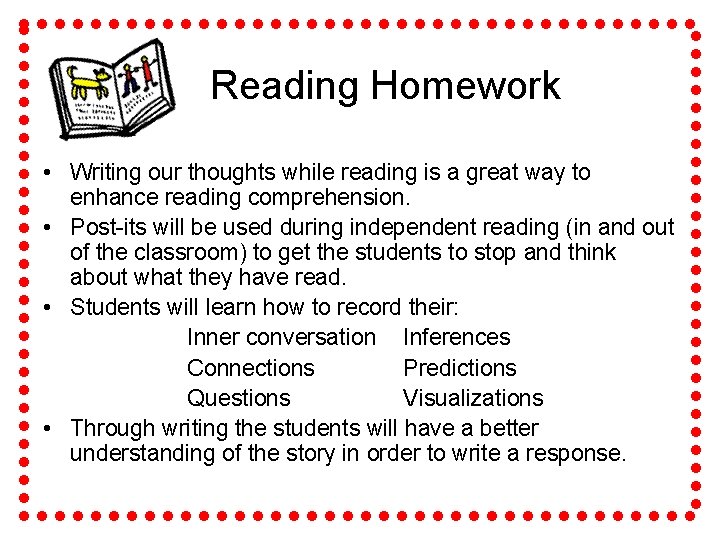
Reading Homework • Writing our thoughts while reading is a great way to enhance reading comprehension. • Post-its will be used during independent reading (in and out of the classroom) to get the students to stop and think about what they have read. • Students will learn how to record their: Inner conversation Inferences Connections Predictions Questions Visualizations • Through writing the students will have a better understanding of the story in order to write a response.
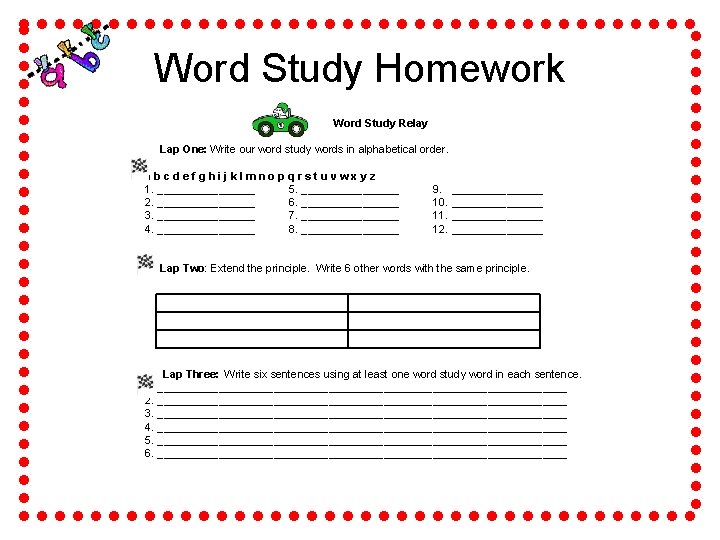
Word Study Homework Word Study Relay Lap One: Write our word study words in alphabetical order. a b c d e f g h i j k l m n o p q r s t u v w x y z 1. ________ 5. ________ 2. ________ 6. ________ 3. ________ 7. ________ 4. ________ 8. ________ 9. ________ 10. ________ 11. ________ 12. ________ Lap Two: Extend the principle. Write 6 other words with the same principle. Lap Three: Write six sentences using at least one word study word in each sentence. 1. __________________________________ 2. __________________________________ 3. __________________________________ 4. __________________________________ 5. __________________________________ 6. __________________________________
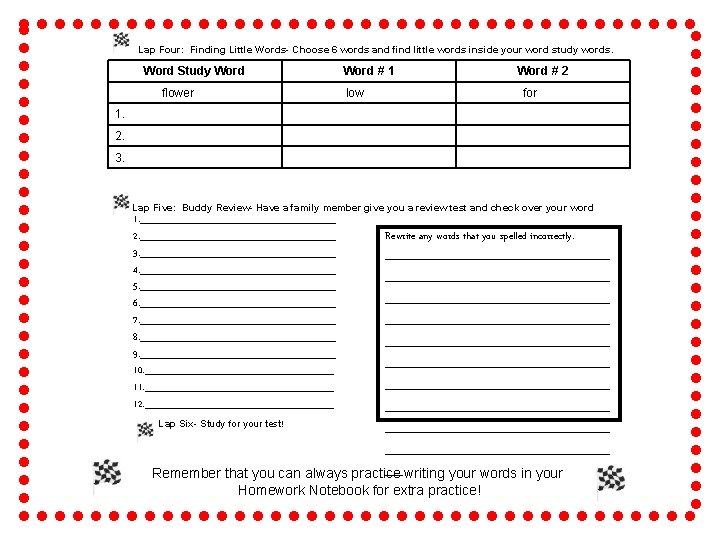
Lap Four: Finding Little Words- Choose 6 words and find little words inside your word study words. Word Study Word flower Word # 1 low Word # 2 for 1. 2. 3. Lap Five: Buddy Review- Have a family member give you a review test and check over your word 1. ______________ 2. ______________ 3. ______________ 4. ______________ 5. ______________ 6. ______________ 7. ______________ 8. ______________ 9. ______________ 10. ______________ 11. ______________ 12. ______________ Lap Six- Study for your test! Rewrite any words that you spelled incorrectly. _________________________ _________________________ _________________________ __ writing your words in your Remember that you can always practice Homework Notebook for extra practice!
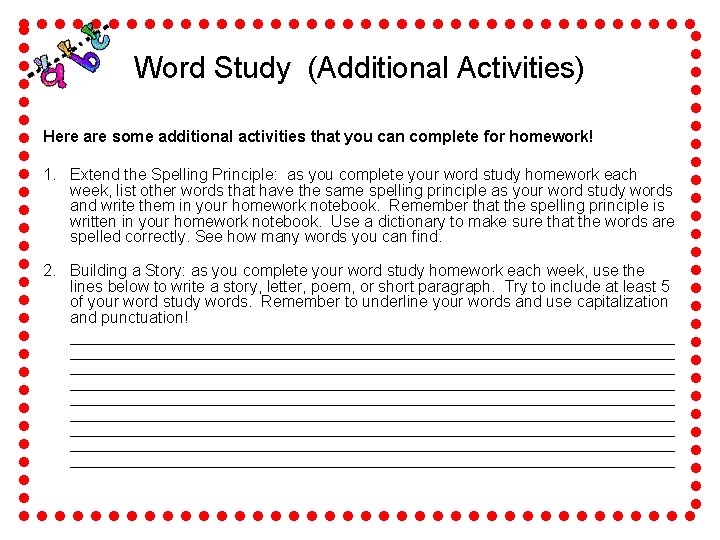
Word Study (Additional Activities) Here are some additional activities that you can complete for homework! 1. Extend the Spelling Principle: as you complete your word study homework each week, list other words that have the same spelling principle as your word study words and write them in your homework notebook. Remember that the spelling principle is written in your homework notebook. Use a dictionary to make sure that the words are spelled correctly. See how many words you can find. 2. Building a Story: as you complete your word study homework each week, use the lines below to write a story, letter, poem, or short paragraph. Try to include at least 5 of your word study words. Remember to underline your words and use capitalization and punctuation! ____________________________________________________________________ ____________________________________________________________________ __________________________________
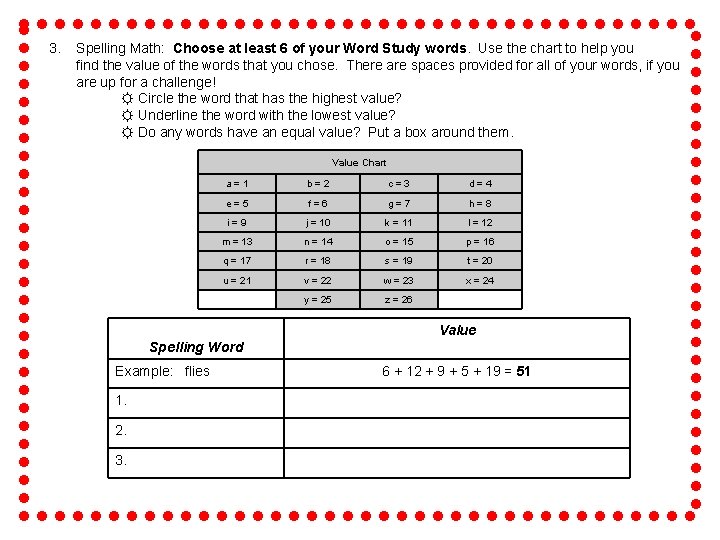
3. Spelling Math: Choose at least 6 of your Word Study words. Use the chart to help you find the value of the words that you chose. There are spaces provided for all of your words, if you are up for a challenge! ☼ Circle the word that has the highest value? ☼ Underline the word with the lowest value? ☼ Do any words have an equal value? Put a box around them. Value Chart a=1 b=2 c=3 d=4 e=5 f=6 g=7 h=8 i=9 j = 10 k = 11 l = 12 m = 13 n = 14 o = 15 p = 16 q = 17 r = 18 s = 19 t = 20 u = 21 v = 22 w = 23 x = 24 y = 25 z = 26 Value Spelling Word Example: flies 1. 2. 3. 6 + 12 + 9 + 5 + 19 = 51
Remember that we are partners in your child’s education. Please feel free to contact me with any questions, comments or concerns that you may have. ☼ School Phone Number: (914) 422 -2400 ☼ Email Address: valentinacardile@wpcsd. k 12. ny. us