
Welcome to Medicare PRESENTERES NAME Program Basics What

Welcome to Medicare *PRESENTERES NAME*
Program Basics ▪ What is Medicare? ▪ Enrolling in Medicare ▪ Part A and B benefits and costs

What is Medicare? ▪ Health insurance for three groups of people ▪ 65 and older ▪ Under 65 with certain disabilities ▪ Any age with End-Stage Renal Disease ▪ Administered by ▪ Centers for Medicare & Medicaid Services

The Four Parts of Medicare

Automatic Enrollment – Parts A and B ▪ Automatic for those receiving ▪ Social Security benefits ▪ Railroad Retirement Board benefits ▪ Initial Enrollment Period package ▪ Age 65 Mailed 3 months before ▪ 25 th month of disability benefits ▪ Others must enroll themselves

Medicare Card ▪ Keep it and accept Medicare Parts A and B ▪ Return it to refuse Part B ▪ Follow instructions on the back of the card Front Jane Doe Back
When Enrolling is Not Automatic ▪ Some people need to sign up for Medicare ▪ Those not automatically enrolled ▪ For example, if not getting Social Security or Railroad Retirement Board (RBB) benefits ▪ Even if you’re eligible to get Part A premium-free ▪ Enroll through Social Security ▪ RRB for railroad retirees ▪ Apply 3 months before you turn 65 ▪ Don’t have to be retired
General Enrollment Period (GEP) ▪ January 1 through March 31 each year ▪ Coverage effective July 1 ▪ Premium penalty ▪ 10 percent for each 12 -months eligible but not enrolled ▪ Must pay as long as you have Part B ▪ Limited exceptions
Enrolling in Part B If You Have Employer Or Union Coverage ▪ May affect your Part B enrollment rights ▪ You may want to delay enrolling in Part B if ▪ You have employer or union coverage, and ▪ You or your spouse, or family member, if you are disabled, is still working ▪ See how your insurance works with Medicare ▪ Contact your employer/union benefits administrator
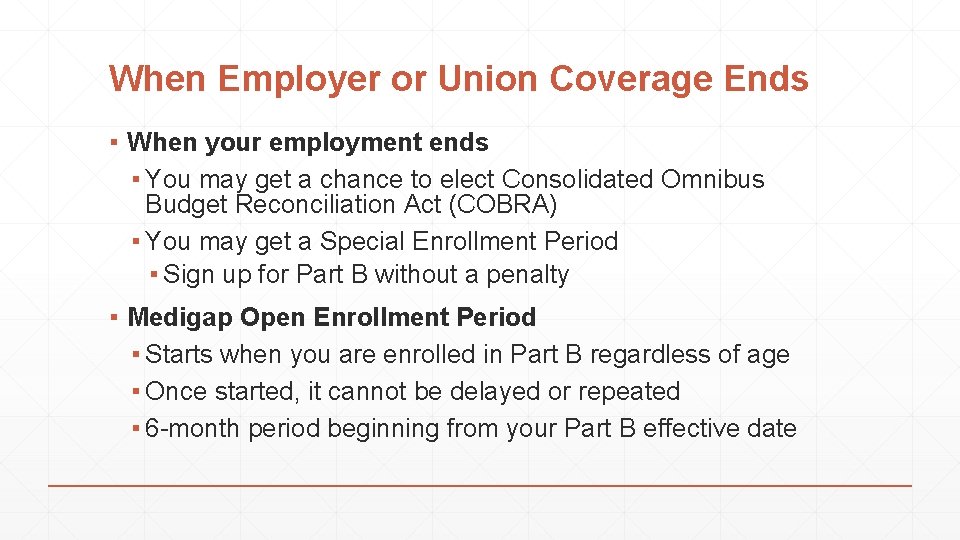
When Employer or Union Coverage Ends ▪ When your employment ends ▪ You may get a chance to elect Consolidated Omnibus Budget Reconciliation Act (COBRA) ▪ You may get a Special Enrollment Period ▪ Sign up for Part B without a penalty ▪ Medigap Open Enrollment Period ▪ Starts when you are enrolled in Part B regardless of age ▪ Once started, it cannot be delayed or repeated ▪ 6 -month period beginning from your Part B effective date
Part A and Part B Benefits and Costs ▪ Medicare Part A (Hospital Insurance) ▪ What’s covered ▪ Part A costs ▪ Medicare Part B (Medical Insurance) ▪ What’s covered ▪ Part B costs

Medicare Part A-Covered Services Inpatient Hospital Stays Semi-private room, meals, general nursing, and other hospital services and supplies. Includes care in critical access hospitals and inpatient rehabilitation facilities. Inpatient mental health care in psychiatric hospital (lifetime 190 -day limit). Generally covers all drugs provided during an inpatient stay received as part of your treatment. Skilled Nursing Facility (SNF) Care Semi-private room, meals, skilled nursing and rehabilitation services, and other services and supplies. Home Health Services Part-time or intermittent skilled nursing care, and/or physical therapy, speechlanguage pathology services, and/or services for people with a continuing need for occupational therapy, some health aide services, medical social services, and medical supplies for use at home. Hospice Care For terminally ill and includes drugs for pain relief and symptom management, medical care, and support services from a Medicare-approved hospice. Blood In most cases, if you need blood as an inpatient, you won’t have to pay for it or replace it.
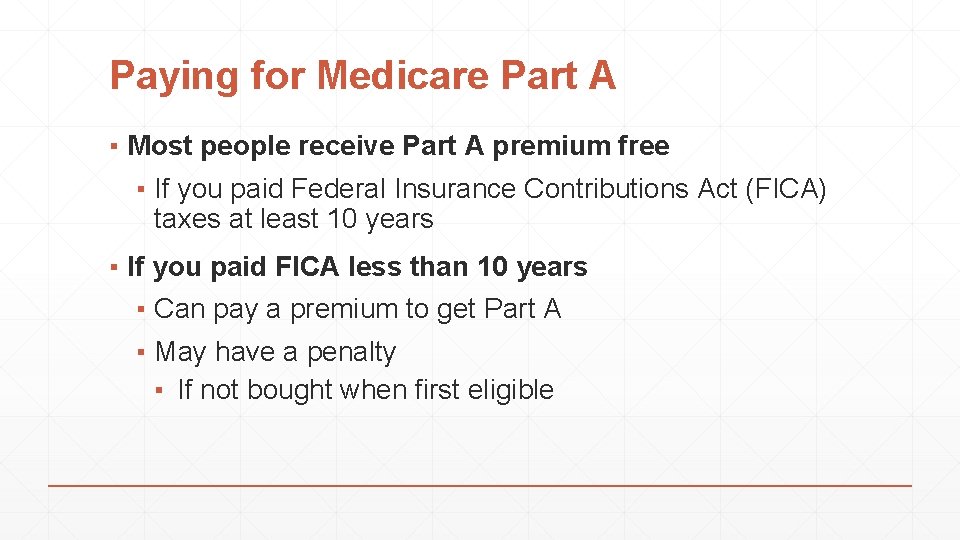
Paying for Medicare Part A ▪ Most people receive Part A premium free ▪ If you paid Federal Insurance Contributions Act (FICA) taxes at least 10 years ▪ If you paid FICA less than 10 years ▪ Can pay a premium to get Part A ▪ May have a penalty ▪ If not bought when first eligible
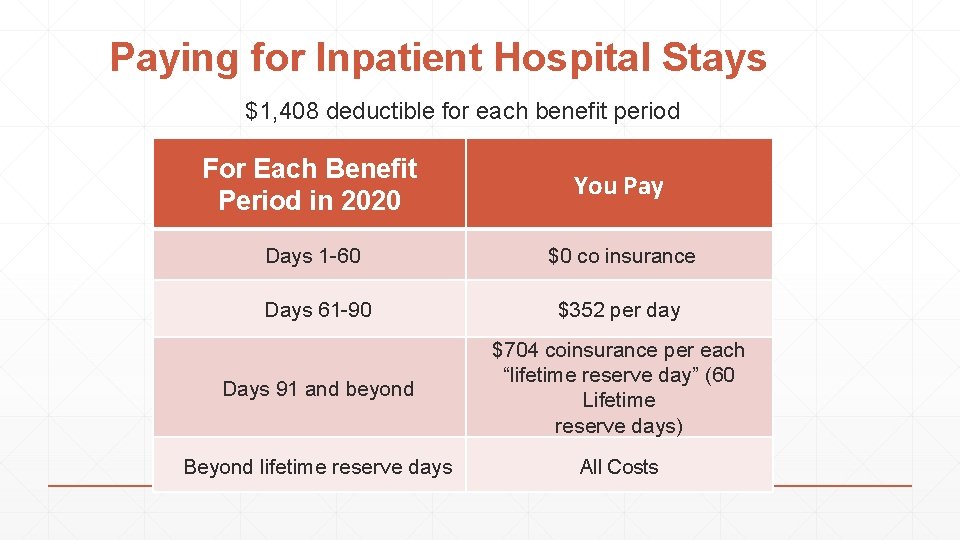
Paying for Inpatient Hospital Stays $1, 408 deductible for each benefit period For Each Benefit Period in 2020 You Pay Days 1 -60 $0 co insurance Days 61 -90 $352 per day Days 91 and beyond $704 coinsurance per each “lifetime reserve day” (60 Lifetime reserve days) Beyond lifetime reserve days All Costs
Skilled Nursing Facility (SNF) Care ▪ Must meet all conditions ▪ Require daily skilled services ▪ Not just long-term or custodial care ▪ Hospital inpatient 3 consecutive days or longer ▪ Admitted to SNF within specific timeframe ▪ Generally 30 days after leaving hospital ▪ SNF care must be for a hospital-treated condition ▪ Or condition that arose while receiving care in the SNF for hospital-treated condition ▪ Must be a Medicare-participating SNF
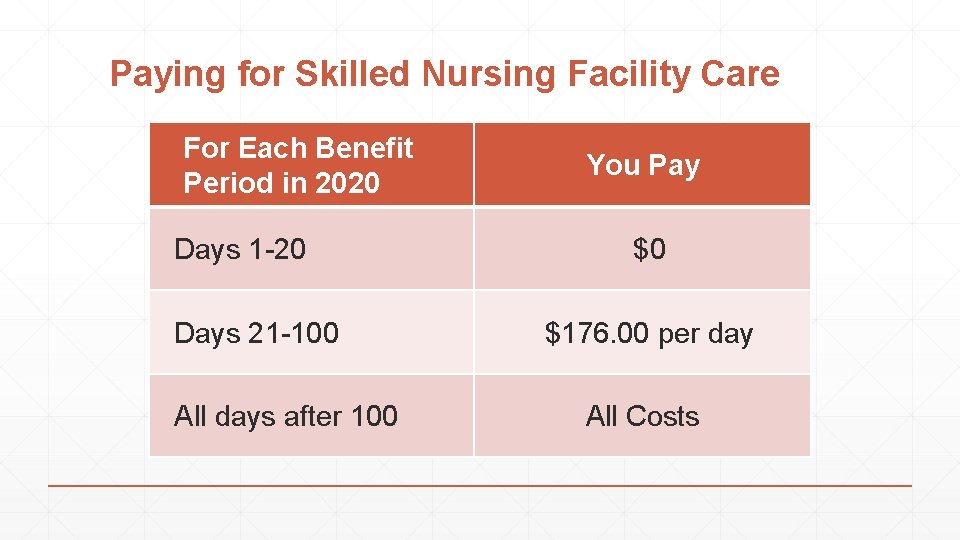
Paying for Skilled Nursing Facility Care For Each Benefit Period in 2020 Days 1 -20 Days 21 -100 All days after 100 You Pay $0 $176. 00 per day All Costs
Five Conditions for Home Health Care ▪ Must be homebound ▪ New definition of “homebound” has been clarified to more accurately reflect the definition in Section 1835(a) of the Social Security Act ▪ Must need skilled care on part-time or intermittent basis ▪ Must be under care of a doctor ▪ Receiving services under a plan of care ▪ Have face-to-face encounter with doctor ▪ Prior to start of care ▪ Home health agency must be Medicare-approved
Paying for Home Health Care ▪ Fully covered by Medicare ▪ Plan of care reviewed every 60 days ▪ Called episode of care ▪ In Original Medicare you pay ▪ Nothing for covered home health care services ▪ 20 percent of Medicare-approved amount ▪ For durable medical equipment ▪ Covered by Part B
Hospice Care ▪ Special care for the terminally ill and family ▪ Expected to live 6 months or less ▪ Focus on comfort and pain relief, not cure ▪ Doctor must certify each “benefit period” ▪ Two 90 -day periods ▪ Then unlimited 60 -day periods ▪ Face-to-face encounter ▪ Hospice provider must be Medicare-approved
Covered Hospice Services ▪ Physician and nursing services ▪ Physical, occupational, and speech therapy ▪ Medical equipment and supplies ▪ Drugs for symptom control and pain relief ▪ Short-term hospital inpatient care ▪ Respite care in a Medicare-certified facility ▪ Up to 5 days each time, no limit to times ▪ Hospice aide and homemaker services ▪ Social worker services ▪ Grief, dietary and other counseling
Paying for Hospice Care ▪ In Original Medicare you pay ▪ Nothing for hospice care ▪ Up to $5 per Rx to manage pain and symptoms ▪ While at home ▪ 5 percent for inpatient respite care ▪ Room and board may be covered ▪ Short-term respite care or for pain/symptom management ▪ If you have Medicaid and live in nursing facility
Blood (Inpatient) ▪ If hospital gets blood free from a blood bank ▪ You won’t have to pay for it or replace it ▪ If hospital has to buy blood for you ▪ You pay for first 3 units per a calendar year, or ▪ You or someone else donates to replace blood
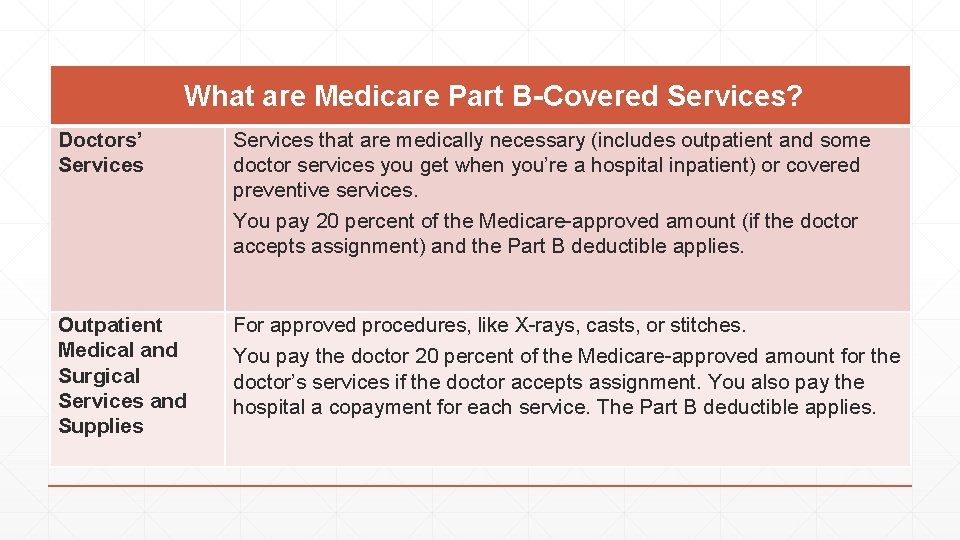
What are Medicare Part B-Covered Services? Doctors’ Services that are medically necessary (includes outpatient and some doctor services you get when you’re a hospital inpatient) or covered preventive services. You pay 20 percent of the Medicare-approved amount (if the doctor accepts assignment) and the Part B deductible applies. Outpatient Medical and Surgical Services and Supplies For approved procedures, like X-rays, casts, or stitches. You pay the doctor 20 percent of the Medicare-approved amount for the doctor’s services if the doctor accepts assignment. You also pay the hospital a copayment for each service. The Part B deductible applies.
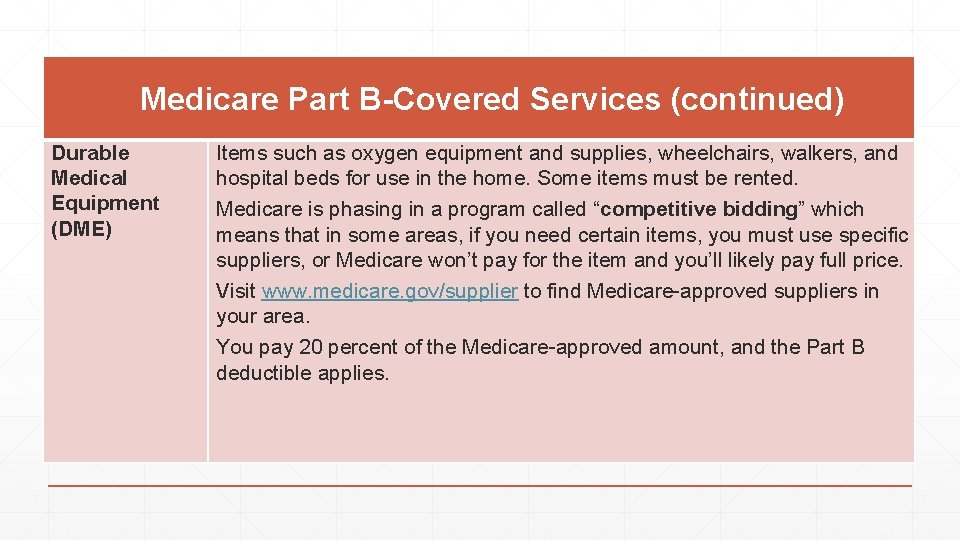
Medicare Part B-Covered Services (continued) Durable Medical Equipment (DME) Items such as oxygen equipment and supplies, wheelchairs, walkers, and hospital beds for use in the home. Some items must be rented. Medicare is phasing in a program called “competitive bidding” which means that in some areas, if you need certain items, you must use specific suppliers, or Medicare won’t pay for the item and you’ll likely pay full price. Visit www. medicare. gov/supplier to find Medicare-approved suppliers in your area. You pay 20 percent of the Medicare-approved amount, and the Part B deductible applies.
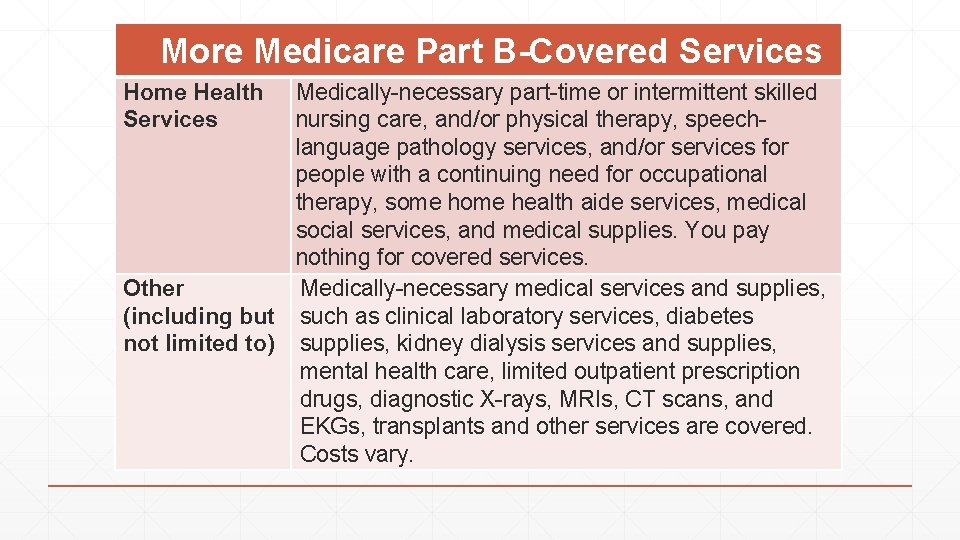
More Medicare Part B-Covered Services Home Health Services Medically-necessary part-time or intermittent skilled nursing care, and/or physical therapy, speechlanguage pathology services, and/or services for people with a continuing need for occupational therapy, some health aide services, medical social services, and medical supplies. You pay nothing for covered services. Other Medically-necessary medical services and supplies, (including but such as clinical laboratory services, diabetes not limited to) supplies, kidney dialysis services and supplies, mental health care, limited outpatient prescription drugs, diagnostic X-rays, MRIs, CT scans, and EKGs, transplants and other services are covered. Costs vary.
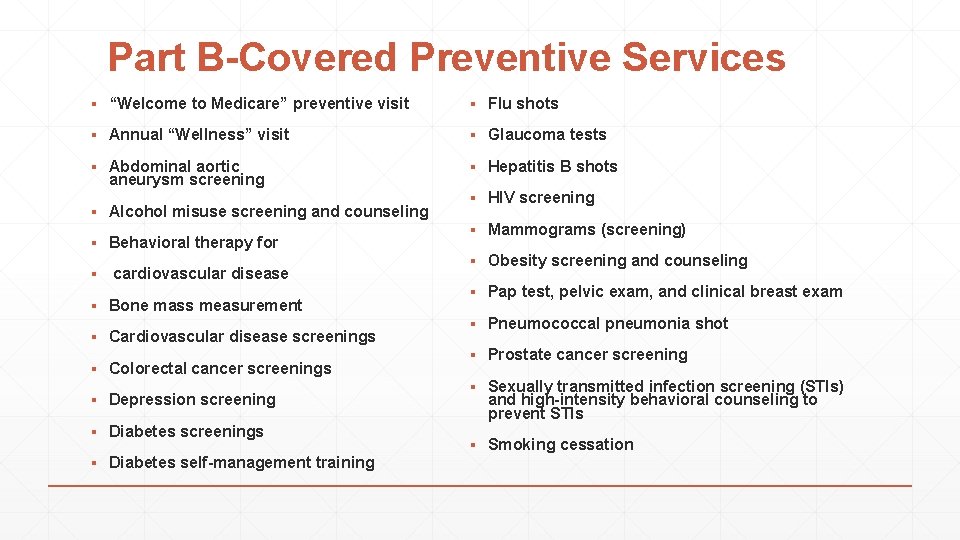
Part B-Covered Preventive Services ▪ “Welcome to Medicare” preventive visit ▪ Flu shots ▪ Annual “Wellness” visit ▪ Glaucoma tests ▪ Abdominal aortic aneurysm screening ▪ Hepatitis B shots ▪ Alcohol misuse screening and counseling ▪ Behavioral therapy for ▪ cardiovascular disease ▪ Bone mass measurement ▪ Cardiovascular disease screenings ▪ Colorectal cancer screenings ▪ Depression screening ▪ Diabetes screenings ▪ Diabetes self-management training ▪ HIV screening ▪ Mammograms (screening) ▪ Obesity screening and counseling ▪ Pap test, pelvic exam, and clinical breast exam ▪ Pneumococcal pneumonia shot ▪ Prostate cancer screening ▪ Sexually transmitted infection screening (STIs) and high-intensity behavioral counseling to prevent STIs ▪ Smoking cessation
NOT Covered by Part A and Part B ▪ Long-term care ▪ Routine dental care ▪ Dentures ▪ Cosmetic surgery ▪ Acupuncture ▪ Hearing aids and exams for fitting hearing aids ▪ Other – check on www. medicare. gov
Paying for Part B Services ▪ In Original Medicare you pay ▪ Yearly deductible of $198 in 2020 ▪ 20 percent coinsurance for most services ▪ Some programs may help pay these costs
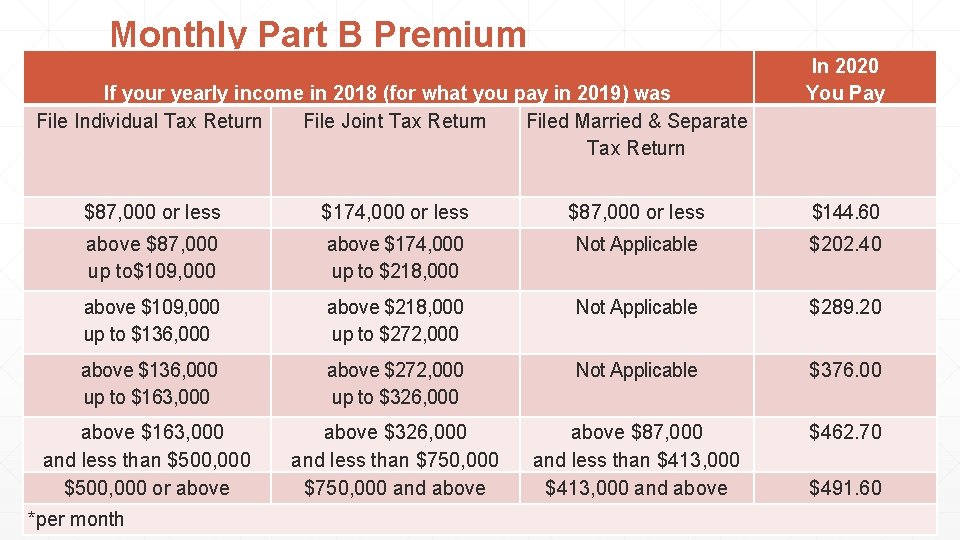
Monthly Part B Premium If your yearly income in 2018 (for what you pay in 2019) was File Individual Tax Return File Joint Tax Return Filed Married & Separate Tax Return In 2020 You Pay $87, 000 or less $174, 000 or less $87, 000 or less $144. 60 above $87, 000 up to$109, 000 above $174, 000 up to $218, 000 Not Applicable $202. 40 above $109, 000 up to $136, 000 above $218, 000 up to $272, 000 Not Applicable $289. 20 above $136, 000 up to $163, 000 above $272, 000 up to $326, 000 Not Applicable $376. 00 above $163, 000 above $326, 000 above $87, 000 $462. 70 ▪ Note: Premiums are usually deducted from your Social Security benefit payment and less than $500, 000 and less than $750, 000 and less than $413, 000 $500, 000 or above $750, 000 and above $413, 000 and above $491. 60 *per month
Paying the Part B Premium ▪ Deducted monthly from ▪ Social Security benefit payments ▪ Railroad retirement benefit payments ▪ Federal retirement benefit payments ▪ If not deducted ▪ Billed every 3 months ▪ Medicare Easy Pay to deduct from bank account ▪ Contact Social Security, the Railroad Retirement Board or Office of Personnel Management about premiums
Part B Late Enrollment Penalty ▪ Penalty for not signing up when first eligible ▪ 10 percent more for each full 12 -month period ▪ May have penalty as long as you have Part B ▪ Sign up during a Special Enrollment Period ▪ Usually no penalty
Your Medicare Coverage Choices ▪ Original Medicare (Part A and Part B) ▪ Assignment ▪ Private Contracts ▪ Medigap Policies ▪ Medicare Advantage Plans (Part C) ▪ Other Medicare Health Plans ▪ Medicare Prescription Drug Coverage (Part D)
What is Original Medicare? ▪ Health care option run by the federal government ▪ Provides your Part A and/or Part B coverage ▪ See any doctor or hospital that accepts Medicare ▪ You pay ▪ Part B premium (Part A is usually premium free) ▪ Deductibles, coinsurance or copayments ▪ Get Medicare Summary Notice ▪ Can join a Part D plan to add drug coverage
Assignment ▪ Doctor, provider, supplier accepts assignment ▪ Signed an agreement with Medicare ▪ Or is required by law ▪ Accept the Medicare-approved amount ▪ As full payment for covered services ▪ Only charge Medicare deductible/coinsurance amount ▪ Most accept assignment ▪ They submit your claim to Medicare directly
Assignment (continued) ▪ Providers and suppliers that don’t accept assignment ▪ May charge you more ▪ The limiting charge is 15 percent more ▪ May have to pay entire charge at time of service ▪ Providers sometimes must accept assignment ▪ Medicare Part B-covered prescription drugs ▪ Ambulance suppliers
Private Contracts ▪ Agreement between you and your doctor ▪ Doctor doesn’t furnish services through Medicare ▪ Original Medicare and Medigap will not pay ▪ Other Medicare plans will not pay ▪ You’ll pay full amount for the services you get ▪ No claim should be submitted ▪ Can’t be asked to sign in an emergency
Medigap (Medicare Supplement Insurance) Policies ▪ Private health insurance for individuals ▪ Sold by private insurance companies ▪ Supplement Original Medicare coverage ▪ Follow federal/state laws that protect you ▪ Medigap Open Enrollment Period ▪ Starts when you are enrolled in Part B regardless of age ▪ Once started, it cannot be delayed or repeated ▪ 6 -month period beginning from your Part B effective date
Medigap Policies ▪ You pay a monthly premium ▪ Costs vary by plan, company and location ▪ Medigap insurance companies can only sell a “standardized” Medigap policy ▪ Identified in most states by letters ▪ MA, MN, and WI standardize their plans differently ▪ Doesn’t work with Medicare Advantage ▪ No networks except with a Medicare SELECT policy
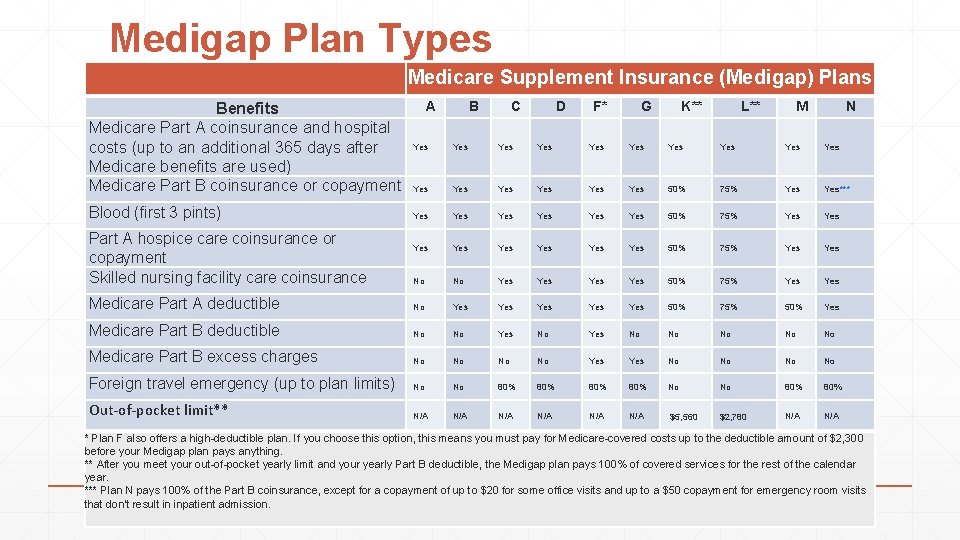
Medigap Plan Types Medicare Supplement Insurance (Medigap) Plans A B C D F* G K** L** M N Benefits Medicare Part A coinsurance and hospital costs (up to an additional 365 days after Medicare benefits are used) Medicare Part B coinsurance or copayment Yes Yes Yes Yes 50% 75% Yes*** Blood (first 3 pints) Yes Yes Yes 50% 75% Yes Yes No No Yes Yes 50% 75% Yes Medicare Part A deductible No Yes Yes Yes 50% 75% 50% Yes Medicare Part B deductible No No Yes No No No Medicare Part B excess charges No No Yes No No Foreign travel emergency (up to plan limits) No No 80% 80% No No 80% Out-of-pocket limit** N/A N/A N/A $5, 560 $2, 780 N/A Part A hospice care coinsurance or copayment Skilled nursing facility care coinsurance * Plan F also offers a high-deductible plan. If you choose this option, this means you must pay for Medicare-covered costs up to the deductible amount of $2, 300 before your Medigap plan pays anything. ** After you meet your out-of-pocket yearly limit and your yearly Part B deductible, the Medigap plan pays 100% of covered services for the rest of the calendar year. *** Plan N pays 100% of the Part B coinsurance, except for a copayment of up to $20 for some office visits and up to a $50 copayment for emergency room visits that don't result in inpatient admission.
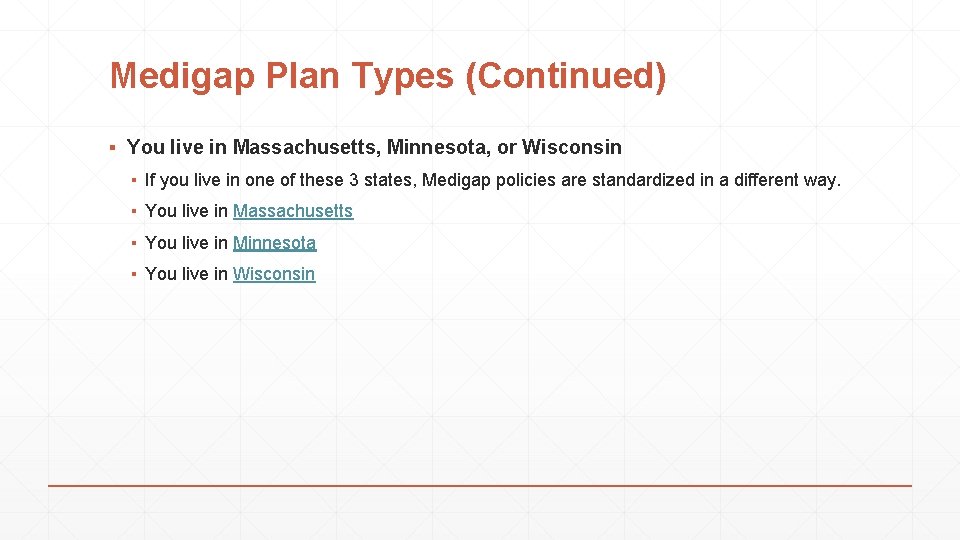
Medigap Plan Types (Continued) ▪ You live in Massachusetts, Minnesota, or Wisconsin ▪ If you live in one of these 3 states, Medigap policies are standardized in a different way. ▪ You live in Massachusetts ▪ You live in Minnesota ▪ You live in Wisconsin
Medicare Advantage (MA) Plans (Part C) ▪ What they are ▪ How the plans work ▪ MA Plan costs ▪ Who can join ▪ When to join and switch plans ▪ Other Medicare health plans
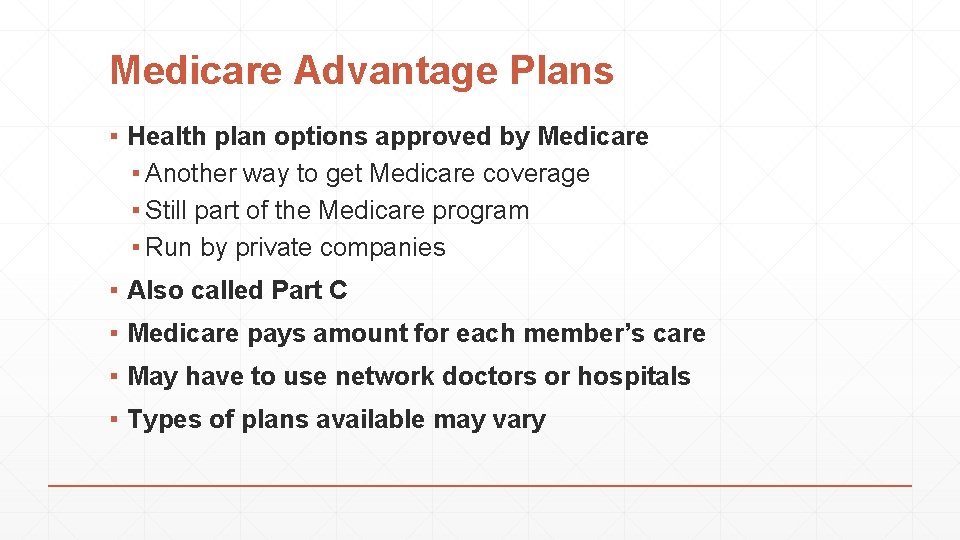
Medicare Advantage Plans ▪ Health plan options approved by Medicare ▪ Another way to get Medicare coverage ▪ Still part of the Medicare program ▪ Run by private companies ▪ Also called Part C ▪ Medicare pays amount for each member’s care ▪ May have to use network doctors or hospitals ▪ Types of plans available may vary
How Medicare Advantage Plans Work ▪ Still in Medicare with all rights and protections ▪ Still get Part A and Part B services ▪ May include prescription drug coverage (Part D) ▪ May include extra benefits ▪ Like vision or dental ▪ Benefits and cost-sharing may be different
Types of Medicare Advantage (MA) Plans ▪ Health Maintenance Organization ▪ HMO Point-of-Service ▪ Preferred Provider Organization ▪ Special Needs Plan ▪ Private Fee-for-Service ▪ Medicare Medical Savings Account
Medicare Advantage Plan Costs ▪ Must still pay Part B premium ▪ Some plans may pay all or part for you ▪ Some people may be eligible for state assistance ▪ You may also pay monthly premium to plan ▪ You pay deductibles/coinsurance/co-payments ▪ Different from Original Medicare ▪ Varies from plan to plan ▪ Costs may be higher if out-of-network
Medicare Advantage Eligibility Requirements ▪ You must live in plan’s service area ▪ You must have Medicare Part A and Part B ▪ You must not have End-Stage Renal Disease when you enroll ▪ Some exceptions ▪ You must provide necessary information ▪ You must follow plan’s rules ▪ You can only belong to one plan at a time
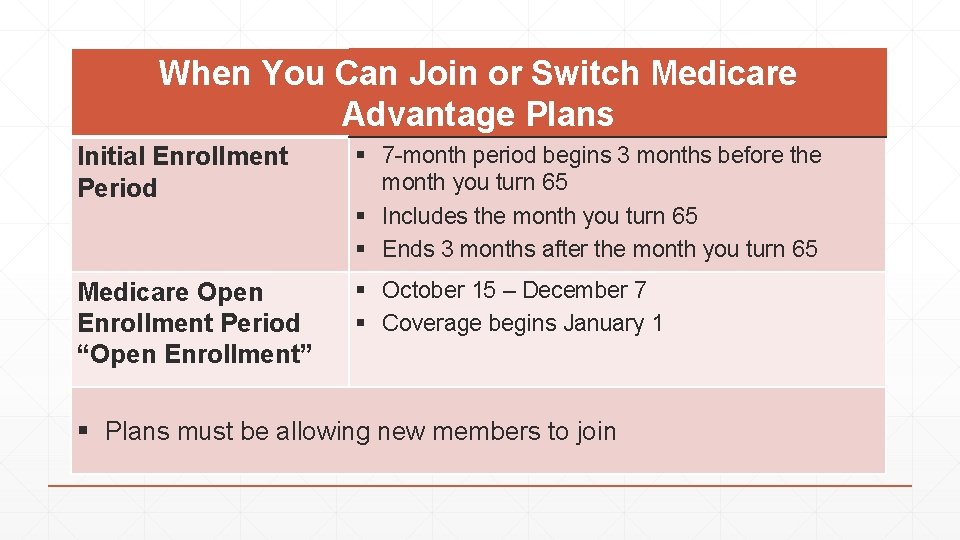
When You Can Join or Switch Medicare Advantage Plans Initial Enrollment Period § 7 -month period begins 3 months before the month you turn 65 § Includes the month you turn 65 § Ends 3 months after the month you turn 65 Medicare Open Enrollment Period “Open Enrollment” § October 15 – December 7 § Coverage begins January 1 § Plans must be allowing new members to join
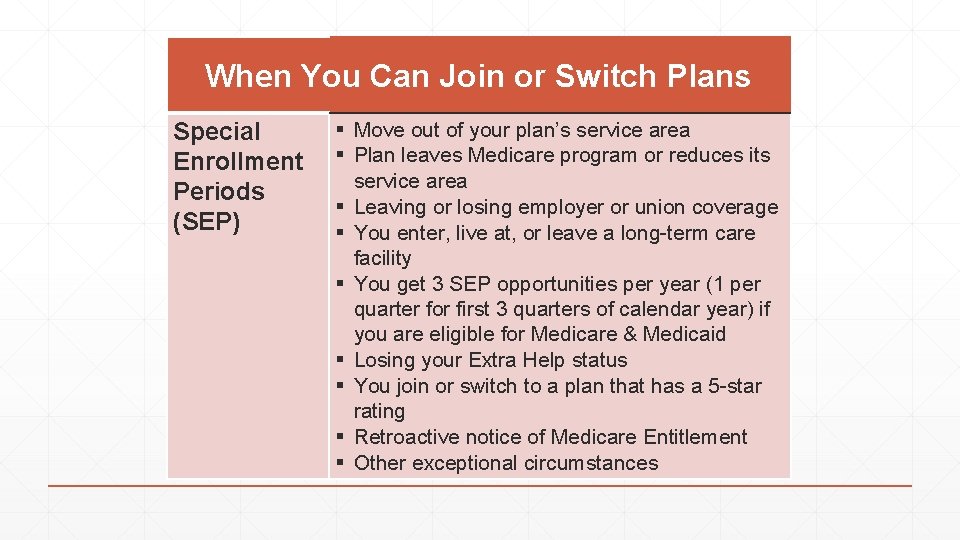
When You Can Join or Switch Plans Special Enrollment Periods (SEP) § Move out of your plan’s service area § Plan leaves Medicare program or reduces its service area § Leaving or losing employer or union coverage § You enter, live at, or leave a long-term care facility § You get 3 SEP opportunities per year (1 per quarter for first 3 quarters of calendar year) if you are eligible for Medicare & Medicaid § Losing your Extra Help status § You join or switch to a plan that has a 5 -star rating § Retroactive notice of Medicare Entitlement § Other exceptional circumstances
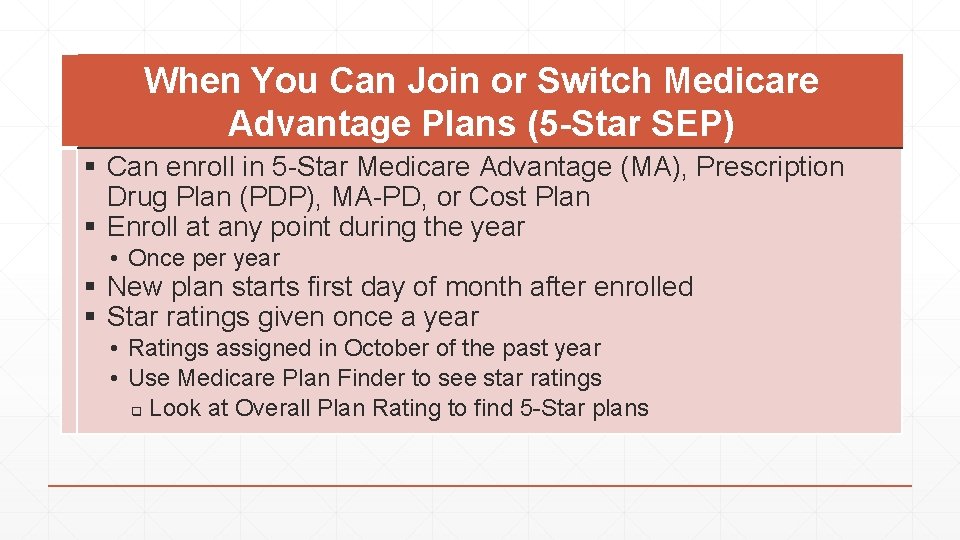
When You Can Join or Switch Medicare Advantage Plans (5 -Star SEP) § Can enroll in 5 -Star Medicare Advantage (MA), Prescription Drug Plan (PDP), MA-PD, or Cost Plan § Enroll at any point during the year • Once per year § New plan starts first day of month after enrolled § Star ratings given once a year • Ratings assigned in October of the past year • Use Medicare Plan Finder to see star ratings q Look at Overall Plan Rating to find 5 -Star plans
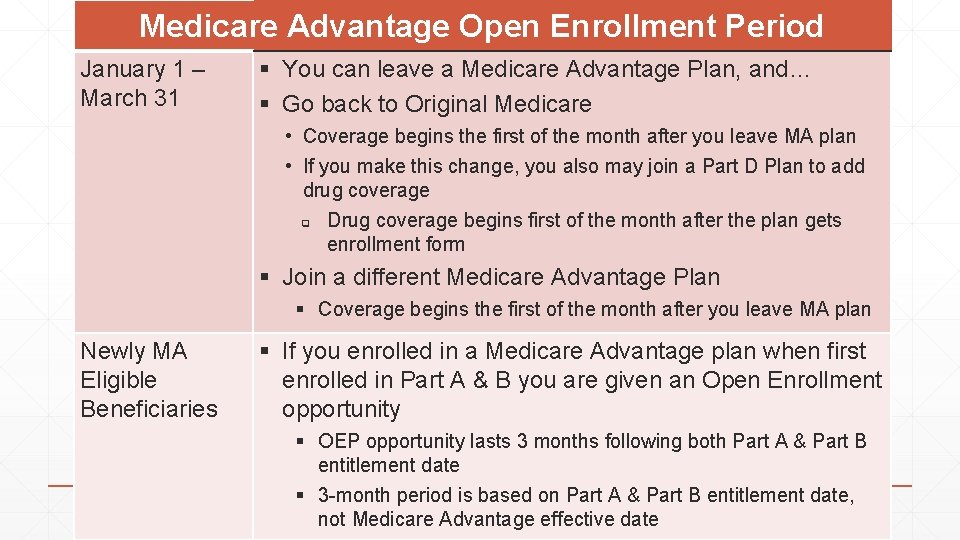
Medicare Advantage Open Enrollment Period January 1 – March 31 § You can leave a Medicare Advantage Plan, and… § Go back to Original Medicare • Coverage begins the first of the month after you leave MA plan • If you make this change, you also may join a Part D Plan to add drug coverage q Drug coverage begins first of the month after the plan gets enrollment form § Join a different Medicare Advantage Plan § Coverage begins the first of the month after you leave MA plan Newly MA Eligible Beneficiaries § If you enrolled in a Medicare Advantage plan when first enrolled in Part A & B you are given an Open Enrollment opportunity § OEP opportunity lasts 3 months following both Part A & Part B entitlement date § 3 -month period is based on Part A & Part B entitlement date, not Medicare Advantage effective date
Other Types of Medicare Health Plans ▪ Other types of Medicare health plans ▪ Not Medicare Advantage Plans ▪ Medicare Cost Plans ▪ Demonstrations and Pilot Programs ▪ Programs of All-inclusive Care for the Elderly (PACE) ▪ Only available in certain areas
Medicare Prescription Drug Coverage ▪ What is Part D? ▪ Part D benefits and costs ▪ Who can join ▪ When to join and switch plans ▪ Part D covered drugs ▪ Drugs not covered ▪ Access to covered drugs
Medicare Prescription Drug Coverage – cont’d ▪ Also called Medicare Part D ▪ Prescription drug plans approved by Medicare ▪ Run by private companies ▪ Available to everyone with Medicare ▪ Must be enrolled in a plan to get coverage ▪ Two sources of coverage ▪ Medicare Prescription Drug Plans (PDPs) ▪ Medicare Advantage Plans with Rx coverage (MA-PDs) ▪ And other Medicare health plans with Rx coverage
Medicare Drug Plan Costs ▪ Costs vary by plan ▪ In 2020, most people will pay ▪ A monthly premium ▪ A yearly deductible ▪ Copayments or coinsurance ▪ Reach a coverage gap once you and plan have paid $4, 020 on covered drugs ▪ 25% for covered brand-name drugs in coverage gap ▪ 25% for covered generic drugs in coverage gap ▪ Very little after spending $6, 350 out-of-pocket
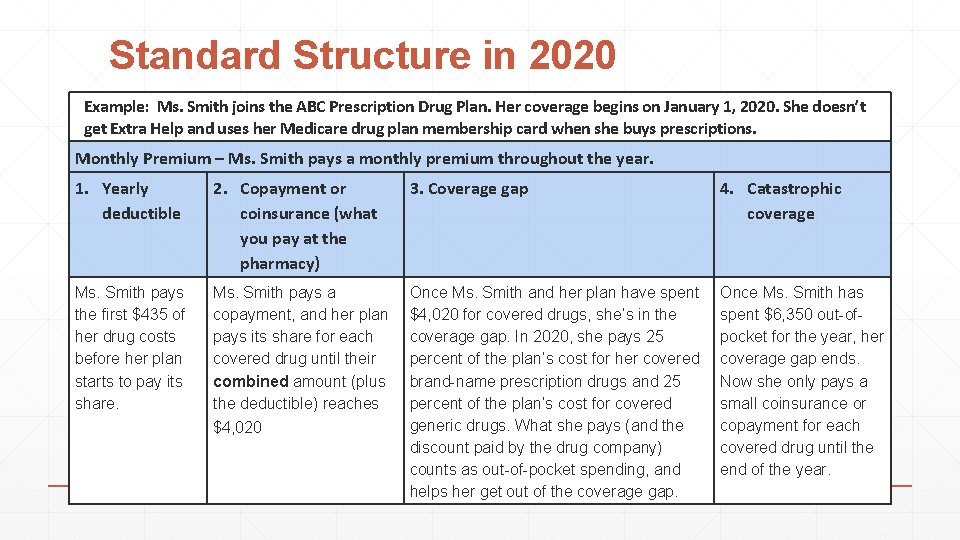
Standard Structure in 2020 Example: Ms. Smith joins the ABC Prescription Drug Plan. Her coverage begins on January 1, 2020. She doesn’t get Extra Help and uses her Medicare drug plan membership card when she buys prescriptions. Monthly Premium – Ms. Smith pays a monthly premium throughout the year. 1. Yearly deductible 2. Copayment or coinsurance (what you pay at the pharmacy) 3. Coverage gap 4. Catastrophic coverage Ms. Smith pays the first $435 of her drug costs before her plan starts to pay its share. Ms. Smith pays a copayment, and her plan pays its share for each covered drug until their combined amount (plus the deductible) reaches Once Ms. Smith and her plan have spent $4, 020 for covered drugs, she’s in the coverage gap. In 2020, she pays 25 percent of the plan’s cost for her covered brand-name prescription drugs and 25 percent of the plan’s cost for covered generic drugs. What she pays (and the discount paid by the drug company) counts as out-of-pocket spending, and helps her get out of the coverage gap. Once Ms. Smith has spent $6, 350 out-ofpocket for the year, her coverage gap ends. Now she only pays a small coinsurance or copayment for each covered drug until the end of the year. $4, 020
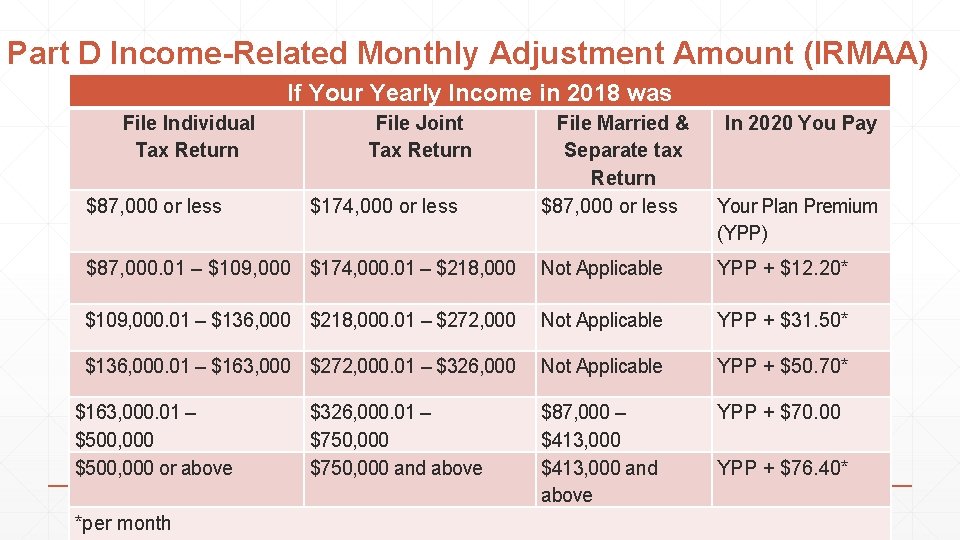
Part D Income-Related Monthly Adjustment Amount (IRMAA) If Your Yearly Income in 2018 was File Individual Tax Return $87, 000 or less File Joint Tax Return $174, 000 or less File Married & Separate tax Return $87, 000 or less In 2020 You Pay Your Plan Premium (YPP) $87, 000. 01 – $109, 000 $174, 000. 01 – $218, 000 Not Applicable YPP + $12. 20* $109, 000. 01 – $136, 000 $218, 000. 01 – $272, 000 Not Applicable YPP + $31. 50* $136, 000. 01 – $163, 000 $272, 000. 01 – $326, 000 Not Applicable YPP + $50. 70* $87, 000 – $413, 000 and above YPP + $70. 00 $163, 000. 01 – $500, 000 or above *per month $326, 000. 01 – $750, 000 and above YPP + $76. 40*
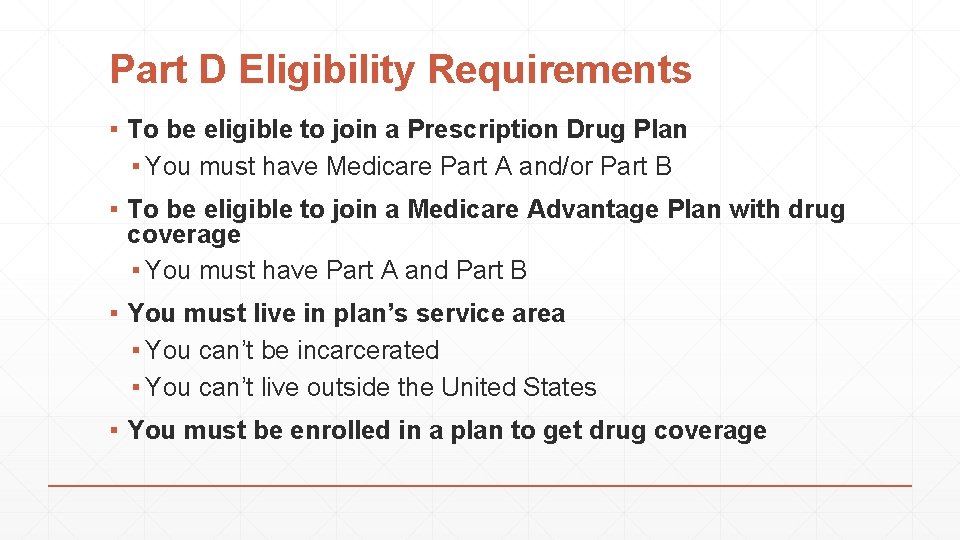
Part D Eligibility Requirements ▪ To be eligible to join a Prescription Drug Plan ▪ You must have Medicare Part A and/or Part B ▪ To be eligible to join a Medicare Advantage Plan with drug coverage ▪ You must have Part A and Part B ▪ You must live in plan’s service area ▪ You can’t be incarcerated ▪ You can’t live outside the United States ▪ You must be enrolled in a plan to get drug coverage
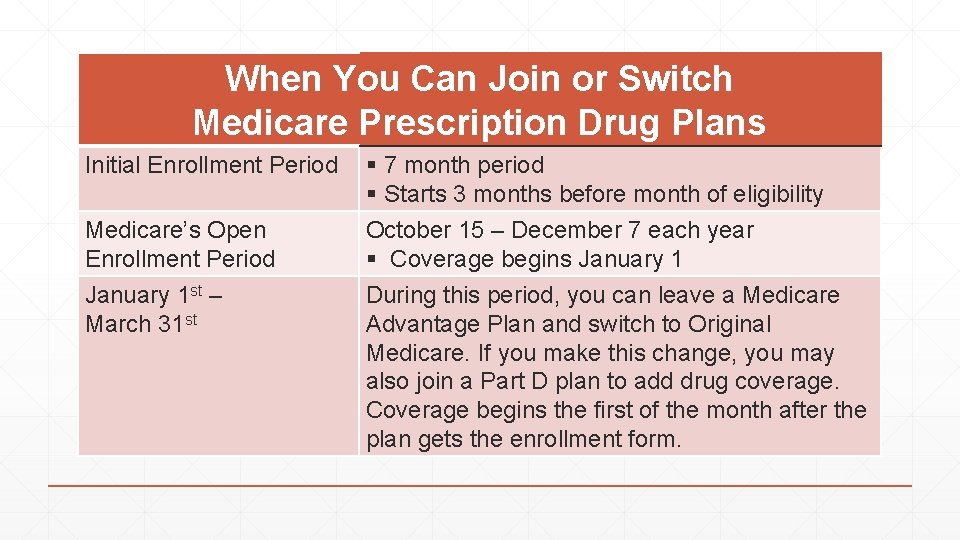
When You Can Join or Switch Medicare Prescription Drug Plans Initial Enrollment Period Medicare’s Open Enrollment Period January 1 st – March 31 st § 7 month period § Starts 3 months before month of eligibility October 15 – December 7 each year § Coverage begins January 1 During this period, you can leave a Medicare Advantage Plan and switch to Original Medicare. If you make this change, you may also join a Part D plan to add drug coverage. Coverage begins the first of the month after the plan gets the enrollment form.
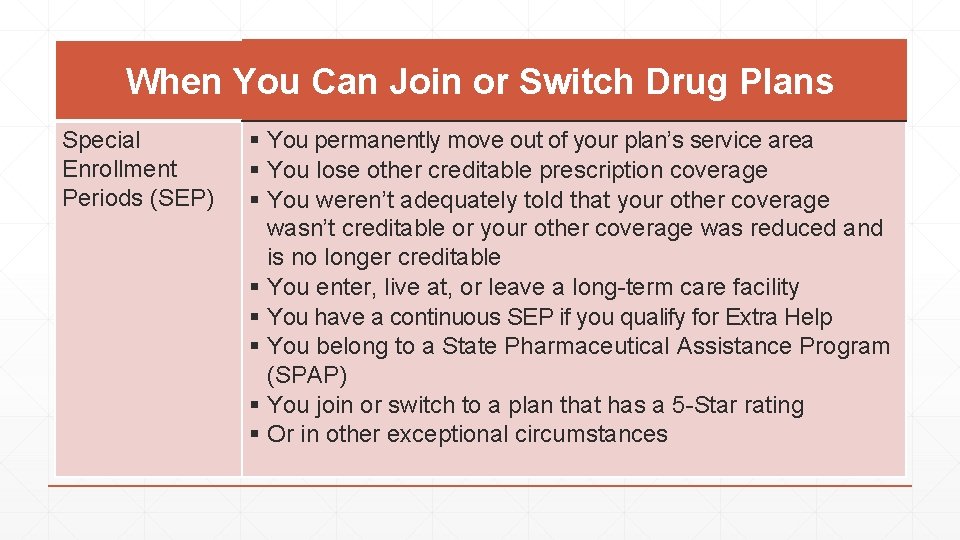
When You Can Join or Switch Drug Plans Special Enrollment Periods (SEP) § You permanently move out of your plan’s service area § You lose other creditable prescription coverage § You weren’t adequately told that your other coverage wasn’t creditable or your other coverage was reduced and is no longer creditable § You enter, live at, or leave a long-term care facility § You have a continuous SEP if you qualify for Extra Help § You belong to a State Pharmaceutical Assistance Program (SPAP) § You join or switch to a plan that has a 5 -Star rating § Or in other exceptional circumstances
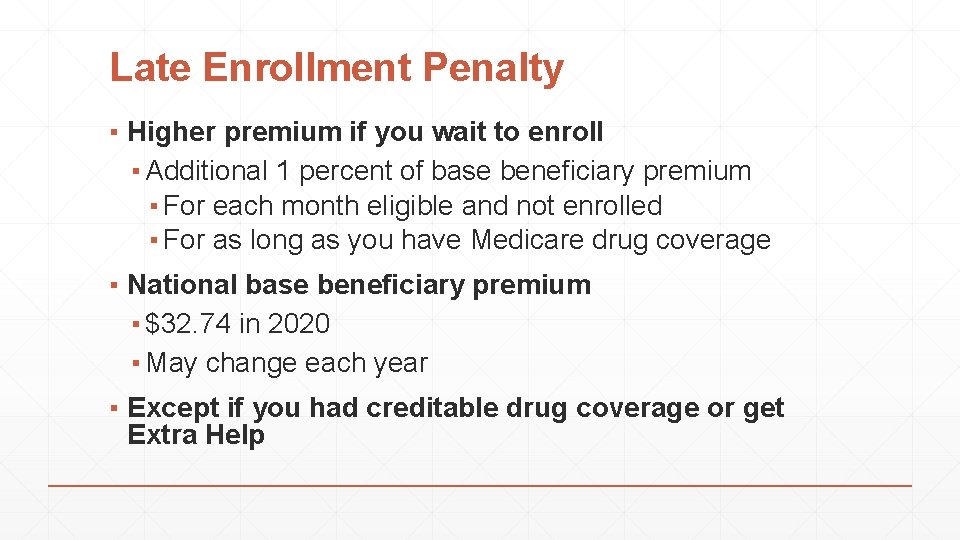
Late Enrollment Penalty ▪ Higher premium if you wait to enroll ▪ Additional 1 percent of base beneficiary premium ▪ For each month eligible and not enrolled ▪ For as long as you have Medicare drug coverage ▪ National base beneficiary premium ▪ $32. 74 in 2020 ▪ May change each year ▪ Except if you had creditable drug coverage or get Extra Help
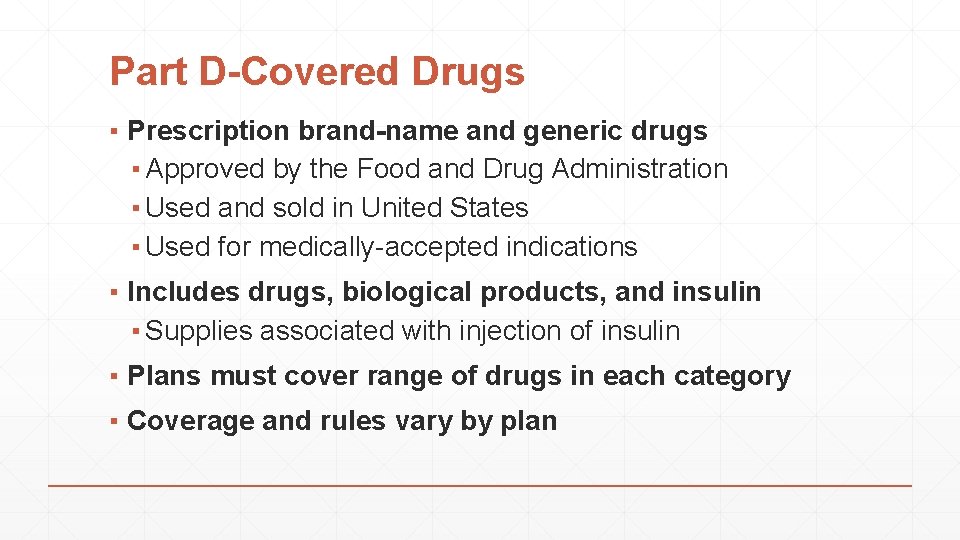
Part D-Covered Drugs ▪ Prescription brand-name and generic drugs ▪ Approved by the Food and Drug Administration ▪ Used and sold in United States ▪ Used for medically-accepted indications ▪ Includes drugs, biological products, and insulin ▪ Supplies associated with injection of insulin ▪ Plans must cover range of drugs in each category ▪ Coverage and rules vary by plan
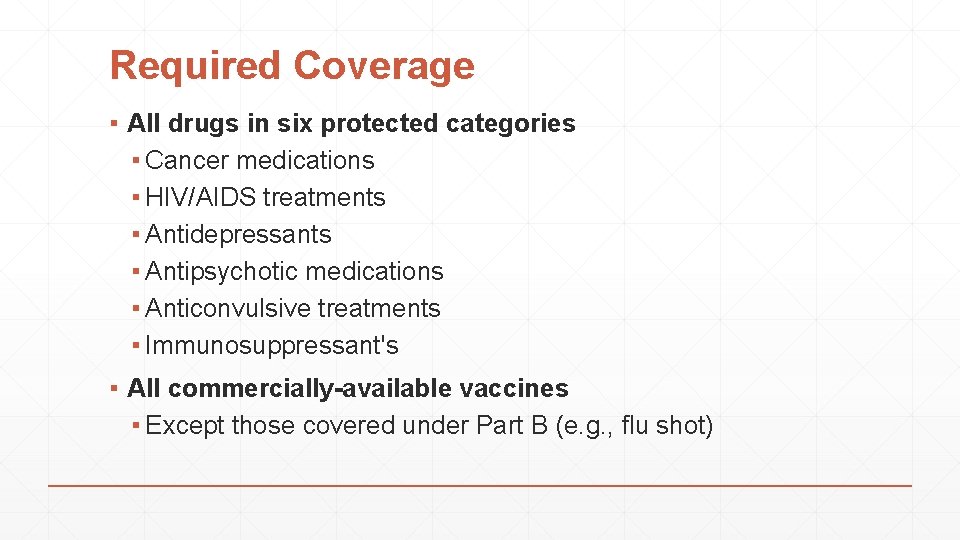
Required Coverage ▪ All drugs in six protected categories ▪ Cancer medications ▪ HIV/AIDS treatments ▪ Antidepressants ▪ Antipsychotic medications ▪ Anticonvulsive treatments ▪ Immunosuppressant's ▪ All commercially-available vaccines ▪ Except those covered under Part B (e. g. , flu shot)
Drugs Excluded by Law Under Part D ▪ Drugs for anorexia, weight loss, or weight gain ▪ Erectile dysfunction drugs when used for the treatment of sexual or erectile dysfunction ▪ Fertility drugs ▪ Drugs for cosmetic or lifestyle purposes ▪ Drugs for symptomatic relief of coughs and colds ▪ Prescription vitamin and mineral products ▪ Non-prescription drugs
Access to Covered Drugs ▪ Plans must cover a range of drugs in each category ▪ Coverage and rules vary by plan ▪ Plans can manage access to drug coverage through ▪ Formularies (list of covered drugs) ▪ Prior authorization (doctor requests before service) ▪ Step therapy (type of prior authorization) ▪ Quantity limits (limits quantity over period of time)
Right to File a Complaint or Appeal ▪ Complaint (sometimes called a grievance) ▪ Quality of services ▪ Care that is received ▪ Appeal a coverage or payment decision ▪ For information contact ▪ Your plan ▪ State Health Insurance Assistance Program (SHIP) ▪ 1 -800 -MEDICARE (1 -800 -633 -4227) ▪ TTY users should call 1 -877 -486 -2048
Programs for People with Limited Income and Resources ▪ Extra Help ▪ Medicaid ▪ Medicare Savings Programs ▪ Help available for people in the U. S. territories
What Is Extra Help? ▪ Program to help people pay for Medicare prescription drug costs ▪ Also called the low-income subsidy ▪ If you have lowest income and resources ▪ Pay no premiums or deductible, and small or no copayments ▪ If you have slightly higher income and resources ▪ Pay reduced deductible and a little more out of pocket ▪ No coverage gap or late enrollment penalty if you qualify for Extra Help
Qualifying for Extra Help ▪ You automatically qualify for Extra Help if you get ▪ Full Medicaid coverage ▪ Supplemental Security Income (SSI) ▪ Help from Medicaid paying your Medicare premiums ▪ All others must apply ▪ Online at socialsecurity. gov ▪ Call Social Security at 1 -800 -772 -1213 (TTY 1 -800 -3250778) ▪ Ask for “Application for Help with Medicare Prescription Drug Plan Costs” (SSA-1020) ▪ Contact your state Medicaid agency
What is Medicaid? ▪ Federal-state health insurance program ▪ For people with limited income/resources ▪ Covers most health care costs ▪ If you have both Medicare and Medicaid ▪ Eligibility determined by state ▪ Application processes and benefits vary ▪ State office names vary ▪ Apply if you MIGHT qualify
Medicare Savings Programs ▪ Help from Medicaid paying Medicare costs ▪ For people with limited income and resources ▪ Often higher income and resources than full Medicaid ▪ Programs include ▪ Qualified Medicare Beneficiary (QMB) ▪ Specified Low-income Medicare Beneficiary (SLMB) ▪ Qualifying Individual (QI) ▪ Qualified Disabled & Working Individuals (QDWI)
Steps to Take ▪ If you think you might qualify 1. Review the income and asset guidelines 2. Collect your personal documents 3. Get more information ▪ Call your state Medical Assistance office ▪ Call your local State Health Insurance Assistance Program ▪ Call your local Area Agency on Aging 4. Complete application with state Medical Assistance office
Programs in U. S. Territories ▪ Help people pay their Medicare costs ▪ U. S. territories ▪ Puerto Rico ▪ Virgin Islands ▪ Guam ▪ Northern Mariana Islands ▪ American Samoa ▪ Programs vary ▪ Contact Medical Assistance office
Medicare and the Marketplace ▪ Medicare isn’t part of the Marketplace ▪ If you have Medicare, you’re covered and don’t need to do anything related to the Marketplace ▪ Marketplace doesn’t offer Medigap or Part D plans ▪ It’s against the law for someone who knows you have Medicare to sell you a Marketplace plan ▪ Even if you only have Part A or Part B
Medicare and the Marketplace (Continued) ▪ People with minimum essential coverage are covered and won’t have to pay a fee ▪ Part A is considered minimum essential coverage ▪ Part B only is not considered minimum essential coverage
Marketplace and Becoming Eligible for Medicare ▪ You can get a Marketplace plan before your Medicare coverage begins ▪ You may cancel the plan when Medicare coverage starts, or ▪ You may keep the plan, but once your Part A coverage starts you won’t be able to get lower costs ▪ Sign up for Medicare during your Initial Enrollment Period ▪ Or you may have to pay a late enrollment penalty for as long as you have Medicare
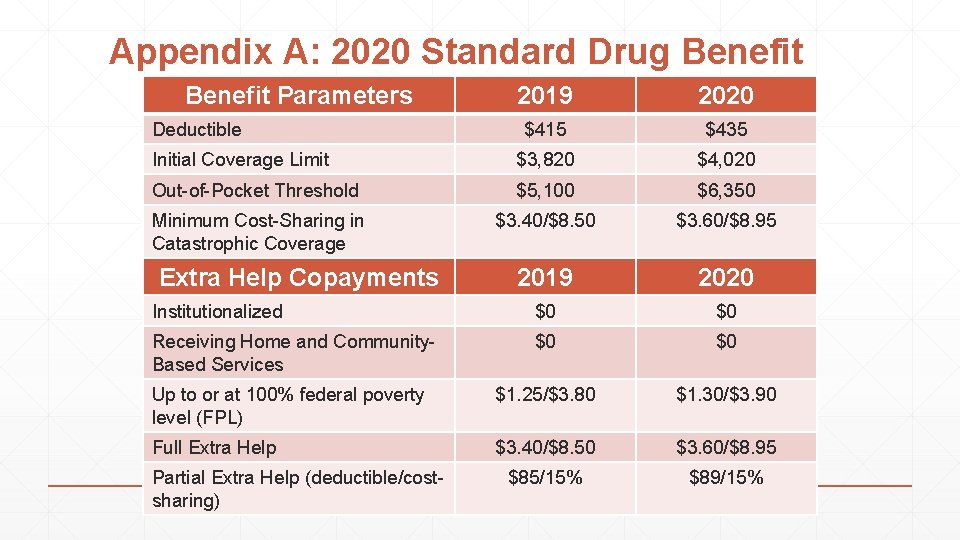
Appendix A: 2020 Standard Drug Benefit Parameters 2019 2020 $415 $435 Initial Coverage Limit $3, 820 $4, 020 Out-of-Pocket Threshold $5, 100 $6, 350 Minimum Cost-Sharing in Catastrophic Coverage $3. 40/$8. 50 $3. 60/$8. 95 2019 2020 Institutionalized $0 $0 Receiving Home and Community. Based Services $0 $0 Up to or at 100% federal poverty level (FPL) $1. 25/$3. 80 $1. 30/$3. 90 Full Extra Help $3. 40/$8. 50 $3. 60/$8. 95 $85/15% $89/15% Deductible Extra Help Copayments Partial Extra Help (deductible/costsharing)
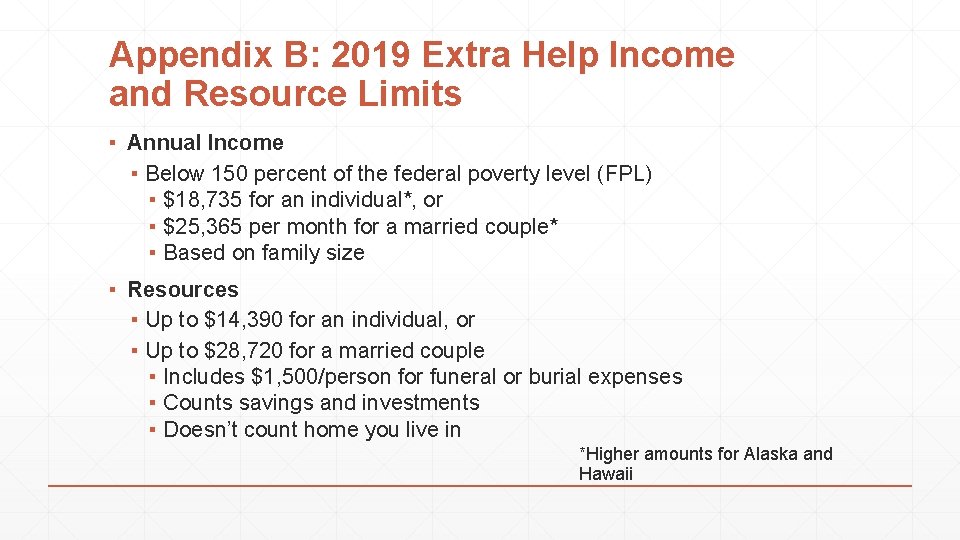
Appendix B: 2019 Extra Help Income and Resource Limits ▪ Annual Income ▪ Below 150 percent of the federal poverty level (FPL) ▪ $18, 735 for an individual*, or ▪ $25, 365 per month for a married couple* ▪ Based on family size ▪ Resources ▪ Up to $14, 390 for an individual, or ▪ Up to $28, 720 for a married couple ▪ Includes $1, 500/person for funeral or burial expenses ▪ Counts savings and investments ▪ Doesn’t count home you live in *Higher amounts for Alaska and Hawaii
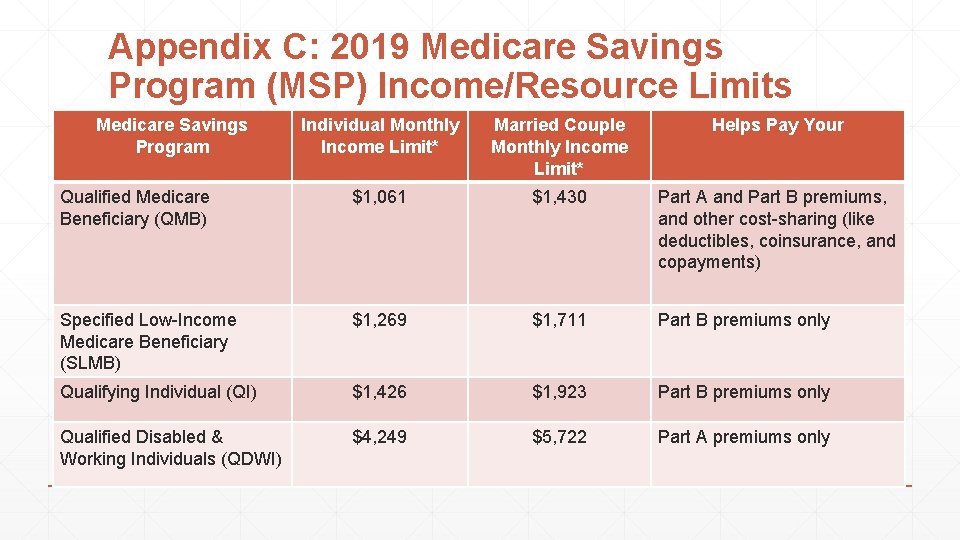
Appendix C: 2019 Medicare Savings Program (MSP) Income/Resource Limits Medicare Savings Program Individual Monthly Income Limit* Married Couple Monthly Income Limit* Helps Pay Your Qualified Medicare Beneficiary (QMB) $1, 061 $1, 430 Part A and Part B premiums, and other cost-sharing (like deductibles, coinsurance, and copayments) Specified Low-Income Medicare Beneficiary (SLMB) $1, 269 $1, 711 Part B premiums only Qualifying Individual (QI) $1, 426 $1, 923 Part B premiums only Qualified Disabled & Working Individuals (QDWI) $4, 249 $5, 722 Part A premiums only

Thank You. Questions?
*Name* *Phone Number* *Email Address*
- Slides: 80