
Welcome to Maynooth University Getting started at MU
- Slides: 25
Welcome to Maynooth University! Getting started at MU & adjusting to your new environment Claire Doran Director of Internationalisation 18 th September 2015
Why are we here? ! 14: 00 – 16: 00 Part 1 Introducing the International Office (IO) Who are we and what do we do? Getting started at MU What? When? Where? Adjusting to your new environment What’s going on? ! Part 2 Introducing the International Society Part 3 Immigration (for non-EU students) 16: 00 – 17: 00 Andy Steves’ Travel Talk Travelling in and around Europe
Introducing the International Office • • Support over 900 students from almost 100 countries Team of 9 staff in Humanity House (South Campus) First point of contact for all international students Information and advice (visas and immigration, English Language courses, on-campus services), letter requests, student support and much more. • Support MU students and staff participating in international mobility programmes: - Erasmus+ exchange and internships (Europe) - Study Abroad (Asia, Australia, N & S America) • Information and advice, management of application process, student support before, during and after studying abroad.
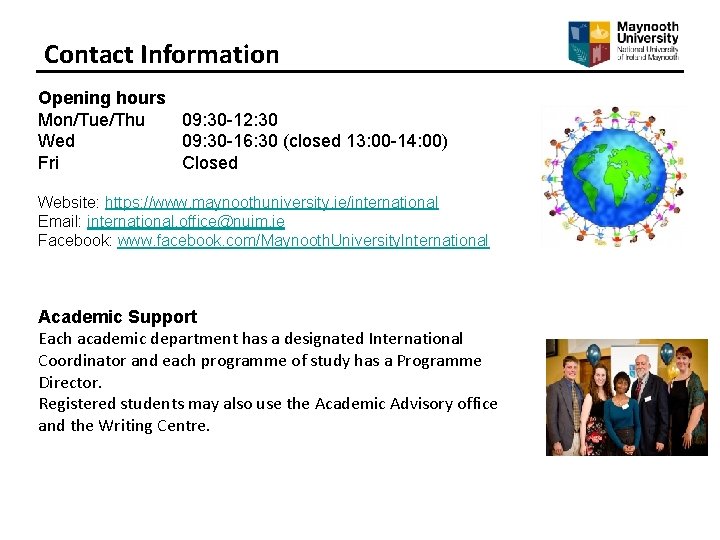
Contact Information Opening hours Mon/Tue/Thu 09: 30 -12: 30 Wed 09: 30 -16: 30 (closed 13: 00 -14: 00) Fri Closed Website: https: //www. maynoothuniversity. ie/international Email: international. office@nuim. ie Facebook: www. facebook. com/Maynooth. University. International Academic Support Each academic department has a designated International Coordinator and each programme of study has a Programme Director. Registered students may also use the Academic Advisory office and the Writing Centre.
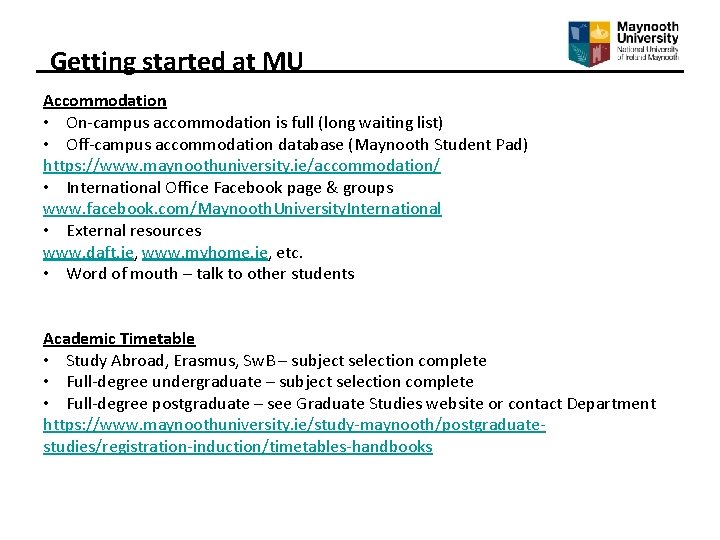
Getting started at MU Accommodation • On-campus accommodation is full (long waiting list) • Off-campus accommodation database (Maynooth Student Pad) https: //www. maynoothuniversity. ie/accommodation/ • International Office Facebook page & groups www. facebook. com/Maynooth. University. International • External resources www. daft. ie, www. myhome. ie, etc. • Word of mouth – talk to other students Academic Timetable • Study Abroad, Erasmus, Sw. B – subject selection complete • Full-degree undergraduate – subject selection complete • Full-degree postgraduate – see Graduate Studies website or contact Department https: //www. maynoothuniversity. ie/study-maynooth/postgraduatestudies/registration-induction/timetables-handbooks
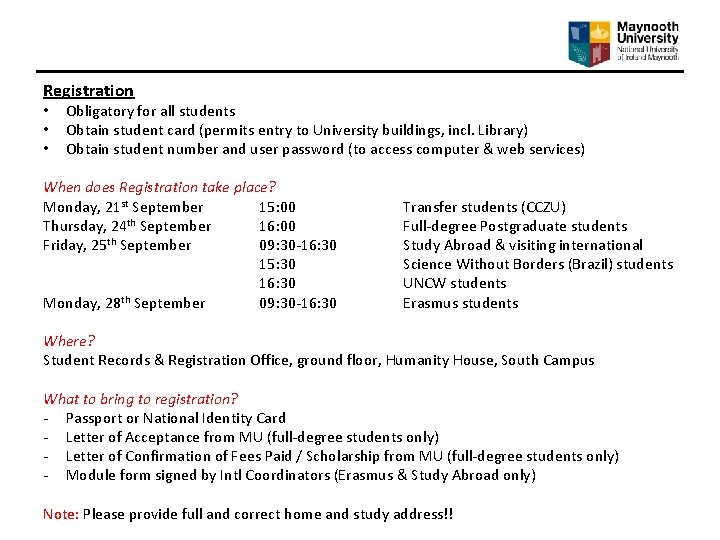
Registration • • • Obligatory for all students Obtain student card (permits entry to University buildings, incl. Library) Obtain student number and user password (to access computer & web services) When does Registration take place? Monday, 21 st September 15: 00 Thursday, 24 th September 16: 00 Friday, 25 th September 09: 30 -16: 30 15: 30 16: 30 th Monday, 28 September 09: 30 -16: 30 Transfer students (CCZU) Full-degree Postgraduate students Study Abroad & visiting international Science Without Borders (Brazil) students UNCW students Erasmus students Where? Student Records & Registration Office, ground floor, Humanity House, South Campus What to bring to registration? - Passport or National Identity Card - Letter of Acceptance from MU (full-degree students only) - Letter of Confirmation of Fees Paid / Scholarship from MU (full-degree students only) - Module form signed by Intl Coordinators (Erasmus & Study Abroad only) Note: Please provide full and correct home and study address!!
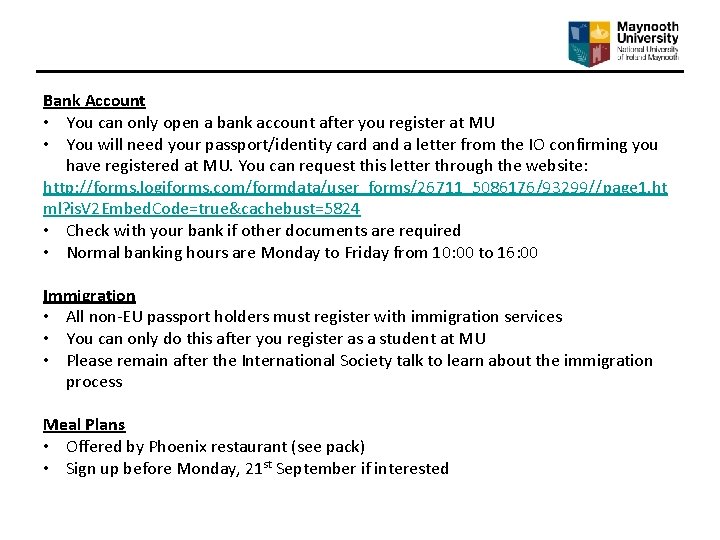
Bank Account • You can only open a bank account after you register at MU • You will need your passport/identity card and a letter from the IO confirming you have registered at MU. You can request this letter through the website: http: //forms. logiforms. com/formdata/user_forms/26711_5086176/93299//page 1. ht ml? is. V 2 Embed. Code=true&cachebust=5824 • Check with your bank if other documents are required • Normal banking hours are Monday to Friday from 10: 00 to 16: 00 Immigration • All non-EU passport holders must register with immigration services • You can only do this after you register as a student at MU • Please remain after the International Society talk to learn about the immigration process Meal Plans • Offered by Phoenix restaurant (see pack) • Sign up before Monday, 21 st September if interested
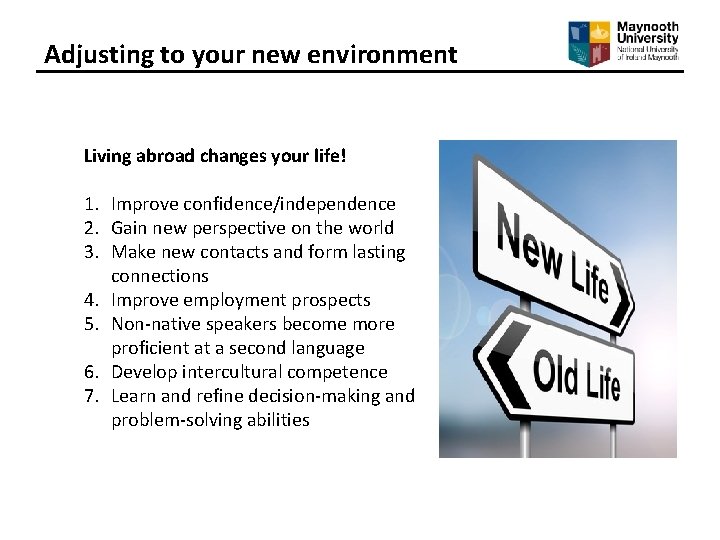
Adjusting to your new environment Living abroad changes your life! 1. Improve confidence/independence 2. Gain new perspective on the world 3. Make new contacts and form lasting connections 4. Improve employment prospects 5. Non-native speakers become more proficient at a second language 6. Develop intercultural competence 7. Learn and refine decision-making and problem-solving abilities
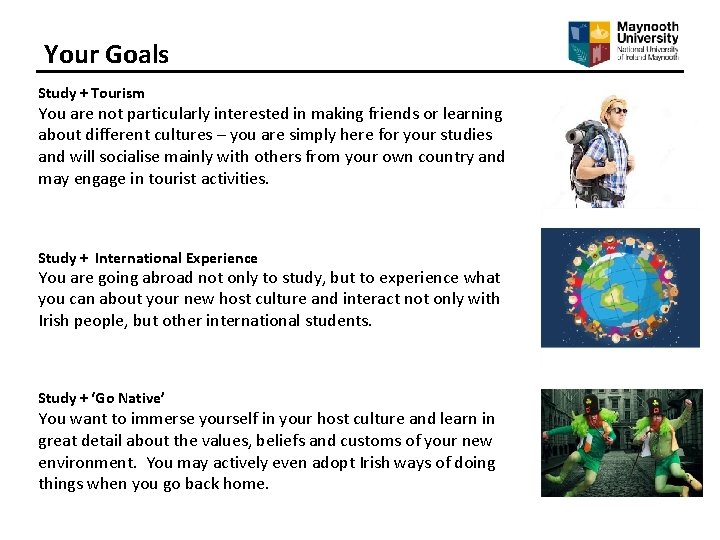
Your Goals Study + Tourism You are not particularly interested in making friends or learning about different cultures – you are simply here for your studies and will socialise mainly with others from your own country and may engage in tourist activities. Study + International Experience You are going abroad not only to study, but to experience what you can about your new host culture and interact not only with Irish people, but other international students. Study + ‘Go Native’ You want to immerse yourself in your host culture and learn in great detail about the values, beliefs and customs of your new environment. You may actively even adopt Irish ways of doing things when you go back home.
Challenge yourself socially! Challenge yourself to interact with others you don’t know and who are different from you. Try to always speak in language of the host country - in this case, English. Don’t wait for others to come to you, it may never happen!
Get involved in student life! Clubs & Societies Over 100 sport and non-sport groups run by students Clubs & Socs Fair on Wednesday, 30 th September (Sports Hall) https: //www. maynoothuniversity. ie/campus-life/student-lifesport/clubs-societies Volunteering Many Societies and academic departments offer opportunities to get involved in volunteering programmes and events in the community, e. g. Saint Vincent de Paul, Galway Cycle, etc. Sports Facilities Range of indoor and outdoor facilities on campus https: //www. maynoothuniversity. ie/campus-life/sports Maynooth Students’ Union (MSU) Representative body for students https: //www. facebook. com/Maynooth. SU
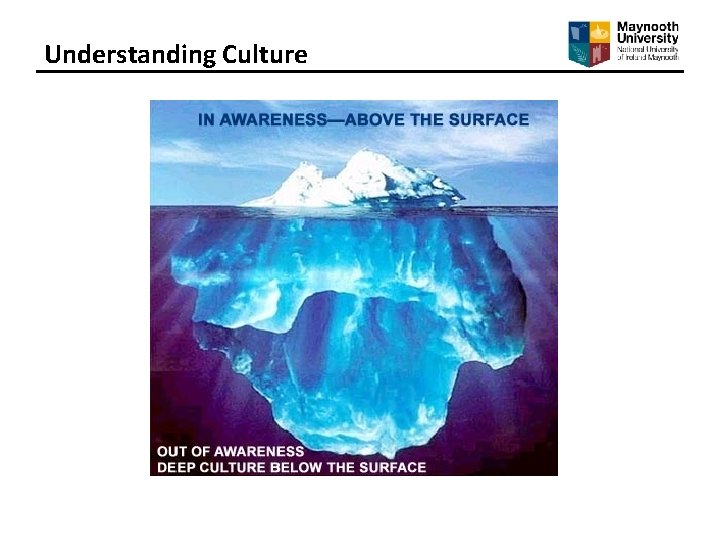
Understanding Culture
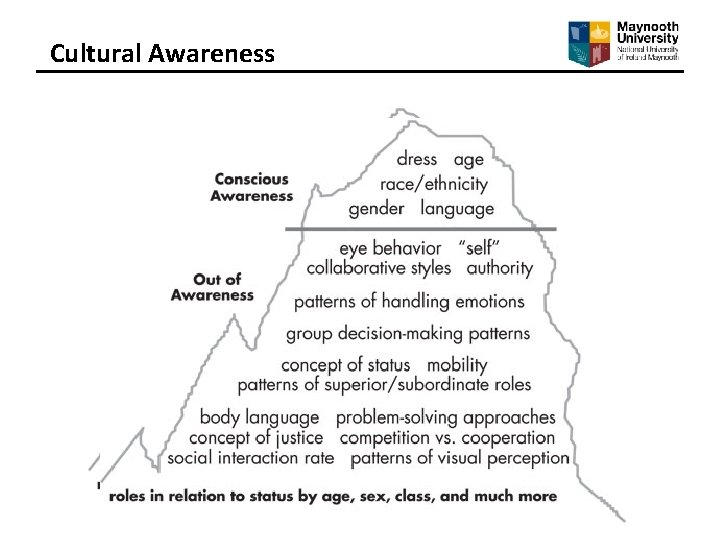
Cultural Awareness
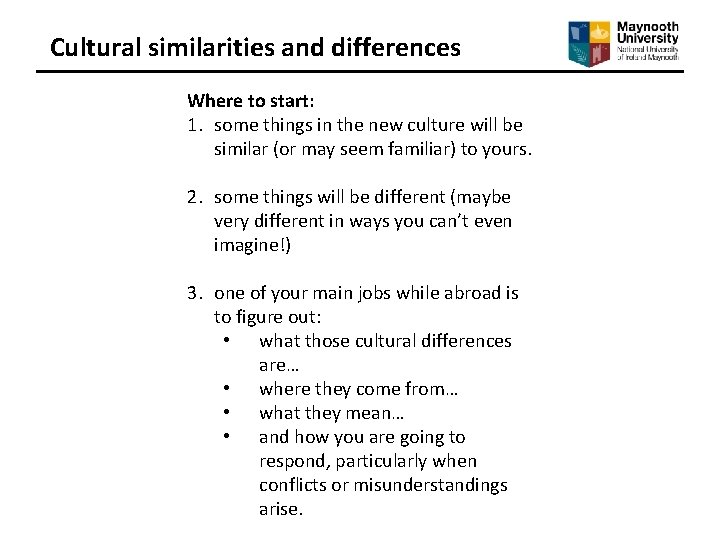
Cultural similarities and differences Where to start: 1. some things in the new culture will be similar (or may seem familiar) to yours. 2. some things will be different (maybe very different in ways you can’t even imagine!) 3. one of your main jobs while abroad is to figure out: • what those cultural differences are… • where they come from… • what they mean… • and how you are going to respond, particularly when conflicts or misunderstandings arise.
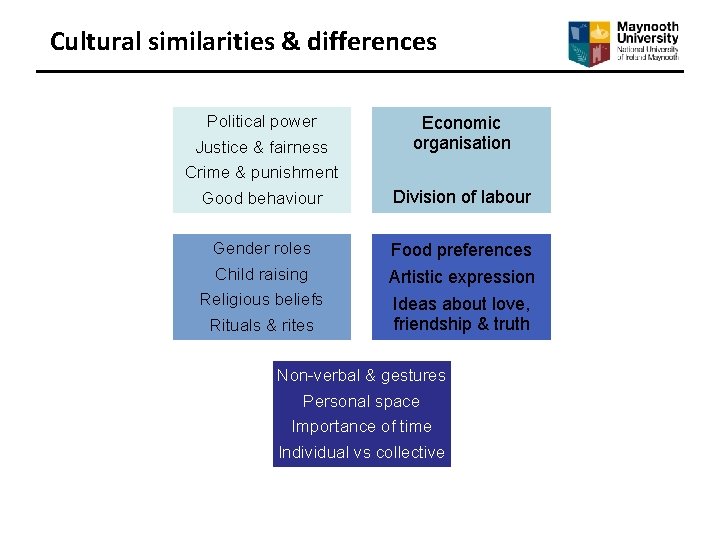
Cultural similarities & differences Political power Justice & fairness Economic organisation Crime & punishment Good behaviour Division of labour Gender roles Child raising Religious beliefs Rituals & rites Food preferences Artistic expression Ideas about love, friendship & truth Non-verbal & gestures Personal space Importance of time Individual vs collective
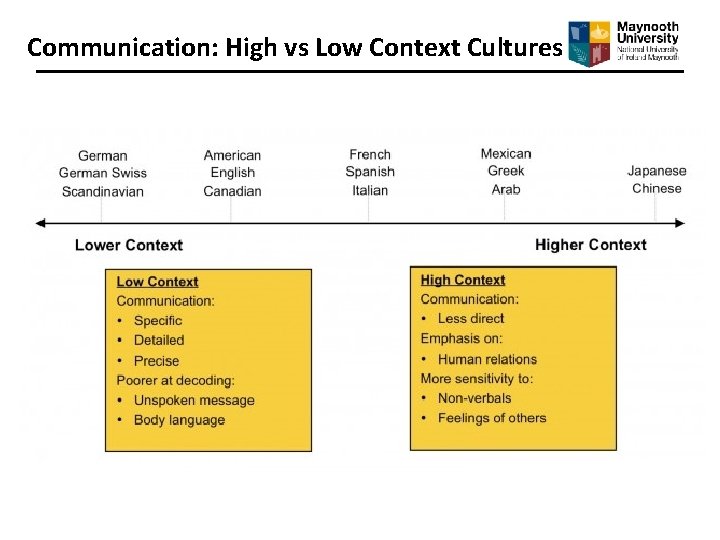
Communication: High vs Low Context Cultures
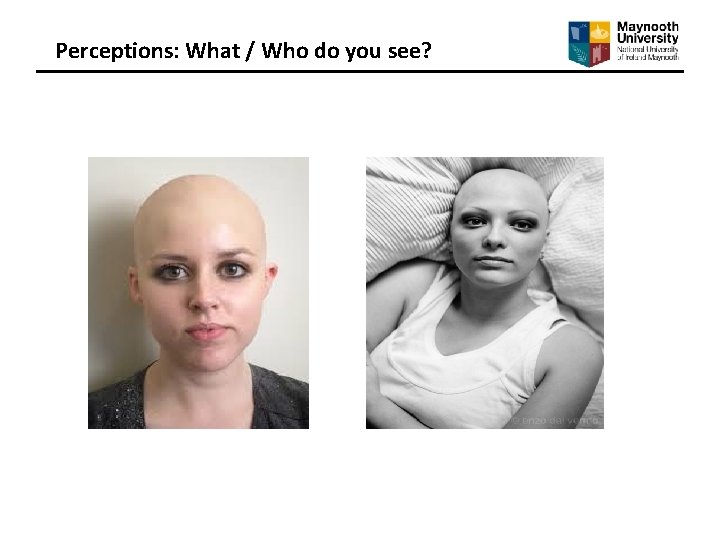
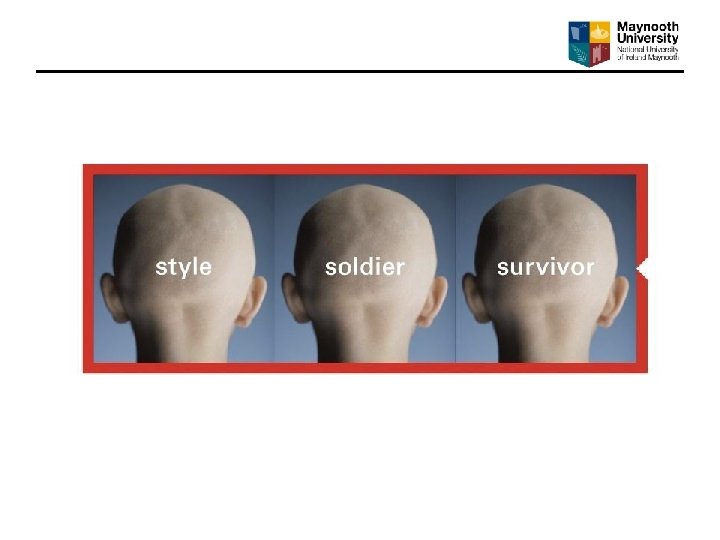
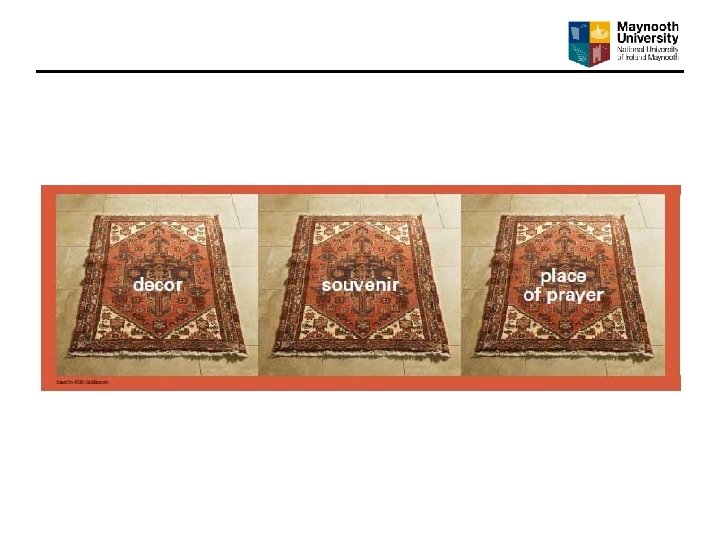
Perceptions: What / Who do you see?
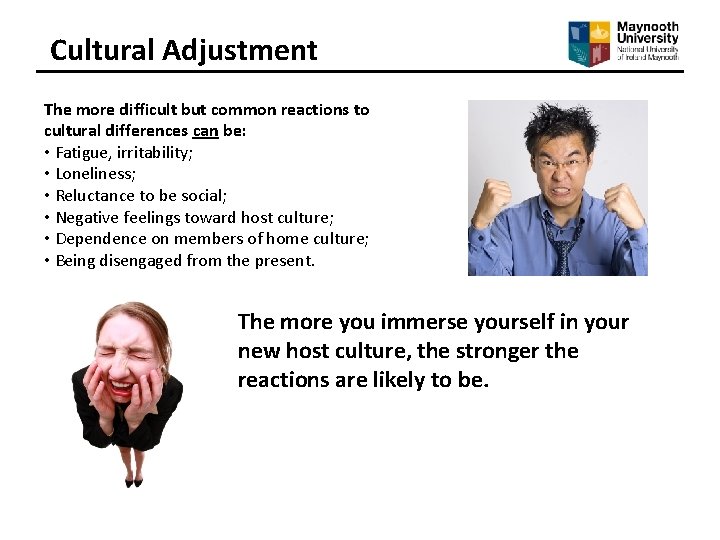
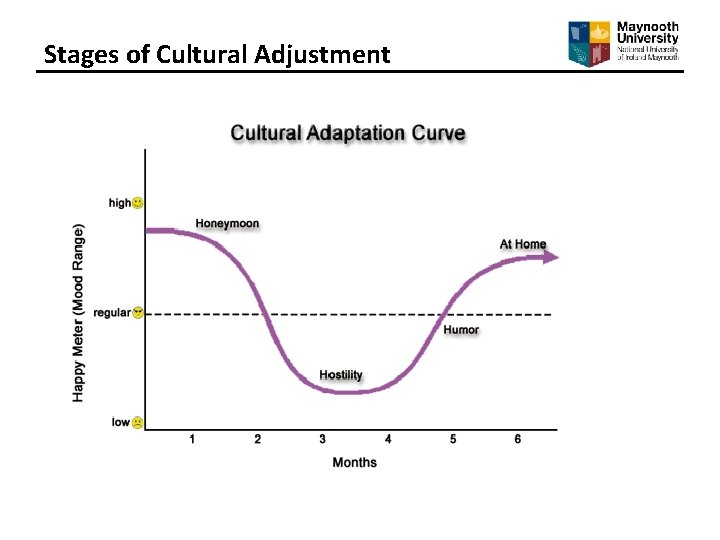
Cultural Adjustment The more difficult but common reactions to cultural differences can be: • Fatigue, irritability; • Loneliness; • Reluctance to be social; • Negative feelings toward host culture; • Dependence on members of home culture; • Being disengaged from the present. The more you immerse yourself in your new host culture, the stronger the reactions are likely to be.
Stages of Cultural Adjustment
Stages of Cultural Adjustment Honeymoon: At the time of arrival, you will be excited for the adventure that awaits you and the wide-ranging opportunities you have as you study will entice a feeling of perfection. Everything seems wonderful and possible! Hostility: After some time, you may start to experience frustration with new cultural norms and the differences from your home country. But don’t worry – your ability to accept these differences and frustrations will improve with time! Humour: Next comes the acceptance stage. You will start to see the similarities between your home and host cultures, understand the local culture, and communicate better with locals. Home: You have settled in and appreciate the cultural differences of the society. You may begin to adopt some of the local norms and have a new perspective on life. You may have difficulty thinking about your time abroad coming to an end.
Managing Cultural Adjustment Dealing effectively with cultural differences: Be curious but non-judgemental Be patient with yourself Be flexible Keep a regular schedule Eat well, exercise, get enough rest Set attainable goals Talk about your concerns with a friend/mentor Keep a journal DON’T. . . fear the symptoms, it is normal! It means you are learning. . . be afraid to make a mistake. It is inevitable, engage humour. . . segregate yourself with others from your home country. . communicate too frequently with friends/family back home (skype/facebook). . be overly critical of the host culture – accept the differences even if you can’t agree with them
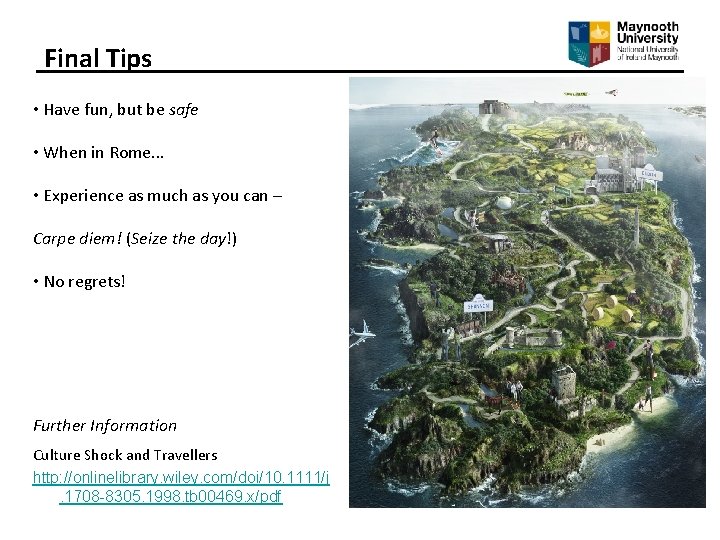
Final Tips • Have fun, but be safe • When in Rome. . . • Experience as much as you can – Carpe diem! (Seize the day!) • No regrets! Further Information Culture Shock and Travellers http: //onlinelibrary. wiley. com/doi/10. 1111/j. 1708 -8305. 1998. tb 00469. x/pdf
Help! Information overload! Don’t worry, it is normal to feel a little overwhelmed! Help is at hand: - Information pack - Pre-Arrival guide on IO website - Contact IO staff Thank you for listening!