
Welcome to Math Night for Parents of 4

- Slides: 42
Welcome to Math Night for Parents of 4 th Grade Students Many, Many Multiplication Methods
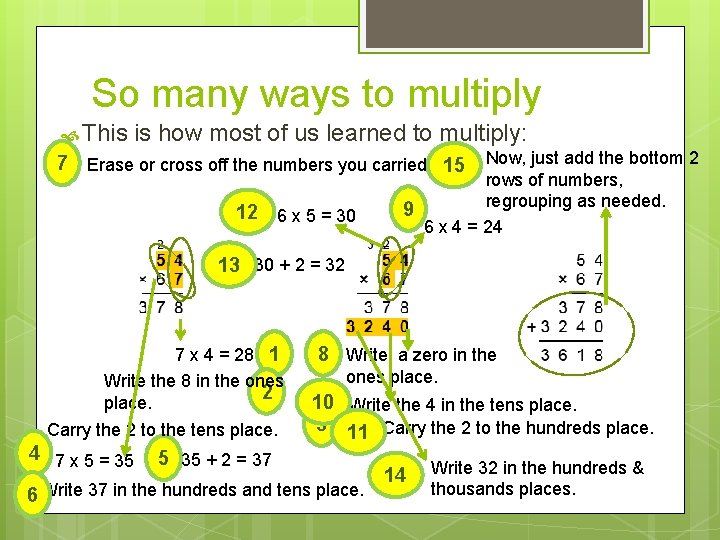
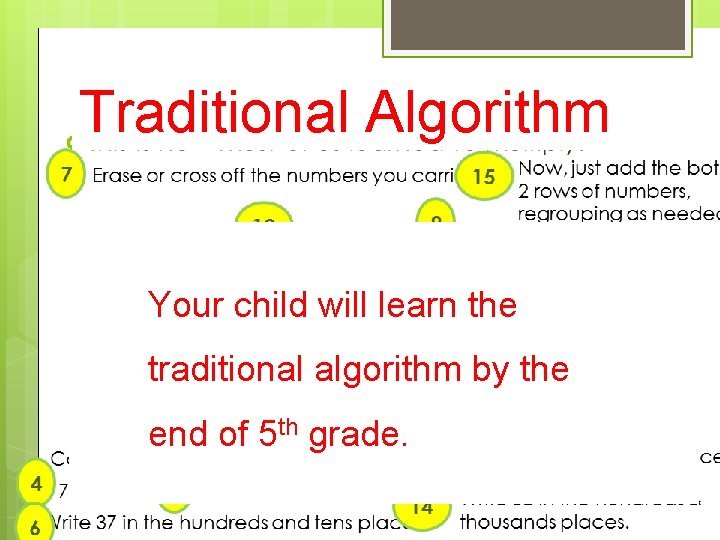
So many ways to multiply This is how most of us learned to multiply: 7 Erase or cross off the numbers you carried. 15 Now, just add the bottom 2 rows of numbers, regrouping as needed. 9 12 6 x 5 = 30 6 x 4 = 24 13 30 + 2 = 32 7 x 4 = 28 1 Write the 8 in the ones 2 place. Carry the 2 to the tens place. 4 7 x 5 = 35 8 Write a zero in the ones place. 10 Write the 4 in the tens place. 3 11 Carry the 2 to the hundreds place. 5 35 + 2 = 37 6 Write 37 in the hundreds and tens place. 14 Write 32 in the hundreds & thousands places.
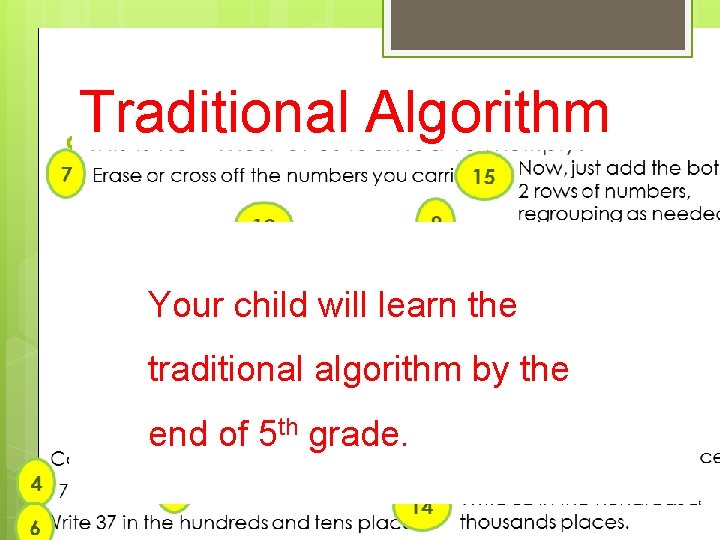
Traditional Algorithm Your child will learn the traditional algorithm by the end of 5 th grade.
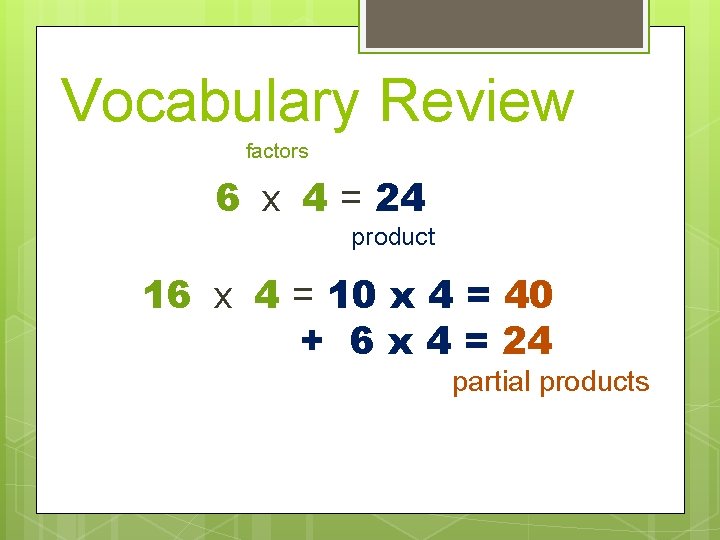
Vocabulary Review factors 6 x 4 = 24 product 16 x 4 = 10 x 4 = 40 + 6 x 4 = 24 partial products
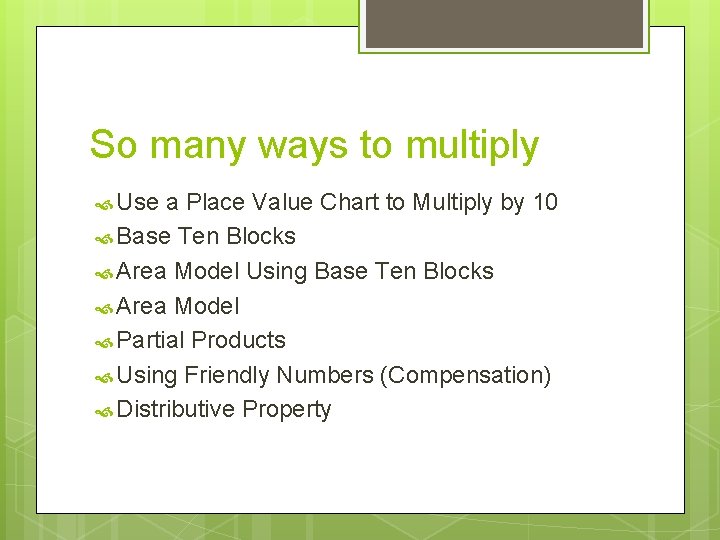
So many ways to multiply Use a Place Value Chart to Multiply by 10
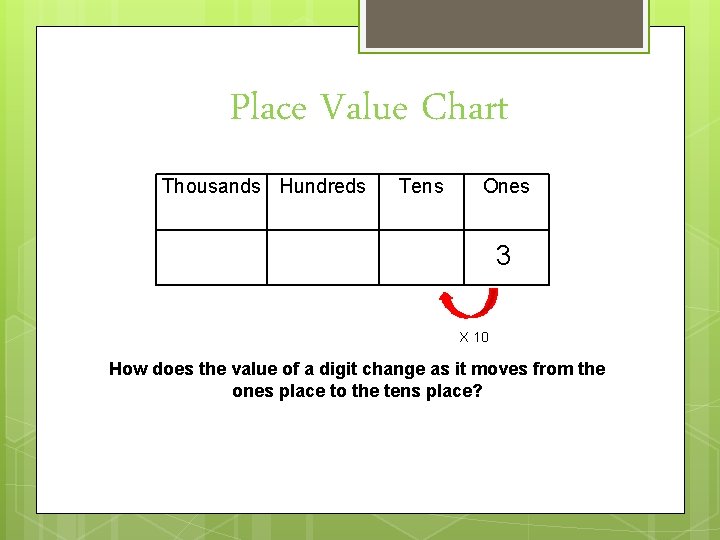
Place Value Chart Thousands Hundreds Tens Ones 3 X 10 How does the value of a digit change as it moves from the ones place to the tens place?
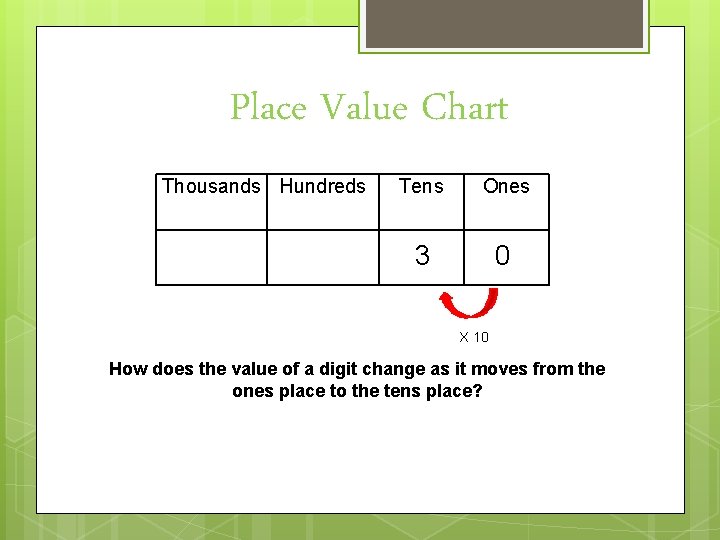
Place Value Chart Thousands Hundreds Tens Ones 3 0 X 10 How does the value of a digit change as it moves from the ones place to the tens place?
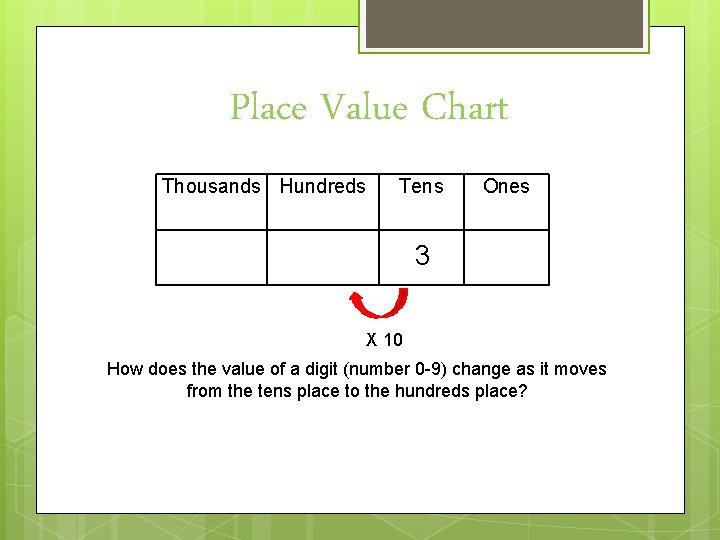
Place Value Chart Thousands Hundreds Tens Ones 3 X 10 How does the value of a digit (number 0 -9) change as it moves from the tens place to the hundreds place?
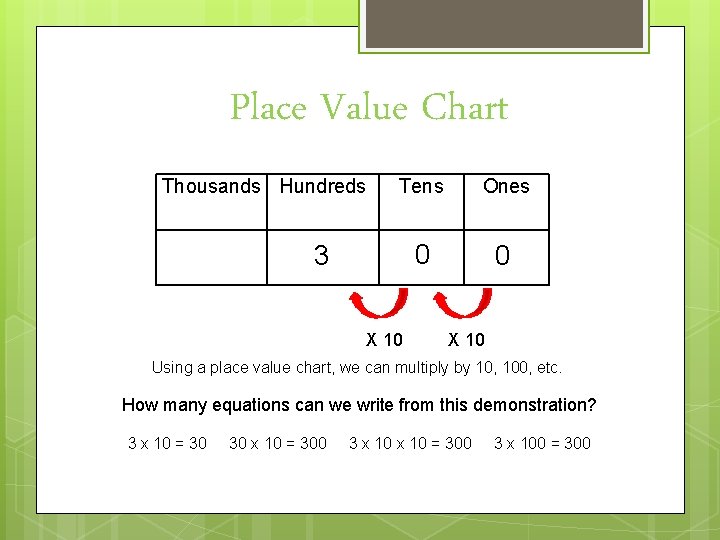
Place Value Chart Thousands Hundreds Tens Ones 0 3 X 10 0 X 10 Using a place value chart, we can multiply by 10, 100, etc. How many equations can we write from this demonstration? 3 x 10 = 30 30 x 10 = 300 3 x 100 = 300
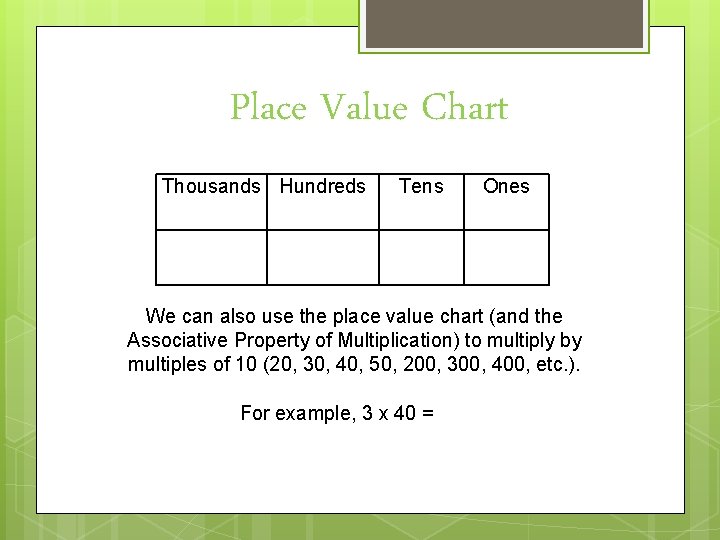
Place Value Chart Thousands Hundreds Tens Ones We can also use the place value chart (and the Associative Property of Multiplication) to multiply by multiples of 10 (20, 30, 40, 50, 200, 300, 400, etc. ). For example, 3 x 40 =
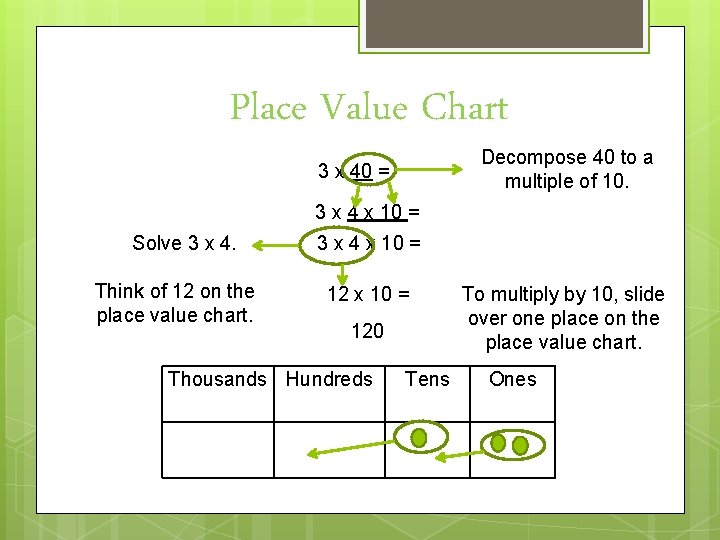
Place Value Chart Decompose 40 to a 3 x 40 = multiple of 10. 3 x 4 x 10 = Solve 3 x 4. Think of 12 on the place value chart. 3 x 4 x 10 = 12 x 10 = To multiply by 10, slide over one place on the place value chart. 120 Thousands Hundreds Tens Ones
So many ways to multiply Use a Place Value Chart to Multiply by 10 Base Ten Blocks
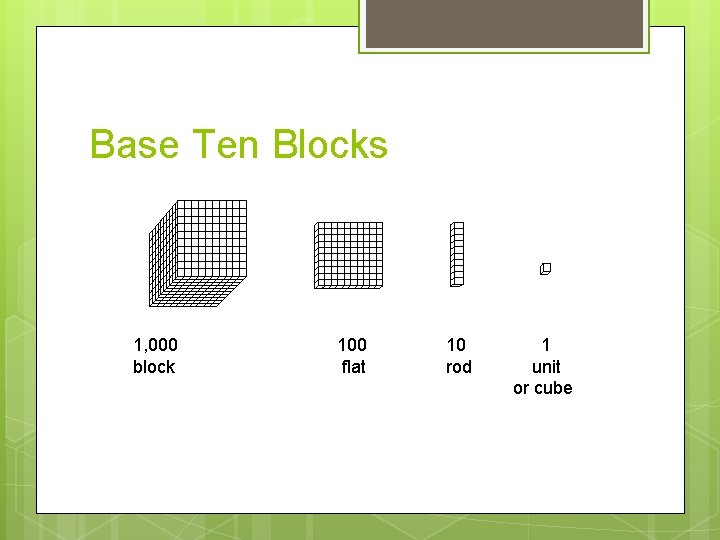
Base Ten Blocks 1, 000 block 100 flat 10 1 rod unit or cube
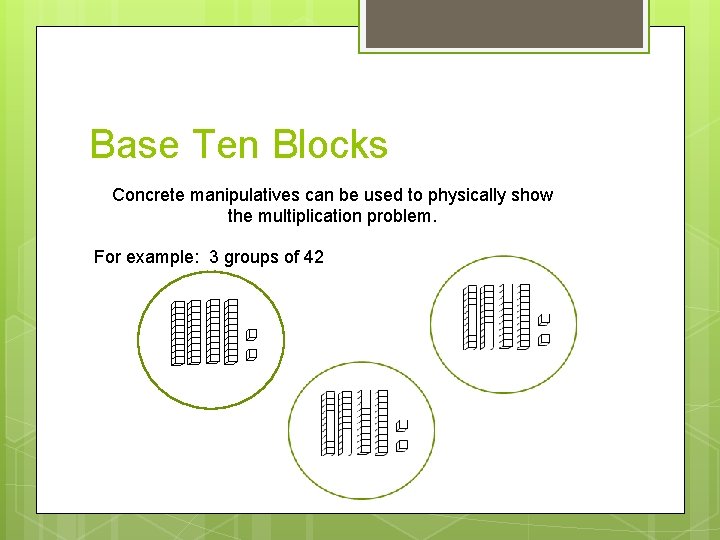
Base Ten Blocks Concrete manipulatives can be used to physically show the multiplication problem. For example: 3 groups of 42
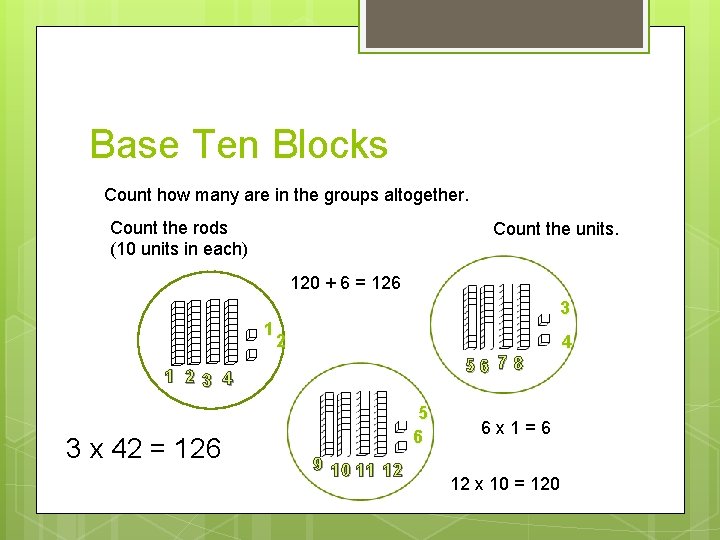
Base Ten Blocks Count how many are in the groups altogether. Count the rods (10 units in each) Count the units. 120 + 6 = 126 1 3 2 56 7 8 1 23 4 3 x 42 = 126 5 6 9 10 11 12 6 x 1 = 6 12 x 10 = 120 4
So many ways to multiply Use a Place Value Chart to Multiply by 10 Base Ten Blocks Area Model Using Base Ten Blocks
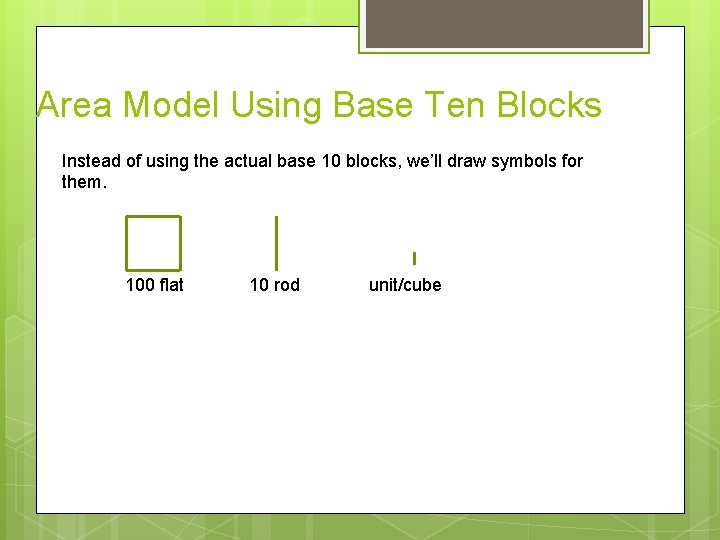
Area Model Using Base Ten Blocks Instead of using the actual base 10 blocks, we’ll draw symbols for them. 100 flat 10 rod unit/cube
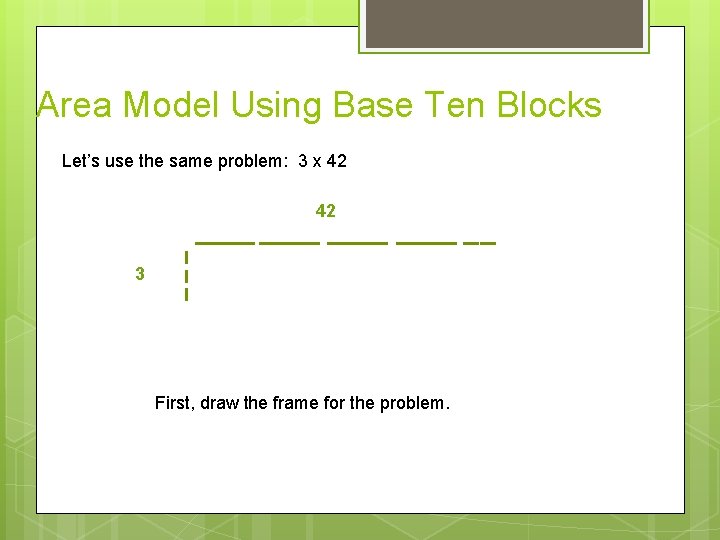
Area Model Using Base Ten Blocks Let’s use the same problem: 3 x 42 42 3 First, draw the frame for the problem.
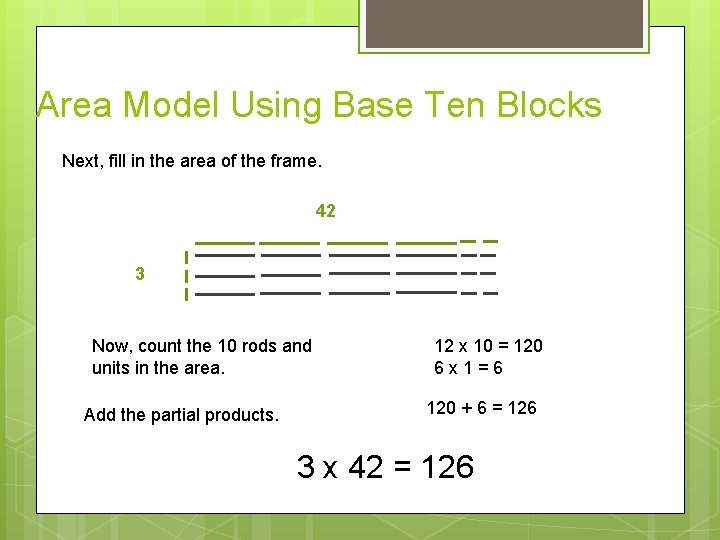
Area Model Using Base Ten Blocks Next, fill in the area of the frame. 42 3 Now, count the 10 rods and units in the area. Add the partial products. 12 x 10 = 120 6 x 1 = 6 120 + 6 = 126 3 x 42 = 126
To see this model demonstrated with other numbers, click on: http: //video. carrollk 12. org/view/EM_HARFIELD_CONCRETE _10242013 and fast forward to 1: 23 – using base ten blocks to multiply multi digit numbers.
So many ways to multiply Use a Place Value Chart to Multiply by 10 Base Ten Blocks Area Model Using Base Ten Blocks Area Model
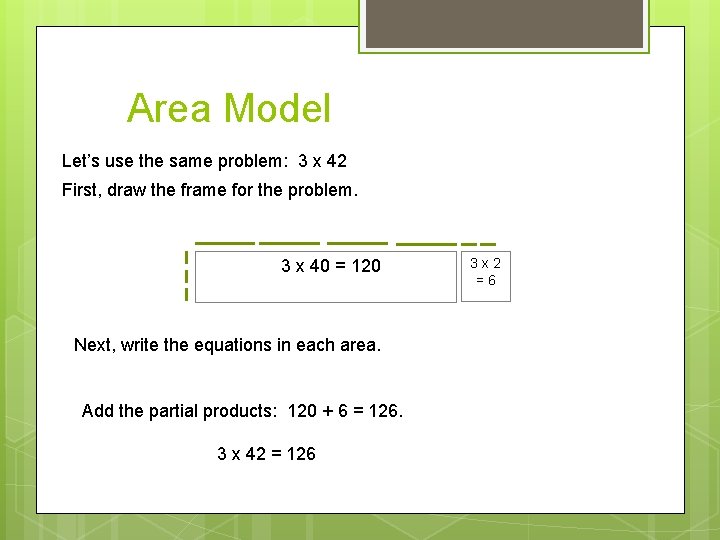
Area Model Let’s use the same problem: 3 x 42 First, draw the frame for the problem. 3 x 40 = 120 Next, write the equations in each area. Add the partial products: 120 + 6 = 126. 3 x 42 = 126 3 x 2 = 6
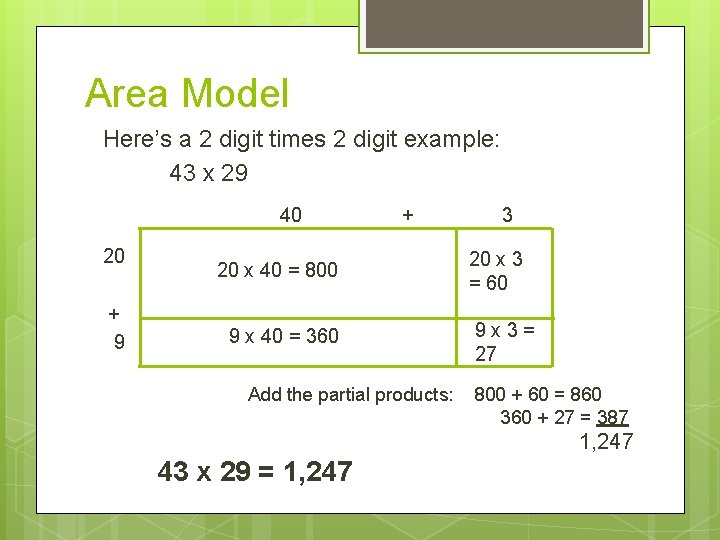
Area Model Here’s a 2 digit times 2 digit example: 43 x 29 40 + 3 20 + 9 20 x 40 = 800 9 x 40 = 360 20 x 3 = 60 9 x 3 = 27 Add the partial products: 800 + 60 = 860 360 + 27 = 387 1, 247 43 x 29 = 1, 247
Area Model Let’s try it! 1. Draw the frame 2. Write the equations in each area 3. Add the partial products
So many ways to multiply Use a Place Value Chart to Multiply by 10 Base Ten Blocks Area Model Using Base Ten Blocks Area Model Partial Products
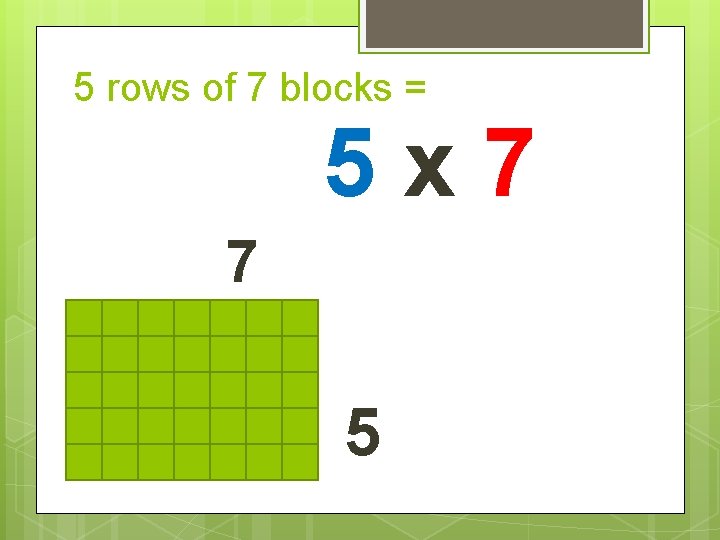
Partial Products Break apart one factor to make the multiplication problems easier to solve. Here’s a simple example using an array.
5 rows of 7 blocks = 5 x 7 7 5
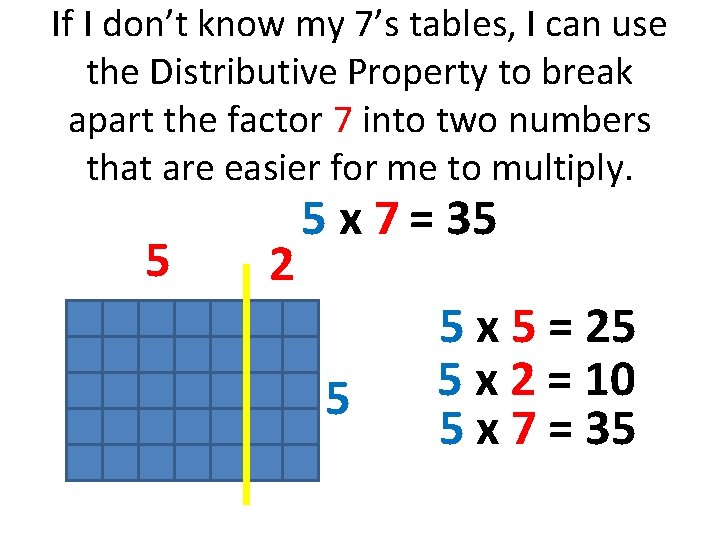
If I don’t know my 7’s tables, I can use the Distributive Property to break apart the factor 7 into two numbers that are easier for me to multiply. 5 2 5 x 7 = 35 5 5 x 5 = 25 5 x 2 = 10 5 x 7 = 35
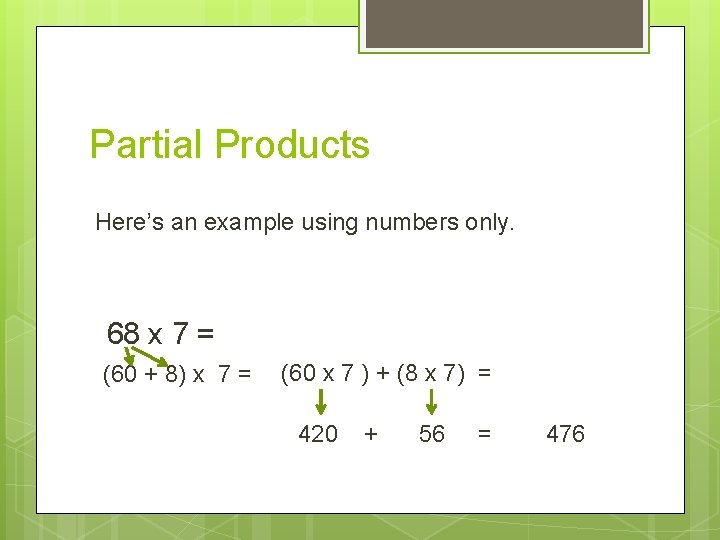
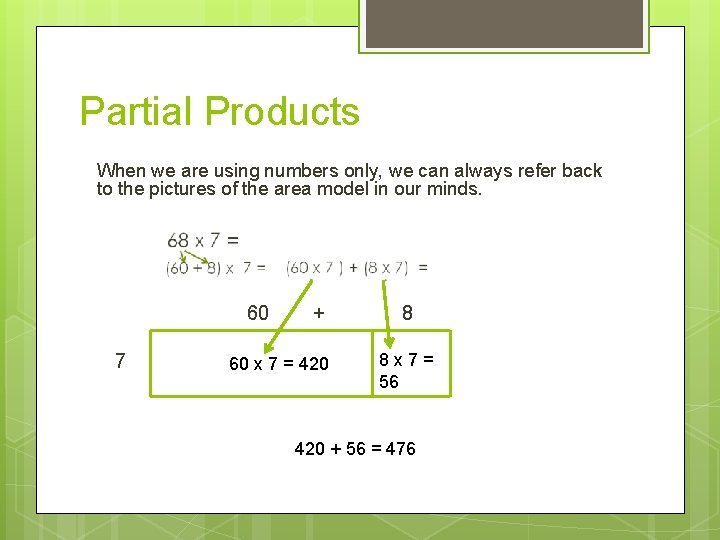
Partial Products Here’s an example using numbers only. 68 x 7 = (60 + 8) x 7 = (60 x 7 ) + (8 x 7) = 420 + 56 = 476
Partial Products When we are using numbers only, we can always refer back to the pictures of the area model in our minds. 60 + 8 7 60 x 7 = 420 8 x 7 = 56 420 + 56 = 476
Partial Products Are you ready to try?
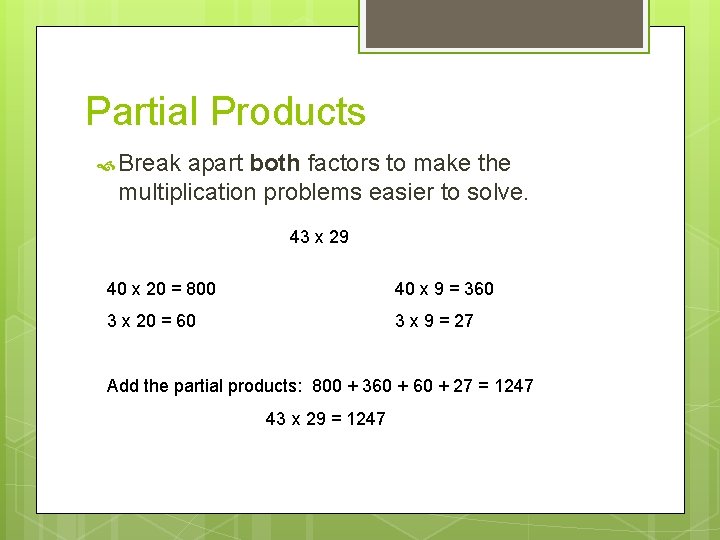
Partial Products Break apart both factors to make the multiplication problems easier to solve. 43 x 29 40 x 20 = 800 40 x 9 = 360 3 x 20 = 60 3 x 9 = 27 Add the partial products: 800 + 360 + 27 = 1247 43 x 29 = 1247
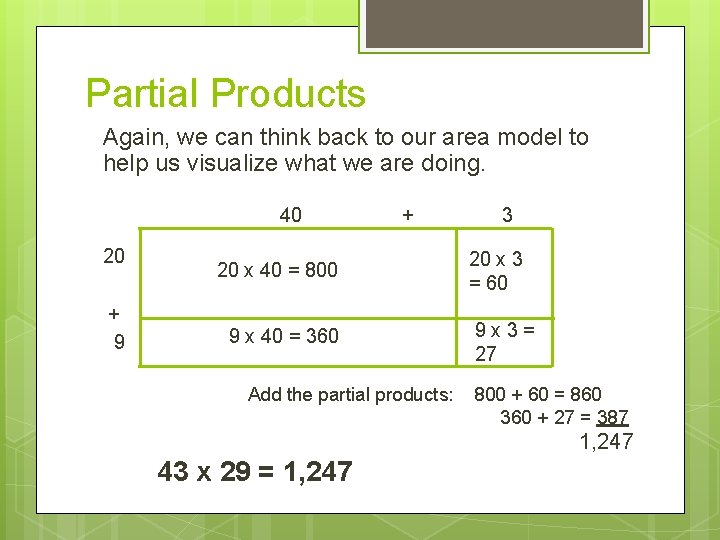
Partial Products Again, we can think back to our area model to help us visualize what we are doing. 40 + 3 20 + 9 20 x 40 = 800 9 x 40 = 360 20 x 3 = 60 9 x 3 = 27 Add the partial products: 800 + 60 = 860 360 + 27 = 387 1, 247 43 x 29 = 1, 247
Partial Products Are you ready to try breaking apart both factors?
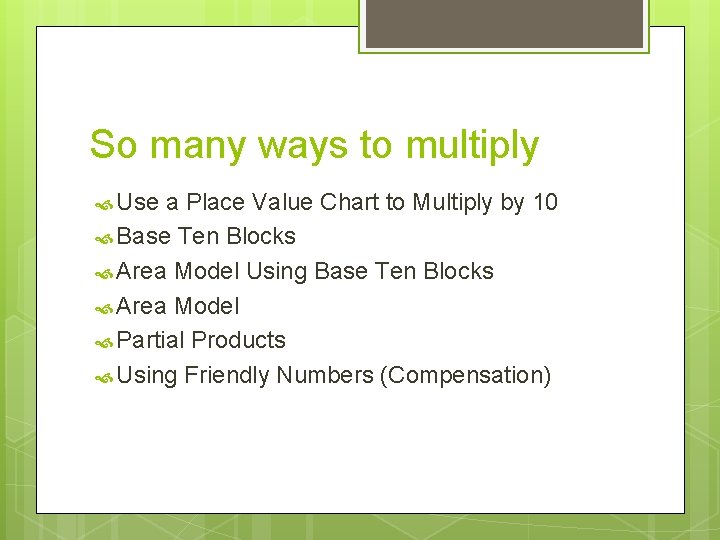
So many ways to multiply Use a Place Value Chart to Multiply by 10 Base Ten Blocks Area Model Using Base Ten Blocks Area Model Partial Products Using Friendly Numbers (Compensation)
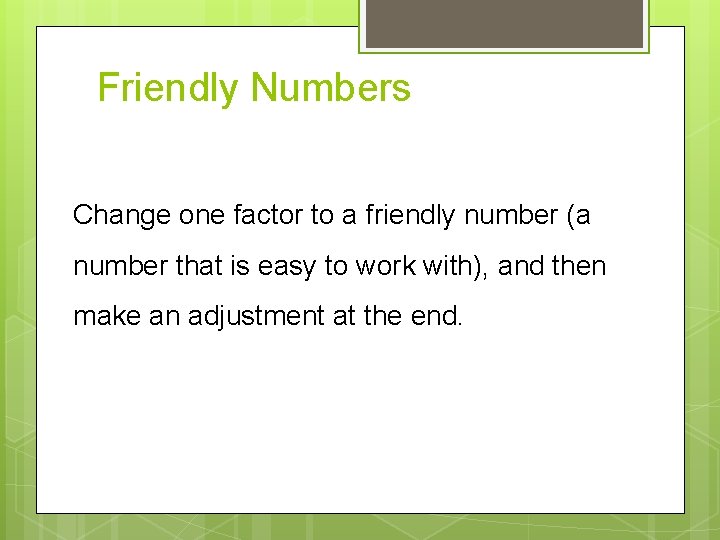
Friendly Numbers Change one factor to a friendly number (a number that is easy to work with), and then make an adjustment at the end.
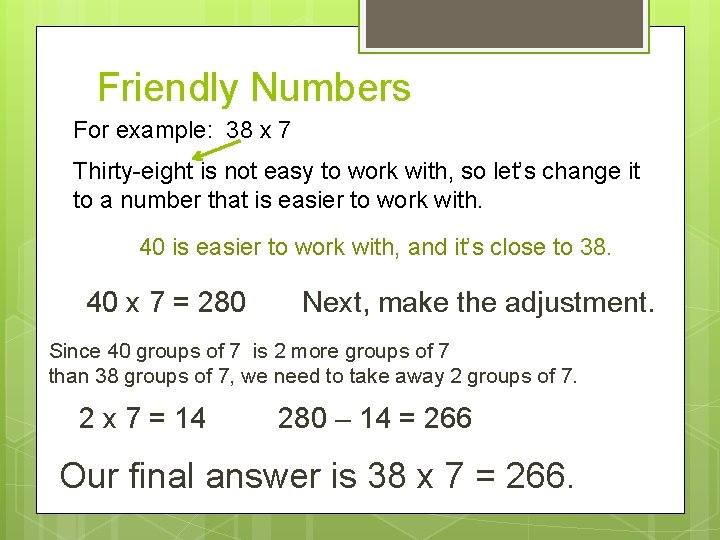
Friendly Numbers For example: 38 x 7 Thirty-eight is not easy to work with, so let’s change it to a number that is easier to work with. 40 is easier to work with, and it’s close to 38. 40 x 7 = 280 Next, make the adjustment. Since 40 groups of 7 is 2 more groups of 7 than 38 groups of 7, we need to take away 2 groups of 7. 2 x 7 = 14 280 – 14 = 266 Our final answer is 38 x 7 = 266.
So many ways to multiply Use a Place Value Chart to Multiply by 10 Base Ten Blocks Area Model Using Base Ten Blocks Area Model Partial Products Using Friendly Numbers (Compensation) Distributive Property
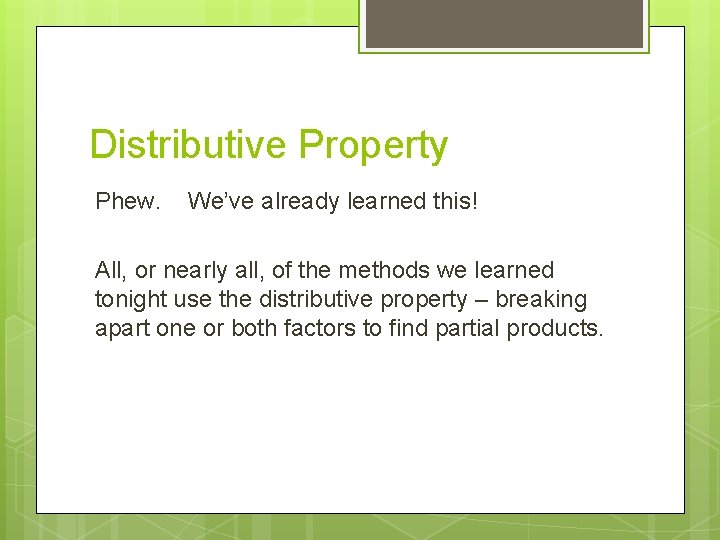
Distributive Property Phew. We’ve already learned this! All, or nearly all, of the methods we learned tonight use the distributive property – breaking apart one or both factors to find partial products.
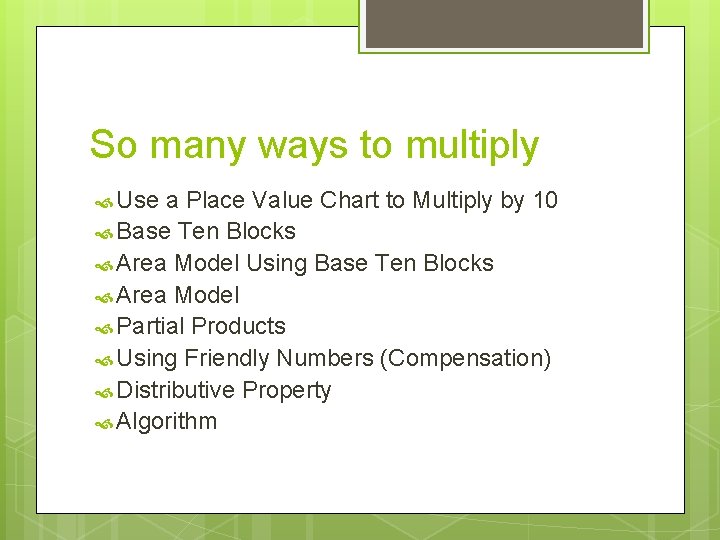
So many ways to multiply Use a Place Value Chart to Multiply by 10 Base Ten Blocks Area Model Using Base Ten Blocks Area Model Partial Products Using Friendly Numbers (Compensation) Distributive Property Algorithm
Traditional Algorithm Your child will learn the traditional algorithm by the end of 5 th grade.
Any Questions? Please feel free to ask for help any time. We can always be reached by email. Thank you so much for attending our Math Night. We hope it will be helpful to you and your child. If you have any suggestions to improve our presentation, please send them our way!