
Welcome to Machine Vision Solutions for Part Identification
- Slides: 57
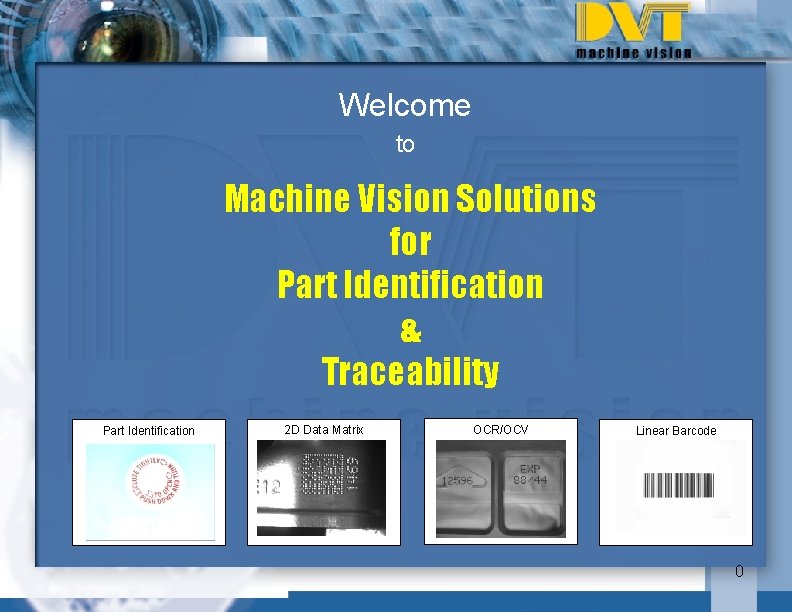
Welcome to Machine Vision Solutions for Part Identification & Traceability Part Identification 2 D Data Matrix OCR/OCV Linear Barcode 0
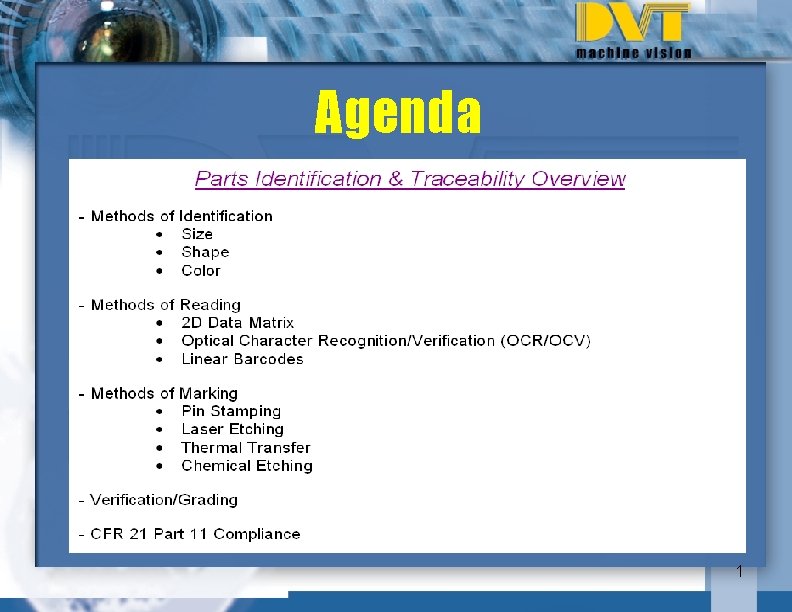
Agenda 1
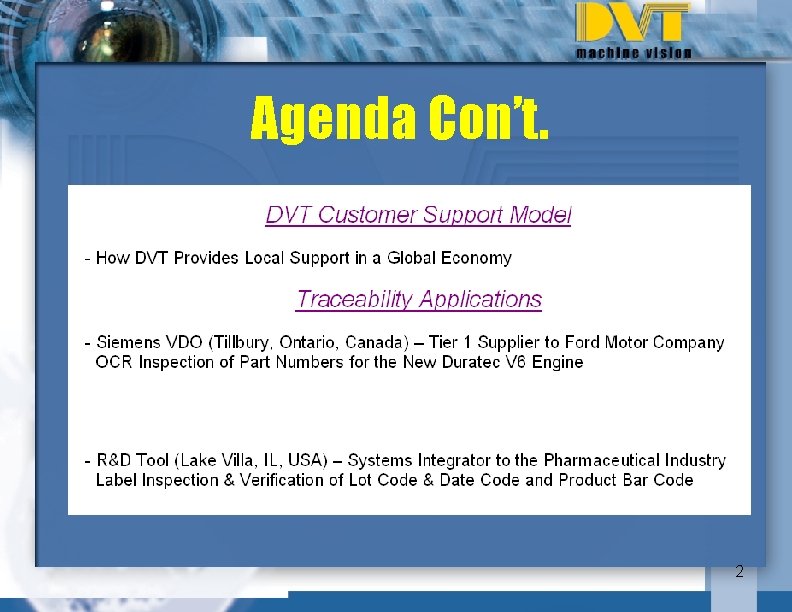
Agenda Con’t. 2
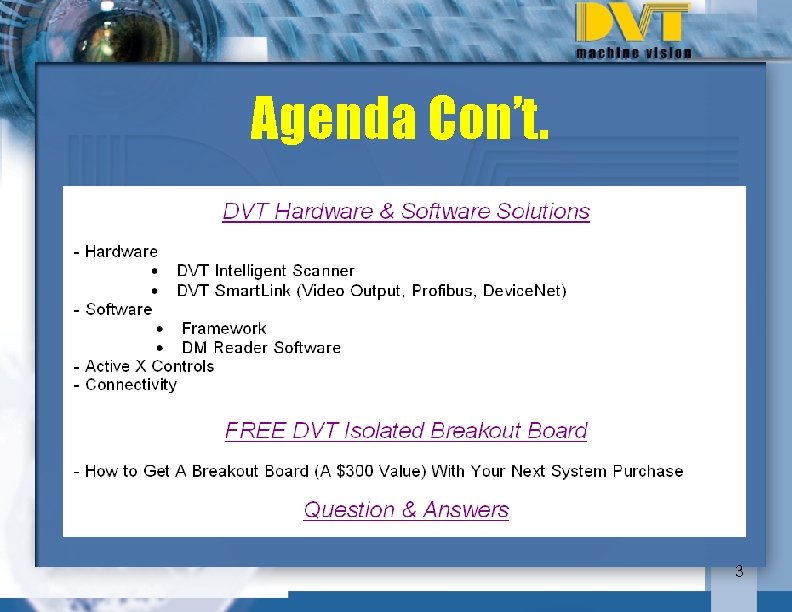
Agenda Con’t. 3
Part Identification & Traceability Overview Dr. Michael Schreiber DVT Director of Applied Engineering 4
Topic Outline • • • Identification and Traceability Methods of Identification OCR 2 D Data. Matrix Marking Methods Readability 5
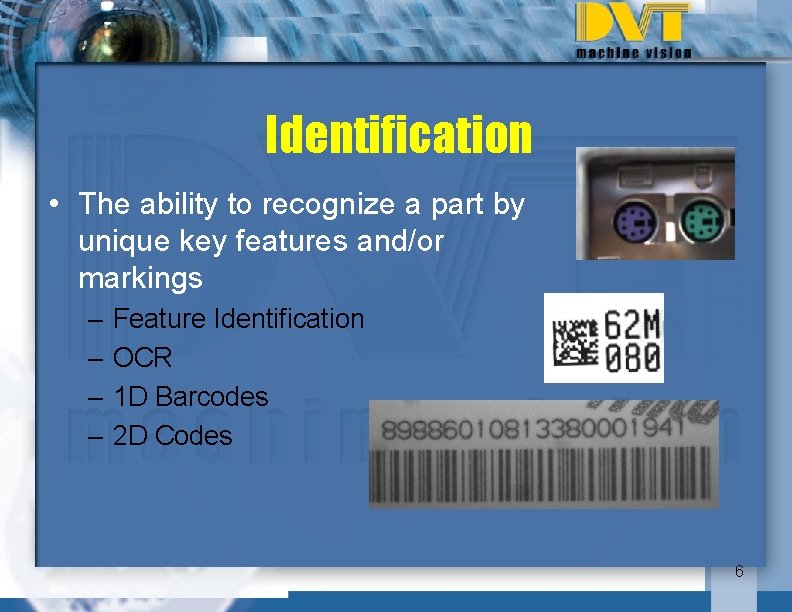
Identification • The ability to recognize a part by unique key features and/or markings – – Feature Identification OCR 1 D Barcodes 2 D Codes 6
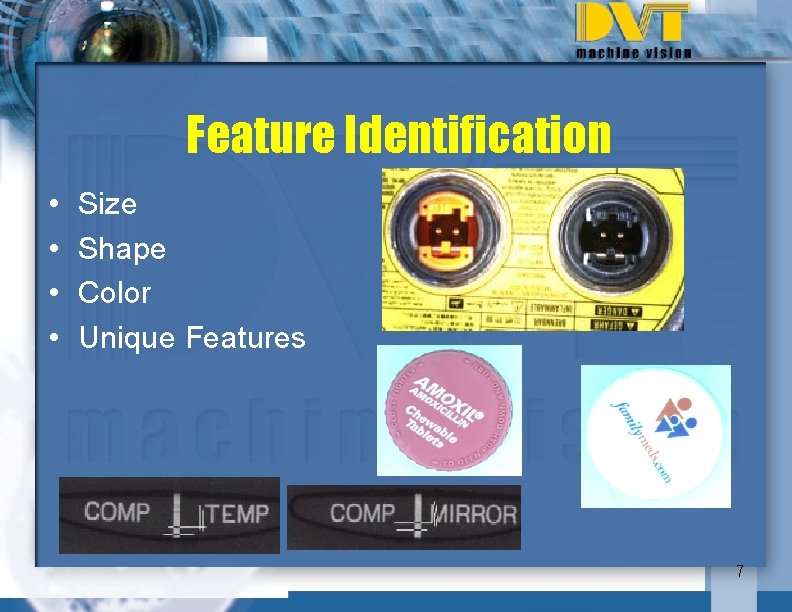
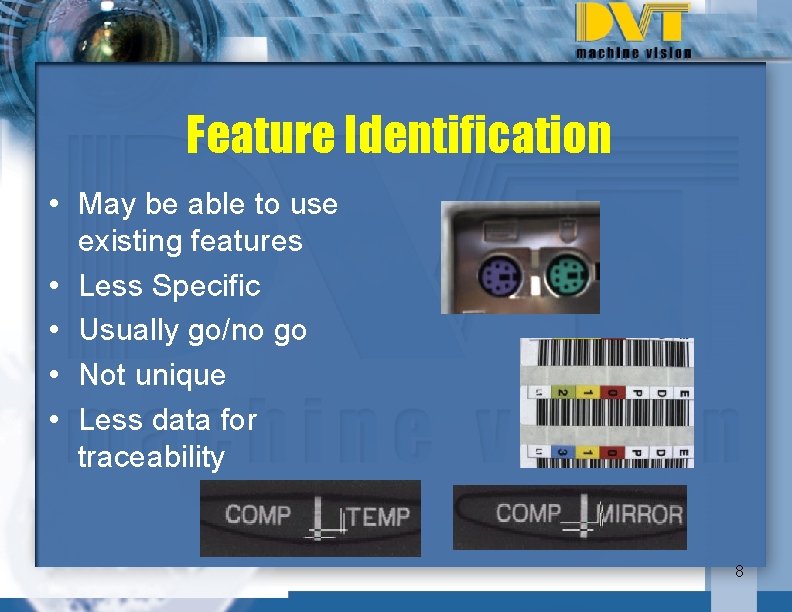
Feature Identification • • Size Shape Color Unique Features 7
Feature Identification • May be able to use existing features • Less Specific • Usually go/no go • Not unique • Less data for traceability 8
Traceability • Ability to store pertain data • Specific to part, date, lot • Data is Valuable – Inventory control, forecasting, business operation – Recall information – Error Proofing – Making sure part are made in the correct order 9
Methods of Reading • Alpha. Numeric – Ease for Human to read – Takes up a large amount of room – Hardest for Machines to read • 1 D Codes – Simple readers – No Error Correction – Large Footprint 10
Methods of Reading • 1 D Stacked Codes – More information, • 2 D Codes – Small Footprint – Error Correction Build-In – More information 11
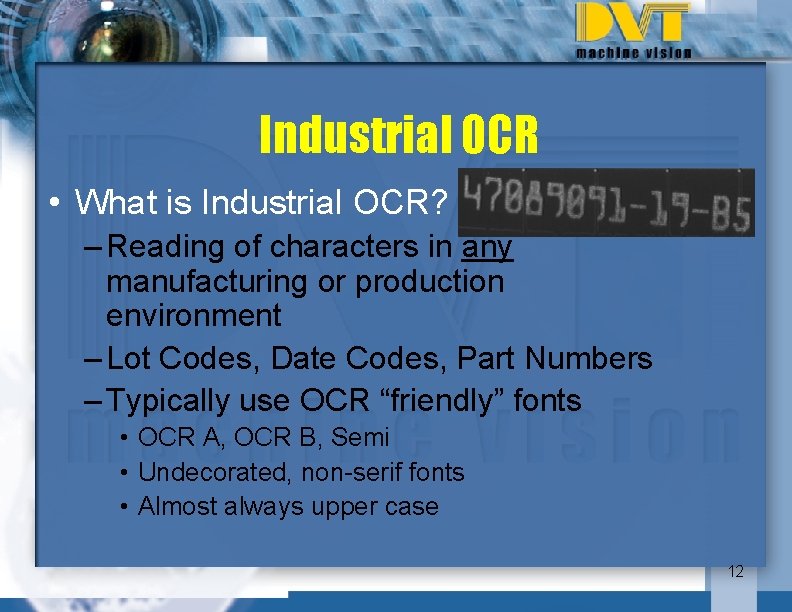
Industrial OCR • What is Industrial OCR? – Reading of characters in any manufacturing or production environment – Lot Codes, Date Codes, Part Numbers – Typically use OCR “friendly” fonts • OCR A, OCR B, Semi • Undecorated, non-serif fonts • Almost always upper case 12
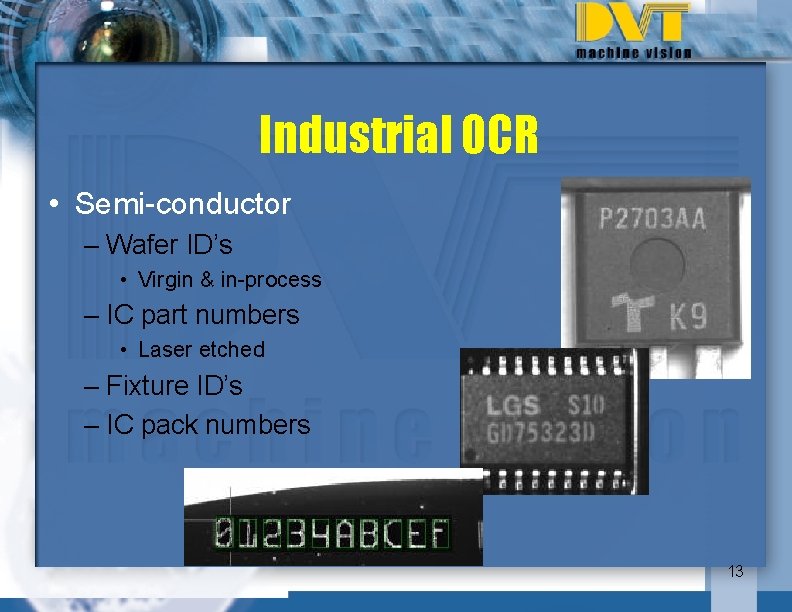
Industrial OCR • Semi-conductor – Wafer ID’s • Virgin & in-process – IC part numbers • Laser etched – Fixture ID’s – IC pack numbers 13
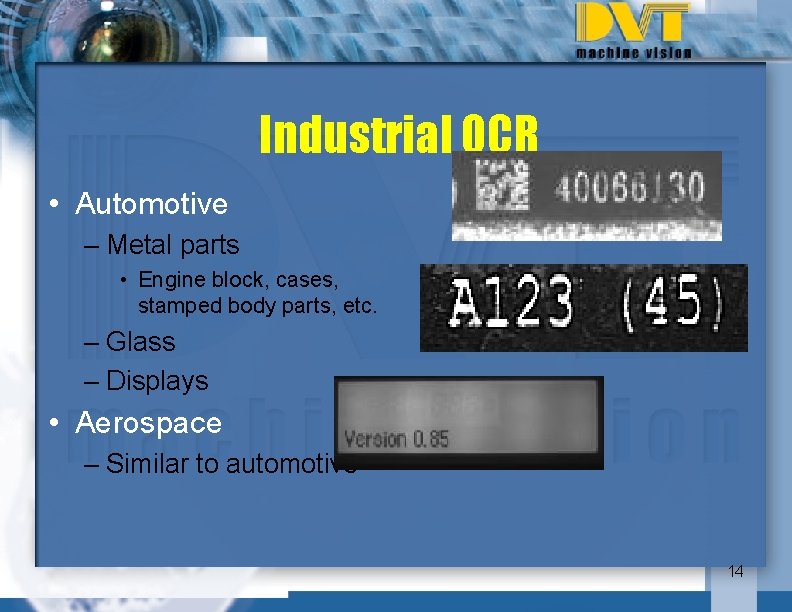
Industrial OCR • Automotive – Metal parts • Engine block, cases, stamped body parts, etc. – Glass – Displays • Aerospace – Similar to automotive 14
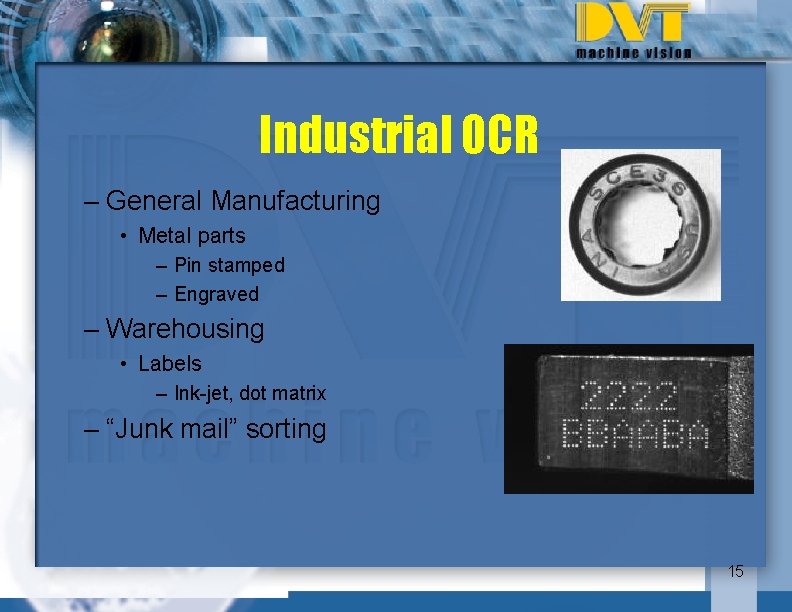
Industrial OCR – General Manufacturing • Metal parts – Pin stamped – Engraved – Warehousing • Labels – Ink-jet, dot matrix – “Junk mail” sorting 15
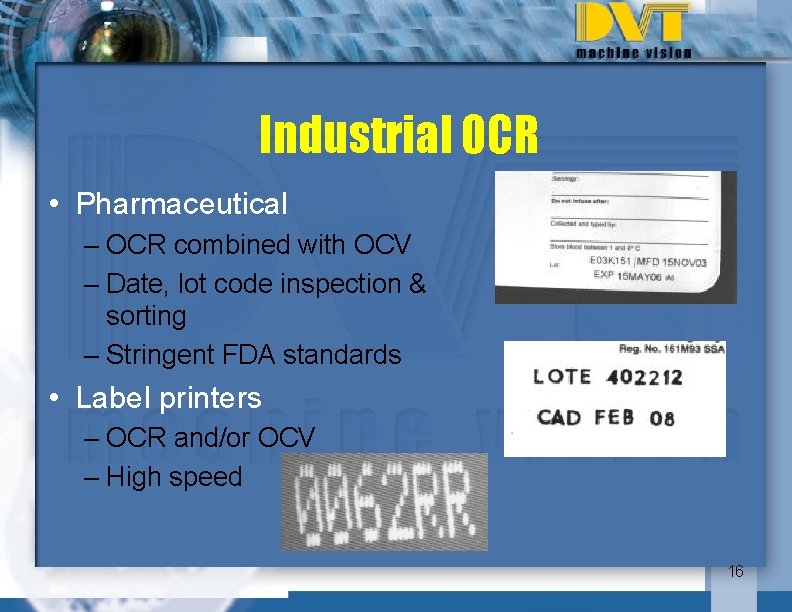
Industrial OCR • Pharmaceutical – OCR combined with OCV – Date, lot code inspection & sorting – Stringent FDA standards • Label printers – OCR and/or OCV – High speed 16
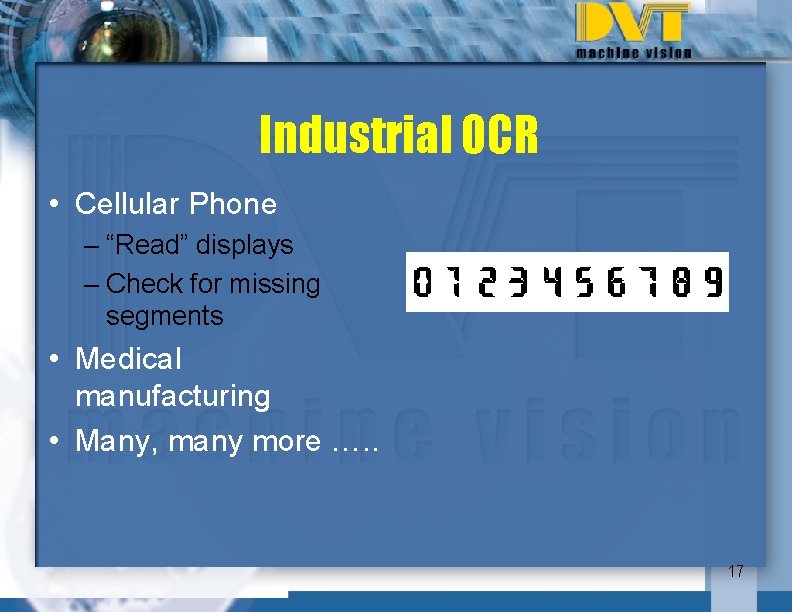
Industrial OCR • Cellular Phone – “Read” displays – Check for missing segments • Medical manufacturing • Many, many more …. . 17
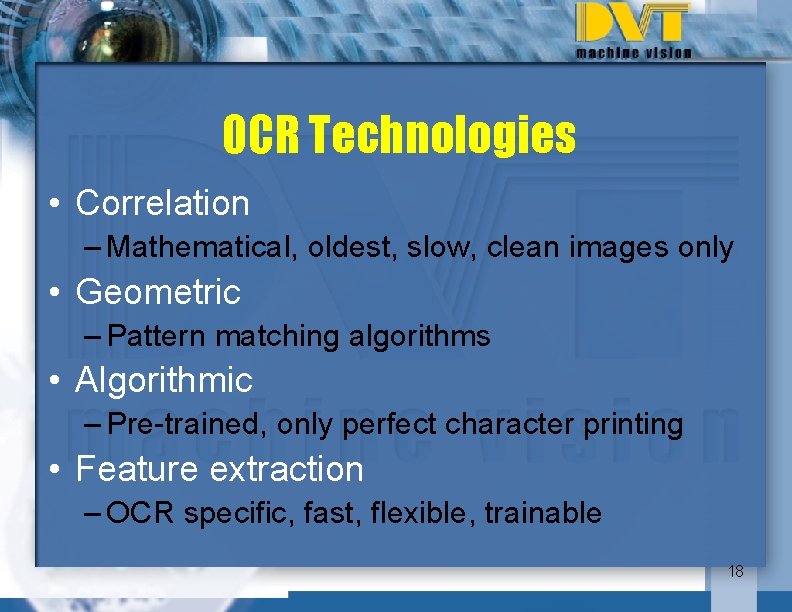
OCR Technologies • Correlation – Mathematical, oldest, slow, clean images only • Geometric – Pattern matching algorithms • Algorithmic – Pre-trained, only perfect character printing • Feature extraction – OCR specific, fast, flexible, trainable 18
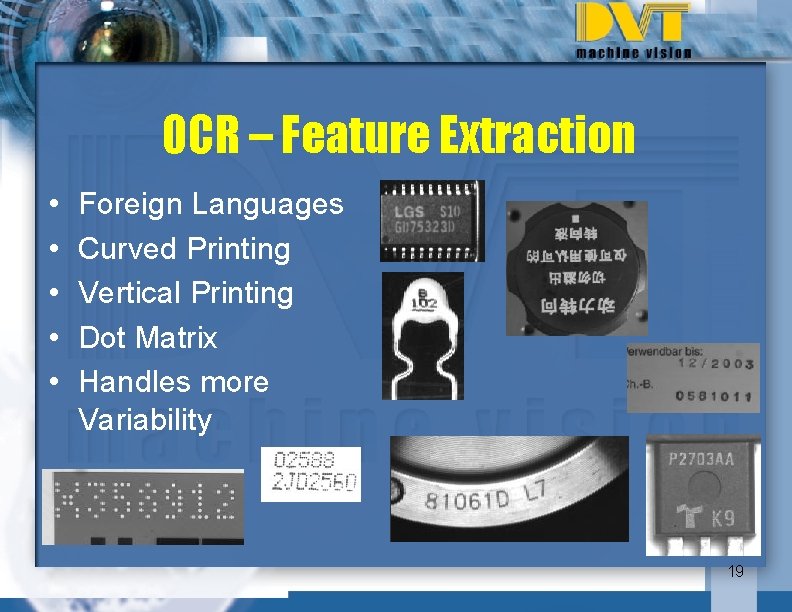
OCR – Feature Extraction • • • Foreign Languages Curved Printing Vertical Printing Dot Matrix Handles more Variability 19
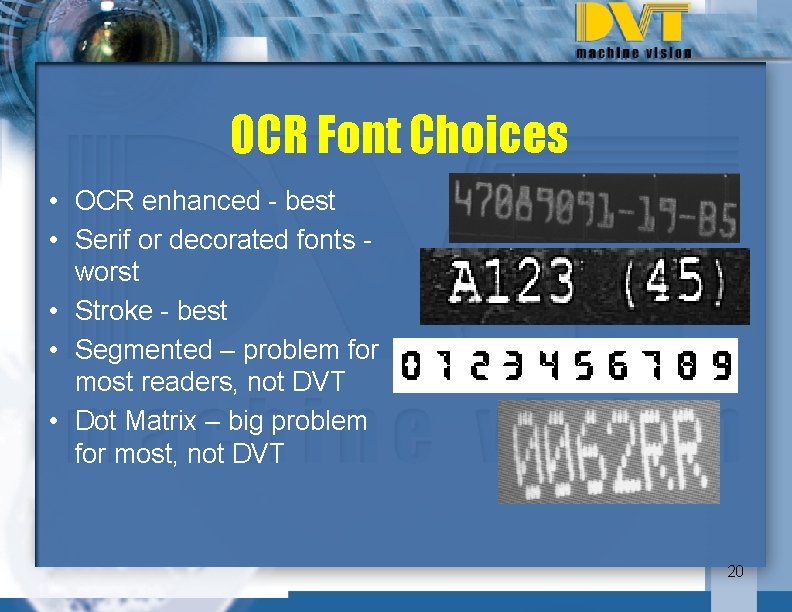
OCR Font Choices • OCR enhanced - best • Serif or decorated fonts worst • Stroke - best • Segmented – problem for most readers, not DVT • Dot Matrix – big problem for most, not DVT 20
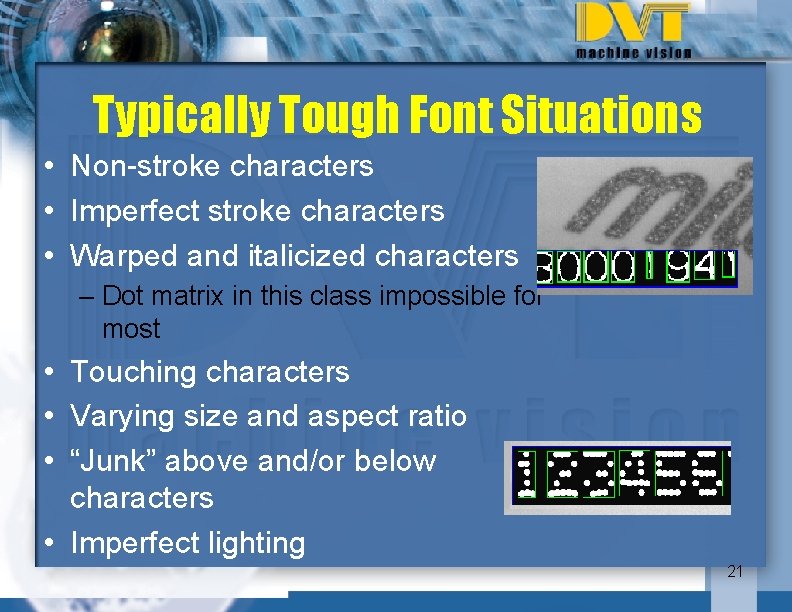
Typically Tough Font Situations • Non-stroke characters • Imperfect stroke characters • Warped and italicized characters – Dot matrix in this class impossible for most • Touching characters • Varying size and aspect ratio • “Junk” above and/or below characters • Imperfect lighting 21
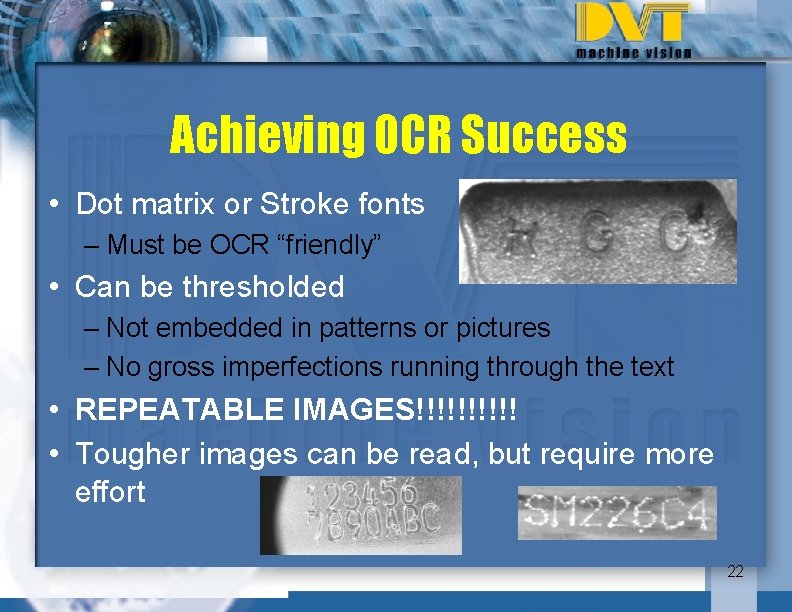
Achieving OCR Success • Dot matrix or Stroke fonts – Must be OCR “friendly” • Can be thresholded – Not embedded in patterns or pictures – No gross imperfections running through the text • REPEATABLE IMAGES!!!!! • Tougher images can be read, but require more effort 22
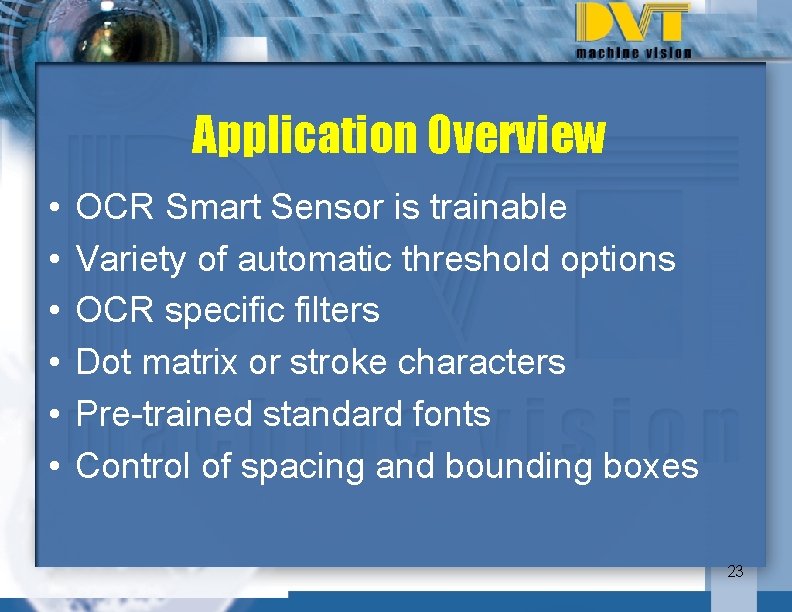
Application Overview • • • OCR Smart Sensor is trainable Variety of automatic threshold options OCR specific filters Dot matrix or stroke characters Pre-trained standard fonts Control of spacing and bounding boxes 23
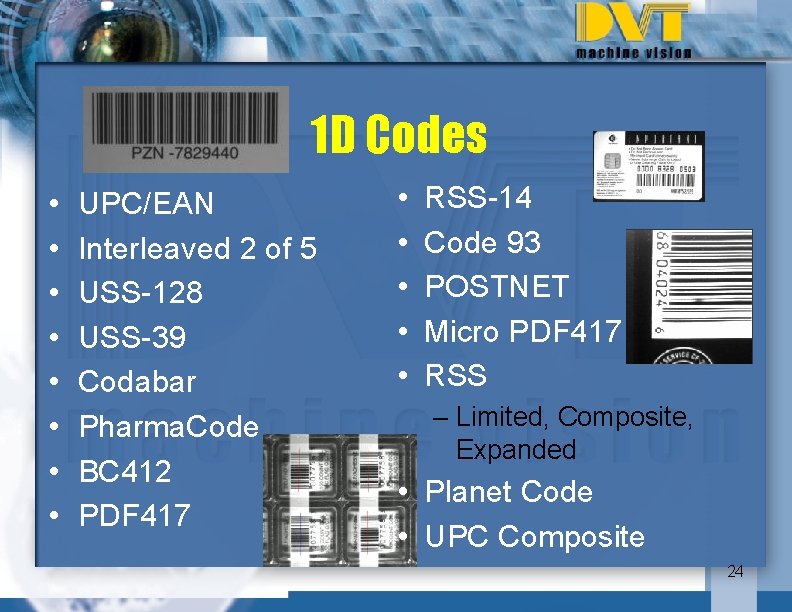
1 D Codes • • UPC/EAN Interleaved 2 of 5 USS-128 USS-39 Codabar Pharma. Code BC 412 PDF 417 • • • RSS-14 Code 93 POSTNET Micro PDF 417 RSS – Limited, Composite, Expanded • Planet Code • UPC Composite 24
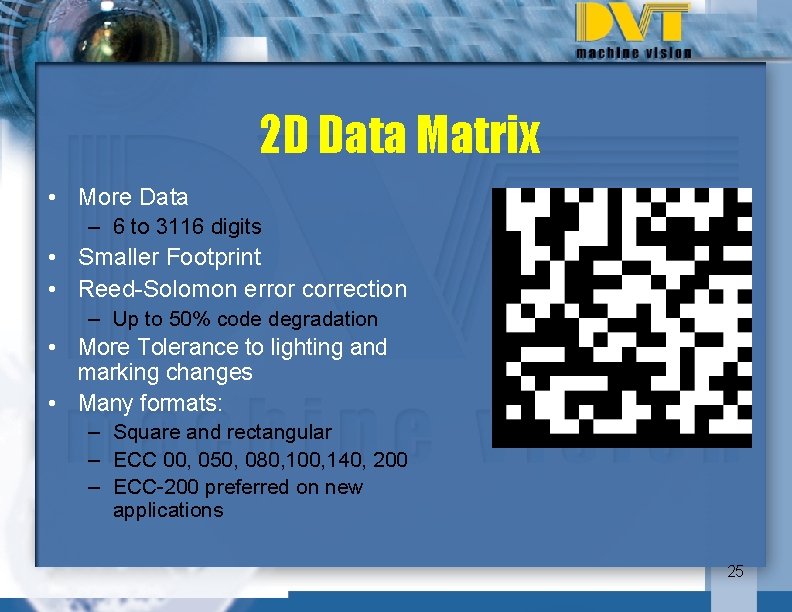
2 D Data Matrix • More Data – 6 to 3116 digits • Smaller Footprint • Reed-Solomon error correction – Up to 50% code degradation • More Tolerance to lighting and marking changes • Many formats: – Square and rectangular – ECC 00, 050, 080, 100, 140, 200 – ECC-200 preferred on new applications 25
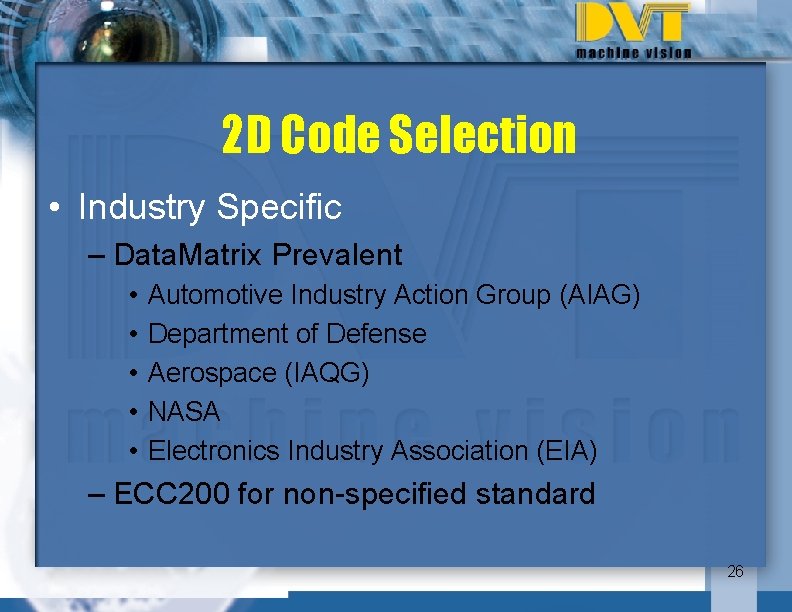
2 D Code Selection • Industry Specific – Data. Matrix Prevalent • • • Automotive Industry Action Group (AIAG) Department of Defense Aerospace (IAQG) NASA Electronics Industry Association (EIA) – ECC 200 for non-specified standard 26
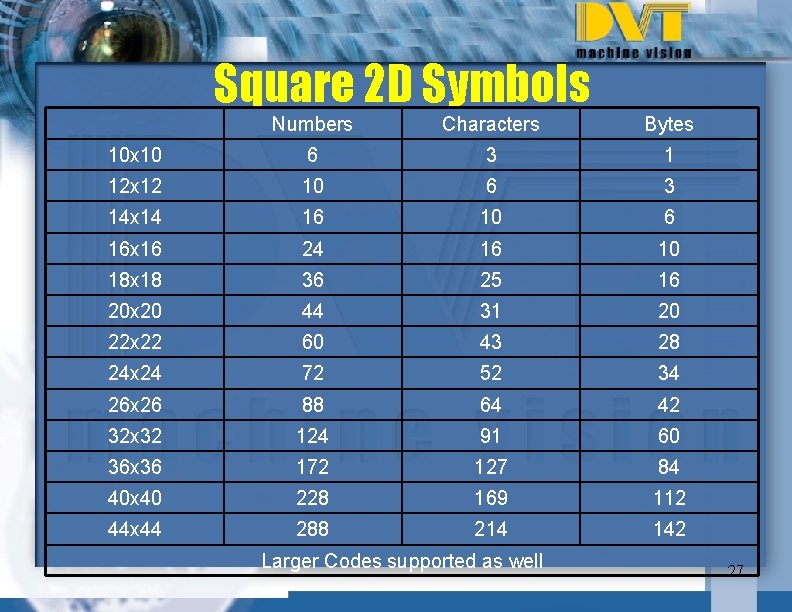
Square 2 D Symbols Numbers Characters Bytes 10 x 10 6 3 1 12 x 12 10 6 3 14 x 14 16 10 6 16 x 16 24 16 10 18 x 18 36 25 16 20 x 20 44 31 20 22 x 22 60 43 28 24 x 24 72 52 34 26 x 26 88 64 42 32 x 32 124 91 60 36 x 36 172 127 84 40 x 40 228 169 112 44 x 44 288 214 142 Larger Codes supported as well 27
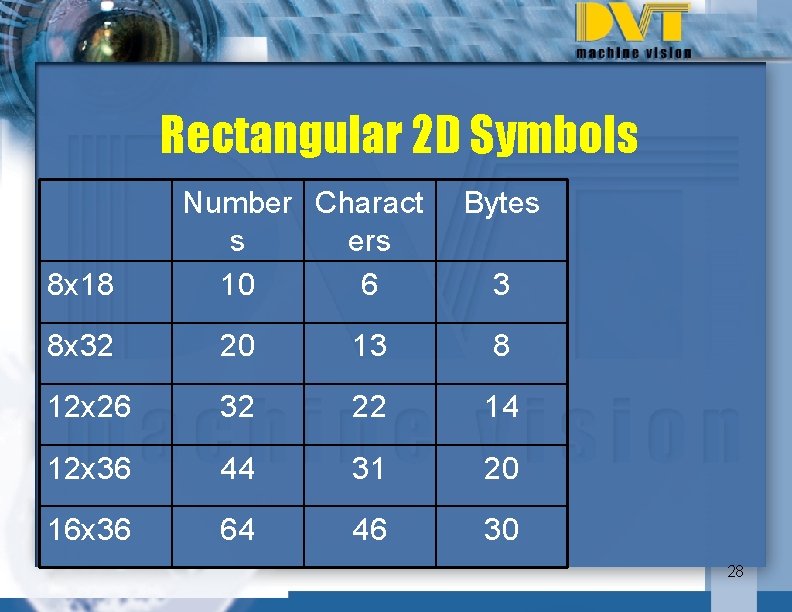
Rectangular 2 D Symbols 8 x 18 Number Charact s ers 10 6 Bytes 3 8 x 32 20 13 8 12 x 26 32 22 14 12 x 36 44 31 20 16 x 36 64 46 30 28
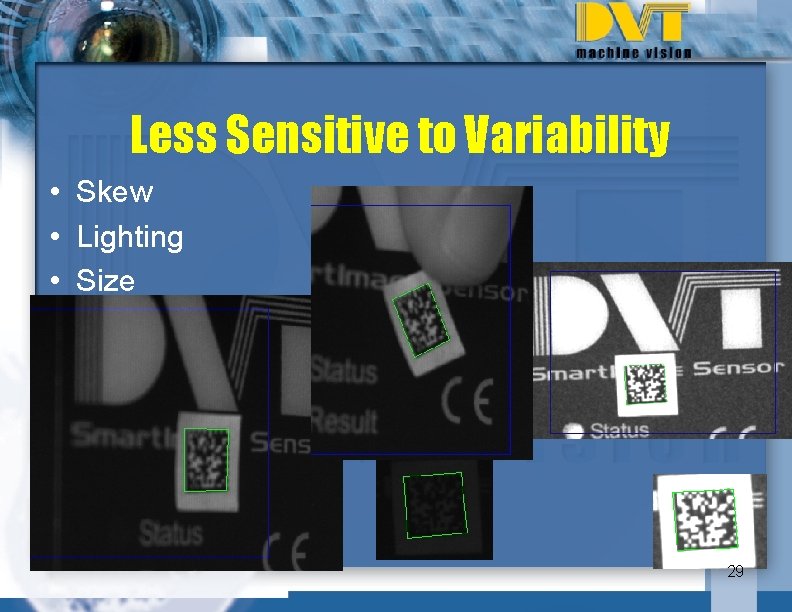
Less Sensitive to Variability • Skew • Lighting • Size 29
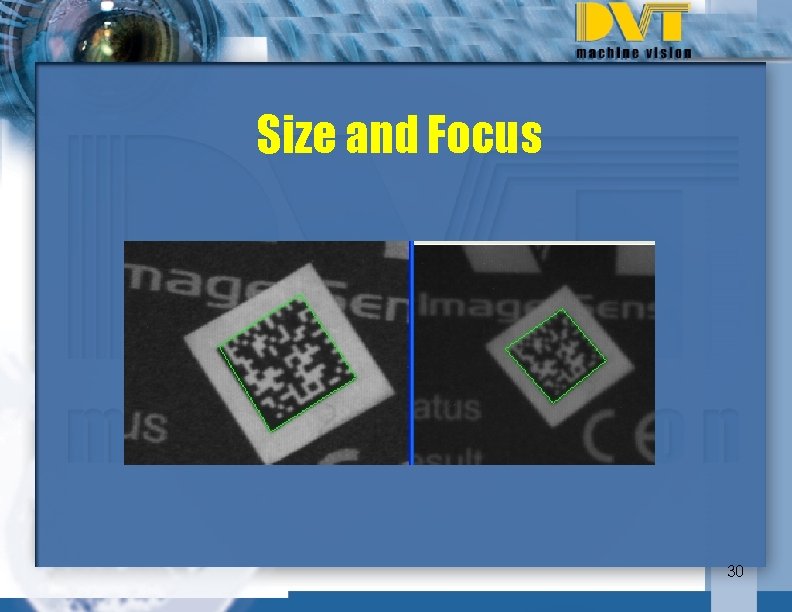
Size and Focus 30
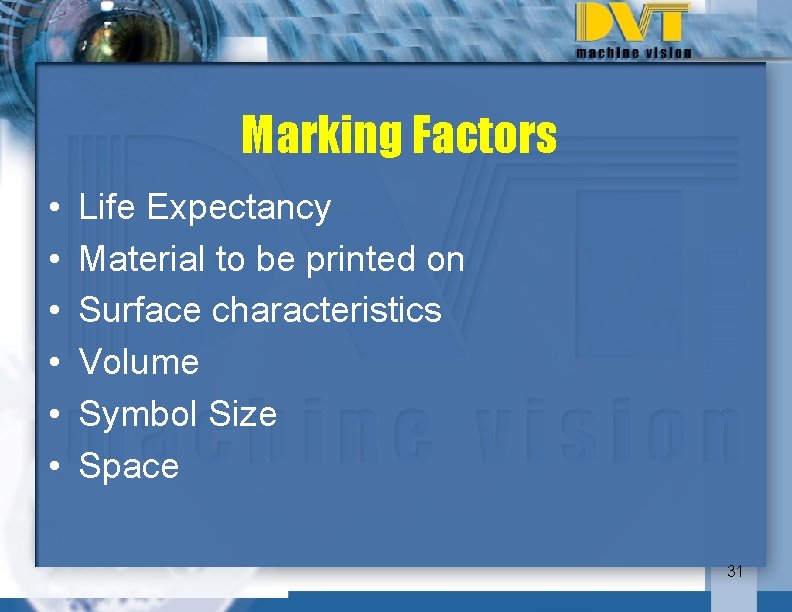
Marking Factors • • • Life Expectancy Material to be printed on Surface characteristics Volume Symbol Size Space 31
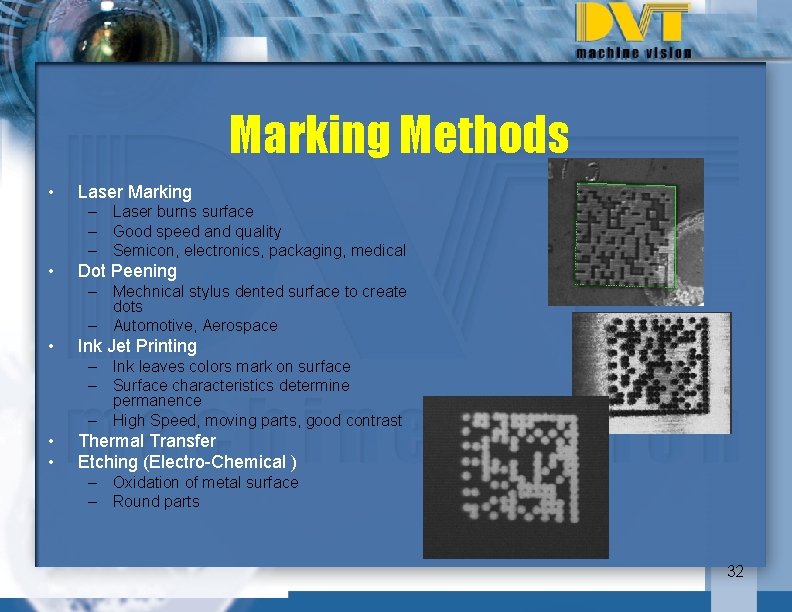
Marking Methods • Laser Marking – Laser burns surface – Good speed and quality – Semicon, electronics, packaging, medical • Dot Peening – Mechnical stylus dented surface to create dots – Automotive, Aerospace • Ink Jet Printing – Ink leaves colors mark on surface – Surface characteristics determine permanence – High Speed, moving parts, good contrast • • Thermal Transfer Etching (Electro-Chemical ) – Oxidation of metal surface – Round parts 32
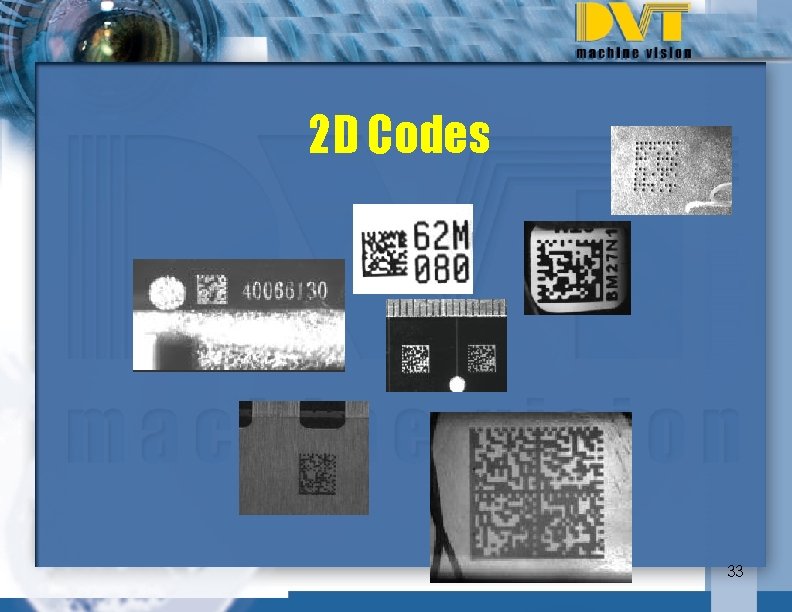
2 D Codes 33
Mark Placement • • Flat Surface Clean Area Raised surface instead of embedded Readily visible 34
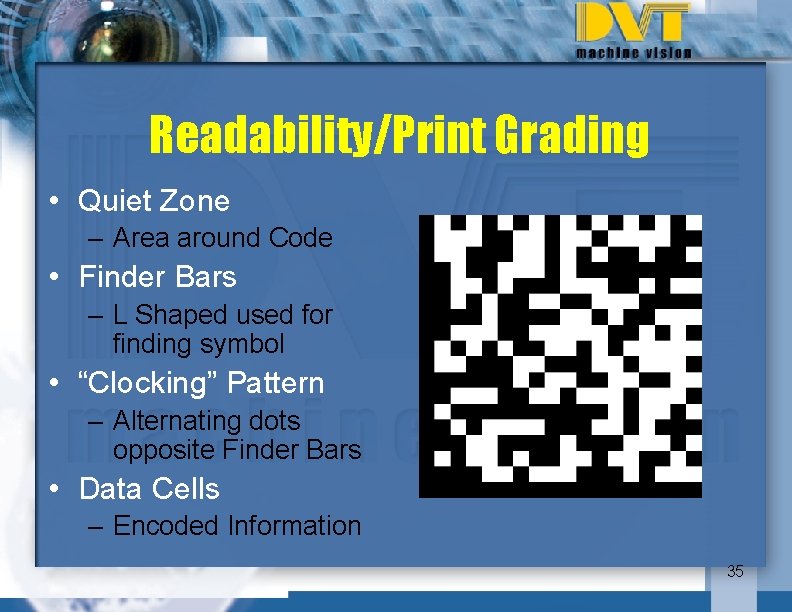
Readability/Print Grading • Quiet Zone – Area around Code • Finder Bars – L Shaped used for finding symbol • “Clocking” Pattern – Alternating dots opposite Finder Bars • Data Cells – Encoded Information 35
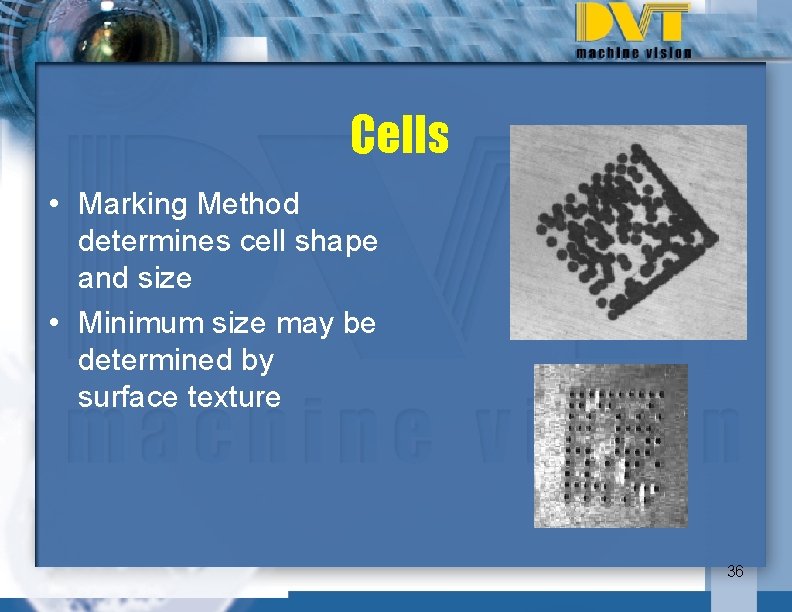
Cells • Marking Method determines cell shape and size • Minimum size may be determined by surface texture 36
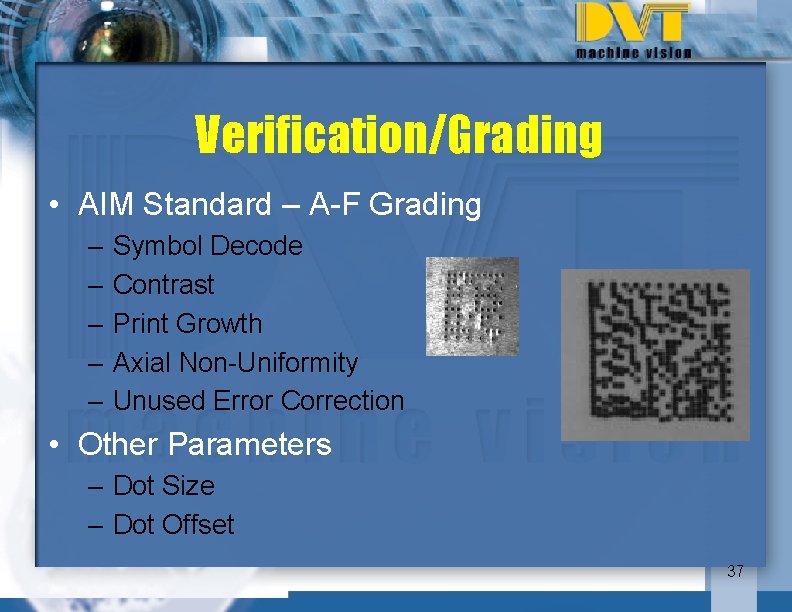
Verification/Grading • AIM Standard – A-F Grading – – – Symbol Decode Contrast Print Growth Axial Non-Uniformity Unused Error Correction • Other Parameters – Dot Size – Dot Offset 37
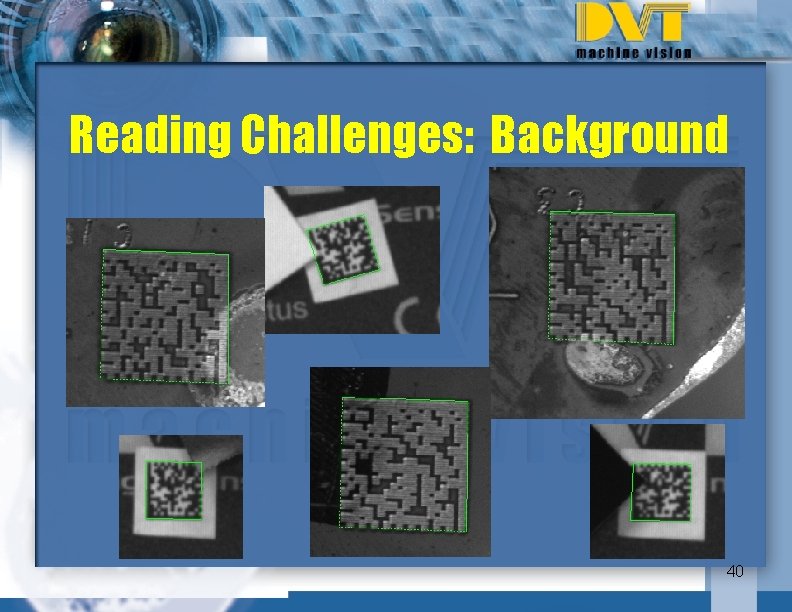
Reading Challenges • • Poor Focus Washed Out Low Contrast Non Uniform Background 38
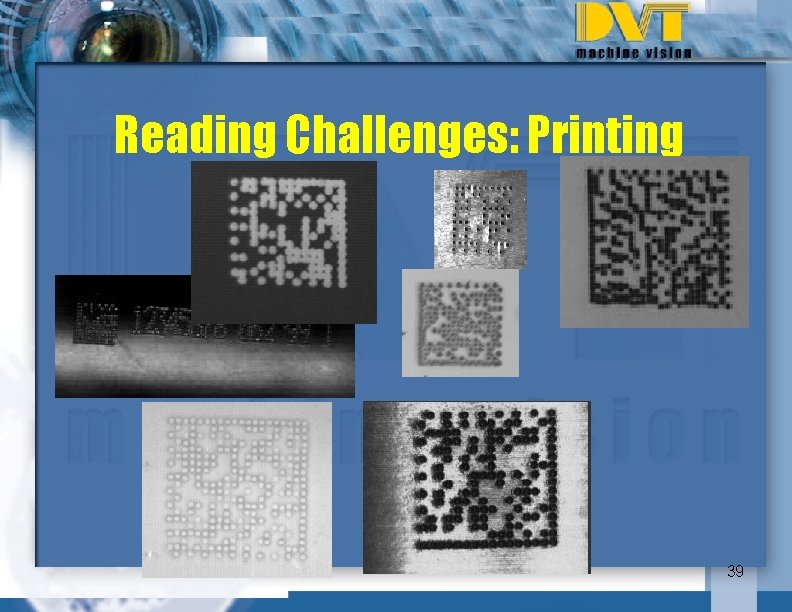
Reading Challenges: Printing 39
Reading Challenges: Background 40
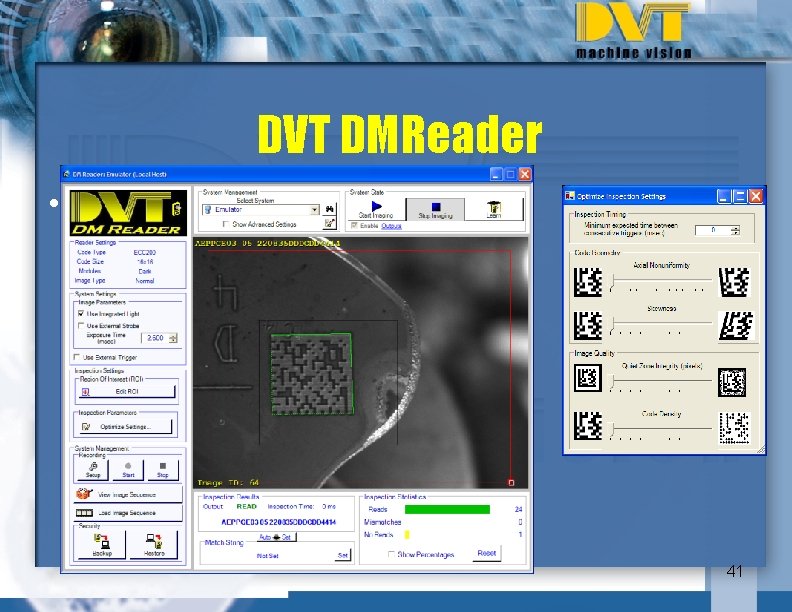
DVT DMReader • Data. Matrix/Readers 41
Solutions • Intelligent Scanners – OCR, 1 D, 2 D Reading – DMReader frontend for simple setup – Regular Speed and High Speed • Smart. Image Sensors – Color, Higher Resolution, Stainless Steel Options 42
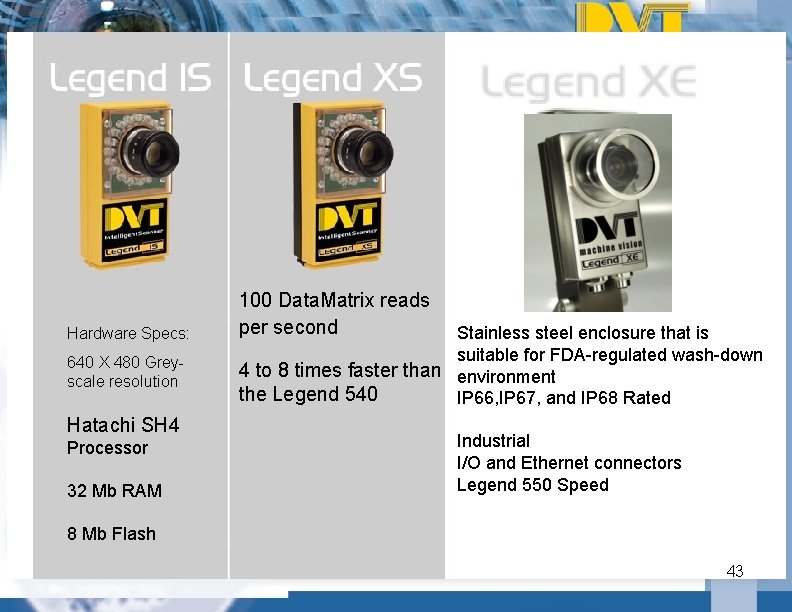
Hardware Specs: 640 X 480 Greyscale resolution Hatachi SH 4 Processor 32 Mb RAM 100 Data. Matrix reads per second Stainless steel enclosure that is suitable for FDA-regulated wash-down 4 to 8 times faster than environment the Legend 540 IP 66, IP 67, and IP 68 Rated Industrial I/O and Ethernet connectors Legend 550 Speed 8 Mb Flash 43
CFR 21 Part 11 • Pertains to – Electronic record keeping – Electronic signatures • In Terms of On. Line inspection Systems – Documenting a trail of changes and – Who made the changes 44
CFR 21 Part 11 • Two DVT Component allow a system to be configured for FDA compliancy. – Access Control – DVT Smart. Logger Service 45
CFR 21 Part 11 • Access Control and Smart. Logger – Aid in creating a FDA 21 Part 11 compliant process – Increase ability to monitor user activities – Maintain version history of camera states – Provide central location for event logging for multiple systems 46
DVT Support Model Bob Settle DVT Director of Marketing 47
Siemens VDO Bob Segraves DVT Director of Business Development 48
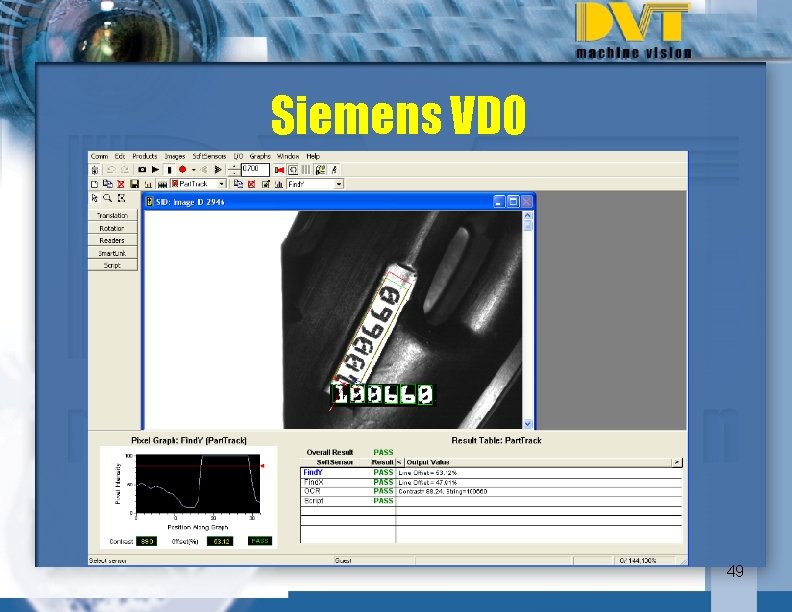
Siemens VDO 49
R&D Tool by Frank Long, DVT Director of Business Development 50
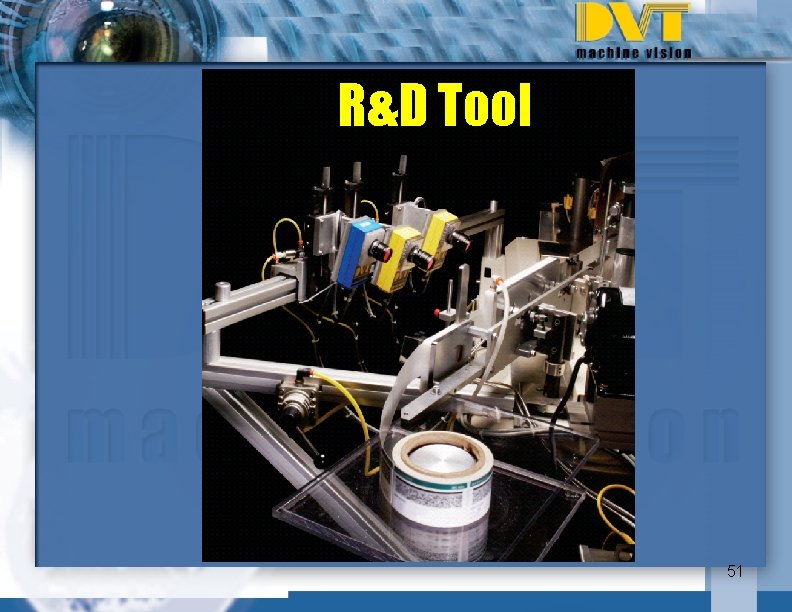
R&D Tool 51
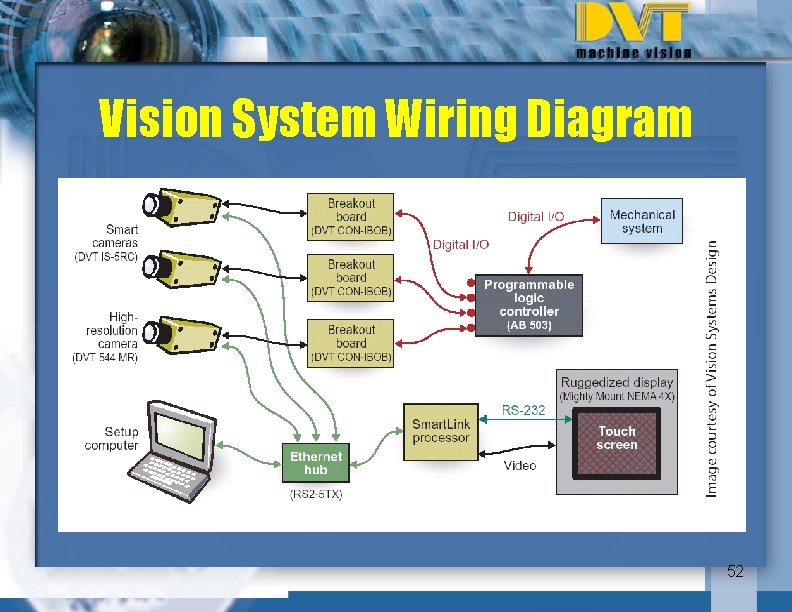
Vision System Wiring Diagram 52
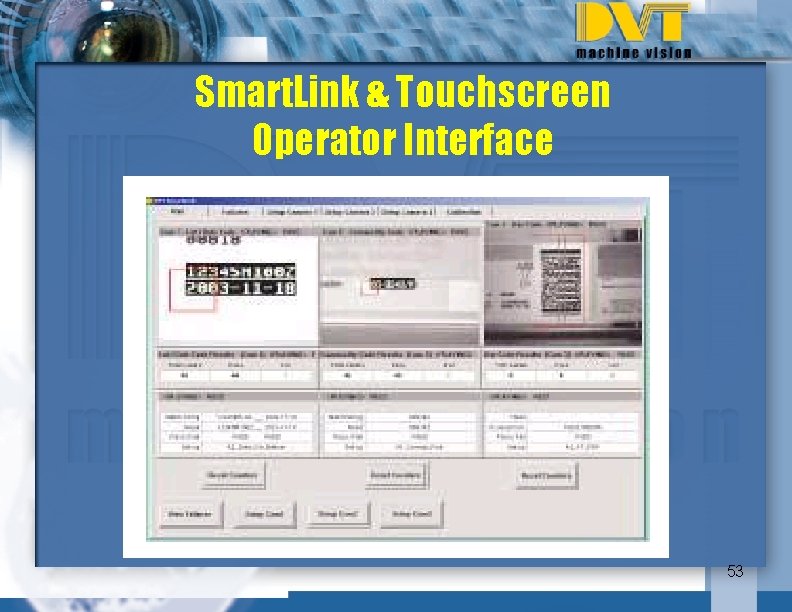
Smart. Link & Touchscreen Operator Interface 53
Free Breakout Board! 54
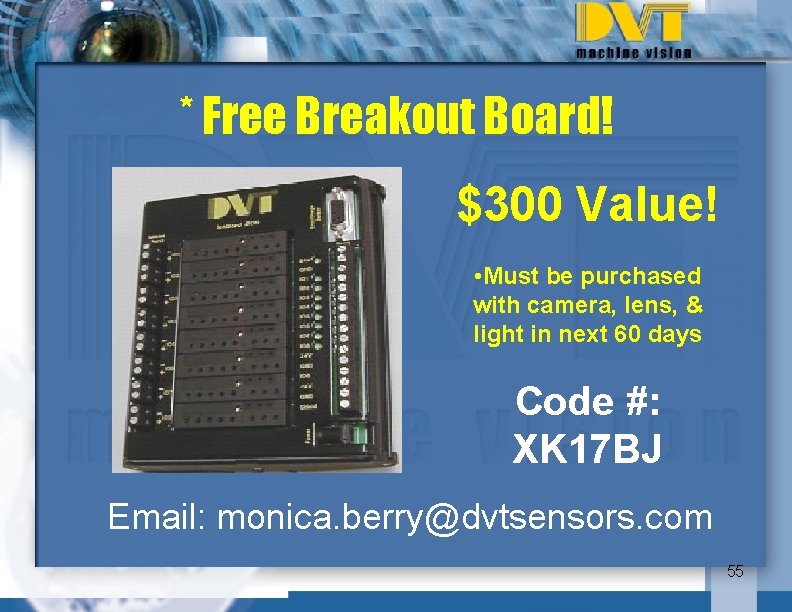
* Free Breakout Board! $300 Value! • Must be purchased with camera, lens, & light in next 60 days Code #: XK 17 BJ Email: monica. berry@dvtsensors. com 55
Our Vision DVT’s core value system is based on the concept of Servant Leadership means putting the needs of others before your own needs. Instead of asking, “What’s in it for me? ” A Servant Leader would ask, “How may I serve you? ” At DVT, we put the needs of our customers and partners ahead of our own needs. Agape – (ä-‘gä-pā) Greek Term meaning – Unconditional Love. DVT ‘s Agape Support is Unconditional. 56