
Welcome to Lifestyle Intervention Program Kay Theyerl MD

























- Slides: 64
Welcome to Lifestyle Intervention Program Kay Theyerl, MD, MS, FACP, ABIHM
Tonight �Overview of Lifestyle Medicine �Lifestyle Intervention Program – from a medical perspective �Group visit to review labs/biometrics �Questions
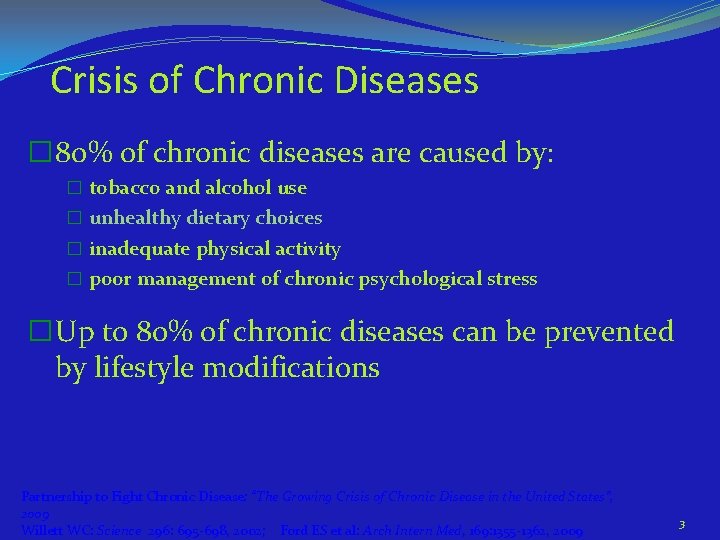
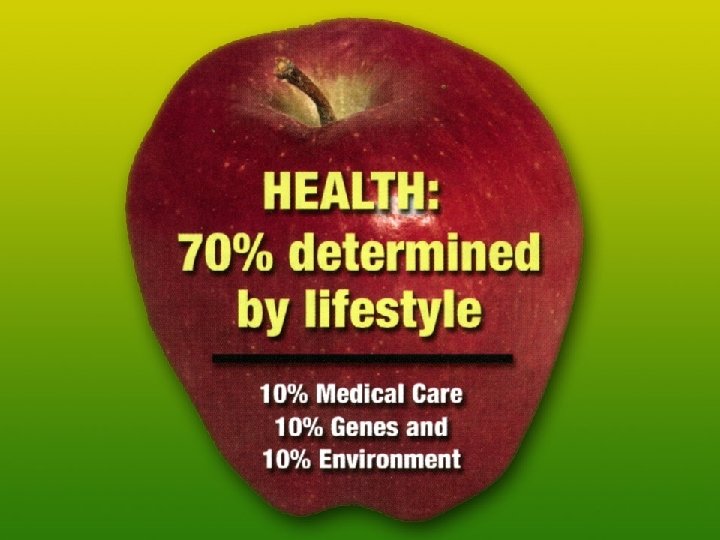
Crisis of Chronic Diseases � 80% of chronic diseases are caused by: � tobacco and alcohol use � unhealthy dietary choices � inadequate physical activity � poor management of chronic psychological stress �Up to 80% of chronic diseases can be prevented by lifestyle modifications Partnership to Fight Chronic Disease: “The Growing Crisis of Chronic Disease in the United States”, 2009 Willett WC: Science 296: 695 -698, 2002; Ford ES et al: Arch Intern Med, 169: 1355 -1362, 2009 3
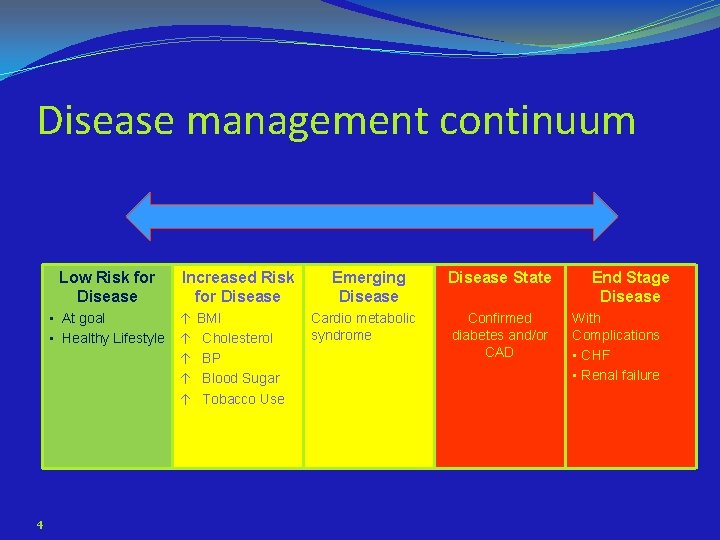
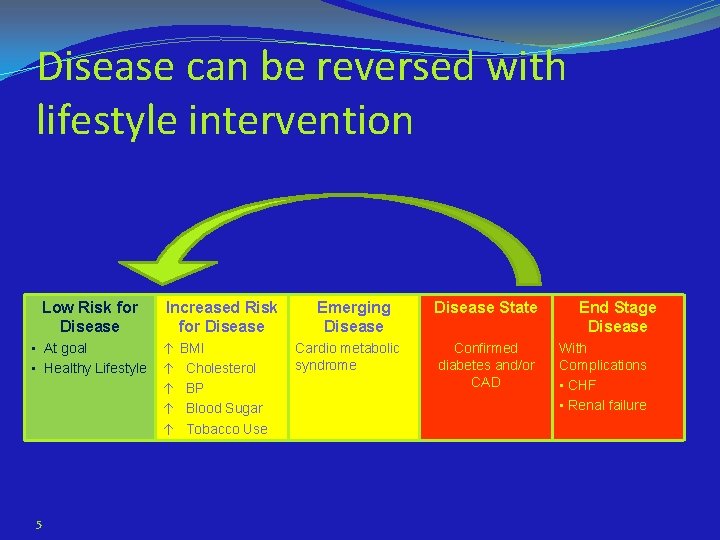
Disease management continuum Low Risk for Disease • At goal • Healthy Lifestyle 4 Increased Risk for Disease á BMI á Cholesterol á BP á Blood Sugar á Tobacco Use Emerging Disease Cardio metabolic syndrome Disease State Confirmed diabetes and/or CAD End Stage Disease With Complications • CHF • Renal failure
Disease can be reversed with lifestyle intervention Low Risk for Disease • At goal • Healthy Lifestyle 5 Increased Risk for Disease á BMI á Cholesterol á BP á Blood Sugar á Tobacco Use Emerging Disease Cardio metabolic syndrome Disease State Confirmed diabetes and/or CAD End Stage Disease With Complications • CHF • Renal failure
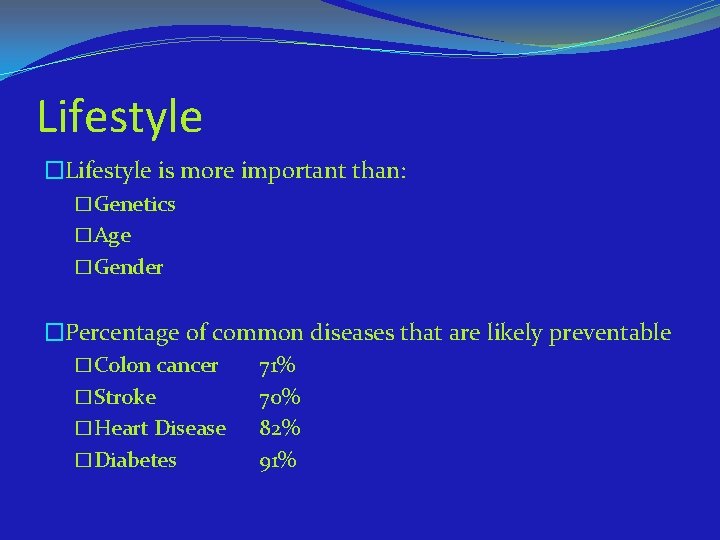
Lifestyle �Lifestyle is more important than: �Genetics �Age �Gender �Percentage of common diseases that are likely preventable �Colon cancer �Stroke �Heart Disease �Diabetes 71% 70% 82% 91%
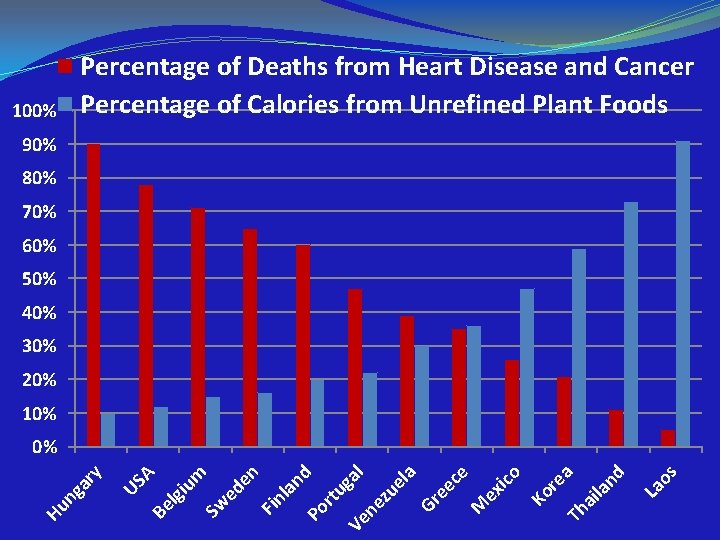
Percentage of Deaths from Heart Disease and Cancer Percentage of Calories from Unrefined Plant Foods 100% 90% 80% 70% 60% 50% 40% 30% 20% 10% Th os La ai la nd a re Ko ex ico M ce Gr ee la ue ne z ga l Ve rtu d Po la n Fin en ed Sw um lg i A US Be Hu ng ar y 0%
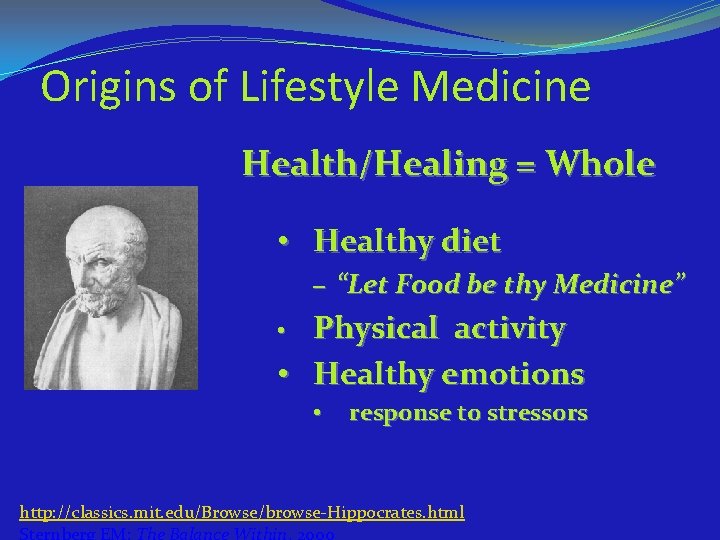
Origins of Lifestyle Medicine Health/Healing = Whole • Healthy diet – “Let Food be thy Medicine” Physical activity • Healthy emotions • • response to stressors http: //classics. mit. edu/Browse/browse-Hippocrates. html
What Can We Do? �Eat Healthy Foods �Move! �Manage Stress These are simple concepts and take work, planning, commitment, and practice
It’s Simple -- Eat Foods As Grown Foods that provide optimal health are eaten as close to their original form as possible: fruits, vegetables, whole grains, and beans
Physical Activity is needed for Good Health Helps to prevent and treat: cancers, heart disease, high blood pressure, diabetes, depression, fractures, stroke, obesity, pain…
Timeless Knowledge A merry heart does good medicine make Proverbs 17; 22
Can I just take a Pill? �Medicine may help and may be necessary in some patients �But – we can “overeat” our medicines �Medicines have side effects �Medicine can be expensive �With proper lifestyle, most patients can decrease or eliminate the need for many medicines �…And reduce their overall health risks 85% of people who currently take medicines for high cholesterol and Type II Diabetes could gain control with lifestyle alone!
Results �Weight loss �Medication decreased and/or discontinued �Cholesterol decreased �BP decreased �Off CPAP �Blood sugar normalized �Prediabetes to normal �Decreased inflammation
Knowing is not enough; we must apply. Willing is not enough; we must do. Johann Wolfgang von Goethe
Theda. Care Lifestyle Programs �Lifestyle (Pilot) � 1 -year program/ 24 sessions �Over 250 participants �Thedacare employees and spouses/domestic partners (NC) �Employers �Community members
Lifestyle Intervention Program Enables participants to reverse their chronic disease states through a structured approach to: � Nutrition � Cooking � Physical activity � Stress management � Yoga in a way that is attainable, practical, and engaging
Lifestyle…IS the Most Powerful Medicine �For general good health �To prevent and treat chronic diseases including: �Diabetes, heart disease, hypertension, obesity, cancer, inflammatory diseases �Theda. Care Lifestyle Intervention Program - designed to help you gain and sustain good health
Visionary The doctor of the future will give no medicine, but instead will interest his patients in the care of the human frame, in diet, and in the cause and prevention of disease. Thomas Edison
Lifestyle Team �Congratulations!!! �Fortunate to be part of the team �Leading this transformation at Theda. Care and at other employers in the Valley – Appvion/Galloway �Look forward to walking with you as you take your first steps in this life-changing journey
Lifestyle Intervention Program Group Visit # 1
Group Visit: Biometrics and Labs Teammates Concept We are all on this journey together!
Biometrics and Labs �HAT Lifestyle Tool �Group Visit to review results (tonight) �Medical Director �Group data �Individual data �May request to opt out of group visit �Communication with PCP �Participant and Medical Director �Labs/biometrics �Medical Director will not treat, change medication, or recommend individual treatment
Biometrics and Labs �Timing �Baseline � 6 weeks � 6 months � 1 year � 18 months � 2 years
Labs � The baseline labs : �Lipid panel �Glucose �Liver panel �Hgb A 1 c �TSH level (thyroid) �Vitamin D �High sensitivity C-reactive Protein (hs-CRP) �Insulin Assay .
Group Visit �Personal Health Assessment (PHA) Tool! �Lifestyle Habits �Biometrics � Biometric (HAT) score � Measurements � Height � Weight (baseline only) � Waist � BP � Lab Results
Reminders �Communicate with your PCP �Your PCP will: �Manage your chronic diseases �Work with you to manage your medications �Give specific recommendations �Lifestyle Medical Director will: �Make general recommendations �Communicate with your PCP if needed
Biometrics and Labs �Definitions – what does it measure? �Implications – what does it mean? �Expectations – how will the Lifestyle Intervention Program affect it?
Personal Health Assessment (PHA) Tool �Summary �Lifestyle Habits �Biometrics �Measurements �Lab Results
Results At-A-Glance (page 3) �Lifestyle Habits �Nutrition �Physical Activity �Stress and Depression �Alcohol Consumption �Need to Work On �Keep Up the Good Work
Results At-A-Glance �Biometrics for HAT �Labs �BMI �Tobacco
Health Trends – HAT (page 4) �Measurements �Weight �BMI �Lifestyle: waist measurement �BP �Labs (usual HAT labs) �Lifestyle �Biometrics (HAT) Score
Lifestyle Lab Trends - page 22 �Lifestyle Labs for comparison
HAT �(Pages 5 -9) �Nutrition �Physical Activity �Stress and Depression �Alcohol Consumption �Tobacco Use
Weight Management (page 10) �Height (health trends – page 4) �Weight (health trends – page 4) �BMI �High Risk: increases risk for � High Blood Pressure � Heart Disease � Diabetes � Cancer �Decreasing body weight by 5% can reduce risk – visceral fat (dangerous fat) is the first to go!
Weight �Goals/expectations �Body composition �Decrease in fat �Increase in muscle �How will program affect weight and BMI? �Healthy weight loss?
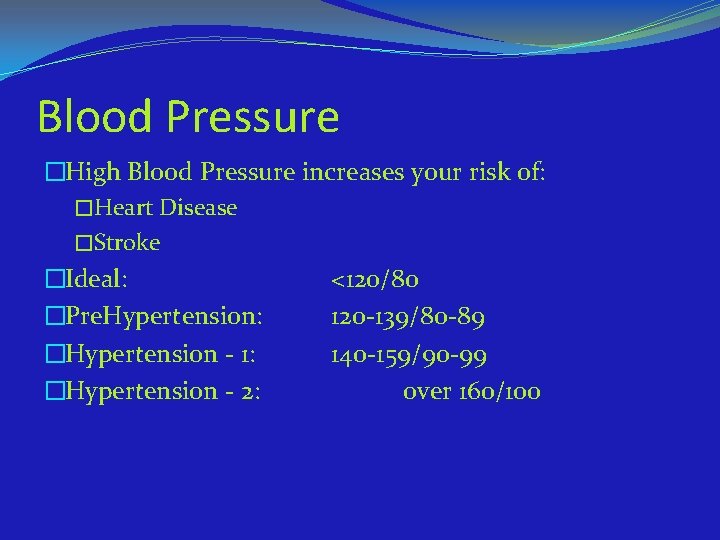
Blood Pressure �High Blood Pressure increases your risk of: �Heart Disease �Stroke �Ideal: <120/80 �Pre. Hypertension: 120 -139/80 -89 �Hypertension - 1: 140 -159/90 -99 �Hypertension - 2: over 160/100
Blood Pressure �How does the program affect BP? �Goals/expectations �What if I am taking medication for Blood Pressure? �How will I know if my medications need to be adjusted? �What do I tell my PCP? “What do I need to do to be able to change my medications? ”
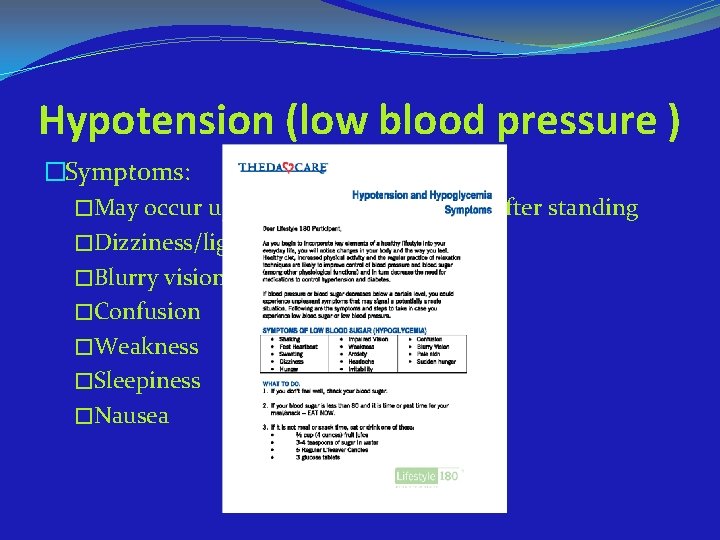
Hypotension (low blood pressure ) �Symptoms: �May occur upon change of position or after standing �Dizziness/lightheaded feeling �Blurry vision �Confusion �Weakness �Sleepiness �Nausea
Hypotension �What to do: �Immediately sit or lie down until symptoms resolve �Change positions slowly �Drink plenty of water especially as we embark on an exercise program �Contact PCP with report of symptoms and blood pressure readings �Call 911 to go to Emergency Department if � Skin is cold/clammy or turns pale or blue � Pulse is weak and rapid � Breathing is rapid/labored
Blood Tests (page 12 - 14) �LDL �HDL �Total Cholesterol/HDL Ratio �Triglycerides �Total Cholesterol �Glucose
Lipids �Total Cholesterol �LDL <200 mg/dl <100 mg/dl �HDL >39 mg/dl �Triglycerides <150 mg/dl � “Bad” cholesterol � Increases risk of cardiovascular diseases � Animal products/saturated fat � “Good” Cholesterol � Protective � Exercise � � Fat Sugar Alcohol Lack of exercise
Lipids �How does the program affect lipids? �Goals/expectations �What if I am taking medications for lipids? �How will I know if my medications could be adjusted? �What do I tell my PCP? “What do I need to do to be able to change my medications? ”
Glucose ( mg/d. L) �Low Risk: less than 100 �Increased Risk: 100 – 125 (Prediabetes) �High Risk: 126 and greater* (Diabetes) *diagnosis requires 2 readings >125
Diabetes and Pre-Diabetes �How will the program affect these? �Goals/expectations �What is I am taking medication for diabetes? �How will I know if my medications may need to be changed?
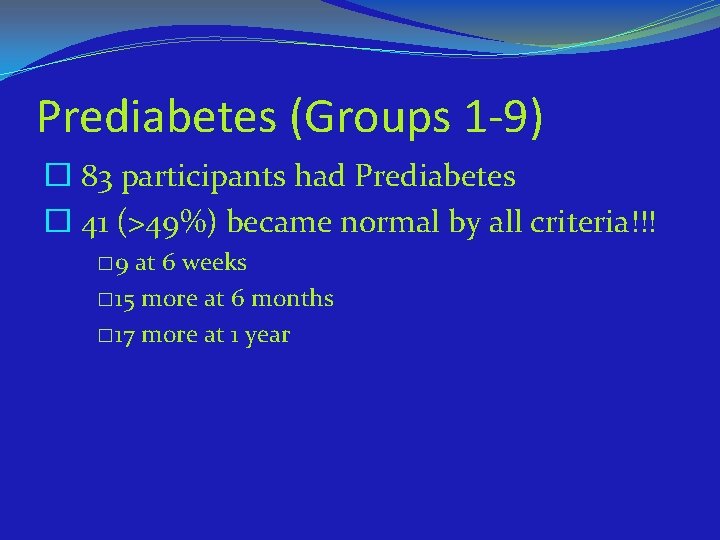
Prediabetes (Groups 1 -9) � 83 participants had Prediabetes � 41 (>49%) became normal by all criteria!!! � 9 at 6 weeks � 15 more at 6 months � 17 more at 1 year
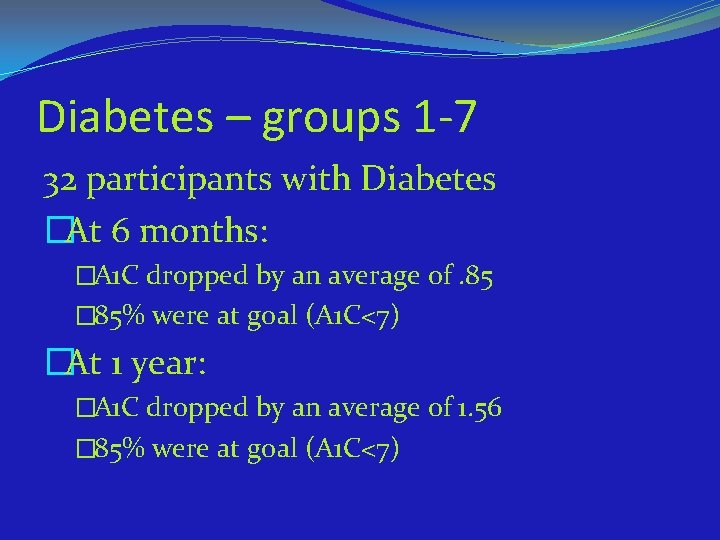
Diabetes – groups 1 -7 32 participants with Diabetes �At 6 months: �A 1 C dropped by an average of. 85 � 85% were at goal (A 1 C<7) �At 1 year: �A 1 C dropped by an average of 1. 56 � 85% were at goal (A 1 C<7)
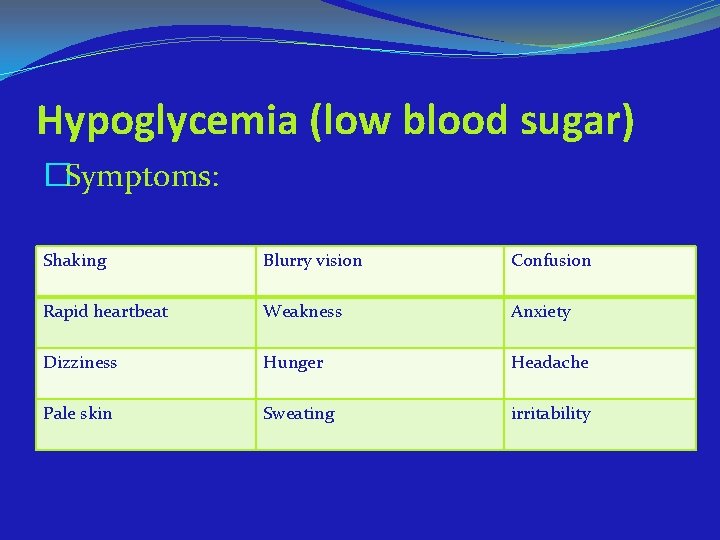
Hypoglycemia (low blood sugar) �Symptoms: Shaking Blurry vision Confusion Rapid heartbeat Weakness Anxiety Dizziness Hunger Headache Pale skin Sweating irritability
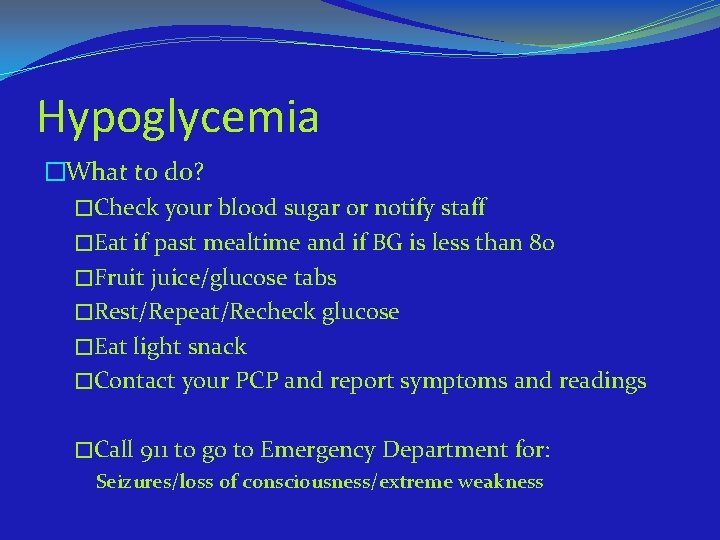
Hypoglycemia �What to do? �Check your blood sugar or notify staff �Eat if past mealtime and if BG is less than 80 �Fruit juice/glucose tabs �Rest/Repeat/Recheck glucose �Eat light snack �Contact your PCP and report symptoms and readings �Call 911 to go to Emergency Department for: Seizures/loss of consciousness/extreme weakness
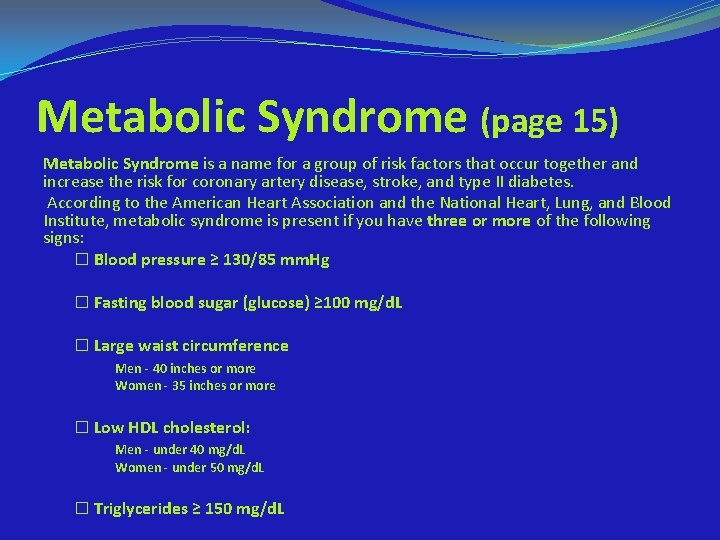
Metabolic Syndrome (page 15) Metabolic Syndrome is a name for a group of risk factors that occur together and increase the risk for coronary artery disease, stroke, and type II diabetes. According to the American Heart Association and the National Heart, Lung, and Blood Institute, metabolic syndrome is present if you have three or more of the following signs: � Blood pressure ≥ 130/85 mm. Hg � Fasting blood sugar (glucose) ≥ 100 mg/d. L � Large waist circumference Men - 40 inches or more Women - 35 inches or more � Low HDL cholesterol: Men - under 40 mg/d. L Women - under 50 mg/d. L � Triglycerides ≥ 150 mg/d. L
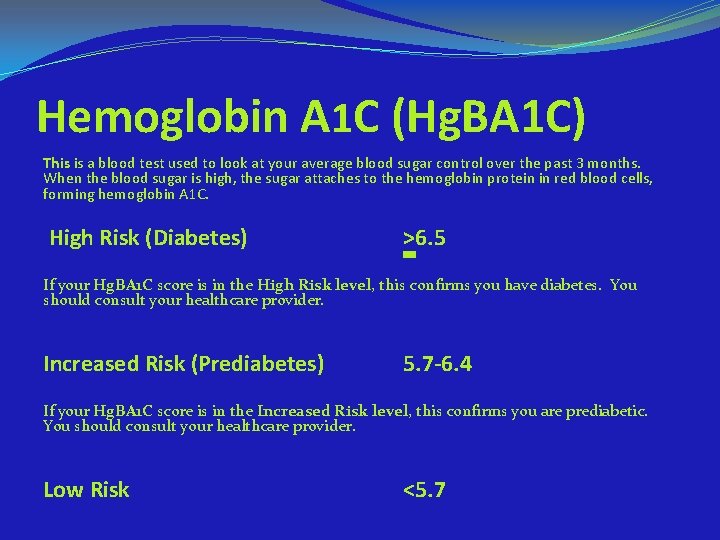
Hemoglobin A 1 C (Hg. BA 1 C) This is a blood test used to look at your average blood sugar control over the past 3 months. When the blood sugar is high, the sugar attaches to the hemoglobin protein in red blood cells, forming hemoglobin A 1 C. High Risk (Diabetes) >6. 5 If your Hg. BA 1 C score is in the High Risk level, this confirms you have diabetes. You should consult your healthcare provider. Increased Risk (Prediabetes) 5. 7 -6. 4 If your Hg. BA 1 C score is in the Increased Risk level, this confirms you are prediabetic. You should consult your healthcare provider. Low Risk <5. 7
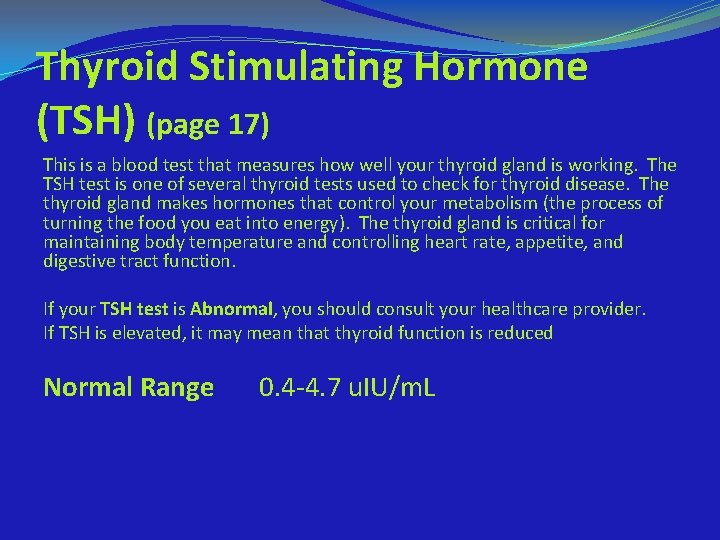
Thyroid Stimulating Hormone (TSH) (page 17) This is a blood test that measures how well your thyroid gland is working. The TSH test is one of several thyroid tests used to check for thyroid disease. The thyroid gland makes hormones that control your metabolism (the process of turning the food you eat into energy). The thyroid gland is critical for maintaining body temperature and controlling heart rate, appetite, and digestive tract function. If your TSH test is Abnormal, you should consult your healthcare provider. If TSH is elevated, it may mean that thyroid function is reduced Normal Range 0. 4 -4. 7 u. IU/m. L
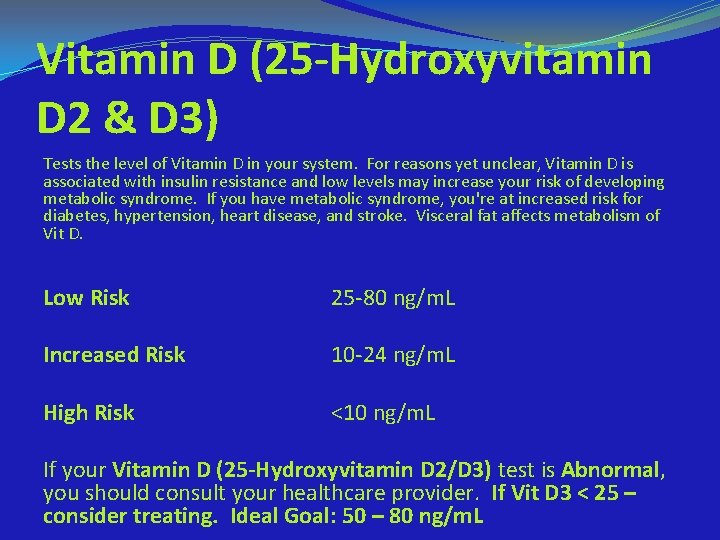
Vitamin D (25 -Hydroxyvitamin D 2 & D 3) Tests the level of Vitamin D in your system. For reasons yet unclear, Vitamin D is associated with insulin resistance and low levels may increase your risk of developing metabolic syndrome. If you have metabolic syndrome, you're at increased risk for diabetes, hypertension, heart disease, and stroke. Visceral fat affects metabolism of Vit D. Low Risk 25 -80 ng/m. L Increased Risk 10 -24 ng/m. L High Risk <10 ng/m. L If your Vitamin D (25 -Hydroxyvitamin D 2/D 3) test is Abnormal, you should consult your healthcare provider. If Vit D 3 < 25 – consider treating. Ideal Goal: 50 – 80 ng/m. L
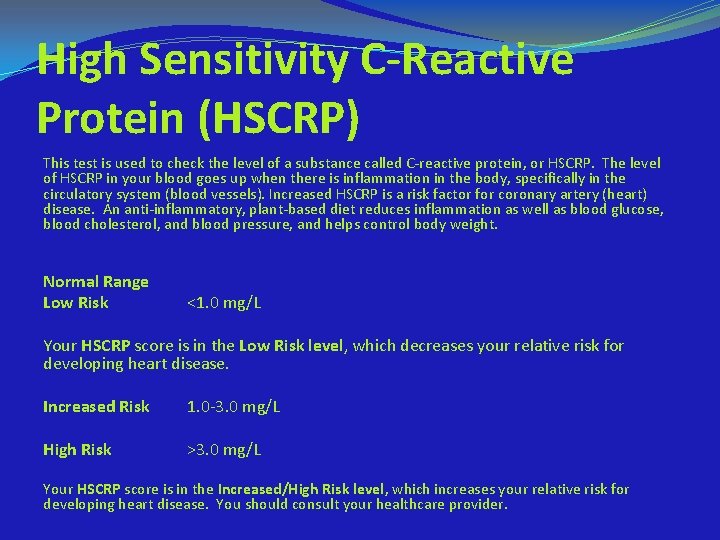
High Sensitivity C-Reactive Protein (HSCRP) This test is used to check the level of a substance called C-reactive protein, or HSCRP. The level of HSCRP in your blood goes up when there is inflammation in the body, specifically in the circulatory system (blood vessels). Increased HSCRP is a risk factor for coronary artery (heart) disease. An anti-inflammatory, plant-based diet reduces inflammation as well as blood glucose, blood cholesterol, and blood pressure, and helps control body weight. Normal Range Low Risk <1. 0 mg/L Your HSCRP score is in the Low Risk level, which decreases your relative risk for developing heart disease. Increased Risk 1. 0 -3. 0 mg/L High Risk >3. 0 mg/L Your HSCRP score is in the Increased/High Risk level, which increases your relative risk for developing heart disease. You should consult your healthcare provider.
Inflammation = Illness Broad Perspective �Acute Inflammation/Acute Disease �Injury �Trauma �Infection �Toxins �Immune reaction/allergies �Treatment �Modern Model of Medicine �Very effective
Chronic Diseases � Atherosclerosis � Coronary heart disease � Stroke � Peripheral artery disease � Cancer � Diabetes � Hypertension � Obesity � Asthma � Chronic Pain � Rheumatoid Arthritis � Autoimmune Disease � Alzheimer’s Disease � Acne � Systemic Lupus Erythematosus (SLE) � MS � IBD
Treatment �Current model �Just give a pill, perform a procedure, right? �If we do not address underlying cause it = bandaid �Expensive �Ineffective in the long run
Chronic Disease Inflammation Gone awry
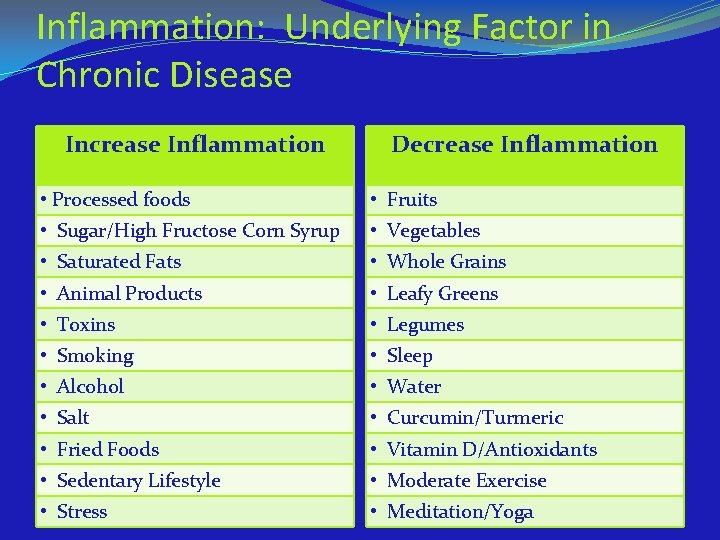
Inflammation: Underlying Factor in Chronic Disease Increase Inflammation Decrease Inflammation • Processed foods • Fruits • Sugar/High Fructose Corn Syrup • Vegetables • Saturated Fats • Whole Grains • Animal Products • Leafy Greens • Toxins • Legumes • Smoking • Sleep • Alcohol • Water • Salt • Curcumin/Turmeric • Fried Foods • Vitamin D/Antioxidants • Sedentary Lifestyle • Moderate Exercise • Stress • Meditation/Yoga
Insulin This test measures the amount of insulin in the blood after a fasting period of at least eight hours. High levels are seen in people with metabolic syndrome (insulin resistance), which increases the risk of developing type II diabetes. If your Insulin Assay Blood test is Abnormal; you should consult your healthcare provider. Normal Range 2. 6 - 24. 9 mc. IU/m. L > 25 mc. IU/m. L = PREDIABETES
Group 11 Data - 30 �Vitamin D deficiency <25: 15 (5 on low end) �Contact PCP to discuss plan �Prediabetes : 11 �hs-CRP: Only 4 were in low risk category �High lipids: 23
I Have Control?
Questions