
Welcome to Introduction to A Framework for Teaching



- Slides: 45
Welcome to. . . Introduction to A Framework for Teaching 3/10/2021 pbevan 1
A Framework for Teaching: The Research • National Board for Professional Teaching Standards • Praxis III Teaching Performance Assessments • State Teaching Standards 3/10/2021 pbevan 2
Learning Intentions, Activity #1: Participants will learn. . . �How their thinking about good teaching compares to the research about good teaching �That the Framework represents good common sense, and much that we already know, about teaching 3/10/2021 pbevan 3
Worksheet #1 Wisdom of Practice: Collecting our thinking about good teaching 3/10/2021 pbevan 4
Wisdom of Practice What are the qualities of teaching most tightly tied to student learning? 3/10/2021 pbevan 5
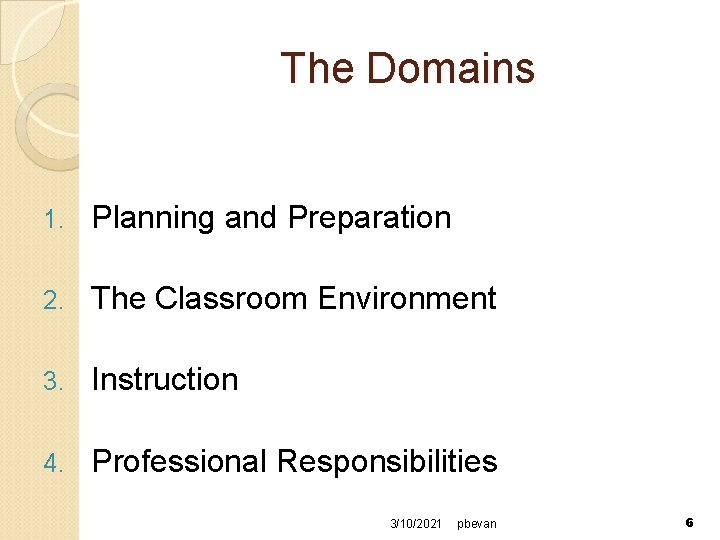
The Domains 1. Planning and Preparation 2. The Classroom Environment 3. Instruction 4. Professional Responsibilities 3/10/2021 pbevan 6
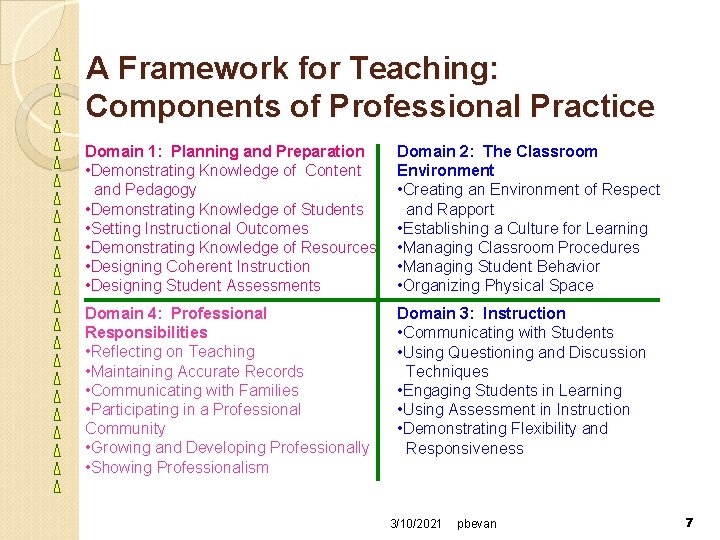
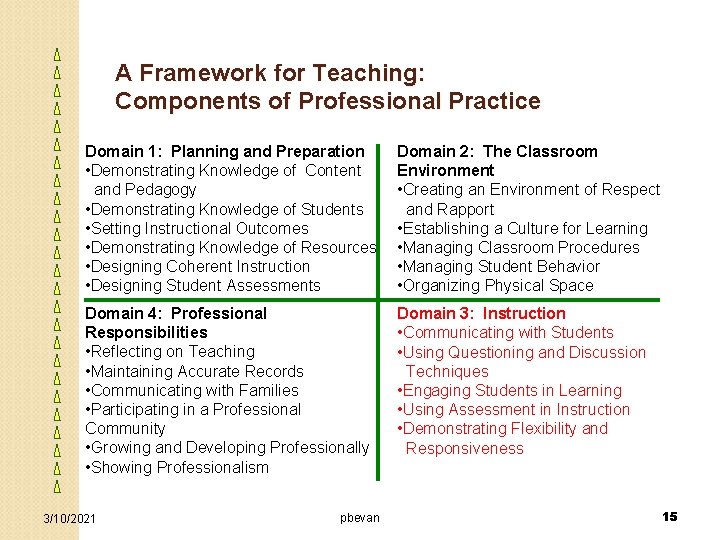
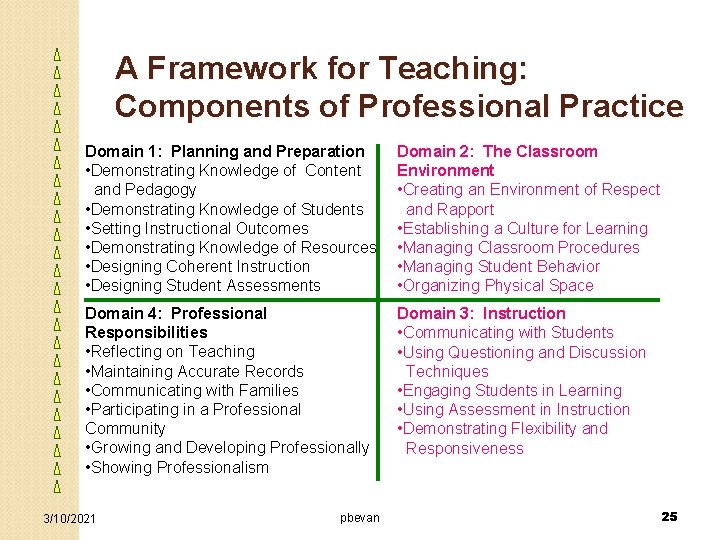
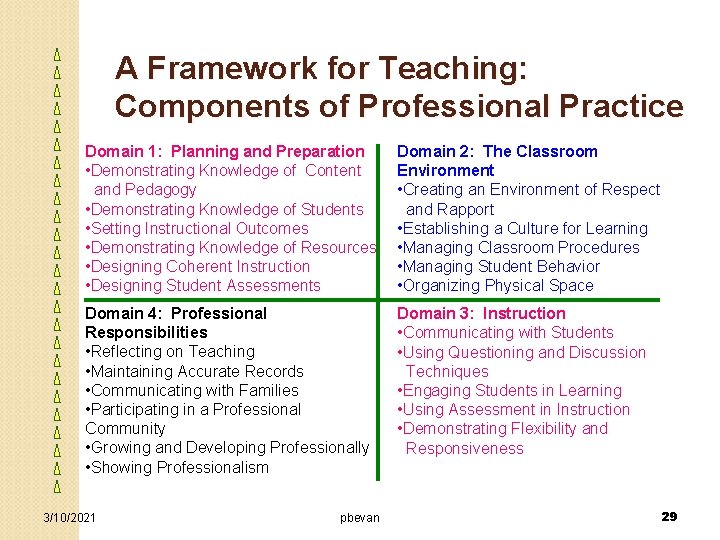
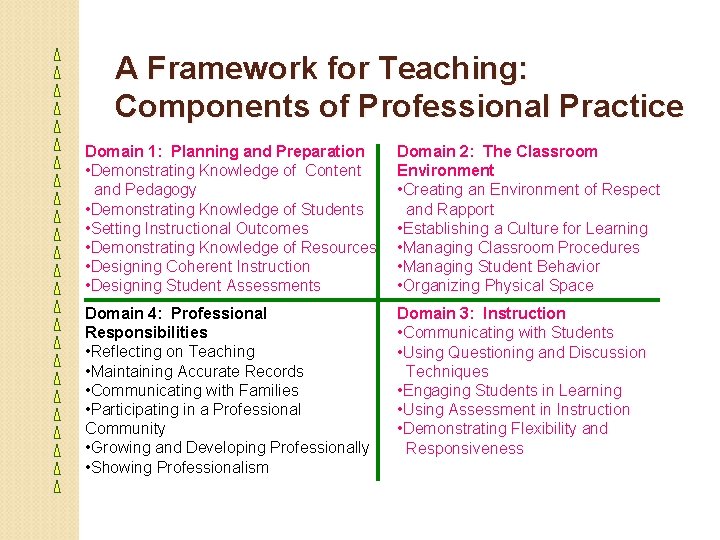
A Framework for Teaching: Components of Professional Practice Domain 1: Planning and Preparation • Demonstrating Knowledge of Content and Pedagogy • Demonstrating Knowledge of Students • Setting Instructional Outcomes • Demonstrating Knowledge of Resources • Designing Coherent Instruction • Designing Student Assessments Domain 2: The Classroom Environment • Creating an Environment of Respect and Rapport • Establishing a Culture for Learning • Managing Classroom Procedures • Managing Student Behavior • Organizing Physical Space Domain 4: Professional Responsibilities • Reflecting on Teaching • Maintaining Accurate Records • Communicating with Families • Participating in a Professional Community • Growing and Developing Professionally • Showing Professionalism Domain 3: Instruction • Communicating with Students • Using Questioning and Discussion Techniques • Engaging Students in Learning • Using Assessment in Instruction • Demonstrating Flexibility and Responsiveness 3/10/2021 pbevan 7
Learning Intentions, Activity #1: Participants will learn. . . �How their thinking about good teaching compares to the research about good teaching �That the Framework represents good common sense, and much that we already know, about teaching 3/10/2021 pbevan 8
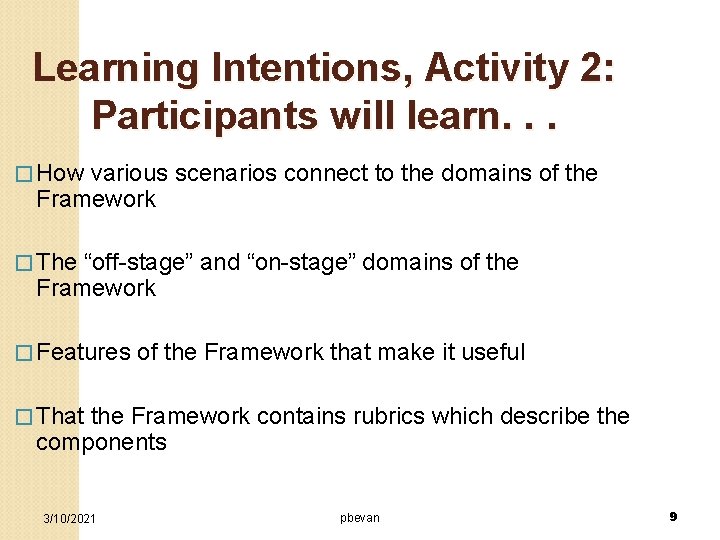
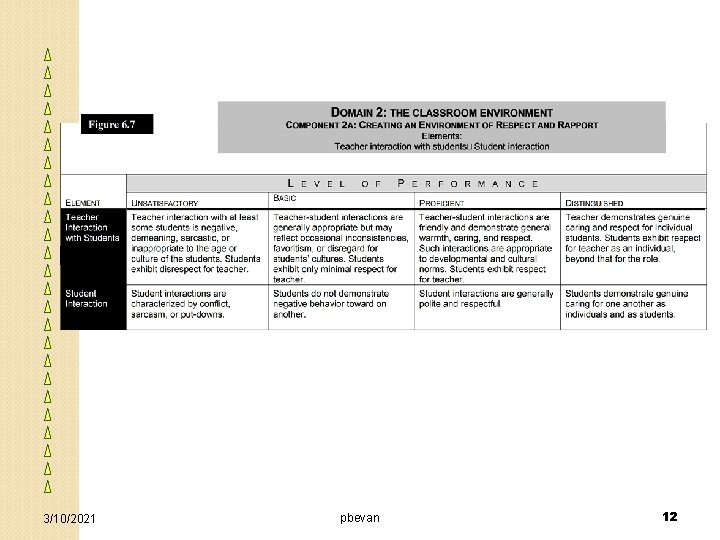
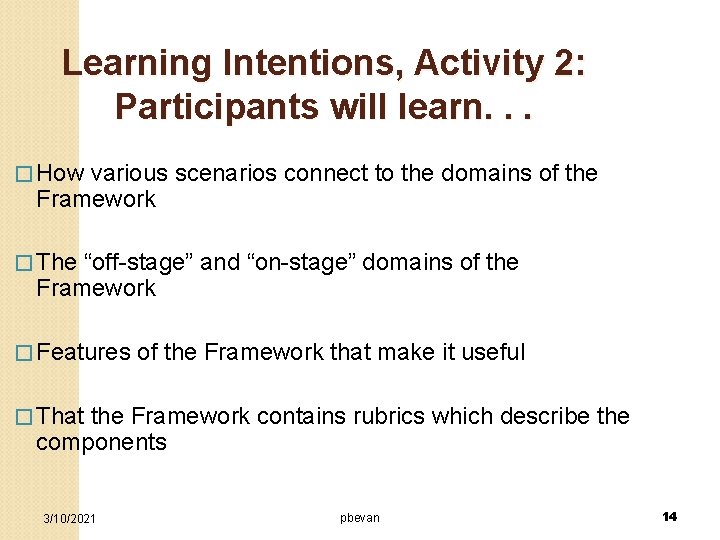
Learning Intentions, Activity 2: Participants will learn. . . � How various scenarios connect to the domains of the Framework � The “off-stage” and “on-stage” domains of the Framework � Features of the Framework that make it useful � That the Framework contains rubrics which describe the components 3/10/2021 pbevan 9
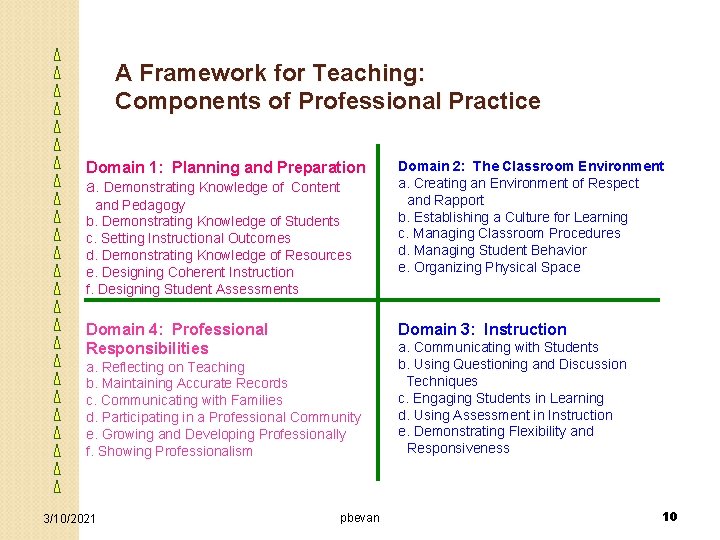
A Framework for Teaching: Components of Professional Practice Domain 1: Planning and Preparation a. Demonstrating Knowledge of Content and Pedagogy b. Demonstrating Knowledge of Students c. Setting Instructional Outcomes d. Demonstrating Knowledge of Resources e. Designing Coherent Instruction f. Designing Student Assessments Domain 4: Professional Responsibilities Domain 3: Instruction a. Reflecting on Teaching b. Maintaining Accurate Records c. Communicating with Families d. Participating in a Professional Community e. Growing and Developing Professionally f. Showing Professionalism 3/10/2021 Domain 2: The Classroom Environment a. Creating an Environment of Respect and Rapport b. Establishing a Culture for Learning c. Managing Classroom Procedures d. Managing Student Behavior e. Organizing Physical Space pbevan a. Communicating with Students b. Using Questioning and Discussion Techniques c. Engaging Students in Learning d. Using Assessment in Instruction e. Demonstrating Flexibility and Responsiveness 10
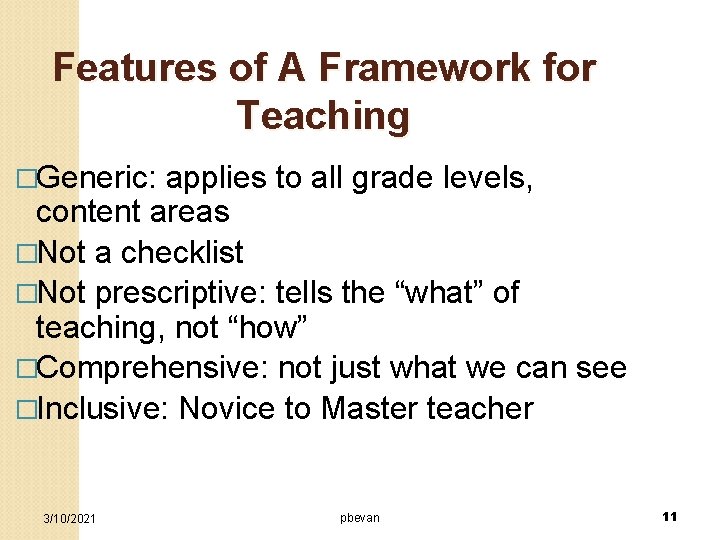
Features of A Framework for Teaching �Generic: applies to all grade levels, content areas �Not a checklist �Not prescriptive: tells the “what” of teaching, not “how” �Comprehensive: not just what we can see �Inclusive: Novice to Master teacher 3/10/2021 pbevan 11
3/10/2021 pbevan 12
Worksheet #2: Identifying the Domains 3/10/2021 pbevan 13
Learning Intentions, Activity 2: Participants will learn. . . � How various scenarios connect to the domains of the Framework � The “off-stage” and “on-stage” domains of the Framework � Features of the Framework that make it useful � That the Framework contains rubrics which describe the components 3/10/2021 pbevan 14
A Framework for Teaching: Components of Professional Practice Domain 1: Planning and Preparation • Demonstrating Knowledge of Content and Pedagogy • Demonstrating Knowledge of Students • Setting Instructional Outcomes • Demonstrating Knowledge of Resources • Designing Coherent Instruction • Designing Student Assessments Domain 2: The Classroom Environment • Creating an Environment of Respect and Rapport • Establishing a Culture for Learning • Managing Classroom Procedures • Managing Student Behavior • Organizing Physical Space Domain 4: Professional Responsibilities • Reflecting on Teaching • Maintaining Accurate Records • Communicating with Families • Participating in a Professional Community • Growing and Developing Professionally • Showing Professionalism Domain 3: Instruction • Communicating with Students • Using Questioning and Discussion Techniques • Engaging Students in Learning • Using Assessment in Instruction • Demonstrating Flexibility and Responsiveness 3/10/2021 pbevan 15
Learning Intentions, Activity 3: Participants will learn. . . �Key concepts of the five components of Domain 3 �The difference between engagement and time on task �The different ways in which the four Levels of Performance may be manifested 3/10/2021 pbevan 16
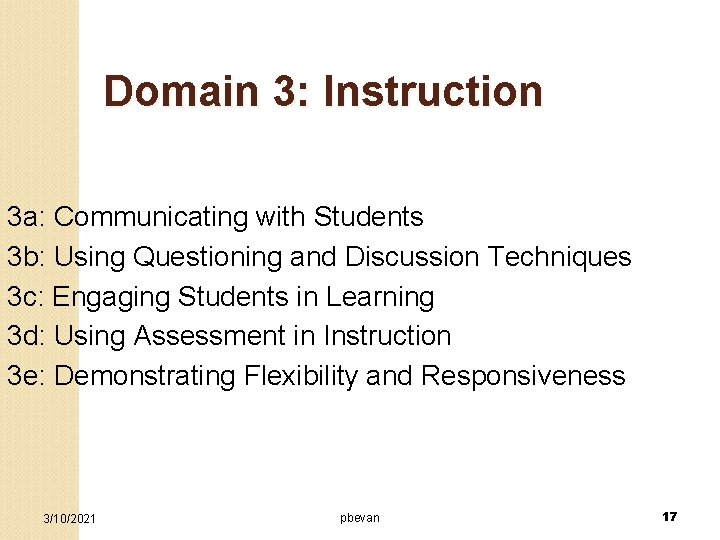
Domain 3: Instruction 3 a: Communicating with Students 3 b: Using Questioning and Discussion Techniques 3 c: Engaging Students in Learning 3 d: Using Assessment in Instruction 3 e: Demonstrating Flexibility and Responsiveness 3/10/2021 pbevan 17
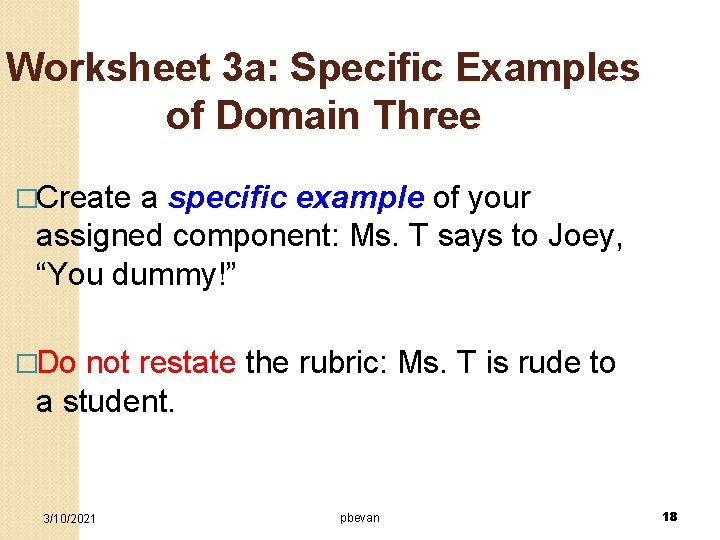
Worksheet 3 a: Specific Examples of Domain Three �Create a specific example of your assigned component: Ms. T says to Joey, “You dummy!” �Do not restate the rubric: Ms. T is rude to a student. 3/10/2021 pbevan 18
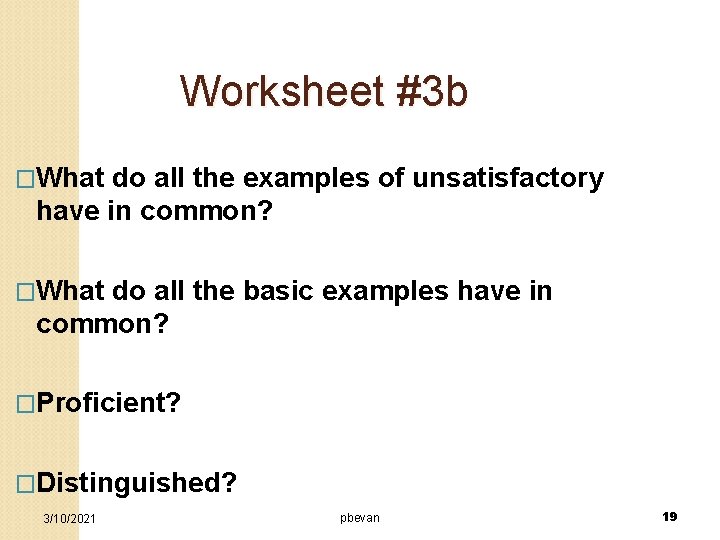
Worksheet #3 b �What do all the examples of unsatisfactory have in common? �What do all the basic examples have in common? �Proficient? �Distinguished? 3/10/2021 pbevan 19
Domain Three: Levels of Performance �Unsatisfactory: �Basic: �Proficient: �Distinguished: 3/10/2021 pbevan 20
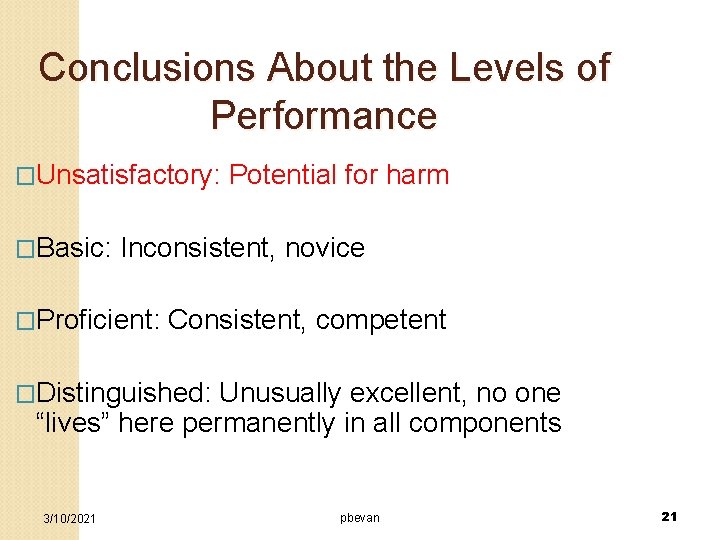
Conclusions About the Levels of Performance �Unsatisfactory: �Basic: Potential for harm Inconsistent, novice �Proficient: Consistent, competent �Distinguished: Unusually excellent, no one “lives” here permanently in all components 3/10/2021 pbevan 21
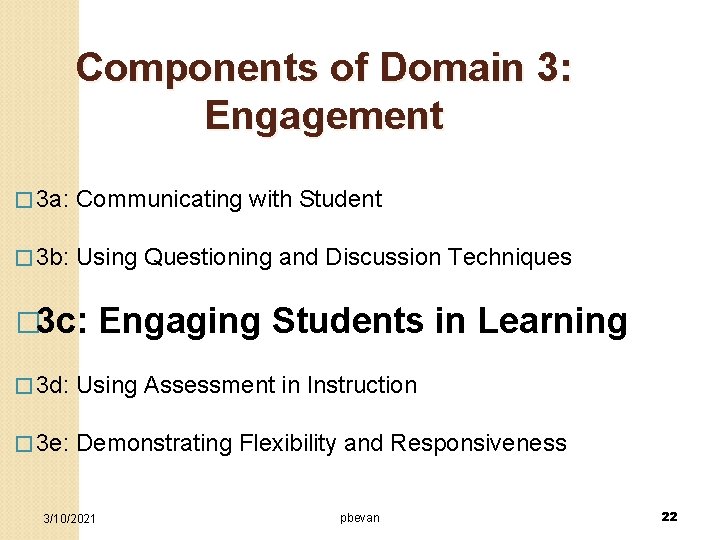
Components of Domain 3: Engagement � 3 a: Communicating with Student � 3 b: Using Questioning and Discussion Techniques � 3 c: Engaging Students in Learning � 3 d: Using Assessment in Instruction � 3 e: Demonstrating Flexibility and Responsiveness 3/10/2021 pbevan 22
Learning Intentions, Activity 3 b: Participants will learn. . . �Key concepts of the five components of Domain 3 �The difference between engagement and time on task �The different ways in which the four Levels of Performance may be manifested 3/10/2021 pbevan 23
Learning Intentions, Activity 4: Participants will learn: �The components of Domain 1 �That Domain is an “off-stage” domain, not fully visible during the act of teaching �How a teacher’s practice produces evidence of Domain 1 3/10/2021 pbevan 24
A Framework for Teaching: Components of Professional Practice Domain 1: Planning and Preparation • Demonstrating Knowledge of Content and Pedagogy • Demonstrating Knowledge of Students • Setting Instructional Outcomes • Demonstrating Knowledge of Resources • Designing Coherent Instruction • Designing Student Assessments Domain 2: The Classroom Environment • Creating an Environment of Respect and Rapport • Establishing a Culture for Learning • Managing Classroom Procedures • Managing Student Behavior • Organizing Physical Space Domain 4: Professional Responsibilities • Reflecting on Teaching • Maintaining Accurate Records • Communicating with Families • Participating in a Professional Community • Growing and Developing Professionally • Showing Professionalism Domain 3: Instruction • Communicating with Students • Using Questioning and Discussion Techniques • Engaging Students in Learning • Using Assessment in Instruction • Demonstrating Flexibility and Responsiveness 3/10/2021 pbevan 25
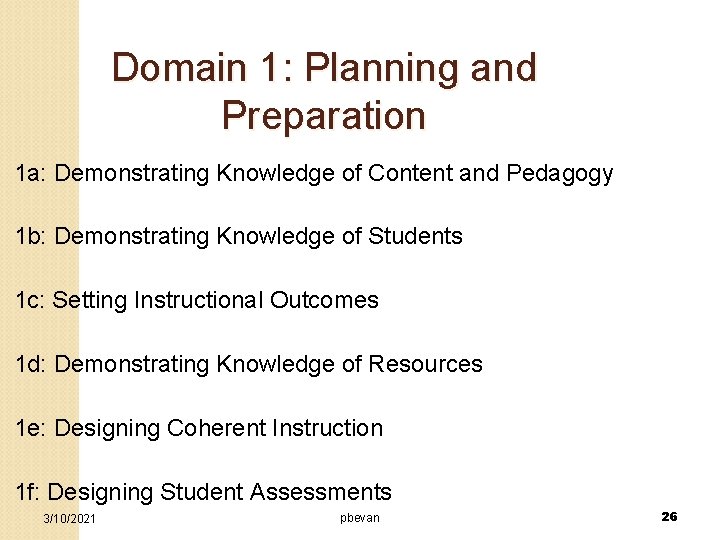
Domain 1: Planning and Preparation 1 a: Demonstrating Knowledge of Content and Pedagogy 1 b: Demonstrating Knowledge of Students 1 c: Setting Instructional Outcomes 1 d: Demonstrating Knowledge of Resources 1 e: Designing Coherent Instruction 1 f: Designing Student Assessments 3/10/2021 pbevan 26
Worksheet #4 �Work alone to complete the worksheet �Share with others as directed by your facilitator �Collect 3/10/2021 your learning pbevan 27
Learning Intentions, Activity 4: Participants will learn: �The components of Domain 1 �That Domain is an “off-stage” domain, not fully visible during the act of teaching �Questions teachers consider about Domain 1 during lesson planning 3/10/2021 pbevan 28
A Framework for Teaching: Components of Professional Practice Domain 1: Planning and Preparation • Demonstrating Knowledge of Content and Pedagogy • Demonstrating Knowledge of Students • Setting Instructional Outcomes • Demonstrating Knowledge of Resources • Designing Coherent Instruction • Designing Student Assessments Domain 2: The Classroom Environment • Creating an Environment of Respect and Rapport • Establishing a Culture for Learning • Managing Classroom Procedures • Managing Student Behavior • Organizing Physical Space Domain 4: Professional Responsibilities • Reflecting on Teaching • Maintaining Accurate Records • Communicating with Families • Participating in a Professional Community • Growing and Developing Professionally • Showing Professionalism Domain 3: Instruction • Communicating with Students • Using Questioning and Discussion Techniques • Engaging Students in Learning • Using Assessment in Instruction • Demonstrating Flexibility and Responsiveness 3/10/2021 pbevan 29
Learning Intentions, Activity 5: Participants will learn. . . �The components of Domain 2 �The relationship between the components of Domain 2 and the components of other domains �Key concepts of Domain 2 as represented by the focus questions 3/10/2021 pbevan 30
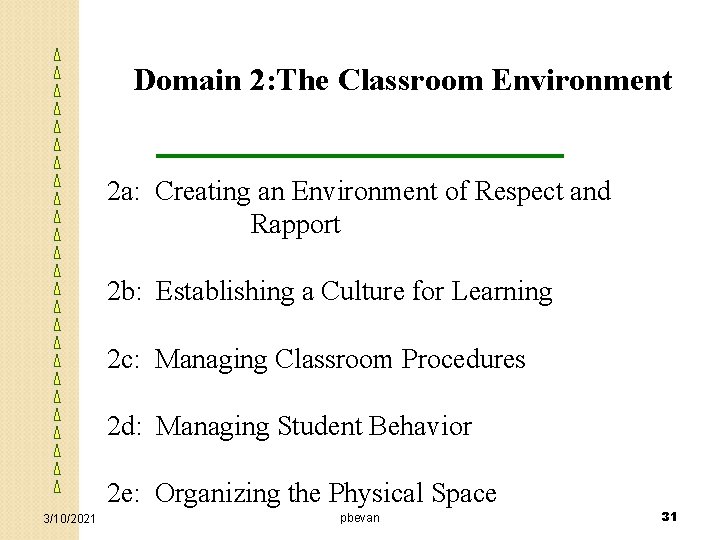
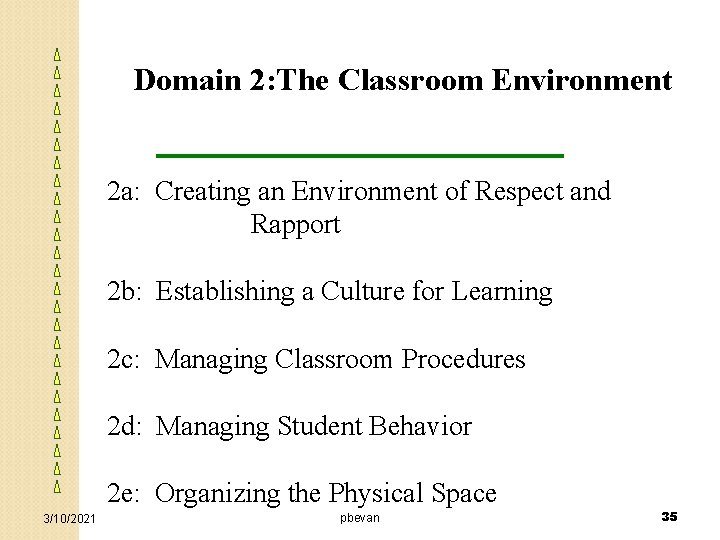
Domain 2: The Classroom Environment 2 a: Creating an Environment of Respect and Rapport 2 b: Establishing a Culture for Learning 2 c: Managing Classroom Procedures 2 d: Managing Student Behavior 2 e: Organizing the Physical Space 3/10/2021 pbevan 31
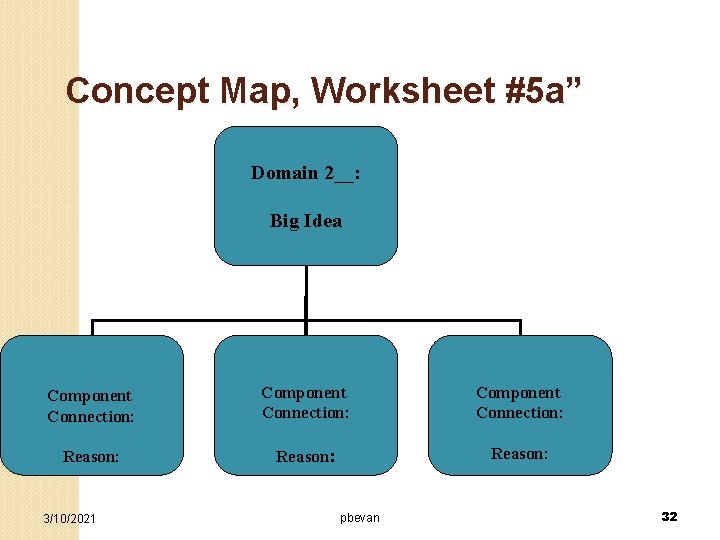
Concept Map, Worksheet #5 a” Domain 2__: Big Idea Component Connection: Reason: 3/10/2021 pbevan 32
Focus Questions, Worksheet 5 b Write answers to your own focus question before beginning your concept map. Write answers to the other focus questions as they are shared. 3/10/2021 pbevan 33
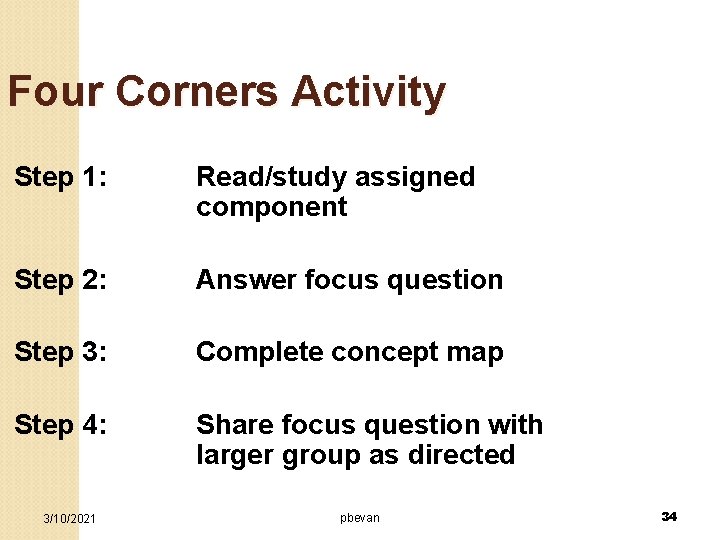
Four Corners Activity Step 1: Read/study assigned component Step 2: Answer focus question Step 3: Complete concept map Step 4: Share focus question with larger group as directed 3/10/2021 pbevan 34
Domain 2: The Classroom Environment 2 a: Creating an Environment of Respect and Rapport 2 b: Establishing a Culture for Learning 2 c: Managing Classroom Procedures 2 d: Managing Student Behavior 2 e: Organizing the Physical Space 3/10/2021 pbevan 35
Learning Intentions, Activity 5: Participants will learn. . . �The components of Domain 2 �The relationship between the components of Domain 2 and the components of other domains �Key concepts of Domain 2 as represented by the focus questions 3/10/2021 pbevan 36
Learning Intentions, Activity #6. Participants will learn. . . �The content of Domain 4 and the components’ importance to student learning. �To analyze and evaluate the relative importance of the Domain 4 components to novices and experienced teachers, respectively.
A Framework for Teaching: Components of Professional Practice Domain 1: Planning and Preparation • Demonstrating Knowledge of Content and Pedagogy • Demonstrating Knowledge of Students • Setting Instructional Outcomes • Demonstrating Knowledge of Resources • Designing Coherent Instruction • Designing Student Assessments Domain 2: The Classroom Environment • Creating an Environment of Respect and Rapport • Establishing a Culture for Learning • Managing Classroom Procedures • Managing Student Behavior • Organizing Physical Space Domain 4: Professional Responsibilities • Reflecting on Teaching • Maintaining Accurate Records • Communicating with Families • Participating in a Professional Community • Growing and Developing Professionally • Showing Professionalism Domain 3: Instruction • Communicating with Students • Using Questioning and Discussion Techniques • Engaging Students in Learning • Using Assessment in Instruction • Demonstrating Flexibility and Responsiveness
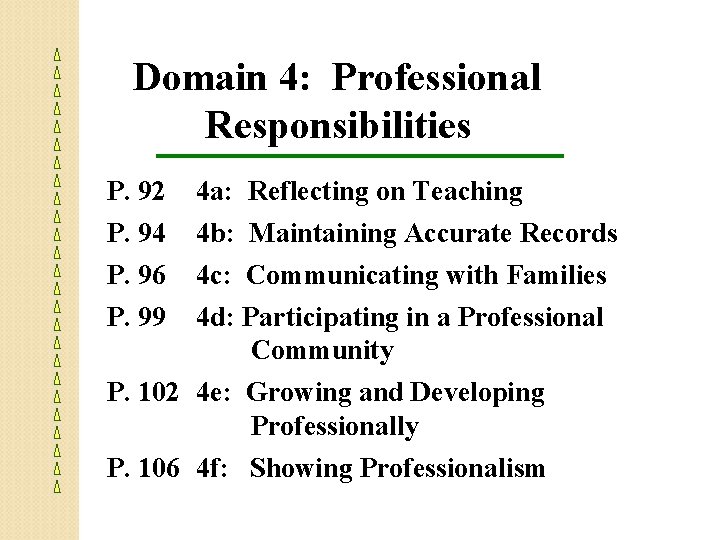
Domain 4: Professional Responsibilities P. 92 4 a: Reflecting on Teaching P. 94 4 b: Maintaining Accurate Records P. 96 4 c: Communicating with Families P. 99 4 d: Participating in a Professional Community P. 102 4 e: Growing and Developing Professionally P. 106 4 f: Showing Professionalism
Domain 4 and Student Learning Skim the rubrics in Domain 4. Have a table conversation about HOW these components might impact student learning.
Rank Order Beginning Teachers Experienced Teachers
Learning Intentions, Activity #6. Participants will learn. . . �The content of Domain 4 and the components’ importance to student learning. �To analyze and evaluate the relative importance of the Domain 4 components to novices and experienced teachers, respectively.
Uses of A Framework for Teaching �Self-Assessment �Reflection �Peer Coaching �Teacher Evaluation �Mentoring and Induction �Professional Growth Plans
Benefits of Using a Framework for Teaching �Common �Similarity Language of vision for teaching that improves teaching: the qualities of the distinguished level �Greater validity and reliability potential for teacher evaluation �Changes in novice thinking �Opportunities for collaboration
Dr. Paula M. Bevan Educational Solutions pbevan@penn. com 814 -371 -1118 The Danielson Group www. danielsongroup. org 3/10/2021 pbevan 45